 QA
QA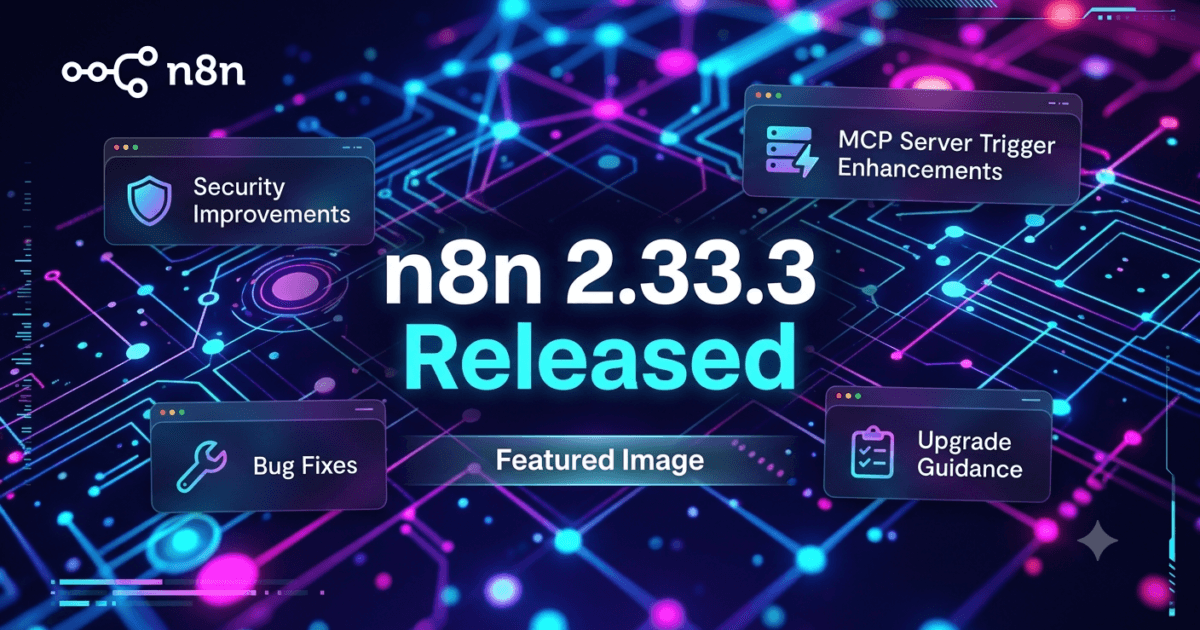
The n8n team has released n8n 2.33.3, a focused maintenance update that addresses important security and workflow execution reliability improvements. Although this release does not introduce major new features, it strengthens the platform by fixing issues that directly impact automation stability, security compliance, and MCP-based AI workflows.
For QA Engineers, SDETs, Automation Engineers, and DevOps teams, maintenance releases like this are just as valuable as feature releases. They reduce operational risks, improve workflow consistency, and help organizations maintain reliable automation pipelines.
If your team uses n8n for API automation, AI workflows, internal process automation, or Model Context Protocol (MCP) integrations, this release is worth evaluating.
What’s New in n8n 2.33.3
According to the official release notes, n8n 2.33.3 contains two targeted bug fixes that improve both platform security and execution reliability.
Security Improvement
The n8n core package now imports security audit risk reporters using an explicit file extension.
Although this appears to be a small internal implementation change, it improves dependency resolution consistency and reduces potential security audit concerns. Improvements like these contribute to a healthier and more secure codebase while helping organizations maintain compliance with modern software supply chain practices.
For enterprise environments where automated security scanning is part of the CI/CD pipeline, this refinement helps reduce unnecessary audit warnings and improves overall code quality.
MCP Server Trigger Reliability
The second improvement focuses on the MCP Server Trigger Node.
Execution data is now saved only after a tool call has completed successfully instead of being written prematurely.
This change improves workflow consistency by ensuring execution records accurately represent completed operations.
For AI-powered automation workflows, this is particularly valuable because it prevents incomplete execution data from being stored when tool invocations are still in progress.
Organizations building AI agents, MCP servers, or intelligent workflow automation can expect more reliable execution histories and easier troubleshooting.
Why This Release Matters for QA Engineers
At first glance, n8n 2.33.3 may appear to be a small maintenance release, but both included fixes have practical value for software testing teams.
Automation engineers frequently investigate workflow failures by reviewing execution history. If execution data is recorded before a tool completes, diagnosing issues becomes more difficult because logs may not accurately reflect the actual workflow state.
Saving execution data after successful tool completion results in:
- More reliable execution history
- Better debugging information
- Improved workflow traceability
- More accurate test validation
- Easier root cause analysis
These improvements help QA teams spend less time investigating automation inconsistencies.
Key Improvement 1 — Stronger Security Foundations
Modern software delivery increasingly depends on automated security scanning and dependency analysis.
The core security-related update in n8n 2.33.3 demonstrates continued investment in maintaining a secure platform.
For QA teams, this means:
- Improved dependency consistency
- Better compatibility with security auditing tools
- Cleaner software supply chain validation
- Reduced false-positive security reports
- Improved long-term maintainability
Although end users may not notice visible changes, security improvements like these contribute to healthier production systems.
Key Improvement 2 — Better MCP Workflow Reliability
Model Context Protocol (MCP) has become an important foundation for AI-powered automation.
The update to the MCP Server Trigger Node ensures execution records are written only after tool calls finish successfully.
This provides several benefits:
- Accurate execution logs
- Better debugging
- Reliable workflow history
- Improved automation monitoring
- More trustworthy execution reporting
For organizations integrating AI assistants, autonomous agents, or external tools into n8n, this change improves operational confidence.
Are There Any Breaking Changes?
Based on the official release notes, n8n 2.33.3 does not introduce any reported breaking changes.
The release focuses entirely on targeted bug fixes and reliability improvements, making it a low-risk update for most existing installations.
As with any production upgrade, organizations should still:
- Validate critical workflows.
- Execute smoke tests.
- Verify MCP integrations.
- Confirm third-party node compatibility.
- Test API-based automations.
- Review production logs after deployment.
A structured validation process remains the best practice before upgrading production environments.
Should You Upgrade Immediately?
For most organizations, yes.
Since n8n 2.33.3 is a maintenance release that improves security and execution reliability without introducing major architectural changes, it is recommended for teams already running the n8n 2.x release series.
Recommended For
- QA Engineers
- SDETs
- Automation Engineers
- DevOps Teams
- AI Workflow Developers
- MCP Server Developers
- Platform Engineers
- Enterprise Automation Teams
How to Upgrade
If you manage n8n using npm, upgrade using the latest available package version and validate your existing workflows after installation.
After upgrading:
- Verify the installed version.
- Execute smoke workflows.
- Test MCP Server Trigger nodes.
- Validate execution history.
- Confirm third-party integrations.
- Monitor production logs during the initial rollout.
For Docker deployments, pull the latest supported n8n image and perform the same validation before promoting the update into production.
Key Takeaways
n8n 2.33.3 is a focused maintenance release that strengthens two important areas of the platform: security and workflow execution reliability. While it does not introduce new functionality, it improves the quality and dependability of AI-driven automation, particularly for organizations using the MCP Server Trigger Node.
For QA Engineers and SDETs, the improvements translate into more accurate execution data, easier troubleshooting, better security compliance, and greater confidence in automated workflows. Teams already using the n8n 2.x release series should plan a controlled upgrade, validate their automation pipelines, and take advantage of these reliability improvements to keep their workflow infrastructure stable and future-ready.
Deep Dive into n8n 2.33.3 for QA Engineers and Automation Teams
Although n8n 2.33.3 is a maintenance release, it addresses areas that directly affect the reliability of workflow automation and AI-powered integrations. For QA Engineers, SDETs, DevOps professionals, and Automation Engineers, reliability improvements often deliver more long-term value than new features because they reduce failures, simplify debugging, and increase confidence in production workflows.
As organizations continue adopting low-code automation, AI agents, and Model Context Protocol (MCP) integrations, every improvement in execution consistency contributes to more dependable automation pipelines.
Why Maintenance Releases Should Not Be Ignored
Many engineering teams focus primarily on feature releases, but maintenance updates are equally important. They typically include bug fixes, dependency improvements, security enhancements, and execution optimizations that improve platform stability without requiring major migration efforts.
Benefits of regular maintenance updates include:
- Improved workflow reliability
- Better execution consistency
- Reduced debugging time
- Stronger platform security
- Improved compatibility with modern dependencies
- Lower operational risk
Keeping n8n up to date helps ensure your automation platform remains stable as your workflows grow in complexity.
Security Improvements for Enterprise Automation
One of the fixes included in n8n 2.33.3 improves how security audit risk reporters are imported within the core platform.
While this change occurs behind the scenes, it has practical value for enterprise environments where automated security scanning is integrated into the software development lifecycle.
Organizations using tools for dependency analysis, vulnerability management, or software supply chain validation benefit from cleaner and more predictable security reporting.
For QA teams, this means:
- Improved dependency consistency
- Better compatibility with security audit tools
- Reduced false-positive audit findings
- Stronger software supply chain practices
- Increased confidence during compliance reviews
These improvements contribute to maintaining secure and reliable automation infrastructure.
Improved MCP Server Trigger Execution
The second bug fix focuses on the MCP Server Trigger Node, an increasingly important component for AI-powered workflows.
Previously, execution data could be stored before a tool call had fully completed. In n8n 2.33.3, execution data is now saved only after the tool execution finishes successfully.
This change provides several operational benefits:
- More accurate execution history
- Reliable workflow status
- Better troubleshooting information
- Improved auditability
- Reduced confusion during failure analysis
For teams building AI agents or integrating external tools through MCP, accurate execution records are essential for monitoring workflow behavior.
Why This Matters for QA Engineers
Quality Assurance teams frequently rely on execution logs to investigate workflow failures. Incomplete or prematurely recorded execution data can make debugging more difficult and increase the time required to identify root causes.
By ensuring execution data is written only after successful completion, n8n provides a more trustworthy record of workflow activity.
This helps QA Engineers:
- Investigate failures more efficiently
- Validate workflow completion accurately
- Confirm expected tool behavior
- Improve defect reproduction
- Reduce time spent analyzing inconsistent logs
Accurate execution records become even more valuable as workflow complexity increases.
Testing Strategy After Upgrading
Although this release introduces no major architectural changes, every production upgrade should follow a structured validation process.
Recommended testing includes:
- Upgrade n8n in a development environment.
- Verify the installed version.
- Execute smoke workflows.
- Validate MCP Server Trigger nodes.
- Test API integrations.
- Review execution history.
- Execute regression workflows.
- Validate production deployment after successful testing.
Following this process minimizes upgrade risk while ensuring existing workflows continue to function correctly.
Validation Checklist
After upgrading to n8n 2.33.3, verify the following areas:
| Validation Area | Purpose |
|---|---|
| Workflow Execution | Confirm existing workflows complete successfully |
| MCP Server Trigger | Validate execution data is recorded correctly |
| API Integrations | Ensure external services continue working |
| Error Handling | Verify workflow failures are logged accurately |
| Execution History | Confirm completed runs are stored correctly |
| Credentials | Ensure authentication remains valid |
| Webhooks | Test inbound and outbound webhook functionality |
| Notifications | Validate email, Slack, or Teams integrations |
| Custom Nodes | Confirm custom extensions remain compatible |
| Production Logs | Monitor runtime behavior after deployment |
Executing this checklist provides confidence before promoting the update to production.
Best Practices for Enterprise Teams
Organizations operating business-critical automation should adopt a phased rollout strategy rather than upgrading every environment simultaneously.
Recommended approach:
- Upgrade a development environment first.
- Execute smoke tests.
- Run complete workflow regression tests.
- Validate AI and MCP integrations.
- Deploy to staging.
- Monitor execution metrics.
- Roll out to production after successful validation.
This staged deployment process reduces operational risk while providing early feedback.
Impact on Different Engineering Roles
QA Engineers gain more accurate execution records, making workflow validation and defect investigation more efficient.
SDETs benefit from improved automation reliability and reduced maintenance caused by inconsistent execution logging.
Automation Engineers can build more dependable workflows with greater confidence in execution history and monitoring.
DevOps Engineers benefit from improved operational visibility and cleaner production diagnostics.
AI Engineers using MCP-based workflows gain more reliable execution tracking for AI tool invocations and agent orchestration.
Expert Recommendation
From a software quality perspective, n8n 2.33.3 is a recommended maintenance update for teams already running the n8n 2.x release series. While the release introduces only two targeted fixes, both contribute to important aspects of modern automation platforms: security and execution reliability.
Organizations using AI workflows, Model Context Protocol integrations, or enterprise automation pipelines should schedule a controlled upgrade, validate their existing workflows, and monitor execution logs after deployment. Keeping n8n current with maintenance releases helps reduce technical debt, strengthen automation reliability, and ensure a stable foundation for future platform enhancements.
Real-World Impact of n8n 2.33.3 on QA and Automation Teams
The release of n8n 2.33.3 may appear small based on the changelog, but its impact extends beyond the two listed bug fixes. In modern automation environments, even minor improvements can significantly enhance workflow reliability, especially for organizations running hundreds or thousands of automated processes every day.
For QA Engineers and SDETs, the true value of this release lies in more accurate execution tracking, improved platform stability, and stronger security practices.
Improving Workflow Reliability
Workflow automation platforms are often responsible for business-critical operations such as API orchestration, test execution, notifications, data synchronization, and AI-driven decision making. A single workflow may interact with multiple external systems before completing successfully.
When execution history accurately reflects the actual completion status of a workflow, engineers can diagnose issues more efficiently and trust the information presented in monitoring dashboards.
The improvements introduced in n8n 2.33.3 help create a more reliable execution lifecycle, reducing confusion during troubleshooting and making workflow behavior easier to understand.
Better Debugging Experience
Debugging automation failures is one of the most time-consuming activities for QA and automation teams. Engineers often rely on execution history to determine where a workflow failed, which node caused the issue, and whether external services responded correctly.
More reliable execution records provide several advantages:
- Faster root cause analysis
- Improved workflow traceability
- Better incident investigation
- More reliable execution reporting
- Increased confidence in production monitoring
As automation platforms continue to grow in complexity, accurate execution data becomes increasingly valuable for maintaining operational stability.
Why MCP Improvements Matter
Model Context Protocol (MCP) is becoming an important standard for connecting AI assistants, external tools, and automation platforms. Organizations are increasingly building workflows that allow AI models to communicate with databases, APIs, documentation systems, and enterprise applications through MCP.
The improvement to the MCP Server Trigger Node ensures that execution data is stored only after tool execution has completed successfully.
For organizations adopting AI-powered automation, this means:
- More accurate workflow histories
- Better monitoring of AI tool execution
- Improved operational visibility
- Easier troubleshooting of AI-driven workflows
- Greater confidence in production automation
As AI agents become more common in enterprise environments, dependable execution tracking will become even more important.
Benefits for Enterprise Automation
Large organizations often use n8n as a central orchestration platform connecting multiple business systems. These environments demand stability because even small workflow inconsistencies can affect downstream services.
The improvements in n8n 2.33.3 support enterprise automation by providing:
- Better workflow consistency
- Improved execution reliability
- Stronger security practices
- More dependable operational monitoring
- Reduced investigation effort during incidents
Although these enhancements occur behind the scenes, they contribute to a more resilient automation platform.
Recommended Validation After Upgrading
Even when upgrading to a maintenance release, QA teams should perform a structured validation process before deploying changes into production.
Recommended validation activities include:
- Verify critical business workflows
- Test AI-enabled workflows
- Validate MCP Server Trigger functionality
- Confirm API integrations
- Review execution history
- Test webhook-based automations
- Validate notification workflows
- Monitor production logs after deployment
Completing these checks helps ensure that existing workflows continue to operate as expected.
Common Mistakes During Maintenance Upgrades
Maintenance releases are generally low risk, but skipping validation can still lead to unexpected issues.
Common mistakes include:
- Deploying directly to production without testing
- Ignoring execution history after the upgrade
- Failing to validate AI integrations
- Overlooking third-party node compatibility
- Skipping regression testing for critical workflows
- Assuming internal platform changes cannot affect existing automations
Avoiding these mistakes helps maintain confidence in production automation systems.
Best Practices for QA Engineers
To maximize the benefits of n8n 2.33.3, QA teams should follow a consistent upgrade strategy.
Recommended best practices include:
- Keep n8n updated with the latest maintenance releases.
- Review official release notes before every upgrade.
- Validate business-critical workflows in a staging environment.
- Monitor workflow execution after deployment.
- Verify integrations with external APIs and services.
- Test AI-powered workflows separately from standard automation.
- Document any environment-specific observations for future upgrades.
These practices help reduce operational risk while maintaining a stable and reliable automation platform.
Who Should Prioritize This Upgrade?
Although every n8n user benefits from maintenance updates, this release is particularly valuable for:
- QA Engineers managing automated testing workflows
- SDETs maintaining enterprise automation frameworks
- DevOps teams responsible for workflow infrastructure
- AI Engineers building MCP-based solutions
- Platform Engineers supporting business process automation
- Organizations using n8n for mission-critical integrations
Teams using the MCP Server Trigger Node should especially consider upgrading to benefit from improved execution data handling.
Internal Links
- n8n 2.32.7 Released: Security Audit Improvements Strengthen Enterprise Workflow Automation
- n8n 2.32.6 Released: Smarter Scheduling Improvements Every QA Engineer Should Know
- n8n 2.32.5 Released: Why This Security-Focused Update Matters for QA Engineers and Automation Teams
- n8n 2.31.4 Improves Workflow Stability and Editor Reliability for QA Engineers
- n8n 2.30.8 Strengthens AI Agent Reliability and Workflow Integrity for Enterprise Automation
- n8n 2.30.7 Strengthens Package Security and AWS SES Reliability for Enterprise Workflow Automation
- n8n 2.30.5 Release Brings Better AI Assistant Analytics, Node Alias Preservation, and Editor Improvements for Workflow Automation
- n8n 2.30.4 Improves Workflow Reliability, Webhook Stability, and Notion Integration for Enterprise Automation
- n8n 2.29.10 Released — What’s New for QA Engineers
- n8n 2.29.9 Released: Strengthening Enterprise AI Automation for Modern QA Teams
- n8n 2.29.8 Released: Enterprise Workflow Stability Gets Even Stronger for QA Engineers
- n8n 2.29.7 Released: AI Workflow Stability Improvements Every QA Engineer Should Know
- n8n 2.28.6 Released: Critical Stability Fixes Every QA Engineer Should Know
- n8n 2.28.7 Released: Critical Dependency Fix Every QA Engineer Should Know
- n8n 2.28.3 Released: Startup Reliability Improvements Every QA Engineer Should Know
- n8n 2.27.4 Released: Essential Workflow Improvements Every QA Engineer Should Know
Official Resources
- Official Documentation: https://docs.n8n.io
- Official Release Notes: https://github.com/n8n-io/n8n/compare/release/2.32.7…release/2.33.3
People Asked Questions
What is n8n 2.33.3?
n8n 2.33.3 is a maintenance release published on July 31, 2026, focusing on bug fixes, security improvements, and improved execution reliability for the MCP Server Trigger Node.
What are the major changes in n8n 2.33.3?
The release includes two primary improvements:
- A security-related fix for importing security audit risk reporters.
- Improved execution handling for the MCP Server Trigger Node by saving execution data only after tool calls complete successfully.
Does n8n 2.33.3 introduce breaking changes?
According to the official release notes, n8n 2.33.3 does not introduce any reported breaking changes. It is a maintenance release centered on bug fixes and platform stability.
Why is the MCP Server Trigger improvement important?
The update ensures execution data is stored only after a tool call finishes successfully, resulting in more accurate workflow history, improved debugging, and better monitoring for AI-powered automation.
Should QA teams upgrade to n8n 2.33.3?
Yes. Teams already using the n8n 2.x release series should consider upgrading after validating their workflows, integrations, and production environments.
Is n8n 2.33.3 suitable for enterprise automation?
Yes. The release improves workflow reliability and strengthens platform security, making it beneficial for enterprise automation platforms and business-critical workflows.
Which teams benefit most from this release?
This update is particularly useful for:
- QA Engineers
- SDETs
- Automation Engineers
- DevOps Engineers
- AI Engineers
- Platform Engineers
- Enterprise Automation Teams
Is this release recommended for AI workflows?
Yes. Organizations using AI agents or Model Context Protocol (MCP) integrations will benefit from improved execution data handling and more reliable workflow tracking.
Key Takeaways
- Released on July 31, 2026
- Improves platform security through core dependency fixes
- Enhances MCP Server Trigger execution reliability
- No reported breaking changes
- Recommended for organizations using n8n 2.x
- Improves debugging and workflow monitoring
- Supports more reliable AI-powered automation
Final Verdict
n8n 2.33.3 is a focused maintenance release that strengthens the platform in two key areas: security and execution reliability. While it does not introduce new user-facing features, the improvements contribute to a more dependable automation environment, particularly for organizations adopting AI-powered workflows and Model Context Protocol integrations.
For QA Engineers, SDETs, and Automation Engineers, this release offers practical operational benefits through more accurate execution records, improved debugging capabilities, and stronger platform stability. Organizations already using the n8n 2.x release series should include n8n 2.33.3 in their regular maintenance schedule, validate their workflows in a staging environment, and confidently adopt the update as part of their ongoing platform management strategy.
Continue Learning with QAPulse by SK
At QAPulse by SK, we continuously analyze the latest releases across n8n, LangChain, CrewAI, LangGraph, Model Context Protocol (MCP), FastAPI, Python, Node.js, Docker, Playwright, Selenium, Locust, k6, and many other technologies shaping the future of intelligent automation and AI-powered software engineering.
Our goal is to help QA Engineers, SDETs, Automation Engineers, AI Engineers, DevOps Engineers, Platform Engineers, and Software Architects stay ahead with enterprise-grade release analyses, migration strategies, AI workflow testing guides, regression checklists, production deployment best practices, and practical automation insights that support building secure, scalable, and production-ready automation platforms.