 QA
QA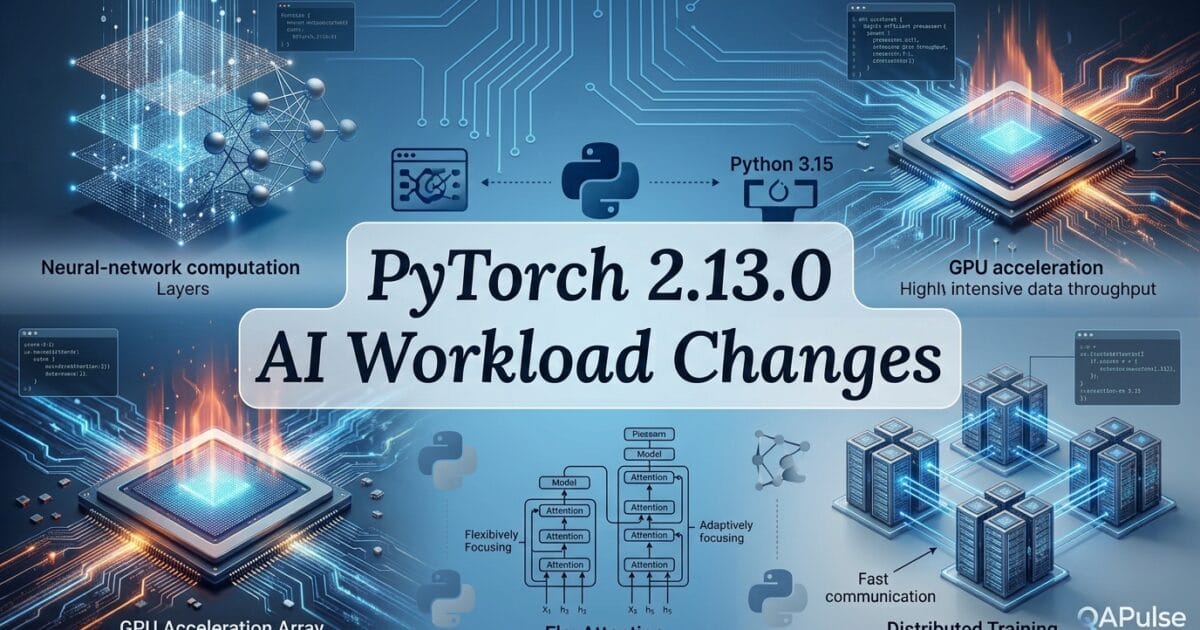
PyTorch 2.13.0 brings more than another framework version bump. The July 2026 release introduces important changes across attention execution, GPU compilation, memory efficiency, distributed training, and Python compatibility. For developers building modern AI systems, these changes create new opportunities for performance—but they also create new dimensions for compatibility and regression testing.
The most useful way to understand this release is not as a long list of features. Instead, think of PyTorch 2.13.0 as an expansion of the execution stack underneath your models.
A modern workload can now move through several layers:
Python Application
       ↓
PyTorch Model
       ↓
Autograd / Graph
       ↓
TorchInductor
       ↓
Triton / CuTeDSL
       ↓
CUDA / MPS
       ↓
GPU
And distributed workloads add another layer:
Model
  ↓
FSDP2
  ↓
torchcomms
  ↓
Multiple GPUs
  ↓
Network / Communication
That means an upgrade can affect much more than whether import torch succeeds.
What is new in PyTorch 2.13.0?
The release highlights several changes worth understanding:
| PyTorch 2.13.0 change | Primary purpose | Engineering impact |
|---|---|---|
| FlexAttention on Apple Silicon MPS | Optimized attention execution | New hardware/backend validation |
| Deterministic FlexAttention backward on CUDA | Reproducible gradients | Better reproducibility testing |
| CuTeDSL Native DSL backend | Additional Inductor execution path | Compiler and kernel validation |
nn.LinearCrossEntropyLoss | Combine prediction and loss | Memory and numerical validation |
torchcomms | Distributed communication | Multi-GPU reliability testing |
| FSDP2 communication overlap | Improve distributed throughput | Performance regression testing |
| Python 3.15 wheels | New interpreter compatibility | Environment validation |
The important question is not simply:
“Should I install PyTorch 2.13.0?”
A better question is:
“Which parts of my AI workload could behave differently after upgrading to PyTorch 2.13.0?”
That question immediately produces a better testing and migration strategy.
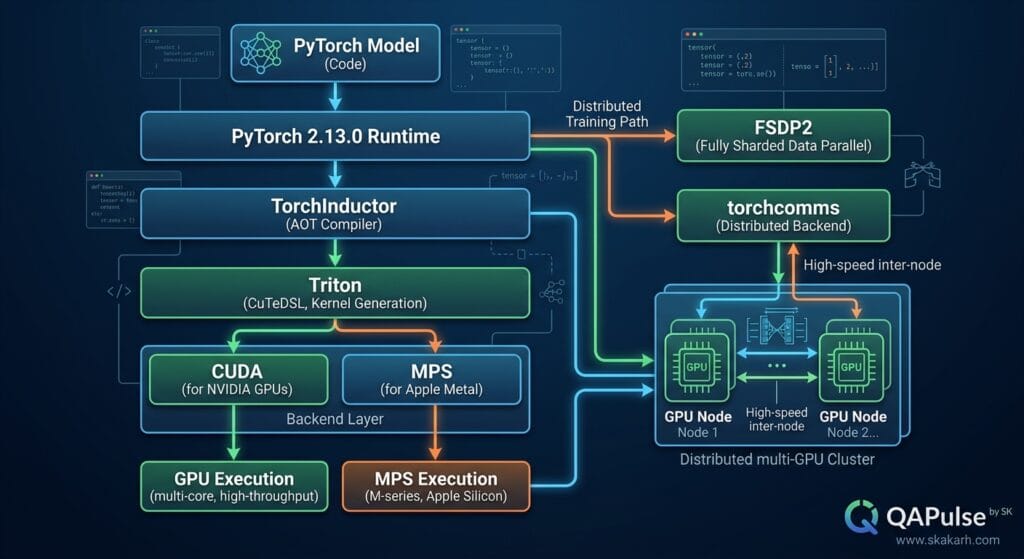
FlexAttention reaches Apple Silicon through MPS
One of the most notable changes in PyTorch 2.13.0 is FlexAttention support on Apple Silicon through the MPS backend.
This matters because attention is central to transformer-based workloads, including large language models, multimodal systems, agents, and other modern AI applications.
A simplified attention pipeline looks like this:
Input
  ↓
Query / Key / Value
  ↓
Attention computation
  ↓
Output
The execution backend can significantly influence the performance and numerical behavior of that computation.
A simple environment check can identify whether MPS is available:
import torch

if torch.backends.mps.is_available():
    device = torch.device("mps")
else:
    device = torch.device("cpu")

print(f"Running on: {device}")
This creates an immediate testing question:
Does a model that passes on CUDA also produce acceptable results on MPS?
You should not automatically assume so.
A cross-backend regression test can compare outputs:
cpu_output = model(input_tensor.to("cpu"))

mps_output = model(
    input_tensor.to("mps")
).cpu()

torch.testing.assert_close(
    cpu_output,
    mps_output,
    rtol=1e-4,
    atol=1e-5
)
The correct tolerance depends on the model, data types, kernels, and workload. Avoid treating a tolerance value as universally correct.
Correctness and performance are different tests
A backend can produce mathematically acceptable output while still introducing a performance regression.
For example:
Backend A
Correctness: PASS
Latency: 120 ms

Backend B
Correctness: PASS
Latency: 240 ms
Both backends pass functional tests, but Backend B has doubled latency.
Therefore, a serious validation matrix should separate these concerns:
| Validation | CPU | CUDA | MPS |
|---|---|---|---|
| Output correctness | ✓ | ✓ | ✓ |
| Shape validation | ✓ | ✓ | ✓ |
| Numerical tolerance | ✓ | ✓ | ✓ |
| Latency | ✓ | ✓ | ✓ |
| Memory | ✓ | ✓ | ✓ |
| Long-running stability | ✓ | ✓ | ✓ |
This is especially relevant for teams that develop AI applications on Mac hardware while deploying production workloads on NVIDIA infrastructure.
Deterministic backward execution makes reproducibility more testable
PyTorch 2.13.0 also introduces a deterministic backward path for FlexAttention on CUDA.
Reproducibility is often treated as an ML research concern, but it has direct consequences for automated testing.
Consider a training operation:
loss = train_one_step(model, batch)

print(loss.item())
If the same test produces significantly different results across identical runs, assertions can become unreliable.
A reproducibility test can establish a fixed seed:
import torch

torch.manual_seed(42)

result_a = train_one_step(model_a, batch)

torch.manual_seed(42)

result_b = train_one_step(model_b, batch)

torch.testing.assert_close(
    result_a,
    result_b
)
Determinism is not guaranteed simply because a seed exists. Hardware, algorithms, kernels, execution order, and configuration can all affect reproducibility.
That is precisely why deterministic execution features should become explicit regression requirements when reproducibility matters.
Instead of writing:
"Training should be reproducible."
turn it into:
Given the same model,
same input,
same seed,
and same execution configuration,

the resulting gradients and loss
must remain within defined tolerances.
That is an actual testable engineering requirement.
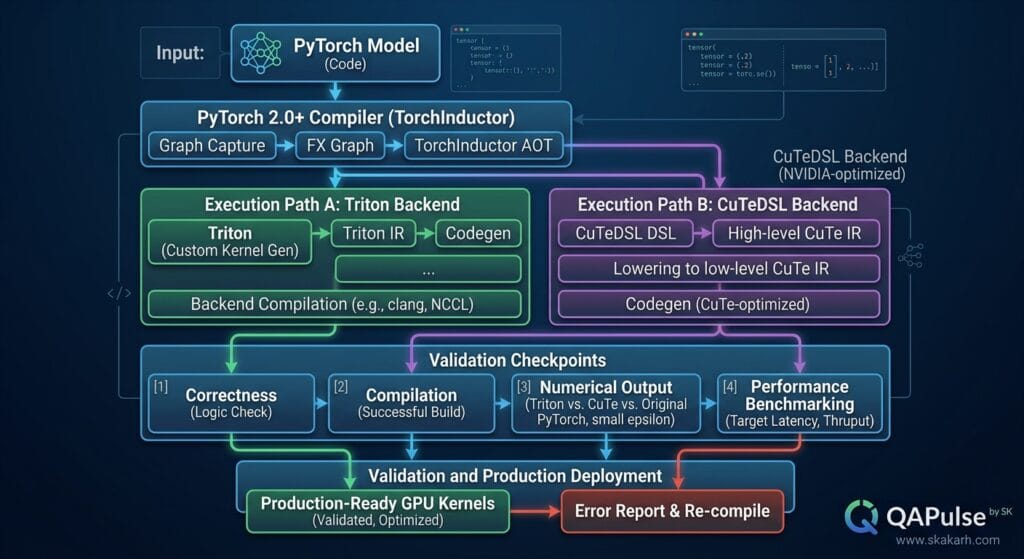
CuTeDSL gives TorchInductor another path to the GPU
Another significant part of PyTorch 2.13.0 is the CuTeDSL “Native DSL” backend.
TorchInductor already provides a compilation layer between PyTorch operations and optimized execution. Adding another backend path changes the testing surface.
Think of the architecture like this:
                PyTorch Model
                      │
                      ▼
                TorchInductor
                 /         \
                /           \
           Triton          CuTeDSL
              \              /
               \            /
                  GPU
This is powerful because different execution strategies can target the same high-level operation.
But it also creates more possible failure locations.
A traditional application might look like:
API
 ↓
Business Logic
 ↓
Database
A compiled AI workload can look more like:
Model
 ↓
Graph
 ↓
Compiler
 ↓
Kernel generation
 ↓
Backend
 ↓
GPU
 ↓
Numerical output
A model-level failure does not necessarily mean the model code is wrong.
The compiler, generated kernel, backend, or hardware path may be responsible.
Triton versus CuTeDSL from a testing perspective
| Area | Triton path | CuTeDSL path |
|---|---|---|
| GPU compilation | Yes | Yes |
| Kernel generation | Yes | Yes |
| Runtime optimization | High | High |
| Additional backend coverage | Existing | New path |
| Regression surface | Moderate | Increased |
| Performance testing | Important | Important |
| Numerical comparison | Important | Important |
You do not necessarily need to execute every backend combination on every pull request.
A better strategy is tiered testing:
Pull Request
    ↓
Fast functional tests
    ↓
Nightly GPU validation
    ↓
Backend comparison
    ↓
Performance regression
    ↓
Release qualification
This gives developers fast feedback without pretending that a small unit-test suite covers the entire GPU execution stack.
nn.LinearCrossEntropyLoss targets memory efficiency
PyTorch 2.13.0 introduces nn.LinearCrossEntropyLoss, combining the final prediction and loss computation.
For large-vocabulary language models, reducing intermediate memory can have a meaningful effect on GPU capacity.
Conceptually, a conventional implementation might perform:
logits = linear(hidden_states)

loss = torch.nn.functional.cross_entropy(
    logits,
    targets
)
The new operation combines those stages.
That creates a very important testing opportunity:
Use the existing implementation as a reference oracle.
For example:
reference_logits = linear(hidden_states)

reference_loss = torch.nn.functional.cross_entropy(
    reference_logits,
    targets
)

optimized_loss = criterion(
    hidden_states,
    targets
)

torch.testing.assert_close(
    optimized_loss,
    reference_loss,
    rtol=1e-4,
    atol=1e-5
)
The exact API usage should be aligned with the official PyTorch 2.13.0 documentation and your model architecture.
The key testing pattern is more important than the specific code:
Optimized implementation
          ↓
       Compare
          ↑
Reference implementation
The reference does not need to be fast.
It needs to be trustworthy.
This is a powerful approach for validating framework optimizations because performance-oriented implementations are often harder to reason about directly.
Memory improvements need memory tests
If the release introduces an optimization intended to reduce memory usage, measuring only accuracy is incomplete.
Capture at least:
Correctness
Latency
Throughput
Peak memory
GPU utilization
Stability
For CUDA workloads, peak allocation can be inspected during a controlled operation:
torch.cuda.reset_peak_memory_stats()

run_training_step()

peak_memory = torch.cuda.max_memory_allocated()

print(
    f"Peak memory: "
    f"{peak_memory / 1024**3:.2f} GB"
)
Now you can compare:
PyTorch baseline
      VS
PyTorch 2.13.0
without relying on assumptions from release notes.
The engineering rule is simple:
Never call an optimization successful until your own workload demonstrates the improvement.
A framework benchmark and your production model are not necessarily the same thing.
Distributed training changes require a different testing mindset
PyTorch 2.13.0 also introduces torchcomms and improvements around FSDP2.
Distributed training is fundamentally different from single-process execution.
Consider a four-GPU workload:
GPU 0 ─────┐
GPU 1 ─────┤
GPU 2 ─────┼── Communication
GPU 3 ─────┘
A local test may pass:
GPU 0
  ↓
Model
  ↓
PASS
while the distributed workload fails because of:
- synchronization problems
- communication timeouts
- worker failures
- inconsistent state
- collective operation failures
- network conditions
- process lifecycle problems
That means distributed validation needs more than:
assert loss is not None
It should also verify synchronization and state consistency.
For example:
import torch.distributed as dist

loss = train_step()

assert torch.isfinite(loss)

dist.barrier()
The exact distributed setup depends on your training architecture, but the principle remains the same:
test the communication system as well as the model.
FSDP2 communication overlap needs a real baseline
FSDP2 improvements can overlap communication operations such as reduce-scatter and all-gather with computation.
A simplified comparison looks like this:
Without overlap

Compute
   ↓
Communication
   ↓
Compute
   ↓
Communication
versus:
With overlap

Compute ──────────────┐
                      ├── Communication
Compute ──────────────┘
The goal is to reduce idle time.
But the presence of an optimization does not guarantee that your workload becomes faster.
Measure:
| Metric | Existing version | PyTorch 2.13.0 |
|---|---|---|
| Step time | Baseline | Measure |
| Samples/sec | Baseline | Measure |
| Peak memory | Baseline | Measure |
| GPU utilization | Baseline | Measure |
| Communication time | Baseline | Measure |
| Failed steps | Baseline | Measure |
This gives you an evidence-based upgrade decision.
A release note can tell you what changed.
Your benchmark tells you whether it matters.
Python 3.15 support adds another compatibility dimension
PyTorch 2.13.0 includes Python 3.15 wheel support for Linux through the PyTorch repository index.
This is important because upgrading the interpreter and framework simultaneously can make regression diagnosis difficult.
Avoid changing both variables without isolating them.
Instead, establish environments such as:
Environment A
Python 3.14
Existing PyTorch

Environment B
Python 3.15
Existing compatible PyTorch

Environment C
Python 3.15
PyTorch 2.13.0
Now, if a test fails in Environment C, you have a much better starting point for determining whether the problem is:
Python
   ↓
PyTorch
   ↓
Dependency interaction
   ↓
Application
This approach is particularly useful when maintaining CI matrices across several Python versions.
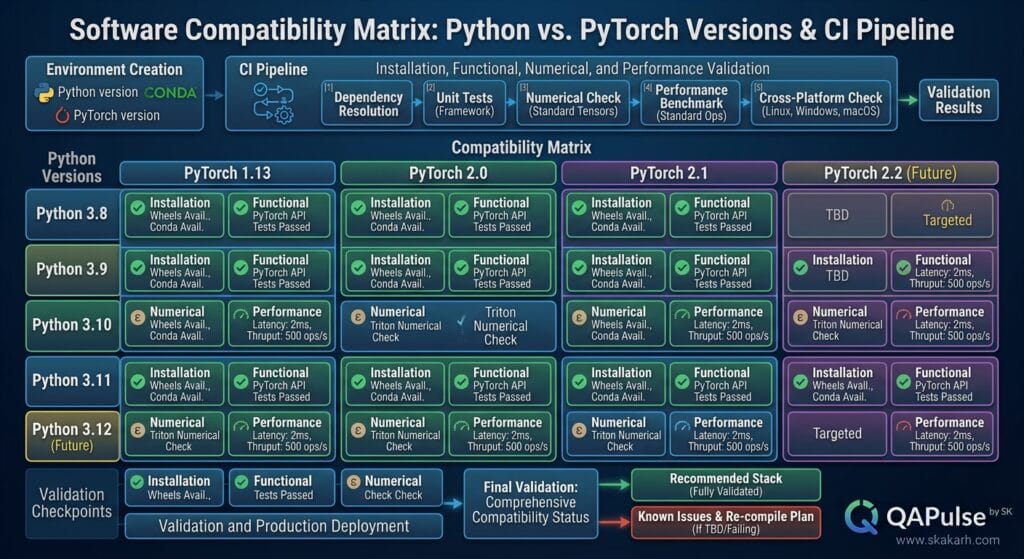
Why PyTorch 2.13.0 needs layered vaidation
A common mistake during framework upgrades is treating this as sufficient:
pip install --upgrade torch
pytest
That can be useful, but it does not test the complete execution surface.
A stronger validation model is:
             PyTorch 2.13.0
                    │
        ┌───────────┼───────────┐
        ↓           ↓           ↓
    Python       Backend     Compiler
        │           │           │
        ↓           ↓           ↓
   APIs        CUDA/MPS    Inductor
        │           │           │
        └───────────┼───────────┘
                    ↓
              Model Output
                    ↓
          Performance / Memory
                    ↓
             Production
This is why an AI framework upgrade should be treated as a system-level change.
The more execution paths a framework supports, the less useful a single “all tests passed” signal becomes.
A practical validation hierarchy
Start with cheap checks:
Level 1 — Installation
Level 2 — Import/API
Level 3 — Unit tests
Level 4 — Numerical regression
Level 5 — Backend validation
Level 6 — Performance
Level 7 — Distributed
Level 8 — Production workload
This allows teams to spend expensive GPU and distributed resources where they provide the most value.
Build a reference model before changing the framework
One of the strongest strategies for framework upgrades is to preserve a baseline.
Before upgrading:
baseline = run_reference_workload(
    model=model,
    dataset=dataset
)

save_metrics(baseline)
After upgrading:
candidate = run_reference_workload(
    model=model,
    dataset=dataset
)

compare(
    baseline,
    candidate
)
Your comparison should include more than the final score.
For example:
Model accuracy
Loss
Latency
Throughput
Peak memory
GPU utilization
Output distributions
Failure rate
This transforms the upgrade process from:
“The tests passed.”
into:
“The upgraded framework maintained correctness while changing latency by X%, memory by Y%, and throughput by Z%.”
That is a much stronger engineering decision.
The bigger lesson behind PyTorch 2.13.0
PyTorch 2.13.0 demonstrates how modern AI frameworks are becoming increasingly sophisticated execution platforms.
The framework is no longer simply:
Python → Tensor operations
It increasingly looks like:
Python
 ↓
PyTorch APIs
 ↓
Autograd / Graph
 ↓
Compiler
 ↓
Kernel generation
 ↓
Hardware backend
 ↓
GPU
 ↓
Distributed communication
Every additional optimization creates another opportunity for performance gains.
It also creates another place where compatibility can fail.
That is why the most effective engineering strategy is to treat framework releases as changes to the execution environment, not merely dependency upgrades.
And when you validate the release, test the layers that your application actually depends on rather than attempting to test everything equally.
What PyTorch 2.13.0 Changes for Real-World AI Development
The most important thing about PyTorch 2.13.0 is not simply the number of new features. The release changes several areas that directly affect how teams build, execute, reproduce, and validate modern AI workloads.
For teams running large language models, computer vision pipelines, distributed training, or GPU-heavy inference, the upgrade should be treated as an engineering change rather than a routine package update.
A useful way to evaluate PyTorch 2.13.0 is to ask four questions:
- Does existing code still behave correctly?
- Does the new backend change performance characteristics?
- Are numerical results still reproducible?
- Does the production environment support the new Python, CUDA, MPS, and distributed features?
That approach is much safer than installing the new version and assuming that a successful import means the upgrade worked.
FlexAttention Changes the Performance Testing Equation
One of the more interesting areas in PyTorch 2.13.0 is the expansion of FlexAttention support on Apple Silicon through MPS.
FlexAttention allows developers to express more flexible attention patterns while giving the compiler opportunities to optimize execution. The release notes report substantial speedups for sparse patterns on MPS compared with SDPA in relevant workloads.
For an AI engineering team, however, “faster” should never be accepted without measurement.
Consider a simple benchmark:
import time
import torch

device = "mps" if torch.backends.mps.is_available() else "cpu"

x = torch.randn(8, 16, 1024, 64, device=device)

start = time.perf_counter()

for _ in range(100):
    y = x @ x.transpose(-2, -1)

if device == "mps":
    torch.mps.synchronize()

elapsed = time.perf_counter() - start

print(f"Device: {device}")
print(f"Elapsed: {elapsed:.4f}s")
The important testing principle is to compare the same workload, not merely compare two package versions.
A meaningful upgrade benchmark should capture:
| Metric | Before upgrade | After upgrade | What to investigate |
|---|---|---|---|
| Execution time | Baseline | New value | Regression/improvement |
| Peak memory | Baseline | New value | Memory pressure |
| GPU utilization | Baseline | New value | Hardware efficiency |
| Output accuracy | Baseline | New value | Numerical changes |
| Compilation time | Baseline | New value | Developer/CI impact |
| Failure rate | Baseline | New value | Runtime stability |
This is where PyTorch 2.13.0 becomes more than a version number. Its performance-oriented changes need performance-oriented validation.
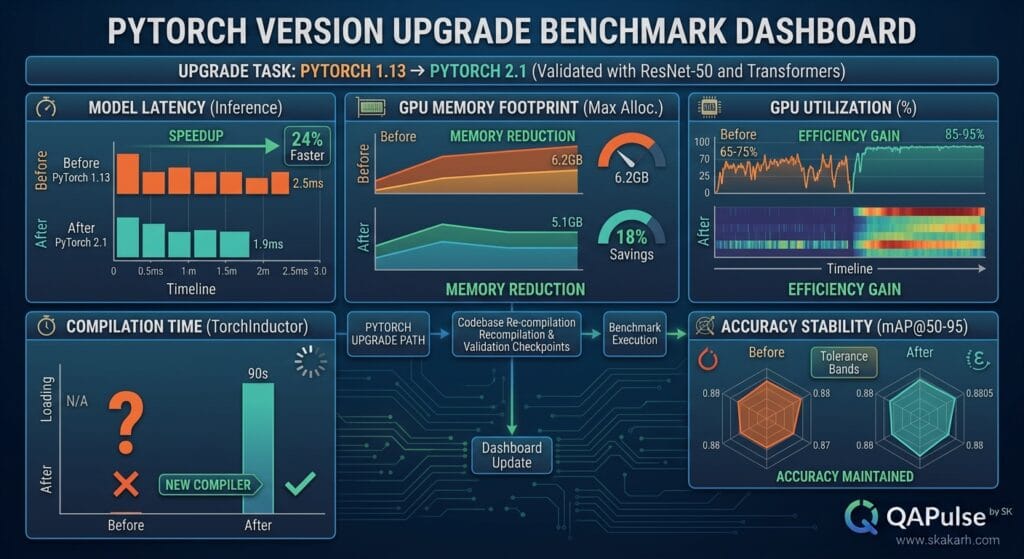
Deterministic Backward Makes Reproducibility More Testable
Another important improvement is the deterministic backward path for FlexAttention on CUDA.
This matters because reproducibility is one of the hardest problems in machine learning testing.
Traditional application testing often expects:
input → function → deterministic output
Machine-learning systems can be more complicated:
input
  ↓
GPU kernels
  ↓
parallel operations
  ↓
floating-point calculations
  ↓
gradient computation
  ↓
model update
  ↓
output
Tiny numerical differences can propagate through training.
For regression testing, therefore, you should distinguish between exact equality and acceptable numerical tolerance.
import torch

expected = torch.tensor([0.123456, 0.987654])
actual = torch.tensor([0.123457, 0.987653])

assert torch.allclose(
    actual,
    expected,
    rtol=1e-5,
    atol=1e-6
)
This is generally more appropriate for floating-point model validation than:
assert actual == expected
A mature test strategy should define acceptable tolerances based on the model and business requirement rather than selecting a random value.
nn.LinearCrossEntropyLoss Can Change Memory Profiles
PyTorch 2.13.0 also introduces nn.LinearCrossEntropyLoss, combining the final prediction and loss calculation.
The practical benefit is particularly relevant for large-vocabulary language models, where memory consumption can become a major bottleneck.
Instead of treating this as merely an API addition, think about it as a resource-management change.
A test that previously passed because the machine had sufficient memory might behave differently when the implementation changes.
Measure:
torch.cuda.reset_peak_memory_stats()

# Run representative training workload here

peak_memory = torch.cuda.max_memory_allocated()

print(
    f"Peak GPU memory: "
    f"{peak_memory / 1024**3:.2f} GB"
)
The comparison should include both correctness and resource behavior.
| Validation area | Question |
|---|---|
| Functional | Does the loss produce the expected result? |
| Numerical | Is the difference within tolerance? |
| Memory | Is peak allocation reduced? |
| Performance | Does training become faster? |
| Compatibility | Does existing training code still work? |
| Gradient | Are gradients still valid? |
This distinction is critical.
A feature can be functionally correct but still cause a production problem through memory allocation, compilation overhead, or hardware compatibility.
PyTorch Distributed Gets More Serious With torchcomms
Distributed training is another area where PyTorch 2.13.0 deserves careful validation.
The new torchcomms backend focuses on communication capabilities such as fault tolerance, scalability, and debugging.
That means testing distributed systems cannot stop at:
import torch
print(torch.__version__)
You need to test the actual communication topology.
For example:
import torch
import torch.distributed as dist

dist.init_process_group(
    backend="nccl"
)

rank = dist.get_rank()

tensor = torch.tensor(
    [float(rank)],
    device="cuda"
)

dist.all_reduce(tensor)

print(
    f"Rank {rank}: "
    f"result={tensor.item()}"
)

dist.destroy_process_group()
A distributed upgrade test should deliberately exercise:
- multiple workers
- collective operations
- process failures
- worker restarts
- communication timeouts
- GPU allocation
- checkpoint recovery
- synchronization
- different cluster sizes
This is where PyTorch 2.13.0 should be compared with the existing distributed stack, not tested in isolation.
FSDP2 Requires Testing More Than Model Accuracy
FSDP2 improvements around communication overlap can potentially increase distributed-training throughput.
But throughput is only one dimension.
Imagine this result:
Version A
Training time: 100 minutes
Validation accuracy: 91.4%

Version B
Training time: 82 minutes
Validation accuracy: 90.7%
Technically, the upgrade improved performance.
Strategically, it may still be a regression.
The correct scorecard is therefore multidimensional:
Upgrade quality =
    correctness
  + performance
  + reproducibility
  + resource efficiency
  + operational stability
For a training pipeline, capture at least:
metrics = {
    "training_time": 82.0,
    "peak_memory_gb": 18.4,
    "throughput_samples_sec": 1420,
    "validation_accuracy": 0.907,
    "failed_steps": 0,
}
Store these results from your baseline and compare them automatically in CI.
Python 3.15 Support Adds Another Compatibility Dimension
PyTorch 2.13.0 also includes Python 3.15 wheel support for Linux through the PyTorch repository index.
This is useful, but it introduces an important lesson for upgrade testing:
A new package version does not mean every environment should immediately move to the newest runtime.
For example, your compatibility matrix might look like this:
| Python | PyTorch 2.13.0 | Test priority |
|---|---|---|
| Python 3.12 | Supported | High |
| Python 3.13 | Supported | High |
| Python 3.14 | Supported | High |
| Python 3.15 | New wheel support | Very high |
| Older Python | Depends on support policy | Migration review |
For CI, explicitly test the versions your organization intends to support.
strategy:
  matrix:
    python-version:
      - "3.12"
      - "3.13"
      - "3.14"
      - "3.15"

steps:
  - uses: actions/checkout@v4

  - uses: actions/setup-python@v5
    with:
      python-version: ${{ matrix.python-version }}

  - run: python -m pip install --upgrade pip
  - run: pip install torch==2.13.0
  - run: pytest -q
This turns compatibility from an assumption into an executable test.
PyTorch 2.13.0 vs Earlier Upgrade Strategies
There is a significant difference between a package upgrade strategy and a platform upgrade strategy.
| Strategy | Basic approach | Risk level |
|---|---|---|
| Reinstall and run tests | Upgrade package and execute existing suite | High |
| Unit-test validation | Focus on API and function correctness | Medium |
| Benchmark validation | Add performance comparisons | Medium |
| Compatibility matrix | Test Python, hardware, and dependencies | Low |
| Production rehearsal | Validate representative workloads before rollout | Lowest |
The strongest approach combines all five.
A unit test can tell you that a function returns the expected tensor.
It cannot necessarily tell you that:
- GPU memory increased by 30%
- compilation became slower
- distributed training stalls under load
- a new backend behaves differently on another accelerator
- numerical reproducibility changed
- a Python-version combination is incompatible
That is why AI framework upgrades need layered validation.
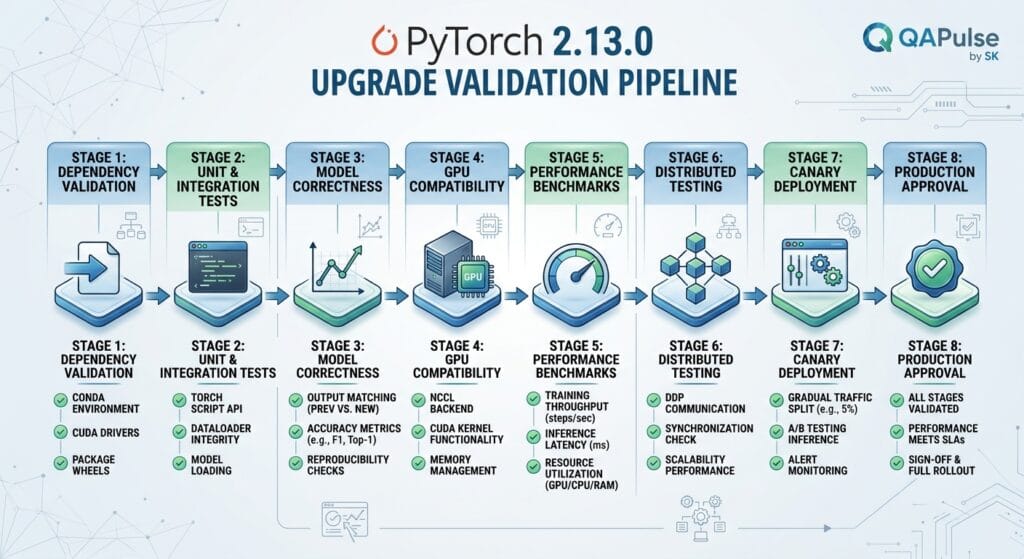
Build an Upgrade Gate Before Moving to Production
A practical PyTorch 2.13.0 rollout can use a simple promotion gate.
          PyTorch 2.13.0
                 |
                 v
        Dependency Validation
                 |
                 v
          Unit Test Suite
                 |
                 v
       Model Correctness Tests
                 |
                 v
       GPU / Accelerator Tests
                 |
                 v
      Performance Benchmarking
                 |
                 v
       Distributed Test Suite
                 |
                 v
       Production-like Workload
                 |
                 v
          Canary Deployment
                 |
                 v
          Production Rollout
Each stage should have a measurable pass condition.
For example:
Unit tests              → 100% pass
Model accuracy          → within approved tolerance
Peak memory             → no critical regression
Latency                 → within performance budget
Distributed tests       → zero critical failures
Checkpoint recovery     → successful
Python matrix           → all required versions pass
Canary workload         → stable
This is much stronger than relying on a single green CI pipeline.
Compare PyTorch With the Other Major ML Frameworks
PyTorch 2.13.0 should also be evaluated within the wider machine-learning ecosystem.
| Area | PyTorch | TensorFlow | JAX |
|---|---|---|---|
| Dynamic model development | Strong | Strong | Strong |
| GPU acceleration | Strong | Strong | Strong |
| Distributed training | Strong | Strong | Strong |
| Research ecosystem | Very strong | Very strong | Strong |
| Python integration | Excellent | Excellent | Excellent |
| Compiler-oriented optimization | TorchInductor ecosystem | XLA ecosystem | XLA ecosystem |
| Debugging flexibility | Strong | Strong | Different workflow |
| Production validation | Requires workload-specific testing | Requires workload-specific testing | Requires workload-specific testing |
The point is not to declare one framework universally superior.
The important engineering principle is that framework upgrades must be validated against the workload they actually serve.
A Better Test Pyramid for PyTorch Upgrades
A traditional test pyramid might look like:
             E2E
            /   \
        Integration
       /           \
      Unit Tests
For AI frameworks, add another dimension:
                 Production
                    ▲
             Model Workloads
                    ▲
          Performance Tests
                    ▲
       Hardware Compatibility
                    ▲
        Integration Tests
                    ▲
             Unit Tests
Each layer catches a different class of failure.
Unit tests catch API-level problems.
Integration tests catch dependency interactions.
Hardware tests catch accelerator-specific behavior.
Performance tests catch regressions that functional tests ignore.
Model-level tests catch numerical and quality regressions.
Production-like workloads validate whether everything works together.
Make the Upgrade Reproducible
Never benchmark an upgrade using an undocumented developer laptop and call the result representative.
Record the environment:
python --version
pip freeze
nvidia-smi
And capture the framework version:
import torch

print("PyTorch:", torch.__version__)
print("CUDA:", torch.version.cuda)
print("MPS available:", torch.backends.mps.is_available())
A useful benchmark record could look like:
{
  "pytorch": "2.13.0",
  "python": "3.15",
  "cuda": "compatible-runtime",
  "gpu": "test-device",
  "batch_size": 32,
  "latency_ms": 41.8,
  "peak_memory_gb": 12.7,
  "accuracy": 0.914
}
Now the result can be reproduced later.
That matters because an upgrade regression discovered three months later is much harder to diagnose if nobody knows what environment produced the original benchmark.
Internal Links
- Learn MCP – Zero to Hero
- Learn AI Agents for QA – Zero to Hero
- Playwright Automation – Zero to Hero
- TencentDB Agent Memory: Complete Zero to Hero
- LangGraph: Complete Zero to Hero
- Learn Python – Zero to Hero
- OpenAI Codex: Complete Zero to Hero
- Cursor AI: Complete Zero to Hero
- Claude Code Tutorial: Complete Zero to Hero
- AutoGen: Complete Zero to Hero Guide
- Free QA Resources Built From Real Experience
- QA Glossary: Test Automation Terms Every Engineer Should Know
External Links
- PyTorch 2.13.0 Release Notes
- PyTorch Official Website
- PyTorch Documentation
- PyTorch GitHub Repository
- PyTorch Previous Versions
- PyTorch Distributed Documentation
- PyTorch FlexAttention Documentation
- PyTorch FSDP Documentation
People Asked Questions
What is PyTorch 2.13.0?
PyTorch 2.13.0 is a major PyTorch release that introduces changes across attention mechanisms, distributed training, memory efficiency, performance optimization, and Python compatibility.
What is new in PyTorch 2.13.0?
Important changes include FlexAttention improvements, a deterministic backward path on CUDA, nn.LinearCrossEntropyLoss, the new torchcomms distributed communication backend, FSDP2 improvements, and Python 3.15 wheel support.
Does PyTorch 2.13.0 support Python 3.15?
Yes. PyTorch 2.13.0 provides Python 3.15 wheel support for Linux through the PyTorch repository index.
What is FlexAttention in PyTorch 2.13.0?
FlexAttention provides a flexible attention implementation designed to allow PyTorch’s compilation and optimization infrastructure to generate efficient execution for different attention patterns.
Should I upgrade to PyTorch 2.13.0?
Upgrade after validating your application’s dependencies, model correctness, hardware compatibility, performance, memory consumption, and distributed workloads. Production environments should not be upgraded solely because the package installs successfully.
Does PyTorch 2.13.0 improve distributed training?
Yes. The release includes torchcomms and improvements to FSDP2, including communication-overlap capabilities intended to improve distributed-training throughput and operational characteristics.
What should I test before upgrading to PyTorch 2.13.0?
Test dependency compatibility, model outputs, numerical tolerances, GPU behavior, peak memory, training or inference latency, distributed workloads, checkpoint recovery, and supported Python versions.
Can PyTorch 2.13.0 change model performance?
Yes. Changes to kernels, compilation, attention implementations, memory management, and distributed execution can affect both performance and resource consumption. Benchmark representative workloads before and after the upgrade.
AI Overview Optimization
What is the biggest change in PyTorch 2.13.0?
PyTorch 2.13.0 expands performance and scalability capabilities through FlexAttention, distributed-training improvements, memory-efficient operations, deterministic computation, and Python 3.15 support.
Conclusion
PyTorch 2.13.0 is more than a routine framework update. Its improvements across FlexAttention, deterministic computation, memory-efficient loss computation, distributed communication, FSDP2, and Python 3.15 support can affect performance, compatibility, reproducibility, and production behavior.
The safest approach is not to ask, “Did PyTorch 2.13.0 install successfully?”
Ask instead:
“Did our models, infrastructure, hardware, dependencies, performance characteristics, and production workflows continue to behave correctly after the upgrade?”
That change in mindset turns framework upgrading from a risky maintenance task into a controlled engineering process.
Final Key Takeaways
- PyTorch 2.13.0 should be validated as a system change, not just a dependency change.
- FlexAttention improvements require workload-specific performance benchmarking.
- Deterministic computation should be validated with reproducibility tests and appropriate numerical tolerances.
- Memory-related improvements should be measured with peak-memory benchmarks rather than assumed from release notes.
- Distributed-training changes require multi-worker and failure-recovery testing.
- FSDP2 throughput improvements must be evaluated alongside model quality and stability.
- Python 3.15 support makes runtime compatibility testing especially important.
- Unit tests alone cannot detect every framework-upgrade regression.
- Baseline metrics should be captured before upgrading and compared automatically afterward.
- A canary or production-like workload is the final confidence layer before broad rollout.
- The best upgrade strategy combines correctness, compatibility, performance, reproducibility, and operational validation.
Continue Learning
Explore more expert articles on Mobile Testing, Backend & API, AI & Agentic, AI Tools, n8n, LangChain, CrewAI, MCP Servers, AI Agents, LlamaIndex, Docker, FastAPI, Playwright, Cypress, Test Automation, DevOps, and Software Engineering at www.skakarh.com.
QAPulse by SK delivers expert release analysis, AI engineering insights, enterprise automation strategies, migration guidance, DevOps best practices, and practical testing knowledge to help software professionals build scalable, intelligent, and production-ready software systems.