 QA
QA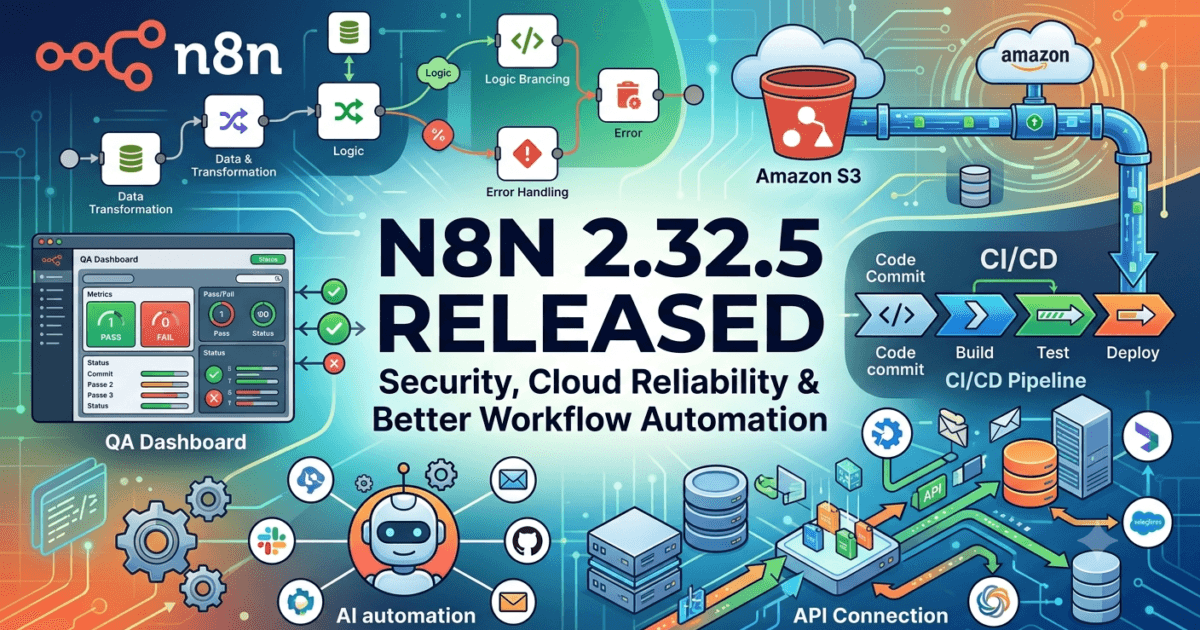
Automation has become the backbone of modern software engineering. From continuous integration and deployment to AI-powered workflows and cloud-native applications, organizations increasingly rely on automation platforms to eliminate repetitive tasks, improve operational efficiency, and accelerate software delivery. Among the growing ecosystem of workflow automation platforms, n8n has emerged as one of the most powerful open-source solutions for connecting applications, orchestrating business processes, and building intelligent automation without vendor lock-in.
For QA engineers and Software Development Engineers in Test (SDETs), n8n is no longer just a workflow automation tool. It has become an essential platform for automating test execution, generating quality reports, orchestrating CI/CD pipelines, validating APIs, integrating AI services, processing cloud storage events, and connecting dozens of testing tools into unified automation workflows. As organizations continue adopting AI-driven testing and cloud-based infrastructure, the reliability and security of workflow automation platforms become increasingly important.
Released on 24 July 2026, n8n 2.32.5 is a focused maintenance release that addresses a critical improvement in how Amazon S3 object paths are signed using strict RFC 3986 URL encoding. Although the official release notes list only a single bug fix, this enhancement has broader implications than its concise description suggests. Proper URL encoding directly affects security, interoperability, cloud storage reliability, API communication, and the stability of automated workflows that depend on signed URLs.
For many QA teams, infrastructure-related improvements like this may appear insignificant at first glance. However, experienced automation engineers understand that seemingly small fixes often prevent difficult-to-diagnose production issues, reduce intermittent workflow failures, and improve compatibility across distributed cloud environments.
In this article, we’ll examine everything included in n8n 2.32.5, explain the technical significance of the S3 signing improvement, discuss why it matters for QA engineers and SDETs, and explore how this release strengthens enterprise automation workflows built around cloud services and modern DevOps practices.
What’s New in n8n 2.32.5
n8n version 2.32.5 was officially released on 24 July 2026 as a maintenance update focused on improving the reliability of Amazon S3 object path signing.
Unlike feature-heavy releases that introduce new workflow nodes or user-facing capabilities, this release concentrates on improving the framework’s internal behaviour. These maintenance releases play an important role in ensuring that existing workflows remain secure, standards-compliant, and compatible with external cloud platforms.
Official Release Notes
Bug Fix
- Core: Sign Amazon S3 object paths using strict RFC 3986 URL encoding.
Although the release notes contain only a single line, the underlying change affects one of the most important aspects of cloud-based workflow automation: generating correctly signed URLs for secure object access.
For organizations storing reports, screenshots, logs, test artifacts, videos, datasets, backups, or AI-generated content in Amazon S3, proper URL encoding is essential to ensuring reliable communication between services.
Understanding the RFC 3986 Encoding Improvement
At the heart of this release is a change to how n8n signs Amazon S3 object paths.
When applications communicate with Amazon S3, they frequently generate signed URLs that grant temporary, secure access to files stored within cloud buckets. These URLs include encoded object paths and cryptographic signatures that Amazon verifies before granting access.
For the signature verification process to succeed, every character within the object path must be encoded according to an agreed standard.
That standard is RFC 3986, the Internet Engineering Task Force (IETF) specification that defines how Uniform Resource Identifiers (URIs) should be formatted and encoded across the web.
If object paths are encoded inconsistently, several problems may occur:
- Invalid request signatures.
- Access denied errors.
- Broken file downloads.
- Failed uploads.
- Authentication mismatches.
- Workflow interruptions.
- Inconsistent behaviour across cloud providers.
By adopting strict RFC 3986 encoding, n8n ensures that S3 object paths are signed using a standards-compliant approach, reducing compatibility issues and improving communication with Amazon S3 services.
Why RFC 3986 Compliance Is Important
URL encoding may seem like a low-level implementation detail, but it plays a fundamental role in secure web communication.
Modern automation workflows exchange thousands of requests between services every day. These requests often include:
- File names containing spaces.
- Unicode characters.
- Special symbols.
- Nested directory structures.
- Timestamped artifacts.
- User-generated content.
- AI-generated filenames.
Without consistent encoding rules, identical object paths can be interpreted differently by different systems.
For example, a space character, plus sign, or reserved URL symbol encoded incorrectly may produce a completely different cryptographic signature.
As a result:
- Amazon S3 rejects the request.
- Authentication fails.
- Files become inaccessible.
- Automation workflows stop unexpectedly.
Strict RFC 3986 compliance eliminates these inconsistencies by ensuring every supported character is encoded according to widely accepted Internet standards.
For enterprise environments where thousands of workflow executions occur daily, this consistency is essential for maintaining reliability.
How Amazon S3 Signed URLs Work
Amazon S3 protects stored objects using authentication mechanisms based on cryptographic signatures.
Instead of exposing files publicly, organizations often generate temporary signed URLs that remain valid for a limited period.
A signed URL contains:
- Bucket information.
- Object path.
- Access credentials.
- Expiration timestamp.
- Cryptographic signature.
Whenever a client requests the file, Amazon recalculates the signature.
If every component—including the encoded object path—matches the expected value, access is granted.
Even a minor encoding difference can invalidate the signature completely.
This explains why proper RFC 3986 encoding is so important.
A filename such as:
QA Report July 2026.pdf
must be encoded consistently before signing.
If different encoding rules are applied during signing and verification, Amazon S3 rejects the request despite the file existing in storage.
By implementing stricter encoding behaviour, n8n reduces these risks and improves compatibility with Amazon’s authentication process.
Why This Release Matters Beyond Cloud Storage
Although the official release specifically references Amazon S3 object signing, the broader significance extends well beyond cloud storage.
Many modern software delivery pipelines depend on S3-compatible storage for:
- Automated test reports.
- Playwright traces.
- Cypress screenshots.
- Selenium execution videos.
- Performance testing artifacts.
- Mobile testing recordings.
- API logs.
- AI-generated datasets.
- Security scan results.
- Backup files.
n8n frequently acts as the orchestration layer connecting these resources.
For example, an automated workflow may:
- Execute a Playwright regression suite.
- Upload screenshots to Amazon S3.
- Generate a signed download URL.
- Send the URL to Slack or Microsoft Teams.
- Create a Jira issue containing execution evidence.
- Archive reports for long-term compliance.
If the signed URL generation process fails because of improper path encoding, the entire workflow may appear broken even though every previous automation step completed successfully.
By improving standards compliance in this area, n8n 2.32.5 increases the reliability of automation pipelines that depend on secure cloud storage, helping QA engineers deliver more dependable reporting and reducing failures caused by infrastructure rather than application defects.
What n8n 2.32.5 Means for QA Engineers and SDETs
At first glance, n8n 2.32.5 appears to be a relatively small maintenance release. The official release notes mention only a single bug fix related to signing Amazon S3 object paths using strict RFC 3986 encoding. However, experienced QA engineers understand that maintenance releases often deliver the greatest long-term value because they improve the reliability, security, and interoperability of automation platforms without introducing disruptive changes.
Modern quality engineering extends far beyond executing automated test cases. QA teams now build complete automation ecosystems that integrate test frameworks, cloud storage, CI/CD platforms, AI services, notification systems, defect management tools, observability platforms, and reporting dashboards. In these environments, every workflow depends on accurate communication between multiple distributed services. A seemingly minor issue such as incorrect URL encoding can cascade into authentication failures, broken artifact links, interrupted pipelines, or incomplete quality reports.
By improving how n8n signs Amazon S3 object paths, version 2.32.5 strengthens one of the most critical layers of cloud-based automation: secure communication with external storage services. For QA engineers responsible for maintaining enterprise-grade automation pipelines, this translates into improved workflow reliability, fewer infrastructure-related failures, and greater confidence in automated reporting processes.
Rather than introducing new workflow nodes or visual enhancements, this release focuses on making existing functionality more dependable. That philosophy aligns perfectly with enterprise quality engineering, where predictable execution is often more valuable than rapidly introducing new features.
Why Cloud Storage Reliability Matters in Modern Test Automation
The way QA teams manage automation artifacts has changed dramatically over the last few years.
Historically, screenshots, execution logs, and test reports were stored on local machines or shared network drives. Today’s automation environments are distributed across cloud infrastructure, requiring secure and scalable storage solutions capable of supporting thousands of concurrent workflow executions.
Platforms such as Amazon S3 have become the standard destination for storing:
- Playwright trace files
- Selenium execution logs
- Cypress screenshots
- Appium videos
- API response archives
- Performance testing reports
- Security scan results
- AI-generated datasets
- Regression reports
- Compliance evidence
n8n frequently orchestrates the movement of these assets between cloud storage, communication platforms, ticketing systems, and reporting tools.
A typical QA workflow might automatically:
- Execute regression testing.
- Upload generated reports to Amazon S3.
- Create secure signed URLs.
- Send notifications through Slack or Microsoft Teams.
- Create Jira defects when failures occur.
- Archive execution evidence for future audits.
Each stage depends on accurate object path handling. If a signed URL becomes invalid because of inconsistent encoding, the workflow may complete technically while still failing from the user’s perspective because stakeholders cannot access the generated artifacts.
The improvements introduced in n8n 2.32.5 reduce these risks by ensuring greater consistency when generating signed URLs.
Key Improvement 1 – Stronger Standards Compliance for Secure Cloud Integrations
One of the most valuable aspects of this release is its commitment to recognised internet standards.
RFC 3986 defines how Uniform Resource Identifiers (URIs) should be encoded to ensure predictable communication between systems. Following this specification consistently improves interoperability across APIs, cloud platforms, and distributed services.
For QA engineers, standards compliance provides several important benefits:
More Reliable Authentication
Cryptographic signatures rely on every character being encoded consistently.
When object paths follow strict RFC 3986 encoding, signature verification becomes more predictable, reducing authentication-related failures.
Better Compatibility Across Cloud Services
Although the release specifically addresses Amazon S3 object signing, many cloud providers and S3-compatible storage platforms follow similar URI encoding expectations.
Improved standards compliance increases portability across cloud environments and reduces vendor-specific inconsistencies.
Reduced Environment-Specific Issues
Development, staging, and production environments often contain different datasets.
Special characters appearing only in production filenames can expose encoding problems that remain hidden during development testing.
By adopting strict encoding rules, n8n reduces the likelihood of these environment-specific failures.
Key Improvement 2 – Increased Stability for Enterprise Workflow Automation
Large organisations rarely use n8n for isolated automation tasks.
Instead, it functions as an orchestration engine connecting dozens of systems across the software delivery lifecycle.
Examples include:
- GitHub Actions
- GitLab CI/CD
- Jenkins
- Azure DevOps
- AWS Lambda
- Amazon S3
- PostgreSQL
- Jira
- Confluence
- Slack
- Microsoft Teams
- OpenAI
- Anthropic
- Google Gemini
- Playwright
- Cypress
- Selenium
- Appium
Every integration introduces additional complexity.
The more external systems involved, the greater the importance of predictable infrastructure behaviour.
The improvements delivered in n8n 2.32.5 strengthen this foundation by ensuring one critical integration—Amazon S3 object signing—operates according to recognised standards.
For enterprise QA teams executing thousands of automated workflows each day, improvements like this contribute directly to greater platform stability and lower maintenance costs.
Impact on AI-Powered QA Workflows
Artificial intelligence is rapidly becoming part of modern software testing.
Many organisations now use n8n to orchestrate AI-powered workflows such as:
- Automated bug classification.
- Test case generation.
- Root cause analysis.
- Failure summarisation.
- Requirement analysis.
- Visual testing.
- Release note generation.
- Test report enrichment.
These workflows often generate large volumes of supporting artifacts including screenshots, trace files, execution logs, PDFs, spreadsheets, videos, and structured datasets.
Those assets are frequently stored in Amazon S3 before being analysed by AI services or shared with engineering teams.
If signed URLs fail because of inconsistent encoding, AI pipelines may lose access to essential evidence, reducing the quality of automated analysis.
By improving S3 compatibility, n8n 2.32.5 helps ensure that AI services receive reliable access to the information they require, making end-to-end intelligent automation workflows more dependable.
Migration Considerations for Existing n8n Deployments
One of the strongest advantages of n8n 2.32.5 is that it introduces minimal migration complexity.
Since the release focuses on improving internal behaviour rather than changing workflow syntax or introducing breaking API changes, most existing workflows should continue operating without modification.
Nevertheless, enterprise QA teams should always validate production workflows after upgrading.
Recommended validation activities include:
Test S3 Upload Workflows
Verify that:
- File uploads complete successfully.
- Signed URLs remain accessible.
- Downloads function correctly.
- File names containing spaces or special characters behave as expected.
Validate Automation Reports
Execute regression suites and confirm that generated reports, screenshots, videos, and trace files can still be accessed through signed links.
Monitor CI/CD Pipelines
Review automation pipelines for unexpected authentication failures, upload errors, or cloud storage warnings following the upgrade.
Review Custom Integrations
If custom workflow nodes or scripts generate S3 object paths manually, verify that their behaviour remains compatible with the updated encoding logic.
A structured validation process helps ensure that production workflows continue operating reliably while benefiting from the improved standards compliance introduced in this release.
Are There Any Breaking Changes?
Based on the official release information, n8n 2.32.5 does not introduce significant breaking changes.
The update focuses on improving the correctness of S3 object path signing rather than modifying workflow behaviour, APIs, or node functionality.
However, organisations that previously relied on non-standard URL encoding behaviour should carefully validate workflows involving:
- Legacy S3 integrations.
- Custom storage adapters.
- Third-party object storage services.
- Self-hosted S3-compatible platforms.
- Custom signing implementations.
Although compatibility issues are unlikely, verifying production workflows remains a best practice whenever infrastructure components are upgraded.
Expert Recommendation: Should You Upgrade to n8n 2.32.5?
For most organisations, the answer is yes.
While n8n 2.32.5 is not a feature-heavy release, it improves a critical area of cloud workflow reliability by ensuring Amazon S3 object paths are signed using strict RFC 3986 encoding. This enhancement reduces interoperability issues, strengthens security, and improves compatibility with cloud storage services that play an increasingly important role in modern QA automation.
Teams should prioritise upgrading if they:
- Store automation artifacts in Amazon S3.
- Build cloud-native CI/CD pipelines.
- Use n8n to orchestrate QA workflows.
- Generate AI-powered testing reports.
- Integrate multiple cloud services within automation frameworks.
- Operate enterprise-scale workflow automation platforms.
For smaller teams, the upgrade remains worthwhile because it introduces minimal migration risk while improving long-term platform stability.
Although the release contains only a single official bug fix, its impact extends well beyond cloud storage. It strengthens one of the foundational building blocks of secure workflow automation, helping QA engineers and SDETs build automation ecosystems that are more reliable, standards-compliant, and ready to support the growing demands of AI-assisted software engineering.
Internal Links
- n8n 2.31.4 Improves Workflow Stability and Editor Reliability for QA Engineers
- n8n 2.30.8 Strengthens AI Agent Reliability and Workflow Integrity for Enterprise Automation
- n8n 2.30.7 Strengthens Package Security and AWS SES Reliability for Enterprise Workflow Automation
- n8n 2.30.5 Release Brings Better AI Assistant Analytics, Node Alias Preservation, and Editor Improvements for Workflow Automation
- n8n 2.30.4 Improves Workflow Reliability, Webhook Stability, and Notion Integration for Enterprise Automation
- n8n 2.29.10 Released — What’s New for QA Engineers
- n8n 2.29.9 Released: Strengthening Enterprise AI Automation for Modern QA Teams
- n8n 2.29.8 Released: Enterprise Workflow Stability Gets Even Stronger for QA Engineers
- n8n 2.29.7 Released: AI Workflow Stability Improvements Every QA Engineer Should Know
- n8n 2.28.6 Released: Critical Stability Fixes Every QA Engineer Should Know
- n8n 2.28.7 Released: Critical Dependency Fix Every QA Engineer Should Know
- n8n 2.28.3 Released: Startup Reliability Improvements Every QA Engineer Should Know
- n8n 2.27.4 Released: Essential Workflow Improvements Every QA Engineer Should Know
Official Resources
- Official Documentation: https://docs.n8n.io
- Official Release Notes: https://github.com/n8n-io/n8n/compare/n8n@2.32.4…n8n@2.32.5
People Asked Questions
What is n8n 2.32.5?
n8n 2.32.5 is a maintenance release that improves Amazon S3 object path signing by implementing strict RFC 3986 URL encoding, enhancing cloud workflow reliability and compatibility.
What changed in n8n 2.32.5?
The primary change is a core bug fix that ensures Amazon S3 object paths are signed using strict RFC 3986 encoding, reducing signature mismatches and improving interoperability.
Should QA engineers upgrade to n8n 2.32.5?
Yes. QA engineers using n8n with Amazon S3, CI/CD pipelines, AI workflows, or cloud-based automation should upgrade after validating their existing workflows.
Does n8n 2.32.5 include breaking changes?
According to the official release notes, there are no significant breaking changes. Existing workflows should continue to operate normally, though cloud storage integrations should be validated after upgrading.
Why is RFC 3986 encoding important?
RFC 3986 defines the standard for URI encoding. Using strict encoding ensures that signed URLs are generated correctly, improving security, authentication accuracy, and compatibility with Amazon S3.
Is n8n suitable for enterprise automation?
Yes. n8n supports enterprise workflow automation by integrating cloud services, APIs, AI platforms, databases, messaging systems, and CI/CD pipelines into scalable automation workflows.
Continue Learning with QAPulse by SK
At QAPulse by SK, we continuously analyze the latest releases across n8n, LangChain, CrewAI, LangGraph, Model Context Protocol (MCP), FastAPI, Python, Node.js, Docker, Playwright, Selenium, Locust, k6, and many other technologies shaping the future of intelligent automation and AI-powered software engineering.
Our goal is to help QA Engineers, SDETs, Automation Engineers, AI Engineers, DevOps Engineers, Platform Engineers, and Software Architects stay ahead with enterprise-grade release analyses, migration strategies, AI workflow testing guides, regression checklists, production deployment best practices, and practical automation insights that support building secure, scalable, and production-ready automation platforms.