 QA
QA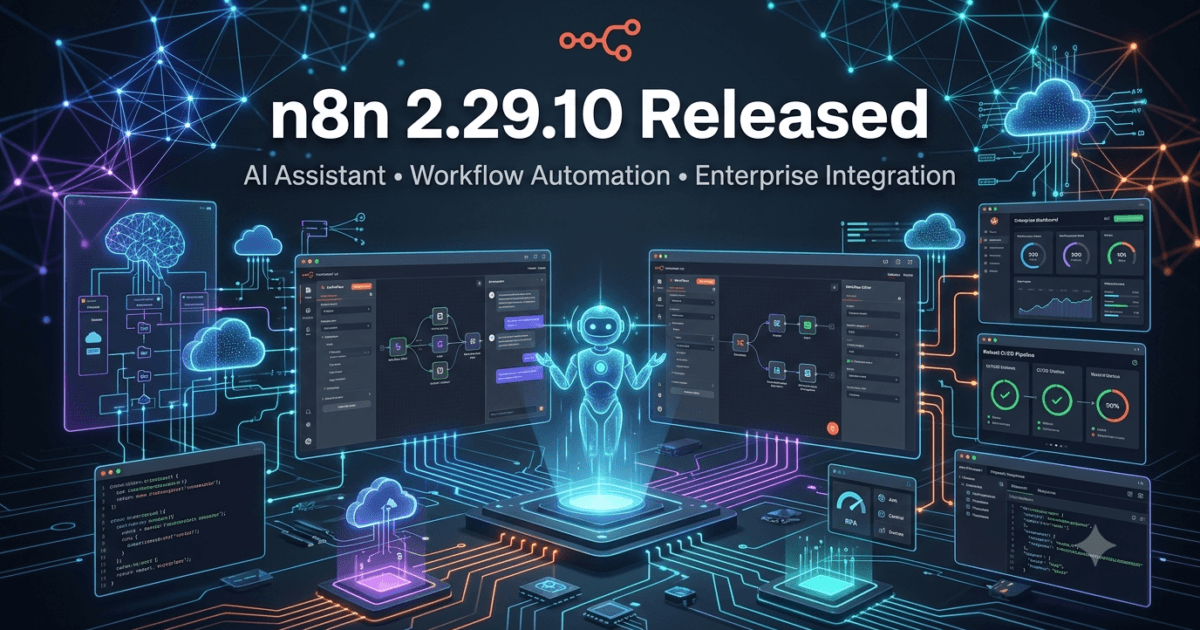
The rapid evolution of AI-powered workflow automation continues with the release of n8n 2.29.10, published on July 10, 2026. Although this is a focused maintenance release rather than a feature-packed update, it addresses an important issue affecting the AI Assistant experience inside the n8n Editor. For organizations building AI-driven automations, intelligent workflows, and enterprise integration pipelines, even a single editor stability improvement can significantly improve developer productivity and reduce interruptions during workflow design.
Over the past year, n8n has transformed from a traditional low-code automation platform into one of the most capable AI workflow orchestration tools available. Features such as AI Agents, LLM integrations, Model Context Protocol (MCP) support, vector databases, Retrieval-Augmented Generation (RAG), and intelligent workflow builders have made n8n a preferred platform for automation engineers, QA professionals, DevOps teams, and AI developers.
The primary focus of n8n 2.29.10 is preserving the AI Assistant thread state during editor hand-offs. While this may appear to be a small bug fix on paper, it has meaningful implications for engineers who rely on AI-assisted workflow development. Losing conversation history while designing or debugging automation flows interrupts productivity, reduces AI context, and forces unnecessary repetition. By ensuring that AI Assistant conversations remain intact throughout editor transitions, this release delivers a smoother and more reliable development experience.
For QA Engineers, SDETs, Test Automation Engineers, AI Engineers, Integration Specialists, DevOps professionals, and Enterprise Software Teams, this release reinforces n8n’s commitment to improving the usability and reliability of its AI-powered development environment.
Official Release Highlights
According to the official release notes, n8n 2.29.10 includes the following improvement:
Bug Fixes
- Editor: Keep AI Assistant thread state intact on editor hand-off (#33925)
Although only one issue is listed, it directly impacts developers who increasingly depend on AI-assisted workflow creation, debugging, and automation design.
Release Overview
| Category | Details |
|---|---|
| Release Version | n8n 2.29.10 |
| Release Date | July 10, 2026 |
| Release Type | Maintenance Release |
| Primary Focus | Editor Stability |
| AI Features | AI Assistant Context Preservation |
| Breaking Changes | None Reported |
| Upgrade Recommendation | Recommended |
Why This Release Matters
Artificial Intelligence is becoming an integral part of modern software engineering. Developers increasingly rely on AI assistants to generate workflow logic, troubleshoot execution failures, explain nodes, suggest expressions, and optimize automation pipelines.
One of the biggest frustrations with AI-assisted development is losing conversational context. When an AI assistant forgets previous interactions because the editor refreshes, switches context, or performs internal state transitions, engineers often need to repeat prompts, re-explain workflow requirements, or rebuild debugging sessions from scratch.
The improvement delivered in n8n 2.29.10 directly addresses this usability challenge by preserving the AI Assistant thread during editor hand-offs. This creates a more seamless conversational experience and allows developers to continue collaborating with AI without interruption.
While this change does not affect workflow execution or runtime performance, it significantly improves the daily experience of teams building AI-powered automations.
Deep Dive into the AI Assistant Improvement
Persistent AI Conversations
The AI Assistant is becoming one of the most valuable productivity features within n8n.
It helps developers:
- Generate workflow logic
- Explain node configurations
- Create expressions
- Debug failed executions
- Optimize automation pipelines
- Recommend best practices
- Produce documentation
- Accelerate workflow development
Maintaining conversation history is essential because AI-generated suggestions depend heavily on previous context.
With n8n 2.29.10, editor transitions no longer disrupt these ongoing AI conversations, allowing engineers to maintain continuity throughout complex automation projects.
Improved Developer Productivity
Workflow development often involves multiple editor interactions, including:
- Opening node settings
- Switching between workflow tabs
- Editing credentials
- Reviewing executions
- Inspecting logs
- Updating expressions
- Returning to AI conversations
Previously, these transitions could interrupt AI Assistant context under certain conditions.
The latest release helps eliminate that friction, allowing engineers to focus on building workflows rather than recovering lost conversations.
Impact on QA Engineers
Quality Assurance is evolving alongside AI-powered development tools. QA Engineers are increasingly responsible for validating intelligent workflows, AI agents, enterprise integrations, and automation pipelines rather than testing only traditional web applications.
For teams using n8n in production, AI Assistant continuity offers several practical benefits:
Faster Automation Development
Engineers can continue refining automation logic without restarting AI conversations after editor changes.
Improved Debugging Sessions
AI retains context from previous troubleshooting discussions, making root cause analysis faster and more accurate.
Better Knowledge Retention
Long-running workflow discussions remain available, reducing repeated prompts and duplicated explanations.
More Efficient Collaboration
Teams collaborating on complex automation projects benefit from a smoother AI-assisted development experience, especially when workflows involve dozens of interconnected nodes.
Comparison with Previous Release
| Feature | n8n 2.29.9 | n8n 2.29.10 |
|---|---|---|
| Workflow Execution | Stable | Stable |
| AI Assistant | Minor editor interruption possible | Thread state preserved |
| Editor Experience | Good | Improved |
| Breaking Changes | None | None |
| Upgrade Risk | Low | Very Low |
| Enterprise Readiness | High | Higher |
Upgrade Recommendation
Based on the official release notes and the scope of this update, n8n 2.29.10 is recommended for all users already running the 2.29.x release series.
Although this is a maintenance release, preserving AI Assistant conversation state delivers measurable productivity improvements for developers, QA Engineers, and automation specialists who rely on AI during workflow creation and debugging.
Organizations using n8n for enterprise automation, AI-powered integrations, and intelligent workflow orchestration should include this update as part of their regular maintenance cycle after completing standard regression testing in staging environments.
How to Upgrade
Update n8n
npm install n8n@latest
Or, if using Docker:
docker pull n8nio/n8n:latest
docker compose pull
docker compose up -d
After upgrading, validate:
- AI Assistant conversations
- Workflow editor behavior
- Node editing
- Execution history
- Workflow debugging
- Existing automation pipelines
- AI-powered workflow generation
- Regression test suites
Successful validation ensures your automation platform continues to operate reliably while benefiting from the improved AI Assistant experience.
What n8n 2.29.10 Means for QA Engineers
The adoption of Artificial Intelligence within software engineering has fundamentally changed how automation platforms are used. Modern workflow automation is no longer limited to connecting APIs or moving data between applications. Today’s enterprise automation platforms are expected to understand natural language, generate workflows, assist with debugging, recommend improvements, and collaborate with engineers during development.
n8n has rapidly evolved into one of the leading AI-native workflow automation platforms by integrating AI Agents, Large Language Models (LLMs), Retrieval-Augmented Generation (RAG), Model Context Protocol (MCP), and intelligent workflow assistants. As these capabilities become more deeply embedded into enterprise development, even seemingly small editor improvements can have a significant impact on engineering productivity.
The primary enhancement in n8n 2.29.10 preserves the AI Assistant thread state during editor hand-offs, ensuring conversations remain uninterrupted while developers navigate complex workflows. Although this release introduces only a single bug fix, it directly improves the day-to-day experience of engineers who rely on AI to build, troubleshoot, and optimize automation pipelines.
For QA Engineers, SDETs, Automation Engineers, DevOps teams, AI Engineers, Platform Engineers, and Enterprise Architects, this update enhances workflow continuity, reduces unnecessary context switching, and creates a more dependable AI-assisted development experience.
Why AI Context Preservation Matters
AI assistants are most effective when they maintain context throughout an engineering session. Modern workflow development often involves dozens of nodes, multiple credentials, API integrations, conditional logic, and iterative testing. During this process, developers frequently move between the workflow editor, execution logs, configuration panels, and debugging screens.
If the AI Assistant loses its conversation history during one of these transitions, engineers are forced to repeat instructions, explain workflow objectives again, or regenerate previous suggestions. This interruption reduces productivity and limits the value of AI-assisted development.
By preserving the conversation thread across editor hand-offs, n8n 2.29.10 enables a more natural collaboration between developers and AI. The assistant can continue providing relevant recommendations based on the full history of the discussion, making troubleshooting and workflow refinement significantly more efficient.
Enterprise Impact
Enterprise organizations increasingly use n8n as an orchestration platform for:
- AI Agents
- Customer support automation
- DevOps pipelines
- Internal developer tools
- Business process automation
- Document processing
- Retrieval-Augmented Generation (RAG)
- MCP-enabled workflows
- API orchestration
- Cloud integrations
In these environments, engineers often spend hours refining a single workflow with assistance from AI.
The improvement delivered in n8n 2.29.10 helps ensure those AI interactions remain continuous instead of being interrupted by editor state changes.
Although this update does not directly affect runtime execution, it improves one of the most frequently used parts of the platform—the workflow development experience itself.
Key Improvements for QA Teams
Better AI-Assisted Debugging
QA Engineers frequently investigate workflow failures involving:
- API responses
- Authentication issues
- Data transformations
- Conditional branches
- Retry logic
- Node configuration
- Expression syntax
Maintaining AI conversation history allows debugging sessions to continue naturally without repeating previously collected information.
This makes AI recommendations increasingly accurate throughout the troubleshooting process.
Improved Test Workflow Design
Many organizations now use AI to generate:
- Test workflows
- API automation
- Validation logic
- Integration scenarios
- Mock data generation
- Expression templates
- Error handling
- Documentation
Preserving AI Assistant state means workflow generation becomes iterative instead of repetitive.
Developers can gradually refine complex automation projects while keeping the assistant fully aware of previous design decisions.
Enhanced Developer Productivity
Context switching is one of the largest productivity killers during software development.
By reducing interruptions, n8n 2.29.10 allows developers to:
- Complete workflows faster
- Spend less time rewriting prompts
- Maintain design consistency
- Reduce repetitive conversations
- Improve AI-generated output quality
These benefits become increasingly valuable as organizations expand their AI-assisted engineering practices.
Real-World Testing Scenarios
The improvements in n8n 2.29.10 positively affect several practical QA workflows.
| Testing Scenario | Benefit |
|---|---|
| Workflow Debugging | AI retains troubleshooting context |
| API Testing | Continuous AI recommendations |
| Expression Development | No lost conversation history |
| AI Agent Testing | Improved workflow continuity |
| Enterprise Automation | Better editing experience |
| Long Workflow Design | Stable AI collaboration |
| Regression Analysis | Faster investigation cycles |
| Integration Testing | More productive AI-assisted debugging |
Regression Testing Checklist
Before deploying n8n 2.29.10 into production, QA teams should validate:
- AI Assistant conversation continuity
- Workflow editor navigation
- Node configuration editing
- Expression editor behavior
- Workflow execution history
- Saved workflow persistence
- Browser refresh scenarios
- Multi-tab editing
- AI-generated workflow suggestions
- Existing automation pipelines
- Credential management
- Execution logs
- Docker deployments
- Cloud-hosted instances
- User acceptance testing
Although the release introduces only one editor fix, comprehensive regression testing ensures that existing automation capabilities remain unaffected.
Migration Guidance
The official release notes report no breaking changes, making n8n 2.29.10 a low-risk maintenance update.
Organizations currently running the 2.29.x release series can typically upgrade without modifying existing workflows or integrations.
A recommended deployment strategy includes:
- Upgrade a development environment.
- Validate AI Assistant behavior.
- Execute regression automation.
- Verify production workflows.
- Deploy to staging.
- Roll out gradually to production.
Following this approach minimizes operational risk while allowing engineering teams to benefit from the improved editor experience.
Should You Upgrade?
Yes.
While n8n 2.29.10 is not a feature-heavy release, it addresses an important usability issue that directly impacts AI-assisted workflow development. Teams actively using the AI Assistant for workflow creation, debugging, and automation design will benefit from smoother conversations and reduced interruptions.
Because there are no reported breaking changes, this release is suitable for production environments after standard regression testing. Organizations building AI-native automation platforms, intelligent integrations, or enterprise orchestration systems should include this update as part of their routine maintenance cycle.
n8n 2.29.10 Released: Key Takeaways
n8n 2.29.10 Released focuses on improving the AI-powered development experience by preserving AI Assistant thread state during editor hand-offs. Although the release contains only a single editor fix, its impact extends to developer productivity, workflow continuity, and AI collaboration.
For QA Engineers, Automation Engineers, AI Developers, SDETs, DevOps teams, and Enterprise Integration Specialists, this update reinforces n8n’s commitment to making AI-assisted workflow development more reliable and less disruptive. As AI becomes an integral part of modern software engineering, maintaining conversational context is essential for efficient debugging, iterative workflow design, and high-quality automation delivery.
Internal Links
- n8n 2.29.9 Released: Strengthening Enterprise AI Automation for Modern QA Teams
- n8n 2.29.8 Released: Enterprise Workflow Stability Gets Even Stronger for QA Engineers
- n8n 2.29.7 Released: AI Workflow Stability Improvements Every QA Engineer Should Know
- n8n 2.28.6 Released: Critical Stability Fixes Every QA Engineer Should Know
- n8n 2.28.7 Released: Critical Dependency Fix Every QA Engineer Should Know
- n8n 2.28.3 Released: Startup Reliability Improvements Every QA Engineer Should Know
- n8n 2.27.4 Released: Essential Workflow Improvements Every QA Engineer Should Know
Official Resources
- Official Documentation: https://docs.n8n.io
- Official Release Notes: https://github.com/n8n-io/n8n/compare/n8n@2.29.9…n8n@2.29.10
Frequently Asked Questions
Is n8n 2.29.10 a major feature release?
No. It is a maintenance release focused on improving the AI Assistant experience within the workflow editor.
Are there any breaking changes?
No. The official release notes do not report any breaking changes.
Who benefits most from this release?
Developers, QA Engineers, Automation Engineers, AI Engineers, and teams that actively use the built-in AI Assistant while designing or debugging workflows.
Should production environments upgrade immediately?
Yes. After standard regression testing, this release is recommended because it improves usability without introducing breaking changes.
Does this release improve workflow execution performance?
No direct runtime performance improvements are included. The primary enhancement targets the workflow editor by preserving AI Assistant conversation state during editor transitions.
Continue Learning with QAPulse by SK
Automation is rapidly evolving into AI-driven orchestration, and QAPulse by SK helps software professionals stay ahead with practical tutorials, release analyses, and engineering insights covering n8n, AI Agents, LangChain, CrewAI, FastAPI, Model Context Protocol (MCP), Claude Code, Docker, Node.js, Playwright, Python, DevOps, Cloud Computing, and Enterprise Test Automation.
Whether you’re building autonomous AI workflows, intelligent automation pipelines, enterprise integration platforms, or next-generation testing frameworks, QAPulse by SK provides actionable guidance to help QA Engineers and software teams design, test, and deploy reliable AI-powered solutions with confidence.