QA
QA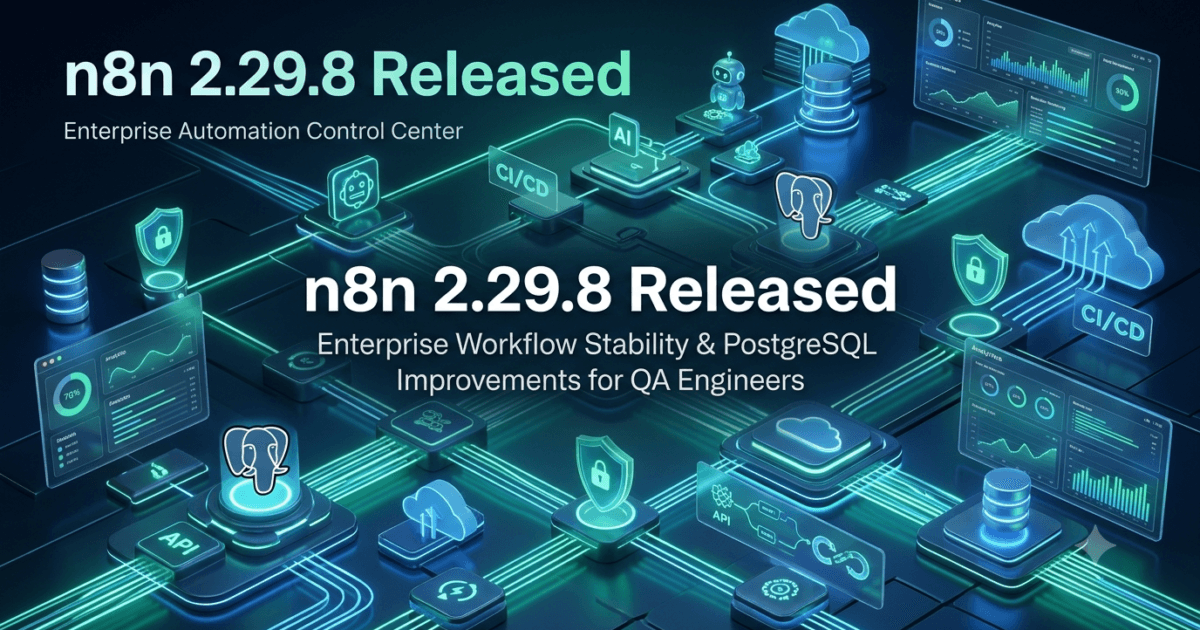
n8n 2.29.8 Released: Enterprise Workflow Stability Gets Even Stronger for QA Engineers
Workflow automation has become one of the most important pillars of modern software engineering. Today’s organizations no longer use automation platforms simply to connect two APIs—they use them to orchestrate AI agents, cloud infrastructure, enterprise applications, customer onboarding systems, DevOps pipelines, security operations, data synchronization, and intelligent business workflows.
As automation continues to expand across every department of an organization, platform stability becomes increasingly critical. A single failure inside the workflow engine can interrupt dozens of connected services, delay software deployments, prevent customer notifications, or even impact revenue-generating processes.
This is why maintenance releases deserve the same level of attention as feature releases.
Released on July 8, 2026, n8n 2.29.8 focuses on improving the reliability of the platform’s core execution engine by addressing two important stability issues. Although this release introduces no new workflow nodes or major AI capabilities, it strengthens the platform where production engineering teams need it most—workflow execution reliability and database connection management.
For QA Engineers, SDETs, Test Automation Engineers, DevOps Professionals, Platform Engineers, AI Developers, and Enterprise Architects, this release is another production-ready update that improves platform resilience while maintaining full backward compatibility.
Rather than introducing flashy features, n8n continues demonstrating the maturity expected from an enterprise automation platform by refining the core components responsible for executing thousands of workflows every day.
What’s New in n8n 2.29.8?
According to the official release notes, n8n 2.29.8 introduces two important fixes within the platform’s core architecture.
Official Changes
Core Improvements
- Guard against null run-data slots during execution redaction.
- Run database connection recovery only for PostgreSQL deployments.
Although these entries appear small in the changelog, they target two areas that directly influence workflow reliability in enterprise environments.
The first improves the way execution data is processed during redaction, helping avoid failures when unexpected null values appear.
The second refines database recovery logic so that automatic recovery mechanisms are applied only where appropriate, reducing unnecessary operations for non-PostgreSQL database configurations.
These improvements may not change the visual experience inside the n8n editor, but they significantly strengthen the platform’s operational consistency under real-world workloads.
Release Highlights
| Component | Improvement | Business Impact |
|---|---|---|
| Execution Engine | Handles null run-data safely during redaction | More reliable workflow execution |
| Security & Data Processing | Improved execution redaction logic | Better handling of sensitive workflow data |
| PostgreSQL Support | Smarter connection recovery | Improved production database reliability |
| Platform Stability | Internal core refinements | Higher enterprise reliability |
| Breaking Changes | None reported | Safe maintenance upgrade |
Why Maintenance Releases Are Critical for Enterprise Automation
Many software teams naturally become excited about feature releases.
New AI integrations.
New workflow nodes.
New automation capabilities.
New connectors.
However, experienced engineering teams understand that maintenance releases often deliver greater long-term value than feature releases.
Every enterprise automation platform eventually reaches a point where stability becomes more important than adding additional functionality.
Consider a typical production n8n deployment.
A single instance may automate:
- Customer onboarding workflows.
- AI document processing.
- CRM synchronization.
- ERP integrations.
- Cloud infrastructure provisioning.
- Security incident response.
- Slack and Microsoft Teams notifications.
- Financial approval workflows.
- Software deployment pipelines.
- Marketing campaign automation.
- Business intelligence reporting.
- Internal operational processes.
These workflows execute continuously throughout the day and often involve multiple external services, databases, AI providers, authentication systems, and cloud platforms.
When the automation engine itself becomes unstable, the effects ripple across the entire business.
That is precisely why releases such as n8n 2.29.8 matter.
By strengthening the workflow engine itself, n8n helps organizations reduce operational risk while increasing confidence in production automation.
Safer Execution Redaction Improves Workflow Reliability
One of the most valuable improvements in this release is the safeguard against null run-data slots during execution redaction.
Execution redaction is an essential security feature because workflow execution records frequently contain sensitive information, including:
- API keys.
- OAuth tokens.
- Database credentials.
- Customer identifiers.
- Internal business data.
- Authentication headers.
- Payment references.
- Personally identifiable information (PII).
Before execution data is stored or displayed, n8n applies redaction rules to ensure sensitive information is properly protected.
The challenge arises when execution records contain unexpected or incomplete data structures.
Without proper safeguards, null execution slots can potentially trigger errors during processing, resulting in failed workflow history generation or unstable execution handling.
The fix included in n8n 2.29.8 makes this process significantly more defensive.
Instead of assuming every execution record contains complete data, the platform now safely handles edge-case scenarios where portions of execution data may be missing.
For enterprise organizations running thousands of workflow executions every day, this improvement contributes to:
- Greater workflow resilience.
- Improved execution consistency.
- Better protection against unexpected runtime failures.
- More reliable execution auditing.
- Enhanced production stability.
Although users may never directly notice this change, QA engineers will appreciate the reduction in unpredictable edge-case failures.
PostgreSQL Recovery Logic Becomes More Intelligent
The second improvement focuses on database connection recovery.
Many enterprise n8n deployments use PostgreSQL because of its scalability, performance, reliability, and cloud-native compatibility.
Automatic recovery logic is useful when temporary database connectivity issues occur.
However, applying PostgreSQL-specific recovery behavior across unrelated database environments introduces unnecessary complexity.
With n8n 2.29.8, database recovery is now limited specifically to PostgreSQL deployments where the functionality is actually required.
This refinement delivers several operational benefits:
- Cleaner recovery behavior.
- Reduced unnecessary recovery attempts.
- Better resource utilization.
- More predictable database interactions.
- Easier production troubleshooting.
For DevOps teams operating containerized deployments across Docker, Kubernetes, AWS, Azure, or Google Cloud Platform, these refinements help create more stable production environments.
Why QA Engineers Should Upgrade
Modern Quality Assurance has evolved far beyond browser testing.
Today’s QA engineers increasingly validate complete automation ecosystems involving:
- AI Agents.
- LangChain applications.
- CrewAI workflows.
- MCP Servers.
- REST APIs.
- Webhooks.
- Database integrations.
- Cloud infrastructure.
- Business process automation.
- Enterprise software integrations.
Each workflow may execute dozens of operations before completing successfully.
If the workflow engine encounters an unexpected failure while processing execution data or recovering database connectivity, identifying the root cause becomes significantly more difficult.
The improvements introduced in n8n 2.29.8 help reduce these operational uncertainties by making the underlying platform more resilient.
For SDETs and automation engineers, that translates into:
- More predictable regression testing.
- Higher workflow execution reliability.
- Fewer intermittent production issues.
- Easier troubleshooting.
- Improved confidence during enterprise automation validation.
As organizations continue expanding AI-powered workflow automation, incremental improvements like these become increasingly valuable because they strengthen the infrastructure supporting every automated business process.
This release reinforces n8n’s ongoing commitment to becoming one of the most reliable workflow automation platforms available for modern enterprise software engineering.
What n8n 2.29.8 Means for QA Engineers
Although n8n 2.29.8 is categorized as a maintenance release, experienced QA engineers know that these are often the updates that have the greatest long-term impact on production environments. New features may attract attention, but reliability improvements are what keep enterprise automation platforms running smoothly every day.
Modern organizations rely on n8n to automate hundreds—or even thousands—of business processes. These workflows frequently connect APIs, databases, cloud services, AI models, messaging platforms, and enterprise applications into a single automated pipeline. A seemingly minor issue inside the workflow engine can interrupt multiple downstream systems, increase operational costs, and require manual intervention from engineering teams.
This release focuses on improving the platform’s internal robustness rather than adding visible functionality. By strengthening execution redaction handling and refining PostgreSQL recovery behavior, n8n 2.29.8 helps reduce the likelihood of unexpected workflow interruptions while improving the overall reliability of enterprise automation.
For QA engineers, this means fewer intermittent failures during regression testing, more predictable execution behavior, and increased confidence when validating business-critical automation.
Enterprise Impact
Automation platforms are no longer simple workflow builders—they have become orchestration engines that power digital transformation initiatives across entire organizations.
Today’s production deployments commonly automate:
- AI-powered customer support
- Intelligent document processing
- CRM synchronization
- ERP integrations
- Financial approval workflows
- Cloud infrastructure management
- Security incident response
- Marketing automation
- DevOps deployment pipelines
- Internal business operations
Many of these workflows execute continuously, often processing thousands of events every hour.
As workflow complexity grows, stability becomes increasingly valuable. Every improvement to the execution engine helps organizations reduce operational risk while improving service reliability.
The enhancements introduced in n8n 2.29.8 strengthen the platform’s foundation by making execution processing more resilient and database recovery behavior more intelligent.
Better Stability for AI Automation
One of the biggest trends in software engineering is the rapid adoption of AI-powered workflows.
Organizations are combining n8n with technologies such as:
- AI Agents
- LangChain
- CrewAI
- MCP Servers
- Retrieval-Augmented Generation (RAG)
- OpenAI
- Anthropic Claude
- Google Gemini
- Vector databases
- Custom LLM applications
These intelligent workflows are significantly more complex than traditional automation because they involve multiple API calls, dynamic decision making, memory management, external tools, and asynchronous execution.
As AI adoption increases, workflow reliability becomes even more important.
Even a small improvement in execution stability can help organizations reduce unexpected workflow failures, improve recovery from edge-case scenarios, and maintain higher availability for AI-driven business processes.
Maintenance releases like n8n 2.29.8 quietly strengthen the infrastructure that supports these increasingly sophisticated automation systems.
PostgreSQL Users Benefit the Most
Many production n8n environments use PostgreSQL because of its scalability, transactional integrity, and excellent support for enterprise deployments.
The refinement to database connection recovery ensures that recovery logic is applied specifically where it is needed instead of running unnecessarily in unrelated environments.
For organizations operating Docker containers, Kubernetes clusters, or managed PostgreSQL services, this improvement contributes to:
- More predictable database behavior.
- Cleaner recovery processes.
- Reduced unnecessary operations.
- Improved production stability.
- Easier operational monitoring.
Platform engineers responsible for highly available automation infrastructure will appreciate these behind-the-scenes improvements because they help reduce operational complexity over time.
Recommended Regression Testing Checklist
Although n8n 2.29.8 introduces no breaking changes, production upgrades should always be validated through comprehensive regression testing.
Before deployment, QA teams should verify:
- Existing production workflows
- AI Agent workflows
- LangChain integrations
- MCP Server connections
- PostgreSQL database connectivity
- Scheduled workflows
- Webhook execution
- REST API integrations
- Error handling scenarios
- Retry mechanisms
- Authentication flows
- Docker deployments
- Kubernetes deployments
- CI/CD automation pipelines
- Community nodes
- Custom nodes
- Workflow execution history
- Workflow recovery after failures
- Concurrent workflow execution
- End-to-end regression suites
Completing these validation steps helps ensure a smooth rollout while minimizing operational risk.
Should You Upgrade?
Yes.
Although n8n 2.29.8 does not introduce major new features, it improves two critical areas of the workflow engine that directly influence production stability.
Reasons to upgrade include:
- Improved workflow execution reliability.
- Better handling of execution edge cases.
- Smarter PostgreSQL recovery behavior.
- No reported breaking changes.
- Safe maintenance upgrade.
- Improved enterprise stability.
- Recommended for production automation platforms.
- Better long-term platform reliability.
Organizations running business-critical workflows should include this release in their normal maintenance cycle after completing regression validation.
How to Upgrade
Upgrade using npm
npm install -g n8n@latest
Upgrade Docker Deployment
docker pull n8nio/n8n:latest
docker compose up -d
Verify Installed Version
n8n --version
After upgrading, rerun representative production workflows, verify PostgreSQL connectivity, validate workflow execution history, and execute your smoke and regression suites before deploying the update across production environments.
Internal Links
- n8n 2.29.7 Released: AI Workflow Stability Improvements Every QA Engineer Should Know
- n8n 2.28.6 Released: Critical Stability Fixes Every QA Engineer Should Know
- n8n 2.28.7 Released: Critical Dependency Fix Every QA Engineer Should Know
- n8n 2.28.3 Released: Startup Reliability Improvements Every QA Engineer Should Know
- n8n 2.27.4 Released: Essential Workflow Improvements Every QA Engineer Should Know
Official Resources
- Official Documentation: https://docs.n8n.io
- Official Release Notes: https://github.com/n8n-io/n8n/releases/tag/n8n%402.28.7
Frequently Asked Questions
Does n8n 2.29.8 include any breaking changes?
No. According to the official release notes, there are no reported breaking changes, making this a low-risk maintenance release for production environments.
What is the most important improvement in this release?
The biggest improvement is the enhanced handling of null run-data during execution redaction, which improves workflow stability and reduces the likelihood of execution-related edge-case failures.
Why is the PostgreSQL recovery improvement important?
The update ensures that database recovery logic is executed only for PostgreSQL deployments, resulting in cleaner recovery behavior, improved operational efficiency, and more predictable production environments.
Should enterprise organizations upgrade?
Yes. Organizations relying on n8n for business-critical automation should upgrade after standard regression testing to benefit from improved stability and platform reliability.
Will existing workflows continue to work?
Yes. Existing workflows should continue functioning normally because this release focuses on internal stability improvements rather than introducing changes to workflow behavior or APIs.
n8n 2.29.8 Released: Key Takeaways
n8n 2.29.8 Released reinforces the platform’s commitment to enterprise-grade reliability by improving execution redaction robustness and refining PostgreSQL connection recovery. While the release does not introduce new automation features, it strengthens the workflow engine that powers AI agents, cloud automation, DevOps pipelines, customer integrations, and mission-critical business processes. For QA engineers, SDETs, DevOps teams, Platform Engineers, and enterprise automation architects, upgrading to n8n 2.29.8 is a practical step toward achieving more reliable workflow execution, reduced operational risk, and greater confidence in production automation environments.
Continue Learning
If you enjoyed this release analysis, explore more expert tutorials, release notes, and hands-on guides on n8n, MCP Servers, LangChain, CrewAI, LlamaIndex, FastAPI, Docker, Playwright, Cypress, AI Agents, Test Automation, and DevOps at www.skakarh.com.
QAPulse by SK delivers in-depth release analysis, enterprise automation insights, AI engineering tutorials, migration strategies, DevOps best practices, and software testing expertise to help developers and QA professionals build scalable, intelligent, and production-ready software systems.