 QA
QA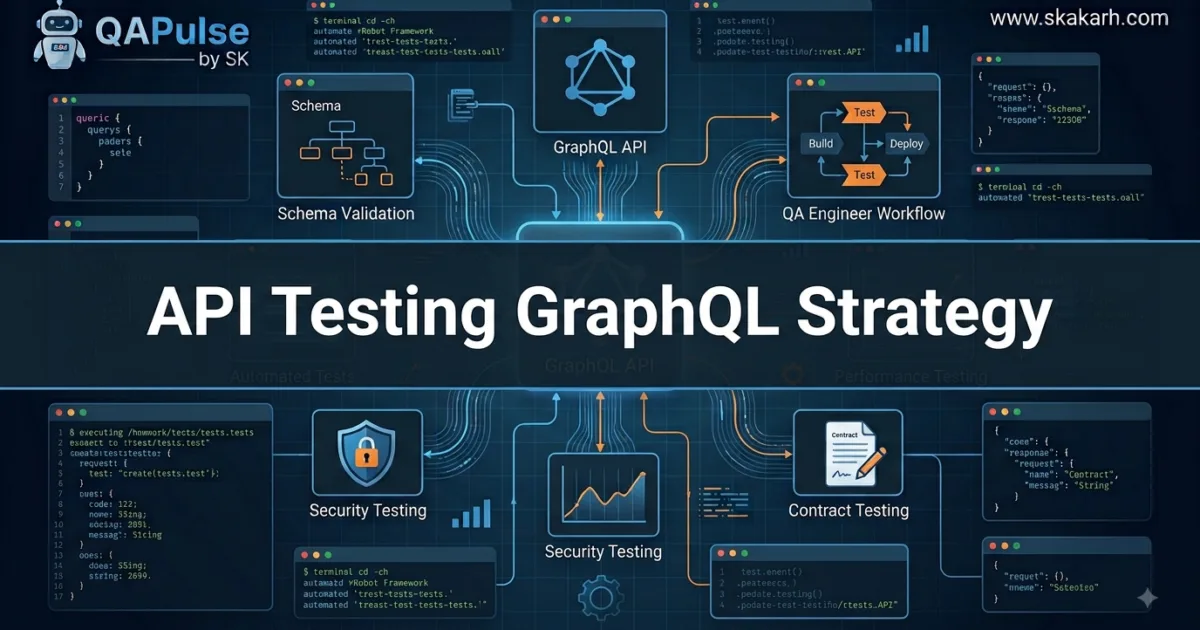
API testing GraphQL requires a different mindset from traditional REST API testing. Instead of validating dozens of fixed endpoints, QA engineers need to validate a flexible schema where clients can request different fields, combine nested objects, execute mutations, and receive partial responses or GraphQL errors.
That difference changes how an SDET should design an automation strategy.
Consider a REST API:
GET /users/42
GET /users/42/orders
GET /users/42/profile
A GraphQL API may expose a single endpoint:
POST /graphql
with the client deciding what it wants:
query {
  user(id: 42) {
    id
    name
    email
    orders {
      id
      total
    }
  }
}
The endpoint is the same.
The operation, selection set, variables, schema, authorization context, and expected response can all change.
That is why API testing GraphQL should not simply copy a REST testing strategy and replace /users with /graphql.
Why GraphQL Changes the Testing Problem
With REST, the URL and HTTP method provide a large amount of information:
GET /users/42
POST /users
PUT /users/42
DELETE /users/42
With GraphQL:
POST /graphql
could represent:
query GetUser {
  user(id: 42) {
    id
    name
  }
}
or:
query GetOrders {
  orders {
    id
    total
  }
}
or:
mutation CreateUser {
  createUser(
    name: "Alex"
    email: "alex@example.com"
  ) {
    id
    name
  }
}
The transport endpoint doesn’t tell you enough.
The GraphQL schema becomes a critical testing artifact.

GraphQL Schema Is Your Testing Map
A GraphQL schema describes the operations and types available to clients.
For example:
type User {
    id: ID!
    name: String!
    email: String!
}

type Query {
    user(id: ID!): User
    users: [User!]!
}
A tester can immediately identify:
Query
 ├── user(id)
 └── users

User
 ├── id
 ├── name
 └── email
This gives you something that is often more powerful than a manually maintained endpoint list.
You can use the schema to derive:
- valid operations
- required arguments
- optional arguments
- return types
- nullable fields
- nested relationships
- mutations
- deprecated fields
That makes schema-aware automation one of the strongest foundations for API testing GraphQL.
Start With a Basic GraphQL Test
Using Python and requests, a simple test can look like this:
import requests

query = """
query {
    users {
        id
        name
    }
}
"""

response = requests.post(
    "https://api.example.com/graphql",
    json={"query": query},
)

assert response.status_code == 200
assert "data" in response.json()
At first glance, this looks straightforward.
But there is an important GraphQL detail.
A successful HTTP response does not necessarily mean the GraphQL operation succeeded.
You could receive:
{
  "data": null,
  "errors": [
    {
      "message": "Unauthorized"
    }
  ]
}
with:
HTTP 200
That means this assertion:
assert response.status_code == 200
is insufficient.
A stronger test is:
body = response.json()

assert response.status_code == 200
assert "errors" not in body
assert body["data"] is not None
This is one of the first major differences between REST-oriented and GraphQL-oriented API testing.
REST vs GraphQL Testing
| Testing Area | REST | GraphQL |
|---|---|---|
| Primary test target | Endpoint | Operation |
| URL structure | Many endpoints | Often one endpoint |
| Contract | OpenAPI | GraphQL schema |
| Request shape | Usually predefined | Client-defined selection set |
| Response shape | Endpoint-defined | Query-defined |
| Nested data | Often multiple requests | Native nested queries |
| Error handling | HTTP status commonly important | HTTP + GraphQL errors |
| Field validation | Endpoint-specific | Schema + selection set |
| Test generation | Endpoint-driven | Schema/operation-driven |
The strategic difference is simple:
REST testing often starts with endpoints. GraphQL testing should start with the schema and operations.
Test Queries, Not Just the Endpoint
Consider:
query {
  user(id: "42") {
    id
    name
    email
  }
}
Your test should verify the requested fields:
body = response.json()

user = body["data"]["user"]

assert user["id"] == "42"
assert user["name"]
assert user["email"]
But don’t stop there.
Try a smaller selection:
query {
  user(id: "42") {
    id
  }
}
Then a nested selection:
query {
  user(id: "42") {
    id
    orders {
      id
      total
    }
  }
}
Now you’re testing whether the API correctly handles different client requirements.
This matters because GraphQL gives consumers much more control over response shape.
Test Field-Level Contracts
Suppose your schema says:
type User {
    id: ID!
    name: String!
    email: String!
}
The ! means those fields are non-null.
Your testing strategy should therefore consider:
id:
  expected → always present

name:
  expected → always present

email:
  expected → always present
A response such as:
{
  "data": {
    "user": {
      "id": "42",
      "name": "Alex",
      "email": null
    }
  }
}
should be suspicious because the schema promises a non-null value.
Schema-aware assertions can therefore detect contract violations that a simple status-code check cannot.
Test Variables Instead of Hard-Coding Everything
Real GraphQL operations commonly use variables.
query GetUser($id: ID!) {
  user(id: $id) {
    id
    name
    email
  }
}
Python:
query = """
query GetUser($id: ID!) {
    user(id: $id) {
        id
        name
        email
    }
}
"""

variables = {
    "id": "42"
}

response = requests.post(
    GRAPHQL_URL,
    json={
        "query": query,
        "variables": variables,
    },
)
This is better automation design than generating a different query string for every test value.
Now your test data can drive the operation:
@pytest.mark.parametrize(
    "user_id",
    ["1", "42", "999"],
)
def test_get_user(user_id):
    ...
This creates a cleaner separation:
GraphQL operation
       +
Test data
       ↓
Test scenario
Negative Testing Is Especially Important
A good GraphQL suite should deliberately send invalid requests.
For example:
query {
  user(id: null) {
    id
  }
}
Or:
query {
  user {
    id
  }
}
if id is required.
Your test should verify that the API rejects invalid operations appropriately.
body = response.json()

assert "errors" in body
But again, don’t make the test dependent only on an error string.
Prefer validating structured error information where your API contract defines it.
For example:
error = body["errors"][0]

assert "message" in error
And where applicable:
assert error["extensions"]["code"] == "BAD_USER_INPUT"
The exact error contract should come from your GraphQL implementation.
Test Unknown Fields
GraphQL clients can request fields that aren’t part of the schema.
For example:
query {
  user(id: "42") {
    id
    secretInternalField
  }
}
The server should reject the invalid selection.
A negative test can verify that:
assert "errors" in response.json()
This tests schema enforcement.
It also provides a useful security boundary.
If an internal field accidentally becomes exposed through the schema, schema-focused testing can help catch it.
Test Introspection Deliberately
GraphQL commonly supports introspection.
A client can ask the schema what types and fields exist.
For example:
{
  __schema {
    types {
      name
    }
  }
}
From a QA perspective, introspection can be extremely useful.
It can help automate:
Schema discovery
      ↓
Operation discovery
      ↓
Test generation
      ↓
Contract validation
But production security policy may restrict introspection depending on the application.
Therefore, test both the intended behavior and the security policy.
If introspection is expected to be enabled:
Expected:
introspection → available
If production should restrict it:
Expected:
introspection → rejected/restricted
The important point is that the behavior should be intentional and tested.
Test Mutations Like Business Transactions
Queries are primarily read operations.
Mutations can change state.
For example:
mutation CreateUser(
    $name: String!
    $email: String!
) {
    createUser(
        name: $name
        email: $email
    ) {
        id
        name
        email
    }
}
Your test should not simply verify:
assert response.status_code == 200
It should validate the state transition.
Before
Users = 10

Mutation
Create User

After
Users = 11
For example:
created_id = body["data"]["createUser"]["id"]

assert created_id

follow_up = get_user(created_id)

assert follow_up["email"] == email
Now you’re testing behavior rather than transport.
Mutation Testing Should Include Idempotency
Suppose the application has:
mutation {
    createOrder(...)
}
What happens when the same request is submitted twice?
A robust QA strategy should ask:
Request 1
   ↓
Order created

Request 2
   ↓
Duplicate?
Safe retry?
Second order?
Error?
This is especially important for:
- payments
- orders
- account creation
- subscriptions
- financial transactions
GraphQL doesn’t automatically solve these business-level problems.
Your test strategy has to.
Test Authorization at the Field Level
One of GraphQL’s major strengths is also a testing challenge.
A single query can request nested information:
query {
  user(id: "42") {
    id
    name
    billing {
      cardLastFour
    }
  }
}
A user may be allowed to see:
id
name
but not:
billing
Your tests should therefore consider authorization at multiple levels:
Endpoint authorization
        ↓
Operation authorization
        ↓
Object authorization
        ↓
Field authorization
        ↓
Nested resolver authorization
This is substantially different from testing only:
GET /users/42 → 200/403
With GraphQL, authorization can become part of the response-tree problem.
Build a Role Matrix
For example:
| Role | User ID | Orders | Billing | |
|---|---|---|---|---|
| Guest | Maybe | No | No | No |
| User | Yes | Yes | Own | No |
| Manager | Yes | Yes | Team | Limited |
| Admin | Yes | Yes | Yes | Yes |
Then automate it.
@pytest.mark.parametrize(
    "role,expected_billing",
    [
        ("guest", False),
        ("user", False),
        ("manager", False),
        ("admin", True),
    ],
)
def test_billing_visibility(
    role,
    expected_billing,
):
    ...
This makes authorization behavior explicit.
Test Nested Query Depth
GraphQL allows nested selections.
For example:
query {
  user(id: "42") {
    orders {
      customer {
        orders {
          customer {
            orders {
              id
            }
          }
        }
      }
    }
  }
}
A poorly protected GraphQL API can be vulnerable to expensive queries.
Therefore, performance and security testing should consider:
- query depth
- query complexity
- nested relationships
- expensive resolvers
- aliases
- repeated fields
- large lists
A production GraphQL implementation may use depth limits or complexity analysis.
Your QA suite should verify those controls rather than assuming they work.

Test Aliases
GraphQL allows multiple fields to be requested with aliases.
For example:
query {
  firstUser: user(id: "1") {
    id
    name
  }

  secondUser: user(id: "2") {
    id
    name
  }
}
This creates an interesting testing scenario.
The same field can be requested multiple times with different arguments.
Your assertions should verify that:
data = response.json()["data"]

assert data["firstUser"]["id"] == "1"
assert data["secondUser"]["id"] == "2"
Aliases also matter when analyzing query complexity.
Test Fragments
Fragments are another important GraphQL feature.
fragment UserFields on User {
  id
  name
  email
}

query {
  user(id: "42") {
    ...UserFields
  }
}
Your automation should include fragment-based operations in its coverage.
Don’t assume that validating direct field selections automatically validates every client query pattern.
A mature test suite should exercise:
Direct fields
Fragments
Nested selections
Aliases
Variables
Directives
Compare GraphQL With REST Automation Strategy
The biggest difference can be summarized like this:
| Area | REST | GraphQL |
|---|---|---|
| Discovery | Endpoint inventory | Schema + operations |
| Contract | OpenAPI | GraphQL schema |
| Main test unit | Endpoint | Operation |
| Response validation | Endpoint schema | Selection-set response |
| Nested resources | Multiple endpoints | Nested query |
| Authorization | Often endpoint-focused | Can be field/resolver-focused |
| Performance risk | Request count | Query depth/complexity |
| Negative testing | URLs/parameters | Schema/query/variables |
| Automation generation | Endpoint-based | Schema-aware |
Neither model is inherently better.
They require different testing strategies.
Build a Reusable GraphQL Test Client
Don’t repeat HTTP request logic in every test.
Create a small client:
import requests


class GraphQLClient:

    def __init__(self, url, headers=None):
        self.url = url
        self.headers = headers or {}

    def execute(self, query, variables=None):
        response = requests.post(
            self.url,
            json={
                "query": query,
                "variables": variables or {},
            },
            headers=self.headers,
        )

        response.raise_for_status()

        return response.json()
Now a test becomes:
client = GraphQLClient(
    "https://api.example.com/graphql"
)

result = client.execute(
    """
    query {
        users {
            id
            name
        }
    }
    """
)

assert "errors" not in result
assert result["data"]["users"]
This gives you a foundation for building a larger automation framework.
Add a GraphQL Assertion Layer
HTTP assertions alone are not enough.
Create semantic assertions:
def assert_graphql_success(body):
    assert "errors" not in body
    assert body.get("data") is not None
And:
def assert_graphql_error(body):
    assert body.get("errors")
Now your tests communicate intent:
result = client.execute(query)

assert_graphql_success(result)
instead of:
assert "errors" not in result
That seems minor, but it becomes valuable as the framework grows.
Schema-Driven Test Generation
The long-term opportunity is automated test generation.
Imagine your schema contains:
type Query {
    user(id: ID!): User
    users: [User!]!
}

type Mutation {
    createUser(
        name: String!
        email: String!
    ): User!
}
Your automation engine can derive:
Queries
 ├── user
 └── users

Mutations
 └── createUser
Then generate baseline tests:
Valid query
Missing required argument
Invalid argument type
Unknown field
Unauthorized access
Nested selection
Empty result
Large result
This is where schema-driven API testing becomes significantly more scalable than manually writing every test.
But Don’t Automate Everything
There is a trap.
You could generate hundreds of tests from a schema.
That doesn’t necessarily mean you have good coverage.
A schema can tell you:
What exists
It cannot fully tell you:
What matters
Business risk still requires human analysis.
For example:
createPayment
should receive much more attention than:
healthStatus
A strategic automation framework combines:
Schema coverage
+
Business risk
+
Production behavior
+
Security requirements
rather than blindly maximizing test count.
A Practical GraphQL Testing Pyramid
A useful test strategy can look like:
                 E2E Business Tests
                       ▲
                       │
                Integration Tests
                       ▲
                       │
               Resolver/Service Tests
                       ▲
                       │
             Schema Contract Tests
                       ▲
                       │
             GraphQL Request Tests
                       ▲
                       │
                 Schema Checks
The lower layers should be fast and broad.
The upper layers should be fewer but more business-focused.
This keeps the pipeline efficient.
Interactive QA Exercise
Take one GraphQL operation from your project:
query {
  user(id: "42") {
    id
    name
    orders {
      id
      total
    }
  }
}
Before writing automation, ask:
1. What happens if user 42 doesn't exist?

2. What happens if the caller isn't authenticated?

3. What happens if orders are empty?

4. Can another user request user 42?

5. Can the caller request billing information?

6. What happens with an invalid ID?

7. What happens when the query becomes deeply nested?

8. What happens when 10,000 orders are returned?
If your current test suite cannot answer these questions, you have identified testing opportunities.
That is the mindset shift that makes API testing GraphQL effective.
The SDET Strategy
A mature GraphQL testing platform should gradually evolve from:
Manual query
     ↓
Automated query
     ↓
Reusable client
     ↓
Schema validation
     ↓
Negative testing
     ↓
Authorization matrix
     ↓
Complexity testing
     ↓
Schema-driven test generation
     ↓
Risk-based continuous testing
The goal isn’t simply to automate GraphQL requests.
The goal is to understand the behavioral surface created by the schema.
Build a Schema-First GraphQL Testing Strategy
API testing GraphQL becomes much more effective when the schema is treated as a living contract rather than simply documentation.
In REST automation, teams often begin with an endpoint inventory:
GET    /users
GET    /users/{id}
POST   /users
DELETE /users/{id}
A GraphQL application changes that model.
You might have one transport endpoint:
POST /graphql
but dozens or hundreds of possible operations.
The schema tells you what clients are allowed to request.
For example:
type Query {
    user(id: ID!): User
    users: [User!]!
}

type User {
    id: ID!
    name: String!
    email: String!
}
From this small schema, your testing system can already identify:
Query
 ├── user(id)
 └── users

User
 ├── id
 ├── name
 └── email
That makes the schema an excellent starting point for automated test design.
Think in Operations Instead of Endpoints
A REST test might look like:
response = client.get("/users/42")

assert response.status_code == 200
GraphQL needs a richer representation:
query = """
query GetUser($id: ID!) {
    user(id: $id) {
        id
        name
        email
    }
}
"""

response = client.execute(
    query,
    {"id": "42"},
)
The important testing unit is now:
Operation
+
Variables
+
Selection set
+
Authorization context
+
Expected response
This is a fundamental shift.
Instead of maintaining:
Endpoint → Test
your framework can maintain:
Operation → Scenario → Assertion
That distinction becomes increasingly important as the GraphQL schema grows.
Create an Operation Model
A reusable testing framework should avoid storing GraphQL operations as unstructured strings everywhere.
A simple model could be:
from dataclasses import dataclass


@dataclass
class GraphQLOperation:
    name: str
    query: str
    variables: dict
Then:
get_user = GraphQLOperation(
    name="GetUser",
    query="""
        query GetUser($id: ID!) {
            user(id: $id) {
                id
                name
                email
            }
        }
    """,
    variables={
        "id": "42"
    },
)
Your test can now consume the object:
result = client.execute(
    get_user.query,
    get_user.variables,
)

assert "errors" not in result
This becomes easier to extend later with:
Operation
├── name
├── query
├── variables
├── expected_status
├── expected_errors
├── required_role
├── risk
└── tags
You are no longer building isolated tests.
You’re building a small GraphQL testing model.
Use the Schema to Discover Test Opportunities
Consider:
type Query {
    user(id: ID!): User
    users(limit: Int): [User!]!
}

type Mutation {
    createUser(
        name: String!
        email: String!
    ): User!
}
A basic automation engine could derive scenarios such as:
user
├── valid ID
├── nonexistent ID
├── invalid ID
└── unauthorized request

users
├── default limit
├── minimum limit
├── maximum limit
├── invalid limit
└── large result set

createUser
├── valid input
├── missing name
├── missing email
├── invalid email
├── duplicate email
└── unauthorized request
Notice what happened.
The schema did not provide the complete tests.
It provided the testing surface.
Business knowledge then determines which scenarios matter most.
Schema-Driven Does Not Mean Schema-Only
This distinction is extremely important for SDETs.
A schema might tell you:
email: String!
It doesn’t tell you whether:
john@example.com
is acceptable in every business context.
It doesn’t tell you whether:
existing@example.com
should produce a duplicate-user error.
It doesn’t tell you whether an administrator can create a user while a normal user cannot.
Therefore:
Schema
   +
Business Rules
   +
Security Policy
   +
Production Risk
   ↓
Test Scenarios
This is much stronger than simply generating one test for every field.


Test the Same Operation With Different Selection Sets
GraphQL allows consumers to choose fields.
Consider:
query {
    user(id: "42") {
        id
    }
}
Now:
query {
    user(id: "42") {
        id
        name
    }
}
And:
query {
    user(id: "42") {
        id
        name
        email
        orders {
            id
            total
        }
    }
}
The server must correctly resolve each selection set.
Your test strategy should therefore consider at least three categories:
Minimal selection
      ↓
Normal selection
      ↓
Deep selection
A useful parameterized test could look like:
@pytest.mark.parametrize(
    "selection",
    [
        "id",
        "id name",
        "id name email",
    ],
)
def test_user_selection(selection):
    ...
In a production framework, you’d normally construct valid GraphQL documents rather than concatenate arbitrary field strings.
The principle remains the same: test response flexibility deliberately.
Test Nested Resolver Behavior
Nested fields are where GraphQL becomes especially interesting for QA.
Suppose:
type User {
    id: ID!
    name: String!
    orders: [Order!]!
}

type Order {
    id: ID!
    total: Float!
}
A query can request:
query {
    user(id: "42") {
        id
        name
        orders {
            id
            total
        }
    }
}
Your assertion should validate both levels:
user = result["data"]["user"]

assert user["id"] == "42"
assert user["name"]

for order in user["orders"]:
    assert order["id"]
    assert order["total"] >= 0
This is more meaningful than checking only:
assert result["data"]
A response can contain data while one nested resolver returns incorrect information.
Test Partial Data and Errors
One of the most important GraphQL behaviors for QA engineers is that a response can contain both data and errors.
For example:
{
  "data": {
    "user": {
      "id": "42",
      "name": "Alex",
      "orders": null
    }
  },
  "errors": [
    {
      "message": "Orders service unavailable"
    }
  ]
}
A simplistic test might fail immediately because it expects:
assert "errors" not in result
But that isn’t always the correct business expectation.
Sometimes partial data is an intentional part of the API contract.
Your testing strategy therefore needs to distinguish:
Unexpected error
        vs
Expected partial failure
For example:
assert result["data"]["user"]["id"] == "42"

assert result["data"]["user"]["orders"] is None

assert result["errors"][0]["message"] == (
    "Orders service unavailable"
)
The exact assertion should follow your application’s contract.
The lesson is more important than the example:
GraphQL errors need semantic assertions, not blanket assertions.
Build Explicit Error Categories
Instead of treating every GraphQL error as identical, classify them.
For example:
ERROR_CODES = {
    "BAD_USER_INPUT",
    "UNAUTHENTICATED",
    "FORBIDDEN",
    "NOT_FOUND",
    "INTERNAL_SERVER_ERROR",
}
Then:
def assert_error_code(result, expected):
    errors = result.get("errors", [])

    assert errors
    assert errors[0]["extensions"]["code"] == expected
Your tests become expressive:
assert_error_code(
    result,
    "BAD_USER_INPUT",
)
This is preferable to:
assert "invalid" in result["errors"][0]["message"]
String matching tends to become fragile as APIs evolve.
Structured error codes are easier to maintain.
Test Authentication Separately From Authorization
A common mistake is treating authentication and authorization as one test.
They are different.
Authentication
Question:
Who is making this request?
For example:
No token
Expired token
Invalid token
Valid token
Authorization
Question:
Is this authenticated user allowed to perform this operation?
For example:
Guest
User
Manager
Admin
Your GraphQL test matrix could therefore be:
| Authentication | Role | Expected |
|---|---|---|
| None | Guest | Reject |
| Valid | User | Allow limited fields |
| Valid | Manager | Allow additional operations |
| Valid | Admin | Allow privileged operations |
| Expired | Unknown | Reject |
This becomes particularly important when field-level authorization exists.
Test Field-Level Authorization
Consider:
type User {
    id: ID!
    name: String!
    email: String!
    salary: Float
}
A normal user might be allowed to request:
query {
    user(id: "42") {
        id
        name
        email
    }
}
but not:
query {
    user(id: "42") {
        id
        name
        salary
    }
}
Your negative test should deliberately request restricted fields.
query = """
query {
    user(id: "42") {
        id
        salary
    }
}
"""

result = client.execute(query)

assert result.get("errors")
But don’t stop there.
Validate the security contract.
For example:
error = result["errors"][0]

assert error["extensions"]["code"] == "FORBIDDEN"
This makes your test much more precise.
Test Cross-User Data Access
This is one of the most important GraphQL security scenarios.
Imagine:
User A → user ID 100
User B → user ID 200
User A should not automatically gain access to User B’s private information simply because the GraphQL query accepts an ID.
Test:
result = client_as(
    "user_a"
).execute(
    """
    query {
        user(id: "200") {
            id
            email
        }
    }
    """
)
Then validate the intended policy:
assert result["errors"][0]["extensions"]["code"] == (
    "FORBIDDEN"
)
This is authorization testing at the object level.
A GraphQL endpoint can be perfectly authenticated while still being vulnerable to object-level authorization problems.
That is why identity testing and access-control testing should remain separate.
Test Query Complexity
GraphQL gives clients enormous flexibility.
That flexibility creates another testing dimension.
Consider:
query {
    users {
        orders {
            items {
                product {
                    reviews {
                        author {
                            orders {
                                items {
                                    product {
                                        id
                                    }
                                }
                            }
                        }
                    }
                }
            }
        }
    }
}
Even if the query is syntactically valid, it may be operationally dangerous.
Your application may enforce:
Maximum depth: 8
Maximum complexity: 100
Your tests should deliberately approach those boundaries.
For example:
Depth 1 → allowed
Depth 3 → allowed
Depth 5 → allowed
Depth 8 → allowed
Depth 9 → rejected
The exact limits depend on your application.
The important strategy is boundary testing.
Boundary Testing for GraphQL
Traditional QA already teaches boundary testing.
GraphQL gives you additional boundaries.
Argument boundaries
limit = 0
limit = 1
limit = 100
limit = 101
Query-depth boundaries
depth = allowed maximum
depth = maximum + 1
Query-complexity boundaries
complexity = allowed
complexity = allowed + 1
Result-size boundaries
0 records
1 record
maximum page size
maximum + 1
This creates a more systematic strategy for GraphQL performance and security validation.
Test Pagination Properly
Suppose your schema has:
type Query {
    users(
        first: Int
        after: String
    ): UserConnection!
}
A basic test:
query {
    users(first: 10) {
        edges {
            node {
                id
            }
        }
    }
}
should verify more than the HTTP response.
data = result["data"]["users"]

assert len(data["edges"]) <= 10
Then test pagination behavior.
Page 1
  ↓
cursor
  ↓
Page 2
  ↓
cursor
  ↓
Page 3
Your test should verify:
- no duplicate records
- no missing records
- stable ordering
- correct cursors
- correct
hasNextPage - correct behavior at the final page
For a production API, pagination bugs can be more damaging than a simple endpoint failure because they silently produce incomplete datasets.
Test Empty Results
Don’t test only successful data retrieval.
For:
query {
    users {
        id
        name
    }
}
you should have a dataset state where no users match.
Then verify the contract:
users = result["data"]["users"]

assert users == []
or, for a nullable object:
assert result["data"]["user"] is None
The distinction between:
[]
and:
null
is meaningful in GraphQL.
Your tests should understand the schema.
Validate Nullability
Consider:
type User {
    id: ID!
    name: String!
    avatar: String
}
The schema says:
id       → cannot be null
name     → cannot be null
avatar   → can be null
Your assertions should reflect that.
user = result["data"]["user"]

assert user["id"] is not None
assert user["name"] is not None

# avatar may legitimately be null
This is much stronger than blindly checking every field for truthiness.
For example:
assert user["avatar"]
could incorrectly fail a perfectly valid response.
Schema-aware assertions make tests more accurate.
Test Type Validation
GraphQL validates argument types before resolver execution.
Suppose:
query User($id: ID!) {
    user(id: $id) {
        id
    }
}
Test:
variables = {
    "id": None
}
and:
result = client.execute(
    query,
    variables,
)

assert result.get("errors")
Then test valid values:
@pytest.mark.parametrize(
    "user_id",
    ["1", "42", "999"],
)
def test_user_ids(user_id):
    ...
This allows the test suite to distinguish:
Schema validation
        ↓
Resolver execution
        ↓
Business validation
These are separate layers and should not be mixed into one giant test.
Test Directives
GraphQL directives can change query behavior.
A common example is:
query GetUser($includeEmail: Boolean!) {
    user(id: "42") {
        id
        name
        email @include(if: $includeEmail)
    }
}
Test both states:
@pytest.mark.parametrize(
    "include_email",
    [True, False],
)
def test_conditional_email(include_email):
    ...
When true:
email → present
When false:
email → omitted
This is another example of why GraphQL response validation must understand the requested selection set.
Don’t Assert Fields That Were Not Requested
Consider:
query {
    user(id: "42") {
        id
        name
    }
}
A test should not blindly assert:
assert "email" in user
because email wasn’t requested.
A better approach is:
assert set(user.keys()) >= {
    "id",
    "name",
}
And if your API contract requires exact response shape:
assert set(user.keys()) == {
    "id",
    "name",
}
The correct choice depends on your contract.
This is a subtle but important difference from traditional API assertions.
Build a Selection-Aware Assertion Helper
A reusable helper can make this cleaner:
def assert_fields(
    obj,
    expected_fields,
):
    missing = (
        set(expected_fields)
        - set(obj.keys())
    )

    assert not missing, (
        f"Missing fields: {missing}"
    )
Then:
assert_fields(
    result["data"]["user"],
    ["id", "name"],
)
This makes tests readable without hiding the actual contract.
Test Aliases for Multiple Objects
GraphQL aliases allow:
query {
    first: user(id: "1") {
        id
        name
    }

    second: user(id: "2") {
        id
        name
    }
}
Your assertions should verify that aliases map to the correct objects:
data = result["data"]

assert data["first"]["id"] == "1"
assert data["second"]["id"] == "2"
This test is valuable because a resolver or caching implementation can theoretically return incorrect data while the overall query still succeeds.
The test therefore validates identity, not merely presence.
Test Fragments as Reusable Contracts
Suppose your application defines:
fragment UserSummary on User {
    id
    name
    email
}
Then:
query {
    users {
        ...UserSummary
    }
}
A good automation suite should include fragment-based operations because real consumers commonly use them.
Test:
Direct selection
        +
Fragment selection
        +
Nested fragment
        +
Fragment with variables
The purpose isn’t to create redundant tests.
It’s to ensure the different GraphQL language constructs used by clients behave consistently.
GraphQL Testing vs REST Testing: A Strategic View
A mature team should not ask:
“Should we use REST-style or GraphQL-style testing?”
Instead ask:
“What information defines the contract of this API?”
For REST:
OpenAPI
+
Endpoints
+
HTTP methods
+
Schemas
For GraphQL:
Schema
+
Operations
+
Selection sets
+
Variables
+
Resolvers
+
Authorization
The test architecture should follow the API’s actual contract model.
That is the strategic difference.
Create a Layered Test Framework
A scalable GraphQL automation framework could look like:
graphql_tests/
├── client.py
├── operations/
│   ├── users.py
│   └── orders.py
├── assertions/
│   ├── response.py
│   └── errors.py
├── data/
│   ├── users.py
│   └── orders.py
├── security/
│   └── authorization.py
└── tests/
    ├── test_queries.py
    ├── test_mutations.py
    ├── test_errors.py
    ├── test_security.py
    └── test_complexity.py
This structure prevents one huge test file from becoming the entire automation framework.
The separation also makes it easier for different engineers to contribute.
A Practical GraphQL Test Client With Authentication
Your client can support role-based testing:
class GraphQLClient:

    def __init__(self, url, token=None):
        self.url = url
        self.token = token

    def execute(self, query, variables=None):
        headers = {}

        if self.token:
            headers["Authorization"] = (
                f"Bearer {self.token}"
            )

        response = requests.post(
            self.url,
            json={
                "query": query,
                "variables": variables or {},
            },
            headers=headers,
        )

        return response
Now:
guest = GraphQLClient(GRAPHQL_URL)

user = GraphQLClient(
    GRAPHQL_URL,
    token=user_token,
)

admin = GraphQLClient(
    GRAPHQL_URL,
    token=admin_token,
)
The same operation can be executed against different security contexts.
             GraphQL Operation
                    │
        ┌───────────┼───────────┐
        ▼           ▼           ▼
      Guest        User        Admin
        │           │           │
        ▼           ▼           ▼
    Expected      Expected     Expected
    denial        access       access
This is far more powerful than maintaining separate copies of the same query.
Use Data-Driven Authorization Tests
For example:
@pytest.mark.parametrize(
    "client,expected",
    [
        (guest, "FORBIDDEN"),
        (user, "FORBIDDEN"),
        (admin, "SUCCESS"),
    ],
)
def test_salary_access(
    client,
    expected,
):
    result = client.execute(SALARY_QUERY)

    ...
The exact implementation depends on your authorization contract.
But the design principle is reusable:
One operation, multiple security identities, explicit expected behavior.
This dramatically improves authorization coverage without multiplying query definitions.
Measure Coverage Beyond Test Count
Suppose your team reports:
1,200 GraphQL tests
That number sounds impressive.
But what does it mean?
You might actually have:
80% repeated happy paths
10% validation
5% authorization
5% business scenarios
A better dashboard could track:
Schema fields covered
Queries covered
Mutations covered
Negative scenarios
Authorization combinations
Complexity boundaries
Error codes covered
Critical business operations
This gives engineering leaders information they can act upon.
For example:
GraphQL Coverage

Queries             94%
Mutations           88%
Error contracts     72%
Authorization       61%
Complexity tests    45%
Critical flows      100%
That tells a much more useful story than raw test count.
The SDET Decision Framework
When deciding what to automate first, classify operations.
Low risk
Health
Read-only metadata
Public catalog
Focus on:
Schema validation
Basic response validation
Medium risk
User profile
Orders
Search
Add:
Negative testing
Authorization
Pagination
Boundary testing
High risk
Payments
Permissions
Account changes
Sensitive data
Add:
Authorization matrix
Security regression
Concurrency
Idempotency
Audit validation
Performance boundaries
This prevents your automation effort from being distributed equally across unequal risks.
Interactive Exercise: Design Five Tests
Take this mutation:
mutation CreateOrder(
    $productId: ID!
    $quantity: Int!
) {
    createOrder(
        productId: $productId
        quantity: $quantity
    ) {
        id
        status
        total
    }
}
Before implementing tests, write down five scenarios.
A strong answer might include:
1. Valid product + quantity
2. Unknown product
3. quantity = 0
4. quantity above allowed maximum
5. Unauthorized user
Now add two more:
6. Duplicate submission
7. Inventory unavailable
Notice how quickly the test surface grows beyond:
assert response.status_code == 200
That’s the central lesson of API testing GraphQL.
Think Beyond Request and Response
GraphQL testing becomes mature when you stop thinking only in terms of:
Request
   ↓
Response
and start thinking:
Client
  ↓
GraphQL operation
  ↓
Schema validation
  ↓
Authorization
  ↓
Resolvers
  ↓
Services
  ↓
Database / external systems
  ↓
Response tree
  ↓
GraphQL errors
Every layer can introduce a different failure mode.
Your testing strategy should deliberately decide which layers are covered by:
- unit tests
- integration tests
- API tests
- security tests
- contract tests
- end-to-end tests
This prevents GraphQL automation from becoming one giant category of tests that is difficult to maintain.
Where API Testing GraphQL Provides the Most Value
The highest-value areas are usually:
Schema contract
       ↓
Operation correctness
       ↓
Authorization
       ↓
Error handling
       ↓
Nested data
       ↓
Mutation state changes
       ↓
Query complexity
       ↓
Business workflows
A team doesn’t need hundreds of tests for every possible field combination.
It needs intentional coverage of the ways the system can fail.
That is the difference between test volume and test strategy.
API testing GraphQL becomes significantly more valuable when the test strategy moves beyond individual requests and starts validating the behavior of the complete GraphQL contract under realistic data, security, failure, and performance conditions.
Test Mutations as State Changes
Queries primarily retrieve information, while mutations change application state.
That difference should influence the test design.
Consider:
mutation CreateUser(
    $name: String!
    $email: String!
) {
    createUser(
        name: $name
        email: $email
    ) {
        id
        name
        email
    }
}
A weak test checks only whether the mutation returns data:
result = client.execute(
    CREATE_USER,
    {
        "name": "Alex",
        "email": "alex@example.com"
    }
)

assert result["data"]["createUser"]
A stronger test validates the state transition:
result = client.execute(
    CREATE_USER,
    {
        "name": "Alex",
        "email": "alex@example.com"
    }
)

created = result["data"]["createUser"]

assert created["id"]
assert created["name"] == "Alex"
assert created["email"] == "alex@example.com"
But even this isn’t enough for a critical application.
You should subsequently query the created user:
verify = client.execute(
    GET_USER,
    {"id": created["id"]}
)

assert verify["data"]["user"]["email"] == (
    "alex@example.com"
)
Now the test validates:
Mutation
   ↓
Response
   ↓
Persisted state
   ↓
Subsequent retrieval
This is much closer to how a real consumer experiences the system.
Test Idempotency and Duplicate Operations
Mutation testing becomes especially important when clients can retry requests.
Imagine a payment or order mutation:
mutation {
    createOrder(
        productId: "P100"
        quantity: 1
    ) {
        id
        status
    }
}
What happens if the client sends it twice?
Possible outcomes include:
Request 1 → Order A created
Request 2 → Order B created
That could be a serious business defect.
Your test should establish the intended behavior.
For example:
first = client.execute(
    CREATE_ORDER,
    variables
)

second = client.execute(
    CREATE_ORDER,
    variables
)

assert first["data"]["createOrder"]["id"] == \
       second["data"]["createOrder"]["id"]
The exact assertion depends on whether the mutation is designed to be idempotent.
For financial, booking, provisioning, and order-management systems, this deserves explicit coverage.
Compare GraphQL and REST Mutation Testing
| Testing concern | GraphQL | REST |
|---|---|---|
| Operation | Mutation | HTTP method + endpoint |
| Input | Variables | JSON/query/path parameters |
| Output | Selection set | Response representation |
| Errors | Often errors array | HTTP status + body |
| Partial result | Possible | Usually endpoint-level |
| Authorization | Operation/field/object | Endpoint/resource |
| State validation | Query after mutation | GET after mutation |
The testing principles are similar, but GraphQL gives the client more control over the requested response shape.
That means your automation must understand both what operation was performed and what data was selected.
Contract Testing Should Start With the Schema
A GraphQL schema is effectively a contract between consumers and the server.
Suppose the schema changes from:
type User {
    id: ID!
    name: String!
    email: String!
}
to:
type User {
    id: ID!
    name: String!
}
Removing email can break consumers.
A schema-diff check can catch this before deployment.
Your CI pipeline can conceptually operate like:
Pull Request
     ↓
Schema generated
     ↓
Schema comparison
     ↓
Breaking change detection
     ↓
GraphQL tests
     ↓
Deployment
This is especially valuable when multiple teams consume the same API.
Separate Breaking and Non-Breaking Schema Changes
Not every schema change has the same risk.
For example, adding a field:
type User {
    id: ID!
    name: String!
    email: String!
    avatar: String
}
is generally less disruptive than removing:
email: String!
But changing:
email: String
to:
email: String!
can also introduce compatibility problems.
Your pipeline should therefore classify schema changes rather than simply reporting:
Schema changed
A useful result might be:
Added field       → Low risk
Deprecated field  → Medium risk
Removed field     → High risk
Type changed      → High risk
Nullability changed → High risk
The exact policy should match your organization’s compatibility rules.


Test Deprecation Before Removal
GraphQL supports deprecation:
type User {
    id: ID!
    username: String! @deprecated(
        reason: "Use displayName instead"
    )
    displayName: String!
}
A mature test strategy should monitor deprecated fields.
Why?
Because deprecation creates a transition period.
Your QA pipeline can identify:
Deprecated field used
        ↓
Consumer identified
        ↓
Migration required
        ↓
Removal approved
This turns schema governance into an engineering process rather than an emergency after a breaking deployment.
Validate Variables Independently
GraphQL variables deserve dedicated negative testing.
Consider:
query GetUsers($limit: Int!) {
    users(limit: $limit) {
        id
        name
    }
}
Test:
@pytest.mark.parametrize(
    "limit",
    [1, 10, 50, 100]
)
def test_valid_limits(limit):
    result = client.execute(
        GET_USERS,
        {"limit": limit}
    )

    assert "errors" not in result
Then boundary cases:
@pytest.mark.parametrize(
    "limit",
    [0, -1, 101, None]
)
def test_invalid_limits(limit):
    result = client.execute(
        GET_USERS,
        {"limit": limit}
    )

    assert result.get("errors")
This gives you a clear distinction between:
Valid domain
Boundary
Invalid domain
Instead of testing random values without a strategy.
Use Property-Based Thinking
You don’t always need to write every test case manually.
For example, if the API guarantees:
quantity > 0
you can generate values around that property.
Conceptually:
@pytest.mark.parametrize(
    "quantity",
    [1, 2, 10, 100]
)
def test_positive_quantity(quantity):
    ...
and:
@pytest.mark.parametrize(
    "quantity",
    [0, -1, -100]
)
def test_non_positive_quantity(quantity):
    ...
The important idea is not the number of generated values.
It is testing the invariant.
Examples of GraphQL invariants include:
ID must exist
Quantity must be positive
Price cannot be negative
Admin-only field requires authorization
Pagination cannot exceed configured limit
Deleted records must not appear in active results
These invariants provide better long-term protection than arbitrary examples.
Test Resolver Failures Deliberately
GraphQL applications often combine multiple backend services.
For example:
GraphQL API
    ↓
User Resolver
    ├── User Database
    └── Profile Service
Or:
Order Resolver
    ├── Order DB
    ├── Inventory Service
    ├── Payment Service
    └── Shipping Service
A successful GraphQL request does not guarantee that every dependency behaved correctly.
Your integration tests should simulate dependency failures.
For example:
Inventory available
Inventory unavailable
Inventory timeout
Payment rejected
Payment timeout
Database unavailable
Then verify the GraphQL contract.
Test Partial Failure With Mocked Dependencies
Imagine the response contract says that user information remains available even when recommendations fail.
You could simulate:
User Service       → SUCCESS
Recommendation     → FAILURE
and expect:
{
  "data": {
    "user": {
      "id": "42",
      "name": "Alex",
      "recommendations": null
    }
  },
  "errors": [
    {
      "message": "Recommendation service unavailable"
    }
  ]
}
A good test should verify all three elements:
assert result["data"]["user"]["id"] == "42"

assert result["data"]["user"][
    "recommendations"
] is None

assert result["errors"]
This is where GraphQL-specific testing becomes much more sophisticated than simply checking status codes.
API Testing GraphQL Must Include Observability
When a test fails, the response alone may not explain why.
Suppose your test reports:
Expected user.email
Actual: null
You need enough diagnostic information to determine whether:
Resolver failed
Database returned null
Authorization removed field
Mapping failed
Service timed out
Your test framework should capture:
Operation name
Query
Variables
Response
GraphQL errors
HTTP status
Request ID
Correlation ID
Execution time
Environment
Build number
For example:
test_metadata = {
    "operation": "GetUser",
    "variables": {"id": "42"},
    "environment": "staging",
}
This dramatically improves debugging in CI.


Measure Resolver Performance
GraphQL makes performance testing interesting because two requests to the same endpoint can have radically different workloads.
Request A:
query {
    user(id: "42") {
        id
        name
    }
}
Request B:
query {
    user(id: "42") {
        id
        name
        orders {
            id
            items {
                product {
                    reviews {
                        author {
                            name
                        }
                    }
                }
            }
        }
    }
}
Both may be:
POST /graphql
But their computational cost can be completely different.
Therefore:
HTTP endpoint performance alone is insufficient for GraphQL performance analysis.
You should measure by operation and query shape.
For example:
GetUser                 120 ms
GetUserWithOrders       340 ms
GetUserOrderHistory     780 ms
SearchCatalog            95 ms
CreateOrder             210 ms
This produces actionable performance data.
Watch for the N+1 Problem
Nested GraphQL fields can expose N+1 behavior.
Imagine:
query {
    users {
        id
        name
        orders {
            id
        }
    }
}
A poorly implemented resolver might execute:
1 query → fetch users

Then:
1 query → orders for User 1
1 query → orders for User 2
1 query → orders for User 3
...
For 100 users:
1 + 100 queries
A batching solution can reduce this dramatically.
Your performance test should therefore monitor backend behavior rather than only total response time.
For example:
Users requested: 100
Database calls: 101
should trigger investigation.
A healthier architecture might produce:
Users requested: 100
Database calls: 2
The exact numbers depend on implementation, but the pattern is what matters.
GraphQL Performance Testing Needs Realistic Query Shapes
Avoid benchmarking only:
query {
    user(id: "1") {
        id
    }
}
That’s useful for a baseline but doesn’t represent production workloads.
Build a workload model:
Simple read       40%
Search            20%
Nested read       15%
Mutation          10%
Heavy query       10%
Admin operation    5%
Then execute those operations under realistic concurrency.
This is much more representative than sending thousands of identical requests.
Compare GraphQL Performance With REST
| Performance concern | GraphQL | REST |
|---|---|---|
| Main workload unit | Operation/query shape | Endpoint |
| Response size | Client-selected | Server-defined |
| Nested data | Common | Often multiple calls |
| Complexity | Query-dependent | Endpoint-dependent |
| N+1 risk | Resolver-heavy | Service-dependent |
| Performance metric | Operation + shape | Endpoint + method |
This is why a GraphQL performance dashboard should not simply group everything under:
POST /graphql
That aggregation hides the actual workload.
Add Security Tests to the Pipeline
Security shouldn’t be a separate activity performed only before release.
Your GraphQL automation can include security scenarios continuously.
For example:
Authentication
Authorization
Object-level access
Field-level access
Introspection policy
Query depth
Query complexity
Input validation
Sensitive data exposure
Rate limiting
A security-focused test might look like:
def test_user_cannot_access_salary():
    result = user_client.execute(
        SALARY_QUERY
    )

    assert result["errors"][0][
        "extensions"
    ]["code"] == "FORBIDDEN"
This is a small test, but it protects an important security boundary.
Test Introspection According to Policy
GraphQL commonly supports schema introspection.
Whether unrestricted introspection should be available depends on your environment and security policy.
Your test should therefore encode the expected behavior.
For example:
query {
    __schema {
        types {
            name
        }
    }
}
In an environment where introspection is intentionally restricted:
result = client.execute(INTROSPECTION_QUERY)

assert result.get("errors")
In a development environment where it is expected to work:
assert result["data"]["__schema"]
The important point is to test your policy, not assume one universal rule.
Add Regression Tests Around Critical Operations
A practical regression suite should not contain every GraphQL operation.
Prioritize business-critical operations.
For example:
Critical
├── Login
├── Create Order
├── Cancel Order
├── Payment
└── Permission Update

Important
├── Search
├── Profile
└── Order History

Low Risk
├── Metadata
└── Public Configuration
Then allocate test depth accordingly.
| Risk | Functional | Security | Performance | Negative |
|---|---|---|---|---|
| Critical | High | High | High | High |
| Important | High | Medium | Medium | High |
| Low | Medium | Low | Low | Medium |
This prevents your CI pipeline from spending most of its time on low-value operations.
Build a GraphQL Quality Gate
Instead of saying:
All tests passed
create meaningful release gates.
For example:
GraphQL Release Gate

Schema breaking changes      PASS
Critical operations          PASS
Authorization tests          PASS
Error contracts              PASS
Critical performance         PASS
Security regression          PASS
A deployment should fail when a high-risk contract breaks even if 99% of unrelated tests pass.
This is risk-based automation.
Create Test Tags
Pytest makes this easy:
@pytest.mark.graphql
@pytest.mark.critical
def test_create_order():
    ...
Security:
@pytest.mark.graphql
@pytest.mark.security
def test_user_cannot_access_salary():
    ...
Performance:
@pytest.mark.graphql
@pytest.mark.performance
def test_heavy_order_query():
    ...
Then CI can execute different suites:
pytest -m graphql
or:
pytest -m "graphql and critical"
or:
pytest -m "graphql and security"
This gives your team control over feedback speed.
Fast Feedback vs Full Coverage
A mature pipeline might use:
Pull Request
↓
Schema validation
↓
Critical GraphQL tests
↓
Security smoke tests
↓
Merge
↓
Full regression
↓
Performance suite
↓
Production monitoring
Not every test needs to execute on every commit.
The goal is:
Run the right test at the right point in the delivery lifecycle.
That is more efficient than simply increasing automation volume.
Interactive Challenge: Find the Missing Tests
Imagine this test:
def test_create_user():
result = client.execute(
CREATE_USER,
{
"name": "Alex",
"email": "alex@example.com"
}
)
assert result["data"]["createUser"]["id"]
What is missing?
A strong SDET should immediately ask:
What if email already exists?
What if name is empty?
What if email is malformed?
What if the user isn't authenticated?
What if the user isn't authorized?
What if the database fails?
What if the mutation is retried?
What if the response is partially successful?
What if downstream services fail?
What if the created object cannot be retrieved afterward?
That mental checklist is more valuable than memorizing a GraphQL testing library.
Build Reusable Assertion Layers
Avoid placing every assertion directly inside test cases.
For example:
def assert_graphql_success(result):
assert not result.get("errors"), (
result.get("errors")
)
def assert_graphql_error(
result,
code,
):
errors = result.get("errors", [])
assert errors
assert errors[0]["extensions"]["code"] == code
Then:
def test_create_user():
result = client.execute(
CREATE_USER,
VALID_USER,
)
assert_graphql_success(result)
And:
def test_duplicate_user():
result = client.execute(
CREATE_USER,
DUPLICATE_USER,
)
assert_graphql_error(
result,
"BAD_USER_INPUT",
)
This keeps business scenarios readable.
The Bigger SDET Strategy
The most effective GraphQL automation frameworks don’t attempt to test every possible query combination.
That approach quickly becomes impossible.
Instead, build coverage around dimensions:
GraphQL Quality
│
┌───────────────┼───────────────┐
▼ ▼ ▼
Contract Behavior Security
│ │ │
Schema Queries Auth
Types Mutations Roles
Nullability Errors Objects
Deprecation State Fields
│ │ │
└───────────────┼───────────────┘
▼
Performance
│
Complexity
Depth
Resolver cost
Concurrency
This gives you a multidimensional quality model.
From Test Cases to Risk Models
Suppose you have 200 GraphQL operations.
You could create:
200 × 10 scenarios = 2,000 tests
But quantity alone doesn’t guarantee quality.
Instead classify each operation:
operation_risk = {
"createPayment": "critical",
"createOrder": "critical",
"updateProfile": "medium",
"getCatalog": "medium",
"getMetadata": "low",
}
Then map risk to coverage.
Critical → functional + security + performance + negative
Medium → functional + negative + authorization
Low → functional + schema
This produces a smaller but more meaningful suite.
What Good GraphQL Automation Looks Like
A strong implementation should give you:
Schema-aware operations
↓
Reusable GraphQL client
↓
Data-driven variables
↓
Functional assertions
↓
Structured error validation
↓
Authorization matrix
↓
Mutation state validation
↓
Complexity boundaries
↓
Performance measurements
↓
CI quality gates
That is the foundation of a maintainable API testing GraphQL strategy.
Practical Checklist for SDETs
Before declaring a GraphQL API adequately tested, ask:
Contract
□ Schema changes are detected
□ Breaking changes are reviewed
□ Deprecated fields are tracked
□ Nullability is validated
Functional
□ Queries tested
□ Mutations tested
□ Nested fields tested
□ Fragments tested
□ Aliases tested
□ Pagination tested
□ Empty results tested
Negative
□ Invalid variables
□ Missing required values
□ Boundary values
□ Invalid business data
□ Dependency failures
□ Partial failures
Security
□ Authentication
□ Authorization
□ Object-level access
□ Field-level access
□ Sensitive data exposure
□ Query complexity
□ Introspection policy
Performance
□ Operation-level latency
□ Nested query performance
□ Resolver performance
□ N+1 detection
□ Concurrency
□ Large responses
Engineering
□ CI integration
□ Test tagging
□ Failure diagnostics
□ Request tracing
□ Risk-based coverage
□ Release quality gates
A Simple Mental Model
When you encounter a new GraphQL operation, don’t immediately write a happy-path test.
Ask five questions:
1. What is the contract?
2. What can go wrong?
3. Who is allowed to execute it?
4. What happens when dependencies fail?
5. What is the business impact if it breaks?
Then convert those answers into tests.
That approach scales much better than generating hundreds of nearly identical requests.


The key shift is simple: don’t measure the strength of your GraphQL test suite by how many requests it sends. Measure whether it can detect meaningful contract, business, security, reliability, and performance failures before users do.
API testing GraphQL reaches its real value when the automation suite becomes a continuous quality system rather than a collection of request-response checks. The goal is not simply to prove that a query works today. The goal is to detect contract drift, authorization failures, broken business rules, dependency problems, performance degradation, and unexpected behavior before those failures reach consumers.
Turn GraphQL Tests Into a Continuous Quality System
A mature pipeline should connect schema validation, functional testing, security testing, performance checks, and production feedback.
A practical architecture looks like this:
GraphQL Schema
│
┌────────────┼────────────┐
▼ ▼ ▼
Contract Operations Security
Tests Tests Tests
│ │ │
└────────────┼────────────┘
▼
Integration Tests
│
▼
Performance Tests
│
▼
CI/CD
│
▼
Production
Monitoring
This approach changes the role of QA.
Instead of asking:
“Did the API return 200?”
the team asks:
“Did the GraphQL system continue to satisfy its contract, security model, business rules, and operational expectations?”
That is a much stronger quality question.
Build a Layered Test Pyramid
Don’t put every GraphQL test at the end-to-end layer.
A better model is:
E2E
/ \
Security Performance
/ \
Integration Tests
/ \
Contract API Tests
/ \
Unit / Resolver Tests
Each layer has a different responsibility.
| Layer | Primary purpose | Typical speed |
|---|---|---|
| Resolver/unit | Business logic | Very fast |
| Schema/contract | API compatibility | Fast |
| API | Operation behavior | Fast-medium |
| Integration | Service interaction | Medium |
| Security | Access boundaries | Medium |
| Performance | Capacity and latency | Slow |
| E2E | Complete workflows | Slowest |
The mistake is making the E2E layer responsible for everything.
If a nullability rule can be detected through schema validation, don’t wait for an expensive browser test to discover it.
Automate Schema Validation in CI
Your schema should become a CI artifact.
Conceptually:
python generate_schema.py > schema.graphql
Then compare it against the previous version:
graphql-inspector diff \
previous-schema.graphql \
schema.graphql
The exact tooling can vary, but the pipeline principle remains:
Schema change
↓
Diff
↓
Breaking change?
↓
┌──┴──┐
Yes No
↓ ↓
Review Continue
This is especially valuable for organizations where multiple frontend, mobile, partner, or internal applications consume the same GraphQL API.
A schema change isn’t just a backend change.
It can be a consumer compatibility event.
Add Consumer Awareness
Imagine three teams consume your API:
GraphQL API
│
├── Web application
├── Mobile application
└── Partner platform
The backend team removes:
email: String!
The backend tests may all pass.
But the mobile application may still depend on it.
This is why API testing GraphQL should eventually include consumer awareness.
A mature system tracks:
Schema field
↓
Consumers
↓
Usage
↓
Deprecation
↓
Removal approval
That turns GraphQL testing into API lifecycle management.
Use Query Registries for Critical Operations
Instead of allowing every test to define arbitrary query strings, maintain a registry for important operations.
OPERATIONS = {
"get_user": GET_USER,
"create_order": CREATE_ORDER,
"cancel_order": CANCEL_ORDER,
"update_profile": UPDATE_PROFILE,
}
Then tests can reference:
result = client.execute(
OPERATIONS["create_order"],
order_variables,
)
This provides a central place to manage important GraphQL operations.
You can extend the model:
OPERATIONS = {
"create_order": {
"query": CREATE_ORDER,
"risk": "critical",
"owner": "orders",
"tags": ["business", "security"],
}
}
Now the operation itself carries useful metadata.
Connect Risk to Automation
This becomes powerful when your CI pipeline understands risk.
For example:
OPERATION_RISK = {
"create_payment": "critical",
"create_order": "critical",
"update_user": "high",
"search_products": "medium",
"get_metadata": "low",
}
Your execution policy could then become:
Critical
→ Functional
→ Security
→ Negative
→ Performance
High
→ Functional
→ Security
→ Negative
Medium
→ Functional
→ Negative
Low
→ Contract
→ Smoke
The goal isn’t to test everything equally.
The goal is to test important things deeply.
Introduce Mutation Rollback Strategies
Mutation tests can modify real application state.
That creates a test-data problem.
Suppose:
mutation {
createUser(
name: "Test User"
email: "test@example.com"
) {
id
}
}
Running this 500 times can create:
Test User #1
Test User #2
Test User #3
...
Eventually your test environment becomes polluted.
A better approach uses controlled test data.
user = create_test_user()
try:
result = client.execute(
CREATE_USER,
user.payload,
)
assert result["data"]["createUser"]
finally:
delete_test_user(user.id)
For systems where deletion is unsafe or impossible, generate unique disposable data:
import uuid
email = f"qa-{uuid.uuid4()}@example.test"
The strategy depends on the environment, but test isolation should be designed rather than assumed.
Validate State Transitions
For important mutations, think in terms of state machines.
Consider an order:
CREATED
↓
CONFIRMED
↓
PAID
↓
SHIPPED
↓
DELIVERED
Invalid transitions should also be tested.
For example:
DELIVERED → CREATED
PAID → CREATED
CANCELLED → SHIPPED
A GraphQL mutation may technically execute successfully while allowing an invalid business transition.
Therefore:
assert order["status"] == "CONFIRMED"
is only the beginning.
You should also verify that forbidden transitions are rejected.
result = client.execute(
UPDATE_ORDER_STATUS,
{
"orderId": order_id,
"status": "CREATED",
},
)
assert result["errors"]
This is where QA moves from API validation to business-system validation.
Test Concurrency Around Mutations
Race conditions are particularly dangerous for operations such as:
- inventory reservation
- payment
- booking
- account balance updates
- coupon redemption
- ticket allocation
Suppose only one item remains:
Inventory = 1
Two clients execute:
mutation {
reserveProduct(
productId: "P100"
quantity: 1
) {
id
status
}
}
Your expected result might be:
Request A → SUCCESS
Request B → REJECTED
A broken implementation could produce:
Request A → SUCCESS
Request B → SUCCESS
Inventory → -1
A concurrency test can expose this.
Conceptually:
from concurrent.futures import ThreadPoolExecutor
def reserve():
return client.execute(
RESERVE_PRODUCT,
{"productId": "P100", "quantity": 1},
)
with ThreadPoolExecutor(max_workers=2) as executor:
results = list(
executor.map(lambda _: reserve(), range(2))
)
Then validate the business invariant.
successes = [
r for r in results
if "errors" not in r
]
assert len(successes) == 1
The exact implementation depends on the application’s concurrency model.
The principle is universal:
If a business operation has a race condition, sequential API tests may never expose it.
Validate Rate Limiting
GraphQL creates another interesting challenge because one endpoint can represent many operations.
A rate limit such as:
100 requests/minute
may not adequately protect an expensive operation.
For example:
Simple query → complexity 2
Medium query → complexity 30
Heavy query → complexity 200
A sophisticated platform may therefore combine:
Request rate
+
Query complexity
+
Query depth
+
Resource consumption
Your tests should verify the application’s actual policy.
For example:
100 simple queries → allowed
100 heavy queries → expected protection
Don’t assume that HTTP-level rate limiting automatically provides GraphQL-level protection.
Test Query Depth Limits
A recursive or deeply nested GraphQL schema can potentially produce expensive requests.
A test matrix might be:
| Query depth | Expected result |
|---|---|
| 1 | Allowed |
| 3 | Allowed |
| 5 | Allowed |
| 8 | Allowed |
| 9 | Rejected |
Your application might use completely different limits.
The important part is that the limit becomes an explicit testable policy.
For example:
def assert_complexity_rejected(result):
errors = result.get("errors", [])
assert errors
assert (
errors[0]["extensions"]["code"]
== "QUERY_TOO_COMPLEX"
)
Structured errors again make the test much more stable.
Validate Error Messages Without Overfitting
Avoid tests such as:
assert result["errors"][0]["message"] == (
"User with id 42 was not found"
)
This can become fragile if the wording changes.
Prefer:
assert result["errors"][0]["extensions"]["code"] == (
"USER_NOT_FOUND"
)
Then optionally validate important message characteristics.
This creates a useful hierarchy:
Error code
↓
Stable contract
Message
↓
Human-readable diagnostic
Your tests should primarily depend on the stable contract.
Don’t Leak Sensitive Information Through Errors
Error testing is also a security exercise.
An internal database error such as:
psycopg2.errors.UniqueViolation:
users_email_key
should not necessarily reach an external consumer.
Your security test can deliberately trigger failures and verify that the response exposes only approved information.
For example:
result = client.execute(
INVALID_OPERATION,
)
message = result["errors"][0]["message"]
assert "postgres" not in message.lower()
assert "password" not in message.lower()
assert "stack trace" not in message.lower()
A stronger system can use a denylist of sensitive patterns.
FORBIDDEN_ERROR_CONTENT = [
"password",
"connection string",
"stack trace",
"database host",
]
This turns error handling into a continuously tested security boundary.
Validate Sensitive Fields
Suppose the schema contains:
type User {
id: ID!
name: String!
email: String!
passwordHash: String!
}
The presence of a field in the schema doesn’t automatically mean every role should receive it.
Your security tests should ask:
Who can request it?
Who can receive it?
Who should never see it?
A safer design might exclude sensitive fields entirely from consumer-facing types.
The testing lesson is important:
GraphQL schema visibility and authorization are separate concerns.
Test Aliases Against Authorization
Consider:
query {
ownUser: user(id: "100") {
email
}
otherUser: user(id: "200") {
email
}
}
A security implementation must apply authorization to both aliases.
Your test should verify:
assert data["ownUser"]["email"]
assert (
data["otherUser"] is None
or data["otherUser"]["email"] is None
)
or whatever your API contract specifies.
This is a valuable security test because GraphQL allows multiple objects to be requested inside a single operation.
Test Batching and Multiple Operations
GraphQL documents can contain multiple operations:
query FirstUser {
user(id: "1") {
id
name
}
}
query SecondUser {
user(id: "2") {
id
name
}
}
Depending on the client protocol, one operation may be selected for execution.
Your tests should verify that operation selection behaves according to the server contract.
For example:
query = """
query FirstUser {
user(id: "1") {
id
}
}
query SecondUser {
user(id: "2") {
id
}
}
"""
result = client.execute(
query,
operation_name="SecondUser",
)
Then:
assert result["data"]["user"]["id"] == "2"
This is another area where GraphQL’s flexible execution model creates additional testing dimensions.
Test Persisted Queries When Used
Some production systems use persisted or registered queries.
The architecture becomes:
Client
↓
Operation ID
↓
Persisted Query Registry
↓
GraphQL Server
Your tests should validate:
Valid operation ID → Execute
Unknown ID → Reject
Modified operation → Reject
Unauthorized ID → Reject
This creates a different contract from sending arbitrary query documents.
If your production architecture uses persisted operations, your automation should test the production execution path rather than only testing raw query strings.
Validate Cache Behavior
GraphQL responses can involve multiple caching layers:
Client cache
↓
CDN/cache
↓
GraphQL server
↓
Resolver cache
↓
Database
Caching bugs can produce especially dangerous failures.
For example:
User A requests profile
↓
Cached response
↓
User B receives User A data
A security-focused test should deliberately vary identity.
user_a = client_as(USER_A)
user_b = client_as(USER_B)
response_a = user_a.execute(USER_PROFILE)
response_b = user_b.execute(USER_PROFILE)
assert response_a != response_b
The exact assertion should compare the fields that must differ.
This is an important example of how API testing GraphQL overlaps with security, performance, and reliability engineering.


Add Contract Tests for Client-Critical Queries
Schema validation tells you whether the API structure is compatible.
But consumer-critical operations deserve their own contract tests.
Suppose a mobile application depends on:
query MobileHome {
currentUser {
id
name
avatar
}
notifications {
id
title
unread
}
}
Your mobile contract test should validate the actual operation.
result = client.execute(
MOBILE_HOME_QUERY
)
assert "errors" not in result
assert result["data"]["currentUser"]["id"]
assert result["data"]["notifications"] is not None
This catches failures that a generic schema test might miss.
The distinction is:
Schema contract
→ Can this operation legally exist?
Consumer contract
→ Does this important operation still behave correctly?
Both are useful.
Introduce Production-Like Test Data
Static test data often creates false confidence.
For example:
User 1
Order 1
Product 1
doesn’t represent real-world complexity.
Production-like data should include:
Large datasets
Multiple user roles
Old records
Missing optional values
High transaction volume
Multiple relationships
Boundary values
For nested GraphQL operations, realistic relationship depth is particularly important.
A query that performs well against:
10 users
may behave very differently against:
100,000 users
especially when nested relationships are involved.
Test Schema Evolution as a Process
A mature GraphQL team should establish a lifecycle:
Developer changes schema
↓
Schema generated
↓
Breaking-change analysis
↓
Consumer impact analysis
↓
Contract tests
↓
Security tests
↓
Regression
↓
Deployment
↓
Production monitoring
The QA engineer’s responsibility is not simply the test execution step.
QA helps establish confidence across the entire change lifecycle.
Connect Test Results With Ownership
A failing GraphQL operation should identify its owner.
For example:
OPERATION_METADATA = {
"createOrder": {
"team": "Orders",
"owner": "orders-platform",
"risk": "critical",
},
"getCatalog": {
"team": "Commerce",
"owner": "catalog-platform",
"risk": "medium",
},
}
A CI failure can then report:
Operation: createOrder
Risk: Critical
Team: Orders
Failure: Authorization contract
Environment: Staging
Build: #8421
This shortens the path from:
Failure
to:
Responsible engineer
That is a practical improvement for large engineering organizations.
Create a GraphQL Quality Score
You can also build a simple quality model.
For example:
Contract coverage 95%
Functional coverage 91%
Security coverage 86%
Negative coverage 79%
Performance coverage 72%
Critical flow coverage 100%
Then create a weighted score:
quality_score = (
contract * 0.20 +
functional * 0.20 +
security * 0.25 +
negative * 0.15 +
performance * 0.10 +
critical * 0.10
)
The exact weights should reflect business risk.
The purpose isn’t to create a magical number.
It is to expose weak areas.
For example:
Overall score: 89%
But:
Performance: 61%
That tells the team something actionable.
Avoid the “Everything Is Green” Trap
Imagine this dashboard:
Tests: 2,450
Passed: 2,450
Failed: 0
It looks excellent.
But suppose:
Security tests: 15
Performance tests: 4
Critical workflows: 60%
The system may still be poorly protected.
Quality metrics must therefore represent risk coverage, not simply test execution.
Ask:
What failures can this suite detect?
rather than:
How many tests do we have?
That is a much better engineering metric.
A Practical CI Strategy
A production-ready pipeline could use four levels.
Pull Request
Run:
Schema validation
Critical operations
Fast negative tests
Basic authorization
Goal:
Fast developer feedback
Merge
Run:
Full API regression
Consumer contracts
Security regression
Goal:
Integration confidence
Pre-Production
Run:
Heavy queries
Concurrency
Load tests
Large datasets
Dependency failures
Goal:
Release confidence
Production
Monitor:
Operation latency
Error rate
Query complexity
Resolver failures
Business failures
Goal:
Real-world confidence
This creates a continuous feedback loop.
Production Monitoring Should Feed Back Into Tests
Suppose monitoring shows:
GetOrderHistory
p95 latency increased
from 320 ms to 710 ms
Don’t simply create a dashboard alert.
Turn the incident into a regression test.
Production issue
↓
Root cause
↓
Regression scenario
↓
Automated test
↓
Permanent protection
This is one of the most powerful practices in modern QA engineering.
Every meaningful production failure should have the potential to improve the test suite.
Use Failure Classification
When a GraphQL test fails, classify it.
For example:
FAILURE_TYPES = [
"SCHEMA_BREAK",
"VALIDATION",
"BUSINESS_RULE",
"AUTHENTICATION",
"AUTHORIZATION",
"DEPENDENCY",
"PERFORMANCE",
"DATA_INTEGRITY",
"SECURITY",
]
Then a report can show:
This build introduced:
2 schema failures
3 authorization failures
1 performance regression
0 business-rule failures
This is much more useful than:
6 tests failed
The report tells engineering leaders what kind of risk was introduced.
A Senior SDET Review Question
When reviewing a new GraphQL test, ask:
“What production failure would this test prevent?”
If the answer is:
“It proves the response contains
data.”
the test may be too weak.
If the answer is:
“It prevents unauthorized users from retrieving another customer’s financial information.”
that’s a meaningful quality control.
This simple question can dramatically improve test design.
Final Practical Architecture
A mature API testing GraphQL framework can eventually evolve toward:
┌───────────────┐
│ GraphQL Schema│
└───────┬───────┘
│
Schema Validation
│
┌─────────────────┼─────────────────┐
▼ ▼ ▼
Operations Security Consumer
Tests Tests Contracts
│ │ │
└─────────────────┼─────────────────┘
▼
Integration Tests
│
┌──────────┴──────────┐
▼ ▼
Performance Reliability
Tests Tests
│ │
└──────────┬──────────┘
▼
CI/CD
│
▼
Production Signals
│
▼
New Regression
The architecture is intentionally layered.
It prevents the test suite from becoming dependent on one type of validation.
The Most Important Shift for QA Engineers
GraphQL changes what it means to test an API.
With a traditional REST mindset, it is easy to think:
URL
+
Method
+
Status Code
+
Response
With GraphQL, the mental model should become:
Schema
+
Operation
+
Variables
+
Selection Set
+
Identity
+
Authorization
+
Resolver Behavior
+
Business State
+
Errors
+
Complexity
+
Performance
That is a much richer testing surface.
And it creates an opportunity for QA engineers to move from endpoint-level validation toward system-level quality engineering.
AI Answer-Engine Definition
API testing GraphQL is the systematic validation of GraphQL schemas, operations, business behavior, security, errors, performance, and consumer contracts to ensure an API remains reliable as it evolves.
People Asked Questions
What is API testing GraphQL?
API testing GraphQL is the process of validating GraphQL schemas, queries, mutations, variables, responses, authorization, errors, business rules, performance, and integration behavior.
How is GraphQL API testing different from REST API testing?
REST testing commonly focuses on individual endpoints and HTTP methods. GraphQL testing focuses more heavily on schemas, operations, selection sets, resolvers, variables, authorization, and potentially partial responses.
What should be tested in a GraphQL API?
A comprehensive suite should test schema compatibility, queries, mutations, validation errors, authentication, authorization, business rules, nested resolvers, query complexity, performance, concurrency, and critical consumer operations.
Can GraphQL APIs be automated?
Yes. GraphQL API testing can be automated using programming languages such as Python or JavaScript and integrated into CI/CD pipelines.
How do you test GraphQL mutations?
Test both the GraphQL response and the resulting application state. Mutation tests should also cover validation failures, authorization, duplicate operations, invalid state transitions, concurrency, and rollback or cleanup behavior.
How do you test GraphQL authorization?
Execute the same operation under different identities and roles, then verify that each user receives only the fields and resources permitted by the authorization policy.
Should GraphQL schema changes be tested?
Yes. Schema changes should be checked for breaking changes and validated against important consumer operations before deployment.
How do you test GraphQL performance?
Measure operation latency, throughput, query complexity, nested resolver behavior, database access, concurrency, and resource consumption under realistic workloads.
What are common GraphQL testing challenges?
Common challenges include nested queries, resolver dependencies, authorization complexity, partial errors, schema evolution, query complexity, N+1 behavior, realistic test data, and mutation side effects.
Is GraphQL testing only functional testing?
No. A mature GraphQL quality strategy includes functional, contract, security, performance, integration, reliability, and regression testing.
AI Overview Optimization
What is API testing GraphQL?
API testing GraphQL validates GraphQL schemas, queries, mutations, variables, authorization, errors, business logic, performance, and integration behavior.
What should you test in GraphQL?
A useful summary:
GraphQL Testing ├── Schema ├── Queries ├── Mutations ├── Variables ├── Errors ├── Authorization ├── Business Rules ├── Contracts ├── Performance ├── Security └── CI/CDGraphQL vs REST Testing
Area GraphQL REST API structure Schema-driven Endpoint-driven Main operation model Query/mutation HTTP methods Response fields Client-selected Usually server-defined Contract GraphQL schema Endpoint/API specification Authorization Often field/object sensitive Usually endpoint/resource focused Testing complexity Higher for flexible queries Usually simpler Query complexity testing Important Less central Partial errors Possible Usually modeled differently Nested data Common Often requires multiple endpoints Schema evolution Central concern API versioning commonly used
Internal Links:
- Learn MCP – Zero to Hero
- Learn AI Agents for QA – Zero to Hero
- Playwright Automation – Zero to Hero
- TencentDB Agent Memory: Complete Zero to Hero
- LangGraph: Complete Zero to Hero
- Learn Python – Zero to Hero
- OpenAI Codex: Complete Zero to Hero
- Cursor AI: Complete Zero to Hero
- Claude Code Tutorial: Complete Zero to Hero
- AutoGen: Complete Zero to Hero Guide
- Free QA Resources Built From Real Experience
- QA Glossary: Test Automation Terms Every Engineer Should Know
External Links
Conclusion
The strongest API testing GraphQL strategy is not the one with the largest number of queries.
It is the one that understands why each operation matters, what can go wrong, who is allowed to execute it, what state it can change, how dependencies can fail, and what business risk exists behind the operation.
GraphQL gives clients tremendous flexibility, but that flexibility also creates new testing dimensions. Selection sets, nested resolvers, partial errors, aliases, fragments, query complexity, field-level authorization, schema evolution, and operation-specific performance all require deliberate coverage.
The most effective approach is therefore layered:
Schema
↓
Contract
↓
Operations
↓
Business behavior
↓
Security
↓
Performance
↓
Observability
↓
Production feedback
The role of the SDET is to connect these layers.
A good test proves that something works.
A strong GraphQL test explains what must remain true.
An excellent QA strategy continuously converts production risk into automated protection.
Final Key Takeaways
- Treat the GraphQL schema as a living API contract.
- Test operations, not just the
/graphqlendpoint. - Separate schema compatibility from consumer-contract validation.
- Validate mutation results and resulting application state.
- Test authentication and authorization independently.
- Include field-level and object-level authorization scenarios.
- Test query depth and complexity boundaries.
- Validate structured GraphQL error codes instead of fragile message strings.
- Test partial data when the application intentionally supports partial failure.
- Monitor nested resolver performance and N+1 behavior.
- Include concurrency tests for high-risk mutations.
- Use realistic test data for complex GraphQL workloads.
- Make critical operations receive deeper automated coverage.
- Feed meaningful production failures back into the regression suite.
- Measure risk coverage instead of celebrating raw test counts.
- Make CI quality gates reflect business-critical GraphQL behavior.
The strategic goal is simple:
Don’t build a test suite that sends more GraphQL requests. Build a quality system that catches more meaningful failures.
Continue Learning
Explore more expert articles on Mobile Testing, Backend & API, AI & Agentic, AI Tools, n8n, LangChain, CrewAI, MCP Servers, AI Agents, LlamaIndex, Docker, FastAPI, Playwright, Cypress, Test Automation, DevOps, and Software Engineering at www.skakarh.com.
QAPulse by SK delivers expert release analysis, AI engineering insights, enterprise automation strategies, migration guidance, DevOps best practices, and practical testing knowledge to help software professionals build scalable, intelligent, and production-ready software systems.