 QA
QA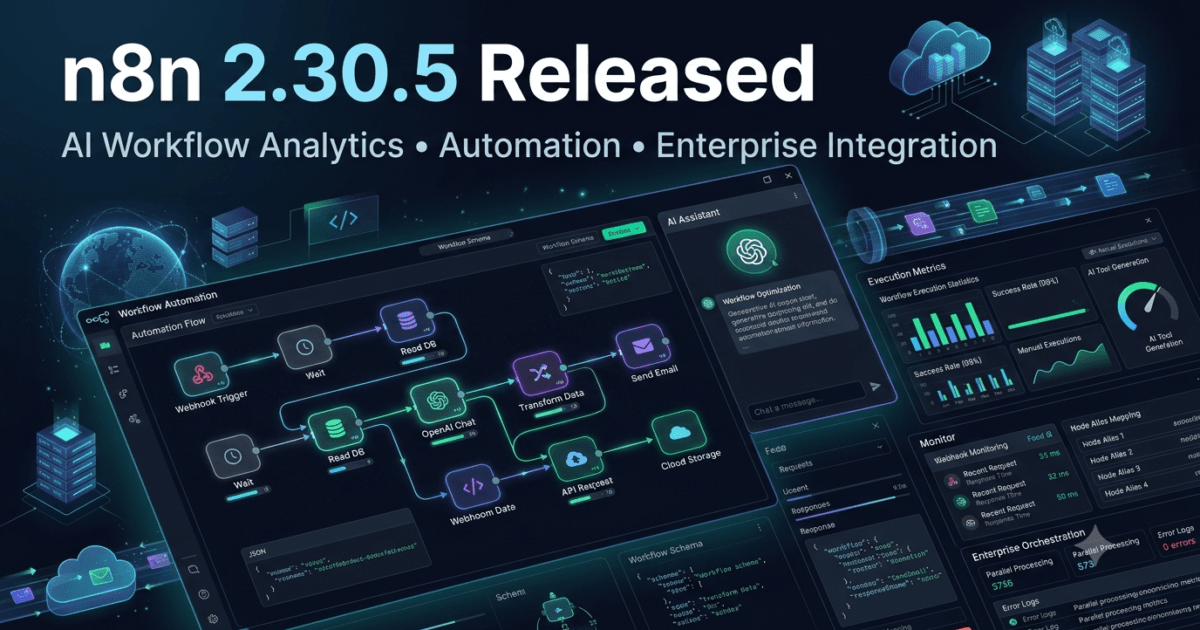
The n8n team has released n8n 2.30.5 on July 15, 2026, delivering another focused update that improves the platform’s growing AI automation capabilities while refining workflow development inside the editor. Although this is a relatively small release in terms of changelog size, it targets several areas that are becoming increasingly important as organizations adopt AI-powered workflow automation, LLM integrations, and agentic business processes.
Unlike feature-heavy releases that introduce entirely new nodes or integrations, n8n 2.30.5 concentrates on improving the overall developer experience, AI workflow analytics, and workflow consistency. These enhancements make the platform more predictable for enterprise deployments where hundreds or even thousands of automated workflows execute every day.
For QA Engineers, SDETs, Automation Engineers, DevOps Engineers, AI Engineers, Platform Teams, Solution Architects, and Workflow Developers, these updates help improve testing accuracy, workflow maintainability, and AI-driven automation reliability without introducing breaking changes.
As AI workflows become more common across customer support, document processing, software delivery, infrastructure automation, and enterprise integrations, maintaining accurate execution metrics and preserving workflow configurations becomes increasingly valuable. This release directly supports those long-term platform goals.
Official Release Highlights
According to the official release notes, n8n 2.30.5 introduces two important bug fixes alongside one experimental editor enhancement.
Bug Fixes
- Core: Count AI Assistant workflow test runs as manual executions in workflow statistics.
- Core: Preserve node aliases when generating AI tool variants.
New Feature
- Editor: Introduce the n8n Credits credential selection experiment within the workflow editor.
Although the changelog is concise, these improvements strengthen the AI workflow ecosystem and improve the experience of designing, testing, and maintaining intelligent automation pipelines.
n8n 2.30.5 Release Overview
| Category | Details |
|---|---|
| Version | n8n 2.30.5 |
| Release Date | July 15, 2026 |
| Release Type | Maintenance + Minor Feature Update |
| Breaking Changes | None Reported |
| AI Assistant Improvements | Yes |
| Editor Improvements | Yes |
| Workflow Compatibility | Fully Compatible |
| Upgrade Recommendation | Recommended |
Why This Release Matters
The direction of modern workflow automation is changing rapidly.
Organizations are no longer building workflows that simply move data between applications. Instead, they are creating intelligent automation systems capable of:
- AI Agent orchestration
- LLM-powered decision making
- Automated document understanding
- Multi-step reasoning workflows
- Human-in-the-loop approvals
- Autonomous customer service
- AI-assisted software delivery
- Business process automation
- Enterprise knowledge retrieval
- Multi-agent collaboration
As these systems become more sophisticated, developers need better tooling for testing AI workflows, tracking execution behavior, and maintaining increasingly complex workflow definitions.
The improvements delivered in n8n 2.30.5 directly contribute to these goals by making AI workflow development more transparent and easier to manage.
AI Assistant Workflow Statistics Become More Accurate
One of the most valuable improvements in this release is the way AI Assistant workflow test runs are counted.
Previously, AI Assistant testing sessions were not always reflected consistently within workflow execution statistics. This could make it more difficult for teams to understand how frequently workflows were being tested during development.
With n8n 2.30.5, AI Assistant workflow test executions are now correctly counted as manual executions.
For development teams, this provides several practical advantages:
- More accurate workflow usage metrics
- Better visibility into developer testing activity
- Improved execution reporting
- More reliable workflow analytics
- Easier monitoring of AI workflow adoption
Organizations building AI-powered automation platforms benefit from clearer operational insights that support capacity planning and workflow optimization.
Node Alias Preservation Improves Workflow Maintainability
Another significant improvement focuses on node aliases.
As workflows grow larger, developers often rely on aliases to make complex automation easier to understand. Clear naming conventions improve readability, simplify debugging, and reduce maintenance effort.
Prior to this release, generating AI tool variants could occasionally affect existing node aliases.
Version 2.30.5 preserves these aliases throughout the generation process.
For enterprise automation teams, this means:
- Better workflow readability
- Reduced manual cleanup
- Improved collaboration between developers
- Easier troubleshooting
- More maintainable AI workflows
This enhancement may appear minor, but it becomes increasingly valuable in environments where workflows contain dozens or even hundreds of interconnected nodes.
New n8n Credits Credential Experiment
The only new feature introduced in this release is an experimental credential selection mechanism for n8n Credits inside the workflow editor.
Although marked as experimental, this feature demonstrates n8n’s ongoing investment in improving the developer experience for AI-powered workflows.
The updated editor experience aims to provide:
- Simplified credential selection
- Cleaner workflow configuration
- Improved onboarding
- Better usability for AI services
- Future-ready credential management
As n8n continues expanding its AI ecosystem, editor enhancements like these help streamline workflow creation while reducing configuration errors.
What This Means for QA Engineers
For software quality professionals, n8n 2.30.5 reinforces the importance of validating not only workflow outputs but also the surrounding developer experience and operational metadata.
QA Engineers should pay particular attention to:
- AI Assistant execution statistics
- Manual execution reporting
- Node alias preservation
- Workflow generation consistency
- AI tool variants
- Credential selection behavior
- Existing workflow compatibility
- Regression testing across editor functionality
While none of these changes alter workflow logic directly, they improve the overall reliability and maintainability of AI-driven automation projects.
Comparison with n8n 2.30.4
| Capability | n8n 2.30.4 | n8n 2.30.5 |
|---|---|---|
| Workflow Stability | Improved | Further Improved |
| AI Assistant Statistics | Standard | More Accurate |
| Node Alias Preservation | Standard | Improved |
| Editor Features | Stable | Credits Credential Experiment |
| Workflow Compatibility | Excellent | Excellent |
| Breaking Changes | None | None |
Upgrade Commands
Docker
docker pull n8nio/n8n:latest
docker compose up -d
npm
npm install n8n@latest
Existing Docker Compose Deployment
docker compose pull
docker compose up -d
After upgrading, QA teams should execute regression tests covering AI Assistant workflows, manual execution statistics, node alias generation, credential configuration, webhook execution, API integrations, scheduled workflows, and enterprise automation scenarios.
Upgrade Recommendation
Based on the official release notes, n8n 2.30.5 is a safe and recommended upgrade for organizations already running the 2.30.x release series.
There are no reported breaking changes, and the improvements primarily enhance workflow analytics, AI workflow generation, editor usability, and long-term maintainability. Teams actively developing AI-powered automations will benefit the most, particularly those using the AI Assistant and workflow generation features on a daily basis.
Although this is a maintenance-focused release, its refinements contribute to a smoother development experience and more reliable operational insights, making it a worthwhile update for enterprise automation platforms.
Enterprise Upgrade Strategy for n8n 2.30.5
Although n8n 2.30.5 is classified as a maintenance release with one experimental editor enhancement, enterprise teams should still follow a structured deployment strategy. Workflow automation platforms frequently execute thousands of business-critical processes every day, including AI agent orchestration, customer onboarding, CRM synchronization, ERP integrations, cloud infrastructure automation, API orchestration, and document processing. Even minor updates affecting workflow statistics or AI tooling should be validated thoroughly before reaching production.
A controlled deployment process minimizes operational risk while ensuring existing workflows continue functioning as expected.
A recommended rollout plan includes:
- Upgrade a dedicated development environment to n8n 2.30.5.
- Validate AI Assistant workflow creation and execution.
- Execute smoke tests covering business-critical workflows.
- Perform a complete regression suite for production workflows.
- Verify manual execution statistics and workflow analytics.
- Test webhook-triggered workflows and scheduled executions.
- Validate node alias preservation after AI tool generation.
- Review the new n8n Credits credential experiment if enabled.
- Deploy to staging for user acceptance testing.
- Roll out gradually to production while monitoring workflow health, execution success rates, and logs for the first 24–48 hours.
Following this approach provides confidence that automation pipelines remain stable while benefiting from the latest improvements.
QA Regression Testing Checklist
After upgrading to n8n 2.30.5, QA Engineers should validate both functional workflows and editor-related enhancements.
| Test Area | Validation Required |
|---|---|
| Workflow Execution | Verify all existing workflows complete successfully |
| AI Assistant | Confirm workflow test runs are counted as manual executions |
| Execution Statistics | Validate reporting accuracy and execution history |
| Node Alias Generation | Ensure aliases remain unchanged when creating AI tool variants |
| Webhook Workflows | Test synchronous and asynchronous webhook executions |
| Scheduled Workflows | Validate Cron and time-based automations |
| AI Agent Workflows | Verify prompts, memory, and tool integrations |
| API Integrations | Test REST, GraphQL, OAuth, and authenticated APIs |
| Credential Management | Validate existing credentials and experimental Credits selection |
| Notion, Slack, Jira & CRM Nodes | Ensure third-party integrations remain operational |
| Workflow Sharing | Verify permissions and execution visibility |
| Error Handling | Confirm graceful recovery from failed executions |
Completing this regression checklist helps identify compatibility issues before production deployment.
Real-World Impact for AI Workflow Automation
The improvements in n8n 2.30.5 are particularly valuable for organizations building AI-native automation systems. Accurate workflow statistics and preserved node aliases contribute to better observability, easier maintenance, and improved collaboration across development teams.
Typical enterprise use cases include:
- AI-powered customer support workflows
- Multi-agent business automation
- Knowledge retrieval pipelines
- Document intelligence systems
- Sales and CRM automation
- Incident management workflows
- DevOps deployment pipelines
- Marketing automation
- HR onboarding processes
- Finance approval workflows
- Internal AI assistants
- Cross-platform API orchestration
As workflows become increasingly sophisticated, maintaining consistency in workflow configuration becomes just as important as adding new features. The alias preservation improvement is especially useful for large teams maintaining shared automation repositories.
Best Practices After Upgrading
Monitor AI Workflow Analytics
Since AI Assistant test runs are now included in manual execution statistics, review your dashboards after upgrading.
Monitor:
- Manual execution counts
- Workflow execution frequency
- AI Assistant testing activity
- Failed execution trends
- Workflow duration
- Queue performance
Improved analytics provide better visibility into development and testing activity.
Maintain Clear Workflow Naming Conventions
Continue using descriptive node aliases throughout your workflows.
Examples include:
- Customer Validation
- Generate Invoice
- AI Classification
- Slack Notification
- Approval Gateway
With alias preservation improved in this release, readable naming conventions become even more valuable for long-term maintenance.
Expand Regression Automation
Automated regression suites should validate:
- Workflow outputs
- API responses
- AI prompt execution
- Tool invocation
- Error recovery
- Retry mechanisms
- Credential resolution
- Node generation behavior
This reduces deployment risk and accelerates future upgrades.
Review Experimental Features Carefully
The new n8n Credits credential selection experiment is intended to improve future workflow configuration. Before enabling experimental functionality in production, evaluate it in isolated development or staging environments and confirm compatibility with your organization’s governance and security policies.
Should You Upgrade?
Yes.
For organizations already running the 2.30.x release series, n8n 2.30.5 is a recommended maintenance update.
While it does not introduce major workflow capabilities, it improves several areas that directly impact enterprise development:
- More accurate AI Assistant workflow statistics
- Better preservation of workflow node aliases
- Improved editor experience through an experimental credential selection feature
- Continued platform stability with no reported breaking changes
Teams actively building AI-driven workflows or maintaining large automation libraries will benefit the most from these refinements.
Final Thoughts
The value of n8n 2.30.5 lies not in a long feature list but in its attention to the details that make enterprise automation platforms more reliable and easier to maintain. Accurate execution metrics improve reporting, preserved node aliases reduce maintenance overhead, and editor enhancements demonstrate the platform’s ongoing investment in AI-first workflow development.
For QA Engineers, SDETs, Automation Engineers, DevOps professionals, and Platform Architects, this release reinforces an important principle: small maintenance updates often have a significant impact on day-to-day productivity and operational stability. By improving workflow analytics and protecting existing configurations, n8n continues to strengthen its position as a leading platform for intelligent workflow automation.
Organizations using n8n to orchestrate AI agents, automate business processes, or integrate cloud services should plan to adopt n8n 2.30.5 as part of their regular maintenance cycle after completing a structured validation process.
Internal Links
- n8n 2.30.4 Improves Workflow Reliability, Webhook Stability, and Notion Integration for Enterprise Automation
- n8n 2.29.10 Released — What’s New for QA Engineers
- n8n 2.29.9 Released: Strengthening Enterprise AI Automation for Modern QA Teams
- n8n 2.29.8 Released: Enterprise Workflow Stability Gets Even Stronger for QA Engineers
- n8n 2.29.7 Released: AI Workflow Stability Improvements Every QA Engineer Should Know
- n8n 2.28.6 Released: Critical Stability Fixes Every QA Engineer Should Know
- n8n 2.28.7 Released: Critical Dependency Fix Every QA Engineer Should Know
- n8n 2.28.3 Released: Startup Reliability Improvements Every QA Engineer Should Know
- n8n 2.27.4 Released: Essential Workflow Improvements Every QA Engineer Should Know
Official Resources
- Official Documentation: https://docs.n8n.io
- Official Release Notes: https://github.com/n8n-io/n8n/releases#release-n8n@2.30.5
People Asked Questions
Is n8n 2.30.5 a major release?
No. It is a maintenance release that introduces workflow analytics improvements, node alias preservation, and one experimental editor enhancement.
Are there any breaking changes?
No. The official release notes report no breaking changes.
What is the biggest improvement?
The most significant change is that AI Assistant workflow test runs are now correctly counted as manual executions, improving workflow analytics and reporting accuracy.
Does this release affect existing workflows?
Existing workflows should continue functioning normally. The node alias preservation fix actually improves backward compatibility for AI-generated workflow variants.
Should enterprise teams upgrade immediately?
Yes, after completing normal regression testing. The release is low risk and provides meaningful improvements for AI workflow development and enterprise automation.
Continue Learning with QAPulse by SK
Modern automation is evolving beyond simple workflow builders into intelligent ecosystems powered by AI agents, LLMs, Model Context Protocol (MCP), API orchestration, and cloud-native automation platforms. At QAPulse by SK, we help QA Engineers, SDETs, Automation Engineers, and AI developers stay ahead with expert release analyses, enterprise migration guides, hands-on tutorials, framework comparisons, and best practices covering n8n, Playwright, Selenium, FastAPI, Docker, Node.js, CrewAI, LangChain, Locust, k6, and the latest innovations in AI engineering.
Whether you’re building scalable enterprise workflows, validating AI-powered automation, or modernizing your software testing strategy, QAPulse by SK delivers practical insights to help you create more reliable, maintainable, and future-ready automation solutions.