 QA
QA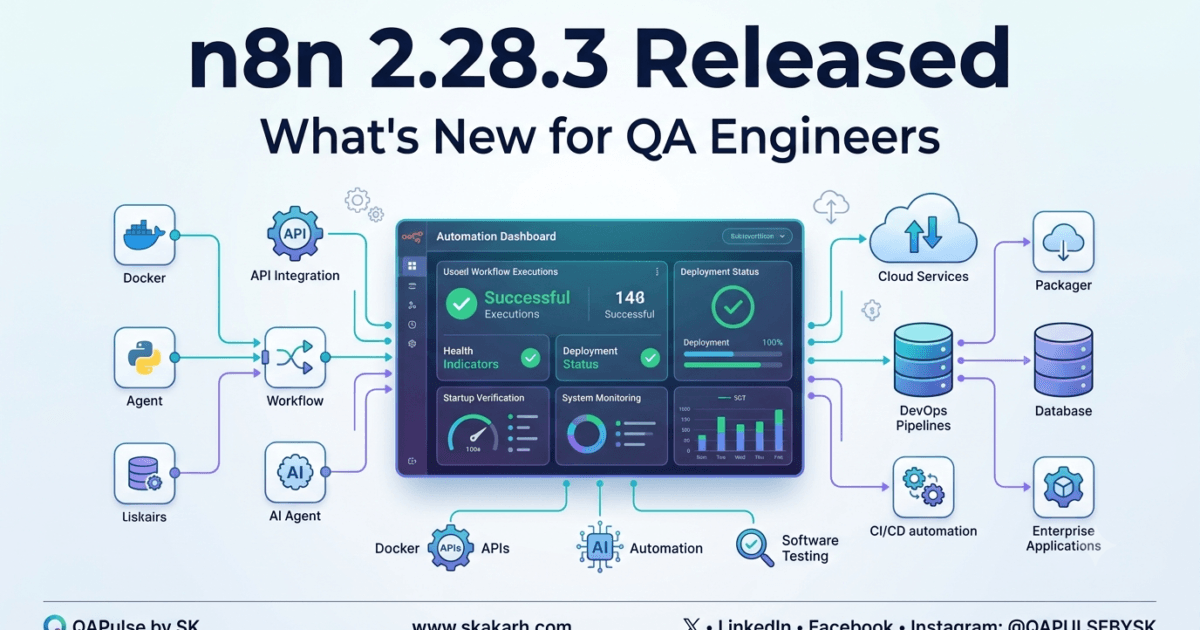
n8n 2.28.3 Released: Small Patch, Big Impact on Workflow Reliability
Not every software release introduces groundbreaking features. Some of the most valuable updates are the ones that quietly eliminate issues capable of disrupting production environments, delaying CI/CD pipelines, or preventing automation platforms from starting altogether.
That is exactly the purpose of n8n 2.28.3.
This maintenance release contains a single bug fix, but it addresses an issue that could prevent an n8n instance from starting when community packages were only partially installed. While this may sound like an uncommon edge case, enterprise automation platforms frequently install, update, and remove community nodes during development, testing, and deployment. Any interruption during these processes can leave packages in an inconsistent state.
Instead of failing gracefully, previous versions could encounter startup problems, resulting in downtime for workflow automation services.
For QA engineers, SDETs, DevOps teams, and platform administrators, reliability improvements like this are often more valuable than new features because they improve operational stability without requiring workflow changes or migration efforts.
The best news is that n8n 2.28.3 introduces no new functionality and no breaking changes, making it an ideal maintenance upgrade for teams running production automation environments.
What’s New in n8n 2.28.3?
According to the official release notes, this version includes one targeted bug fix:
Bug Fix
- Core: Prevent startup failure caused by partially installed community packages.
Although the changelog is brief, the issue affects one of the most critical stages of any automation platform—application startup.
If the orchestration engine cannot initialize successfully, every workflow, scheduled automation, webhook, and integration depending on that instance becomes unavailable.
This release focuses entirely on improving platform resilience during initialization.
Release Highlights of n8n 2.28.3
| Component | Improvement | Impact for QA Teams |
|---|---|---|
| Core Platform | Prevent startup failures caused by partially installed community packages | Improves platform reliability during upgrades and package management |
| Stability | Better handling of inconsistent package states | Reduces downtime after interrupted installations |
| Enterprise Operations | More resilient startup sequence | Improves reliability of CI/CD and workflow automation environments |
| Compatibility | No breaking changes | Safe maintenance upgrade for existing deployments |
Understanding the Startup Issue
Community packages are one of n8n’s biggest strengths. They allow teams to extend the platform with custom nodes that integrate with proprietary systems, internal APIs, AI platforms, cloud services, databases, messaging platforms, and third-party applications.
However, package installation is not always perfect.
In enterprise environments, installations can be interrupted due to:
- Network connectivity problems
- Container restarts
- Pipeline failures
- Permission issues
- Storage interruptions
- Manual deployment cancellations
These situations may leave a package only partially installed.
Prior to n8n 2.28.3, this inconsistent package state could prevent the platform from completing its startup process.
Instead of loading available workflows while reporting the faulty package, the application could fail to initialize entirely.
Version 2.28.3 improves how the platform handles these incomplete installations, allowing startup to proceed more reliably and reducing the operational impact of failed package deployments.
Why This release of n8n 2.28.3 Matters for QA Engineers
From a testing perspective, startup reliability is one of the most overlooked quality attributes.
Automation platforms like n8n frequently serve as orchestration layers connecting dozens of services including REST APIs, databases, messaging queues, AI agents, cloud storage, notification systems, and business applications.
When the platform itself cannot start, testing activities quickly come to a halt.
A startup failure can interrupt:
- Automated regression testing
- Scheduled API validation
- AI workflow execution
- Integration testing
- CI/CD automation
- Test data preparation
- Monitoring workflows
- Deployment verification
For QA engineers responsible for maintaining automation infrastructure, eliminating a single startup failure scenario can significantly improve system availability and reduce recovery time after failed deployments.
Rather than introducing new capabilities, this release strengthens the reliability of the platform itself—a quality improvement that benefits every workflow running on top of n8n.
What n8n 2.28.3 Means for QA Engineers
At first glance, n8n 2.28.3 may appear to be a routine maintenance release with only a single bug fix. However, experienced QA engineers know that the most disruptive production incidents are often caused by reliability issues rather than missing features.
Automation platforms are expected to run continuously, orchestrating API calls, executing regression workflows, synchronizing cloud services, triggering AI agents, and integrating with dozens of third-party systems. If the platform fails to start because of a partially installed extension, the impact extends far beyond one failed package—it can halt entire testing pipelines.
This release addresses that operational risk by making startup more resilient when community packages are left in an incomplete installation state.
For organizations using n8n as part of their CI/CD pipeline, test automation framework, or AI workflow orchestration platform, this improvement reduces unnecessary downtime and increases confidence during upgrades.
Although there are no new workflow features, the stability improvements alone make this update worthwhile for production deployments.
Enterprise Impact
Many enterprise teams rely heavily on community nodes to integrate n8n with internal systems and external SaaS platforms.
Typical examples include:
- AI agent orchestration
- CRM automation
- ERP integrations
- Internal REST APIs
- Slack and Microsoft Teams notifications
- GitHub and GitLab automation
- Database synchronization
- Cloud storage workflows
As the number of installed community packages grows, so does the likelihood of interrupted installations during upgrades or deployments.
Version 2.28.3 helps reduce the operational impact of these scenarios by improving how n8n handles partially installed packages during initialization.
For platform administrators, this translates into:
- Better service availability
- Fewer deployment failures
- More resilient automation infrastructure
- Reduced operational maintenance
Should You Upgrade n8n 2.28.3?
Yes.
Although this is a maintenance release, it is highly recommended for teams running production n8n environments.
The update:
- Improves platform startup reliability.
- Requires no workflow migration.
- Introduces no breaking changes.
- Carries very low upgrade risk.
- Benefits organizations using community nodes.
If your environment regularly installs custom nodes or community packages, upgrading should be considered a standard maintenance task.
Regression Testing Checklist
Before upgrading production environments, validate the following:
- Existing workflows execute successfully.
- Community packages load correctly.
- Scheduled workflows continue running.
- Webhook triggers remain functional.
- API credentials are preserved.
- Docker containers start normally.
- Existing AI agent workflows complete successfully.
- CI/CD automation jobs execute without interruption.
- Workflow execution history remains accessible.
- Logging and monitoring continue reporting correctly.
Completing these checks ensures the platform remains stable after the upgrade.
How to Upgrade
Upgrade n8n
npm install n8n@latest
For Docker deployments:
docker pull n8nio/n8n:latest
docker compose up -d
After upgrading, restart the instance and verify that all workflows initialize successfully.
Internal Links
- How Postman’s AI Evolution Is Turning API Collections into Autonomous Testing Systems
- Pytest AI in 2026: The Rise of Autonomous, Self-Healing Test Runners
- How I Used GPT-5 to Auto-Generate Pytest API Tests from a Swagger File
Official Resources
- Official Release Notes: https://github.com/n8n-io/n8n/releases/tag/n8n%402.28.3
- Official Documentation: https://docs.n8n.io
Final Verdict
n8n 2.28.3 is a reliability-focused maintenance release that production teams should not overlook.
While the changelog contains only a single fix, it addresses an issue capable of preventing the entire automation platform from starting when community packages are only partially installed. For organizations relying on n8n to orchestrate testing pipelines, AI agents, business processes, or enterprise integrations, improved startup resilience directly contributes to higher platform availability and fewer deployment interruptions.
This is not a feature release—it is a stability release. Those are often the updates that deliver the greatest long-term value.
Recommendation: Upgrade during your next maintenance window. The update is low risk, requires no workflow migration, and strengthens the operational reliability of production environments.
Frequently Asked Questions
Does n8n 2.28.3 introduce new features?
No. This release focuses exclusively on fixing a startup reliability issue related to partially installed community packages.
Are there any breaking changes?
No. The official release notes do not report any breaking changes or required migration steps.
Who benefits most from this update?
Teams running production n8n instances, especially those using community nodes, custom integrations, or automated deployment pipelines.
Should QA teams upgrade immediately?
Yes. Since the release is low risk and improves platform stability, it is recommended for most production environments after completing standard regression testing.
Continue Learning
Explore more expert articles on n8n, MCP, CrewAI, LangChain, Playwright, Selenium, FastAPI, AI Agents, Test Automation, and Software Engineering at www.skakarh.com.
QAPulse by SK provides practical release analysis, migration guidance, enterprise testing strategies, and AI engineering insights to help QA professionals stay ahead of the rapidly evolving automation landscape.