 QA
QA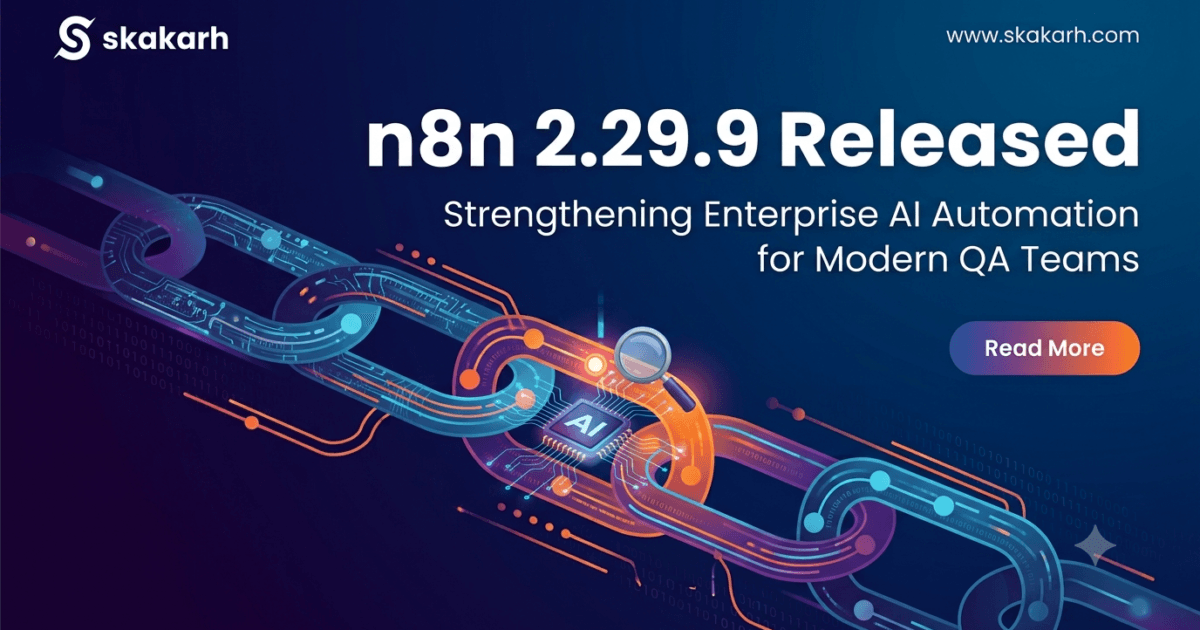
n8n 2.29.9 Released: Why Every QA Engineer Should Pay Attention
Automation platforms have evolved far beyond connecting applications through simple drag-and-drop workflows. Modern automation solutions are now responsible for orchestrating AI agents, Model Context Protocol (MCP) servers, Retrieval-Augmented Generation (RAG) pipelines, enterprise APIs, cloud infrastructure, business intelligence platforms, customer relationship management systems, and intelligent decision-making workflows. As organizations increasingly rely on AI-powered automation to drive mission-critical business operations, the reliability of the automation platform becomes just as important as the quality of the applications it connects.
That is why every n8n maintenance release deserves careful evaluation—even when the official changelog appears small.
Released on July 9, 2026, n8n 2.29.9 continues the platform’s steady commitment to improving reliability, operational consistency, and long-term maintainability. While this release does not introduce major user-facing capabilities or new workflow nodes, it represents another important milestone in strengthening one of the fastest-growing workflow automation platforms in the AI ecosystem.
Experienced QA engineers understand that production incidents rarely occur because a platform lacks new features. Instead, they are usually caused by hidden compatibility issues, inconsistent execution behavior, integration failures, dependency conflicts, or workflow reliability problems that surface only under production workloads. Maintenance releases are specifically designed to reduce these risks before they impact customers.
For organizations operating hundreds or even thousands of automated workflows, incremental stability improvements often generate far greater business value than introducing another experimental feature.
For QA Engineers, SDETs, Test Automation Architects, DevOps Engineers, Platform Engineers, AI Developers, Solution Architects, and Enterprise Automation Teams, n8n 2.29.9 represents another recommended production update that continues improving the maturity and stability of the platform.
What’s New in n8n 2.29.9?
According to the official release information, n8n 2.29.9 was released on July 9, 2026.
Unlike feature-focused releases, version 2.29.9 is primarily a maintenance update intended to keep the platform stable, reliable, and production-ready as the automation ecosystem continues to evolve.
Although the official release notes do not list detailed feature additions or bug fixes, maintenance releases like this typically focus on areas such as:
- Overall workflow execution stability.
- Internal platform reliability.
- Dependency maintenance.
- Platform consistency.
- Improved compatibility with the latest ecosystem packages.
- Long-term maintainability of enterprise automation environments.
For engineering teams, these updates help reduce operational risk while ensuring that automation platforms remain dependable under real-world workloads.
Release Highlights
| Component | Improvement | Why It Matters |
|---|---|---|
| Platform Stability | Ongoing maintenance improvements | Improves long-term workflow reliability |
| Workflow Engine | Internal refinements | More predictable automation execution |
| Enterprise Readiness | Continued platform hardening | Better support for production workloads |
| AI Automation | Stable foundation for intelligent workflows | Improves confidence in AI-powered automations |
| Breaking Changes | None reported | Safe maintenance upgrade for existing deployments |
Why Maintenance Releases Matter More Than Feature Releases
One of the biggest misconceptions in software engineering is that only major releases deserve attention.
In reality, experienced automation teams often place greater importance on maintenance releases because they improve the characteristics that directly affect production success:
- Stability.
- Predictability.
- Compatibility.
- Performance consistency.
- Operational resilience.
- Reduced technical debt.
Consider an enterprise organization running thousands of automated workflows every day.
Those workflows may include:
- AI agents.
- Customer onboarding.
- Payment processing.
- Infrastructure provisioning.
- Incident response.
- Document approvals.
- ERP synchronization.
- CRM automation.
- Cloud deployments.
- Software release orchestration.
A single workflow failure can trigger delayed business operations, customer dissatisfaction, manual intervention, or even financial loss.
Maintenance releases reduce the probability of these incidents by continuously strengthening the platform underneath existing workflows.
This is precisely why mature engineering organizations treat maintenance upgrades as part of their regular operational strategy rather than optional updates.
n8n Continues to Lead the AI Automation Revolution
Over the past year, n8n has rapidly transformed from a traditional workflow automation platform into one of the leading ecosystems for AI-native automation.
Modern n8n deployments now integrate technologies including:
- Large Language Models (LLMs).
- AI Agents.
- MCP Servers.
- LangChain.
- CrewAI.
- OpenAI.
- Anthropic Claude.
- Google Gemini.
- Vector databases.
- Enterprise SaaS applications.
- Cloud infrastructure.
- Custom APIs.
Instead of simply connecting applications together, organizations now use n8n to build intelligent automation systems capable of making decisions, orchestrating multiple AI services, and automating complex business processes with minimal human intervention.
As the platform expands into enterprise AI engineering, maintaining a stable workflow engine becomes increasingly important.
Every maintenance release contributes to that long-term vision.
Why QA Engineers Should Care About n8n 2.29.9
Quality Assurance has changed dramatically over the last few years.
Modern QA teams no longer validate only web applications or REST APIs.
Today’s automation engineers increasingly test:
- AI-powered workflows.
- Multi-agent systems.
- Intelligent document processing.
- Enterprise integrations.
- Cloud automation.
- Business process orchestration.
- Event-driven architectures.
- Low-code automation platforms.
- API ecosystems.
- Continuous deployment pipelines.
Every one of these systems depends on the reliability of the automation platform executing the workflow.
A stable automation engine provides several important benefits:
- More reliable regression testing.
- Reduced workflow failures.
- Faster production deployments.
- Lower maintenance costs.
- Higher confidence in automation.
- Improved operational efficiency.
For organizations building AI-powered enterprise workflows, n8n 2.29.9 continues strengthening that foundation, ensuring that QA teams can focus on validating business logic instead of troubleshooting platform instability.
What n8n 2.29.9 Means for QA Engineers
At first glance, n8n 2.29.9 may appear to be a quiet maintenance release. The official release notes provide minimal information and introduce no headline features. However, experienced QA engineers understand that the value of a release cannot be measured solely by the number of new capabilities it introduces. In production software engineering, stability, predictability, and operational consistency are often far more valuable than adding another feature.
As enterprise organizations increasingly depend on AI-powered automation, every workflow engine becomes part of the production infrastructure. Even a minor issue inside the automation platform can interrupt dozens of interconnected business processes, delay deployments, or affect customer-facing services.
This is why maintenance releases like n8n 2.29.9 deserve serious attention.
Rather than expanding functionality, this release continues n8n’s strategy of refining the platform’s core reliability. These incremental improvements may not be immediately visible to end users, but they play a significant role in reducing technical debt, improving long-term maintainability, and strengthening the platform that powers thousands of enterprise automation workflows.
For QA engineers, these improvements translate into fewer unexpected automation failures, greater confidence in regression testing, and a more dependable environment for validating increasingly complex AI-driven business processes.
Enterprise Impact
Enterprise workflow automation has evolved into one of the most business-critical layers of modern software architecture.
Organizations no longer use n8n simply to connect two APIs.
Today, n8n orchestrates complete digital ecosystems involving:
- AI Agents
- Model Context Protocol (MCP) Servers
- LangChain applications
- CrewAI multi-agent workflows
- Retrieval-Augmented Generation (RAG) pipelines
- Customer onboarding systems
- CRM synchronization
- ERP integrations
- Cloud infrastructure automation
- Security operations
- CI/CD deployments
- Business intelligence reporting
- Financial workflows
- HR automation
- Marketing automation
- IT service management
Many enterprises execute tens of thousands of workflow runs every day, with individual workflows coordinating dozens of external services simultaneously.
When an automation platform experiences instability, the consequences can include:
- Interrupted customer journeys.
- Failed AI workflows.
- Delayed software releases.
- Incomplete business transactions.
- Increased operational costs.
- Manual recovery efforts.
- Reduced engineering productivity.
Even if the official release notes appear modest, every maintenance update contributes toward making these enterprise workflows more reliable and resilient.
That long-term reliability is precisely what organizations expect from a mature automation platform.
AI Automation Continues to Mature
One of the most exciting developments across the automation industry has been the rapid convergence of workflow automation and Artificial Intelligence.
Platforms like n8n are no longer limited to connecting applications—they are becoming orchestration engines for intelligent software systems.
Modern AI workflows increasingly combine:
- Large Language Models (LLMs)
- AI Agents
- Tool calling
- Function execution
- Vector databases
- MCP Servers
- External APIs
- Human approval workflows
- Memory systems
- Multi-agent collaboration
Each workflow may involve multiple AI providers including OpenAI, Anthropic Claude, Google Gemini, Azure OpenAI, or self-hosted language models.
As workflow complexity increases, the stability of the orchestration platform becomes increasingly important.
A dependable workflow engine ensures:
- Consistent execution.
- Predictable workflow behavior.
- Better recovery from failures.
- Lower operational risk.
- Improved observability.
- Easier troubleshooting.
- More reliable AI automation.
Maintenance releases like n8n 2.29.9 quietly strengthen these foundational capabilities, allowing organizations to scale AI adoption with greater confidence.
Why This Release Matters for DevOps and Platform Engineering
Modern DevOps teams rely heavily on automation.
Typical automation responsibilities include:
- Infrastructure provisioning.
- Deployment pipelines.
- Environment management.
- Secrets management.
- Cloud resource orchestration.
- Monitoring automation.
- Incident response.
- Backup validation.
- Compliance reporting.
- Release orchestration.
The workflow engine becomes a critical dependency for nearly every operational process.
Improving platform stability reduces:
- Pipeline interruptions.
- Infrastructure failures.
- Unexpected workflow errors.
- Operational downtime.
- Manual intervention.
- Deployment risk.
Although these improvements may not appear in feature announcements, they deliver measurable value throughout the software delivery lifecycle.
Should You Upgrade?
Yes.
Although n8n 2.29.9 is primarily a maintenance release, it represents the type of update that enterprise engineering teams should adopt after completing standard validation.
Reasons to upgrade include:
- Continued platform stability improvements.
- Better workflow execution consistency.
- Stronger enterprise reliability.
- Improved long-term maintainability.
- Safe production maintenance release.
- No reported breaking changes.
- Recommended for AI workflow environments.
- Compatible with existing automation projects.
- Supports long-term platform health.
- Low-risk upgrade for production deployments.
Organizations running business-critical workflows should remain current with maintenance releases to benefit from continuous platform refinement.
Regression Testing Checklist
Before deploying n8n 2.29.9, QA teams should validate:
- Existing production workflows.
- AI Agent automation.
- MCP integrations.
- LangChain workflows.
- CrewAI orchestration.
- REST API integrations.
- Database operations.
- Webhook processing.
- Authentication flows.
- Workflow retries.
- Scheduled workflows.
- Error handling logic.
- Notification pipelines.
- Docker deployments.
- Kubernetes environments.
- CI/CD automation.
- Community node compatibility.
- Existing custom nodes.
- Performance under concurrent execution.
- End-to-end regression suites.
Executing these regression scenarios helps ensure that maintenance updates integrate smoothly into production automation environments without introducing unintended side effects.
How to Upgrade
Upgrade Using npm
npm install -g n8n@latest
Upgrade Docker Deployment
docker pull n8nio/n8n:latest
docker compose up -d
Verify Installed Version
n8n --version
After upgrading, execute representative production workflows, validate AI integrations, rerun smoke tests, verify scheduled automations, and complete a full regression cycle before promoting the release across production environments.
Internal Links
- n8n 2.29.8 Released: Enterprise Workflow Stability Gets Even Stronger for QA Engineers
- n8n 2.29.7 Released: AI Workflow Stability Improvements Every QA Engineer Should Know
- n8n 2.28.6 Released: Critical Stability Fixes Every QA Engineer Should Know
- n8n 2.28.7 Released: Critical Dependency Fix Every QA Engineer Should Know
- n8n 2.28.3 Released: Startup Reliability Improvements Every QA Engineer Should Know
- n8n 2.27.4 Released: Essential Workflow Improvements Every QA Engineer Should Know
Official Resources
- Official Documentation: https://docs.n8n.io
- Official Release Notes: https://github.com/n8n-io/n8n/releases/tag/n8n%402.28.7
Final Verdict
n8n 2.29.9 demonstrates an important principle of enterprise software engineering: mature platforms are built through continuous refinement rather than constant feature expansion. While this release introduces no major user-facing functionality, it reinforces the stability, consistency, and operational maturity that organizations expect from a production-grade automation platform.
For QA engineers, SDETs, DevOps teams, Platform Engineers, AI Developers, and Enterprise Architects, the greatest benefit lies in maintaining a dependable automation foundation capable of supporting increasingly sophisticated AI workflows and business-critical integrations. As organizations continue adopting AI Agents, MCP Servers, RAG pipelines, and intelligent workflow orchestration, platform reliability becomes a competitive advantage rather than just a technical requirement.
Recommendation: Upgrade to n8n 2.29.9 after completing your standard regression validation. It is a low-risk, production-ready maintenance release that strengthens the platform’s reliability while helping enterprise teams build more stable, scalable, and future-ready automation ecosystems.
Frequently Asked Questions
Does n8n 2.29.9 introduce breaking changes?
No. The official release information does not report any breaking changes. This release is intended as a maintenance update focused on platform stability.
Should enterprise teams upgrade immediately?
Yes. After validating the release in a staging environment, enterprise teams should upgrade to benefit from ongoing platform improvements and maintain compatibility with the latest n8n ecosystem.
Will existing workflows require modifications?
In most cases, no. Existing workflows should continue operating normally, making this a straightforward maintenance upgrade for production deployments.
Why are maintenance releases important for automation platforms?
Maintenance releases improve workflow reliability, reduce operational risk, strengthen platform stability, improve compatibility, and help organizations maintain dependable automation systems over the long term.
n8n 2.29.9 Released: Key Takeaways
n8n 2.29.9 Released continues the platform’s focus on enterprise reliability, operational stability, and long-term maintainability. Although this release does not introduce new workflow features, it reinforces the automation engine that powers AI Agents, MCP Servers, enterprise integrations, cloud infrastructure, and intelligent business workflows. For QA engineers, SDETs, DevOps professionals, and enterprise automation teams, upgrading to n8n 2.29.9 is a sensible investment that supports more reliable regression testing, stronger workflow execution, improved operational confidence, and a solid foundation for future AI-driven automation initiatives.
Continue Learning
Explore more expert articles on n8n, LangChain, CrewAI, MCP Servers, AI Agents, LlamaIndex, Docker, FastAPI, Playwright, Cypress, Test Automation, DevOps, and Software Engineering at www.skakarh.com.
QAPulse by SK delivers expert release analysis, AI engineering insights, enterprise automation strategies, migration guidance, DevOps best practices, and practical testing knowledge to help software professionals build scalable, intelligent, and production-ready software systems.