 QA
QA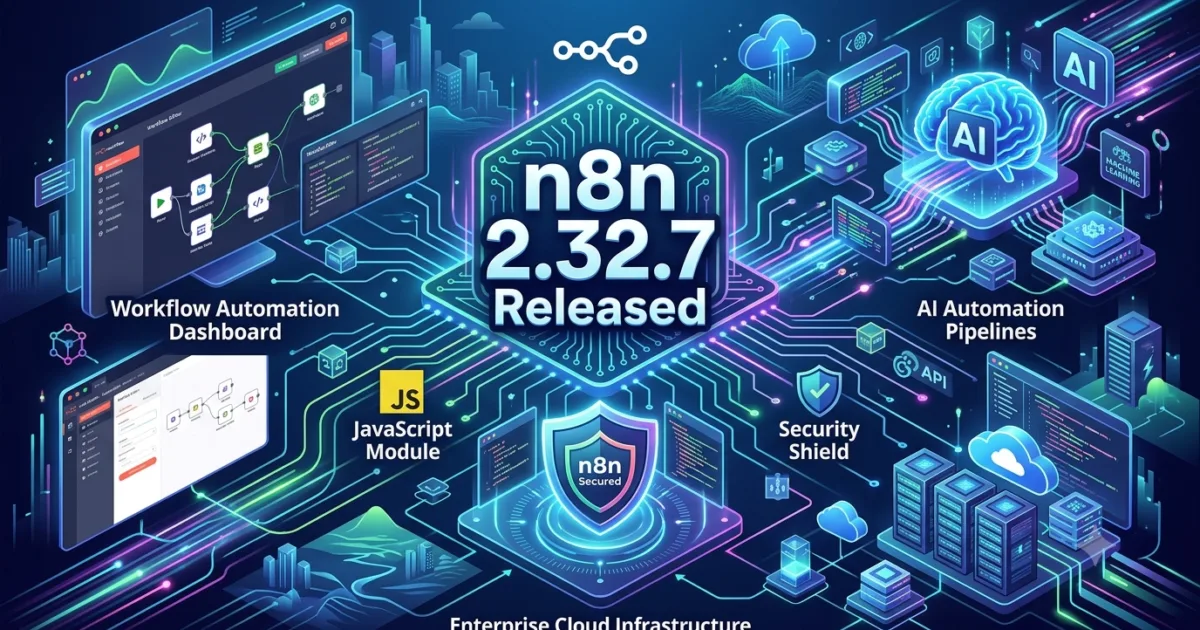
Introduction
n8n 2.32.7 was officially released on July 31, 2026, continuing the platform’s rapid release cycle with another maintenance update focused on improving reliability and internal security processes. While this release contains only a single bug fix, experienced QA Engineers, SDETs, DevOps Engineers, Platform Engineers, and AI Automation Developers understand that maintenance releases like this often play a critical role in keeping enterprise automation environments stable, secure, and production-ready.
n8n has become one of the most widely adopted open-source workflow automation platforms, enabling organizations to build sophisticated automation pipelines that integrate APIs, databases, cloud services, AI models, business applications, messaging platforms, and custom code—all through a visual workflow editor. As businesses increasingly rely on automation for mission-critical operations, ensuring the security and reliability of the underlying platform is just as important as introducing new features.
The primary focus of n8n 2.32.7 is a core security-related bug fix involving the import of security audit risk reporters with explicit file extensions. Although this change may appear highly technical, it contributes to better compatibility, more predictable module resolution, improved security auditing, and greater reliability across modern JavaScript and Node.js environments.
For organizations deploying enterprise workflow automation, AI-powered business processes, or DevSecOps pipelines, these behind-the-scenes improvements help reduce operational risk while ensuring security analysis components function consistently across different deployment environments.
Official Release Highlights
According to the official release notes, n8n 2.32.7 contains the following update.
Core Bug Fix
Import security audit risk reporters with a file extension
Issue Reference:
- #35267
Component:
- Core
Release Date:
- July 31, 2026
Although the changelog is intentionally small, this fix improves the way internal security audit modules are imported, helping maintain compatibility with evolving JavaScript module standards and modern runtime environments.
Understanding the Security Audit Improvement
Modern JavaScript applications increasingly rely on ES Modules (ESM) instead of the traditional CommonJS module system. As the JavaScript ecosystem evolves, runtime environments have become stricter about how files are imported, often requiring explicit file extensions to ensure reliable module resolution.
The update in n8n 2.32.7 adjusts how security audit risk reporters are imported within the platform’s core. By explicitly specifying file extensions during imports, the framework reduces the likelihood of module resolution errors that can occur in different execution environments, build systems, or deployment configurations.
Although end users may never directly notice this improvement, it enhances the stability of n8n’s internal security auditing mechanisms, particularly for organizations running automated compliance checks, vulnerability scans, or enterprise security workflows.
Why This Matters for QA Engineers
Security is no longer solely the responsibility of cybersecurity teams. Modern QA Engineers are increasingly expected to validate application security, deployment reliability, and infrastructure behavior alongside traditional functional testing.
When workflow automation platforms are used to process sensitive customer data, financial transactions, healthcare records, or internal business operations, reliable security auditing becomes essential.
The improvements introduced in n8n 2.32.7 indirectly benefit QA teams by helping ensure that:
- Security audit components initialize correctly.
- Module imports behave consistently across environments.
- Automated security validation executes without unexpected failures.
- Enterprise deployments remain compatible with modern JavaScript tooling.
Even though this release does not change workflow functionality, it contributes to a stronger foundation for secure software delivery.
Benefits for Enterprise Automation Platforms
Many organizations use n8n as the backbone of their automation ecosystem, integrating hundreds of internal and external services into production workflows.
Typical enterprise automations include:
- API orchestration
- CI/CD deployment pipelines
- AI agent workflows
- Incident management
- Customer onboarding
- Cloud infrastructure automation
- Security operations
- Business intelligence reporting
Because these workflows frequently execute in production around the clock, even small improvements to platform reliability can significantly reduce operational risk over time.
The security-related enhancement in n8n 2.32.7 supports this objective by improving the consistency of internal auditing mechanisms across modern runtime environments.
Upgrade Recommendation
From a QA and production perspective, n8n 2.32.7 is a recommended maintenance update.
It is particularly valuable for organizations that:
- Deploy n8n in enterprise environments.
- Maintain automated security auditing pipelines.
- Use modern Node.js and ES Module configurations.
- Integrate AI workflows into business automation.
- Prioritize long-term platform stability.
No breaking changes have been announced, and migration effort is expected to be minimal. Teams should still execute standard regression testing after upgrading to verify workflow execution, integrations, and deployment pipelines continue operating as expected.
Although the release introduces only a single core bug fix, it reinforces n8n’s commitment to maintaining a secure, reliable, and enterprise-ready workflow automation platform. For QA Engineers, SDETs, DevOps teams, and automation architects, updates like n8n 2.32.7 help ensure that production automation remains stable while keeping pace with the rapidly evolving JavaScript ecosystem.
n8n 2.32.7: Why a Small Security Fix Matters for Workflow Automation and AI Engineering
Why Small Maintenance Releases Should Never Be Ignored
Software release notes often attract the most attention when they introduce exciting new features, visual improvements, or major architectural changes. Maintenance releases, on the other hand, are frequently overlooked because they appear to contain only minor fixes. However, experienced QA Engineers, SDETs, DevOps Engineers, and Platform Architects know that these seemingly small updates are often responsible for improving the stability, security, and long-term maintainability of enterprise software.
The release of n8n 2.32.7 is a perfect example. The changelog contains only one bug fix related to importing security audit risk reporters with explicit file extensions. At first glance, this may appear insignificant, but it addresses an important aspect of modern JavaScript application development—module resolution consistency. As JavaScript runtimes evolve and enterprise applications increasingly adopt ECMAScript Modules (ESM), strict import rules have become essential for ensuring predictable behavior across development, testing, and production environments.
For organizations using n8n to automate AI workflows, cloud infrastructure, DevOps pipelines, and business processes, this update helps strengthen the platform’s internal reliability without changing existing workflow functionality.
Understanding Module Resolution in Modern JavaScript
Every JavaScript application is composed of multiple modules that import and export functionality. Historically, Node.js applications relied on the CommonJS module system, where import resolution was relatively flexible. Modern JavaScript, however, is steadily transitioning toward ES Modules (ESM), which enforce stricter import rules to improve portability, consistency, and compatibility across different environments.
One of the key requirements of ESM is the use of explicit file extensions when importing modules in many scenarios.
Instead of relying on implicit resolution such as:
import reporter from "./riskReporter";
modern environments increasingly expect:
import reporter from "./riskReporter.js";
Although this appears to be a very small syntax difference, it eliminates ambiguity during module resolution and reduces compatibility issues across different runtime environments, bundlers, and deployment platforms.
By updating its internal imports for security audit risk reporters, n8n 2.32.7 aligns more closely with modern JavaScript standards and ensures these components load consistently across supported environments.
Why Security Audit Components Matter
Security auditing is an essential part of enterprise workflow automation.
Organizations increasingly rely on automated security checks to identify vulnerabilities before software reaches production. Within automation platforms such as n8n, security audit components may help evaluate workflow risks, dependency health, configuration issues, or compliance-related concerns.
Although end users typically do not interact directly with these internal modules, they contribute to the overall security posture of the platform.
Reliable loading of these security-related components helps ensure:
- Security scans execute correctly.
- Risk analysis remains available.
- Compliance workflows continue functioning.
- Internal tooling behaves consistently.
- Enterprise security automation remains dependable.
The fix in n8n 2.32.7 improves this reliability by reducing the likelihood of module-loading inconsistencies.
Benefits for QA Engineers and SDETs
From a testing perspective, infrastructure-level improvements often have a greater impact than visible UI changes.
QA Engineers are increasingly responsible for validating not only application functionality but also deployment stability, platform compatibility, and operational resilience.
The changes in n8n 2.32.7 support several important testing objectives.
More Reliable Test Environments
Automated testing environments frequently differ from local development machines.
Teams may execute tests across:
- Local workstations
- Docker containers
- Kubernetes clusters
- GitHub Actions
- Azure DevOps
- Jenkins
- GitLab CI/CD
- Cloud-hosted infrastructure
Consistent module resolution helps ensure that internal platform components behave identically across all these environments, reducing environment-specific failures that are often difficult to reproduce.
Improved Security Validation
Organizations implementing DevSecOps practices increasingly integrate security validation into automated testing pipelines.
QA teams can have greater confidence that security-related components initialize correctly, allowing automated compliance and vulnerability checks to execute without unexpected module-loading issues.
Reduced Deployment Risk
Unexpected runtime errors caused by module resolution can delay software releases and interrupt production deployments.
By aligning internal imports with modern JavaScript expectations, n8n reduces one potential source of deployment instability, contributing to more predictable release cycles.
Impact on AI Workflow Automation
n8n is no longer used solely for traditional workflow automation. It has become a powerful orchestration platform for Agentic AI, LLM integrations, RAG pipelines, and AI-powered business automation.
Many organizations now use n8n to coordinate complex AI workflows involving:
- OpenAI models
- Anthropic Claude
- Google Gemini
- LangChain
- LangGraph
- MCP servers
- Vector databases
- External APIs
- Enterprise SaaS platforms
As these AI workflows become increasingly mission-critical, the stability of the underlying automation platform becomes just as important as the intelligence of the models themselves.
Even though n8n 2.32.7 does not introduce new AI capabilities, it strengthens the platform that powers these advanced automation systems.
Recommended Validation After Upgrading
Although this release does not contain breaking changes, engineering teams should still follow standard validation procedures after upgrading.
Recommended verification activities include:
Functional Testing
- Execute existing automation workflows.
- Verify trigger execution.
- Confirm successful API integrations.
- Validate workflow completion.
Regression Testing
- Compare workflow execution before and after the upgrade.
- Verify existing business logic remains unchanged.
- Monitor execution logs for unexpected warnings.
Security Validation
- Confirm security audit tools initialize correctly.
- Verify internal reporting mechanisms function as expected.
- Review application logs for module-loading errors.
Infrastructure Testing
- Validate Docker deployments.
- Test Kubernetes environments.
- Verify CI/CD pipeline execution.
- Monitor production startup behavior.
Key Takeaways
- n8n upgraded to version 2.32.7
- Core security audit import bug fixed
- Better JavaScript module compatibility
- Improved platform reliability
- Stronger enterprise deployment stability
- Supports modern Node.js environments
- No breaking changes announced
- Safe maintenance update
- Recommended for production deployments
People Also Ask
What is n8n 2.32.7?
n8n 2.32.7 is a maintenance release that fixes internal security audit module imports for improved compatibility and reliability.
What changed in n8n 2.32.7?
The release updates how security audit risk reporters are imported by explicitly using file extensions.
Does n8n 2.32.7 introduce new features?
No. It is a maintenance release focused on improving platform stability and security.
Should QA Engineers upgrade to n8n 2.32.7?
Yes. The release improves deployment reliability and strengthens internal platform consistency without requiring significant migration.
Does n8n 2.32.7 contain breaking changes?
No breaking changes have been announced in the official release notes.
Why are explicit file extensions important?
Modern JavaScript runtimes increasingly require explicit file extensions for reliable module resolution and improved compatibility.
Is n8n suitable for AI workflow automation?
Yes. n8n is widely used for AI workflow orchestration, API automation, DevOps pipelines, and enterprise process automation.
Is this release production ready?
Yes. n8n 2.32.7 is recommended as a production maintenance update.
Internal Links
- n8n 2.32.6 Released: Smarter Scheduling Improvements Every QA Engineer Should Know
- n8n 2.32.5 Released: Why This Security-Focused Update Matters for QA Engineers and Automation Teams
- n8n 2.31.4 Improves Workflow Stability and Editor Reliability for QA Engineers
- n8n 2.30.8 Strengthens AI Agent Reliability and Workflow Integrity for Enterprise Automation
- n8n 2.30.7 Strengthens Package Security and AWS SES Reliability for Enterprise Workflow Automation
- n8n 2.30.5 Release Brings Better AI Assistant Analytics, Node Alias Preservation, and Editor Improvements for Workflow Automation
- n8n 2.30.4 Improves Workflow Reliability, Webhook Stability, and Notion Integration for Enterprise Automation
- n8n 2.29.10 Released — What’s New for QA Engineers
- n8n 2.29.9 Released: Strengthening Enterprise AI Automation for Modern QA Teams
- n8n 2.29.8 Released: Enterprise Workflow Stability Gets Even Stronger for QA Engineers
- n8n 2.29.7 Released: AI Workflow Stability Improvements Every QA Engineer Should Know
- n8n 2.28.6 Released: Critical Stability Fixes Every QA Engineer Should Know
- n8n 2.28.7 Released: Critical Dependency Fix Every QA Engineer Should Know
- n8n 2.28.3 Released: Startup Reliability Improvements Every QA Engineer Should Know
- n8n 2.27.4 Released: Essential Workflow Improvements Every QA Engineer Should Know
Official Resources
- Official Documentation: https://docs.n8n.io
- Official Release Notes: https://github.com/n8n-io/n8n/compare/release/2.32.6…release/2.32.7
Final Thoughts
Although n8n 2.32.7 introduces only a single core bug fix, it reinforces an important principle of modern software engineering: platform reliability is built through continuous refinement rather than occasional large updates. By improving how security audit risk reporters are imported, the release strengthens compatibility with modern JavaScript module standards while reducing the likelihood of runtime inconsistencies across enterprise environments.
For QA Engineers, SDETs, DevOps teams, and AI automation specialists, this update represents a low-risk, production-ready maintenance release that enhances the stability of the platform supporting business automation, AI orchestration, and enterprise workflows. Organizations relying on n8n for mission-critical automation should consider upgrading to version 2.32.7 as part of their regular maintenance cycle to benefit from improved reliability and long-term compatibility.
Continue Learning with QAPulse by SK
At QAPulse by SK, we continuously analyze the latest releases across n8n, LangChain, CrewAI, LangGraph, Model Context Protocol (MCP), FastAPI, Python, Node.js, Docker, Playwright, Selenium, Locust, k6, and many other technologies shaping the future of intelligent automation and AI-powered software engineering.
Our goal is to help QA Engineers, SDETs, Automation Engineers, AI Engineers, DevOps Engineers, Platform Engineers, and Software Architects stay ahead with enterprise-grade release analyses, migration strategies, AI workflow testing guides, regression checklists, production deployment best practices, and practical automation insights that support building secure, scalable, and production-ready automation platforms.