QA
QA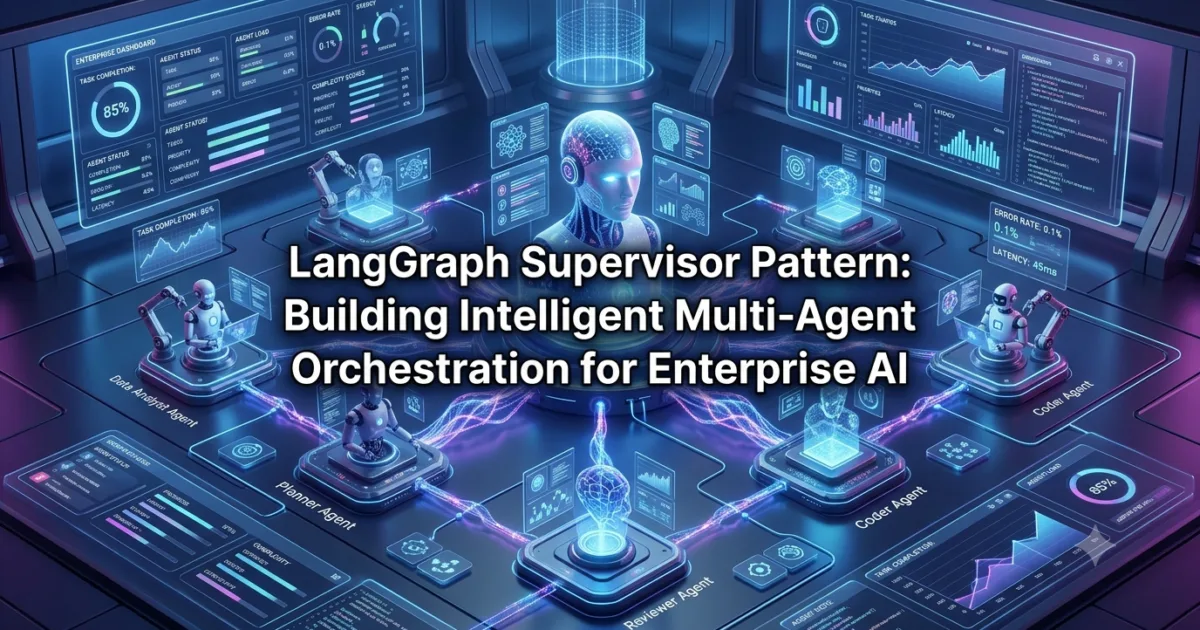
Introduction
As AI systems continue to evolve, simply connecting multiple agents together is no longer enough. While specialized agents improve modularity and maintainability, they also introduce a new challenge: who decides what happens next?
Consider a software development assistant that includes multiple AI agents. One agent plans the project, another researches documentation, a third writes code, while others test the application and generate documentation. Without proper coordination, these agents may execute tasks out of order, duplicate work, or even enter infinite execution loops.
This is where the LangGraph Supervisor Pattern becomes invaluable.
Instead of allowing agents to communicate randomly or following a fixed sequence, the Supervisor Pattern introduces a central orchestration agent responsible for managing the entire workflow. The supervisor understands the current state of the graph, delegates tasks to the appropriate specialized agent, evaluates their outputs, and determines the next step until the objective is complete.
This architecture enables developers to build intelligent AI systems that are dynamic, scalable, and significantly easier to maintain than traditional workflows.
In this lesson, you’ll learn how the LangGraph Supervisor Pattern works, why it has become one of the most popular architectural patterns in LangGraph, and where it fits into modern enterprise AI applications.
What Is the LangGraph Supervisor Pattern?
The LangGraph Supervisor Pattern is a multi-agent architecture where a dedicated supervisor agent controls the execution of specialized worker agents.
Unlike worker agents that perform domain-specific tasks, the supervisor focuses entirely on orchestration.
Its responsibilities include:
- Understanding the user’s objective
- Selecting the most appropriate agent
- Delegating tasks
- Monitoring workflow progress
- Validating intermediate results
- Routing execution to the next agent
- Determining when the workflow is complete
Rather than solving the user’s request directly, the supervisor coordinates a team of AI agents that collaborate to produce the final result.
A simplified architecture looks like this:
                     User Request
                          │
                          ▼
                 Supervisor Agent
                          │
      ┌───────────┬────────────┬────────────┐
      ▼           ▼            ▼            ▼
 Planner      Research      Coding      Documentation
   Agent         Agent        Agent          Agent
      │           │            │             │
      └───────────┴────────────┴─────────────┘
                          │
                          ▼
                   Testing Agent
                          │
                          ▼
                  Supervisor Review
                          │
                          ▼
                    Final Response
The supervisor remains responsible for every routing decision while worker agents concentrate solely on completing their assigned responsibilities.
Why Do Multi-Agent Systems Need a Supervisor?
In the previous lesson, you learned how multiple agents can collaborate to solve complex problems. However, collaboration alone does not guarantee an efficient workflow.
Let’s examine a common software engineering scenario.
Suppose a user asks an AI application to build an e-commerce REST API.
Several specialized agents may participate:
- Planner Agent
- Research Agent
- Backend Coding Agent
- Database Agent
- Testing Agent
- Documentation Agent
- Reviewer Agent
Without coordination, several issues can occur.
The Coding Agent may begin implementation before the Planner Agent has finalized the architecture.
The Documentation Agent might generate documentation before the API is complete.
The Testing Agent could execute tests against incomplete code.
Multiple agents may even perform identical work because no component tracks the overall workflow state.
These situations reduce efficiency and often produce inconsistent results.
The Supervisor Pattern eliminates these problems by ensuring every task is executed at the appropriate time and in the correct sequence.
Instead of allowing every agent to make independent routing decisions, one intelligent supervisor manages the entire process.
Responsibilities of the Supervisor Agent
The supervisor is the decision-maker within the workflow.
Unlike worker agents, it rarely performs business-specific tasks. Instead, it evaluates the workflow after every completed step and decides what should happen next.
Typical responsibilities include:
Task Delegation
The supervisor determines which agent should execute based on the current workflow state.
For example:
User Request
      │
      ▼
Supervisor
      │
      ▼
Planner Agent
Once planning is complete, the supervisor evaluates the updated state before selecting another agent.
Workflow Routing
Not every request follows the same execution path.
A simple summarization request may require only:
Supervisor
      │
      ▼
Summary Agent
      │
      ▼
Final Response
A software engineering request may involve several specialized agents.
Supervisor
      │
      ▼
Planner
      │
      ▼
Research
      │
      ▼
Coding
      │
      ▼
Testing
      │
      ▼
Documentation
The supervisor dynamically chooses the appropriate route instead of relying on a fixed pipeline.
Progress Monitoring
Throughout execution, the supervisor continuously evaluates the workflow.
Typical questions include:
- Has the assigned task finished successfully?
- Is additional information required?
- Should another agent continue the work?
- Has the user’s objective been achieved?
These decisions allow workflows to adapt instead of blindly following predefined steps.
Error Recovery
Worker agents occasionally produce incomplete or incorrect outputs.
Rather than terminating the workflow immediately, the supervisor can redirect execution.
For example:
Coding Agent
      │
      ▼
Generated Code
      │
      ▼
Testing Agent
      │
      ▼
Tests Failed
      │
      ▼
Supervisor
      │
      ▼
Return to Coding Agent
This feedback loop allows the system to improve results automatically before producing the final response.
How the Supervisor Differs from Sequential Workflows
Many beginners assume a sequential workflow and a supervisor-based workflow are identical because both involve multiple steps.
In reality, they are fundamentally different.
A sequential workflow follows a predefined execution order.
Planner
   │
Research
   │
Coding
   │
Testing
   │
Documentation
Regardless of the task, every step executes in the same sequence.
While this approach works for predictable processes, it lacks flexibility.
The Supervisor Pattern introduces decision-making into the workflow.
                 Supervisor
                      │
       ┌──────────────┼──────────────┐
       ▼              ▼              ▼
 Planner         Research        Coding
       │              │              │
       └──────────────┼──────────────┘
                      ▼
                 Testing
                      │
          ┌───────────┴───────────┐
          ▼                       ▼
      Retry Code             Final Output
The execution path depends on the current workflow state rather than a hardcoded sequence.
This makes the system significantly more adaptive and suitable for real-world enterprise applications.
Real-World Applications of the Supervisor Pattern
The LangGraph Supervisor Pattern is widely applicable across industries because many business processes require coordination between multiple specialized tasks.
Software Development
A supervisor can orchestrate agents responsible for:
- Requirement analysis
- Architecture planning
- Code generation
- Unit testing
- Documentation
- Code review
Each agent contributes independently while the supervisor manages the overall development lifecycle.
Enterprise Knowledge Assistants
Large organizations often maintain thousands of internal documents.
A supervisor can coordinate agents that:
- Retrieve relevant knowledge
- Validate policies
- Summarize documents
- Generate responses
- Verify accuracy before delivery
This produces more reliable answers than relying on a single agent.
Customer Support Automation
Support workflows frequently involve several independent tasks.
Examples include:
- Intent classification
- Knowledge retrieval
- Account verification
- Policy validation
- Response generation
- Escalation handling
The supervisor ensures these tasks occur in the appropriate order while adapting to the customer’s request.
AI Research Systems
Research assistants often combine multiple specialized capabilities.
A supervisor can coordinate agents that:
- Search academic literature
- Collect web sources
- Compare findings
- Summarize evidence
- Generate structured reports
This results in more organized and transparent research workflows.
Why Enterprise AI Platforms Prefer the Supervisor Pattern
As AI applications grow beyond prototypes, enterprise requirements become increasingly demanding.
Organizations expect AI systems to be:
- Modular
- Scalable
- Observable
- Fault tolerant
- Easy to maintain
- Easy to extend
- Production ready
The LangGraph Supervisor Pattern addresses these requirements by separating orchestration from execution.
Instead of embedding workflow logic inside every agent, routing decisions remain centralized within the supervisor. Worker agents become reusable building blocks that can participate in multiple workflows without modification.
This architecture simplifies debugging, improves maintainability, and allows teams to introduce new agents with minimal impact on existing systems.
Understanding the Architecture of the LangGraph Supervisor Pattern
Before implementing the Supervisor Pattern in LangGraph, it’s important to understand how the overall architecture works. Although the workflow may involve multiple AI agents, the execution remains organized because every decision passes through a single supervisory layer.
Think of the supervisor as the central traffic controller. Worker agents never decide which agent should execute next. They simply perform their assigned task, update the shared workflow state, and return control to the supervisor.
This design keeps the workflow predictable while still allowing dynamic decision-making.
A typical Supervisor Pattern architecture looks like this:
                     User Request
                          │
                          ▼
                 Supervisor Agent
                          │
          ┌───────────────┼───────────────┐
          ▼               ▼               ▼
    Research Agent   Coding Agent   Review Agent
          │               │               │
          └───────────────┼───────────────┘
                          ▼
                 Shared Graph State
                          │
                          ▼
                 Supervisor Decision
                          │
                Continue or Finish
Notice that every worker agent communicates through the shared graph state rather than directly interacting with other agents.
This separation makes the system significantly easier to understand, debug, and extend.
Core Components of the Supervisor Pattern
A Supervisor Pattern in LangGraph typically consists of four major components.
Supervisor Agent
The Supervisor Agent is responsible for orchestration rather than execution.
Its primary responsibilities include:
- Understanding the user’s request
- Selecting the appropriate worker agent
- Monitoring execution progress
- Evaluating intermediate outputs
- Deciding the next workflow step
- Determining when execution should stop
Unlike worker agents, the supervisor rarely performs business-specific tasks itself.
Instead, it continuously asks:
- Which agent should execute next?
- Is the current task complete?
- Does another agent need to participate?
- Can the workflow finish now?
This decision-making process is what makes the Supervisor Pattern intelligent rather than static.
Worker Agents
Worker agents specialize in a single responsibility.
Examples include:
| Agent | Responsibility |
|---|---|
| Research Agent | Collect information |
| Planner Agent | Create execution strategy |
| Coding Agent | Generate implementation |
| Testing Agent | Validate generated code |
| Documentation Agent | Produce technical documentation |
| Reviewer Agent | Verify overall quality |
Each worker focuses on one well-defined task.
This specialization keeps prompts shorter, improves reasoning quality, and makes each agent reusable across multiple workflows.
Shared Workflow State
One of LangGraph’s most powerful features is its shared state.
Instead of passing large prompts between agents, information is stored inside the graph state.
For example:
State

User Request:
"Build a FastAPI CRUD application"

Research Completed:
True

Code Generated:
True

Tests Passed:
False

Documentation Generated:
False
Every worker reads the current state before execution and updates it after completing its task.
Because all agents reference the same workflow state, they always operate using the latest information.
Routing Logic
The final component is the routing mechanism.
After each worker completes its task, control returns to the supervisor.
The supervisor examines the updated state before determining what should happen next.
For example:
Research Complete?

        │
   Yes  ▼
     Coding Agent

        │
   No   ▼
Continue Research
This continuous evaluation allows the workflow to adapt dynamically instead of following a rigid sequence.
How the Supervisor Makes Decisions
The supervisor’s primary responsibility is decision-making.
Unlike traditional automation tools where every step is predefined, LangGraph allows the supervisor to evaluate the workflow after every action.
A simplified execution cycle looks like this:
Receive Request

        │

Select Worker

        │

Worker Executes

        │

Update State

        │

Evaluate Results

        │

Choose Next Agent

        │

Repeat Until Complete
This cycle continues until the supervisor determines that all objectives have been achieved.
Because decisions depend on the current graph state, two identical workflows may follow different execution paths depending on intermediate results.
This flexibility is one of the biggest advantages of the Supervisor Pattern.
Example Workflow: Building a REST API
Let’s examine how a supervisor coordinates multiple agents during a real software development task.
Suppose the user submits the following request.
Build a REST API for inventory management using FastAPI.
The supervisor first analyzes the request.
Instead of immediately assigning it to the Coding Agent, it determines that planning should occur first.
User Request
      │
      ▼
Supervisor
      │
      ▼
Planner Agent
The Planner Agent creates the project structure, identifies required endpoints, and recommends a development strategy.
Once planning is complete, the updated workflow state returns to the supervisor.
The supervisor now determines that research is required.
Planner Completed

        │

Supervisor

        │

Research Agent
The Research Agent retrieves FastAPI documentation, authentication best practices, and database recommendations.
After research completes, the supervisor routes execution to the Coding Agent.
Research Complete

        │

Supervisor

        │

Coding Agent
The Coding Agent generates the implementation before returning the updated state.
Rather than immediately finishing, the supervisor forwards execution to the Testing Agent.
Coding Complete

        │

Supervisor

        │

Testing Agent
Suppose several unit tests fail.
Instead of terminating execution, the Testing Agent updates the workflow state.
Tests Passed:
False
The supervisor evaluates the state and determines that the Coding Agent should revise the implementation.
Testing Failed

        │

Supervisor

        │

Coding Agent
This iterative feedback loop continues until the tests succeed.
Once all validations pass, the supervisor delegates the remaining documentation tasks before producing the final response.
The entire workflow is driven by decisions rather than a fixed sequence.
Shared State Enables Intelligent Collaboration
Without shared state, every agent would need to receive the complete conversation history and intermediate outputs.
This approach quickly becomes inefficient.
LangGraph avoids this problem by storing workflow information in a centralized state object.
A simplified example might look like this:
Workflow State

Task:
Create Inventory API

Planning:
Completed

Research:
Completed

Implementation:
Completed

Tests:
Passed

Documentation:
Pending
Each worker updates only the information relevant to its responsibility.
The supervisor then evaluates the complete workflow state before deciding the next step.
This centralized approach offers several benefits:
- Consistent workflow context
- Reduced prompt size
- Easier debugging
- Better observability
- Simplified maintenance
It also enables developers to inspect the execution history at any stage of the workflow.
Dynamic Routing vs Static Routing
One of the most common questions beginners ask is:
“Why not simply connect agents sequentially?”
The answer lies in flexibility.
A static workflow always follows the same path.
Planner

   │

Research

   │

Coding

   │

Testing

   │

Documentation
Even if research is unnecessary or documentation already exists, every step still executes.
This wastes both time and compute resources.
Dynamic routing behaves differently.
The supervisor evaluates the current workflow state before making each decision.
                  Supervisor

             ┌────────┼────────┐

             ▼        ▼        ▼

         Research   Coding   Testing

             │        │        │

             └────────┼────────┘

                     ▼

             Documentation

                     │

               Finish Workflow
Depending on the request, the supervisor may:
- Skip unnecessary agents
- Repeat failed tasks
- Invoke additional specialists
- Terminate early when objectives are complete
This adaptability makes the Supervisor Pattern ideal for production AI systems where every request may require a different execution path.
Advantages of Separating Orchestration from Execution
Separating orchestration from execution provides several long-term benefits.
Cleaner Agent Design
Worker agents remain focused on their own responsibility.
They don’t need to understand the complete workflow.
This keeps prompts concise and improves response quality.
Easier Scalability
Adding a new worker agent becomes straightforward.
For example, introducing a Security Review Agent only requires updating the supervisor’s routing logic.
Existing agents remain unchanged.
Improved Testing
Each worker agent can be tested independently.
Similarly, the supervisor’s routing decisions can be validated without modifying worker implementations.
This modularity significantly improves software quality.
Better Observability
Since every routing decision passes through the supervisor, developers gain complete visibility into workflow execution.
This makes debugging production systems much easier.
Enterprise Flexibility
Different business workflows often require different execution paths.
A supervisor can dynamically assemble the most appropriate team of agents for each request without changing the underlying architecture.
Preparing for Implementation
Understanding the architecture is the foundation for building effective multi-agent applications.
The Supervisor Pattern is not simply about connecting multiple AI agents. It is about creating an intelligent orchestration layer that continuously evaluates the workflow, routes tasks based on the current state, and ensures every specialized agent contributes at the right time.
Implementing the LangGraph Supervisor Pattern Using Python
Now that you understand how the LangGraph Supervisor Pattern works conceptually, it’s time to implement it using Python and LangGraph.
The implementation is surprisingly straightforward because LangGraph already provides the building blocks needed to create graph-based workflows. The real challenge is not writing code—it’s designing the workflow correctly.
In a Supervisor Pattern, every execution follows the same high-level lifecycle:
User Request
      │
      ▼
Supervisor
      │
      ▼
Select Worker Agent
      │
      ▼
Worker Executes
      │
      ▼
Update Graph State
      │
      ▼
Supervisor Reviews State
      │
      ▼
Continue or Finish
Notice that the supervisor always regains control after every worker finishes its task.
This allows the workflow to remain dynamic instead of following a predefined sequence.
Step 1: Define the Shared Workflow State
Every LangGraph application revolves around a shared state.
Rather than passing long prompts between agents, all relevant information is stored in a single state object that every node can access.
A typical supervisor workflow may store information such as:
- User request
- Current task
- Research results
- Generated code
- Test status
- Documentation
- Review feedback
- Next agent
- Final response
A simplified state representation looks like this:
Workflow State

User Query:
Build an Authentication API

Current Agent:
Research Agent

Research:
Completed

Implementation:
Pending

Testing:
Pending

Documentation:
Pending
Every worker reads this state before execution and updates only the fields related to its responsibility.
This approach keeps agents independent while allowing seamless collaboration.
Step 2: Create Specialized Worker Agents
The Supervisor Pattern works best when every worker agent has a single responsibility.
Instead of creating one large prompt capable of doing everything, each agent is designed to solve one specific problem.
For example:
| Worker Agent | Primary Responsibility |
|---|---|
| Planner Agent | Analyze requirements |
| Research Agent | Retrieve documentation |
| Coding Agent | Generate source code |
| Testing Agent | Validate implementation |
| Documentation Agent | Produce documentation |
| Reviewer Agent | Perform final review |
Each worker receives the current workflow state.
It performs its assigned task.
Then it updates the shared state before returning control to the supervisor.
Because responsibilities are isolated, prompts remain significantly smaller and easier to maintain.
Step 3: Build the Supervisor Node
The supervisor is different from every other node in the graph.
Worker agents perform business logic.
The supervisor performs orchestration logic.
Instead of answering the user’s question directly, the supervisor evaluates the workflow after each completed task.
Typical questions include:
- Which agent should execute next?
- Is additional research required?
- Did testing succeed?
- Should the implementation be revised?
- Can the workflow finish now?
A simplified decision process looks like this:
Workflow Starts

        │

Supervisor

        │

Research Needed?

   Yes ▼

Research Agent

        │

Supervisor

        │

Implementation Ready?

   Yes ▼

Coding Agent
The supervisor repeats this decision-making process until every required task has been completed.
Step 4: Connect the Graph
Unlike traditional applications where functions call one another directly, LangGraph connects nodes through graph edges.
The Supervisor Pattern typically follows this structure:
                Supervisor
                     │
      ┌──────────────┼──────────────┐
      ▼              ▼              ▼
 Planner        Research       Coding
      │              │              │
      └──────────────┼──────────────┘
                     ▼
                Testing
                     │
                     ▼
              Documentation
                     │
                     ▼
                Supervisor
                     │
                     ▼
                 END Graph
Notice that worker agents don’t decide the next destination.
Every completed task returns control to the supervisor.
This centralized routing greatly simplifies workflow management.
Step 5: Configure Conditional Routing
One of LangGraph’s most powerful capabilities is conditional routing.
Instead of hardcoding execution paths, the supervisor can evaluate the workflow state before choosing the next node.
For example:
Tests Passed?

      │

 Yes  ▼

Documentation Agent

      │

 No   ▼

Coding Agent
Similarly:
Research Complete?

      │

 Yes ▼

Planner Agent

      │

 No ▼

Research Agent
These conditional transitions allow the workflow to adapt automatically to changing circumstances.
This flexibility is one of the reasons LangGraph is particularly well suited for agentic AI systems.
Example: AI Software Development Workflow
Let’s examine a practical workflow.
A user submits the following request.
Build a Blog API using FastAPI and PostgreSQL.
The supervisor begins by analyzing the request.
User Request

      │

Supervisor

      │

Planner Agent
The planner creates the project architecture.
Once planning is complete, the supervisor evaluates the updated state.
Because technical documentation is required, it delegates the task to the Research Agent.
Planner Complete

      │

Supervisor

      │

Research Agent
The Research Agent retrieves information about:
- FastAPI
- PostgreSQL
- SQLAlchemy
- Authentication
- Best practices
Once research finishes, the supervisor sends execution to the Coding Agent.
Research Complete

      │

Supervisor

      │

Coding Agent
The Coding Agent generates:
- Project structure
- API endpoints
- Database models
- CRUD operations
The implementation is then forwarded for testing.
Coding Complete

      │

Supervisor

      │

Testing Agent
Suppose several unit tests fail.
Instead of ending the workflow, the Testing Agent updates the graph state.
Tests Passed:
False
The supervisor immediately detects the failure.
Rather than proceeding to documentation, it routes execution back to the Coding Agent.
Testing Failed

      │

Supervisor

      │

Coding Agent
Once the implementation satisfies all tests, documentation generation begins.
Finally, the Reviewer Agent validates the complete project before returning the final response.
This feedback loop demonstrates why the Supervisor Pattern is significantly more powerful than a simple sequential workflow.
How Shared State Changes During Execution
The shared workflow state evolves continuously as agents complete their responsibilities.
Initial state:
Planning:
Pending

Research:
Pending

Coding:
Pending

Testing:
Pending

Documentation:
Pending
After planning:
Planning:
Completed

Research:
Pending

Coding:
Pending
After research:
Planning:
Completed

Research:
Completed

Coding:
Pending
After implementation:
Planning:
Completed

Research:
Completed

Coding:
Completed

Testing:
Pending
After testing:
Planning:
Completed

Research:
Completed

Coding:
Completed

Testing:
Passed

Documentation:
Pending
Final state:
Planning:
Completed

Research:
Completed

Coding:
Completed

Testing:
Passed

Documentation:
Completed

Workflow:
Finished
Because every worker updates the same state object, the supervisor always has complete visibility into the workflow.
Handling Failures Gracefully
Real-world AI systems rarely execute perfectly on the first attempt.
APIs may fail.
Search results may be incomplete.
Generated code may contain errors.
External tools may become unavailable.
The Supervisor Pattern allows these situations to be handled intelligently.
Instead of terminating execution, the supervisor can:
- Retry failed tasks
- Select an alternative worker
- Skip optional steps
- Request additional information
- Escalate to a human reviewer
- End the workflow safely
For example:
Research Failed

        │

Supervisor

        │

Retry Research

        │

Still Failed

        │

Fallback Search Agent
Similarly:
Testing Failed

        │

Supervisor

        │

Coding Agent

        │

Retest

        │

Continue Workflow
These recovery mechanisms make multi-agent systems considerably more reliable in production environments.
Best Practices for Building Supervisor-Based Workflows
When implementing the Supervisor Pattern, several design principles can significantly improve maintainability.
Keep Worker Agents Focused
Each worker should perform only one primary responsibility.
Avoid combining research, coding, testing, and documentation into a single node.
Smaller agents are easier to debug, reuse, and optimize.
Centralize Routing Decisions
Worker agents should never decide which agent executes next.
All routing decisions should remain inside the supervisor.
This keeps the workflow predictable and easier to modify.
Store Only Relevant Information
Avoid filling the workflow state with unnecessary data.
Store only information required for future decision-making.
A smaller state reduces memory usage and improves performance.
Design for Reusability
A well-designed worker agent should be reusable across multiple workflows.
For example, a Documentation Agent may participate in:
- API generators
- Code assistants
- DevOps pipelines
- Internal developer platforms
This modular approach reduces duplication and simplifies long-term maintenance.
Moving Toward Production-Ready Systems
Implementing the LangGraph Supervisor Pattern is more than connecting several nodes inside a graph. It is about creating an intelligent orchestration layer capable of adapting to changing conditions, coordinating specialized agents, and recovering gracefully when problems occur.
Production Use Cases of the LangGraph Supervisor Pattern
The LangGraph Supervisor Pattern is much more than an academic concept. It has become one of the most widely adopted architectural patterns for building enterprise-grade AI systems because it enables intelligent orchestration, modular development, and dynamic decision-making.
Instead of hardcoding every workflow, organizations use supervisor-based architectures to coordinate specialized AI agents that collaborate toward a common goal.
Let’s explore where this pattern is making the biggest impact.
AI Software Engineering Assistants
Modern coding assistants do much more than generate code.
A complete software engineering workflow often includes:
- Requirement analysis
- Architecture planning
- API research
- Backend development
- Frontend development
- Unit testing
- Code review
- Documentation generation
- Deployment preparation
A supervisor coordinates these specialized agents while ensuring every task is completed in the correct order.
A simplified workflow looks like this:
                  User Request
                       │
                       ▼
                Supervisor Agent
                       │
        ┌──────────────┼──────────────┐
        ▼              ▼              ▼
   Planner        Research      Backend Dev
        │              │              │
        ▼              ▼              ▼
 Frontend Dev     Unit Testing   Documentation
        └──────────────┼──────────────┘
                       ▼
                  Final Review
                       │
                       ▼
                 Project Delivered
Instead of relying on one overloaded prompt, each worker focuses on its own responsibility while the supervisor maintains complete control over the workflow.
Enterprise Knowledge Assistants
Large organizations often manage thousands of documents spread across multiple departments.
When an employee asks a question, the AI system may need to:
- Search internal documentation
- Retrieve company policies
- Validate compliance rules
- Summarize multiple documents
- Verify factual consistency
- Generate a final response
Rather than assigning all these tasks to one agent, a supervisor delegates each responsibility to specialized workers before producing a reliable answer.
Customer Support Automation
Customer support systems frequently require multiple independent decisions.
For example:
Customer Query
       │
       ▼
Supervisor
       │
 ┌─────┼─────┬─────────┐
 ▼     ▼     ▼         ▼
Intent Account Policy Knowledge
Agent  Agent  Agent    Agent
       │
       ▼
Response Generator
       │
       ▼
Customer Reply
This architecture improves both response quality and operational efficiency while allowing each agent to evolve independently.
AI Research Platforms
Research applications often require collaboration between multiple agents.
A supervisor can coordinate workers that:
- Search academic papers
- Collect online resources
- Compare findings
- Identify contradictions
- Generate citations
- Produce structured reports
This approach creates significantly more reliable research workflows than relying on a single LLM prompt.
Supervisor Pattern vs Other Multi-Agent Patterns
Throughout this series, you’ve explored several ways to build multi-agent workflows.
Each pattern solves a different problem.
Understanding when to use each architecture is an important skill for AI engineers.
| Pattern | Best Used For |
|---|---|
| Sequential Workflow | Fixed execution order |
| Parallel Workflow | Independent tasks running simultaneously |
| Router Pattern | Selecting one agent from many options |
| Multi-Agent Collaboration | Agents working together on shared objectives |
| Supervisor Pattern | Intelligent orchestration and dynamic routing |
The key difference is that the Supervisor Pattern continuously evaluates the workflow after every completed task.
Instead of following predefined transitions, the supervisor makes decisions using the latest workflow state.
This makes it particularly valuable for applications where execution paths vary from one request to another.
Common Mistakes When Implementing the Supervisor Pattern
Although the Supervisor Pattern is powerful, beginners often make design mistakes that reduce its effectiveness.
Understanding these pitfalls can save considerable development time.
Giving the Supervisor Too Many Responsibilities
The supervisor should coordinate the workflow—not perform every task itself.
A common mistake is allowing the supervisor to:
- Research documentation
- Generate code
- Execute tests
- Produce reports
At that point, it stops behaving like a supervisor and becomes another worker agent.
Keep orchestration and execution separate.
Creating Overly Complex Worker Agents
Another common mistake is designing worker agents that handle multiple unrelated responsibilities.
For example:
Research + Coding + Testing
is much harder to maintain than:
Research Agent

↓

Coding Agent

↓

Testing Agent
Smaller agents are easier to debug, optimize, and reuse across multiple workflows.
Ignoring Workflow State
The shared graph state is the foundation of LangGraph.
If agents fail to update the state correctly, the supervisor cannot make informed decisions.
Always ensure that each worker:
- Reads the current state
- Updates relevant fields
- Returns the latest workflow information
A consistent state leads to more reliable routing decisions.
Hardcoding Every Decision
Some developers recreate traditional workflows by hardcoding every transition.
For example:
Planner

↓

Research

↓

Coding

↓

Testing

↓

Documentation
Although this works, it eliminates the primary advantage of the Supervisor Pattern.
Instead, let the supervisor evaluate the workflow dynamically.
For example:
Tests Passed?

      │

 Yes ▼

Documentation

      │

 No ▼

Return to Coding
Dynamic routing creates workflows that adapt to real-world situations.
Best Practices for Enterprise Applications
Organizations building production AI systems typically follow several architectural principles.
Design Small, Reusable Agents
Each worker should perform one clearly defined responsibility.
Examples include:
- Planner Agent
- SQL Generator
- Documentation Writer
- Code Reviewer
- Security Auditor
These agents can be reused across multiple enterprise workflows.
Keep the Supervisor Lightweight
The supervisor should focus on:
- Delegation
- Monitoring
- Decision-making
- Workflow completion
Avoid embedding business logic inside the supervisor whenever possible.
Track Every Execution
Production systems should record:
- Agent execution history
- State updates
- Routing decisions
- Execution duration
- Errors
- Retry attempts
These records simplify debugging and improve observability.
Build Fault-Tolerant Workflows
Enterprise AI systems should anticipate failures.
Examples include:
- API timeouts
- Missing data
- Invalid responses
- Network interruptions
- Tool failures
Instead of terminating immediately, the supervisor should determine the most appropriate recovery strategy.
Continuously Evaluate Workflow State
The workflow state should always represent the current progress of the application.
Rather than assuming a task succeeded, allow the supervisor to verify the updated state before continuing.
This approach significantly improves reliability.
When Should You Use the Supervisor Pattern?
Not every LangGraph application requires a supervisor.
Simple workflows often perform perfectly well using sequential execution.
For example:
- Text summarization
- Document translation
- Email generation
- Content rewriting
These tasks typically involve a predictable sequence of operations.
The Supervisor Pattern becomes valuable when workflows require:
- Multiple specialized agents
- Dynamic routing
- Conditional execution
- Retry mechanisms
- Decision-making
- Long-running processes
- Enterprise orchestration
As application complexity increases, the benefits of centralized orchestration become increasingly apparent.
The Future of Agentic AI
The rapid growth of agentic AI is shifting application design from single intelligent models toward collaborative systems composed of specialized agents.
Rather than asking one model to solve every problem, developers are building intelligent teams where each agent contributes its expertise while a supervisor coordinates the overall workflow.
This mirrors the way successful organizations operate.
Software engineers collaborate with architects.
Researchers collaborate with analysts.
Developers collaborate with testers.
Managers coordinate the work without performing every task themselves.
The Supervisor Pattern brings this same organizational structure into AI applications, creating systems that are easier to scale, maintain, and extend.
As LangGraph continues to evolve, supervisor-based architectures will likely become a standard approach for building production-ready autonomous AI systems.
Key Takeaways
The LangGraph Supervisor Pattern provides a structured approach to orchestrating multiple AI agents within a single workflow. Rather than allowing agents to communicate randomly or relying on rigid execution pipelines, a dedicated supervisor analyzes the current graph state, delegates work to specialized agents, evaluates intermediate results, and determines the next action until the user’s objective is achieved.
By separating orchestration from execution, developers can build AI applications that are modular, reusable, fault tolerant, and easier to maintain. Worker agents remain focused on individual responsibilities, while the supervisor ensures that every task is executed at the right time and in the right order.
This architecture is particularly valuable for enterprise AI systems that require intelligent routing, conditional execution, retry mechanisms, and collaboration between multiple specialized agents. Whether you’re building coding assistants, research platforms, customer support solutions, or autonomous business workflows, the Supervisor Pattern offers a scalable foundation for developing production-ready multi-agent applications.
People Asked Questions (PAQ)
1. What is the LangGraph Supervisor Pattern?
The LangGraph Supervisor Pattern is a multi-agent architecture where a dedicated supervisor agent manages specialized worker agents. Instead of performing every task itself, the supervisor analyzes the workflow state, delegates tasks, evaluates results, and decides which agent should execute next until the objective is completed.
2. Why should I use the Supervisor Pattern in LangGraph?
The Supervisor Pattern improves scalability, modularity, maintainability, and reliability. It separates orchestration from execution, making it easier to build complex AI workflows that involve multiple specialized agents.
3. How is the Supervisor Pattern different from a sequential workflow?
A sequential workflow follows a fixed execution order regardless of the task. The Supervisor Pattern uses dynamic routing, allowing the supervisor to evaluate the workflow after each step and determine the next action based on the current graph state.
4. What is the role of the Supervisor Agent?
The Supervisor Agent coordinates the workflow by assigning tasks to worker agents, monitoring progress, handling retries, validating outputs, and deciding when the workflow is complete.
5. Can the Supervisor Pattern handle failures?
Yes. The supervisor can detect failed tasks, retry operations, reroute execution to another agent, request additional information, or safely terminate the workflow based on predefined conditions.
6. What are worker agents in LangGraph?
Worker agents are specialized AI agents responsible for performing specific tasks such as planning, research, coding, testing, reviewing, or documentation. They update the shared graph state and return control to the supervisor.
7. What industries use the LangGraph Supervisor Pattern?
The Supervisor Pattern is commonly used in software engineering, customer support, financial services, healthcare, research automation, enterprise knowledge management, cybersecurity, and autonomous AI systems.
8. Is the LangGraph Supervisor Pattern suitable for production applications?
Yes. The Supervisor Pattern is specifically designed for production-grade AI applications because it supports modular architecture, dynamic routing, fault tolerance, shared state management, and intelligent orchestration.
Internal Links:
- Learn MCP – Zero to Hero
- Learn AI Agents for QA – Zero to Hero
- Playwright Automation – Zero to Hero
- LangGraph: Complete Zero to Hero
- Learn Python – Zero to Hero
- OpenAI Codex: Complete Zero to Hero
- Cursor AI: Complete Zero to Hero
- Claude Code Tutorial: Complete Zero to Hero
- Free QA Resources Built From Real Experience
- QA Glossary: Test Automation Terms Every Engineer Should Know
External Resources:
- LangGraph Official Documentation
- LangChain Documentation
- Python Official Documentation
- OpenAI Platform Documentation
- Anthropic Documentation
- Google AI Documentation
- LangGraph GitHub Repository
Featured Snippet
What Is the LangGraph Supervisor Pattern?
The LangGraph Supervisor Pattern is a multi-agent architecture where a dedicated supervisor agent orchestrates specialized worker agents. Instead of performing tasks itself, the supervisor analyzes the workflow state, delegates work to the appropriate agent, monitors progress, evaluates results, and dynamically determines the next execution step. This approach enables scalable, maintainable, and production-ready AI workflows.
AI Overview Answer
The LangGraph Supervisor Pattern helps developers build intelligent multi-agent AI systems by separating orchestration from execution. A supervisor agent coordinates specialized worker agents using shared graph state and dynamic routing, ensuring tasks execute in the correct order while supporting retries, conditional execution, and fault tolerance. This architecture is widely used for enterprise AI applications such as coding assistants, research systems, customer support automation, and autonomous workflows.
Enjoyed this article? Explore more in-depth guides on AI engineering, automation testing, Model Context Protocol, Playwright, and intelligent software quality at www.skakarh.com. Follow QAPulse by SK for practical, production-focused tutorials designed for QA engineers, SDETs, and AI developers.