 QA
QA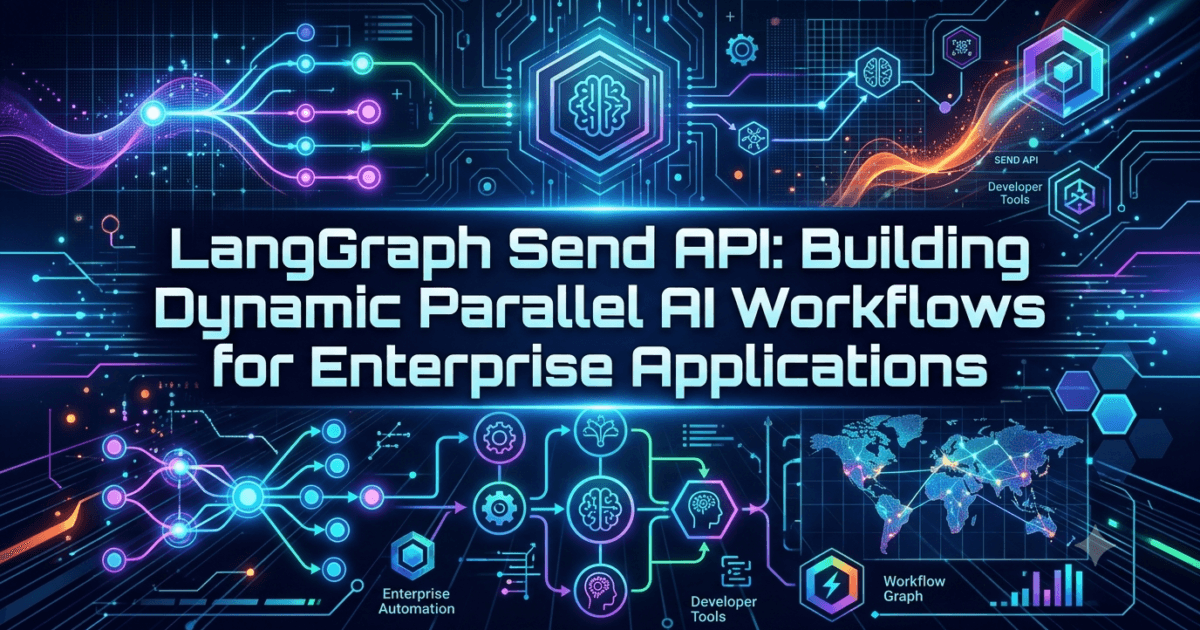
Introduction
As AI workflows become larger and more sophisticated, executing every task sequentially is no longer the most efficient approach. Many enterprise AI applications perform multiple independent operations that do not rely on one another. Executing these tasks one after another increases latency, consumes additional resources, and limits the scalability of the application.
Imagine an enterprise AI assistant that receives the following request:
“Analyze this customer support ticket, identify customer sentiment, extract key entities, classify the issue, search the knowledge base, and generate a response.”
If each operation executes sequentially, the workflow might spend several seconds waiting for one task to finish before starting the next.
However, these operations are independent.
- Sentiment Analysis
- Entity Extraction
- Issue Classification
- Knowledge Base Search
can all execute simultaneously.
This is where the LangGraph Send API becomes one of the most powerful features for building high-performance AI applications.
The LangGraph Send API enables developers to dynamically dispatch multiple workflow executions in parallel instead of following a single sequential execution path. Rather than manually defining every parallel branch during graph construction, the LangGraph Send API creates workflow branches dynamically at runtime based on the current workflow state.
Unlike traditional graph execution, where one node transitions directly to another, the LangGraph Send API allows a single node to generate multiple independent execution paths that run concurrently before eventually converging back into the primary workflow.
This capability makes the LangGraph Send API essential for enterprise AI systems that process large datasets, coordinate multiple AI agents, distribute workloads, perform batch operations, or execute complex reasoning pipelines.
Organizations building production AI applications increasingly rely on the LangGraph Send API because it improves scalability, reduces execution time, increases resource utilization, and simplifies workflow orchestration.
Throughout this lesson, you’ll learn what the LangGraph Send API is, how it works, why it differs from traditional routing mechanisms, and how it enables developers to build highly scalable, production-ready LangGraph workflows.
What Is the LangGraph Send API?
The LangGraph Send API is a workflow execution mechanism that dynamically creates multiple parallel tasks during graph execution.
Instead of routing execution to only one downstream node, the LangGraph Send API can dispatch multiple workflow branches simultaneously.
Each dispatched branch executes independently while receiving its own workflow context.
A simplified architecture looks like this:
                    User Request
                          │
                          ▼
                  Processing Node
                          │
                          ▼
                 LangGraph Send API
          ┌──────────┬──────────┬──────────┐
          ▼          ▼          ▼          ▼
      Task A     Task B     Task C     Task D
          │          │          │          │
          └──────────┴──────────┴──────────┘
                         ▼
                 Aggregate Results
                         │
                         ▼
                  Final Response
Unlike static workflow definitions, the LangGraph Send API creates these parallel branches dynamically according to runtime conditions.
This flexibility allows AI workflows to scale naturally as workload size increases.
Why the LangGraph Send API Was Introduced
Traditional workflow execution follows a predictable sequence.
User Request

      │

Node A

      │

Node B

      │

Node C

      │

Complete
While this architecture works well for simple applications, it becomes inefficient when several tasks can execute independently.
Suppose an AI workflow must analyze ten uploaded documents.
Without the LangGraph Send API, the workflow might process:
Document 1

↓

Document 2

↓

Document 3

↓

...

↓

Document 10
Each document waits for the previous one to finish.
The total execution time increases linearly.
The LangGraph Send API solves this problem by dispatching all document processing tasks simultaneously.
                 Uploaded Documents
                        │
                        ▼
               LangGraph Send API
        ┌──────┬──────┬──────┬──────┐
        ▼      ▼      ▼      ▼
      Doc1   Doc2   Doc3   Doc4 ...
        │      │      │      │
        └──────┴──────┴──────┘
               ▼
      Merge Processing Results
This significantly improves throughput while reducing overall execution time.
How the LangGraph Send API Works
The LangGraph Send API follows a simple execution model.
A workflow node analyzes the current workflow state before determining whether parallel execution is beneficial.
If multiple independent tasks exist, the node generates several Send operations.
Each Send operation creates an independent workflow execution.
The overall lifecycle looks like this:
Receive Workflow State

        │

Analyze Input

        │

Generate Send Tasks

        │

────────┼────────

│       │       │

Send1  Send2  Send3

│       │       │

Parallel Execution

│       │       │

────────┼────────

        ▼

Merge Results

        ▼

Continue Workflow
Every branch executes independently while preserving the integrity of the overall workflow.
Understanding Dynamic Parallel Execution
One of the defining characteristics of the LangGraph Send API is that parallel branches are created dynamically.
The number of branches is not fixed.
Instead, it depends entirely on the workflow state.
For example:
Uploaded Files

3 Files

↓

Create 3 Send Tasks
Another execution may contain:
Uploaded Files

120 Files

↓

Create 120 Send Tasks
The graph structure remains unchanged.
Only the number of runtime executions changes.
This makes the LangGraph Send API extremely flexible for enterprise applications where workload size varies continuously.
Common Use Cases for the LangGraph Send API
The LangGraph Send API is useful whenever independent tasks can execute simultaneously.
Common examples include:
Document Processing
Large document collections can be processed in parallel.
Examples include:
- PDF analysis
- Contract review
- Invoice processing
- Resume screening
- Medical records
- Compliance reports
Each document becomes an independent workflow branch.
Multi-Agent Collaboration
Specialized AI agents often perform independent work.
Examples include:
- Research Agent
- Coding Agent
- Documentation Agent
- Testing Agent
- Security Review Agent
The LangGraph Send API allows these agents to work concurrently before combining their outputs.
Large Dataset Analysis
Enterprise analytics platforms frequently process:
- Customer records
- Sales transactions
- Log files
- Sensor data
- Product catalogs
Parallel execution dramatically reduces processing time.
Knowledge Retrieval
Rather than searching one knowledge source at a time, the LangGraph Send API can simultaneously query:
- Internal documentation
- Company wiki
- API documentation
- Vector databases
- External knowledge sources
The workflow later combines all retrieved information into a single response.
Benefits of the LangGraph Send API
Organizations increasingly adopt the LangGraph Send API because it provides several significant advantages.
Faster Workflow Execution
Independent tasks execute simultaneously instead of sequentially.
Better Resource Utilization
Available computing resources remain active instead of waiting for previous tasks to complete.
Improved Scalability
Applications continue performing efficiently even as workload size increases.
Cleaner Workflow Design
Developers no longer need to manually define every possible parallel branch.
Enterprise Performance
Large AI applications process thousands of independent tasks far more efficiently using the LangGraph Send API.
LangGraph Send API vs Sequential Workflows
Understanding the difference between sequential execution and the LangGraph Send API is important.
Sequential workflow:
Task A

↓

Task B

↓

Task C

↓

Task D
Parallel workflow using the LangGraph Send API:
          Task A
             │
 ┌───────────┼───────────┐
 ▼           ▼           ▼
Task B    Task C     Task D
 └───────────┼───────────┘
             ▼
        Merge Results
Both workflows produce the same outcome.
However, the LangGraph Send API achieves the result much more efficiently by executing independent operations simultaneously.
Understanding the Architecture of the LangGraph Send API
After understanding the fundamentals of the LangGraph Send API, the next step is to explore how it works internally. Understanding the architecture of the LangGraph Send API is essential because it explains why this feature is one of the most powerful mechanisms for building scalable, production-ready AI workflows.
Unlike traditional workflow execution, where one node simply hands control to the next node, the LangGraph Send API allows a node to generate multiple independent execution paths dynamically. Each path receives its own workflow context, executes independently, and eventually contributes its results back to the parent workflow.
Instead of thinking of the workflow as a straight line, developers should think of the LangGraph Send API as a branching execution engine capable of distributing work across multiple concurrent tasks.
A typical LangGraph Send API architecture looks like this:
                   Current Workflow State
                            │
                            ▼
                    Processing Node
                            │
                            ▼
                  Analyze Runtime Data
                            │
                            ▼
                  LangGraph Send API
          ┌─────────┬─────────┬─────────┐
          ▼         ▼         ▼         ▼
      Worker 1   Worker 2   Worker 3   Worker 4
          │         │         │         │
          └─────────┴─────────┴─────────┘
                            ▼
                  Aggregate All Results
                            │
                            ▼
                  Continue Workflow
The ability to dynamically create parallel execution paths makes the LangGraph Send API fundamentally different from traditional workflow routing.
The Core Components of the LangGraph Send API
Every LangGraph Send API execution consists of several architectural components working together.
Parent Workflow
The parent workflow controls the overall execution process.
It is responsible for:
- Receiving user requests
- Maintaining the shared workflow state
- Creating Send tasks
- Collecting results
- Continuing graph execution
The parent workflow never performs every task itself.
Instead, it delegates work to child executions.
Processing Node
The processing node analyzes the workflow state before deciding whether parallel execution is required.
Typical responsibilities include:
- Reading workflow state
- Evaluating workload size
- Splitting large tasks
- Creating Send operations
Instead of processing every item individually, it prepares work for multiple workers.
Send Tasks
Each Send task represents one independent workflow execution.
Every task receives:
- Input data
- Workflow context
- Assigned responsibility
For example:
Customer Records

        │

────────┼────────

│       │       │

Send 1 Send 2 Send 3

│       │       │

Customer A
Customer B
Customer C
Each Send task operates independently without interfering with other tasks.
Result Aggregation
After every parallel branch completes execution, the workflow collects all outputs.
Worker 1 Result

        │

Worker 2 Result

        │

Worker 3 Result

        │

────────┼────────

        ▼

Merged Output
The merged data becomes available for downstream nodes.
This aggregation stage is a key part of every LangGraph Send API workflow.
Workflow Lifecycle of the LangGraph Send API
A LangGraph Send API execution follows a predictable lifecycle.
Receive Workflow State

        │

Analyze Workload

        │

Generate Send Tasks

        │

Parallel Execution

        │

Collect Results

        │

Merge State

        │

Continue Workflow
Although multiple tasks execute simultaneously, LangGraph maintains complete control over workflow consistency.
Dynamic Task Generation
One of the defining characteristics of the LangGraph Send API is dynamic task generation.
Unlike static workflows, the number of parallel tasks is determined during execution.
Consider an AI document processing application.
Case 1:
Documents

3 Files

↓

Create 3 Workers
Case 2:
Documents

250 Files

↓

Create 250 Workers
Notice that the graph definition never changes.
Only the runtime behavior changes.
This flexibility allows the LangGraph Send API to scale automatically according to workload size.
Workflow State in the LangGraph Send API
Many developers wonder how workflow state behaves during parallel execution.
Each Send task receives its own execution context.
For example:
Parent State

User:
Alice

Task:
Analyze Reports

Reports:
50
The LangGraph Send API creates multiple child executions.
Worker 1

Report 1

────────────

Worker 2

Report 2

────────────

Worker 3

Report 3
Each worker processes its assigned data independently.
After execution finishes, results are merged back into the parent workflow.
This architecture prevents workers from accidentally modifying one another’s execution state.
How the LangGraph Send API Differs from Traditional Loops
Many developers initially compare the LangGraph Send API to a standard programming loop.
Although both process multiple items, they operate very differently.
Traditional loop:
Item 1

↓

Item 2

↓

Item 3

↓

Item 4
Every item waits for the previous one.
The LangGraph Send API executes differently.
Items

        │

────────┼────────

│       │       │

Item1  Item2  Item3

│       │       │

Parallel Execution
Instead of waiting, multiple tasks execute concurrently.
This significantly improves performance for independent workloads.
LangGraph Send API vs Conditional Edges
Developers frequently ask whether the LangGraph Send API replaces Conditional Edges.
The answer is no.
Each feature solves a different problem.
| Conditional Edges | LangGraph Send API |
|---|---|
| Routes to one next node | Creates multiple parallel executions |
| Single execution path | Multiple concurrent execution paths |
| Best for branching decisions | Best for workload distribution |
| Static graph routing | Dynamic runtime task generation |
| Sequential execution | Parallel execution |
Enterprise workflows often use both together.
Conditional Edges determine whether parallel processing should occur.
The LangGraph Send API performs the parallel execution.
LangGraph Send API vs Command Object
The LangGraph Command Object and the LangGraph Send API are also complementary rather than competing features.
| LangGraph Command Object | LangGraph Send API |
|---|---|
| Controls graph routing | Creates parallel execution |
| Updates workflow state | Distributes independent work |
| Selects one next node | Creates many execution branches |
| Ideal for supervisors | Ideal for distributed processing |
Large enterprise AI applications commonly combine both capabilities.
A Supervisor Agent may use the LangGraph Command Object to determine that parallel execution is required.
The workflow then uses the LangGraph Send API to dispatch the work.
Enterprise Use Cases for the LangGraph Send API
Organizations increasingly rely on the LangGraph Send API across numerous industries.
Examples include:
AI Document Processing
Thousands of documents can be analyzed simultaneously.
Financial Analytics
Multiple customer accounts can be evaluated in parallel.
Cybersecurity
Independent log files can be scanned concurrently for suspicious activity.
Software Engineering
Code quality analysis, security scanning, documentation generation, and unit testing can execute simultaneously.
Healthcare
Large collections of medical reports can be processed independently before generating consolidated insights.
These enterprise workloads would be considerably slower using sequential execution.
Benefits of the LangGraph Send API
The LangGraph Send API provides several architectural advantages.
Improved Performance
Multiple tasks execute simultaneously, reducing total workflow duration.
Automatic Scalability
The number of execution branches adapts dynamically to the workload.
Better Resource Utilization
Available compute resources remain active throughout execution.
Cleaner Workflow Design
Developers avoid manually defining dozens of parallel graph branches.
Enterprise Flexibility
The LangGraph Send API supports highly dynamic workflows capable of handling varying workloads without redesigning the graph.
Preparing to Build Parallel LangGraph Workflows
Understanding the architecture of the LangGraph Send API provides the foundation for building highly scalable AI applications. By dynamically creating parallel workflow branches, the LangGraph Send API enables developers to process large workloads efficiently while keeping workflow definitions clean, modular, and maintainable.
Implementing the LangGraph Send API Using Python
Now that you understand the architecture of the LangGraph Send API, it’s time to explore how developers implement it in real-world LangGraph applications.
The LangGraph Send API is designed to distribute work dynamically across multiple workflow branches. Instead of processing every task sequentially, a node analyzes the workload, creates multiple Send operations, and allows LangGraph to execute them in parallel.
This approach significantly improves the performance of AI applications that handle large datasets, multiple documents, independent API calls, or collaborative AI agents.
Unlike traditional workflows where developers manually define every execution path, the LangGraph Send API creates workflow branches automatically at runtime based on the current workflow state.
A simplified implementation flow looks like this:
                 Workflow State
                       │
                       ▼
               Processing Node
                       │
          Analyze Current Workload
                       │
                       ▼
            Generate Send Tasks
        ┌────────┬────────┬────────┐
        ▼        ▼        ▼        ▼
    Worker 1  Worker 2  Worker 3  Worker 4
        │        │        │        │
        └────────┴────────┴────────┘
                  ▼
           Merge All Results
                  │
                  ▼
          Continue Workflow
This execution model allows the LangGraph Send API to scale naturally as workloads increase.
Step 1: Analyze the Current Workflow State
Every LangGraph Send API execution begins with the shared workflow state.
The processing node examines the available information before deciding whether parallel execution is necessary.
The workflow state may contain:
- Uploaded documents
- Customer records
- Product information
- API requests
- Search queries
- User messages
- Business transactions
- Images awaiting analysis
For example:
Workflow State

Documents:
25

Task:
Summarize Documents

Status:
Pending
The node recognizes that twenty-five documents can be processed independently.
Rather than analyzing each document one after another, it prepares multiple Send tasks.
Step 2: Split the Workload
After evaluating the workflow state, the processing node divides the workload into smaller independent units.
Consider an invoice processing application.
Instead of creating one large processing task, the LangGraph Send API creates one task for each invoice.
Invoices

        │

────────┼────────

│       │       │

Invoice A
Invoice B
Invoice C
Invoice D
Each invoice becomes its own execution branch.
This workload decomposition allows all invoices to be processed simultaneously.
Step 3: Generate Send Operations
The defining feature of the LangGraph Send API is dynamic task creation.
Rather than manually defining parallel branches, the workflow generates Send operations during execution.
Conceptually the process looks like this:
Workload

        │

Generate Send Tasks

        │

────────┼────────

│       │       │

Send A Send B Send C

│       │       │

Worker A
Worker B
Worker C
Every Send operation represents an independent workflow execution.
The number of Send tasks depends entirely on runtime data.
One execution may generate five workers.
Another may generate five hundred.
The graph definition itself never changes.
Step 4: Execute Parallel Workflow Branches
After creating Send tasks, LangGraph schedules every branch independently.
Each worker receives:
- Assigned input
- Required workflow context
- Execution instructions
For example:
Processing Images

        │

────────┼────────

│       │       │

Image 1
Image 2
Image 3

│       │       │

Classification
Classification
Classification
Because every image is processed independently, overall execution finishes much faster than a sequential implementation.
This ability to process many independent tasks simultaneously is one of the greatest strengths of the LangGraph Send API.
Step 5: Aggregate Parallel Results
Once every worker completes execution, LangGraph combines all outputs.
The aggregation stage ensures downstream nodes receive a complete picture of the completed work.
Worker 1

        │

Worker 2

        │

Worker 3

        │

────────┼────────

        ▼

Combined Output
The merged workflow state can then continue through the remaining graph.
Result aggregation is automatic, allowing developers to focus on business logic rather than synchronization.
Implementing the LangGraph Send API in Multi-Agent Systems
The LangGraph Send API plays an important role in advanced multi-agent architectures.
Imagine an AI software engineering platform responsible for building an application.
Instead of assigning every responsibility to one agent, the workflow distributes tasks across multiple specialists.
                  User Request
                        │
                        ▼
                Planning Agent
                        │
                        ▼
             LangGraph Send API
      ┌──────────┬──────────┬──────────┐
      ▼          ▼          ▼          ▼
 Research   Code Generation  Testing  Documentation
      │          │          │          │
      └──────────┴──────────┴──────────┘
                     ▼
              Final Review Agent
Each specialized agent works independently before the workflow combines their outputs into a final response.
Without the LangGraph Send API, these tasks would execute sequentially, increasing response time significantly.
Using the LangGraph Send API for Document Processing
Document processing is one of the most common enterprise use cases.
Suppose an organization uploads hundreds of compliance reports.
The workflow becomes:
Upload Reports

        │

Split Reports

        │

────────┼────────

│       │       │

Report 1
Report 2
Report 3

│       │       │

Analyze
Analyze
Analyze

│       │       │

────────┼────────

        ▼

Generate Summary
The LangGraph Send API dramatically reduces processing time by distributing work across independent execution branches.
Combining the LangGraph Send API with Tool Calling
Enterprise AI applications frequently integrate external services.
Examples include:
- CRM systems
- Search APIs
- Internal databases
- Financial platforms
- Cloud storage
- Vector databases
Instead of calling these services one by one, the LangGraph Send API enables simultaneous API requests.
Customer Request

        │

────────┼────────

│       │       │

CRM API
Knowledge API
Search API

│       │       │

────────┼────────

        ▼

Merge Responses
The combined information becomes available for downstream reasoning.
This reduces latency while improving user experience.
Common Implementation Mistakes
Developers new to the LangGraph Send API often make several architectural mistakes.
Parallelizing Dependent Tasks
Only independent work should execute through the LangGraph Send API.
If Task B requires the output of Task A, sequential execution remains the correct approach.
Creating Excessive Parallel Tasks
Although the LangGraph Send API scales efficiently, generating thousands of unnecessary workers increases system overhead.
Developers should group workloads appropriately when handling extremely large datasets.
Ignoring Result Aggregation
Every parallel workflow eventually produces outputs.
Applications should define a clear strategy for combining those results before continuing execution.
Mixing Business Logic Across Workers
Each worker should perform one clearly defined responsibility.
Smaller, focused execution branches are easier to test, monitor, and maintain.
Best Practices for Using the LangGraph Send API
Organizations building production AI applications typically follow several proven practices.
Parallelize Only Independent Work
Tasks should execute independently without requiring intermediate synchronization.
Keep Workers Small
Smaller tasks improve fault isolation and simplify debugging.
Design for Variable Workloads
The LangGraph Send API should adapt naturally whether processing five items or five thousand.
Combine with Other LangGraph Features
The LangGraph Send API integrates exceptionally well with:
- LangGraph Command Object
- Supervisor Pattern
- Multi-Agent Systems
- Tool Calling Agents
- Shared State
- Checkpointing
- Persistence
- Interrupts
Together, these capabilities enable highly scalable enterprise AI workflows.
Moving Toward High-Performance AI Workflow Design
The LangGraph Send API transforms how developers build scalable AI systems by enabling dynamic parallel execution without increasing graph complexity. Instead of processing workloads sequentially, developers can distribute independent tasks across multiple execution branches, improving performance, scalability, and resource utilization.
Advanced Design Patterns with the LangGraph Send API
As AI applications continue to grow in complexity, parallel execution is no longer just a performance optimization—it has become an essential architectural requirement. Enterprise AI systems frequently process hundreds or even thousands of independent tasks simultaneously, making sequential workflows inefficient and difficult to scale.
The LangGraph Send API addresses this challenge by allowing developers to distribute workloads dynamically across multiple workflow branches while maintaining a clean and maintainable graph structure.
Unlike traditional workflow engines that require every execution path to be predefined, the LangGraph Send API enables workflows to create execution branches dynamically based on runtime data. This makes AI applications more flexible, scalable, and capable of adapting to changing business requirements.
Organizations building production AI platforms increasingly rely on the LangGraph Send API to accelerate processing, improve throughput, and simplify orchestration across distributed AI systems.
Building Large-Scale Document Processing Pipelines
One of the most common enterprise use cases for the LangGraph Send API is large-scale document processing.
Consider an organization that receives hundreds of contracts every day.
Each contract must undergo several independent operations:
- Text extraction
- Language detection
- Clause identification
- Risk analysis
- Compliance validation
- Document summarization
Instead of processing every contract one after another, the LangGraph Send API distributes the workload dynamically.
                 Uploaded Contracts
                         │
                         ▼
                LangGraph Send API
      ┌──────────┬──────────┬──────────┐
      ▼          ▼          ▼          ▼
 Contract 1  Contract 2  Contract 3  Contract 4
      │          │          │          │
      └──────────┴──────────┴──────────┘
                     ▼
             Consolidated Report
Each contract is processed independently before the workflow combines the results into a single report.
This architecture significantly reduces processing time while maintaining consistent workflow behavior.
Using the LangGraph Send API in Multi-Agent Systems
Modern AI applications often consist of multiple specialized agents working together.
The LangGraph Send API allows these agents to execute concurrently whenever their responsibilities are independent.
For example, an AI software engineering assistant may include:
- Research Agent
- Backend Development Agent
- Frontend Development Agent
- Testing Agent
- Documentation Agent
- Security Review Agent
Instead of executing one after another, the LangGraph Send API enables these agents to work simultaneously.
                   Planner Agent
                         │
                         ▼
                LangGraph Send API
     ┌────────┬────────┬────────┬────────┐
     ▼        ▼        ▼        ▼
 Research  Backend  Frontend  Testing
     │        │        │        │
     └────────┴────────┴────────┘
               ▼
       Documentation Agent
               ▼
          Final Response
Because every agent performs a specialized task independently, the workflow completes much faster than a sequential implementation.
Combining the LangGraph Send API with the Command Object
Enterprise LangGraph applications rarely use one feature in isolation.
The LangGraph Send API works exceptionally well with the LangGraph Command Object.
A common execution sequence looks like this:
Current Workflow

        │

Supervisor Decision

        │

Command Object

        │

Determine Parallel Work

        │

LangGraph Send API

        │

Parallel Execution

        │

Aggregate Results
The LangGraph Command Object determines what should happen next, while the LangGraph Send API determines how the workload should be distributed.
Together, they provide a highly flexible orchestration model for enterprise AI systems.
Parallel Knowledge Retrieval
Retrieval-Augmented Generation (RAG) systems often query multiple knowledge sources before generating a response.
Instead of searching each source sequentially, the LangGraph Send API allows simultaneous retrieval.
For example:
                  User Question
                        │
                        ▼
               LangGraph Send API
     ┌────────┬────────┬────────┬────────┐
     ▼        ▼        ▼        ▼
 Vector DB  Company Wiki  API Docs  SQL Database
     │        │        │        │
     └────────┴────────┴────────┘
               ▼
       Combine Retrieved Data
               ▼
        Generate Final Answer
This architecture reduces response time while improving the completeness of retrieved information.
Parallel Tool Calling
Many enterprise AI assistants interact with multiple external systems.
Examples include:
- Customer Relationship Management (CRM)
- Enterprise Resource Planning (ERP)
- Inventory Management
- Payment Systems
- Internal APIs
- Cloud Storage
The LangGraph Send API enables these systems to be queried simultaneously.
Customer Request

        │

────────┼────────

│       │       │

CRM

ERP

Inventory

│       │       │

────────┼────────

        ▼

Combined Business Data
Rather than waiting for each external service individually, the workflow gathers all information concurrently.
Best Practices for Using the LangGraph Send API
Organizations successfully implementing the LangGraph Send API generally follow several architectural principles.
Parallelize Only Independent Tasks
The LangGraph Send API should only be used when tasks do not depend on one another.
Independent execution improves performance without introducing synchronization issues.
Keep Worker Responsibilities Small
Each parallel worker should perform one clearly defined responsibility.
Smaller execution units improve:
- Reliability
- Debugging
- Reusability
- Monitoring
Design for Variable Workloads
Enterprise workloads constantly change.
The LangGraph Send API should support:
- Five tasks
- Fifty tasks
- Five hundred tasks
- Five thousand tasks
without requiring workflow redesign.
Merge Results Carefully
Parallel execution eventually produces multiple outputs.
Developers should define a clear aggregation strategy that combines results consistently before downstream processing begins.
Monitor Parallel Execution
Production AI systems should monitor:
- Worker failures
- Execution duration
- Retry attempts
- Resource utilization
- Processing bottlenecks
Monitoring helps maintain reliable enterprise workflows.
Common Mistakes to Avoid
Although the LangGraph Send API is straightforward to use, developers frequently encounter several design mistakes.
Using Parallel Execution for Sequential Problems
Not every workflow benefits from parallel execution.
If one task depends on another, sequential processing remains the correct solution.
Creating Too Many Small Tasks
Extremely fine-grained task splitting can introduce unnecessary scheduling overhead.
Developers should choose task sizes that balance concurrency with execution efficiency.
Ignoring Failure Handling
Some parallel workers may fail while others succeed.
Enterprise workflows should include strategies for retries, error reporting, and graceful recovery.
Forgetting Result Aggregation
Parallel execution is only valuable when downstream nodes receive complete and consistent results.
Aggregation logic should always be part of the workflow design.
Enterprise Benefits of the LangGraph Send API
Organizations adopting the LangGraph Send API experience several long-term advantages.
These include:
- Faster workflow execution
- Better scalability
- Improved resource utilization
- Reduced processing latency
- Cleaner workflow architecture
- Dynamic workload distribution
- Better support for multi-agent collaboration
- Efficient batch processing
- Simplified enterprise orchestration
- Improved user experience
These advantages become increasingly important as AI applications grow from small prototypes into enterprise-scale platforms handling thousands of concurrent operations.
Conclusion
The LangGraph Send API is one of the most powerful capabilities available in LangGraph for building scalable AI applications. By enabling dynamic parallel execution, it allows developers to distribute independent workloads efficiently without increasing graph complexity. Instead of processing tasks sequentially, the LangGraph Send API creates execution branches at runtime, improving performance, reducing latency, and making better use of available computing resources.
Whether you’re building document processing systems, multi-agent applications, enterprise automation platforms, or Retrieval-Augmented Generation (RAG) workflows, the LangGraph Send API provides the flexibility required to develop high-performance, production-ready AI systems.
As you continue mastering LangGraph, understanding how to combine the LangGraph Send API with features such as the LangGraph Command Object, Supervisor Pattern, Tool Calling Agents, and Shared State will enable you to design intelligent AI workflows that scale efficiently and remain easy to maintain.
Featured Snippet
What Is the LangGraph Send API?
The LangGraph Send API is a workflow execution feature that enables LangGraph nodes to dynamically create multiple parallel execution branches during runtime. It allows independent tasks to run simultaneously, improving workflow performance, scalability, and resource utilization while simplifying enterprise AI workflow orchestration.
AI Overview Answer
The LangGraph Send API helps developers build scalable AI workflows by enabling dynamic parallel execution. Instead of processing tasks sequentially, the Send API distributes independent workloads across multiple execution branches, significantly improving performance and reducing execution time. It is widely used in document processing, multi-agent systems, Retrieval-Augmented Generation (RAG), batch processing, enterprise automation, and production AI applications where efficient workload distribution is essential.
People Asked Questions (PAQ)
What is the LangGraph Send API?
The LangGraph Send API is a feature that allows LangGraph workflows to dynamically create multiple parallel execution branches. It distributes independent tasks across concurrent workers, making AI workflows faster and more scalable.
Why should I use the LangGraph Send API?
The LangGraph Send API improves workflow performance by executing independent tasks simultaneously instead of sequentially. It is particularly useful for enterprise AI applications handling large datasets, document processing, and multi-agent collaboration.
How is the LangGraph Send API different from the Command Object?
The LangGraph Command Object controls workflow routing and updates the workflow state, whereas the LangGraph Send API focuses on creating multiple parallel execution branches. Both features complement each other and are often used together in enterprise LangGraph applications.
Can the LangGraph Send API be used with Multi-Agent Systems?
Yes. The LangGraph Send API enables multiple AI agents to work concurrently on independent tasks such as research, coding, testing, documentation, and validation before combining their outputs into a unified response.
Is the LangGraph Send API suitable for batch processing?
Absolutely. The LangGraph Send API is ideal for processing batches of documents, customer records, invoices, images, log files, or transactions because it distributes workloads dynamically across parallel execution branches.
Does the LangGraph Send API support Retrieval-Augmented Generation (RAG)?
Yes. The LangGraph Send API allows RAG applications to query multiple knowledge sources simultaneously, including vector databases, internal documentation, APIs, and enterprise knowledge bases, reducing response times and improving retrieval quality.
Can the LangGraph Send API be combined with Tool Calling Agents?
Yes. The LangGraph Send API works seamlessly with Tool Calling Agents by enabling multiple API calls or external service requests to execute concurrently before aggregating the results for downstream reasoning.
Is the LangGraph Send API recommended for production AI applications?
Yes. The LangGraph Send API is designed for production-grade AI systems that require scalable parallel execution, efficient workload distribution, improved resource utilization, and high-performance workflow orchestration.
Internal Links:
- Learn MCP – Zero to Hero
- Learn AI Agents for QA – Zero to Hero
- Playwright Automation – Zero to Hero
- LangGraph: Complete Zero to Hero
- Learn Python – Zero to Hero
- OpenAI Codex: Complete Zero to Hero
- Cursor AI: Complete Zero to Hero
- Claude Code Tutorial: Complete Zero to Hero
- Free QA Resources Built From Real Experience
- QA Glossary: Test Automation Terms Every Engineer Should Know
External Resources:
- LangGraph Official Documentation
- LangChain Documentation
- Python Official Documentation
- OpenAI Platform Documentation
- Anthropic Documentation
- Google AI Documentation
- LangGraph GitHub Repository
Key Takeaways
- The LangGraph Send API enables dynamic parallel execution by creating multiple workflow branches during runtime.
- The LangGraph Send API improves performance by allowing independent tasks to execute simultaneously instead of sequentially.
- Enterprise AI applications use the LangGraph Send API for document processing, multi-agent collaboration, batch processing, parallel tool calling, and large-scale data analysis.
- The LangGraph Send API works seamlessly with the LangGraph Command Object, Supervisor Pattern, Tool Calling Agents, Shared State, and other advanced LangGraph features.
- Developers should use the LangGraph Send API only for independent tasks and implement proper result aggregation, monitoring, and error handling to build reliable, production-ready AI workflows.
- Mastering the LangGraph Send API is essential for creating scalable, high-performance LangGraph applications capable of handling complex enterprise workloads efficiently.
Enjoyed this article? Explore more in-depth guides on AI engineering, automation testing, Model Context Protocol, Playwright, and intelligent software quality at www.skakarh.com. Follow QAPulse by SK for practical, production-focused tutorials designed for QA engineers, SDETs, and AI developers.