 QA
QA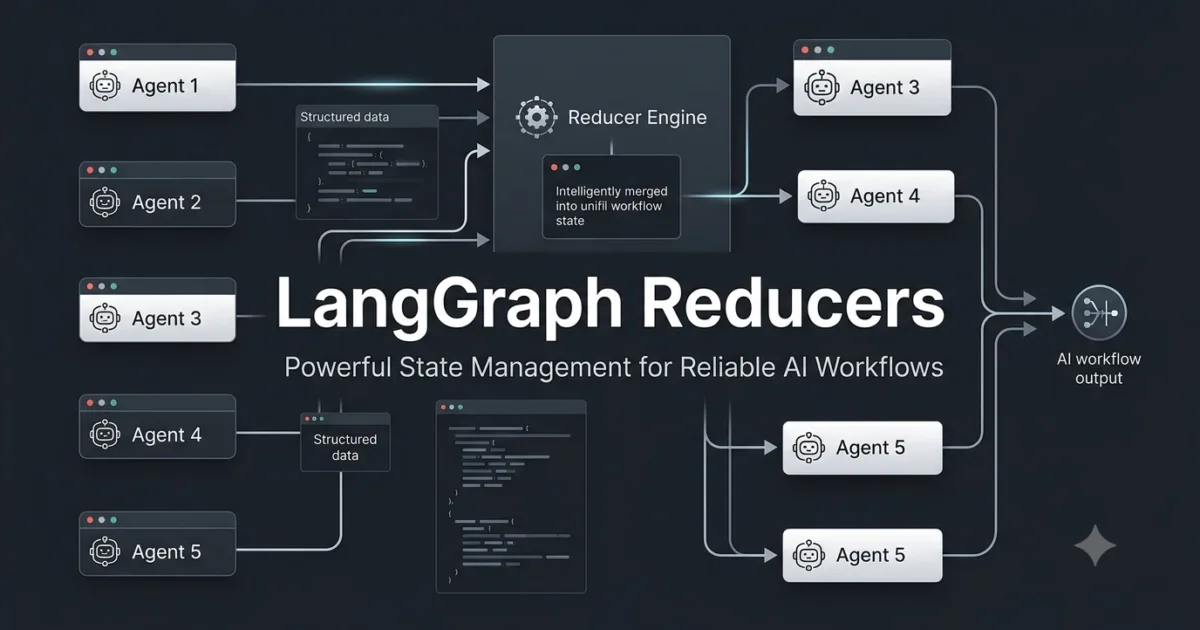
Introduction
As LangGraph applications become more advanced, managing workflow state becomes increasingly important. A simple AI workflow may begin with a small amount of information, such as a user question and an AI response. However, production-grade applications quickly become more complicated.
A single workflow may contain multiple agents, parallel operations, tool calls, document processing steps, validation nodes, human interactions, and external services. All of these components may need to read from and update the same workflow state.
This creates an important architectural question:
What should happen when multiple LangGraph nodes update the same state field?
This is where LangGraph Reducers become essential.
A reducer defines how updates to a particular state field should be combined when multiple updates occur. Instead of simply replacing existing state values, a reducer can determine whether new information should be appended, merged, accumulated, deduplicated, or processed according to custom logic.
Understanding LangGraph Reducers is therefore critical for developers building parallel workflows, multi-agent systems, message-based applications, data-processing pipelines, and production-ready AI agents.
In this lesson, we will explore what reducers are, why they are necessary, how they interact with LangGraph state, and how they help coordinate information across increasingly complex graph architectures.
What Are LangGraph Reducers?
A reducer is a function that determines how a state field should be updated when a node returns a new value.
Consider a simple state definition:
from typing import TypedDict


class AgentState(TypedDict):
    message: str
Suppose a node returns:
{
    "message": "Hello from the agent"
}
The new value replaces the previous value of message.
For many workflows, this default behavior is perfectly acceptable.
However, imagine that multiple nodes are generating pieces of information that all need to be preserved.
For example:
Research Agent
      │
      ├── Finding A
      │
      ▼

Research Agent 2
      │
      ├── Finding B
      │
      ▼

Research Agent 3
      │
      ├── Finding C
If all three nodes write to the same state field and the field simply uses replacement semantics, the workflow may not retain all of the information.
Instead, we may want:
[
    "Finding A",
    "Finding B",
    "Finding C"
]
A reducer provides the mechanism for defining that behavior.
Conceptually:
Existing State + New Update
           │
           ▼
        Reducer
           │
           ▼
     Updated State
This simple idea becomes extremely powerful when combined with LangGraph parallel execution.
Why State Management Becomes Difficult in Large LangGraph Applications
State management is relatively straightforward when a graph executes sequentially.
Consider:
START
  │
  ▼
Research
  │
  ▼
Analysis
  │
  ▼
Summary
  │
  ▼
END
Each node executes after the previous node.
The state flow is predictable:
Initial State
     │
     ▼
Research Update
     │
     ▼
Analysis Update
     │
     ▼
Summary Update
But modern AI applications often require parallel execution.
For example:
                    START
                      │
                      ▼
                   Router
                      │
          ┌───────────┼───────────┐
          ▼           ▼           ▼
       Agent A     Agent B     Agent C
          │           │           │
          └───────────┼───────────┘
                      ▼
                  Aggregator
                      │
                      ▼
                     END
Now several nodes may produce updates that need to be combined.
Suppose:
Agent A → ["Python", "LangGraph"]

Agent B → ["Agents", "RAG"]

Agent C → ["Testing", "Automation"]
The final state may need to contain:
[
    "Python",
    "LangGraph",
    "Agents",
    "RAG",
    "Testing",
    "Automation"
]
Simply replacing the state value would not provide the desired behavior.
This is one of the most important reasons to understand LangGraph Reducers.
Default State Updates vs Reducer-Based Updates
To understand reducers properly, it helps to distinguish between two different state-update behaviors.
Default State Update
Suppose we define:
from typing import TypedDict


class State(TypedDict):
    result: str
A node might return:
{
    "result": "First result"
}
The state becomes:
result = "First result"
Another node later returns:
{
    "result": "Second result"
}
The value becomes:
result = "Second result"
The previous value has effectively been replaced.
Reducer-Based State Update
Now consider a list field:
from typing import Annotated, TypedDict
import operator


class State(TypedDict):
    results: Annotated[list[str], operator.add]
The reducer tells LangGraph how updates should be combined.
Suppose one node produces:
{
    "results": ["First result"]
}
and another produces:
{
    "results": ["Second result"]
}
The resulting state can contain:
[
    "First result",
    "Second result"
]
The important concept is that the reducer defines the aggregation behavior.
The Basic Reducer Pattern
A common pattern uses Python’s operator.add.
import operator
from typing import Annotated, TypedDict


class State(TypedDict):
    results: Annotated[list[str], operator.add]
Here:
Annotated[list[str], operator.add]
communicates that updates to results should be combined using the specified reducer.
This can be especially useful when multiple nodes contribute independent pieces of information.
For example:
def research_agent(state: State):
    return {
        "results": ["LangGraph supports graph-based workflows."]
    }


def documentation_agent(state: State):
    return {
        "results": ["Reducers control how state updates are combined."]
    }
Rather than having one result overwrite another, the reducer can combine them.
Understanding the Reducer Function
At a conceptual level, a reducer can be thought of as:
def reducer(existing_value, new_value):
    return combined_value
For example:
def combine_results(existing, new):
    return existing + new
If the current state contains:
["A", "B"]
and the new update contains:
["C", "D"]
the reducer produces:
["A", "B", "C", "D"]
So the reducer acts as a rule for state aggregation.
Conceptually:
Existing State
      │
      │ ["A", "B"]
      ▼
   Reducer
      ▲
      │ ["C", "D"]
      │
New Update

      ↓

["A", "B", "C", "D"]
This becomes especially valuable when building workflows where multiple agents contribute to a shared result.
LangGraph Reducers and Parallel Execution
One of the strongest use cases for LangGraph Reducers is parallel execution.
Imagine an AI research system that needs to investigate three sources simultaneously.
                    Research Request
                           │
                           ▼
                       Dispatcher
                           │
              ┌────────────┼────────────┐
              ▼            ▼            ▼
          Web Agent     Docs Agent    Database Agent
              │            │            │
              ▼            ▼            ▼
          Findings A    Findings B    Findings C
              │            │            │
              └────────────┼────────────┘
                           ▼
                       Aggregator
                           │
                           ▼
                     Final Answer
Each research agent can produce its own findings.
For example:
def web_agent(state):
    return {
        "findings": [
            "Web research result"
        ]
    }


def docs_agent(state):
    return {
        "findings": [
            "Documentation result"
        ]
    }


def database_agent(state):
    return {
        "findings": [
            "Database result"
        ]
    }
A reducer can combine those updates into a shared collection.
This gives the workflow a natural aggregation mechanism.
Why Reducers Matter for Multi-Agent Systems
Multi-agent architectures are one of the most important areas where reducers become useful.
Consider a system containing:
Supervisor
    │
    ├── Research Agent
    ├── Coding Agent
    ├── Testing Agent
    ├── Documentation Agent
    └── Review Agent
Different agents may produce different types of information.
The Research Agent may generate research findings.
The Coding Agent may produce implementation suggestions.
The Testing Agent may generate test results.
The Documentation Agent may produce documentation recommendations.
A shared state might look like:
class State(TypedDict):
    findings: Annotated[list[str], operator.add]
    recommendations: Annotated[list[str], operator.add]
Now different agents can contribute without unnecessarily overwriting each other’s results.
This makes reducers an important building block for collaborative AI systems.
Reducers Are Not Just for Lists
Although list aggregation is one of the easiest examples to understand, reducers are not limited to lists.
They can be used to define custom state-update behavior for many types of data.
For example, you might need to:
- Merge dictionaries
- Accumulate numerical values
- Combine messages
- Append events
- Track execution history
- Aggregate agent outputs
- Maintain tool results
- Deduplicate information
- Apply custom business rules
The key idea is simple:
The reducer determines how the previous value and incoming update should interact.
Dictionary Aggregation
Suppose several nodes contribute metadata.
You might have:
class State(TypedDict):
    metadata: dict
A custom reducer could combine dictionaries.
For example:
def merge_metadata(existing, new):
    return {
        **existing,
        **new
    }
Then:
Existing:

{
    "source": "database",
    "version": 1
}
New update:
{
    "status": "validated"
}
The combined result becomes:
{
    "source": "database",
    "version": 1,
    "status": "validated"
}
This pattern can be useful when different nodes progressively enrich shared workflow state.
Custom Reducers
Developers are not restricted to built-in Python operations.
A custom reducer can implement application-specific logic.
For example:
def merge_unique(existing, new):
    return list(dict.fromkeys(existing + new))
This reducer combines lists while removing duplicates.
Consider:
Existing:

["Python", "LangGraph"]
New update:
["LangGraph", "AI Agents"]
The result becomes:
["Python", "LangGraph", "AI Agents"]
This is useful in research systems where multiple agents may discover the same information.
Reducers and Message History
Message-based applications are another major use case.
An AI assistant may need to maintain a conversation:
User:
Explain LangGraph.

Assistant:
LangGraph is a framework for building stateful workflows.

User:
How does state work?

Assistant:
State carries information between nodes.
The workflow needs to preserve previous messages rather than replace them every time a new message arrives.
This is why message-oriented state schemas often use reducer-style aggregation.
A simplified conceptual example is:
class State(TypedDict):
    messages: Annotated[list, operator.add]
Each node can contribute new messages while the existing conversation remains available.
This is particularly important for:
- Chatbots
- AI assistants
- Multi-turn conversations
- Agentic workflows
- Tool-calling applications
- Human-in-the-loop systems
Reducers and State History
Reducers can also help create an execution history.
Imagine a workflow where every agent reports what it did.
class State(TypedDict):
    history: Annotated[list[str], operator.add]
A node could return:
def research_agent(state):
    return {
        "history": [
            "Research agent completed web research."
        ]
    }
Another node could return:
def testing_agent(state):
    return {
        "history": [
            "Testing agent completed validation."
        ]
    }
The resulting history could become:
[
    "Research agent completed web research.",
    "Testing agent completed validation."
]
This can provide useful context for debugging, auditing, and observability.
Reducers and Enterprise AI Workflows
In enterprise applications, state frequently contains information from multiple systems.
For example:
Customer Request
       │
       ▼
Intent Detection
       │
       ├── CRM Data
       ├── Knowledge Base
       ├── Order System
       ├── Support History
       └── Policy Engine
              │
              ▼
         AI Decision
Each component may add information to the workflow state.
A reducer can help combine those updates into a structured state representation.
This allows the workflow to progressively build a complete context rather than repeatedly replacing previous information.
A Simple Practical Example
Let’s create a small LangGraph workflow where two agents independently generate findings.
import operator
from typing import Annotated, TypedDict

from langgraph.graph import StateGraph, START, END


class ResearchState(TypedDict):
    topic: str
    findings: Annotated[list[str], operator.add]
Now define two nodes:
def research_agent(state: ResearchState):
    return {
        "findings": [
            f"Research completed for {state['topic']}"
        ]
    }


def analysis_agent(state: ResearchState):
    return {
        "findings": [
            f"Analysis completed for {state['topic']}"
        ]
    }
Create the graph:
builder = StateGraph(ResearchState)

builder.add_node("research", research_agent)
builder.add_node("analysis", analysis_agent)

builder.add_edge(START, "research")
builder.add_edge("research", "analysis")
builder.add_edge("analysis", END)

graph = builder.compile()
Invoke it:
result = graph.invoke({
    "topic": "LangGraph",
    "findings": []
})

print(result["findings"])
The reducer ensures that updates to the findings field follow the aggregation behavior defined by the state schema.
Moving Toward Parallel Reducer Workflows
The real power appears when multiple nodes contribute to the same field during parallel execution.
Consider:
                   START
                     │
                     ▼
                 Dispatcher
                     │
          ┌──────────┼──────────┐
          ▼          ▼          ▼
       Research    Analysis   Validation
          │          │          │
          └──────────┼──────────┘
                     ▼
                  Results
                     │
                     ▼
                    END
Without a suitable reducer, developers need to carefully manage how concurrent updates are combined.
With an appropriate reducer, the state schema explicitly declares the aggregation behavior.
That makes the workflow easier to reason about.
The state itself communicates an important architectural decision:
findings: Annotated[list[str], operator.add]
This effectively tells developers:
Multiple updates to this field are expected, and they should be accumulated.
That clarity becomes increasingly valuable as graphs grow.
The Relationship Between State and Reducers
It is useful to think about LangGraph state and reducers as two closely related concepts.
State defines what information the workflow stores.
Reducers define how particular state values should change when updates arrive.
For example:
State
 │
 ├── user_query
 │
 ├── findings
 │       │
 │       └── Reducer: accumulate
 │
 ├── metadata
 │       │
 │       └── Reducer: merge
 │
 └── messages
         │
         └── Reducer: append/aggregate
This distinction allows developers to design state behavior intentionally rather than relying on accidental update semantics.
Why Reducer Design Matters
A poorly designed reducer can create unexpected workflow behavior.
For example, blindly appending everything may produce duplicate information.
["Python", "LangGraph", "Python", "LangGraph"]
A replacement strategy may discard valuable information.
Previous:
["Python", "LangGraph"]

New:
["AI Agents"]

Final:
["AI Agents"]
A dictionary merge may accidentally overwrite important keys.
Therefore, reducer design should be treated as part of the application’s architecture.
The right question is not:
“Can I combine these values?”
The better question is:
“What should the final state mean when multiple nodes update this field?”
That mindset becomes extremely important when designing production LangGraph applications.
How LangGraph Reducers Combine State Updates
Understanding the definition of a reducer is only the beginning. To use LangGraph Reducers effectively, you need to understand exactly what happens when a node returns an update and how LangGraph incorporates that update into the existing graph state.
The most important idea is that a node does not normally need to return the entire state.
Instead, a node can return only the fields it wants to update.
For example:
def research_node(state):
    return {
        "findings": ["LangGraph supports stateful workflows."]
    }
LangGraph takes that update and applies the appropriate state-update behavior.
If the field has a reducer, the reducer determines how the existing value and incoming value are combined.
Conceptually:
Existing State
      │
      │
      ▼
┌───────────────┐
│    Reducer    │
└───────────────┘
      ▲
      │
New Node Update
      │
      ▼
Updated State
This mechanism becomes especially important when multiple nodes contribute information to the same field.
Understanding Replacement and Aggregation
Consider a state field without a reducer:
from typing import TypedDict


class State(TypedDict):
    result: str
A node returns:
{
    "result": "Research completed"
}
The state now contains:
result = "Research completed"
If another node returns:
{
    "result": "Analysis completed"
}
the latest update becomes the value of that field.
Conceptually:
Before:

result = "Research completed"

        ↓

New Update

result = "Analysis completed"

        ↓

After:

result = "Analysis completed"
This behavior is appropriate when a field represents a single current value.
For example:
- Current status
- Current decision
- Final answer
- Current user intent
- Current workflow phase
But it is not always appropriate for collections.
When Replacement Is the Wrong Strategy
Imagine three research agents running as part of a larger workflow.
The first agent returns:
{
    "findings": ["LangGraph manages stateful workflows."]
}
The second agent returns:
{
    "findings": ["Reducers control state aggregation."]
}
The third agent returns:
{
    "findings": ["Parallel nodes can contribute to shared state."]
}
If findings uses simple replacement semantics, the final state may contain only the latest update.
That means valuable information from the other agents can disappear.
For a research workflow, this is usually undesirable.
Instead, we want:
[
    "LangGraph manages stateful workflows.",
    "Reducers control state aggregation.",
    "Parallel nodes can contribute to shared state."
]
This is where LangGraph Reducers provide a much better state-management model.
Using operator.add as a Reducer
One of the simplest reducer patterns uses operator.add.
import operator
from typing import Annotated, TypedDict


class State(TypedDict):
    findings: Annotated[list[str], operator.add]
The important part is:
Annotated[list[str], operator.add]
The field is a list, and operator.add defines how the existing value and incoming update are combined.
Conceptually:
Existing:

["Finding A", "Finding B"]

       +

New:

["Finding C"]

       ↓

Result:

["Finding A", "Finding B", "Finding C"]
This makes operator.add particularly convenient for accumulation.
Building a Research Aggregator
Let’s create a more practical example.
Suppose an AI research workflow contains three specialized nodes:
                    START
                      │
                      ▼
                  Research
                      │
          ┌───────────┼───────────┐
          ▼           ▼           ▼
        Web         Docs        Database
       Agent        Agent         Agent
          │           │           │
          └───────────┼───────────┘
                      ▼
                  Aggregator
                      │
                      ▼
                     END
Each agent produces findings.
We can define the state like this:
import operator
from typing import Annotated, TypedDict


class ResearchState(TypedDict):
    topic: str
    findings: Annotated[list[str], operator.add]
Now define the specialized nodes:
def web_research(state: ResearchState):
    return {
        "findings": [
            f"Web research completed for {state['topic']}"
        ]
    }


def documentation_research(state: ResearchState):
    return {
        "findings": [
            f"Documentation research completed for {state['topic']}"
        ]
    }


def database_research(state: ResearchState):
    return {
        "findings": [
            f"Database research completed for {state['topic']}"
        ]
    }
Each node returns only its own contribution.
The reducer is responsible for combining those contributions.
Reducers and Fan-Out Workflows
A common LangGraph architecture is a fan-out workflow.
One node receives a request and sends work to several downstream nodes.
For example:
                         START
                           │
                           ▼
                        Router
                           │
             ┌─────────────┼─────────────┐
             ▼             ▼             ▼
          Agent A        Agent B        Agent C
             │             │             │
             └─────────────┼─────────────┘
                           ▼
                        Results
The router distributes work.
The downstream nodes process their individual responsibilities.
Eventually, their outputs need to be brought together.
This is sometimes called fan-out and fan-in.
Reducers are especially useful on the fan-in side.
Fan-Out

       Router
      /  |  \
     /   |   \
    A    B    C
     \   |   /
      \  |  /
       Reducer
          │
          ▼
      Combined State
The reducer acts as the aggregation rule that brings the independent contributions together.
A Complete Fan-Out Example
Consider a workflow that asks three agents to analyze a technical topic.
import operator
from typing import Annotated, TypedDict

from langgraph.graph import StateGraph, START, END


class AnalysisState(TypedDict):
    topic: str
    results: Annotated[list[str], operator.add]
Create the worker nodes:
def security_agent(state: AnalysisState):
    return {
        "results": [
            f"Security analysis for {state['topic']}"
        ]
    }


def performance_agent(state: AnalysisState):
    return {
        "results": [
            f"Performance analysis for {state['topic']}"
        ]
    }


def reliability_agent(state: AnalysisState):
    return {
        "results": [
            f"Reliability analysis for {state['topic']}"
        ]
    }
The graph can then connect the workers into the workflow.
The important architectural point is that each worker contributes to the same results field.
Because the field uses a reducer, the contributions can be accumulated rather than accidentally replacing one another.
Why Reducers Are Important for Parallel AI Agents
Imagine a real enterprise AI system.
A user asks:
“Analyze this software architecture.”
The application may dispatch the request to:
- Security Agent
- Performance Agent
- Reliability Agent
- Cost Optimization Agent
- Compliance Agent
Each agent examines the architecture from a different perspective.
Their outputs could look like:
Security Agent
→ 4 security findings

Performance Agent
→ 3 performance findings

Reliability Agent
→ 5 reliability findings

Cost Agent
→ 2 cost findings

Compliance Agent
→ 4 compliance findings
The final workflow needs all of these results.
A reducer-based state field provides a natural aggregation mechanism:
class ArchitectureState(TypedDict):
    findings: Annotated[list[str], operator.add]
The final state can contain all findings:
findings
├── Security Finding 1
├── Security Finding 2
├── Security Finding 3
├── Performance Finding 1
├── Performance Finding 2
├── Reliability Finding 1
├── Reliability Finding 2
├── Cost Finding 1
└── Compliance Finding 1
This is much more scalable than manually creating separate state fields for every agent.
Designing a Custom List Reducer
operator.add is useful, but production applications sometimes need more control.
Suppose several agents return duplicate findings.
For example:
Agent A:
["API authentication is missing"]

Agent B:
["API authentication is missing"]

Agent C:
["Database credentials should be encrypted"]
Simply concatenating these values produces:
[
    "API authentication is missing",
    "API authentication is missing",
    "Database credentials should be encrypted"
]
A custom reducer can remove duplicates.
def merge_unique(existing, new):
    return list(dict.fromkeys(existing + new))
The state can use the custom function:
from typing import Annotated, TypedDict


class State(TypedDict):
    findings: Annotated[list[str], merge_unique]
Now duplicate findings can be removed during aggregation.
Why Custom Reducers Are Powerful
Custom reducers allow developers to encode business rules directly into state-management behavior.
For example, a reducer can:
- Append values
- Remove duplicates
- Merge dictionaries
- Sum numbers
- Select the latest value
- Select the highest-priority value
- Combine structured records
- Maintain execution history
- Normalize incoming updates
The reducer therefore becomes a small but important piece of workflow architecture.
A Reducer for Numeric Aggregation
Reducers are not limited to strings and lists.
Suppose multiple nodes calculate costs.
Agent A → $10
Agent B → $25
Agent C → $15
The application may want:
Total = $50
A custom reducer could add the values:
def add_cost(existing, new):
    return existing + new
The state might be:
class CostState(TypedDict):
    total_cost: Annotated[float, add_cost]
Now each node can return:
{
    "total_cost": 10.0
}
or:
{
    "total_cost": 25.0
}
The reducer determines how those updates are accumulated.
This pattern can be useful for:
- Token usage
- API costs
- Processing time
- Scores
- Counts
- Metrics
- Aggregated statistics
Reducers for Dictionary Merging
Another common requirement is merging structured metadata.
Suppose one node produces:
{
    "source": "CRM",
    "customer_id": "123"
}
and another produces:
{
    "risk_score": 72,
    "segment": "enterprise"
}
A custom reducer can merge these objects:
def merge_dicts(existing, new):
    return {
        **existing,
        **new
    }
The state becomes:
class CustomerState(TypedDict):
    metadata: Annotated[dict, merge_dicts]
This enables different workflow components to progressively enrich the same metadata structure.
Handling Conflicting Dictionary Values
Dictionary merging introduces an important design question.
What happens if both nodes provide the same key?
For example:
Existing:
{
    "status": "pending"
}
New:
{
    "status": "approved"
}
A basic merge:
def merge_dicts(existing, new):
    return {
        **existing,
        **new
    }
will allow the new value to replace the old value.
That may be correct for some workflows.
But it may be dangerous in others.
A more sophisticated reducer could detect conflicts:
def merge_with_conflict_detection(existing, new):
    result = existing.copy()

    for key, value in new.items():
        if key in result and result[key] != value:
            raise ValueError(
                f"Conflicting values for {key}"
            )

        result[key] = value

    return result
Now the application explicitly detects conflicting state updates.
This demonstrates an important principle:
Reducers should reflect business semantics, not merely technical convenience.
Reducers and Message-Based Applications
Message aggregation is another major LangGraph use case.
An AI assistant may receive:
User Message
     ↓
Supervisor
     ↓
Research Agent
     ↓
Tool Agent
     ↓
Final Agent
Each stage may contribute messages to the workflow.
Instead of manually maintaining a growing list, message-aware state handling can define how messages are accumulated.
A simplified conceptual state might look like:
class ChatState(TypedDict):
    messages: Annotated[list, operator.add]
A node can then return a new message:
def assistant_node(state):
    return {
        "messages": [
            "I have completed the research."
        ]
    }
The previous messages remain part of the conversation state according to the reducer behavior.
For production conversational systems, message handling often requires additional semantics beyond simple list concatenation, so developers should choose the appropriate message-state strategy rather than assuming every message field should use operator.add.
Reducers and Tool-Calling Workflows
Tool-calling agents can also benefit from reducer-based state aggregation.
Consider an AI agent that calls several tools:
                   AI Agent
                      │
        ┌─────────────┼─────────────┐
        ▼             ▼             ▼
     Search         CRM          Database
        │             │             │
        ▼             ▼             ▼
     Result A       Result B      Result C
        │             │             │
        └─────────────┼─────────────┘
                      ▼
                  AI Agent
The final agent may need access to all tool results.
A state field such as:
class ToolState(TypedDict):
    tool_results: Annotated[list[dict], operator.add]
can represent an accumulating collection of results.
Each tool node returns its contribution:
def search_tool(state):
    return {
        "tool_results": [
            {
                "tool": "search",
                "result": "..."
            }
        ]
    }
Another tool can return:
def crm_tool(state):
    return {
        "tool_results": [
            {
                "tool": "crm",
                "result": "..."
            }
        ]
    }
The reducer determines how these updates are incorporated into state.
Reducers and Validation Results
Reducers can also aggregate validation results from multiple quality checks.
Imagine an AI-generated code workflow:
                    Generated Code
                          │
             ┌────────────┼────────────┐
             ▼            ▼            ▼
          Security     Unit Tests    Style Check
          Validator      Agent         Agent
             │            │            │
             └────────────┼────────────┘
                          ▼
                    Validation
Each validator can produce findings:
class ValidationState(TypedDict):
    issues: Annotated[list[str], operator.add]
Security might return:
{
    "issues": [
        "Potential hard-coded credential detected."
    ]
}
Testing might return:
{
    "issues": [
        "Missing test coverage for authentication."
    ]
}
The style checker might return:
{
    "issues": [
        "Line exceeds configured length."
    ]
}
The final state can contain all findings.
This architecture is particularly relevant for AI-powered software engineering and automated testing workflows.
Reducers and Human-in-the-Loop Workflows
Reducers can also become useful when humans participate in an AI workflow.
Consider:
AI Agent
   │
   ▼
Generate Recommendation
   │
   ▼
Human Review
   │
   ├── Approved
   │
   └── Rejected
          │
          ▼
      Revision Agent
The workflow may need to preserve:
- AI recommendations
- Human comments
- Revision history
- Validation results
- Approval decisions
A history field could accumulate events:
class ReviewState(TypedDict):
    history: Annotated[list[str], operator.add]
The AI node could add:
{
    "history": [
        "AI recommendation generated."
    ]
}
The human-review step could add:
{
    "history": [
        "Human reviewer requested revision."
    ]
}
The revision agent could add:
{
    "history": [
        "Recommendation revised."
    ]
}
The accumulated state provides a useful execution trail.
Reducer Design for Auditability
Enterprise workflows often require traceability.
For example:
Request Received
       ↓
Research Completed
       ↓
Risk Analysis Completed
       ↓
Human Approved
       ↓
Action Executed
Instead of storing only the current status, an event-history field can preserve what happened throughout the workflow.
def add_event(existing, new):
    return existing + new
State:
class AuditState(TypedDict):
    events: Annotated[list[str], add_event]
This pattern can help with:
- Debugging
- Auditing
- Compliance
- Workflow analysis
- Operational troubleshooting
- Agent observability
It is important to distinguish this application-level history from LangGraph’s own execution and persistence mechanisms. A reducer-based history field is something your workflow explicitly maintains for its own purposes.
Reducers and State Immutability Concepts
When designing reducers, developers should think carefully about how state values are transformed.
A reducer should produce the intended next value rather than introducing unexpected mutations.
For example:
def append_results(existing, new):
    return existing + new
This is easy to reason about because it creates a combined result.
A more complicated reducer may mutate the existing object directly:
def risky_reducer(existing, new):
    existing.extend(new)
    return existing
While this may appear convenient, mutable state behavior can make workflows harder to understand and debug.
A safer pattern is generally to construct the resulting value explicitly:
def append_results(existing, new):
    return [*existing, *new]
The exact implementation should follow the expectations of the state type and application architecture, but the broader principle remains important:
Make reducer behavior predictable and easy to reason about.
Reducers Should Be Deterministic When Possible
Another important consideration is determinism.
Suppose a reducer receives:
Existing:
[A, B]

New:
[C, D]
Ideally, the reducer should consistently produce the intended result.
For example:
def combine(existing, new):
    return existing + new
is straightforward.
But if a reducer performs unpredictable operations, such as depending on external state or random values, debugging becomes considerably more difficult.
For production AI systems, reducers should generally be:
- Predictable
- Testable
- Easy to understand
- Deterministic where practical
- Independent of external side effects
This makes state transitions easier to test and troubleshoot.
Testing a Custom Reducer
Reducers should be tested independently from the full graph whenever possible.
For example:
def merge_unique(existing, new):
    return list(dict.fromkeys(existing + new))
A basic test can verify:
existing = ["Python", "LangGraph"]
new = ["LangGraph", "AI"]

result = merge_unique(existing, new)

assert result == [
    "Python",
    "LangGraph",
    "AI"
]
You can also test empty values:
assert merge_unique([], ["Python"]) == ["Python"]
and duplicate-heavy inputs:
assert merge_unique(
    ["Python", "Python"],
    ["Python", "LangGraph"]
) == [
    "Python",
    "LangGraph"
]
Testing reducers separately makes it easier to identify whether a problem comes from state aggregation or from graph execution itself.
Common Reducer Mistakes
Developers new to LangGraph Reducers often make a few predictable mistakes.
Mistake 1: Using Replacement When Aggregation Is Required
If multiple agents contribute to a collection, replacement semantics can discard previous results.
Mistake 2: Using Aggregation Everywhere
Not every field should accumulate.
A field such as:
current_status: str
usually represents one current value.
Turning it into an accumulating list may make the state harder to use.
Mistake 3: Ignoring Duplicate Data
Appending every result can create repeated information.
For research and multi-agent workflows, deduplication may be necessary.
Mistake 4: Ignoring Conflicting Updates
Two agents may produce different values for the same business field.
The reducer should define what happens.
Mistake 5: Making Reducers Too Complicated
A reducer should not become an entire business-logic engine.
Complex business decisions are often better represented as dedicated graph nodes.
Mistake 6: Forgetting Parallel Execution Semantics
Reducers become especially important when multiple nodes can update the same state key during the same graph step.
The state schema should make the intended aggregation behavior explicit.
A Practical Reducer Selection Guide
When defining a state field, ask what the field represents.
| State Requirement | Possible Strategy |
|---|---|
| Single current value | Default replacement |
| Accumulating list | List reducer |
| Combined messages | Message-aware reducer |
| Unique findings | Deduplicating reducer |
| Combined metadata | Dictionary merge reducer |
| Total cost | Numeric aggregation |
| Workflow events | History reducer |
| Conflicting values | Custom validation reducer |
The goal is not to choose the most sophisticated reducer.
The goal is to choose the reducer that accurately represents the meaning of the state field.
Key Takeaways
LangGraph Reducers provide a powerful mechanism for controlling how state updates are combined throughout an AI workflow.
The most important concepts from this section are:
- A node can return only the state fields it needs to update.
- State fields can have different update semantics.
- Default behavior is appropriate for many single-value fields.
- Reducers are useful when updates need to be aggregated.
operator.addprovides a simple accumulation pattern.- Custom reducers allow application-specific aggregation logic.
- Reducers are particularly useful in parallel and multi-agent workflows.
- Dictionary reducers can progressively enrich metadata.
- Deduplicating reducers can prevent repeated findings.
- Numeric reducers can accumulate costs, scores, and metrics.
- History reducers can preserve workflow events.
- Reducers should be predictable, testable, and easy to understand.
- Not every state field requires a reducer.
As LangGraph applications move from simple sequential workflows toward parallel execution, multi-agent orchestration, tool calling, human-in-the-loop processes, and enterprise AI systems, thoughtful state aggregation becomes increasingly important.
Advanced LangGraph Reducer Patterns for Complex AI Workflows
As LangGraph applications become more sophisticated, basic state accumulation is often not enough. Production workflows frequently need to coordinate multiple agents, merge structured outputs, preserve message history, resolve duplicate information, track workflow events, and safely handle updates generated by parallel branches.
This is where advanced LangGraph Reducers become particularly valuable.
A reducer is not simply a utility for joining two lists. It can become an important part of the workflow’s state architecture by defining exactly how information should evolve as different nodes contribute updates.
For example, a research workflow might have several specialized agents:
                         Supervisor
                             │
          ┌──────────────────┼──────────────────┐
          ▼                  ▼                  ▼
    Research Agent      Analysis Agent      Validation Agent
          │                  │                  │
          └──────────────────┼──────────────────┘
                             ▼
                       Shared State
                             │
                             ▼
                       Final Response
Each agent can contribute different information.
The research agent might provide sources.
The analysis agent might provide conclusions.
The validation agent might provide warnings.
A well-designed reducer allows these contributions to coexist inside the workflow state without accidentally destroying previous information.
Reducers in Parallel LangGraph Workflows
Parallel execution is one of the areas where reducer design becomes especially important.
Imagine a workflow that needs to analyze a document from four different perspectives:
                         Document
                            │
                            ▼
                         Router
                            │
          ┌─────────────────┼─────────────────┐
          ▼                 ▼                 ▼
      Security           Quality           Compliance
       Agent              Agent              Agent
          │                 │                 │
          └─────────────────┼─────────────────┘
                            ▼
                       Aggregator
                            │
                            ▼
                       Final Report
Each branch can generate findings.
For example:
def security_agent(state):
    return {
        "findings": [
            "Authentication configuration requires review."
        ]
    }


def quality_agent(state):
    return {
        "findings": [
            "Input validation should be strengthened."
        ]
    }


def compliance_agent(state):
    return {
        "findings": [
            "Audit logging requirements should be verified."
        ]
    }
The state can define an aggregation rule:
import operator
from typing import Annotated, TypedDict


class ReviewState(TypedDict):
    document: str
    findings: Annotated[list[str], operator.add]
The reducer allows the workflow to collect contributions from different branches.
This is a fundamental pattern for building LangGraph parallel workflows.
Fan-Out and Fan-In With Reducers
The architecture above represents two important workflow concepts.
Fan-out means distributing work across multiple branches.
Fan-in means bringing those results back together.
Reducers are particularly useful during fan-in.
                       Input
                         │
                         ▼
                      Fan-Out
                    /    |    \
                   /     |     \
                  ▼      ▼      ▼
                 A       B       C
                  \      |      /
                   \     |     /
                    ▼    ▼    ▼
                      Fan-In
                         │
                         ▼
                     Final State
Suppose the branches return:
A → ["Security issue"]
B → ["Performance issue"]
C → ["Compliance issue"]
The aggregated state can become:
[
    "Security issue",
    "Performance issue",
    "Compliance issue"
]
Without an appropriate reducer, the application may not achieve the desired aggregation behavior.
Building a Parallel Analysis Graph
Let’s look at a practical example.
import operator
from typing import Annotated, TypedDict

from langgraph.graph import StateGraph, START, END


class AnalysisState(TypedDict):
    document: str
    findings: Annotated[list[str], operator.add]
Now create the worker nodes:
def security_check(state: AnalysisState):
    return {
        "findings": [
            "Security analysis completed."
        ]
    }


def performance_check(state: AnalysisState):
    return {
        "findings": [
            "Performance analysis completed."
        ]
    }


def compliance_check(state: AnalysisState):
    return {
        "findings": [
            "Compliance analysis completed."
        ]
    }
The graph can connect the analysis nodes so that multiple branches contribute to the same findings field.
The important part is not merely that the nodes execute independently.
The important part is that the state schema explicitly defines how their contributions should be combined.
Why Reducer Semantics Matter During Parallel Execution
Suppose three nodes produce:
Node A → ["A"]
Node B → ["B"]
Node C → ["C"]
The workflow needs a clear rule for combining those updates.
A list reducer can conceptually perform:
Existing + Update A + Update B + Update C
producing:
["A", "B", "C"]
But developers should avoid assuming that parallel execution means a deterministic ordering of independently produced updates.
If ordering matters to your application, the workflow should explicitly encode that requirement rather than relying on incidental execution order.
This is an important production consideration.
For example, if a final report must always contain sections in this order:
1. Security
2. Performance
3. Compliance
you should not design the application around the assumption that parallel branch completion order will automatically produce that sequence.
Instead, store structured information and perform explicit ordering during aggregation.
Structured Reducer State
A strong approach is to avoid storing complex information as plain strings.
Instead of:
class State(TypedDict):
    findings: Annotated[list[str], operator.add]
you might use structured records:
from typing import TypedDict


class Finding(TypedDict):
    category: str
    severity: str
    description: str
Then:
class ReviewState(TypedDict):
    findings: Annotated[list[Finding], operator.add]
A security agent can return:
def security_agent(state):
    return {
        "findings": [
            {
                "category": "security",
                "severity": "high",
                "description": "Authentication configuration requires review."
            }
        ]
    }
A performance agent can return:
def performance_agent(state):
    return {
        "findings": [
            {
                "category": "performance",
                "severity": "medium",
                "description": "Database query optimization is recommended."
            }
        ]
    }
Now the final workflow state contains structured information that downstream nodes can process programmatically.
This is significantly more useful than a large collection of unstructured strings.
Custom Reducers for Deduplication
Parallel AI systems frequently produce duplicate information.
For example:
Research Agent:
"LangGraph uses graph-based workflows."

Documentation Agent:
"LangGraph uses graph-based workflows."

Analysis Agent:
"LangGraph uses graph-based workflows."
A simple list reducer would preserve all three entries.
That may be undesirable.
A custom reducer can remove duplicates:
def unique_items(existing, new):
    combined = existing + new
    return list(dict.fromkeys(combined))
The state becomes:
from typing import Annotated, TypedDict


class State(TypedDict):
    facts: Annotated[list[str], unique_items]
Now:
existing = [
    "LangGraph uses graph-based workflows."
]

new = [
    "LangGraph uses graph-based workflows.",
    "LangGraph supports stateful execution."
]

result = unique_items(existing, new)

print(result)
The resulting collection contains each fact only once.
Deduplication With Structured Objects
Deduplicating structured dictionaries requires more thought.
Consider:
[
    {
        "category": "security",
        "description": "Authentication requires review."
    }
]
A simple set() cannot be applied directly to dictionaries because dictionaries are not hashable.
A custom reducer can instead define what makes two findings equivalent.
For example:
def merge_findings(existing, new):
    combined = existing + new

    seen = set()
    result = []

    for finding in combined:
        key = (
            finding["category"],
            finding["description"]
        )

        if key not in seen:
            seen.add(key)
            result.append(finding)

    return result
This makes the application’s definition of a duplicate explicit.
That is an important design principle for LangGraph Reducers:
Deduplication should be based on business meaning, not merely object identity.
Priority-Based Reducers
Some workflows need more than accumulation.
Suppose multiple agents evaluate the same request and produce risk levels:
Agent A → low
Agent B → medium
Agent C → high
The application may want the highest severity.
A custom reducer can implement that rule.
PRIORITY = {
    "low": 1,
    "medium": 2,
    "high": 3,
    "critical": 4,
}


def highest_severity(existing, new):
    if existing is None:
        return new

    if PRIORITY[new] > PRIORITY[existing]:
        return new

    return existing
The state could contain:
class RiskState(TypedDict):
    severity: Annotated[str, highest_severity]
Now different agents can contribute risk assessments while the reducer keeps the highest priority.
This pattern can be useful for:
- Security systems
- Compliance workflows
- Fraud detection
- Incident management
- Automated testing
- AI risk assessment
Reducers for Aggregating Scores
Another useful pattern is combining numerical scores.
Suppose several evaluation agents produce:
Security Agent      → 80
Performance Agent   → 90
Quality Agent       → 85
You may want to calculate an aggregate score.
For a simple sum:
def add_scores(existing, new):
    return existing + new
For a maximum:
def max_score(existing, new):
    return max(existing, new)
For an average, however, simply storing the average as the reducer value can become problematic because the reducer needs enough information to correctly calculate the result across multiple updates.
A better approach is to store structured aggregation state:
class ScoreState(TypedDict):
    total: int
    count: int
and design the workflow so that both values are updated consistently.
This illustrates another important lesson:
A reducer should preserve enough information to produce a correct future state.
Reducers and Multi-Agent Supervisors
Reducers become especially useful in LangGraph Supervisor Pattern architectures.
Consider:
                         Supervisor
                             │
          ┌──────────────────┼──────────────────┐
          ▼                  ▼                  ▼
      Researcher          Coder             Tester
          │                  │                  │
          └──────────────────┼──────────────────┘
                             ▼
                         Shared State
The supervisor decides which specialized agent should work next.
The agents may contribute:
Researcher → research findings
Coder      → implementation details
Tester     → test results
A state schema might look like:
class AgentState(TypedDict):
    research: Annotated[list[str], operator.add]
    code_notes: Annotated[list[str], operator.add]
    test_results: Annotated[list[str], operator.add]
This separates different categories of information while still allowing multiple updates within each category.
A more generalized approach can use structured events:
class AgentEvent(TypedDict):
    agent: str
    event_type: str
    content: str
Then:
class AgentState(TypedDict):
    events: Annotated[list[AgentEvent], operator.add]
Each agent can add events to the shared workflow history.
Event-Based State Aggregation
An event-based state model can be particularly useful for complex agentic applications.
For example:
def research_agent(state):
    return {
        "events": [
            {
                "agent": "researcher",
                "event_type": "research_completed",
                "content": "Documentation research completed."
            }
        ]
    }
The testing agent might return:
def testing_agent(state):
    return {
        "events": [
            {
                "agent": "tester",
                "event_type": "tests_completed",
                "content": "All validation checks completed."
            }
        ]
    }
The final state becomes an event stream:
events
│
├── researcher → research_completed
└── tester     → tests_completed
A downstream node can then inspect these events and decide what should happen next.
This architecture can be useful for agent observability and workflow auditing.
Reducers and Long-Running AI Workflows
Long-running workflows may accumulate a significant amount of state.
For example:
User Request
    │
    ▼
Research
    │
    ▼
Planning
    │
    ▼
Implementation
    │
    ▼
Testing
    │
    ▼
Review
    │
    ▼
Deployment
Each stage may produce information.
If every piece of information is appended indefinitely, state can become unnecessarily large.
Therefore, reducer design should also consider state growth.
A useful strategy is to separate:
Current state
from:
Historical state
For example:
class State(TypedDict):
    current_plan: str
    history: Annotated[list[str], operator.add]
The current plan can be replaced when updated.
The history can accumulate.
This provides a clearer state model:
Current Plan
    ↓
Latest Value

History
    ↓
Accumulated Events
Reducers and Context Management
State growth matters particularly in LLM-based applications because large state objects may eventually become part of prompts or influence downstream processing.
Imagine a workflow that accumulates hundreds of messages:
Message 1
Message 2
Message 3
...
Message 500
Sending everything to an LLM at every step can become inefficient.
A reducer should therefore not be used simply because “more history is better.”
Instead, the application may need:
- Summarization
- Truncation
- Filtering
- Message selection
- Structured storage
- External persistence
A reducer determines how state updates are combined, but it does not automatically solve context-window management.
Reducers and State Normalization
Another advanced technique is normalizing state after aggregation.
Suppose multiple agents return tags:
Agent A → ["AI", "LangGraph"]
Agent B → ["langgraph", "Agents"]
Agent C → ["AI", "Workflow"]
Simply appending them produces duplicates with different casing.
A normalization reducer can standardize them:
def normalize_tags(existing, new):
    combined = existing + new

    normalized = [
        tag.strip().lower()
        for tag in combined
    ]

    return list(dict.fromkeys(normalized))
The resulting state becomes:
[
    "ai",
    "langgraph",
    "agents",
    "workflow"
]
This can simplify downstream processing.
Reducers Should Not Replace Graph Logic
A common architectural mistake is putting too much business logic inside reducers.
Imagine a reducer that:
- Calls an external API
- Makes an LLM request
- Writes to a database
- Performs authentication
- Sends an email
- Updates external systems
This is generally a poor design.
Reducers should primarily determine how state values are combined.
Business operations belong in graph nodes or dedicated application services.
A useful mental model is:
Node
│
├── Performs work
│
└── Returns state update
             │
             ▼
          Reducer
             │
             ▼
        Updated State
The node performs the work.
The reducer determines how its result interacts with existing state.
Reducers and Side Effects
A reducer should generally avoid external side effects.
For example, this is a poor design:
def bad_reducer(existing, new):
    save_to_database(new)
    return existing + new
Now state aggregation also triggers external operations.
This makes retries, testing, debugging, and failure handling considerably more complicated.
A cleaner architecture is:
Node
 │
 ├── Perform external operation
 │
 └── Return result
          │
          ▼
       Reducer
          │
          ▼
      State Update
Keeping these responsibilities separate makes the workflow easier to reason about.
Testing Reducers With Edge Cases
A production reducer should be tested with more than a normal input.
For example:
def merge_unique(existing, new):
    return list(dict.fromkeys(existing + new))
Test empty state:
assert merge_unique([], ["A"]) == ["A"]
Test empty update:
assert merge_unique(["A"], []) == ["A"]
Test duplicates:
assert merge_unique(
    ["A", "B"],
    ["B", "C"]
) == ["A", "B", "C"]
Test repeated duplicates:
assert merge_unique(
    ["A", "A"],
    ["A", "B", "B"]
) == ["A", "B"]
Testing these cases independently makes reducer behavior much easier to validate.
Designing Reducers for Production
When designing LangGraph Reducers for production applications, consider the following questions.
What Does This State Field Represent?
Is it:
- A current value?
- A collection?
- A history?
- A metric?
- A structured object?
- A message stream?
The answer determines the appropriate update behavior.
Can Multiple Nodes Update It?
If only one node updates a field, a reducer may not be necessary.
If multiple branches can contribute, aggregation may be required.
Can Updates Conflict?
If two nodes produce different values for the same field, define what should happen.
Can Duplicates Occur?
If multiple agents may discover the same information, consider deduplication.
Does Ordering Matter?
If the order of results is important, explicitly design for it.
Do not rely on incidental parallel execution order.
Can State Grow Without Limit?
History and message fields can become large.
Plan for summarization or cleanup where necessary.
Is the Reducer Easy to Test?
If a reducer is difficult to test independently, it may be doing too much.
A Practical Architecture for Reducer-Based AI Systems
A production-oriented architecture might look like:
                         User Request
                              │
                              ▼
                         Supervisor
                              │
              ┌───────────────┼───────────────┐
              ▼               ▼               ▼
         Research Agent   Coding Agent   Testing Agent
              │               │               │
              ▼               ▼               ▼
         Findings          Code Notes      Test Results
              │               │               │
              └───────────────┼───────────────┘
                              ▼
                         State Reducers
                              │
             ┌────────────────┼────────────────┐
             ▼                ▼                ▼
          Findings          Events          Messages
             │                │                │
             └────────────────┼────────────────┘
                              ▼
                         Review Agent
                              │
                              ▼
                         Final Answer
This architecture separates responsibilities cleanly.
Agents perform specialized work.
Reducers manage state aggregation.
The review agent consumes the aggregated state.
The final response is generated only after the required information has been collected.
Reducers and Observability
When troubleshooting complex LangGraph applications, understanding state changes is essential.
Suppose the final response is incorrect.
You may need to determine:
- Which agent produced the information?
- Which node modified the state?
- Was information overwritten?
- Was information duplicated?
- Did two agents produce conflicting values?
- Did the reducer combine updates correctly?
Structured state can make this much easier.
For example:
class WorkflowEvent(TypedDict):
    node: str
    event: str
    details: str
and:
class State(TypedDict):
    events: Annotated[list[WorkflowEvent], operator.add]
Now each node can contribute a structured event.
This gives developers a useful application-level execution history that can support debugging and observability.
Reducers and Error Collection
Error aggregation is another practical pattern.
Suppose several validation nodes run simultaneously.
class ValidationState(TypedDict):
    errors: Annotated[list[str], operator.add]
One node returns:
def api_validator(state):
    return {
        "errors": [
            "API authentication failed."
        ]
    }
Another returns:
def schema_validator(state):
    return {
        "errors": [
            "Required field is missing."
        ]
    }
A final validation node can inspect:
state["errors"]
and decide whether the workflow should continue.
For example:
def validation_summary(state):
    if state["errors"]:
        return {
            "status": "failed"
        }

    return {
        "status": "passed"
    }
This creates a clean separation between:
Error collection
and:
Error decision-making
The reducer collects the errors.
A graph node decides what they mean.
Reducers and Conditional Routing
Reducers can work alongside conditional edges.
Consider:
              Validation
                  │
                  ▼
              Error List
                  │
          ┌───────┴───────┐
          ▼               ▼
       Errors          No Errors
          │               │
          ▼               ▼
     Recovery          Continue
The reducer collects validation errors.
A routing node then evaluates the state.
For example:
def route_after_validation(state):
    if state["errors"]:
        return "recovery"

    return "continue"
This demonstrates how reducers and graph routing complement each other.
The reducer answers:
How should information be combined?
The routing function answers:
What should the workflow do next?
Keeping these responsibilities separate produces cleaner LangGraph architectures.
Reducer Strategy for Agent Collaboration
For multi-agent applications, a useful design is to represent agent outputs as structured records.
class AgentResult(TypedDict):
    agent: str
    status: str
    output: str
Then:
class MultiAgentState(TypedDict):
    results: Annotated[list[AgentResult], operator.add]
A researcher might return:
{
    "results": [
        {
            "agent": "researcher",
            "status": "completed",
            "output": "Research findings..."
        }
    ]
}
A tester might return:
{
    "results": [
        {
            "agent": "tester",
            "status": "completed",
            "output": "Validation results..."
        }
    ]
}
This is more extensible than maintaining many unrelated string fields.
A downstream supervisor or reviewer can inspect the results by agent.
A Better Reducer Mindset
When designing a LangGraph state schema, don’t begin with:
“Which reducer should I use?”
Start with:
“What should this state field mean after multiple workflow components update it?”
For example:
Current answer
Keep the latest value.
Research findings
Accumulate findings.
Unique tags
Accumulate and deduplicate.
Risk level
Keep the highest severity.
Workflow events
Accumulate structured events.
Metadata
Merge according to explicit conflict rules.
This approach makes reducer selection much more deliberate.
Key Takeaways
Advanced LangGraph Reducers are particularly valuable when workflows contain parallel branches, multiple agents, structured outputs, validation systems, or accumulating execution history.
The most important lessons are:
- Reducers define how state updates are combined.
- Parallel workflows frequently require aggregation semantics.
- Fan-out and fan-in architectures are natural use cases.
- Structured state is often better than collections of unstructured strings.
- Custom reducers can implement deduplication and priority rules.
- Reducers can aggregate scores, costs, findings, messages, and events.
- Parallel result ordering should not be assumed unless explicitly designed.
- State growth should be considered when accumulating messages or history.
- Reducers should generally avoid external side effects.
- Business logic should remain in graph nodes rather than becoming hidden inside reducers.
- Reducer behavior should be independently tested.
- Conditional routing can consume reducer-generated state to determine the next workflow step.
- Multi-agent systems benefit from structured reducer-managed state.
Once you understand these principles, LangGraph Reducers stop looking like a small state-management feature and start becoming what they really are: an important architectural mechanism for coordinating information across complex AI workflows.
Production Best Practices for LangGraph Reducers
Building a LangGraph workflow that works in a simple demonstration is one thing. Building a reliable workflow that can handle parallel execution, multiple AI agents, tool calls, validation, retries, and continuously changing state is another.
This is where careful LangGraph Reducers design becomes important.
A reducer sits at the boundary between a node’s output and the workflow’s existing state. If that boundary is poorly designed, the application can produce duplicated information, unexpected overwrites, conflicting values, oversized state, or difficult-to-debug behavior.
A production-ready LangGraph application should therefore treat reducer design as part of its overall architecture.
Design State Before Designing the Reducer
One of the most effective practices is to design the state model first.
Instead of immediately writing:
class State(TypedDict):
    data: Annotated[list, operator.add]
ask what data actually represents.
For example, is it:
- A collection of independent results?
- A sequence of messages?
- A set of unique findings?
- A current decision?
- A workflow history?
- A numerical metric?
- Structured metadata?
The answer determines the appropriate aggregation strategy.
A better state design might be:
class State(TypedDict):
    user_query: str
    findings: Annotated[list[str], operator.add]
    status: str
    errors: Annotated[list[str], operator.add]
Here, each field has a clear semantic purpose.
user_query represents the request.
findings represents accumulated information.
status represents the current workflow state.
errors represents accumulated validation or execution problems.
This is much easier to understand than placing everything into one generic field.
Do Not Add Reducers to Every State Field
A common mistake is assuming that every state field should use a reducer.
That is not necessary.
Suppose a workflow has:
class State(TypedDict):
    user_query: str
    current_agent: str
    final_answer: str
These fields normally represent one current value.
If the supervisor changes:
{
    "current_agent": "researcher"
}
and later changes it to:
{
    "current_agent": "reviewer"
}
you generally want:
current_agent = "reviewer"
You do not want:
[
    "researcher",
    "reviewer"
]
The default update behavior is therefore appropriate.
Use a reducer when the meaning of the field requires aggregation.
Use Reducers for Accumulating Information
Reducers are particularly useful when multiple nodes contribute independent information.
For example:
import operator
from typing import Annotated, TypedDict


class State(TypedDict):
    findings: Annotated[list[str], operator.add]
Multiple nodes can return:
{
    "findings": ["Finding from Agent A"]
}
and:
{
    "findings": ["Finding from Agent B"]
}
The resulting collection can preserve both contributions.
This is useful for:
- Research findings
- Validation errors
- Tool results
- Agent events
- Audit records
- Generated recommendations
- Test failures
The important principle is simple:
Use aggregation only when multiple updates are expected to coexist.
Prefer Structured State Over Unstructured Strings
As AI workflows become more complex, storing everything as plain strings becomes difficult to maintain.
Instead of:
class State(TypedDict):
    results: Annotated[list[str], operator.add]
consider structured records:
class AgentResult(TypedDict):
    agent: str
    category: str
    status: str
    content: str
Then:
class State(TypedDict):
    results: Annotated[list[AgentResult], operator.add]
An agent can return:
def research_agent(state):
    return {
        "results": [
            {
                "agent": "researcher",
                "category": "research",
                "status": "completed",
                "content": "Research completed successfully."
            }
        ]
    }
This provides downstream nodes with much richer information.
A reviewer can determine:
for result in state["results"]:
    print(result["agent"])
    print(result["status"])
Structured state is particularly valuable in LangGraph Multi-Agent Systems.
Make Reducers Small and Focused
A reducer should generally perform one clear responsibility.
For example:
def merge_unique(existing, new):
    return list(dict.fromkeys(existing + new))
This reducer has a simple purpose:
Combine values while removing duplicates.
Avoid turning the reducer into a large processing function:
def complicated_reducer(existing, new):
    # Call an LLM
    # Query a database
    # Validate credentials
    # Call an API
    # Transform documents
    # Send notifications
    # Calculate business decisions
    # Merge state
This makes the workflow difficult to understand and test.
A better architecture is:
Node
 │
 ├── Perform business operation
 │
 └── Return structured update
             │
             ▼
          Reducer
             │
             ▼
       Updated State
The node performs the work.
The reducer combines the result.
Keep External Side Effects Outside Reducers
A reducer should not normally send emails, write to databases, invoke external APIs, or make LLM calls.
For example, avoid:
def bad_reducer(existing, new):
    save_to_database(new)
    return existing + new
Why?
Because state updates can happen as part of graph execution behavior that should remain easy to reason about.
External side effects introduce additional concerns:
- Retries
- Duplicate operations
- Failure recovery
- Idempotency
- Testing
- Observability
Instead:
def database_node(state):
    result = save_to_database(state["data"])

    return {
        "database_result": result
    }
Then use a reducer only if multiple database results need aggregation.
This separation produces cleaner architecture.
Make Reducers Idempotent When Practical
Idempotency becomes particularly important in production AI workflows.
Suppose an agent produces:
{
    "findings": ["Authentication issue"]
}
and the same update is accidentally processed twice.
A simple append reducer could produce:
[
    "Authentication issue",
    "Authentication issue"
]
A deduplicating reducer can make repeated updates safer:
def merge_unique(existing, new):
    return list(dict.fromkeys(existing + new))
This is not a universal solution. Two identical values are not always duplicates from a business perspective.
But where duplicate updates should represent the same logical item, idempotent aggregation can improve reliability.
Design Explicit Conflict Resolution
Not every state update can simply be appended.
Consider:
Agent A → risk = "medium"

Agent B → risk = "high"
What should the final state contain?
Possible policies include:
Keep latest
Keep highest severity
Reject conflict
Ask another agent
Require human review
The application should make this decision explicit.
For example:
SEVERITY = {
"low": 1,
"medium": 2,
"high": 3,
"critical": 4,
}
def highest_severity(existing, new):
if existing is None:
return new
return (
new
if SEVERITY[new] > SEVERITY[existing]
else existing
)
Then:
from typing import Annotated, TypedDict
class RiskState(TypedDict):
risk: Annotated[str, highest_severity]
Now the state behavior reflects a clear business rule.
Avoid Depending on Parallel Completion Order
Parallel execution introduces an important consideration.
Suppose:
Agent A → Result A
Agent B → Result B
Agent C → Result C
It is tempting to assume that the final list will always be:
[A, B, C]
because that is how the graph was visually designed.
That assumption is dangerous.
Parallel branches should be treated as independent computations unless the workflow explicitly establishes ordering.
If ordering matters, store structured information:
class Finding(TypedDict):
source: str
priority: int
content: str
Then sort in a dedicated node:
def organize_findings(state):
findings = sorted(
state["findings"],
key=lambda item: item["priority"]
)
return {
"findings": findings
}
This is more reliable than depending on execution timing.
Use a Dedicated Aggregation Node When Logic Becomes Complex
Reducers are excellent for straightforward state aggregation.
However, some aggregation logic becomes too complex for a reducer.
For example, suppose you need to:
- Group findings by category.
- Remove duplicates.
- Calculate severity.
- Rank findings.
- Generate a summary.
- Decide whether human approval is required.
That is no longer a simple state-combination operation.
A dedicated node is a better choice:
Parallel Agents
│
▼
Reducer
│
▼
Aggregation Node
│
├── Group
├── Deduplicate
├── Rank
├── Summarize
└── Validate
│
▼
Decision Node
The reducer handles basic state combination.
The aggregation node handles business logic.
This separation makes the workflow much easier to maintain.
Reducers and Error Handling
Reducers can also support robust error collection.
Consider several independent validators:
class ValidationState(TypedDict):
errors: Annotated[list[str], operator.add]
status: str
A validator might return:
def security_validator(state):
return {
"errors": [
"Authentication configuration is invalid."
]
}
Another might return:
def schema_validator(state):
return {
"errors": [
"Required field is missing."
]
}
A final node can inspect the accumulated errors:
def validation_summary(state):
if state["errors"]:
return {
"status": "failed"
}
return {
"status": "passed"
}
This produces a clean architecture:
Validators
│
▼
Error Reducer
│
▼
Validation Summary
│
├── Passed
│
└── Failed
Reducers and Retry Workflows
Reducers can also be useful in workflows that track retry or recovery information.
For example:
class RetryEvent(TypedDict):
node: str
attempt: int
status: str
State:
class WorkflowState(TypedDict):
retry_history: Annotated[list[RetryEvent], operator.add]
A node can record:
def record_retry(state):
return {
"retry_history": [
{
"node": "research_agent",
"attempt": 2,
"status": "retrying"
}
]
}
This creates an application-level history that can help developers understand what happened during execution.
It can be particularly useful alongside retry policies and observability systems.
Reducers and Human Review
AI systems increasingly require human oversight for high-impact decisions.
A workflow might contain:
AI Analysis
│
▼
Risk Assessment
│
▼
Human Review
│
├── Approve
│
└── Reject
The state may preserve review events:
class ReviewEvent(TypedDict):
actor: str
action: str
comment: str
Then:
class ReviewState(TypedDict):
review_history: Annotated[list[ReviewEvent], operator.add]
The human-review node can add:
def human_review(state):
return {
"review_history": [
{
"actor": "human_reviewer",
"action": "approved",
"comment": "Recommendation accepted."
}
]
}
The history remains available to downstream nodes.
This creates a useful audit trail without forcing every state field to become historical.
Reducers and LangGraph Persistence
Reducers and persistence solve different problems.
A reducer determines:
How should incoming updates be combined with existing state?
Persistence determines:
How should workflow state be saved and recovered across executions or checkpoints?
These concepts work together but should not be confused.
For example:
Node Output
│
▼
Reducer
│
▼
Updated State
│
▼
Checkpoint / Persistence
The reducer determines the resulting state.
The persistence mechanism allows that state to be retained according to the application’s configuration.
This distinction becomes important when building long-running or recoverable AI workflows.
Reducers and LangGraph Subgraphs
Complex applications can divide functionality into subgraphs.
For example:
Main Graph
│
├── Research Subgraph
│
├── Analysis Subgraph
│
├── Validation Subgraph
│
└── Reporting Subgraph
Each subgraph may maintain its own internal state while integrating with the larger workflow.
Reducers can help define how information is accumulated within the appropriate state boundary.
A well-designed architecture should clearly identify:
- Which state belongs to the subgraph
- Which state belongs to the parent graph
- Which fields are accumulated
- Which fields represent current values
- How outputs are exposed to the parent workflow
This prevents state-management logic from becoming difficult to follow as applications grow.
Reducers and Large Language Model Outputs
LLM applications create another interesting challenge.
An agent may generate:
Research result
Tool result
Reasoning metadata
Validation result
Final recommendation
Not every piece should automatically be appended to one giant state field.
Instead, separate state according to purpose:
class State(TypedDict):
research: Annotated[list[str], operator.add]
tool_results: Annotated[list[dict], operator.add]
validation_errors: Annotated[list[str], operator.add]
final_answer: str
This structure is much easier for downstream nodes to consume.
The final answer should not be mixed with raw research findings.
Tool results should not automatically become permanent conversation history.
Validation errors should remain distinguishable from successful outputs.
Good state design therefore improves both reducer behavior and LLM application architecture.
Avoid Excessive State Accumulation
One of the biggest production concerns with reducers is uncontrolled state growth.
Suppose a workflow accumulates:
10 messages
100 messages
1,000 messages
10,000 messages
The state can become expensive to process.
This is particularly important when downstream LLM calls consume parts of the state as prompt context.
A better architecture may use:
Raw Events
│
▼
Reducer
│
▼
Summarization
│
▼
Compact Context
For example, instead of retaining every research observation indefinitely, a summarization node can periodically produce a compact representation.
This does not mean reducers are problematic.
It means state retention should be intentional.
Reducers and State Size
A useful production question is:
Does this state need to contain everything that has ever happened?
Often the answer is no.
For example:
class State(TypedDict):
current_plan: str
research_findings: Annotated[list[str], operator.add]
final_answer: str
After the research phase is complete, the application might summarize the findings before sending them to another LLM.
The workflow can therefore distinguish between:
Raw operational state
and:
Useful decision-making context
This distinction becomes increasingly important as workflows become longer.
Test Reducers Independently
A reducer should be easy to test without executing the complete graph.
For example:
def merge_unique(existing, new):
return list(dict.fromkeys(existing + new))
Test normal behavior:
assert merge_unique(
["Python"],
["LangGraph"]
) == [
"Python",
"LangGraph"
]
Test duplicates:
assert merge_unique(
["Python"],
["Python", "LangGraph"]
) == [
"Python",
"LangGraph"
]
Test empty input:
assert merge_unique(
[],
["LangGraph"]
) == [
"LangGraph"
]
Test an empty update:
assert merge_unique(
["LangGraph"],
[]
) == [
"LangGraph"
]
These small tests can catch state-aggregation problems before they appear inside a complicated multi-agent graph.
Test Reducers With Realistic Data
Simple unit tests are useful, but production applications should also test realistic state.
For example:
existing = [
{
"agent": "researcher",
"category": "documentation",
"content": "Finding A"
}
]
new = [
{
"agent": "tester",
"category": "validation",
"content": "Finding B"
}
]
The reducer should produce the expected structured collection.
This becomes particularly important when reducers handle nested dictionaries, metadata, priorities, or deduplication rules.
Document Reducer Semantics
In a team environment, state fields should make their update behavior understandable.
For example:
class WorkflowState(TypedDict):
user_query: str
findings: Annotated[list[str], operator.add]
status: str
A developer reading this schema can quickly infer:
user_query → current value
findings → accumulated values
status → current value
That is valuable documentation in itself.
For more complex reducers, comments can make the intended behavior even clearer:
def merge_unique(existing, new):
"""
Combine findings while removing exact duplicates.
"""
return list(dict.fromkeys(existing + new))
Clear reducer semantics reduce onboarding time for future developers.
Monitor Reducer-Managed State
Production systems should monitor state growth and unexpected aggregation.
Useful metrics may include:
- Number of accumulated findings
- Number of workflow events
- Number of tool results
- Number of messages
- Duplicate rate
- Error count
- State size
- Retry count
For example:
def state_metrics(state):
return {
"finding_count": len(state.get("findings", [])),
"error_count": len(state.get("errors", [])),
"event_count": len(state.get("events", [])),
}
These metrics can help identify unexpected workflow behavior.
If the number of findings suddenly grows from 20 to 20,000, that may indicate a reducer or routing problem.
A Production-Style Reducer Architecture
A robust AI workflow might use several different state strategies at once:
import operator
from typing import Annotated, TypedDict
class WorkflowState(TypedDict):
user_query: str
current_agent: str
findings: Annotated[
list[str],
operator.add
]
errors: Annotated[
list[str],
operator.add
]
events: Annotated[
list[dict],
operator.add
]
final_answer: str
This state model demonstrates an important architectural principle.
Not every field behaves the same way.
Some values represent the current state.
Others represent accumulated information.
The state schema makes that distinction explicit.
Example: A Multi-Agent Review Workflow
Let’s combine the concepts into a realistic architecture.
User Request
│
▼
Supervisor
│
┌─────────────────┼─────────────────┐
▼ ▼ ▼
Research Agent Security Agent Testing Agent
│ │ │
▼ ▼ ▼
Findings Findings Errors
│ │ │
└─────────────────┼─────────────────┘
▼
State Reducers
│
┌─────────────┼─────────────┐
▼ ▼ ▼
Findings Errors Events
│ │ │
└─────────────┼─────────────┘
▼
Review Agent
│
▼
Final Response
A simplified state might be:
class ReviewState(TypedDict):
request: str
findings: Annotated[list[str], operator.add]
errors: Annotated[list[str], operator.add]
events: Annotated[list[dict], operator.add]
final_answer: str
The architecture is easy to reason about because each field has a specific responsibility.
When Not to Use a Reducer
Knowing when not to use a reducer is just as important as knowing when to use one.
You probably do not need one when:
- Only one node updates the field.
- The field represents the latest value.
- Previous values are irrelevant.
- Aggregation would create unnecessary state.
- A dedicated node should perform the actual business logic.
For example:
class State(TypedDict):
current_status: str
is perfectly reasonable.
There is no need to turn every state field into an accumulating collection.
The best LangGraph state schema is usually the simplest one that accurately represents the workflow.
A Practical Checklist for LangGraph Reducers
Before deploying a workflow, review each reducer using this checklist.
State Meaning
Does the field clearly represent one logical concept?
Aggregation Rule
Is the reducer behavior appropriate for that concept?
Duplicate Handling
Can duplicate updates occur?
Conflict Handling
Can different nodes produce contradictory values?
Ordering
Does the application depend on result order?
State Growth
Can the field grow indefinitely?
External Side Effects
Does the reducer remain free of external side effects?
Testing
Can the reducer be tested independently?
Observability
Can unexpected state growth or aggregation be detected?
Maintainability
Can another developer understand the reducer without reverse-engineering the entire graph?
If the answer to these questions is yes, the reducer is much more likely to remain reliable as the workflow grows.
LangGraph Reducers in Production AI Engineering
The deeper lesson behind LangGraph Reducers is that state management is not a minor implementation detail.
It is part of the architecture of an AI application.
A simple workflow may only need a few fields:
query
response
status
But a production multi-agent system may require:
query
messages
research findings
tool results
validation errors
agent events
risk scores
approval history
retry history
current agent
final response
Different fields have different semantics.
Some should replace.
Some should accumulate.
Some should merge.
Some should deduplicate.
Some should resolve conflicts according to business priority.
Reducers provide a clean mechanism for expressing these rules directly within the state model.
People Asked Questions
What are LangGraph Reducers?
LangGraph Reducers define how state updates are combined with existing state inside a LangGraph workflow. They are useful when multiple nodes contribute updates to the same state field.
Why are reducers important in LangGraph?
Reducers become important when workflows contain parallel execution, multiple agents, repeated state updates, or accumulating information. They allow developers to define predictable state aggregation behavior.
How do LangGraph Reducers work with parallel execution?
When multiple branches contribute updates to the same state field, a reducer determines how those updates should be combined. This makes reducers especially useful for fan-out and fan-in architectures.
Can LangGraph Reducers remove duplicate results?
Yes. Developers can create custom reducers that combine incoming values while removing duplicate entries. This is useful when multiple AI agents may produce overlapping findings.
Can I create custom LangGraph Reducers?
Yes. Custom reducers can implement application-specific behavior such as deduplication, priority-based selection, aggregation, conflict resolution, and structured merging.
Should every LangGraph state field use a reducer?
No. Reducers should be used when a state field needs aggregation or custom update behavior. Fields representing a single current value generally do not require an accumulating reducer.
Are LangGraph Reducers suitable for multi-agent systems?
Yes. Multi-agent workflows are an important use case because several specialized agents may contribute findings, events, tool results, validation results, or recommendations to shared workflow state.
Should reducers contain business logic?
Reducers should generally focus on state-combination behavior. Complex business operations, external API calls, database operations, and LLM calls are usually better handled inside graph nodes.
Can reducers cause state to grow too large?
Yes. Accumulating messages, findings, events, or tool results indefinitely can increase state size. Production workflows should consider summarization, filtering, truncation, or other state-management strategies.
How should LangGraph Reducers be tested?
Reducers should be tested independently with normal updates, empty values, duplicate values, conflicting values, structured objects, and other edge cases relevant to the application’s state model.
Internal Links:
- Learn MCP – Zero to Hero
- Learn AI Agents for QA – Zero to Hero
- Playwright Automation – Zero to Hero
- LangGraph: Complete Zero to Hero
- Learn Python – Zero to Hero
- OpenAI Codex: Complete Zero to Hero
- Cursor AI: Complete Zero to Hero
- Claude Code Tutorial: Complete Zero to Hero
- Free QA Resources Built From Real Experience
- QA Glossary: Test Automation Terms Every Engineer Should Know
External Resources:
- LangGraph Official Documentation
- LangChain Documentation
- Python Official Documentation
- OpenAI Platform Documentation
- Anthropic Documentation
- Google AI Documentation
- LangGraph GitHub Repository
Conclusion
LangGraph Reducers are one of the key mechanisms for building reliable stateful AI workflows.
They become especially important when a LangGraph application moves beyond simple sequential execution and starts incorporating parallel branches, multi-agent collaboration, tool calling, validation pipelines, human-in-the-loop workflows, retries, subgraphs, and enterprise-scale orchestration.
The core principle is straightforward:
A reducer defines how an incoming state update should interact with the existing state value.
For simple current-value fields, the default replacement behavior may be all you need.
For accumulating findings, messages, events, errors, tool results, or agent outputs, reducers provide controlled aggregation.
For more advanced requirements, custom reducers can implement:
- Deduplication
- Priority selection
- Numeric aggregation
- Dictionary merging
- Conflict detection
- Structured event collection
- Application-specific state rules
However, powerful does not mean complicated.
The best reducer is the one that clearly expresses the intended meaning of the state field while remaining predictable, testable, and easy to maintain.
A strong LangGraph architecture therefore starts with a clear state model, chooses reducers only where aggregation is actually required, keeps business logic inside graph nodes, avoids external side effects inside reducers, controls state growth, and explicitly handles conflicts and ordering.
When these principles are combined, LangGraph Reducers provide a dependable foundation for building sophisticated AI applications where multiple agents and workflow components can contribute information without losing important state.
Enjoyed this article? Explore more in-depth guides on AI engineering, automation testing, Model Context Protocol, Playwright, and intelligent software quality at www.skakarh.com. Follow QAPulse by SK for practical, production-focused tutorials designed for QA engineers, SDETs, and AI developers.