 QA
QA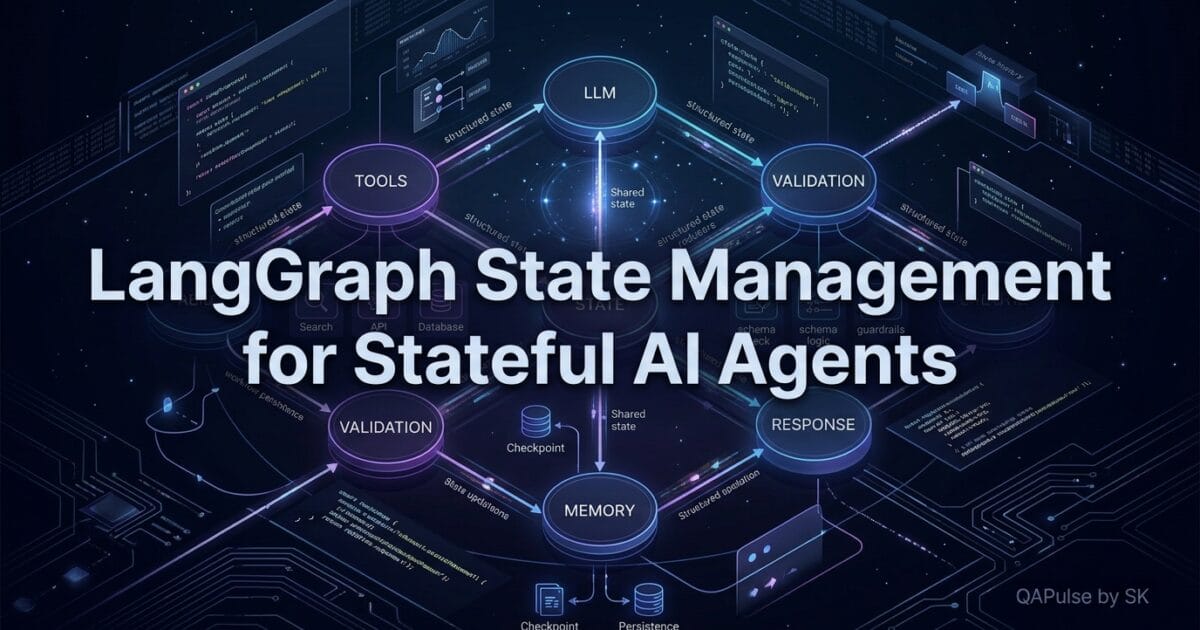
LangGraph State Management is the foundation that determines how information moves through an agent workflow, how nodes share data, and how state changes are controlled over time. If you understand the state model first, concepts such as reducers, memory, checkpoints, parallel execution, and multi-agent workflows become much easier to reason about.
For QA engineers and SDETs, this matters for a different reason: state is where many agent bugs hide. An agent can execute every node successfully and still produce an incorrect result because a value was overwritten, stale data was retained, messages were duplicated, or two parallel nodes updated the same field unexpectedly.
The practical question is therefore not simply “How do I store data in LangGraph?” It is:
How do I design, update, validate, and test agent state so the workflow remains predictable?
What is LangGraph State Management?
In a LangGraph application, state represents the information shared across the graph as execution moves between nodes.
A simple state can contain a user’s request, intermediate results, messages, validation status, and final output.
from typing import TypedDict

class AgentState(TypedDict):
    question: str
    answer: str
    status: str
A node can read that state and return an update:
def analyze_question(state: AgentState):
    return {
        "answer": f"Analyzing: {state['question']}",
        "status": "analyzed"
    }
The important distinction is that a node does not need to manually manage the entire state object. It can return the fields it wants to update.
This makes LangGraph state management fundamentally different from simply passing variables between ordinary Python functions.
Think of the graph as a controlled state-transition system:
Current State
     │
     ▼
   Node A
     │
     ▼
 State Update
     │
     ▼
   Node B
     │
     ▼
 State Update
     │
     ▼
  Final State
That model becomes increasingly important as the graph grows.
Why State Is the Real Backbone of a LangGraph Agent
Consider a customer-support agent.
It might perform these steps:
User Request
     ↓
Intent Detection
     ↓
Knowledge Retrieval
     ↓
Answer Generation
     ↓
Safety Validation
     ↓
Final Response
Each stage may need information produced by an earlier stage.
For example:
class SupportState(TypedDict):
    question: str
    intent: str
    documents: list[str]
    response: str
    approved: bool
The state becomes the shared contract between the nodes.
def classify_intent(state: SupportState):
    return {
        "intent": "billing"
    }


def retrieve_documents(state: SupportState):
    return {
        "documents": [
            "Billing policy",
            "Refund policy"
        ]
    }


def generate_response(state: SupportState):
    return {
        "response": "Here is the billing information..."
    }
Notice the architectural benefit.
Each node has a relatively focused responsibility, while the state provides the information required to connect those responsibilities.
This is one of the most important ideas behind LangGraph state management:
Nodes perform work. State carries context. Graph edges control execution.
When those responsibilities are clearly separated, debugging becomes much easier.
State Schema Is Your Agent’s Contract
One of the biggest mistakes developers make is treating state as an informal dictionary.
For a small experiment, this may work:
state = {
    "question": "How do refunds work?"
}
But production agents need an explicit state contract.
from typing import TypedDict

class ResearchState(TypedDict):
    query: str
    sources: list[str]
    summary: str
    confidence: float
Now every developer working on the graph can understand what information exists.
The schema also gives you a natural place to think about testing.
| State Field | Type | Purpose | Typical Owner |
|---|---|---|---|
query | str | Original request | Input |
sources | list[str] | Retrieved information | Retrieval node |
summary | str | Generated result | LLM node |
confidence | float | Quality signal | Validation node |
For QA engineers, this is particularly useful because the state schema becomes part of the test contract.
You can ask:
- Can this field be missing?
- Who is allowed to update it?
- What values are valid?
- Can multiple nodes update it?
- Should the value be replaced or accumulated?
- Should it survive a checkpoint?
- What happens if the node returns malformed data?
Those questions turn agent testing from “does the chatbot answer?” into actual system testing.


State Updates Are Not the Same as State Replacement
This is where many beginners misunderstand LangGraph state management.
Suppose the current state contains:
{
    "status": "processing"
}
A node returns:
{
    "status": "completed"
}
The expected result is:
{
    "status": "completed"
}
The new value replaces the old value.
But consider a list:
{
    "findings": ["authentication issue"]
}
Another node returns:
{
    "findings": ["authorization issue"]
}
Do you want:
["authorization issue"]
or:
["authentication issue", "authorization issue"]
That is not a small implementation detail.
It is a state-management decision.
This is where reducers become important.
from typing import Annotated
import operator

class QAState(TypedDict):
    findings: Annotated[list[str], operator.add]
Now updates can be accumulated rather than simply replacing the previous value.
This connects directly with the earlier concept of LangGraph reducers.
A useful mental model is:
State Field
    │
    ├── No reducer
    │       ↓
    │    Replace
    │
    └── Reducer
            ↓
       Combine Updates
Overwrite vs Accumulate
| Requirement | Suitable Behavior |
|---|---|
| Current status | Overwrite |
| Current user intent | Overwrite |
| Latest generated answer | Overwrite |
| Collection of findings | Accumulate |
| Message history | Merge according to message semantics |
| Metrics | Often accumulate/aggregate |
| Configuration | Usually overwrite |
The mistake is not using overwrite behavior.
The mistake is using the wrong behavior for the data.
LangGraph State Management and Reducers Work Together
Reducers define how a particular state field handles updates.
For example:
from typing import Annotated, TypedDict
import operator

class AgentState(TypedDict):
    messages: Annotated[list[str], operator.add]
    status: str
Now the state has two fundamentally different update strategies.
messages → accumulate
status   → replace
That is a much more realistic production model.
An agent often has state fields that should behave differently.
For example:
class ResearchState(TypedDict):
    query: str
    sources: Annotated[list[str], operator.add]
    summary: str
    errors: Annotated[list[str], operator.add]
Here:
queryrepresents the current request.sourcesaccumulate.summaryrepresents the latest generated summary.errorsaccumulate.
This is a strategic approach to LangGraph state management because the state schema documents the intended behavior.
State Management in Sequential Workflows
A sequential graph is the easiest place to understand state transitions.
Input
 ↓
Research
 ↓
Analyze
 ↓
Summarize
 ↓
Validate
Example:
def research(state):
    return {
        "sources": ["source-1", "source-2"]
    }


def analyze(state):
    return {
        "summary": "The evidence indicates..."
    }


def validate(state):
    return {
        "approved": True
    }
The state gradually evolves:
Initial
{
    query
}

      ↓

After research
{
    query,
    sources
}

      ↓

After analysis
{
    query,
    sources,
    summary
}

      ↓

After validation
{
    query,
    sources,
    summary,
    approved
}
This gives you a powerful testing strategy.
Instead of validating only the final answer, validate the state after meaningful transitions.
assert state["sources"]
assert state["summary"]
assert state["approved"] is True
State Management Becomes Harder With Parallel Nodes
Now imagine two agents running simultaneously:
             ┌── Research Agent A ──┐
Input ───────┤                       ├── Shared State
             └── Research Agent B ──┘
Both agents may update the same field.
For example:
def security_agent(state):
    return {
        "findings": ["missing authentication"]
    }


def performance_agent(state):
    return {
        "findings": ["slow database query"]
    }
If findings needs to preserve both results, your state design must explicitly support that.
This is why LangGraph state management cannot be separated from concurrency considerations.
Ask this before adding parallel nodes:
What happens if two nodes write to this state field at the same time?
If the answer is unclear, the state design is incomplete.
LangGraph State Management vs Traditional Variable Passing
LangGraph is not simply Python functions connected together.
| Approach | State Handling | Parallel Work | Persistence | Agent Workflows |
|---|---|---|---|---|
| Regular Python functions | Manual | Manual | Manual | Limited |
| Class-based application | Object attributes | Developer-managed | Manual | Possible |
| Global variables | Implicit | Risky | Poor | Not recommended |
| LangGraph | Explicit graph state | Graph-aware | Checkpoint support | Designed for it |
The key advantage is not that LangGraph magically eliminates state complexity.
It makes state transitions explicit enough to reason about.
That is valuable for both developers and testers.
A QA Engineer’s View of Agent State
Traditional UI testing might ask:
Did the user receive the correct response?
Agent testing should ask several additional questions:
Was the initial state valid?
        ↓
Did each node produce the expected update?
        ↓
Was state merged correctly?
        ↓
Was stale state carried forward?
        ↓
Did parallel updates conflict?
        ↓
Was the final state valid?
        ↓
Did the user receive the expected result?
This gives you a much stronger testing model.
For example:
def test_research_state():
    result = run_research_graph(
        "What is the refund policy?"
    )

    assert result["query"] == "What is the refund policy?"
    assert len(result["sources"]) > 0
    assert result["summary"]
But production-grade testing should go further.
def test_state_contract():
    result = run_research_graph(
        "What is the refund policy?"
    )

    assert isinstance(result["query"], str)
    assert isinstance(result["sources"], list)
    assert isinstance(result["summary"], str)
Now you are testing the state contract, not merely the UI output.
The Most Useful State-Management Questions
Before implementing a production graph, ask these questions for every important state field:
| Question | Why It Matters |
|---|---|
| Who creates this field? | Establishes ownership |
| Who can update it? | Prevents accidental mutation |
| Can multiple nodes update it? | Identifies merge requirements |
| Should updates replace or accumulate? | Determines reducer strategy |
| What type should it contain? | Creates validation rules |
| Can it be empty? | Defines edge cases |
| Should it persist? | Influences checkpoint design |
| Is it sensitive? | Influences logging and security |
| How will it be tested? | Creates acceptance criteria |
This turns LangGraph state management from an implementation detail into an architectural design practice.
Try This Design Challenge
Imagine you are building a test-analysis agent.
Three nodes run in parallel:
             ┌── Functional Agent ──┐
             │                       │
Test Run ────┼── API Agent ──────────┼── QA State
             │                       │
             └── Performance Agent ──┘
Each node produces findings.
Design the state:
class TestAnalysisState(TypedDict):
    test_run_id: str
    findings: list[str]
    critical_count: int
    final_report: str
Now ask yourself:
- Should
findingsoverwrite or accumulate? - Should
critical_countbe calculated independently or updated by each node? - Who owns
final_report? - What happens when one agent fails?
- How would you test duplicate findings?
- What happens when two agents modify the same field?
There is no good production architecture until these questions have explicit answers.
The Strategic Rule for LangGraph State Management
A useful engineering principle is:
Design state based on how information changes, not merely on what information exists.
For every field, define its lifecycle:
Created
  ↓
Read
  ↓
Updated
  ↓
Merged?
  ↓
Validated
  ↓
Persisted?
  ↓
Consumed
That lifecycle is more important than simply creating a large TypedDict.
A poorly designed state schema can make an otherwise sophisticated AI agent unpredictable.
A well-designed state schema makes the graph easier to develop, debug, test, observe, and evolve.
Designing Production-Grade LangGraph State Management
A useful LangGraph state management design should answer one question before implementation begins:
What information must survive each transition, who is allowed to change it, and what should happen when multiple nodes update it?
That question becomes critical when a prototype evolves into a real AI application.
A small graph might have three fields:
class AgentState(TypedDict):
    question: str
    answer: str
    status: str
A production workflow could require considerably more:
from typing import Annotated, TypedDict
import operator

class AgentState(TypedDict):
    question: str
    messages: Annotated[list, operator.add]
    sources: Annotated[list[str], operator.add]
    answer: str
    errors: Annotated[list[str], operator.add]
    status: str
The important part is not the number of fields. It is the behavior of each field.
question might be replaced only once.
messages may accumulate.
sources may be collected from several retrieval operations.
answer may represent the latest generated response.
errors may accumulate across validation stages.
That means one state object can contain several different update strategies.
State Ownership Matters
One practical technique is to assign an owner to important state fields.
| State Field | Owner | Other Nodes | Update Strategy |
|---|---|---|---|
question | Input | Read-only | Replace |
messages | Conversation nodes | Read/write | Merge |
sources | Retrieval | Read | Accumulate |
answer | Generation | Read | Replace |
errors | Validation | Read | Accumulate |
status | Workflow controller | Read | Replace |
This prevents a common agent-design problem: every node believing it can modify everything.
For example, a retrieval node should not casually modify the final answer:
def retrieve_documents(state):
    documents = search(state["question"])

    return {
        "sources": documents
    }
The generation node owns the answer:
def generate_answer(state):
    return {
        "answer": build_answer(
            state["question"],
            state["sources"]
        )
    }
This separation makes the workflow easier to understand and test.
Treat State as an API Contract
In conventional software, an API contract defines what a service accepts and returns.
The same thinking can be applied to LangGraph state management.
Your state schema is effectively the internal contract between graph nodes.
class ResearchState(TypedDict):
    query: str
    sources: list[str]
    summary: str
    confidence: float
Now consider a node that accidentally returns:
return {
    "confidence": "high"
}
The graph may execute, but the state contract has been violated because the expected type is float.
A stronger testing strategy catches that before the incorrect value reaches downstream logic.
assert isinstance(state["confidence"], float)
assert 0.0 <= state["confidence"] <= 1.0
This is especially important for AI systems because LLM-generated values are not inherently trustworthy.
State Validation Should Happen at Boundaries
Do not wait until the final response to discover invalid state.
Consider:
Input
  ↓
Validate
  ↓
Retrieve
  ↓
Validate
  ↓
Generate
  ↓
Validate
  ↓
Final Response
Each important transition becomes a quality gate.
For example:
def validate_research(state):
    if not state["sources"]:
        return {
            "status": "insufficient_evidence"
        }

    return {
        "status": "ready_for_generation"
    }
The generation node can then make a deliberate decision:
def generate_answer(state):
    if state["status"] != "ready_for_generation":
        return {
            "answer": "I don't have enough reliable evidence."
        }

    return {
        "answer": create_answer(state["sources"])
    }
This is significantly safer than allowing every node to assume that upstream data is valid.
LangGraph State Management for Multi-Agent Workflows
The complexity increases when several specialized agents share state.
Imagine a software-testing agent with three workers:
                    ┌── Functional Agent ──┐
                    │                       │
Test Execution ─────┼── API Agent ──────────┼──► Shared State
                    │                       │
                    └── Performance Agent ──┘
The agents might return:
# Functional agent
{
    "findings": ["Login validation failed"]
}
# API agent
{
    "findings": ["401 response schema is incorrect"]
}
# Performance agent
{
    "findings": ["Checkout API exceeded latency threshold"]
}
If the state field simply accepts replacement updates, one result could overwrite another.
For accumulating findings, a reducer-based field is more appropriate:
from typing import Annotated, TypedDict
import operator

class TestState(TypedDict):
    findings: Annotated[list[str], operator.add]
Conceptually:
["Login validation failed"]
             +
["401 response schema is incorrect"]
             +
["Checkout API exceeded latency threshold"]
             ↓
Final findings
[
    "Login validation failed",
    "401 response schema is incorrect",
    "Checkout API exceeded latency threshold"
]
This is one reason LangGraph state management becomes inseparable from reducer design in multi-node workflows.
But Do Not Use Reducers Everywhere
A reducer is not automatically better than replacement.
Consider:
class AgentState(TypedDict):
    current_status: str
If one node changes:
"processing"
to:
"completed"
you probably want the new value to replace the old value.
Accumulating statuses would produce something like:
["started", "processing", "completed"]
That might be useful for an audit history, but it is not the same thing as a current_status field.
A better design could separate the concepts:
class AgentState(TypedDict):
    current_status: str
    status_history: Annotated[list[str], operator.add]
Now each field has a clear purpose.
| Field | Example | Behavior |
|---|---|---|
current_status | "completed" | Replace |
status_history | ["started", "processing", "completed"] | Accumulate |
This is a small design decision with a large impact on predictability.
Handling Errors as State
AI workflows should not treat errors exclusively as exceptions.
Some failures are expected business outcomes.
For example:
class AgentState(TypedDict):
    question: str
    answer: str
    errors: Annotated[list[str], operator.add]
    status: str
A retrieval node could report an issue:
def retrieve(state):
    documents = search(state["question"])

    if not documents:
        return {
            "errors": ["No relevant documents found"],
            "status": "insufficient_evidence"
        }

    return {
        "sources": documents,
        "status": "retrieval_complete"
    }
This allows downstream nodes to make informed decisions.
The distinction is useful:
Exception
   ↓
Unexpected technical failure

State error
   ↓
Expected workflow condition
For example:
- API timeout → potentially exception/retry
- No search results → state condition
- Invalid user request → state condition
- Authentication failure → potentially workflow error
- Model unavailable → infrastructure failure
This distinction makes LangGraph state management more robust because the graph can represent meaningful workflow conditions explicitly.
State and Memory Are Not the Same Thing
These concepts are often confused.
State represents information associated with graph execution.
Memory generally refers to information that needs to persist and influence future interactions or executions.
For example:
Current execution
      ↓
Graph State
      ↓
Checkpoint
      ↓
Persistent storage
      ↓
Future execution
A conversation message may exist in the current state while a checkpoint mechanism allows the workflow to resume or retain information beyond a single execution.
This distinction becomes particularly important when designing long-running agents.
| Concept | Purpose |
|---|---|
| State | Current graph information |
| Reducer | Controls state-update behavior |
| Checkpoint | Captures graph execution state |
| Memory | Retains useful information across interactions |
| Database | External durable application data |
Do not automatically put everything into state.
Ask:
Does this information belong to this execution, or does the application need it later?
That question prevents oversized state objects.


Testing LangGraph State Transitions
A strong test strategy should validate state transitions rather than only the final response.
Suppose your graph contains:
Input → Retrieval → Analysis → Generation → Validation
A weak test might only check:
assert result["answer"]
A stronger test checks the state contract:
assert result["question"]
assert result["sources"]
assert result["answer"]
assert result["status"] == "approved"
You can also test invalid conditions:
def test_empty_retrieval():
    result = run_graph("unknown query")

    assert result["status"] == "insufficient_evidence"
    assert result["answer"]
Test State Invariants
An invariant is something that must remain true throughout execution.
Examples:
assert isinstance(state["sources"], list)
assert isinstance(state["errors"], list)
assert state["confidence"] >= 0
assert state["confidence"] <= 1
For a testing agent:
assert state["critical_count"] >= 0
assert len(state["findings"]) >= state["critical_count"]
These checks are more powerful than simply asserting that the workflow completed.
Test Parallel State Updates
Parallel execution deserves its own tests.
Suppose two nodes produce:
node_a = {
    "findings": ["authentication failure"]
}

node_b = {
    "findings": ["slow response"]
}
Your test should verify that both survive:
assert "authentication failure" in result["findings"]
assert "slow response" in result["findings"]
Also test duplicates:
node_a = {
    "findings": ["authentication failure"]
}

node_b = {
    "findings": ["authentication failure"]
}
Should the final result contain one or two entries?
That depends on the application’s requirements.
If duplicates are undesirable, your reducer or downstream normalization strategy must explicitly handle them.
The important principle is:
Do not let concurrency define your data semantics accidentally.
Define the semantics first, then implement them.
Common LangGraph State Management Anti-Patterns
One Giant State Object
Avoid putting every piece of application data into one state schema.
class BadState(TypedDict):
    user: dict
    database: dict
    configuration: dict
    logs: list
    analytics: dict
    prompts: dict
    files: list
    everything_else: dict
A giant state object becomes difficult to reason about and test.
Every Node Modifies Everything
This creates hidden coupling.
Prefer:
Retriever → owns sources
Generator → owns answer
Validator → owns validation result
Controller → owns workflow status
Using Lists When You Need a Current Value
Do not store:
status = ["started", "processing", "completed"]
if the application only needs:
status = "completed"
Create a history field separately if history is genuinely required.
Testing Only the Final Answer
A final answer can look correct while intermediate state is wrong.
Test:
Input
 ↓
State
 ↓
Transition
 ↓
State
 ↓
Transition
 ↓
Final State
Ignoring State Size
Large state can increase complexity, serialization overhead, checkpoint size, and debugging difficulty.
Keep state focused on information required by the graph.
LangGraph State Management vs Other Approaches
| Approach | Strength | Weakness |
|---|---|---|
| Plain Python variables | Simple | No structured workflow semantics |
| Global state | Easy to access | Hidden coupling and concurrency risks |
| Class/object state | Encapsulation | Workflow transitions remain manual |
| Database state | Durable | Too heavy for every intermediate transition |
| LangGraph state | Explicit graph-aware state | Requires deliberate schema design |
LangGraph is particularly useful when state changes are part of the workflow itself.
The goal is not to replace databases or application-level state.
The goal is to provide a structured state model for graph execution.
A Production State-Design Checklist
Before shipping an agent, review every important field:
□ Is the field necessary?
□ Is its type explicit?
□ Who owns it?
□ Who reads it?
□ Who writes it?
□ Can multiple nodes update it?
□ Should updates replace or merge?
□ Does it need a reducer?
□ Can the value be invalid?
□ How is invalid state handled?
□ Does it need persistence?
□ Is sensitive information being exposed?
□ Is there a test for the field?
□ Is there a test for parallel updates?
□ Is there a test for failure paths?
This checklist converts LangGraph state management into an engineering discipline rather than an afterthought.
A Practical Architecture for QA and SDET Agents
For an AI-powered test-analysis system, a practical state could look like this:
from typing import Annotated, TypedDict
import operator

class TestAnalysisState(TypedDict):
    test_run_id: str
    test_results: list[dict]
    findings: Annotated[list[str], operator.add]
    errors: Annotated[list[str], operator.add]
    critical_count: int
    recommendation: str
    status: str
Then divide ownership:
Test Runner
    │
    ├── test_results
    │
    ▼
Analysis Agents
    │
    ├── findings
    ├── errors
    │
    ▼
Risk Calculator
    │
    └── critical_count
    │
    ▼
Recommendation Agent
    │
    └── recommendation
    │
    ▼
Controller
    │
    └── status
This architecture makes the state understandable before anyone opens the implementation.
That is the real objective of LangGraph state management: not merely storing values, but making the movement and ownership of information predictable.
LangGraph State Management vs Other Agent Frameworks
| Capability | LangGraph | Traditional workflow code | Basic agent loop |
|---|---|---|---|
| Explicit state model | Strong | Manual | Often implicit |
| State transitions | Graph-based | Custom | Loop-based |
| Reducers | Supported | Manual | Usually manual |
| Persistence | Supported through ecosystem | Custom | Depends on implementation |
| Human-in-the-loop | Strong workflow fit | Custom | Varies |
| Complex branching | Strong | Manual | Limited |
| Production workflow control | Strong | Depends on architecture | Often weaker |
Internal Links
- Learn MCP – Zero to Hero
- Learn AI Agents for QA – Zero to Hero
- Playwright Automation – Zero to Hero
- TencentDB Agent Memory: Complete Zero to Hero
- LangGraph: Complete Zero to Hero
- Learn Python – Zero to Hero
- OpenAI Codex: Complete Zero to Hero
- Cursor AI: Complete Zero to Hero
- Claude Code Tutorial: Complete Zero to Hero
- AutoGen: Complete Zero to Hero Guide
- Free QA Resources Built From Real Experience
- QA Glossary: Test Automation Terms Every Engineer Should Know
External Links
People Asked Questions
What is LangGraph state management?
LangGraph state management is the mechanism used to define, update, share, and persist information as a LangGraph workflow executes across multiple nodes.
How does state work in LangGraph?
LangGraph workflows define a state schema, and nodes return updates to that state as execution moves through the graph.
What is the difference between LangGraph state and memory?
State represents information used by the workflow, while memory generally refers to information intentionally retained for future interactions. Checkpointing can persist graph state between executions.
Why are reducers important in LangGraph?
Reducers define how updates to the same state key should be combined. They are particularly useful when multiple nodes contribute to lists, messages, counters, or accumulated results.
How do you test LangGraph state management?
Test initial state, individual node updates, reducer behavior, branching, parallel execution, persistence, recovery, and important state invariants.
Can LangGraph state be persisted?
Yes. LangGraph supports checkpointing mechanisms that can persist graph execution state and enable workflows to resume depending on the configured persistence setup.
Is LangGraph state the same as conversation memory?
No. Conversation history can be part of state, but state itself is broader. It can contain inputs, intermediate results, tool outputs, decisions, metadata, and other workflow information.
AI Overview Optimization
LangGraph state management is the structured way LangGraph workflows define, update, combine, and persist information as an AI agent moves between graph nodes. State provides the shared data model for the workflow, while reducers control how conflicting or repeated updates are merged and checkpointing can preserve execution state for recovery and continuation.
Conclusion
Good LangGraph state management starts with a simple principle: state should have explicit meaning and explicit behavior.
A state field should not exist merely because a node happens to produce a value. It should have a defined purpose, type, owner, lifecycle, and update strategy.
For production AI agents, the strongest approach is to:
- Define a clear state schema.
- Give important fields clear ownership.
- Decide whether updates replace or accumulate.
- Use reducers when multiple updates must be combined.
- Separate transient state from persistent memory.
- Validate state at meaningful boundaries.
- Test intermediate state, not just final responses.
- Test parallel updates explicitly.
- Keep state focused instead of turning it into a giant data container.
- Treat the state schema as an internal contract between nodes.
The most important mindset shift is this:
Your agent is only as predictable as the state transitions underneath it.
When the state model is well designed, nodes become easier to reason about, failures become easier to reproduce, and QA engineers can test the workflow at the level where many of the most important agent bugs actually occur.
Final Key Takeaways
- LangGraph state management is the backbone of a stateful agent workflow.
- A state schema should define both what information exists and how that information changes.
- Not every state field should use the same update strategy.
- Use overwrite behavior for values representing the current truth.
- Use reducers when multiple node updates need to survive or be combined.
- Parallel nodes make state semantics especially important.
- State and persistent memory are related but should not be treated as identical concepts.
- QA should validate state transitions and invariants, not only final AI responses.
- Assigning ownership to state fields reduces hidden coupling between nodes.
- The best production strategy is to design state semantics before implementing graph logic.
Continue Learning
Explore more expert articles on Mobile Testing, Backend & API, AI & Agentic, AI Tools, n8n, LangChain, CrewAI, MCP Servers, AI Agents, LlamaIndex, Docker, FastAPI, Playwright, Cypress, Test Automation, DevOps, and Software Engineering at www.skakarh.com.
QAPulse by SK delivers expert release analysis, AI engineering insights, enterprise automation strategies, migration guidance, DevOps best practices, and practical testing knowledge to help software professionals build scalable, intelligent, and production-ready software systems.