 QA
QA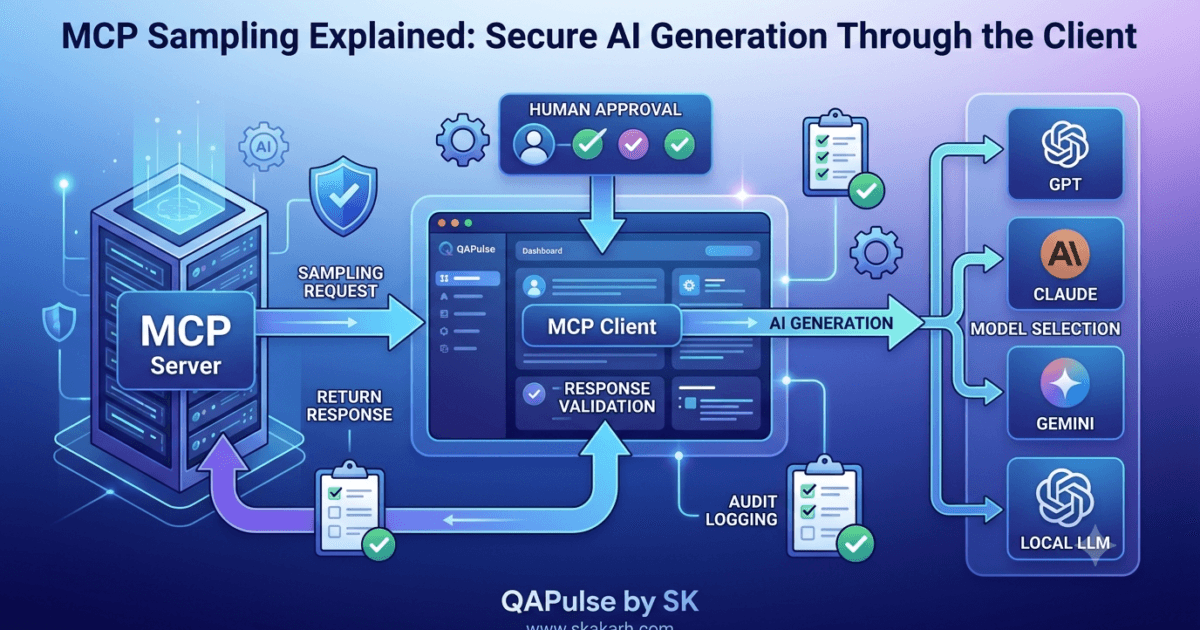
What is MCP Sampling?
So far in this series, you’ve learned about three core capabilities of the Model Context Protocol:
- MCP Tools execute actions.
- MCP Resources provide read-only information.
- MCP Prompts provide reusable AI instructions.
The fourth major capability is MCP Sampling.
Unlike the previous capabilities, MCP Sampling allows an MCP server to ask the client to generate a response using an AI model.
Instead of the server communicating directly with an LLM provider such as OpenAI or Anthropic, the server delegates that responsibility to the MCP client.
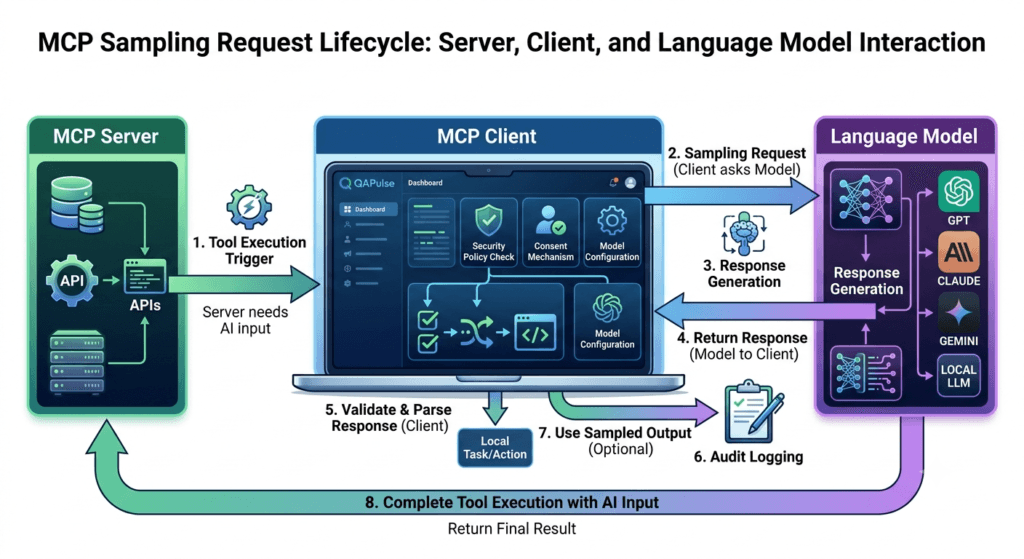
The workflow looks like this:
User

↓

LLM

↓

MCP Client

↓

MCP Server

↓

sampling/createMessage

↓

MCP Client

↓

LLM

↓

Generated Response

↓

MCP Server

↓

Client
This design keeps model access under the client’s control.
Why MCP Sampling Exists
Imagine an MCP server responsible for project management.
The server receives a request to generate:
- Code documentation
- Architecture summaries
- SQL explanations
- Security recommendations
- Release notes
- Bug analysis
The server could integrate directly with an AI provider.
However, this introduces several challenges:
- Every server must manage API keys.
- Each server must support multiple AI providers.
- Organizations lose centralized AI governance.
- Users cannot choose which model to use.
Instead, MCP allows the server to ask the client to perform AI generation.
MCP Server

↓

Sampling Request

↓

MCP Client

↓

Selected AI Model

↓

Response
This architecture separates business logic from AI model management.
Traditional AI Architecture vs MCP Sampling
Without MCP Sampling:
Server

↓

OpenAI

Anthropic

Gemini

Azure OpenAI

Multiple Integrations
Every server needs separate integrations.
With MCP Sampling:
Server

↓

MCP Client

↓

Selected Model

↓

Response
The server communicates only through the MCP protocol.
The client manages model selection.
How MCP Sampling Works
Sampling follows a request-response workflow.
Server

↓

Create Sampling Request

↓

Client

↓

LLM

↓

Generate Response

↓

Return Result
The server never communicates directly with the model provider.
Instead, it requests the client to generate the completion.
The Role of the MCP Client
The client becomes responsible for:
- Selecting the AI model
- Managing API credentials
- Sending prompts
- Receiving completions
- Applying organization policies
- Returning responses
Conceptually:
Sampling Request

↓

Client

├── Model Selection

├── Authentication

├── API Call

└── Response
This keeps servers provider-independent.
Sampling Request
A sampling request typically includes:
- Messages
- Model preferences
- System instructions
- Temperature
- Maximum tokens
- Optional metadata
Conceptually:
Sampling Request

├── Messages

├── Model Preferences

├── Temperature

├── Max Tokens

└── Metadata
The client may honor these preferences or apply its own policies.
Message Structure
Sampling requests contain structured conversation messages.
Example message types include:
- System
- User
- Assistant
Conceptually:
Conversation

↓

System Message

↓

User Message

↓

Assistant Response
The conversation history provides context for the language model.
Human-in-the-Loop
One of MCP Sampling’s most important features is client approval.
The client may require user confirmation before sending a request to an AI provider.
Sampling Request

↓

User Approval

├── Approve

│      ↓

│ Call Model

│

└── Reject

       ↓

Cancel Request
This gives users complete control over AI interactions.
Provider Independence
Because servers never communicate directly with LLM providers, switching models becomes simple.
Example:
Today

↓

GPT Model

Tomorrow

↓

Claude

Later

↓

Gemini

Future

↓

Local LLM
No server changes are required.
Only the client configuration changes.
Enterprise Advantages
Organizations benefit from centralized AI management.
The client can enforce:
- Approved models
- Usage quotas
- Cost limits
- Compliance policies
- Audit logging
- Content filtering
Organization Policy

↓

MCP Client

↓

Approved Model

↓

Sampling Response
This architecture simplifies enterprise governance.
Common Sampling Use Cases
MCP Sampling is useful whenever servers need AI-generated content.
Examples include:
- Documentation generation
- Code explanations
- SQL optimization
- Architecture analysis
- Bug summaries
- Test case generation
- Security recommendations
- Meeting summaries
- Email drafting
- Technical reports
Instead of implementing separate AI integrations, servers simply issue sampling requests.
Benefits of MCP Sampling
Using MCP Sampling offers several advantages:
- Keeps servers AI-provider independent.
- Centralizes model management.
- Eliminates duplicate AI integrations.
- Supports multiple language models.
- Enables human approval.
- Improves governance.
- Simplifies enterprise deployments.
- Future-proofs AI infrastructure.
Common Misconceptions
| Misconception | Reality |
|---|---|
| The server talks directly to the AI model | The client communicates with the model |
| Every server needs AI API keys | API credentials remain with the client |
| Sampling replaces tools | Sampling generates AI responses; tools execute actions |
| Sampling replaces prompts | Prompts guide AI behavior, while sampling requests AI generation |
| Sampling requires a specific AI provider | The protocol remains provider-independent |
MCP Sampling Architecture
User Request

↓

MCP Client

↓

MCP Server

↓

sampling/createMessage

↓

MCP Client

↓

Selected LLM

↓

Generated Response

↓

MCP Server

↓

Client Response
MCP Sampling enables MCP servers to request AI-generated responses through the client rather than communicating directly with language model providers. This architecture separates AI model management from server implementation, allowing organizations to centralize authentication, governance, provider selection, cost control, and user approval while keeping MCP servers portable, scalable, and independent of any specific AI platform.
MCP Sampling Request, Message Structure and Response Lifecycle
Understanding the MCP Sampling Workflow
In the previous lesson, you learned that MCP Sampling allows an MCP server to request AI-generated content through the client.
Unlike MCP Tools, which execute operations directly, or MCP Resources, which return existing information, MCP Sampling generates entirely new content using a language model.
A complete sampling workflow follows this sequence:
User Request

↓

MCP Client

↓

MCP Server

↓

Create Sampling Request

↓

MCP Client

↓

Language Model

↓

Generate Response

↓

MCP Client

↓

MCP Server

↓

User
Every AI-generated response follows this lifecycle.
Creating a Sampling Request
When an MCP server determines that AI generation is required, it constructs a sampling request.
The request typically contains:
- Conversation messages
- System instructions
- Model preferences
- Sampling parameters
- Token limits
- Optional metadata
Conceptually:
Sampling Request

├── Messages

├── Model Preferences

├── Temperature

├── Max Tokens

├── Stop Sequences

└── Metadata
The request describes how the model should generate the response.
Conversation Messages
Messages provide the context required by the language model.
Most conversations contain three primary message types.
System Message
Defines the AI’s behavior.
Example purposes:
- QA expert
- Security reviewer
- Software architect
- Documentation writer
User Message
Contains the user’s actual request.
Examples:
- Explain this code.
- Generate unit tests.
- Review this API.
- Summarize this document.
Assistant Message
Represents previous AI responses that maintain conversation continuity.
A simplified conversation appears as:
System

↓

User

↓

Assistant

↓

User

↓

Assistant
Maintaining conversation history improves response quality.
Why System Instructions Matter
System instructions establish consistent AI behavior.
Instead of relying only on the user’s request:
User

↓

Generate Tests
The server can provide additional guidance.
System

↓

Follow Company Testing Standards

↓

User Request

↓

Generate Tests
The resulting output aligns with organizational expectations.
Model Preferences
An MCP server may recommend the characteristics of the desired model.
Examples include:
- Large reasoning model
- Fast response model
- Low-cost model
- High-accuracy model
- Vision-capable model
Sampling Request

↓

Preferred Model Characteristics

↓

Client Chooses Model
These preferences are advisory rather than mandatory.
The client remains responsible for the final model selection.
Temperature
Temperature controls the randomness of AI responses.
| Temperature | Typical Behavior |
|---|---|
| Low | Predictable and deterministic |
| Medium | Balanced creativity |
| High | More diverse and creative responses |
Examples:
Low temperature:
- Code generation
- SQL queries
- API documentation
Higher temperature:
- Brainstorming
- Story writing
- Marketing content
The server may suggest a temperature, but the client may override it.
Maximum Token Limit
Large responses increase:
- Cost
- Processing time
- Latency
A maximum token limit controls the response size.
Sampling Request

↓

Max Tokens

↓

Language Model

↓

Controlled Output
Choosing appropriate limits improves efficiency.
Stop Sequences
Sometimes response generation should stop automatically.
Examples include:
- End of JSON object
- End of Markdown section
- End of code block
- Custom delimiters
Generate Response

↓

Encounter Stop Sequence

↓

Finish Generation
This prevents unnecessary output.
Metadata
Metadata provides additional information without affecting prompt content.
Examples include:
- Request ID
- Session ID
- Project name
- Organization identifier
- Conversation identifier
Sampling Request

↓

Metadata

↓

Tracking
Metadata is useful for monitoring and auditing.
Client Evaluation
Before contacting the language model, the client evaluates the request.
Checks may include:
- User approval
- Organization policies
- Model availability
- Budget limits
- Safety rules
- Rate limits
Sampling Request

↓

Client Evaluation

├── Approved

│      ↓

│ Continue

│

└── Rejected

       ↓

Return Error
The server does not control these decisions.
AI Response Generation
After approval, the client forwards the request to the selected model.
Client

↓

Language Model

↓

Generate Completion

↓

Return Response
The generated completion is then returned to the MCP server.
Response Lifecycle
A complete response follows multiple stages.
Request

↓

Validation

↓

Approval

↓

Model Selection

↓

Generation

↓

Receive Response

↓

Return to Server
Each stage contributes to reliability and governance.
Error Handling
Sampling requests may fail for several reasons.
Examples include:
- User rejected the request
- Authentication failure
- Invalid parameters
- Rate limit exceeded
- Model unavailable
- Network interruption
Sampling Request

↓

Processing

├── Success

│      ↓

│ Response

│

└── Failure

       ↓

Error Returned
Servers should always handle failures gracefully.
Best Practices for Sampling Requests
When designing MCP Sampling requests:
- Keep system instructions focused.
- Supply only relevant conversation history.
- Use appropriate token limits.
- Choose sensible temperature values.
- Avoid unnecessary metadata.
- Respect user approval workflows.
- Handle errors consistently.
- Keep requests provider-independent.
Common Design Mistakes
| Mistake | Impact | Best Practice |
|---|---|---|
| Sending excessive conversation history | Increased cost and latency | Include only relevant context |
| Hardcoding a specific AI provider | Reduced portability | Let the client choose the model |
| Ignoring token limits | Higher costs | Set appropriate maximum tokens |
| Missing system instructions | Inconsistent responses | Define clear AI behavior |
| Assuming every request succeeds | Poor reliability | Implement comprehensive error handling |
| Bypassing client approval | Governance violations | Respect approval workflows |
Complete MCP Sampling Request Lifecycle
Server Creates Request

↓

Conversation Messages

↓

System Instructions

↓

Model Preferences

↓

Sampling Parameters

↓

Client Validation

↓

User Approval

↓

Model Selection

↓

Generate Response

↓

Return Completion

↓

Server Processes Result
A well-designed MCP Sampling request combines structured conversation messages, clear system instructions, sensible generation parameters, and provider-independent model preferences. By allowing the client to manage authentication, approval, model selection, and execution, the Model Context Protocol creates a flexible and secure architecture that supports multiple AI providers while maintaining consistent governance, scalability, and enterprise control.
MCP Sampling Security, Human Approval and Multi-Model Strategies
Why MCP Sampling Requires Strong Security
Unlike MCP Resources, which return existing information, or MCP Prompts, which provide reusable instructions, MCP Sampling generates new content by interacting with a language model.
Because the sampling request may contain sensitive business data, source code, customer information, or internal documentation, every request should pass through multiple security checks before reaching the AI model.
A secure sampling workflow looks like this:
Sampling Request

↓

Authentication

↓

Authorization

↓

Policy Validation

↓

Human Approval

↓

AI Model

↓

Response
Security is one of the primary reasons why MCP delegates sampling to the client instead of allowing servers to communicate directly with AI providers.
Human-in-the-Loop Approval
One of the most important concepts in MCP Sampling is Human-in-the-Loop (HITL).
Instead of automatically sending every request to an AI model, the client can ask the user for approval.
Example workflow:
Server Requests Sampling

↓

Client Receives Request

↓

Show Approval Dialog

├── Approve

│      ↓

│ Call AI Model

│

└── Reject

       ↓

Cancel Request
This ensures users remain in control of AI interactions.
When User Approval Should Be Required
Not every sampling request carries the same level of risk.
Organizations commonly require approval for:
- Source code analysis
- Internal documentation
- Customer records
- Financial reports
- Security configurations
- Infrastructure details
- Legal documents
- Healthcare information
Lower-risk requests, such as generating general documentation or public content, may be processed automatically based on organizational policy.
Organization Policy Enforcement
Enterprise environments often enforce strict AI governance.
Before executing a sampling request, the client may verify:
- Approved AI providers
- Data residency requirements
- Maximum token limits
- Budget constraints
- Department-specific policies
- Compliance requirements
- Content filtering rules
Sampling Request

↓

Organization Policy Engine

↓

Approved

↓

Language Model
This centralized enforcement keeps all AI interactions consistent across applications.
Multi-Model Architecture
A major advantage of MCP Sampling is support for multiple language models.
Instead of depending on one provider, the client can choose the most suitable model.
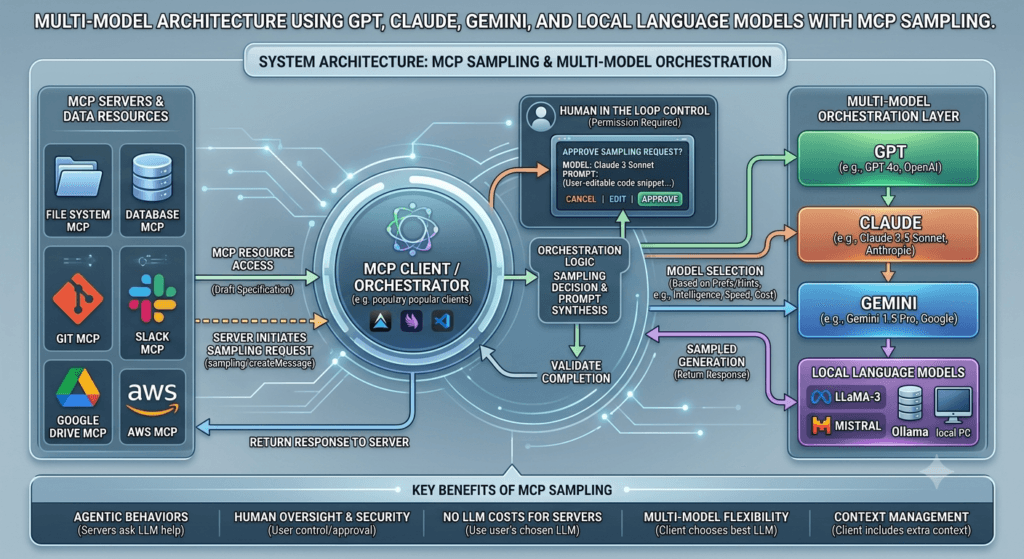
Example architecture:
Sampling Request

↓

MCP Client

├── GPT

├── Claude

├── Gemini

├── Local LLM

└── Future Models
The MCP server remains completely unaware of which model performs the generation.
Intelligent Model Selection
Different AI models excel at different tasks.
Examples include:
| Task | Preferred Model Characteristics |
|---|---|
| Code generation | Strong programming capabilities |
| Documentation | Excellent technical writing |
| Reasoning | Advanced analytical performance |
| Summarization | Fast inference and concise output |
| Translation | High multilingual accuracy |
The client evaluates available models and selects the one that best satisfies the request.
Model Fallback Strategy
AI services occasionally become unavailable.
Instead of failing immediately, the client can implement fallback logic.
Primary Model

↓

Available?

├── Yes

│      ↓

│ Generate Response

│

└── No

       ↓

Secondary Model

↓

Response
Fallback strategies improve system reliability without requiring changes to the MCP server.
Local Models vs Cloud Models
Organizations often choose between cloud-hosted and locally deployed language models.
| Cloud Models | Local Models |
|---|---|
| Internet connectivity required | Operate within private infrastructure |
| Managed by AI provider | Managed by the organization |
| Frequent capability updates | Greater deployment control |
| Usage-based pricing | Infrastructure costs |
| Easy scalability | Better data privacy |
Because MCP Sampling is provider-independent, clients can switch between deployment models without modifying server implementations.
Data Privacy During Sampling
Sampling requests frequently include confidential information.
Before forwarding requests to an AI provider, organizations may:
- Remove sensitive fields
- Mask personal information
- Replace identifiers
- Filter confidential sections
- Apply anonymization
Example:
Original Request

↓

Data Sanitization

↓

Safe Request

↓

Language Model
This reduces the risk of exposing sensitive data.
Sampling Rate Limiting
Uncontrolled sampling requests can increase costs and overload AI services.
Clients commonly implement rate limiting.
Incoming Requests

↓

Rate Limiter

├── Allowed

│      ↓

│ Continue

│

└── Limit Exceeded

       ↓

Reject Request
Rate limiting protects both budgets and infrastructure.
Cost Management
Large-scale AI systems may process millions of sampling requests.
Organizations typically monitor:
- Tokens consumed
- Cost per request
- Daily AI spending
- Department budgets
- Model usage
- Request frequency
Sampling Requests

↓

Cost Monitor

↓

Budget Validation

↓

Model Execution
Monitoring helps maintain predictable operational costs.
Monitoring Sampling Activity
Every sampling request should be monitored.
Useful operational metrics include:
| Metric | Purpose |
|---|---|
| Sampling requests | Measure usage |
| Model selection | Understand provider distribution |
| Approval rate | Evaluate human intervention |
| Average response time | Performance optimization |
| Token consumption | Cost management |
| Failure rate | Reliability analysis |
| Rejected requests | Security monitoring |
These metrics support continuous optimization and governance.
Logging Sampling Operations
Production systems should maintain audit logs for every sampling request.
Recommended log events include:
- Sampling requested
- User approval decision
- Model selected
- Request sent
- Response received
- Token usage
- Error generated
Sampling Request

↓

Processing

↓

Response

↓

Audit Log
Audit logs assist with compliance, troubleshooting, and operational visibility.
Production Best Practices
When implementing MCP Sampling, follow these recommendations:
- Require authentication before processing requests.
- Apply authorization based on organizational policies.
- Use human approval for sensitive operations.
- Support multiple language models.
- Implement fallback strategies.
- Sanitize confidential information.
- Enforce rate limits.
- Monitor performance and costs.
- Log every sampling operation.
- Keep servers independent of AI providers.
Common Design Mistakes
| Mistake | Impact | Best Practice |
|---|---|---|
| Connecting servers directly to AI providers | Tight coupling | Route requests through the MCP client |
| Sending confidential data without filtering | Data exposure | Sanitize sensitive information |
| Depending on one AI provider | Reduced resilience | Support multiple models |
| Ignoring approval workflows | Governance violations | Require human approval when appropriate |
| No fallback strategy | Service interruption | Configure secondary models |
| No cost monitoring | Budget overruns | Track token usage and spending |
Complete Secure Sampling Workflow
Sampling Request

↓

Authentication

↓

Authorization

↓

Policy Validation

↓

Data Sanitization

↓

Human Approval

↓

Model Selection

↓

AI Generation

↓

Response Validation

↓

Return Response

↓

Audit Logging
A production-ready MCP Sampling implementation combines secure request handling, human approval, policy enforcement, provider independence, multi-model support, data sanitization, rate limiting, monitoring, and audit logging. By delegating AI generation to the MCP client instead of the server, the Model Context Protocol enables organizations to maintain centralized governance while remaining flexible enough to adopt new language models and deployment strategies without changing server-side business logic.
MCP Sampling Lifecycle, Error Handling and Production Best Practices
Understanding the Complete MCP Sampling Lifecycle
A production-ready MCP Sampling implementation involves much more than sending a request to a language model. Every sampling request passes through multiple stages that ensure security, governance, reliability, and high-quality AI responses.
A complete lifecycle looks like this:
Server Creates Request

↓

Client Receives Request

↓

Authentication

↓

Authorization

↓

Policy Validation

↓

Human Approval

↓

Model Selection

↓

AI Generation

↓

Response Validation

↓

Return Response

↓

Logging & Monitoring
Each stage contributes to building a secure and scalable AI application.
Request Validation
Before a request reaches the language model, the client validates it.
Typical validation includes:
- Required fields present
- Valid message structure
- Supported parameters
- Maximum token limits
- Accepted temperature values
- Metadata verification
Sampling Request

↓

Validate Structure

↓

Valid?

├── Yes

│      ↓

│ Continue

│

└── No

       ↓

Return Error
Early validation prevents unnecessary API calls and reduces processing costs.
Selecting the Best AI Model
The client is responsible for choosing the most appropriate model.
Selection criteria may include:
- Task complexity
- Model availability
- Organization policies
- Cost constraints
- Latency requirements
- Context window size
- Required capabilities
Sampling Request

↓

Model Evaluation

↓

Best Available Model

↓

Generation
The MCP server remains independent of these decisions.
Response Validation
After the model generates a response, the client should validate it before returning it to the server.
Validation may include:
- Complete response received
- Output format verification
- JSON validation
- Safety policy checks
- Content moderation
- Size validation
AI Response

↓

Validate Output

↓

Approved

↓

Return Response
This prevents malformed or policy-violating responses from reaching downstream systems.
Error Handling
Sampling operations can fail at multiple stages.
Common failure scenarios include:
- Authentication failure
- Authorization denied
- User rejected approval
- Invalid parameters
- AI provider unavailable
- Network timeout
- Rate limit exceeded
- Token limit exceeded
- Invalid response format
Sampling Request

↓

Processing

├── Success

│      ↓

│ Return Response

│

└── Failure

       ↓

Return Structured Error
Every error should be predictable and easy for clients to handle.
Retry Strategy
Some failures are temporary.
Examples include:
- Network interruptions
- Service overload
- Temporary provider outages
Instead of failing immediately, the client may retry.
Request Failed

↓

Retry Policy

├── Success

│      ↓

│ Return Response

│

└── Retry Limit Reached

       ↓

Return Error
Retries should use limits and backoff strategies to avoid overwhelming AI providers.
Timeout Management
AI requests should never wait indefinitely.
Timeouts help maintain application responsiveness.
Sampling Request

↓

Start Timer

↓

Response Received?

├── Yes

│      ↓

│ Continue

│

└── Timeout

       ↓

Cancel Request
Timeout values should balance user experience with model performance.
Cost Optimization
Enterprise AI systems often process thousands of sampling requests daily.
Optimization techniques include:
- Choosing the smallest suitable model
- Limiting output tokens
- Reducing unnecessary context
- Reusing conversation history efficiently
- Avoiding duplicate requests
- Caching repeated prompts where appropriate
Request

↓

Optimization

↓

Lower Cost

↓

Generation
Efficient request design reduces operational expenses.
Observability
Observability provides visibility into sampling operations.
Key metrics include:
| Metric | Purpose |
|---|---|
| Total sampling requests | Measure adoption |
| Average latency | Performance monitoring |
| Model utilization | Capacity planning |
| Token consumption | Cost analysis |
| Approval rate | User interaction analysis |
| Failure rate | Reliability tracking |
| Retry frequency | Infrastructure health |
These metrics support ongoing optimization.
Audit Logging
Every sampling request should generate structured audit logs.
Recommended events include:
- Request created
- Validation completed
- User approval
- Selected model
- Generation started
- Response received
- Tokens consumed
- Errors encountered
Sampling Request

↓

Execution

↓

Audit Events

↓

Log Storage
Comprehensive logging improves troubleshooting, governance, and compliance.
Governance and Compliance
Organizations frequently impose AI governance policies.
Examples include:
- Approved AI providers
- Sensitive data handling
- Prompt review policies
- Cost limits
- Department quotas
- Compliance regulations
- Data retention rules
Organization Policy

↓

Sampling Request

↓

Compliance Check

↓

Approved
Centralized governance ensures consistent AI usage across all applications.
Production Deployment Checklist
Before deploying MCP Sampling, verify the following:
| Requirement | Status |
|---|---|
| Authentication enabled | ✓ |
| Authorization enforced | ✓ |
| Human approval supported | ✓ |
| Request validation implemented | ✓ |
| Multi-model support available | ✓ |
| Retry strategy configured | ✓ |
| Timeout management implemented | ✓ |
| Cost monitoring enabled | ✓ |
| Rate limiting configured | ✓ |
| Audit logging enabled | ✓ |
| Monitoring dashboard available | ✓ |
| Governance policies documented | ✓ |
Common Production Mistakes
| Mistake | Impact | Best Practice |
|---|---|---|
| Direct server integration with AI providers | Tight coupling | Route requests through the MCP client |
| Ignoring validation | Invalid requests | Validate every sampling request |
| Using a single AI provider | Reduced availability | Support multiple models and fallback |
| No retry strategy | Lower reliability | Retry transient failures responsibly |
| No monitoring | Limited operational visibility | Track metrics and logs continuously |
| Ignoring governance | Compliance risks | Apply centralized AI policies |
MCP Capability Comparison
| Capability | Primary Purpose | Protocol Operation |
|---|---|---|
| MCP Tools | Execute actions | tools/call |
| MCP Resources | Retrieve read-only information | resources/read |
| MCP Prompts | Provide reusable AI instructions | prompts/get |
| MCP Sampling | Request AI-generated responses | sampling/createMessage |
Each capability has a distinct responsibility, allowing MCP servers to remain modular, maintainable, and extensible.
Complete MCP Sampling Workflow
Create Sampling Request

↓

Validate Request

↓

Authenticate

↓

Authorize

↓

Policy Evaluation

↓

User Approval

↓

Select Model

↓

Generate Response

↓

Validate Output

↓

Return Response

↓

Monitor

↓

Audit Log
Key Takeaways
Throughout this tutorial, you learned that MCP Sampling enables an MCP server to request AI-generated responses through the client rather than communicating directly with a language model provider. This architecture separates AI generation from business logic, allowing the client to manage authentication, provider selection, human approval, governance, retry strategies, cost optimization, monitoring, and compliance. A production-ready implementation includes structured request validation, multi-model support, response validation, timeout management, audit logging, and comprehensive observability, making MCP Sampling a secure and scalable foundation for enterprise AI applications.
Internal Links
- Day 1: What is MCP?
- Day 2: Why MCP Matters for AI Agents
- Day 3: MCP vs REST APIs vs Plugins
- Day 4: MCP Architecture Deep Dive
- Day 5: Build Your First Production-Ready MCP Development Environment (Python & VS Code)
- Day 6: Build Your First MCP Server in Python: A Production-Ready Guide for Beginners
- Day 7: Master the 4 MCP Transport Layer Options: STDIO vs HTTP vs SSE vs WebSockets
- Day 8: MCP Client Lifecycle: From Initialization to Tool Execution
- Day 9: MCP Server Lifecycle: From Startup to Graceful Shutdown
- Day 10: MCP Tools Explained: Building the Core Capabilities of an MCP Server
- Day 11: MCP Prompts Explained: Reusable AI Instructions in the Model Context Protocol
External Links
- Model Context Protocol: https://modelcontextprotocol.io
- Prompt Engineering Guide: https://www.promptingguide.ai
- JSON Schema: https://json-schema.org
- Python string.Template: https://docs.python.org/3/library/string.html#template-strings
- RFC 6570 URI Template: https://www.rfc-editor.org/rfc/rfc6570
- WebSocket API: https://developer.mozilla.org/docs/Web/API/WebSockets_API
- Model Context Protocol: https://modelcontextprotocol.io
- JSON-RPC Specification: https://www.jsonrpc.org/specification
- Python subprocess: https://docs.python.org/3/library/subprocess.html
- Python asyncio: https://docs.python.org/3/library/asyncio.html
- Python logging: https://docs.python.org/3/library/logging.html
- Python multiprocessing: https://docs.python.org/3/library/multiprocessing.html
What’s Next
In the next lesson, you’ll explore MCP Roots, a capability that allows clients to define the filesystem locations and project boundaries that an MCP server can access. You’ll learn how roots improve security, workspace isolation, project discovery, and controlled access to local files in the Model Context Protocol.
AI Search Optimized Snippets
What is MCP Sampling?
MCP Sampling is a Model Context Protocol capability that allows an MCP server to request AI-generated responses through an MCP client. The client communicates with the language model, applies security and governance policies, and returns the generated response to the server.
Why does MCP Sampling use the client instead of the server?
The client manages AI provider authentication, model selection, user approval, governance policies, and cost controls. This keeps MCP servers independent of specific AI providers and simplifies enterprise AI management.
How does MCP Sampling work?
An MCP server creates a sampling request, the client validates it, optionally requests user approval, selects an AI model, generates the response using the language model, validates the output, and returns the final result to the server.
What is the difference between MCP Sampling and MCP Prompts?
| MCP Sampling | MCP Prompts |
|---|---|
| Requests AI-generated responses | Provides reusable prompt templates |
Uses sampling/createMessage | Uses prompts/get |
| Produces new AI content | Supplies reusable AI instructions |
| Requires an AI model | Does not generate responses by itself |
Common Interview Questions
What is MCP Sampling?
MCP Sampling is a protocol capability that enables an MCP server to request AI-generated content through an MCP client instead of communicating directly with a language model provider.
Why is the MCP client responsible for AI communication?
The client manages authentication, provider selection, security policies, user approval, and governance, allowing the server to remain provider-independent.
What is Human-in-the-Loop approval in MCP Sampling?
Human-in-the-Loop (HITL) allows the client to request user approval before sending sensitive information to an AI model, improving security and organizational control.
Can MCP Sampling support multiple AI providers?
Yes. Because the MCP client abstracts AI provider integration, it can work with OpenAI, Anthropic, Google Gemini, Azure OpenAI, local models, or future providers without changing the MCP server.
How is MCP Sampling different from MCP Tools?
MCP Sampling generates AI responses using language models, whereas MCP Tools execute predefined business logic or interact with external systems.
Conclusion
Throughout this tutorial, you explored MCP Sampling, one of the core capabilities of the Model Context Protocol that enables servers to request AI-generated responses through the client instead of communicating directly with a language model provider. You learned how sampling requests are structured, how conversation messages, system instructions, model preferences, and generation parameters influence AI responses, and why the MCP client is responsible for model selection, authentication, and provider management. You also examined human-in-the-loop approval, enterprise security, policy enforcement, multi-model strategies, response validation, error handling, retry mechanisms, monitoring, audit logging, and production best practices. Together, these concepts demonstrate how MCP Sampling provides a secure, scalable, and provider-independent architecture that allows organizations to build governed AI applications while remaining flexible enough to adopt new language models and evolving AI technologies.
Continue Your MCP Zero to Hero Journey
From here onward, every lesson will build on this environment as we move from concepts to production-ready implementations.
Enjoyed this article? Explore more in-depth guides on AI engineering, automation testing, Model Context Protocol, Playwright, and intelligent software quality at www.skakarh.com. Follow QAPulse by SK for practical, production-focused tutorials designed for QA engineers, SDETs, and AI developers.