 QA
QA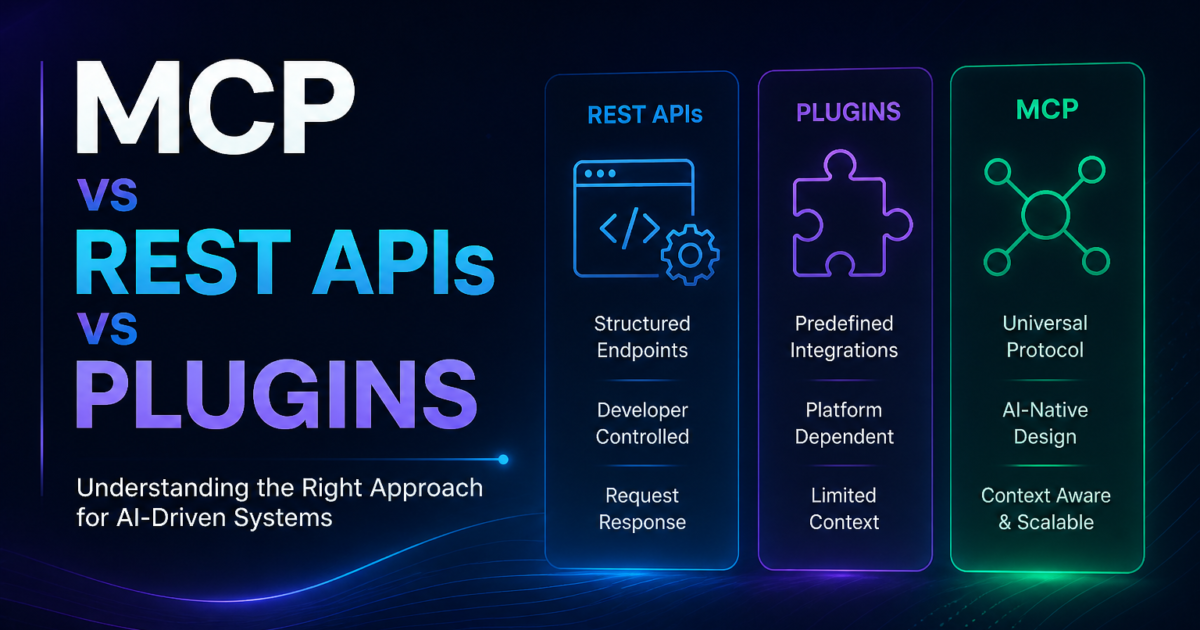
MCP vs REST APIs vs Plugins is not simply a comparison of three ways to connect software. It is a comparison of three different integration philosophies: traditional application-to-application communication, AI-oriented capability discovery, and packaged workflow enablement.
If you are building AI agents, developer tools, automation platforms, internal copilots, or intelligent testing systems, choosing between these approaches can have a major architectural impact. A REST API can expose a service extremely well, but an AI agent may still need additional information about what that service can do, which parameters are expected, and when a particular operation should be used. A plugin can package capabilities and workflow instructions, but it is generally tied to the host ecosystem in which that plugin is installed. MCP takes a different approach by defining a standardized protocol through which AI applications can discover and interact with tools, resources, and prompts.
That distinction is the foundation of MCP vs REST APIs vs Plugins.
The important question is therefore not:
“Which technology is better?”
The better engineering question is:
“Which integration layer solves the problem I actually have?”
For example, if your requirement is simply exposing /users/{id} to a mobile application, REST may be exactly what you need. If you want an AI coding assistant to discover a database query capability, inspect available resources, and invoke a tool using a standardized model-facing interface, MCP becomes much more interesting. If your organization wants to package several capabilities, instructions, and applications into a repeatable workflow for a particular host, a plugin can make more sense.
The latest MCP specification is particularly important here. The July 28, 2026 specification introduced a stateless protocol core, multi-round-trip requests, header-based routing, cacheable list results, authorization hardening, an extensions framework, and a formal deprecation policy. That evolution shows that MCP is becoming an integration protocol rather than merely a convenient mechanism for connecting an AI assistant to a local tool. (Model Context Protocol Blog)
So let us examine MCP vs REST APIs vs Plugins from the perspective of architecture, discovery, AI interaction, security, portability, and real-world engineering.
What Are We Actually Comparing?
Before comparing the three technologies, it is important to define what each one represents.
REST APIs primarily solve a service communication problem.
A REST-style service exposes resources or operations through HTTP. A client knows the endpoint, HTTP method, authentication mechanism, request structure, and expected response structure. The client then explicitly makes a request.
A simplified example might look like this:
GET /api/users/42
Authorization: Bearer <token>
Accept: application/json
The server might return:
{
  "id": 42,
  "name": "Sarah",
  "role": "QA Engineer"
}
This works extremely well when the client already understands the API contract.
Plugins solve a somewhat different problem.
A plugin is usually a packaged capability or workflow layer. Modern plugin systems can combine instructions, skills, applications, permissions, and actions. For example, OpenAI’s current plugin architecture describes plugins as packages that can include reusable skills and apps connecting to external systems. (OpenAI Help Center)
MCP focuses on a different layer again.
MCP provides a standardized protocol for exposing capabilities to AI hosts. An MCP server can expose tools, resources, and prompts, while an MCP client or host can discover and use those capabilities.
The current TypeScript SDK, for example, explicitly describes MCP servers as exposing tools, resources, and prompts. (MCP TypeScript SDK)
That gives us a useful mental model:
| Technology | Primary problem solved | Typical consumer |
|---|---|---|
| REST API | Application/service communication | Web, mobile, backend applications |
| Plugin | Packaged workflow/capability | Host platform, users, teams |
| MCP | AI-to-capability communication | AI agents, assistants, IDEs, AI applications |
This is why MCP vs REST APIs vs Plugins should not be treated as a simple “replacement” comparison.
In many architectures, you will use more than one.
For example:
AI Agent
   |
   v
MCP Server
   |
   +----> REST API
   |
   +----> Database
   |
   +----> Internal Service
   |
   +----> SaaS Platform
The MCP server can become the AI-facing integration layer while REST remains the application-facing service interface.
That distinction is one of the most important architectural insights in this entire comparison.
The 5 Powerful Differences at a Glance
Here is the high-level MCP vs REST APIs vs Plugins comparison before we go deeper.
| Difference | MCP | REST APIs | Plugins |
|---|---|---|---|
| Primary abstraction | AI capability protocol | Web/service API | Packaged capability/workflow |
| Discovery | Designed for capability discovery | Usually documented externally | Usually host/plugin catalog based |
| AI awareness | High | None inherently | Depends on host/plugin design |
| Portability | Designed for multiple compatible hosts | Extremely broad | Often ecosystem-dependent |
| Interaction model | Tools, resources, prompts and protocol messages | HTTP resources/endpoints | Packaged skills/apps/actions |
| Best use case | AI agents and assistants | Application integration | Workflow enablement |
| Client knowledge | Can discover capabilities | Usually must know API contract | Host knows installed capability |
| AI context | First-class concern | Not inherent | Depends on implementation |
| Existing infrastructure | Can wrap APIs/services | Native service layer | Can package multiple integrations |
| Architecture role | AI integration layer | Service integration layer | Workflow/product layer |
The five differences we will examine are:
- Architecture and abstraction
- Capability discovery and context
- Interaction with AI agents
- Portability and ecosystem dependence
- Security, governance, and operational strategy
These differences matter more than syntax.
Difference 1: Architecture and Abstraction
The first major difference in MCP vs REST APIs vs Plugins is the level at which each technology operates.
REST operates primarily at the service boundary.
Suppose you have a payment service:
POST /payments
GET  /payments/{id}
POST /payments/{id}/refund
A conventional application can call those endpoints directly.
The client knows:
Endpoint
HTTP method
Authentication
Parameters
Response schema
Error handling
The relationship is relatively explicit.
MCP operates at a more AI-oriented abstraction layer.
Instead of merely saying:
POST /refundan MCP server can expose a meaningful capability such as:
refund_paymentwith a structured input schema.
Conceptually:
{
  "name": "refund_payment",
  "description": "Refund a completed customer payment",
  "inputSchema": {
    "type": "object",
    "properties": {
      "payment_id": {
        "type": "string"
      },
      "reason": {
        "type": "string"
      }
    },
    "required": ["payment_id"]
  }
}
The important difference is semantic.
A REST API primarily tells a client how to communicate with a service.
An MCP tool can describe what capability is available to an AI system.
That does not mean REST cannot have excellent semantic documentation. Modern REST APIs can use OpenAPI, JSON Schema, rich descriptions, SDKs, and generated clients. The distinction is that AI-oriented capability exposure is part of MCP’s protocol model rather than an optional documentation layer.
The current MCP ecosystem also goes beyond tools. MCP supports resources and prompts, which gives an AI host multiple categories of interaction rather than forcing every integration into an endpoint-shaped abstraction. (MCP TypeScript SDK)
A useful architectural diagram is:
REST

Application
    |
    | HTTP
    v
REST API
    |
    v
Business Service
Whereas:
MCP

AI Host
   |
   | MCP
   v
MCP Server
   |
   +---- Tool
   |
   +---- Resource
   |
   +---- Prompt
   |
   v
Business System
And a plugin can sit at an even higher workflow layer:
User
 |
 v
Plugin
 |
 +---- Skill / Instructions
 |
 +---- App
 |
 +---- Actions
 |
 +---- Permissions
 |
 v
External Systems
This difference matters when designing systems because you should avoid forcing one layer to perform another layer’s job.
Strategic engineering lesson
If your architecture already has stable REST services, you do not necessarily need to replace them with MCP.
Instead:
Existing REST APIs
        |
        v
   MCP Adapter
        |
        v
    AI Agent
This lets you preserve your existing application architecture while adding an AI-native interface.
That is often a much safer migration strategy than rewriting backend services simply because AI has entered the architecture.
A Practical Example: QA Automation
Imagine you operate a testing platform with these REST endpoints:
GET /tests
POST /tests
GET /tests/{id}
POST /tests/{id}/run
GET /tests/{id}/results
A human developer can understand the API.
An AI agent, however, might receive a request such as:
“Run the checkout regression suite and tell me whether the failure is caused by a test issue or an application issue.”
The agent potentially needs to:
- Find available test suites.
- Identify the checkout suite.
- Execute it.
- Retrieve results.
- Inspect logs.
- Compare failures.
- Produce an explanation.
You could expose every operation as REST.
But the AI-facing layer could expose higher-level capabilities:
list_test_suites
run_test_suite
get_test_results
get_test_logs
analyze_test_failure
The REST API remains underneath.
This is where MCP vs REST APIs vs Plugins becomes a design question rather than a technology popularity contest.
Difference 2: Discovery and Context
The second major difference is how capabilities become understandable to the consumer.
REST clients commonly operate from predefined contracts.
A developer reads documentation:
GET /customers/{customerId}
POST /customers
DELETE /customers/{customerId}
The application is then programmed against those endpoints.
The API can provide OpenAPI metadata, but the application generally has an integration contract established during development.
An AI agent has a different problem.
It may not know beforehand which tools are available.
Suppose an agent connects to an MCP server and discovers:
Tools:
- search_customers
- create_customer
- update_customer
- refund_payment

Resources:
- customer://schema
- payment://policy
- refund://policy

Prompts:
- investigate_customer_issue
- analyze_payment_failure
The agent now has a structured capability surface.
That discovery mechanism is one of MCP’s most important distinctions.
The current MCP specification also makes list responses cacheable, including results associated with tools, prompts, and resources. This matters operationally because capability discovery does not necessarily have to become an expensive repeated operation in large systems. (Model Context Protocol Blog)
Why discovery changes AI architecture
Consider two approaches.
Without capability discovery:
Developer
   |
   +---- manually tells AI:
   |      "Use POST /orders when..."
   |
   +---- manually defines schemas
   |
   +---- manually maintains instructions
   |
   v
AI Agent
With a standardized capability layer:
AI Host
   |
   v
MCP Server
   |
   +---- discover tools
   +---- discover resources
   +---- discover prompts
   |
   v
AI Agent
This can reduce hardcoded integration knowledge.
That does not eliminate configuration or governance. It changes where some of the integration metadata lives.
REST versus MCP discovery
| Capability | REST | MCP |
|---|---|---|
| Endpoint discovery | Usually documentation/OpenAPI | Protocol-level capability discovery |
| Tool semantics | Documentation-dependent | Tool metadata can be exposed |
| Resource discovery | Resource URLs/endpoints | Resources are explicit protocol concepts |
| Prompt discovery | Not a REST primitive | Prompt capability is supported |
| AI-oriented metadata | Optional | Core design concern |
| Dynamic capability surface | Possible but custom | Designed into protocol |
The important word here is standardization.
REST can absolutely implement discovery.
The issue is that REST does not prescribe one universal AI capability discovery model.
MCP exists specifically to establish such a protocol layer.
Interactive Thought Experiment
Imagine you join a new engineering team and someone gives you:
https://internal-api.company.comWould you automatically know what it does?
No.
You need:
- documentation
- OpenAPI specification
- authentication instructions
- examples
- domain knowledge
- error semantics
Now imagine connecting an AI host to an MCP server that advertises a structured collection of tools and resources.
The host can inspect the available capabilities according to the protocol.
That does not mean the AI automatically understands the company’s business rules perfectly.
But the integration surface becomes more machine-discoverable.
That distinction is crucial.
Difference 3: AI Interaction Model
The third difference is arguably the most important.
REST was designed for networked resources and services.
MCP was designed around AI application interaction.
Plugins operate at the workflow/product layer.
Consider a conventional REST request:
import requests

response = requests.get(
    "https://example.com/api/orders/123"
)

order = response.json()
print(order)
The program decides when and how to call the endpoint.
Now consider an AI agent.
The user might say:
“Check order 123 and tell me whether it qualifies for a refund.”
The agent needs to reason about the request.
It may decide:
1. Get order
2. Read refund policy
3. Determine eligibility
4. If eligible, ask for confirmation
5. Execute refund
This is fundamentally different from:
GET /orders/123MCP’s tool-oriented model fits naturally into this agent loop.
Conceptually:
User
  |
  v
AI Agent
  |
  | "What capabilities are available?"
  v
MCP Server
  |
  +---- get_order
  +---- get_refund_policy
  +---- refund_order
  |
  v
Agent reasoning
  |
  v
Tool invocation
  |
  v
Result
OpenAI’s current API documentation similarly describes tools as a way to extend models with external data and functions, including custom API calls and remote MCP. (OpenAI Platform)
That gives us an important distinction:
REST provides operations.
MCP provides a standardized way for AI hosts to discover and invoke capabilities.
Plugins package capabilities and workflows for a particular host ecosystem.
These concepts can coexist.
The agent loop
A simplified AI-agent interaction might look like this:
user_request = """
Find the failed checkout tests from today's regression run
and summarize the likely root cause.
"""

while True:
    response = agent.run(user_request)

    if response.requires_tool:
        result = mcp_client.call_tool(
            response.tool_name,
            response.arguments
        )

        user_request = result

    else:
        break
The actual implementation is more sophisticated, but the conceptual difference is important.
The AI decides that it needs an external capability.
The protocol provides a standardized mechanism for reaching that capability.
REST may still exist underneath the capability.
For example:
Agent
  |
  v
MCP Tool: run_regression
  |
  v
MCP Server
  |
  v
POST /api/test-runs
  |
  v
Testing Platform
This is not an either/or architecture.
It is layered architecture.
Difference 4: Portability and Ecosystem Dependence
The fourth difference is portability.
REST has an enormous advantage here.
Almost every programming language, framework, cloud platform, browser, mobile platform, and backend environment can communicate over HTTP.
A REST API can be consumed by:
Java
Python
JavaScript
Go
Rust
C#
Swift
Kotlin
PHP
Ruby
That makes REST extremely portable.
MCP is also designed around interoperability, but its portability is specifically about compatible AI hosts and MCP implementations.
The goal is not:
“Every application should become an MCP client.”
The goal is closer to:
“AI applications should be able to interact with compatible capability providers through a common protocol.”
That distinction matters.
A REST API might be consumed by:
Mobile App
Web App
Backend
CLI
Microservice
IoT Device
AI Agent
An MCP server is primarily valuable to:
AI Host
Agent
AI Assistant
IDE Agent
Developer Tool
AI Application
Plugins have another portability challenge
Plugins are often closely associated with their host ecosystem.
A plugin may depend on:
Host platform
Plugin manifest
Host permissions
Host UI
Host skill system
Host authentication
Host app model
Modern OpenAI plugin architecture, for example, treats a plugin as a package that can include skills and apps, with permissions and availability managed through the relevant host/workspace configuration. (OpenAI Help Center)
This makes plugins excellent for packaging workflows but potentially less portable than a lower-level protocol.
Think about the layers:
REST
 |
 +---- broad application interoperability

MCP
 |
 +---- AI integration interoperability

Plugin
 |
 +---- host/workflow interoperability
That is a much more useful comparison than simply asking which one is “better.”
Portability matrix
| Question | REST | MCP | Plugin |
|---|---|---|---|
| Works across programming languages | Excellent | Excellent with compatible SDKs/clients | Depends on host |
| Works with ordinary applications | Excellent | Not usually the primary purpose | Depends on host |
| Works with AI agents | Possible | Designed for it | Designed for supported host workflows |
| Host-independent | Generally yes | Generally protocol-oriented | Often no |
| Vendor lock-in risk | Relatively low | Lower when multiple clients support protocol | Potentially higher |
| Workflow packaging | Limited | Moderate | Strong |
The latest MCP SDK ecosystem includes TypeScript, Python, Go, C# and other implementation support, reinforcing the protocol’s cross-language direction. (MCP TypeScript SDK)
Difference 5: Security, Governance, and Operational Control
The fifth difference is where architecture becomes production engineering.
A developer might initially think:
“MCP is just a way to call tools.”
That mindset is dangerous.
The moment an AI system can execute actions, you have created a security boundary.
Consider these tools:
search_customer
read_customer
delete_customer
refund_payment
send_email
deploy_application
rotate_credentials
These capabilities have completely different risk levels.
A good architecture must distinguish between:
Read
Write
Destructive
Financial
Administrative
Security-sensitive
MCP’s latest specification work explicitly includes authorization hardening and formalized security-related changes. The July 2026 release also introduced changes around issuer validation and client metadata as part of the authorization model. (Model Context Protocol Blog)
But protocol-level security does not eliminate application-level security.
Your MCP server still needs:
Authentication
Authorization
Input validation
Rate limiting
Audit logging
Least privilege
Approval policies
Secret management
Tool-level controls
The same is true for REST APIs.
REST security commonly involves:
OAuth
JWT
API keys
mTLS
Gateway policies
RBAC
Rate limits
WAF
Audit logs
Plugins introduce another governance layer because the host may control which plugins can be installed, which apps they access, which actions they can perform, and whether confirmation is required. OpenAI’s current plugin documentation specifically highlights role access, app permissions, action controls, confirmation, and source-system permissions as security considerations. (OpenAI Help Center)
Security comparison
| Security concern | REST | MCP | Plugin |
|---|---|---|---|
| Authentication | API/service layer | Protocol + service layer | Host/app + service |
| Authorization | API/server | Tool/server + backend | Host + app + backend |
| Tool-level approval | Custom | Can be implemented by host/application | Host-controlled |
| Auditability | Mature | Requires implementation | Host-dependent |
| Least privilege | Mature patterns | Must be designed carefully | Often host/admin controlled |
| Destructive actions | API policy | Tool policy + agent policy | Plugin/app policy |
| Governance | Enterprise API tooling | Emerging AI governance layer | Host/workspace governance |
The key lesson is:
Never confuse protocol capability with authorization to perform a business action.
If an MCP server exposes:
delete_production_databasethe fact that the AI can discover the tool does not mean the AI should automatically be allowed to execute it.
A production design might instead expose:
request_database_deletionand require human approval before execution.
That is an architectural decision, not merely an MCP configuration detail.
A Better Architecture: Use All Three
One of the biggest mistakes in MCP vs REST APIs vs Plugins discussions is assuming that selecting MCP means eliminating REST or plugins.
In mature systems, the three layers can complement each other.
Consider an enterprise QA platform.
Backend layer
REST APIs
    |
    +---- Test Management
    +---- Test Execution
    +---- Defect Management
    +---- Reporting
AI integration layer
MCP Server
    |
    +---- list_tests
    +---- run_test
    +---- get_results
    +---- create_defect
    +---- analyze_failure
Workflow layer
Plugin
    |
    +---- QA investigation skill
    +---- Testing app
    +---- Defect system
    +---- Approval workflow
User layer
Engineer
    |
    v
AI Assistant
    |
    v
Plugin / Host
    |
    v
MCP
    |
    v
REST APIs
    |
    v
Enterprise Systems
This architecture is much more realistic than:
REST is old.
MCP is new.
Replace REST.
That is rarely good engineering.
REST is still excellent at what it does.
MCP adds an AI-facing protocol layer.
Plugins can package user-facing workflows.
When Should You Choose REST?
Choose REST when your primary problem is application-to-service communication.
REST is usually the right answer when:
- You are building a public web API.
- Mobile clients need backend access.
- Multiple applications consume the same service.
- Your services already have stable HTTP contracts.
- You need broad ecosystem compatibility.
- Your integration is deterministic.
- The consumer already knows the operations it needs.
- You need mature API gateway and observability tooling.
For example:
Mobile App
    |
    v
REST API
    |
    v
Order Service
    |
    v
Database
There is no reason to introduce MCP merely because the company uses AI elsewhere.
That would be architectural overengineering.
When Should You Choose MCP?
Choose MCP when the central problem is exposing capabilities to AI applications in a standardized way.
MCP becomes particularly attractive when:
- AI agents need dynamic tool discovery.
- Multiple AI hosts should consume the same capabilities.
- You want tools, resources, and prompts represented through a common protocol.
- You want an AI-facing abstraction above existing services.
- You are building developer agents.
- You are integrating databases, SaaS platforms, testing systems, cloud services, or internal tools with AI.
- You want to avoid building a completely custom integration model for every AI client.
For example:
             +----------------+
             | Claude / IDE   |
             +-------+--------+
                     |
             +-------v--------+
             |   MCP Server   |
             +-------+--------+
                     |
        +------------+-------------+
        |            |             |
        v            v             v
      REST         DB API       SaaS API
The value is not that MCP magically makes the backend intelligent.
The value is that it creates a standardized capability boundary between the AI host and the underlying systems.
When Should You Choose a Plugin?
Choose a plugin when your primary problem is packaging a workflow or set of capabilities for a specific host environment.
A plugin becomes useful when you want to package things such as:
Instructions
Skills
Applications
Actions
Permissions
Workflow conventions
Modern plugin systems can combine multiple capabilities into one workflow package. OpenAI’s current documentation describes plugins as containers for skills and apps, with plugins potentially depending on multiple applications and inheriting the relevant app permissions. (OpenAI Help Center)
For example:
QA Investigation Plugin
        |
        +---- Testing Skill
        +---- Jira App
        +---- GitHub App
        +---- CI App
        +---- MCP Capability
The plugin is not necessarily competing with MCP.
It can package or orchestrate capabilities that ultimately use APIs or MCP.
The Most Important Concept: Layers, Not Competitors
If you remember only one architecture diagram from this article, remember this:
                    USER
                      |
                      v
               AI APPLICATION
                      |
              +-------+-------+
              |               |
              v               v
           Plugin           Native AI Tools
              |
              v
             MCP
              |
       +------+------+
       |             |
       v             v
   REST APIs      Databases
       |
       v
 Enterprise Services
These technologies operate at different layers.
That means MCP vs REST APIs vs Plugins is often a false binary comparison.
They can be complementary.
A REST API can be your stable business-service interface.
MCP can become your AI integration interface.
A plugin can become your user-facing workflow package.
That separation creates cleaner architecture.
Code-Level Comparison
Consider a simple customer lookup.
REST
import requests

response = requests.get(
    "https://api.example.com/customers/123",
    headers={
        "Authorization": "Bearer TOKEN"
    }
)

customer = response.json()
The application knows the URL.
MCP
Conceptually, the AI-facing application might discover:
Tool: get_customer

Input:
{
    "customer_id": "123"
}
Then invoke:
result = await mcp_client.call_tool(
    "get_customer",
    {
        "customer_id": "123"
    }
)
The client does not necessarily need to know the underlying backend implementation.
The MCP server could internally call:
response = requests.get(
    "https://api.example.com/customers/123"
)
The AI-facing contract remains:
get_customer(customer_id)while the implementation can change.
Plugin
At the workflow layer, the user might simply ask:
"Investigate this customer issue."The plugin could provide:
Customer Investigation Skill
        |
        +---- search customer
        +---- inspect orders
        +---- check support tickets
        +---- summarize issue
The user does not need to understand whether those operations are backed by REST, MCP, database queries, or another integration.
That is the difference in abstraction.
A Decision Framework for Architects
Instead of asking:
“Should my company adopt MCP?”
Ask these five questions.
Question 1: Who is the primary consumer?
If the answer is:
Web/mobile/backend applicationsstart with REST or another conventional service protocol.
If the answer is:
AI agents / AI assistants / AI IDEsevaluate MCP.
If the answer is:
Users inside a specific AI/workflow platformevaluate plugins.
Question 2: Does the consumer need capability discovery?
If no:
REST may be sufficient.If yes:
MCP becomes more compelling.Question 3: Is workflow packaging important?
If yes:
Pluginmay be useful.
Question 4: Do existing APIs already work?
If yes, do not rewrite them automatically.
Consider:
REST
  |
  v
MCP adapter
  |
  v
AI
Question 5: What is the risk of each capability?
Create a capability classification:
| Capability | Risk | Suggested control |
|---|---|---|
| Search data | Low | Read permission |
| Read customer | Medium | Scoped authorization |
| Update record | Medium | Validation + audit |
| Send email | High | Confirmation |
| Refund payment | High | Approval |
| Delete production data | Critical | Human approval / restricted access |
This is much more valuable than blindly adopting a protocol.
A Real-World SDET Strategy
For SDETs and QA engineers, the difference becomes especially interesting.
Imagine an AI testing agent with these capabilities:
search_test_cases
create_test_case
run_playwright_test
run_api_test
get_ci_results
read_application_logs
create_bug
update_bug
generate_test_report
A conventional REST architecture might expose:
GET /tests
POST /tests
POST /test-runs
GET /test-runs/{id}
GET /logs
POST /bugs
The AI-facing MCP layer can expose semantically meaningful capabilities:
search_test_cases
run_playwright_test
get_ci_results
analyze_test_failure
create_bug
Then a workflow plugin can package them into:
"Investigate CI Failure"The engineer could ask:
“Investigate the checkout regression failure from the latest pipeline.”
The workflow might become:
Plugin
  |
  v
AI Agent
  |
  v
MCP
  |
  +---- get_ci_results
  |
  +---- get_test_logs
  |
  +---- get_application_logs
  |
  +---- analyze_test_failure
  |
  +---- create_bug
The underlying infrastructure remains:
GitHub
Jenkins
Playwright
Jira
REST APIs
Databases
Cloud logs
This is where AI-native testing architecture becomes powerful.
The objective is not to make every backend an AI system.
The objective is to create a controlled capability layer through which AI can safely interact with existing engineering systems.
Common Misconceptions
“MCP replaces REST”
Not necessarily.
MCP can sit above REST.
AI
 |
MCP
 |
REST
 |
Service
This is often a better architecture than rewriting existing services.
“MCP is just an API”
It is more accurate to describe MCP as a protocol for AI-oriented context and capability interaction.
Its model includes concepts such as tools, resources, and prompts rather than merely HTTP endpoints.
“Plugins and MCP are the same thing”
No.
A plugin is generally a packaged capability or workflow construct associated with a host ecosystem.
MCP is a protocol.
A plugin can use or package capabilities that ultimately communicate through MCP.
“REST cannot work with AI”
It absolutely can.
An AI application can call REST APIs through function calling, custom tools, SDKs, or an integration layer.
The difference is that REST itself does not define an AI capability protocol.
“MCP automatically makes agents safe”
Absolutely not.
If you expose dangerous capabilities, you still need:
Authentication
Authorization
Approval
Validation
Auditing
Rate limiting
Least privilege
Protocol standardization does not remove security engineering.
The Strategic Difference in One Sentence
If you need a simple way to remember MCP vs REST APIs vs Plugins, use this:
REST connects applications to services, MCP connects AI applications to discoverable capabilities, and plugins package capabilities into host-oriented workflows.
That sentence captures the architectural distinction better than dozens of feature checklists.
Final Comparison Matrix
| Area | MCP | REST APIs | Plugins |
|---|---|---|---|
| Core purpose | AI capability interoperability | Service interoperability | Workflow/capability packaging |
| Primary abstraction | Tools, resources, prompts | Resources/endpoints | Skills, apps, actions |
| Designed for AI | Yes | No | Often yes |
| Designed for normal applications | Not primarily | Yes | Depends on host |
| Discovery | Protocol-oriented | Documentation/OpenAPI/custom | Host/catalog-oriented |
| Tool semantics | Strong | External/optional | Workflow-dependent |
| Resources | First-class concept | URLs/endpoints | Depends on included apps |
| Prompts | First-class concept | Not inherent | Skills/instructions may provide similar workflow guidance |
| Transport | Protocol-defined | HTTP commonly | Host-dependent |
| Portability | Compatible AI ecosystem | Extremely broad | Host-dependent |
| Existing backend reuse | Excellent through adapters | Native | Through apps/integrations |
| Best for | Agents and AI assistants | Web/mobile/backend systems | Packaged workflows |
| Security model | Protocol + host + backend | API + backend | Host + app + backend |
| Governance | AI capability governance | Mature API governance | Workspace/plugin governance |
| Replacement for REST? | Usually no | N/A | No |
| Replacement for plugins? | No | No | N/A |
How to Choose Without Overengineering
Use this practical rule:
Need application communication?
        |
        +---- YES ---> REST/API

Need AI capability discovery?
        |
        +---- YES ---> MCP

Need packaged host workflow?
        |
        +---- YES ---> Plugin

Need all three?
        |
        +---- YES ---> Use them as layers
For an enterprise AI platform, a strong architecture could therefore be:
                         USER
                           |
                           v
                     AI ASSISTANT
                           |
                 +---------+---------+
                 |                   |
                 v                   v
              Plugin             AI Tools
                 |
                 v
                MCP
                 |
        +--------+---------+
        |        |         |
        v        v         v
      REST      DB      SaaS APIs
        |
        v
  Business Services
This architecture preserves the strengths of each technology instead of forcing one technology to solve every integration problem.
Conclusion
The real lesson from MCP vs REST APIs vs Plugins is that these technologies should be evaluated according to the layer of the architecture they address.
REST APIs remain one of the strongest choices for conventional service integration because they are simple, widely supported, language-independent, and deeply integrated into modern application architecture.
Plugins solve a different problem: packaging capabilities, skills, applications, permissions, and workflows into an experience controlled by a host ecosystem. Modern plugin systems can combine several capabilities into a single workflow package, which makes them particularly useful when the goal is not merely exposing an API but delivering an operational experience. (OpenAI Help Center)
MCP is valuable because AI systems introduce a new integration problem. An agent needs more than a URL. It needs to understand available capabilities, their inputs, their outputs, and how those capabilities fit into an interactive reasoning workflow. MCP provides a standardized protocol model for that AI-facing interaction.
The most powerful architecture is therefore often not:
MCP OR REST OR Pluginbut:
Plugin / AI Host
        |
        v
       MCP
        |
        v
 REST APIs / Databases / SaaS
        |
        v
 Business Systems
That approach allows existing systems to continue serving applications while MCP provides a standardized AI-facing capability boundary and plugins package those capabilities into useful workflows.
The five differences matter because they answer five different architectural questions:
- Architecture: What layer are you integrating?
- Discovery: Does the consumer already know the interface?
- AI interaction: Does the system need agent-oriented capability invocation?
- Portability: Who needs to consume the integration?
- Security: Who controls what the capability is allowed to do?
If your application already has mature REST APIs, keep them.
If AI agents need to interact with those services, consider an MCP layer rather than rebuilding the backend.
If users need repeatable workflows inside a particular AI ecosystem, consider packaging the capabilities through a plugin.
That is the strategic difference.
Final Key Takeaways
- REST APIs are service interfaces.
- MCP is an AI-oriented capability protocol.
- Plugins are packaged workflow/capability layers.
- MCP does not automatically replace REST.
- Plugins do not automatically replace MCP.
- REST can remain the backend while MCP becomes the AI-facing layer.
- MCP’s tool, resource, and prompt model is particularly useful for agent-based systems. (MCP TypeScript SDK)
- MCP capability discovery is a major architectural distinction from conventional API consumption.
- REST remains the better default for many ordinary application integrations.
- MCP becomes more valuable when AI agents need standardized access to multiple tools and systems.
- Plugins become valuable when capabilities need to be packaged into host-specific workflows.
- Security must be designed around individual capabilities, not merely around the protocol.
- Read-only capabilities should be separated from destructive or financially sensitive actions.
- Human approval can remain an important control for high-risk AI actions.
- Existing REST infrastructure can often be reused behind an MCP server.
- The strongest enterprise architecture may use plugins + MCP + REST, with each layer doing a different job.
The key difference is therefore simple:
REST tells software how to communicate with a service. MCP gives AI applications a standardized way to discover and use capabilities. Plugins package those capabilities into workflows that users can consume through a host platform.
Once you understand that distinction, MCP vs REST APIs vs Plugins stops being a question of which technology is newer or more powerful and becomes what it should have been from the beginning: an architecture decision based on the consumer, abstraction layer, workflow, portability, and security requirements of your system.
More Relevant Articles
- Day 1: What is MCP?
- Day 2: Why MCP Matters for AI Agents
- Day 3: MCP vs REST APIs vs Plugins
- Day 4: MCP Architecture Deep Dive
- Day 5: Build Your First Production-Ready MCP Development Environment (Python & VS Code)
- Day 6: Build Your First MCP Server in Python: A Production-Ready Guide for Beginners
External References
- Model Context Protocol Specification
https://modelcontextprotocol.io - JSON-RPC 2.0 Specification
https://www.jsonrpc.org/specification - Python subprocess Documentation
https://docs.python.org/3/library/subprocess.html - Mozilla WebSocket API
https://developer.mozilla.org/docs/Web/API/WebSockets_API - MDN Server-Sent Events
https://developer.mozilla.org/docs/Web/API/Server-sent_events
Continue Learning
Explore more expert articles on Mobile Testing, Backend & API, AI & Agentic, AI Tools, n8n, LangChain, CrewAI, MCP Servers, AI Agents, LlamaIndex, Docker, FastAPI, Playwright, Cypress, Test Automation, DevOps, and Software Engineering at www.skakarh.com.
QAPulse by SK delivers expert release analysis, AI engineering insights, enterprise automation strategies, migration guidance, DevOps best practices, and practical testing knowledge to help software professionals build scalable, intelligent, and production-ready software systems.