 QA
QA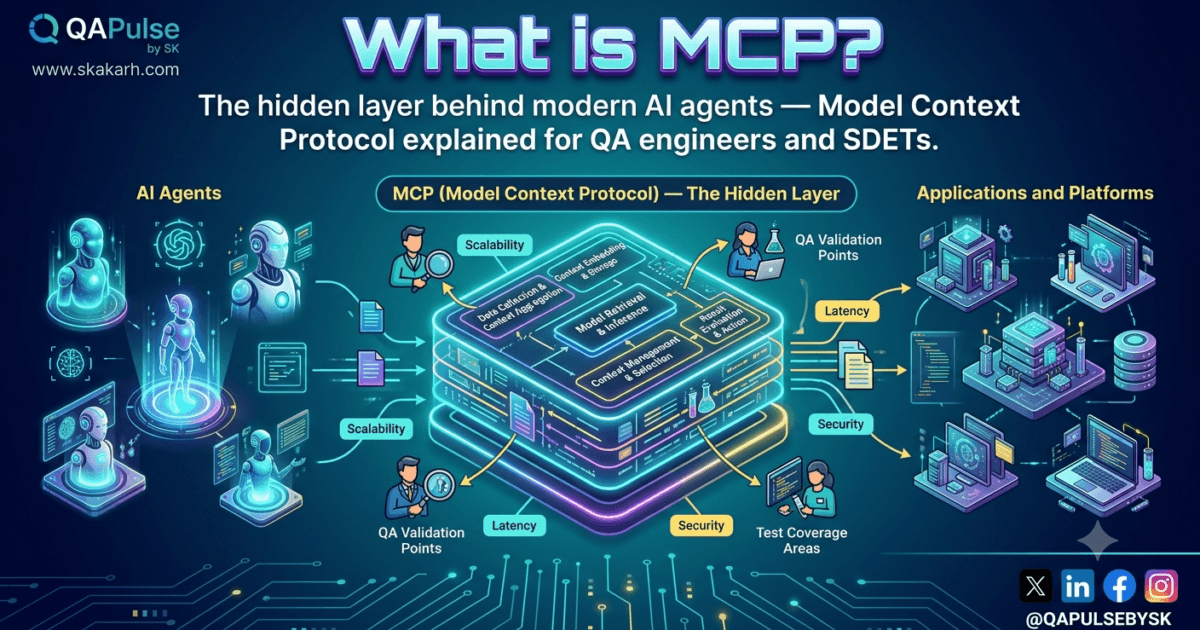
What is MCP?
The Hidden Layer Behind Modern AI Agents (And Why Nobody Explains It Properly)
If you’ve been building with AI tools lately, you’ve probably felt it:
“Everything looks powerful… but something is missing under the hood.”
You connect an LLM to tools.
You try function calling.
You experiment with agents.
And yet… it still feels fragile.
That missing piece has a name:
👉 Model Context Protocol (MCP)
And today, we start a 30-day journey to understand it — not as theory, but as something you can actually build with.
The Real Problem Nobody Talks About
Let’s be honest.
Modern AI systems look like this:
- LLM (brain 🧠)
- Tools (hands 🛠️)
- APIs (random connectors 🌐)
But here’s the issue:
👉 There is no standard way for AI to talk to tools.
Every project reinvents:
- Tool schemas
- Context passing
- Memory structure
- API wrappers
- Agent logic
It’s chaos disguised as innovation.
And this is exactly where MCP enters.
So, Exactly What is MCP?
Let’s simplify it:
👉 MCP is a standard communication layer between AI models and external systems
Think of it like this:
Without MCP:
Every AI app builds its own broken bridge to tools.
With MCP:
There is a universal highway for AI → tools → data systems
What is MCP in One Line
MCP defines how an AI model can discover, call, and use external tools in a structured way.
That’s it.
But the impact is huge.
A Simple Analogy (This will stick)
Imagine you are building software systems:
Before MCP:
Every company uses different:
- APIs
- Formats
- Authentication styles
- Response structures
It’s like every road in a city having different traffic rules.
Chaos.
After MCP:
All roads follow the same system:
- Same request format
- Same tool structure
- Same context handling
- Same response behavior
Now AI agents can travel anywhere without confusion.
Why MCP Matters Right Now
We are shifting from:
“Chat with AI”
to
“AI that does work for you”
And that shift needs infrastructure.
MCP is that infrastructure layer.
It enables:
💡 AI agents that can use tools reliably
💡 Multi-system automation (DB + APIs + UI)
💡 Clean separation between logic and tools
💡 Reusable agent ecosystems
Without MCP vs With MCP
❌ Without MCP
- Every agent is custom-built
- Tool integration is messy
- Scaling = rewriting everything
- Debugging is painful
✅ With MCP
- Standard tool interface
- Plug-and-play systems
- Easier debugging
- Scalable agent architecture
Think Like an SDET for a Second to know what is MCP?
If you come from automation/testing background, this should click instantly:
👉 MCP is like the Selenium WebDriver standard for AI agents
Before WebDriver:
- Every browser automation tool was different
After WebDriver:
- One standard changed everything
That’s the level of shift MCP is bringing to AI.
Where MCP is Used (Real World)
MCP-style systems are already powering:
- AI coding assistants
- Autonomous dev agents
- Data extraction pipelines
- QA automation agents
- DevOps automation bots
And soon:
👉 Every serious AI system will likely have an MCP layer
To know What is MCP? What We Will Build in This Series
Over the next 30 days, we will go from:
🟢 Beginner
- Understanding MCP
- Setting up environment
- First MCP server
🟡 Intermediate
- Tool integration
- Database + API connections
- Agent communication
🔴 Advanced
- Production MCP systems
- Scaling architecture
- Real-world AI automation systems
No fluff. Only building.
Key Insight for Today: What is MCP?
Here’s what most people miss:
MCP is not about AI models.
It’s about how AI interacts with the real world.
That’s the real revolution.
Not smarter models —
but better connections.
🚀 Final Thought What is MCP? (Day 1)
Every major shift in tech has one hidden layer:
- Web had HTTP
- Mobile had APIs
- Cloud had containers
- AI now has MCP
And most people won’t notice it… until it becomes the default.
You are early to this.
And over the next 30 days, we’re going to build it from scratch — not just understand it.
👉 Coming (Day 2)
We’ll break down:
Why MCP is better than REST APIs, plugins, and function calling
And trust me — this is where things start clicking.
More Relevant Articles
- 7 Powerful AI Agent Workflows Every Modern SDET Should Learn
- Day 4: MCP Architecture Deep Dive
- Day 3: MCP vs REST APIs vs Plugins