 QA
QA
Reading documentation helps you understand features, but practical implementation is what builds expertise. These Claude Code examples demonstrate how developers, QA engineers, SDETs, DevOps engineers, and technical leads use Claude Code to solve real software engineering problems.
Rather than focusing on simple prompts, this guide shows realistic scenarios that reflect day-to-day development in professional engineering teams.
Why Learn Through Examples?
Most developers don’t start with an empty project.
Instead, they usually need to:
- Understand an unfamiliar codebase.
- Add features without breaking existing functionality.
- Fix production issues.
- Improve existing code.
- Increase automated test coverage.
- Document engineering decisions.
The following examples demonstrate how Claude Code supports each of these tasks.
Example 1: Understand an Unknown Repository
One of the most valuable uses of Claude Code is accelerating repository onboarding.
Scenario
You have joined a new engineering team and need to understand a large codebase quickly.
Prompt
Analyze this repository and explain the overall architecture, folder structure, execution flow, dependency relationships, coding standards, testing strategy, deployment process, and key business modules. Present the explanation as if onboarding a senior software engineer.
Expected Outcome
Claude Code should explain:
- Repository structure
- Service interactions
- Business logic flow
- Technology stack
- Coding conventions
- Testing framework
- Build process
- Deployment architecture
This saves hours of manual repository exploration.
Example 2: Implement a New Feature
Large features should be implemented systematically.
Scenario
A product owner requests user profile management with role-based permissions.
Prompt
Implement user profile management using the existing architecture. Reuse current services, follow the repository's coding conventions, support role-based access control, include input validation, generate automated tests, and explain all architectural decisions.
Expected Outcome
Claude Code should:
- Analyze existing services.
- Reuse current architecture.
- Avoid duplicate logic.
- Generate maintainable code.
- Produce automated tests.
- Document implementation decisions.
The result is a feature that integrates naturally with the existing application.
Example 3: Refactor Legacy Code
Legacy systems often require modernization without introducing regressions.
Scenario
A service has become difficult to maintain because of duplicated logic and outdated patterns.
Prompt
Review this module for technical debt. Identify duplicated logic, outdated design patterns, large functions, unnecessary complexity, and maintainability issues. Refactor the implementation while preserving existing functionality and generating regression tests.
Expected Outcome
Claude Code should:
- Identify technical debt.
- Simplify complex code.
- Improve readability.
- Preserve business logic.
- Generate regression tests.
- Explain the refactoring decisions.
Incremental refactoring reduces risk while improving long-term maintainability.
Example 4: Debug a Production Issue
Fixing bugs without understanding the root cause often creates new problems.
Scenario
Users report intermittent HTTP 500 errors during checkout.
Prompt
Investigate this production issue. Analyze the repository, identify the root cause of the HTTP 500 errors, explain affected components, recommend the safest fix, implement the solution, and generate regression tests to prevent future failures.
Expected Outcome
Claude Code should:
- Investigate the error.
- Identify the root cause.
- Explain the failure path.
- Recommend a safe fix.
- Generate regression tests.
- Reduce the likelihood of recurrence.
Root-cause analysis is more valuable than temporary fixes.
Example 5: Generate Automated Tests
Automated testing should accompany every new implementation.
Scenario
A new payment service has been completed and requires comprehensive validation.
Prompt
Generate automated tests for this payment service. Include unit tests, API tests, Playwright end-to-end tests, negative scenarios, edge cases, validation checks, and meaningful assertions while following the existing testing framework.
Expected Outcome
Claude Code should generate:
- Unit tests
- Integration tests
- API tests
- Playwright tests
- Boundary condition tests
- Error handling validation
- Regression coverage
Well-designed automated tests increase confidence before deployment.
Common Mistakes
Avoid these common mistakes when using Claude Code examples:
- Copying prompts without adapting them to your repository.
- Requesting complete applications instead of focused features.
- Ignoring project architecture and coding standards.
- Skipping automated testing.
- Deploying AI-generated code without review.
Customizing examples to match your project’s context consistently produces better results.
Expert Tip
The most valuable Claude Code examples are those based on real engineering workflows rather than isolated coding exercises. Adapt every example to your repository, architecture, business rules, and testing strategy. Over time, build your own library of proven examples so your team can solve recurring engineering problems more efficiently while maintaining consistency across projects.
Advanced Claude Code Examples for Real Software Engineering Projects
Understanding prompts is useful, but applying them to realistic engineering scenarios is what separates beginners from experienced developers. These advanced Claude Code examples demonstrate how AI can support planning, implementation, testing, documentation, and operational excellence across complex software projects.
Example 6: Design a REST API
A well-designed API should be consistent with the existing architecture and easy to maintain.
Scenario
Your application needs a new Order Management API.
Prompt
Design and implement an Order Management REST API using the existing architecture. Reuse current services, follow repository conventions, generate request validation, error handling, OpenAPI documentation, automated tests, and explain every architectural decision.
Expected Outcome
Claude Code should:
- Review the existing API structure.
- Reuse common components.
- Design RESTful endpoints.
- Generate validation logic.
- Produce API documentation.
- Create automated API tests.
- Maintain architectural consistency.
Example 7: Create a Playwright Test Suite
Automation should reflect real user behavior.
Scenario
Your team needs end-to-end tests for an e-commerce checkout flow.
Prompt
Generate Playwright tests for the checkout process using the existing Page Object Model. Cover successful purchases, failed payments, coupon validation, guest checkout, logged-in users, responsive layouts, accessibility checks, and edge cases.
Expected Outcome
Claude Code should generate:
- Page Objects
- Reusable fixtures
- Stable locators
- Clear assertions
- Negative scenarios
- Regression coverage
- Readable test organization
The resulting test suite should integrate naturally with the existing automation framework.
Example 8: Review a Pull Request
AI can improve code quality before peer review begins.
Scenario
A developer submits a large pull request introducing multiple new features.
Prompt
Review this pull request as a senior software architect. Evaluate maintainability, readability, security, performance, coding standards, automated testing, documentation, and architectural consistency. Recommend improvements before merging.
Expected Outcome
Claude Code should identify:
- Code smells
- Maintainability issues
- Missing tests
- Security concerns
- Performance risks
- Documentation gaps
- Refactoring opportunities
Early review reduces review cycles and improves software quality.
Example 9: Investigate Performance Problems
Performance optimization should be based on evidence rather than assumptions.
Scenario
Users report slow dashboard loading during peak traffic.
Prompt
Analyze the dashboard module and identify performance bottlenecks. Review database queries, API calls, caching opportunities, asynchronous operations, rendering efficiency, and memory usage. Recommend optimizations with expected performance improvements.
Expected Outcome
Claude Code should:
- Identify inefficient queries.
- Recommend indexing improvements.
- Detect unnecessary API requests.
- Suggest caching strategies.
- Improve algorithm efficiency.
- Estimate performance gains.
Structured analysis leads to targeted optimizations.
Example 10: Perform a Security Assessment
Security should be evaluated before deployment.
Scenario
A new authentication service is ready for release.
Prompt
Perform a comprehensive security review of this authentication module. Evaluate authentication, authorization, session management, password handling, input validation, logging, dependency usage, and common web security vulnerabilities. Recommend improvements with explanations.
Expected Outcome
Claude Code should review:
- Authentication logic
- Authorization rules
- Session security
- Input validation
- Sensitive data handling
- Logging practices
- Dependency risks
Security assessments reduce deployment risk.
Example 11: Generate Technical Documentation
Documentation should evolve alongside implementation.
Scenario
A completed feature needs developer documentation.
Prompt
Generate comprehensive technical documentation for this feature. Include architecture overview, configuration steps, API usage, testing strategy, troubleshooting guidance, deployment considerations, and future maintenance recommendations.
Expected Outcome
Claude Code should produce:
- Architecture documentation
- Configuration guides
- API references
- Testing documentation
- Deployment notes
- Troubleshooting information
Comprehensive documentation improves maintainability and onboarding.
Example 12: Analyze Technical Debt
Technical debt should be addressed before it slows future development.
Scenario
A legacy repository has become increasingly difficult to maintain.
Prompt
Analyze this repository and identify technical debt. Highlight duplicated logic, oversized classes, outdated dependencies, inconsistent coding standards, missing tests, documentation gaps, and architectural weaknesses. Prioritize improvements based on engineering impact.
Expected Outcome
Claude Code should:
- Identify technical debt.
- Prioritize improvements.
- Recommend incremental refactoring.
- Preserve existing functionality.
- Reduce long-term maintenance costs.
Incremental modernization is safer than complete rewrites.
Enterprise Engineering Example
Large organizations often combine multiple activities into a structured engineering process.
Repository Analysis

↓

Architecture Review

↓

Implementation

↓

Unit Testing

↓

API Testing

↓

Playwright Testing

↓

Security Review

↓

Performance Validation

↓

Documentation

↓

Code Review

↓

CI/CD

↓

Production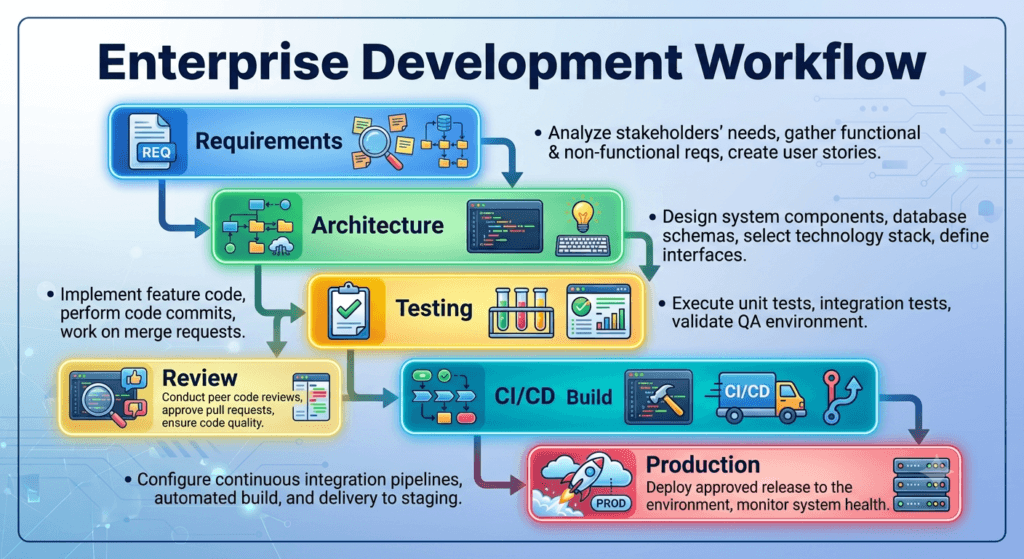
Following this sequence produces more predictable engineering outcomes.
Common Mistakes
Using Generic Prompts
Include repository context, coding standards, business rules, and testing expectations for more accurate responses.
Skipping Repository Analysis
Claude Code generates better implementations after understanding the existing architecture.
Treating Every Project the Same
Adapt prompts to your framework, technology stack, and engineering standards.
Ignoring Documentation
Every completed implementation should include updated technical documentation.
Expert Tips
Build an Internal Example Library
The most valuable Claude Code examples are those created from your own engineering projects. Store successful prompts, implementation patterns, testing strategies, documentation templates, and review workflows in a shared repository so every developer benefits from proven solutions.
Adapt Examples to Your Engineering Standards
Treat these examples as starting points rather than fixed templates. Modify them to match your repository structure, coding conventions, architectural patterns, testing framework, CI/CD pipeline, and business requirements. Consistent adaptation produces higher-quality software and strengthens long-term maintainability.
Claude Code Examples for QA, DevOps, CI/CD, and Enterprise Teams
The most practical Claude Code examples are not limited to writing application code. Modern engineering teams use Claude Code to improve testing, DevOps, release management, documentation, incident response, and team collaboration. These real-world scenarios demonstrate how AI supports the complete software development lifecycle.
Example 13: Create a Comprehensive QA Test Plan
Successful testing begins before implementation.
Scenario
A new subscription management module is scheduled for the next release.
Prompt
Review the subscription management requirements and create a complete QA test plan. Include functional testing, negative scenarios, API validation, database verification, accessibility testing, compatibility testing, security validation, performance considerations, and regression coverage.
Expected Outcome
Claude Code should generate:
- Functional test scenarios
- Boundary value tests
- Negative test cases
- API validation checklist
- Database verification
- Accessibility checks
- Regression test recommendations
A structured QA plan improves release confidence.
Example 14: Generate API Test Cases
API testing should validate both expected and unexpected behavior.
Scenario
A payment gateway exposes multiple REST endpoints.
Prompt
Generate comprehensive API test cases for this payment gateway. Validate successful requests, authentication failures, invalid payloads, missing parameters, rate limiting, timeout handling, error responses, and business rule validation.
Expected Outcome
Claude Code should create:
- Positive API scenarios
- Negative API scenarios
- Authentication validation
- Response verification
- Error handling tests
- Business logic validation
- Edge case coverage
Comprehensive API testing reduces production integration issues.
Example 15: Optimize a CI/CD Pipeline
Deployment pipelines should evolve as projects grow.
Scenario
A GitHub Actions pipeline has become slow and unreliable.
Prompt
Review this GitHub Actions workflow and identify opportunities to improve build speed, dependency caching, parallel execution, automated testing, deployment reliability, security validation, and overall pipeline efficiency.
Expected Outcome
Claude Code should recommend:
- Faster build stages
- Better caching strategies
- Parallel test execution
- Improved quality gates
- Deployment safeguards
- Pipeline simplification
Pipeline optimization improves engineering productivity.
Example 16: Investigate a Production Incident
Production incidents require systematic analysis.
Scenario
Users experience intermittent failures while uploading files.
Prompt
Investigate this production issue using application logs, repository context, and deployment history. Explain the root cause, affected services, business impact, corrective actions, preventive measures, and required regression tests.
Expected Outcome
Claude Code should provide:
- Root-cause analysis
- Timeline of events
- Impact assessment
- Corrective actions
- Preventive recommendations
- Regression testing strategy
Structured investigations reduce recurring incidents.
Example 17: Upgrade Project Dependencies
Dependency upgrades should be planned carefully.
Scenario
Several critical libraries are outdated.
Prompt
Review the project's dependencies. Identify outdated packages, security vulnerabilities, breaking changes, compatibility concerns, migration requirements, and recommend a phased upgrade strategy with regression testing guidance.
Expected Outcome
Claude Code should identify:
- Outdated dependencies
- Security advisories
- Breaking changes
- Upgrade priorities
- Migration risks
- Validation strategy
Incremental upgrades reduce deployment risk.
Example 18: Prepare Release Documentation
Release documentation improves communication between engineering and stakeholders.
Scenario
Version 3.0 is ready for deployment.
Prompt
Generate professional release documentation summarizing new features, bug fixes, breaking changes, migration steps, deployment instructions, rollback strategy, testing summary, and known limitations.
Expected Outcome
Claude Code should create:
- Release notes
- Deployment checklist
- Migration guide
- Rollback procedure
- Testing summary
- Known issues
Clear documentation simplifies production releases.
Example 19: Perform an Architecture Review
Architecture should be reviewed before major feature expansion.
Scenario
A monolithic application is beginning to scale rapidly.
Prompt
Review the current architecture. Identify scalability limitations, tightly coupled modules, technical debt, performance concerns, maintainability issues, and recommend an incremental modernization strategy.
Expected Outcome
Claude Code should recommend:
- Architectural improvements
- Modularization opportunities
- Scalability enhancements
- Technical debt reduction
- Incremental migration plan
Architecture reviews support sustainable growth.
Example 20: Create Engineering Onboarding Documentation
Large engineering teams require efficient onboarding.
Scenario
Several new developers are joining the project.
Prompt
Create a complete engineering onboarding guide explaining the repository structure, development workflow, coding standards, testing framework, deployment process, CI/CD pipeline, documentation standards, and contribution guidelines.
Expected Outcome
Claude Code should produce:
- Repository overview
- Development setup
- Coding guidelines
- Testing instructions
- Deployment workflow
- Team conventions
- Contribution process
Strong onboarding documentation accelerates developer productivity.
Enterprise Workflow Example
Successful engineering organizations combine multiple activities into a unified process.
Requirements

↓

Architecture Review

↓

Development

↓

QA Planning

↓

Automation

↓

Security Review

↓

CI/CD

↓

Release Documentation

↓

Production

↓

Monitoring

↓

Continuous Improvement
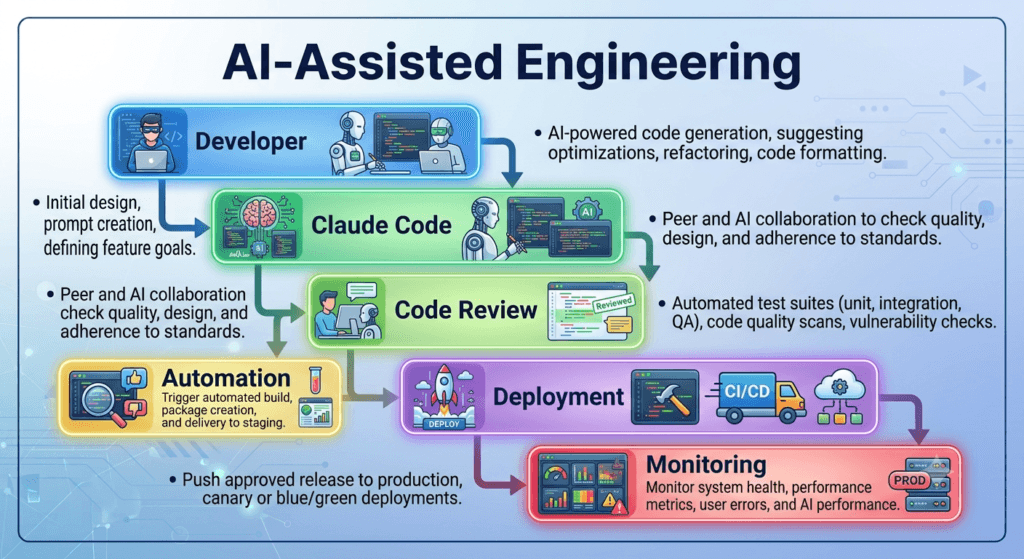
A standardized workflow improves collaboration across engineering teams.
Common Mistakes
Asking AI to Solve Every Problem
Use Claude Code to support engineering decisions, not replace critical thinking.
Ignoring Existing Team Processes
Align prompts with your organization’s coding standards, testing practices, and deployment workflows.
Forgetting Operational Activities
AI provides significant value during incident response, documentation, releases, and onboarding—not just coding.
Using Static Examples Forever
Review and update prompt libraries as technologies, frameworks, and engineering practices evolve.
Expert Tips
Organize Examples by Engineering Discipline
Build a categorized library of Claude Code examples covering software development, QA, test automation, DevOps, security, documentation, architecture, and incident management. This makes it easier for engineers to find reusable solutions for recurring tasks.
Continuously Expand Your Example Library
Every successful implementation, review, or production incident is an opportunity to create a new example. Over time, your organization will develop a valuable engineering knowledge base that improves consistency, accelerates onboarding, and strengthens AI-assisted software development across every project.
Claude Code Examples: Practical Lessons for Professional Developers
Throughout this guide, you’ve explored Claude Code examples that reflect real engineering work instead of isolated AI demonstrations. From repository analysis and feature implementation to testing, documentation, DevOps, and production support, these examples show how Claude Code becomes more valuable when integrated into established software engineering practices.
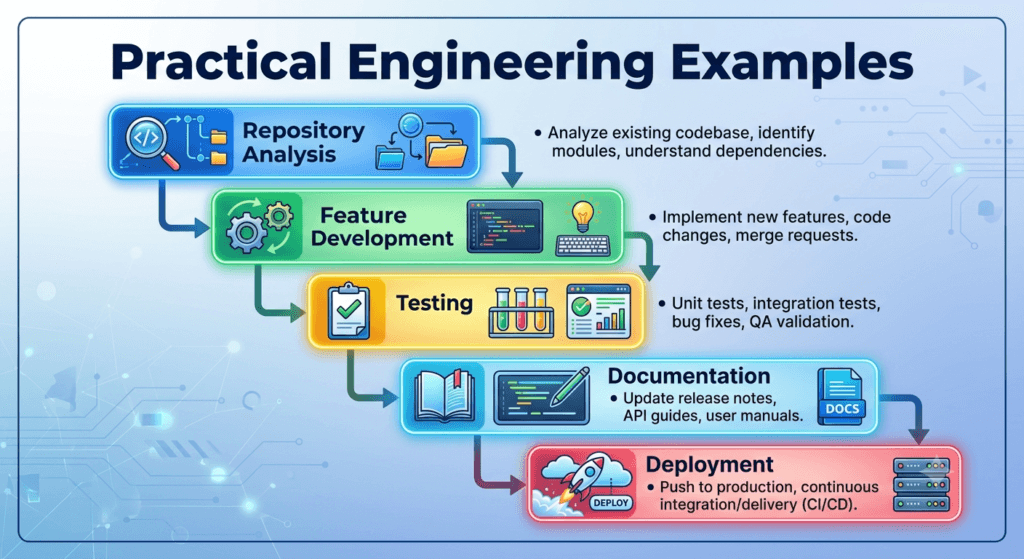
The goal is not to copy prompts but to understand how experienced engineers approach complex technical problems.
The Complete Claude Code Engineering Journey
The most effective teams use Claude Code throughout the entire software development lifecycle.
Understand Requirements

↓

Analyze Repository

↓

Review Architecture

↓

Plan Implementation

↓

Develop Feature

↓

Generate Automated Tests

↓

Review Code

↓

Update Documentation

↓

Validate CI/CD

↓

Deploy

↓

Monitor Production

↓

Continuously Improve
This structured approach reduces rework, improves software quality, and creates repeatable engineering processes.
Choosing the Right Example
Different engineering challenges require different prompting strategies.
| Objective | Recommended Example |
|---|---|
| Understand a new repository | Repository Analysis |
| Build a new feature | Feature Implementation |
| Improve legacy code | Refactoring |
| Fix production issues | Root Cause Investigation |
| Validate REST APIs | API Testing |
| Automate user journeys | Playwright Testing |
| Improve deployment quality | CI/CD Optimization |
| Review code changes | Pull Request Review |
| Secure applications | Security Assessment |
| Improve performance | Performance Analysis |
| Document projects | Technical Documentation |
| Reduce technical debt | Architecture Review |
Selecting the appropriate example saves time and improves the quality of AI-generated results.
Build Your Own Example Library
As you gain experience with Claude Code, create a reusable collection of examples tailored to your engineering environment.
Recommended categories:
Software Development
- Feature implementation
- Refactoring
- Bug fixes
- Architecture planning
Testing
- Unit testing
- API testing
- Playwright automation
- Regression testing
DevOps
- CI/CD optimization
- Deployment validation
- Infrastructure reviews
- Incident response
Documentation
- README generation
- API documentation
- Architecture guides
- Release notes
Engineering Management
- Sprint planning
- Repository health reports
- Technical debt analysis
- Knowledge transfer
A well-organized example library becomes a long-term engineering asset.
Evaluate the Results
Do not assume every AI-generated response is production ready.
Review each result for:
- Functional correctness
- Architectural consistency
- Code readability
- Performance
- Security
- Test coverage
- Documentation quality
- Maintainability
AI accelerates implementation, but engineering validation remains essential.
Scale Across Teams
As more developers adopt Claude Code, standardize successful examples across the organization.
Recommended adoption process:
Collect Successful Examples

↓

Review with Senior Engineers

↓

Standardize Prompt Templates

↓

Publish Internal Library

↓

Train Engineering Teams

↓

Gather Feedback

↓

Continuously Improve
Shared examples improve consistency and reduce onboarding time.
Common Challenges
Treating Examples as Fixed Templates
Every repository has unique architecture, coding standards, business rules, and testing requirements. Adapt examples accordingly.
Providing Too Little Context
Repository structure, framework versions, coding conventions, and project constraints help Claude Code generate more accurate recommendations.
Ignoring Existing Engineering Processes
AI should enhance your current workflows rather than replace established review, testing, and deployment practices.
Never Updating Prompt Libraries
As Claude Code evolves, review and refine your example library to reflect new capabilities and engineering standards.
Long-Term Success Strategy
To maximize the value of Claude Code examples, focus on:
- Repository understanding before implementation.
- Small, well-defined engineering tasks.
- Clear technical requirements.
- Reusable prompt templates.
- Automated testing with every feature.
- Continuous documentation.
- Peer review before deployment.
- Ongoing refinement of prompt libraries.
- Knowledge sharing across engineering teams.
- Measuring software quality instead of coding speed.
These practices help transform individual productivity into organization-wide engineering excellence.
Key Takeaways
Professional developers use Claude Code to:
- Analyze unfamiliar repositories quickly.
- Compare architectural solutions before implementation.
- Build maintainable features.
- Refactor legacy systems safely.
- Generate comprehensive automated tests.
- Improve code reviews.
- Strengthen documentation.
- Optimize CI/CD pipelines.
- Investigate production incidents.
- Build reusable engineering knowledge.
These examples provide a foundation that can be adapted to almost any software project.
Conclusion
The true value of Claude Code examples lies in their ability to demonstrate repeatable engineering patterns rather than isolated prompts. By adapting these examples to your repository, architecture, coding standards, testing framework, and deployment process, you can build a reliable AI-assisted development workflow that improves productivity without sacrificing software quality.
As your experience grows, continue expanding your internal example library, refining prompt templates, and sharing proven engineering practices across your team. Over time, these examples become more than reference material—they evolve into a structured engineering knowledge base that accelerates development, improves collaboration, and supports the delivery of secure, scalable, and maintainable software.
Internal Links:
- Learn MCP – Zero to Hero
- Learn AI Agents for QA – Zero to Hero
- Playwright Automation – Zero to Hero
- Learn Python – Zero to Hero
- Claude Code Tutorial: Complete Zero to Hero
- Free QA Resources Built From Real Experience
- QA Glossary: Test Automation Terms Every Engineer Should Know
External Resources:
- Anthropic Claude documentation
- Anthropic API documentation
- Model Context Protocol documentation
- Playwright documentation
- GitHub documentation
- TypeScript documentation
- Prompt Engineering Overview
- Git Documentation
- Visual Studio Code
- Cursor Documentation
People Also Ask
What are Claude Code Examples?
Claude Code Examples are practical software engineering scenarios that demonstrate how Claude Code can be used for repository analysis, feature implementation, debugging, testing, documentation, code reviews, CI/CD, and DevOps workflows.
Are Claude Code Examples suitable for beginners?
Yes. Beginners can use them to understand repository analysis, prompt design, and software engineering workflows, while experienced developers can adapt them for enterprise projects.
Can Claude Code Examples be used in enterprise software development?
Yes. Many examples focus on real engineering activities such as architecture reviews, automated testing, pull request reviews, incident investigations, deployment pipelines, and technical documentation.
Should developers copy prompts exactly?
No. The examples should be customized to match the repository structure, technology stack, coding standards, business requirements, and testing framework of each project.
Which engineering teams benefit from Claude Code Examples?
Software development, QA, SDET, DevOps, platform engineering, engineering management, and technical architecture teams can all benefit from practical Claude Code Examples.
Featured Snippet
Claude Code Examples Every Developer Should Try
The most useful Claude Code examples include:
- Repository analysis
- Feature implementation
- Legacy code refactoring
- Production debugging
- API development
- Playwright automation
- Code review
- Security assessment
- Performance optimization
- Technical documentation
These examples demonstrate how Claude Code supports the complete software development lifecycle.
AI Overview Answer
Claude Code Examples show developers how to apply AI to real engineering work rather than isolated prompts. They cover repository onboarding, feature development, automated testing, debugging, documentation, DevOps, CI/CD, and software maintenance, helping teams adopt repeatable AI-assisted engineering workflows.
Enjoyed this article? Explore more in-depth guides on AI engineering, automation testing, Model Context Protocol, Playwright, and intelligent software quality at www.skakarh.com. Follow QAPulse by SK for practical, production-focused tutorials designed for QA engineers, SDETs, and AI developers.