QA
QA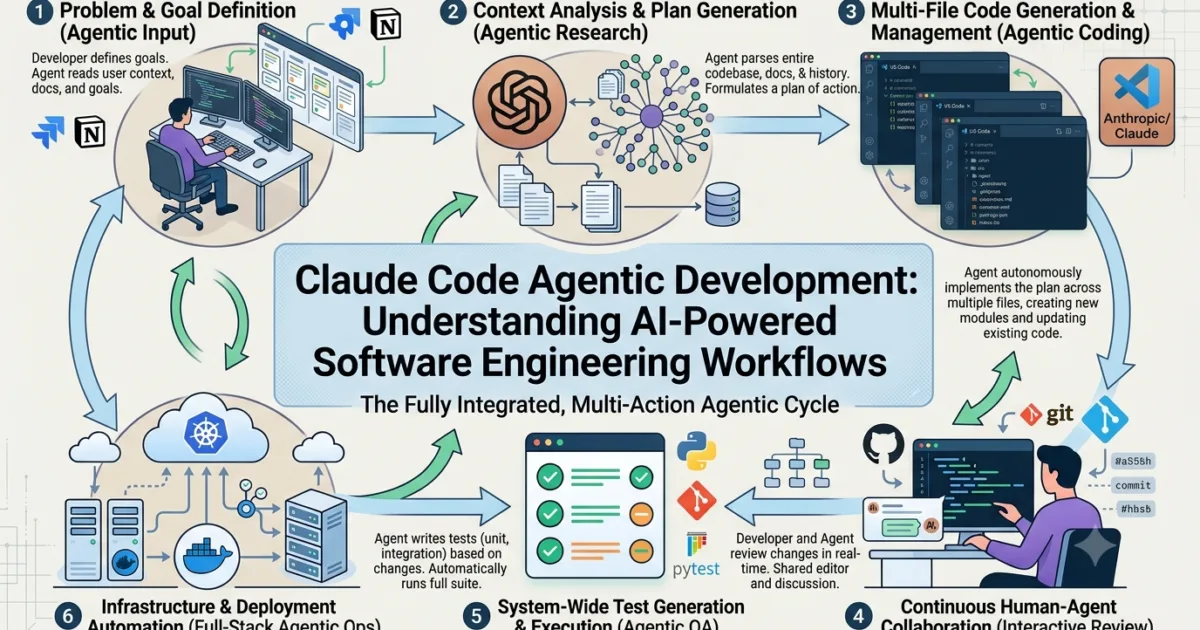
Introduction to Claude Code Agentic Development
Software development is entering a new era where artificial intelligence is moving beyond simple code generation and becoming an active engineering collaborator.
Traditional AI coding assistants primarily focused on answering questions, generating snippets, and explaining concepts. Developers still had to manually navigate repositories, understand project structures, modify files, execute commands, debug issues, and manage the complete development workflow.
Modern agentic coding tools introduce a different approach.
Claude Code Agentic Development represents a workflow where Claude Code operates as an intelligent software engineering partner capable of understanding repositories, analysing codebases, planning changes, executing development tasks, and assisting developers throughout the software lifecycle.
Instead of asking:
“How do I write this function?”
developers can now ask:
“Analyse this repository, identify the issue, implement the required changes, update tests, and explain the modifications.”
This shift transforms AI from a passive assistant into an active development collaborator.
The Evolution of AI Coding Assistants
The journey of AI-assisted development has progressed through several stages.
Traditional Coding

↓

Code Search & Documentation

↓

AI Code Completion

↓

AI Coding Assistants

↓

Agentic AI Development
Stage 1: Traditional Software Development
Developers manually performed every activity:
- Understanding requirements
- Searching documentation
- Designing solutions
- Writing code
- Debugging problems
- Creating tests
The developer controlled every step.
Stage 2: AI Code Completion
Tools introduced intelligent suggestions while developers wrote code.
Examples:
- Autocomplete
- Function suggestions
- Code predictions
- Syntax assistance
These tools improved speed but required developers to guide every action.
Stage 3: AI Coding Assistants
AI assistants became capable of:
- Explaining code
- Generating functions
- Creating documentation
- Suggesting improvements
However, developers still managed the overall workflow.
Stage 4: Agentic AI Development
Agentic systems changed the interaction model.
Developers provide goals, and the AI agent can:
- Analyse the repository
- Create a plan
- Modify multiple files
- Run commands
- Execute tests
- Review results
- Iterate on solutions
This is the foundation of Claude Code Agentic Development.
What Is Claude Code Agentic Development?
Claude Code Agentic Development is the practice of using Claude Code as an AI software engineering agent that can understand context, reason about implementation strategies, interact with development environments, and assist with complex engineering tasks.
Unlike traditional code generation, agentic development focuses on completing objectives rather than producing isolated code fragments.
A typical interaction looks like:
Developer Goal

↓

Repository Understanding

↓

Task Planning

↓

Code Modification

↓

Testing

↓

Validation

↓

Final Explanation
The developer provides direction while Claude Code helps execute the engineering process.
Why Agentic Development Matters
Modern software projects are becoming increasingly complex.
A single application may include:
- Frontend frameworks
- Backend services
- Databases
- APIs
- Authentication systems
- Cloud infrastructure
- Automated testing
- CI/CD pipelines
Understanding all these components requires significant engineering effort.
Claude Code Agentic Development helps reduce cognitive load by assisting developers with:
- Repository exploration
- Code understanding
- Implementation planning
- Debugging
- Testing
- Documentation
- Refactoring
The goal is not simply writing more code.
The goal is improving engineering effectiveness.
How Claude Code Understands a Repository
One of the most powerful aspects of agentic development is context awareness.
Before making changes, Claude Code can analyse:
- Project structure
- Source files
- Configuration files
- Dependencies
- Existing patterns
- Documentation
- Testing approaches
Example repository:
ecommerce-platform

├── frontend

│   ├── components

│   ├── pages

│   └── services

│

├── backend

│   ├── controllers

│   ├── models

│   └── routes

│

├── tests

├── database

├── docker

└── README.md
Instead of manually opening every file, developers can ask Claude Code to understand the application architecture first.
Context Understanding in Agentic Development
Context is one of the most important concepts in AI-assisted engineering.
A good AI agent needs to understand:
Project Context
Examples:
- Framework choices
- Coding conventions
- Architecture decisions
- Development standards
Technical Context
Examples:
- Programming languages
- Dependencies
- APIs
- Database models
Business Context
Examples:
- User requirements
- Application behaviour
- Feature goals
Without context, AI-generated solutions may not align with the actual project.
Planning Before Coding
One major difference between traditional code generation and agentic development is planning.
A simple coding assistant may generate:
“Here is the function you requested.”
An agentic workflow thinks:
“What changes are required across the system to complete this task?”
For example:
Requirement:
“Add password reset functionality.”
A traditional approach may generate only a reset function.
An agentic approach considers:
User Interface

↓

API Endpoint

↓

Validation

↓

Email Service

↓

Database Update

↓

Security Testing
This broader reasoning creates more complete solutions.
Claude Code as a Software Engineering Partner
The role of Claude Code changes depending on the task.
It can act as:
Coding Assistant
Helping developers:
- Generate implementations
- Explain syntax
- Suggest solutions
Code Reviewer
Helping identify:
- Bugs
- Security risks
- Maintainability issues
Debugging Partner
Helping analyse:
- Error messages
- Logs
- Runtime problems
Documentation Assistant
Helping create:
- README files
- Technical documentation
- API explanations
Architecture Assistant
Helping evaluate:
- Design patterns
- System structure
- Implementation approaches
Human-in-the-Loop Development
Although Claude Code Agentic Development introduces powerful automation, human involvement remains essential.
Professional software engineering requires human judgement for:
- Architecture decisions
- Security choices
- Business logic
- Performance trade-offs
- Production approvals
The ideal workflow is collaboration:
Human Defines Goal

↓

Claude Code Analyses

↓

AI Suggests Implementation

↓

Human Reviews

↓

AI Refines

↓

Human Approves
This creates a balance between AI productivity and engineering responsibility.
Agentic Development for Enterprise Teams
Enterprise software development involves large teams and complex systems.
Claude Code can support teams with:
- Faster onboarding
- Legacy code understanding
- Automated documentation
- Faster debugging
- Consistent implementation patterns
- Improved developer productivity
Examples:
Legacy Application Modernisation
Claude Code can help analyse older systems and suggest migration strategies.
Feature Development
Teams can accelerate implementation while maintaining review processes.
Bug Investigation
Developers can provide errors and receive structured analysis.
Documentation Improvement
AI can help maintain technical knowledge.
Claude Code Agentic Development vs Traditional AI Coding
| Traditional AI Coding | Agentic Development |
|---|---|
| Generates code snippets | Completes engineering tasks |
| Limited context | Repository-aware |
| Developer manages workflow | AI assists workflow execution |
| Single-file focus | Multi-file understanding |
| Reactive responses | Goal-oriented actions |
| Manual navigation | Automated exploration |
This difference represents a major shift in how developers interact with AI systems.
Challenges of Agentic Development
Despite its advantages, agentic development introduces new challenges.
Maintaining Control
Developers must understand what changes AI makes.
Security Concerns
AI agents interacting with codebases require careful permission management.
Incorrect Assumptions
AI may misunderstand requirements or project constraints.
Over-Automation
Not every engineering decision should be delegated.
Best Practices for Claude Code Agentic Development
To use Claude Code effectively:
- Start with clear requirements.
- Provide project context.
- Review AI-generated changes.
- Use version control.
- Run automated tests.
- Validate security-sensitive changes.
- Keep humans involved in important decisions.
- Improve prompts through iteration.
- Document architectural decisions.
The Future of AI Software Engineering
Agentic development represents a significant transformation in software engineering.
Future development environments will increasingly include:
- Autonomous coding agents
- AI-powered debugging
- Automated testing strategies
- Intelligent architecture assistance
- Continuous code improvement
- AI-driven maintenance workflows
Developers who understand how to collaborate with AI agents will be better prepared for the future of software engineering.
Summary
Claude Code Agentic Development represents the next stage of AI-assisted programming, moving beyond simple code generation into intelligent engineering collaboration. By understanding repositories, planning changes, assisting implementation, and supporting testing workflows, Claude Code helps developers solve complex software problems more efficiently.
The future developer workflow will not be humans versus AI. It will be humans working alongside AI agents to build better software faster, while maintaining quality, security, and engineering discipline.
Claude Code Agentic Development Architecture: How AI Coding Agents Understand, Plan, and Execute Software Tasks
Understanding the Architecture Behind Claude Code Agentic Development
Modern software development is moving from simple AI-assisted coding toward intelligent engineering collaboration. Earlier coding assistants primarily focused on generating code snippets, completing functions, or answering programming questions.
Claude Code Agentic Development introduces a more advanced approach where Claude Code can understand software projects, analyse existing implementations, reason about required changes, execute development actions, and help developers complete complex engineering tasks.
The difference is not only about generating better code.
The difference is the ability to understand the complete software engineering context.
A traditional coding assistant follows this pattern:
Developer Question

↓

AI Response

↓

Developer Implements Solution
An agentic coding workflow follows:
Developer Goal

↓

Repository Understanding

↓

Task Analysis

↓

Implementation Planning

↓

Code Changes

↓

Testing

↓

Validation

↓

Developer Approval
This shift changes AI from a reactive coding helper into an active engineering partner.
Core Architecture of Claude Code Agentic Development
A successful agentic coding system requires multiple layers working together.
The overall architecture can be represented as:
Claude Code Agent

│

├── Intent Understanding Layer

├── Context Management Layer

├── Repository Analysis Layer

├── Planning and Reasoning Layer

├── Tool Execution Layer

├── Code Modification Layer

├── Testing and Validation Layer

└── Human Feedback Layer
Each layer contributes to creating a reliable AI-assisted software engineering workflow.
Intent Understanding Layer
The first responsibility of an AI coding agent is understanding what the developer actually wants to achieve.
Developers usually describe goals rather than technical instructions.
Example:
“Improve the authentication system and make it more secure.”
This request requires deeper analysis.
Claude Code needs to understand:
- Existing authentication implementation
- Security risks
- User management flow
- Database structure
- API endpoints
- Testing requirements
The intent understanding layer transforms a business or technical request into an engineering objective.
Example:
Developer Request

↓

Identify Goal

↓

Understand Constraints

↓

Determine Required Changes

↓

Create Engineering Task
Without accurate intent understanding, even technically correct code may solve the wrong problem.
Context Management Layer
Context is one of the most important capabilities in Claude Code Agentic Development.
Large software projects contain:
- Thousands of files
- Multiple frameworks
- Complex dependencies
- Existing design decisions
- Business rules
- Testing strategies
An AI agent must identify which information is relevant.
For example, if a developer requests:
“Fix the payment failure issue.”
Claude Code needs context from:
Payment Feature

↓

Frontend Checkout

↓

Payment API

↓

Backend Services

↓

Database Transactions

↓

External Gateway Integration

↓

Error Handling
Without proper context management, AI may generate isolated fixes that do not solve the actual problem.
Repository Understanding and Codebase Analysis
One of the biggest differences between normal AI assistants and agentic systems is repository awareness.
Before making changes, Claude Code needs to understand:
- Application structure
- Programming languages
- Frameworks
- Dependencies
- Coding patterns
- Existing implementations
A typical repository analysis process:
Explore Repository

↓

Identify Important Files

↓

Understand Architecture

↓

Locate Related Components

↓

Analyse Existing Logic
For example, in a full-stack application:
customer-platform

├── frontend

│   ├── components

│   ├── pages

│   └── services

│

├── backend

│   ├── APIs

│   ├── controllers

│   └── services

│

├── database

├── tests

└── deployment
The agent needs to understand how these parts communicate before suggesting modifications.
Planning Layer: Thinking Before Implementation
A major advantage of Claude Code Agentic Development is planning before execution.
Traditional code generation often jumps directly into implementation.
Agentic workflows first create an approach.
Example requirement:
“Add a user notification system.”
A planning-based approach considers:
Analyse Existing User System

↓

Design Notification Architecture

↓

Create Database Changes

↓

Implement Backend Services

↓

Update Frontend

↓

Add Tests

↓

Validate Behaviour
Planning reduces unnecessary changes and improves implementation quality.
Tool Execution Layer
Agentic coding systems become powerful because they can interact with development environments.
The tool execution layer allows AI agents to assist with:
- Reading files
- Analysing code
- Modifying implementations
- Running commands
- Executing tests
- Reviewing results
The workflow becomes:
Task Request

↓

Analyse Required Action

↓

Use Development Tools

↓

Evaluate Output

↓

Continue or Adjust
This creates an iterative engineering process.
Code Modification Layer
Real-world software changes rarely involve a single file.
A new feature may require changes across:
- Frontend components
- Backend services
- Database models
- Configuration files
- Automated tests
- Documentation
Example:
Adding user profile management:
Frontend Profile Page

↓

User API Endpoints

↓

Database Schema

↓

Validation Rules

↓

Automation Tests

↓

Documentation
Claude Code Agentic Development helps developers manage these connected changes more effectively.
Testing and Validation Layer
Writing code is only one stage of software engineering.
Professional development requires validation.
An agentic workflow includes:
Generate Changes

↓

Run Tests

↓

Analyse Results

↓

Fix Issues

↓

Repeat Validation
Testing activities include:
- Unit testing
- Integration testing
- API validation
- End-to-end testing
- Regression testing
For QA engineers and SDETs, this creates opportunities to integrate AI directly into quality engineering workflows.
Human Feedback and Approval Layer
Although AI agents can perform complex tasks, humans remain responsible for final decisions.
The human feedback layer ensures:
- Architecture decisions remain controlled
- Security changes are reviewed
- Business requirements are validated
- Production deployments are approved
The ideal collaboration model:
Human Defines Objective

↓

Claude Code Analyses

↓

AI Suggests Changes

↓

Human Reviews

↓

AI Improves

↓

Human Approves
This keeps developers in control while benefiting from AI acceleration.
Claude Code Agentic Development in Feature Implementation
Consider a real-world request:
“Add multi-factor authentication to an existing SaaS application.”
A complete agentic workflow includes:
Step 1: Repository Analysis
Claude Code examines:
- Authentication modules
- User database models
- Existing security logic
- Frontend login components
Step 2: Implementation Planning
The agent identifies:
- Required backend changes
- New database fields
- Authentication flow updates
- Testing requirements
Step 3: Development Changes
Possible updates:
- Generate authentication services
- Update APIs
- Add UI components
- Create test cases
Step 4: Validation
The workflow verifies:
- Login behaviour
- Security rules
- Regression impact
This demonstrates how agentic workflows handle complete engineering tasks rather than isolated coding requests.
Agentic Development for Legacy Applications
Many organisations maintain applications created years ago.
Legacy systems often contain:
- Older frameworks
- Limited documentation
- Complex dependencies
- Technical debt
Claude Code can assist by:
- Explaining unfamiliar code
- Mapping application architecture
- Identifying outdated patterns
- Suggesting migration strategies
- Creating documentation
Example workflow:
Legacy Application

↓

Code Analysis

↓

Architecture Understanding

↓

Modernisation Plan

↓

Incremental Migration
Challenges of Claude Code Agentic Development
Although agentic coding provides significant advantages, teams must understand its limitations.
Incorrect Understanding
AI may misunderstand requirements or business rules.
Overly Broad Changes
Large requests may result in unnecessary modifications.
Security Risks
Generated changes require security validation.
Lack of Business Knowledge
AI understands technical patterns but may not understand hidden organisational requirements.
Best Practices for Agentic Coding Workflows
To use Claude Code Agentic Development effectively:
- Start with clear objectives.
- Allow repository analysis before implementation.
- Break large tasks into smaller steps.
- Review generated changes carefully.
- Use version control.
- Run automated tests.
- Validate security-sensitive updates.
- Maintain human oversight.
- Document important decisions.
Preparing for Practical Claude Code Agentic Development
Understanding the architecture behind Claude Code Agentic Development provides the foundation for effective AI-assisted software engineering.
The next step is applying this architecture to real development scenarios, including repository exploration, feature implementation, debugging workflows, automated testing, and continuous improvement.
Summary
Claude Code Agentic Development combines intent understanding, repository analysis, planning, tool interaction, code modification, testing, and human feedback into a complete AI-assisted engineering workflow.
The future of software development will not depend only on writing code faster. It will depend on building intelligent collaboration between developers and AI agents that can understand complex systems, support engineering decisions, and improve software delivery quality.
Claude Code Agentic Development Workflows: Building, Debugging, Testing, and Improving Real-World Applications
Applying Claude Code Agentic Development in Real Software Projects
Understanding the architecture of AI coding agents is important, but the real value comes from applying them to practical engineering workflows.
Claude Code Agentic Development changes how developers approach software tasks. Instead of manually performing every step—from understanding requirements to searching files, implementing changes, writing tests, and debugging failures—developers can collaborate with Claude Code throughout the complete development lifecycle.
The modern AI-assisted development workflow becomes:
Requirement

↓

Repository Analysis

↓

Implementation Planning

↓

Code Development

↓

Testing

↓

Debugging

↓

Code Review

↓

Deployment
This approach allows developers to focus more on engineering decisions while reducing repetitive implementation effort.
Repository Analysis Before Making Changes
One of the most important practices in Claude Code Agentic Development is allowing the agent to understand the project before modifying anything.
A common mistake with AI coding assistants is immediately requesting code changes without providing enough context.
Professional workflows begin with exploration.
Example request:
“Analyse this repository and explain the architecture, main components, dependencies, and development workflow.”
Claude Code can help identify:
- Application structure
- Framework usage
- Important modules
- Entry points
- Configuration files
- Testing approach
- Deployment process
Example:
Repository Scan

↓

Framework Detection

↓

Dependency Analysis

↓

Architecture Mapping

↓

Development Recommendations
This creates a strong foundation before implementation begins.
Feature Development Workflow Using Claude Code
Adding new features is one of the strongest use cases for agentic development.
Consider a requirement:
“Add a customer feedback system to the application.”
A traditional workflow requires developers to manually:
- Find relevant files
- Design implementation
- Create database changes
- Build APIs
- Develop UI components
- Write tests
With Claude Code Agentic Development, the workflow becomes collaborative.
Step 1: Requirement Understanding
Claude Code helps transform a business requirement into technical tasks.
Example:
Business Requirement:
Users should be able to submit feedback and view previous submissions.
Technical breakdown:
User Interface

↓

Feedback Form

↓

API Endpoint

↓

Database Model

↓

Validation Logic

↓

Testing
This creates a structured implementation plan.
Step 2: Codebase Exploration
Before writing code, Claude Code analyses:
- Existing user management
- Current API patterns
- Database structure
- Frontend architecture
- Testing framework
Example:
Find User Module

↓

Understand Existing Patterns

↓

Identify Integration Points

↓

Plan Required Changes
Following existing patterns helps maintain consistency.
Step 3: Implementation Assistance
Once the approach is clear, Claude Code can assist with:
- Creating new files
- Updating existing modules
- Adding business logic
- Generating reusable components
- Creating configuration changes
Example changes:
Backend:
Feedback Model

↓

Feedback API

↓

Validation Service
Frontend:
Feedback Component

↓

API Integration

↓

User Interface Updates
Testing:
Unit Tests

↓

API Tests

↓

End-to-End Tests
Debugging Applications with Claude Code
Debugging is one of the most time-consuming activities in software engineering.
Developers often spend hours analysing:
- Error messages
- Logs
- Stack traces
- Unexpected behaviour
- Integration failures
Claude Code Agentic Development can accelerate debugging by helping identify possible root causes.
Example:
Developer:
“The API returns a 500 error when users upload profile images. Investigate the issue.”
A structured debugging workflow:
Analyse Error

↓

Inspect Related Code

↓

Check Configuration

↓

Identify Root Cause

↓

Suggest Fix

↓

Validate Solution
Debugging Complex Issues
Large problems often involve multiple components.
Example:
Image upload failure:
Frontend Upload Component

↓

API Request

↓

Backend Processing

↓

File Storage

↓

Database Record

↓

Response Handling
An agentic workflow analyses the complete chain instead of focusing only on one file.
Refactoring Existing Code
Software systems continuously evolve.
Over time, applications accumulate:
- Duplicate logic
- Complex functions
- Poor naming
- Outdated patterns
- Technical debt
Claude Code can assist with refactoring tasks.
Examples:
- Simplifying complex functions
- Improving code organisation
- Applying design patterns
- Removing duplication
- Improving readability
Example:
Before:
Large Service Class

↓

Multiple Responsibilities

↓

Hard to Maintain
After:
Separate Services

↓

Clear Responsibilities

↓

Better Testing
Test Automation with Claude Code
Testing is a critical part of modern software engineering.
Claude Code Agentic Development can support QA engineers and SDETs by assisting with:
- Test case generation
- Automation scripts
- Framework improvements
- Test debugging
- Regression analysis
Common automation scenarios:
Web Testing
Tools:
- Playwright
- Selenium
- Cypress
Claude Code can help generate:
- Page Object Models
- Test scenarios
- Locators
- Assertions
API Testing
Tools:
- PyTest
- REST Assured
- Postman
Support includes:
- API validation
- Request generation
- Response verification
Integration Testing
Claude Code can help connect:
- Database testing
- Service testing
- End-to-end workflows
Creating Playwright Tests with Claude Code
For SDETs, one practical workflow is generating browser automation.
Example requirement:
“Create Playwright tests for user registration.”
Claude Code can help design:
Requirement

↓

Test Scenarios

↓

Page Objects

↓

Automation Scripts

↓

Execution

↓

Failure Analysis
Generated tests should still be reviewed for:
- Reliable locators
- Test stability
- Maintainability
- Coverage quality
API Development and Validation
Backend developers can use Claude Code for API workflows.
Example:
“Create an API endpoint for managing customer orders.”
The agent can assist with:
- Route creation
- Request validation
- Data models
- Error handling
- API tests
Example architecture:
Client Request

↓

API Endpoint

↓

Business Logic

↓

Database

↓

Response
Documentation Generation
Documentation is often neglected because it requires additional effort.
Claude Code can help generate:
- README files
- API documentation
- Architecture explanations
- Setup guides
- Migration notes
Good documentation improves:
- Team collaboration
- Developer onboarding
- Project maintenance
CI/CD Workflow Improvements
Modern development depends on automation pipelines.
Claude Code can assist with:
- GitHub Actions workflows
- Build scripts
- Test execution pipelines
- Deployment configurations
Example:
Code Commit

↓

Build

↓

Automated Tests

↓

Quality Checks

↓

Deployment
This helps teams create faster feedback loops.
Using Claude Code for Code Reviews
Code review ensures software quality.
Claude Code can assist reviewers by analysing:
- Potential bugs
- Security concerns
- Code duplication
- Performance issues
- Maintainability problems
Example review request:
“Review this pull request and identify possible issues before production deployment.”
The developer still makes the final approval decision.
Claude Code Agentic Development for SDET Teams
For QA automation engineers, agentic development creates new possibilities.
SDETs can use Claude Code for:
- Designing automation frameworks
- Generating tests
- Analysing failures
- Improving coverage
- Writing test documentation
Example workflow:
Requirement

↓

Test Strategy

↓

Automation Design

↓

Test Implementation

↓

Execution

↓

Quality Analysis
This aligns strongly with modern AI-driven quality engineering practices.
Common Mistakes in Practical Agentic Workflows
Giving Unclear Instructions
Poor requirements produce poor results.
Skipping Code Review
Generated changes require validation.
Making Large Changes at Once
Small incremental changes are easier to verify.
Ignoring Existing Architecture
AI suggestions should match project standards.
Best Practices for Real-World Usage
To get better results with Claude Code Agentic Development:
- Explain the goal clearly.
- Provide technical constraints.
- Let Claude Code analyse first.
- Review proposed changes.
- Keep commits small.
- Run tests frequently.
- Maintain version control.
- Validate security-sensitive changes.
- Document important decisions.
Preparing for Advanced Agentic Engineering
Practical workflows demonstrate the real power of Claude Code Agentic Development. The ability to analyse repositories, implement features, debug problems, generate tests, and improve existing systems creates a new development model.
The next lesson will explore advanced enterprise use cases, including AI-powered software maintenance, large-scale refactoring, security improvements, and professional engineering strategies.
Summary
Claude Code Agentic Development enables developers and SDETs to collaborate with AI throughout the software development lifecycle. From repository analysis and feature implementation to debugging, testing, and documentation, Claude Code helps reduce repetitive work while improving engineering productivity.
The most effective workflow combines AI capabilities with human expertise, allowing teams to build software faster while maintaining quality, security, and reliability.
Claude Code Agentic Development Best Practices: Enterprise Workflows, Security, Scalability, and Future of AI Engineering
Moving from AI Assistance to AI-Powered Engineering
The previous lessons explored the foundations, architecture, and practical workflows of Claude Code Agentic Development. We learned how AI coding agents can understand repositories, analyse requirements, assist implementation, generate tests, and support debugging.
However, professional software engineering requires more than making AI generate code.
Enterprise development environments require:
- Security
- Scalability
- Maintainability
- Governance
- Collaboration
- Quality assurance
- Production reliability
This is where advanced Claude Code Agentic Development practices become essential.
The future of software engineering will not be defined by how much code AI can generate. It will be defined by how effectively engineering teams can collaborate with AI while maintaining professional software standards.
The Enterprise Agentic Development Model
In enterprise environments, AI agents become part of a structured engineering workflow.
A mature workflow looks like:
Business Requirement

↓

Technical Planning

↓

Claude Code Analysis

↓

Implementation Assistance

↓

Automated Testing

↓

Security Review

↓

Code Review

↓

Deployment

↓

Continuous Monitoring
This approach ensures AI improves productivity without reducing engineering discipline.
Claude Code Agentic Development for Large Codebases
Enterprise applications often contain:
- Millions of lines of code
- Multiple services
- Legacy components
- Complex integrations
- Distributed teams
Understanding such systems manually can take weeks.
Claude Code Agentic Development helps engineers accelerate this process by assisting with:
- Codebase exploration
- Architecture understanding
- Dependency analysis
- Documentation creation
- Migration planning
Example:
A developer joins a team maintaining a 10-year-old enterprise application.
Instead of manually reading thousands of files, they can use Claude Code to help answer:
- How is authentication implemented?
- Where are business rules stored?
- Which services communicate with each other?
- How are tests organised?
This reduces onboarding time significantly.
Legacy Application Modernisation
Many organisations still depend on legacy systems.
Common challenges include:
- Outdated frameworks
- Missing documentation
- Technical debt
- Complex dependencies
- Difficult maintenance
Claude Code can support modernisation strategies.
Example workflow:
Legacy System Analysis

↓

Architecture Mapping

↓

Identify Technical Debt

↓

Create Migration Strategy

↓

Incremental Modernisation

↓

Validation Testing
Possible modernisation activities:
- Migrating old frameworks
- Improving code structure
- Adding automated tests
- Updating documentation
- Refactoring complex modules
AI helps analyse and accelerate changes, but engineers remain responsible for migration decisions.
Security in Claude Code Agentic Development
Security becomes even more important when AI agents interact with software systems.
Developers must consider:
- Code access permissions
- Sensitive information handling
- Dependency security
- Authentication logic
- Infrastructure changes
A secure agentic workflow includes:
AI-Assisted Development

↓

Security Analysis

↓

Code Review

↓

Vulnerability Testing

↓

Approval
Common Security Risks
Exposed Secrets
AI-generated code should never introduce:
- API keys
- Passwords
- Tokens
- Private credentials
Use:
- Environment variables
- Secret managers
- Secure configuration systems
Unsafe Input Handling
Generated code should validate:
- User input
- API requests
- File uploads
- Database operations
Dependency Vulnerabilities
New packages should always be reviewed.
Check:
- Package reputation
- Maintenance status
- Security history
- Compatibility
AI Governance and Engineering Standards
As organisations adopt AI coding agents, governance becomes important.
Teams should define:
- Where AI can be used
- What data can be shared
- Review requirements
- Approval processes
- Security rules
Example AI development policy:
AI Generates Suggestions

↓

Developer Reviews

↓

Automated Checks Run

↓

Human Approval Required

↓

Production Deployment
This ensures responsible AI adoption.
Claude Code Agentic Development in DevOps
Modern engineering teams rely heavily on DevOps automation.
Claude Code can assist with:
- CI/CD workflows
- Infrastructure scripts
- Deployment automation
- Configuration management
- Monitoring improvements
Example workflow:
Code Change

↓

CI Pipeline

↓

Automated Testing

↓

Security Scanning

↓

Deployment

↓

Monitoring
AI assistance can help teams create and maintain these workflows faster.
AI-Assisted Incident Management
Production incidents require fast investigation.
Claude Code can support engineers by analysing:
- Error logs
- Stack traces
- Configuration changes
- Recent deployments
Example:
Problem:
“Users are receiving intermittent API failures after deployment.”
Investigation workflow:
Review Logs

↓

Analyse Recent Changes

↓

Identify Possible Cause

↓

Suggest Fix

↓

Validate Solution
This reduces debugging time during critical incidents.
Claude Code for Continuous Improvement
Software systems require continuous improvement.
Agentic development can support:
- Code optimisation
- Documentation updates
- Test improvements
- Refactoring
- Technical debt reduction
Example:
Monitor Application

↓

Identify Improvement Area

↓

Plan Change

↓

Implement Update

↓

Measure Results
Measuring the Impact of Agentic Development
Organisations should measure whether AI adoption improves engineering outcomes.
Useful metrics include:
Development Productivity
Measure:
- Feature delivery speed
- Implementation time
- Developer efficiency
Software Quality
Measure:
- Defect reduction
- Test coverage
- Production stability
Engineering Experience
Measure:
- Developer satisfaction
- Onboarding speed
- Reduced repetitive tasks
AI adoption should improve engineering quality, not simply increase the amount of generated code.
Claude Code Agentic Development for QA and Quality Engineering
For QA engineers and SDETs, agentic workflows introduce new opportunities.
Claude Code can support:
- Test strategy creation
- Automation framework development
- Test generation
- Failure analysis
- Regression improvement
Example workflow:
Requirement

↓

Risk Analysis

↓

Test Strategy

↓

Automation Development

↓

Execution

↓

Quality Improvement
This aligns with modern AI-driven quality engineering practices.
Building Reliable Human-AI Collaboration
The most successful teams will not completely automate engineering.
They will create effective collaboration models.
Human responsibilities:
- Architecture decisions
- Business understanding
- Security approval
- Quality standards
AI responsibilities:
- Analysis assistance
- Code generation
- Documentation support
- Repetitive task automation
The ideal relationship:
Human Creativity

+

AI Productivity

=

Better Software Engineering
Limitations of Claude Code Agentic Development
Despite its capabilities, agentic development has limitations.
AI Does Not Replace Engineering Knowledge
Developers still need:
- Programming skills
- Architecture understanding
- Testing knowledge
- Security awareness
AI Can Make Incorrect Decisions
Generated solutions require validation.
Complex Systems Need Human Leadership
Large architectural decisions cannot be delegated completely.
Quality Depends on Input
Better requirements produce better results.
Best Practices Checklist
For successful Claude Code Agentic Development:
Planning
- Define clear objectives.
- Understand requirements.
- Break large tasks into smaller steps.
Development
- Let AI analyse before modifying.
- Follow existing architecture.
- Review generated changes.
Testing
- Automate validation.
- Check edge cases.
- Maintain regression coverage.
Security
- Protect sensitive data.
- Review dependencies.
- Validate security-critical changes.
Collaboration
- Keep humans involved.
- Document decisions.
- Share AI usage guidelines.
The Future of Claude Code Agentic Development
The next generation of software engineering will involve deeper collaboration between humans and AI agents.
Future possibilities include:
- Autonomous feature development
- AI-powered architecture planning
- Intelligent debugging systems
- Automated security analysis
- Continuous software improvement
- AI-assisted maintenance
Developers will increasingly become engineering leaders who guide AI systems rather than manually performing every repetitive coding task.
Preparing for the Next Stage
Understanding Claude Code Agentic Development provides the foundation for modern AI-powered engineering workflows.
The journey continues beyond individual coding tasks. The next stage involves advanced practical implementations where developers learn how to use Claude Code for complete project development, repository automation, testing workflows, and enterprise engineering scenarios.
Summary
Claude Code Agentic Development represents a major evolution in software engineering by enabling AI agents to participate throughout the development lifecycle. From understanding large codebases and modernising legacy systems to improving testing, security, and DevOps workflows, Claude Code provides powerful assistance for modern engineering teams.
The strongest results come from combining AI capabilities with human expertise, structured workflows, security practices, and continuous quality improvement. AI agents will not replace great engineers—they will amplify what great engineers can achieve.
Internal Links:
- Learn MCP – Zero to Hero
- Learn AI Agents for QA – Zero to Hero
- Playwright Automation – Zero to Hero
- LangGraph: Complete Zero to Hero
- Learn Python – Zero to Hero
- OpenAI Codex: Complete Zero to Hero
- Cursor AI: Complete Zero to Hero
- Claude Code Tutorial: Complete Zero to Hero
- Free QA Resources Built From Real Experience
- QA Glossary: Test Automation Terms Every Engineer Should Know
External Resources:
- Anthropic Claude documentation
- Anthropic API documentation
- Model Context Protocol documentation
- Playwright documentation
- GitHub documentation
- TypeScript documentation
- Prompt Engineering Overview
- Git Documentation
- Visual Studio Code
- Cursor Documentation
People Asked Questions
What is Claude Code Agentic Development?
Claude Code Agentic Development is an AI-assisted software engineering approach where Claude Code helps developers understand projects, plan solutions, modify code, debug issues, and improve development workflows.
How is Claude Code Agentic Development different from normal AI coding assistants?
Traditional AI coding assistants mainly generate code snippets. Agentic development focuses on completing engineering tasks by analysing context, planning changes, interacting with tools, and validating results.
Can Claude Code Agentic Development build complete applications?
Yes. Claude Code can assist developers with application architecture, implementation, testing, debugging, documentation, and deployment workflows.
Is Claude Code Agentic Development replacing software developers?
No. Claude Code works as an engineering assistant. Developers remain responsible for architecture decisions, security validation, business requirements, and production approvals.
How can QA engineers use Claude Code Agentic Development?
QA engineers and SDETs can use Claude Code for test generation, automation framework improvements, debugging failures, regression analysis, and quality engineering workflows.
Is AI-generated code safe for production?
AI-generated code requires human review, testing, security validation, and compliance checks before production usage.
Conclusion
Claude Code Agentic Development represents a major evolution in software engineering where AI systems move beyond simple code suggestions and become intelligent development collaborators.
By combining repository understanding, planning, implementation support, testing assistance, and continuous improvement, Claude Code enables developers and QA engineers to build software faster while maintaining engineering quality.
The future of development will belong to engineers who can effectively combine human creativity with AI-powered engineering workflows.
Enjoyed this article? Explore more in-depth guides on AI engineering, automation testing, Model Context Protocol, Playwright, and intelligent software quality at www.skakarh.com. Follow QAPulse by SK for practical, production-focused tutorials designed for QA engineers, SDETs, and AI developers.