 QA
QA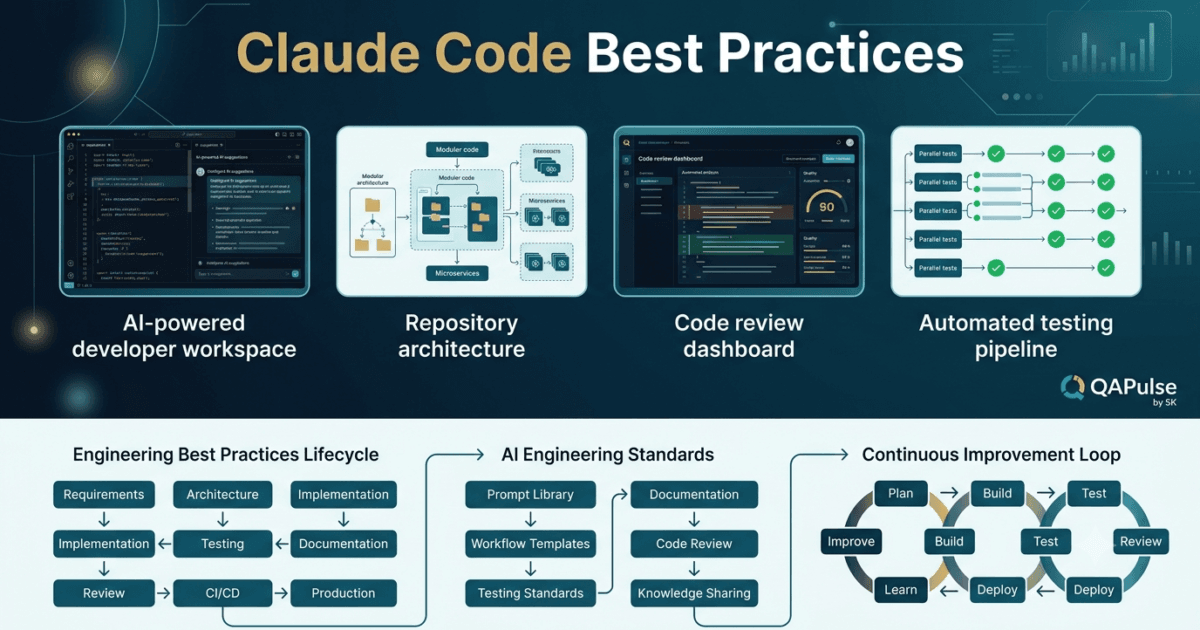
Using Claude Code effectively is not about writing the perfect prompt. It is about following engineering practices that produce maintainable, secure, testable, and scalable software. These Claude Code best practices help developers move beyond basic AI assistance and integrate Claude Code into professional software development.
Whether you are working on a personal project or an enterprise application, adopting these practices will improve code quality and reduce long-term maintenance costs.
Why Best Practices Matter
AI can generate code quickly, but speed alone does not produce reliable software.
Professional engineering requires:
- Clear requirements
- Consistent architecture
- Reliable testing
- Secure implementations
- Thorough documentation
- Careful code reviews
Claude Code becomes significantly more valuable when it supports these practices instead of replacing them.
Best Practice 1: Understand the Repository First
Never begin implementation without understanding the existing project.
Ask Claude Code to explain:
- Repository structure
- Folder organization
- Application architecture
- Business logic
- Coding conventions
- Dependency relationships
- Testing framework
Example prompt:
Analyze this repository and explain the architecture, module relationships, coding standards, testing strategy, dependencies, and important implementation patterns before recommending any code changes.
Understanding the repository reduces architectural inconsistencies and unnecessary refactoring.
Best Practice 2: Define Clear Requirements
Unclear requirements produce unreliable implementations.
Before requesting code, specify:
- Functional requirements
- Business rules
- Validation logic
- Performance expectations
- Security requirements
- Edge cases
- Testing expectations
Example prompt:
Implement user profile management using the existing architecture. Support role-based access control, input validation, audit logging, automated testing, and preserve all existing coding conventions.
The more precise the requirements, the more accurate the implementation.
Best Practice 3: Respect Existing Architecture
Claude Code should extend your architecture rather than replace it.
Request that implementations:
- Reuse existing services
- Follow current design patterns
- Maintain folder structure
- Preserve dependency injection
- Follow naming conventions
- Avoid unnecessary dependencies
Architecture consistency makes software easier to maintain over time.
Best Practice 4: Build Incrementally
Avoid generating complete applications in one request.
Instead, divide work into logical phases.
Example workflow:
Analyze Requirements

↓

Design Solution

↓

Implement Service

↓

Generate Tests

↓

Review Code

↓

Update Documentation
Incremental development simplifies testing, debugging, and code reviews.
Best Practice 5: Validate Before Merging
AI-generated code should never be merged without verification.
Review:
- Functionality
- Readability
- Performance
- Security
- Test coverage
- Documentation
- Coding standards
Example prompt:
Review this implementation for maintainability, security, performance, testing completeness, documentation quality, and architectural consistency. Recommend improvements before merging.
Validation protects long-term software quality.
Common Mistakes to Avoid
Many teams reduce the effectiveness of Claude Code by making avoidable mistakes.
Avoid:
- Requesting complete applications in one prompt.
- Ignoring repository conventions.
- Skipping automated testing.
- Deploying AI-generated code without review.
- Forgetting to update documentation.
- Treating AI as a replacement for engineering judgment.
Avoiding these habits leads to more reliable software.
Expert Tip
The most valuable Claude Code best practices revolve around engineering discipline rather than prompt length. Begin with repository understanding, define precise requirements, preserve the existing architecture, implement features incrementally, and validate every AI-generated change through testing and peer review. These practices enable developers to use Claude Code as a reliable engineering partner while maintaining high standards of software quality.
Advanced Claude Code Best Practices for Enterprise Engineering
Professional engineering teams use Claude Code best practices to improve consistency across repositories, reduce technical debt, and deliver reliable software. These practices focus on long-term maintainability rather than short-term productivity, ensuring that AI enhances established engineering processes instead of replacing them.
Best Practice 6: Plan Before Implementation
One of the biggest mistakes developers make is asking Claude Code to write code immediately.
Instead, start with planning.
Recommended workflow:
Understand Requirements

↓

Analyze Repository

↓

Identify Constraints

↓

Compare Solutions

↓

Select Best Approach

↓

Implement
Example prompt:
Analyze this requirement and propose three implementation approaches. Compare scalability, maintainability, performance, testing effort, and long-term support before generating any code.
Evaluating multiple solutions often leads to better architectural decisions.
Best Practice 7: Separate Planning from Coding
Avoid mixing architecture discussions with implementation.
Instead of requesting everything at once:
❌ Design architecture, implement features, generate tests, and create documentation.
Break the work into independent engineering activities:
- Architecture review
- Feature implementation
- Test generation
- Documentation
- Code review
Smaller objectives improve response quality and simplify validation.
Best Practice 8: Reuse Existing Components
Large repositories already contain reusable code.
Before implementing new functionality, ask Claude Code to identify:
- Existing services
- Shared utilities
- Helper methods
- Validation libraries
- Common components
- Existing APIs
Example prompt:
Review the repository and identify existing components that can be reused for this feature. Avoid creating duplicate functionality or introducing unnecessary dependencies.
Reusing existing code reduces maintenance costs.
Best Practice 9: Preserve Coding Standards
Consistency is more valuable than cleverness.
Request implementations that follow:
- Existing naming conventions
- Formatting standards
- Folder organization
- Error handling
- Logging practices
- Dependency injection
- Testing patterns
Maintaining coding standards improves readability across teams.
Best Practice 10: Generate Tests with Every Feature
Testing should never be postponed.
Recommended sequence:
Implement Feature

↓

Generate Unit Tests

↓

Generate API Tests

↓

Generate Playwright Tests

↓

Review Test Coverage
Example prompt:
After implementing this feature, generate unit tests, integration tests, API tests, and Playwright end-to-end tests that follow the existing testing framework and project conventions.
Generating tests alongside implementation improves software reliability.
Best Practice 11: Request Self-Review
Before reviewing the implementation yourself, ask Claude Code to evaluate its own work.
Example prompt:
Review the generated implementation and identify weaknesses, missing validations, potential bugs, performance issues, security concerns, testing gaps, and documentation improvements.
Self-review often reveals issues before human code review begins.
Best Practice 12: Document Technical Decisions
Code alone does not explain why engineering decisions were made.
Request documentation for:
- Design choices
- Trade-offs
- Architectural decisions
- Performance considerations
- Security measures
- Future maintenance
Example prompt:
Document the architectural decisions made during this implementation. Explain the alternatives considered, the reasons for the selected approach, and the long-term maintenance implications.
Good documentation improves knowledge sharing.
Best Practice 13: Keep Pull Requests Small
Large pull requests are difficult to review.
Recommended workflow:
Small Feature

↓

Tests

↓

Documentation

↓

Review

↓

Merge
Smaller pull requests:
- Receive faster reviews
- Reduce merge conflicts
- Simplify testing
- Improve code quality
Claude Code performs better when implementing focused changes.
Best Practice 14: Protect Backward Compatibility
When modifying existing functionality, avoid breaking current users.
Example prompt:
Implement this enhancement while preserving backward compatibility, maintaining existing public interfaces, and preventing breaking changes for current integrations.
Backward compatibility reduces deployment risk.
Best Practice 15: Treat AI as an Engineering Partner
Claude Code should support engineering decisions, not replace them.
Use it to:
- Explore architecture
- Compare solutions
- Generate implementation ideas
- Produce automated tests
- Improve documentation
- Review code
- Identify risks
Final responsibility remains with the engineering team.
Engineering Best Practice Workflow
Requirements

↓

Architecture Planning

↓

Repository Analysis

↓

Implementation

↓

Automated Testing

↓

Self Review

↓

Documentation

↓

Peer Review

↓

Deployment
This workflow balances AI assistance with engineering discipline.
Common Mistakes
Implementing Without Planning
Architecture discussions should always precede implementation.
Creating Duplicate Functionality
Reuse existing repository components whenever possible.
Skipping Test Generation
Every new feature should include automated tests.
Ignoring Documentation
Document both the implementation and the reasoning behind important decisions.
Expert Tips
Standardize Engineering Practices
The most effective Claude Code best practices become organization-wide standards. Create shared prompt templates, implementation checklists, testing requirements, and documentation guidelines so every engineer follows a consistent AI-assisted development process.
Optimize for Long-Term Maintainability
Measure success by maintainability, test coverage, code review quality, and deployment reliability rather than the amount of code generated. AI delivers the greatest value when it strengthens software engineering fundamentals instead of accelerating shortcuts.
Claude Code Best Practices for Testing, Security, Performance, and Team Collaboration
As engineering teams mature, AI becomes part of the entire software development lifecycle rather than just the coding phase. These advanced Claude Code best practices focus on improving software quality, reducing operational risk, and enabling effective collaboration across development, QA, DevOps, and engineering management.
Best Practice 16: Generate a Test Strategy Before Writing Tests
Many developers immediately ask Claude Code to create test cases.
A better approach is to design the testing strategy first.
Recommended workflow:
Analyze Feature

↓

Identify Risks

↓

Design Test Strategy

↓

Generate Test Cases

↓

Implement Automation

↓

Review Coverage
Example prompt:
Create a complete testing strategy for this feature. Include unit testing, integration testing, API testing, Playwright end-to-end testing, accessibility validation, performance testing, regression coverage, and edge cases before generating test scripts.
A structured strategy leads to more comprehensive test coverage.
Best Practice 17: Perform Security Reviews Before Deployment
Security reviews should be integrated into every feature, not reserved for dedicated audits.
Review:
- Authentication
- Authorization
- Input validation
- Sensitive data handling
- Dependency risks
- Logging practices
- Error handling
- Common vulnerabilities
Example prompt:
Review this implementation for security. Identify authentication weaknesses, authorization issues, insecure input handling, exposed sensitive information, dependency risks, and recommend practical improvements.
Security validation helps reduce production vulnerabilities.
Best Practice 18: Optimize Existing Code Instead of Rewriting
Complete rewrites introduce unnecessary risk.
Prefer targeted improvements.
Example prompt:
Improve the readability, maintainability, and performance of this module while preserving all business logic, public interfaces, and existing architecture.
Incremental optimization simplifies testing and reduces deployment risk.
Best Practice 19: Review Performance Before Scaling
Performance problems are less expensive to fix early.
Evaluate:
- Database queries
- Memory usage
- Network requests
- Algorithm efficiency
- Caching opportunities
- Asynchronous processing
Example prompt:
Analyze this implementation for performance bottlenecks. Explain database efficiency, memory consumption, CPU usage, network overhead, and recommend optimizations with expected benefits.
Performance reviews improve scalability before production traffic increases.
Best Practice 20: Keep Documentation Synchronized
Documentation should evolve with every implementation.
Update:
- README files
- API documentation
- Architecture diagrams
- Configuration guides
- Deployment instructions
- Troubleshooting guides
Example prompt:
Update all technical documentation to reflect this implementation. Include architecture changes, API behavior, configuration updates, testing requirements, deployment considerations, and troubleshooting guidance.
Accurate documentation reduces onboarding time and operational confusion.
Best Practice 21: Use Claude Code During Code Reviews
AI should support—not replace—peer reviews.
Recommended review workflow:
Analyze Changes

↓

Review Architecture

↓

Evaluate Maintainability

↓

Review Security

↓

Assess Test Coverage

↓

Suggest Improvements

↓

Peer Review
Example prompt:
Review this pull request as a senior software architect. Evaluate maintainability, security, performance, testing, documentation, coding standards, and long-term scalability. Recommend improvements before human review.
Pre-reviewing code improves review quality and shortens feedback cycles.
Best Practice 22: Improve Team Knowledge Sharing
Engineering knowledge should not remain with individual developers.
Ask Claude Code to create:
- Architecture summaries
- Feature overviews
- Troubleshooting guides
- Runbooks
- Onboarding documentation
- Technical FAQs
Knowledge sharing improves team resilience.
Best Practice 23: Create Reusable Engineering Templates
Instead of repeatedly writing similar prompts, maintain standardized templates.
Recommended template categories:
| Category | Template Examples |
|---|---|
| Development | Feature implementation, refactoring |
| Testing | Unit, API, Playwright, regression |
| Reviews | Code review, security review |
| Documentation | README, architecture, release notes |
| DevOps | CI/CD review, deployment checklist |
| Operations | Incident investigation, production audit |
Shared templates improve consistency across projects.
Best Practice 24: Continuously Improve Prompt Quality
Prompt engineering is an iterative process.
After every project:
- Review response quality.
- Remove unnecessary instructions.
- Add missing context.
- Improve reusable templates.
- Share successful prompts with the team.
Small improvements produce better long-term results.
Best Practice 25: Measure Engineering Outcomes
Avoid measuring AI success by coding speed alone.
Track engineering metrics such as:
| Metric | Why It Matters |
|---|---|
| Deployment success | Release stability |
| Production defects | Software quality |
| Pull request quality | Maintainability |
| Test coverage | Validation completeness |
| Documentation quality | Knowledge sharing |
| Technical debt | Long-term sustainability |
| Developer onboarding | Team productivity |
These metrics provide a realistic measure of engineering effectiveness.
Team Adoption Workflow
Engineering Standards

↓

Prompt Templates

↓

Workflow Guidelines

↓

Repository Analysis

↓

Implementation

↓

Testing

↓

Documentation

↓

Review

↓

Continuous Improvement
Organizations that standardize AI-assisted workflows achieve more predictable engineering outcomes.
Common Mistakes
Focusing Only on Code Generation
Claude Code provides value throughout planning, testing, documentation, reviews, and operations—not just implementation.
Ignoring Team Standards
AI-generated solutions should always align with existing architecture, coding conventions, and engineering practices.
Measuring Productivity Incorrectly
The objective is reliable software delivery, not maximum code output.
Treating AI as Autonomous
Human expertise remains essential for architectural decisions, business logic, security, and final approvals.
Expert Tips
Build Sustainable Engineering Practices
The most effective Claude Code best practices reinforce disciplined software engineering. Standardize repository analysis, architecture reviews, automated testing, documentation, and peer reviews so AI consistently supports—not replaces—your existing development process.
Continuously Refine Your AI Workflow
Review your team’s AI usage after each release. Update prompt libraries, improve workflow templates, and capture lessons learned. Continuous refinement ensures Claude Code remains aligned with evolving technologies, coding standards, and business requirements while delivering long-term engineering value.
Claude Code Best Practices: From Individual Productivity to Engineering Excellence
Mastering Claude Code best practices is not about memorizing prompts or generating more code. It is about creating a disciplined engineering process where AI consistently improves software quality, accelerates development, and supports collaboration across the entire software development lifecycle.
Organizations that successfully adopt AI treat Claude Code as an engineering partner that assists with planning, implementation, testing, documentation, code reviews, and continuous improvement.
The Complete Claude Code Best Practices Framework
Professional software development follows a structured process rather than isolated AI interactions.
Business Requirements

↓

Repository Analysis

↓

Architecture Planning

↓

Implementation

↓

Unit Testing

↓

API Testing

↓

End-to-End Testing

↓

Security Review

↓

Performance Validation

↓

Documentation

↓

Peer Review

↓

CI/CD

↓

Production Deployment

↓

Monitoring

↓

Continuous Improvement
Each stage contributes to delivering reliable, maintainable, and scalable software.
Best Practices by Engineering Role
Claude Code supports multiple engineering disciplines.
| Role | Primary Responsibilities |
|---|---|
| Software Developer | Architecture analysis, implementation, refactoring, documentation |
| QA Engineer | Test planning, functional validation, regression strategy |
| SDET | Test automation, framework improvements, Playwright implementation |
| DevOps Engineer | CI/CD optimization, deployment validation, infrastructure reviews |
| Technical Lead | Architecture reviews, technical debt reduction, engineering standards |
| Engineering Manager | Repository health, workflow standardization, knowledge sharing |
Adapting Claude Code to each role improves collaboration across engineering teams.
Build an Internal AI Engineering Standard
As organizations grow, individual prompting styles become difficult to manage.
Create standardized assets such as:
Prompt Library
Maintain approved prompts for planning, implementation, testing, documentation, security reviews, debugging, and release preparation.
Workflow Templates
Document repeatable engineering workflows so teams follow consistent AI-assisted processes.
Code Review Checklists
Combine AI-assisted reviews with human peer reviews to improve maintainability and reduce production defects.
Documentation Standards
Require architecture updates, API documentation, deployment notes, and troubleshooting guides alongside every significant implementation.
A shared engineering standard improves consistency across repositories and teams.
Measure Success Using Engineering Metrics
The effectiveness of Claude Code should be evaluated through software quality rather than AI usage.
Recommended metrics include:
| Metric | Engineering Benefit |
|---|---|
| Deployment frequency | Faster software delivery |
| Lead time for changes | Improved development efficiency |
| Change failure rate | Higher release quality |
| Mean time to recovery | Better operational resilience |
| Pull request review time | Faster collaboration |
| Automated test coverage | Greater software reliability |
| Technical debt reduction | Easier long-term maintenance |
| Documentation completeness | Better knowledge sharing |
Tracking these metrics provides meaningful insight into engineering performance.
Organizational Adoption Roadmap
Successful AI adoption typically progresses through the following stages:
Individual Experimentation

↓

Shared Prompt Library

↓

Workflow Standardization

↓

Engineering Guidelines

↓

Repository Integration

↓

Organization-Wide Adoption

↓

Continuous Optimization
Each stage strengthens collaboration while reducing inconsistencies between teams.
Common Challenges During Adoption
Expecting AI to Replace Engineering Expertise
Claude Code accelerates development but does not replace architectural thinking, business understanding, or technical leadership.
Introducing AI Without Standards
Organizations should establish prompt guidelines, review processes, testing expectations, and documentation requirements before large-scale adoption.
Neglecting Repository Context
AI recommendations become significantly more accurate when repository architecture, coding conventions, and project constraints are provided.
Forgetting Continuous Improvement
Engineering standards, workflows, and prompt libraries should evolve as projects, technologies, and business requirements change.
Long-Term Engineering Strategy
To maximize the value of Claude Code best practices, organizations should focus on:
- Repository understanding before implementation.
- Clear engineering requirements.
- Consistent architectural patterns.
- Incremental feature development.
- Comprehensive automated testing.
- Continuous documentation.
- AI-assisted code reviews.
- Standardized engineering workflows.
- Knowledge sharing across teams.
- Ongoing refinement of prompts and processes.
These practices establish a sustainable foundation for AI-assisted software engineering.
Key Takeaways
The most successful engineering teams:
- Analyze repositories before writing code.
- Plan implementations before development begins.
- Preserve existing architecture and coding standards.
- Build features in small, reviewable increments.
- Generate automated tests alongside implementation.
- Document technical decisions and deployment considerations.
- Combine AI reviews with human code reviews.
- Measure engineering outcomes rather than coding speed.
- Maintain reusable prompt libraries and workflow templates.
- Continuously improve AI-assisted engineering practices.
Following these principles helps teams deliver reliable software while maintaining long-term maintainability.
Conclusion
Effective Claude Code best practices extend far beyond prompt engineering. They represent a disciplined approach to AI-assisted software development that prioritizes architecture, testing, documentation, collaboration, and continuous improvement. When integrated into established engineering workflows, Claude Code becomes a valuable partner that enhances productivity without compromising software quality.
As AI continues to transform software engineering, organizations that invest in standardized workflows, shared prompt libraries, rigorous testing, and knowledge sharing will be best positioned to build scalable, secure, and maintainable applications. The true advantage lies not in generating more code, but in creating better engineering systems that consistently deliver high-quality software.
Internal Links:
- Learn MCP – Zero to Hero
- Learn AI Agents for QA – Zero to Hero
- Playwright Automation – Zero to Hero
- Learn Python – Zero to Hero
- Claude Code Tutorial: Complete Zero to Hero
- Free QA Resources Built From Real Experience
- QA Glossary: Test Automation Terms Every Engineer Should Know
External Resources:
- Anthropic Claude documentation
- Anthropic API documentation
- Model Context Protocol documentation
- Playwright documentation
- GitHub documentation
- TypeScript documentation
- Prompt Engineering Overview
- Git Documentation
- Visual Studio Code
- Cursor Documentation
People Also Ask
What are Claude Code Best Practices?
Claude Code Best Practices are proven software engineering techniques that help developers use Claude Code effectively for repository analysis, architecture planning, implementation, testing, documentation, code reviews, and deployment while maintaining high engineering standards.
Why are Claude Code Best Practices important?
They improve software quality, reduce technical debt, strengthen testing, standardize engineering workflows, and help teams use AI responsibly without compromising maintainability or security.
Should AI-generated code always be reviewed?
Yes. Every AI-generated implementation should be validated through automated tests, peer reviews, architectural evaluation, and security checks before being merged into production.
Can Claude Code improve enterprise software development?
Yes. Claude Code supports planning, implementation, documentation, testing, debugging, and code reviews, making it valuable for enterprise engineering teams when integrated into standardized workflows.
How do engineering teams adopt Claude Code successfully?
Successful teams establish prompt libraries, workflow templates, review guidelines, documentation standards, and continuous improvement processes so AI becomes part of the engineering lifecycle.
Featured Snippet
Claude Code Best Practices
To use Claude Code effectively:
- Understand the repository before coding.
- Define clear implementation requirements.
- Preserve the existing architecture.
- Build features incrementally.
- Generate automated tests.
- Review AI-generated code.
- Update documentation.
- Standardize engineering workflows.
- Measure software quality.
- Continuously improve prompts and processes.
AI Overview Answer
Claude Code Best Practices help developers integrate AI into professional software engineering by emphasizing repository understanding, architecture planning, incremental implementation, automated testing, documentation, security reviews, code quality, and continuous improvement. Following these practices leads to more maintainable, reliable, and scalable software.
Enjoyed this article? Explore more in-depth guides on AI engineering, automation testing, Model Context Protocol, Playwright, and intelligent software quality at www.skakarh.com. Follow QAPulse by SK for practical, production-focused tutorials designed for QA engineers, SDETs, and AI developers.