 QA
QA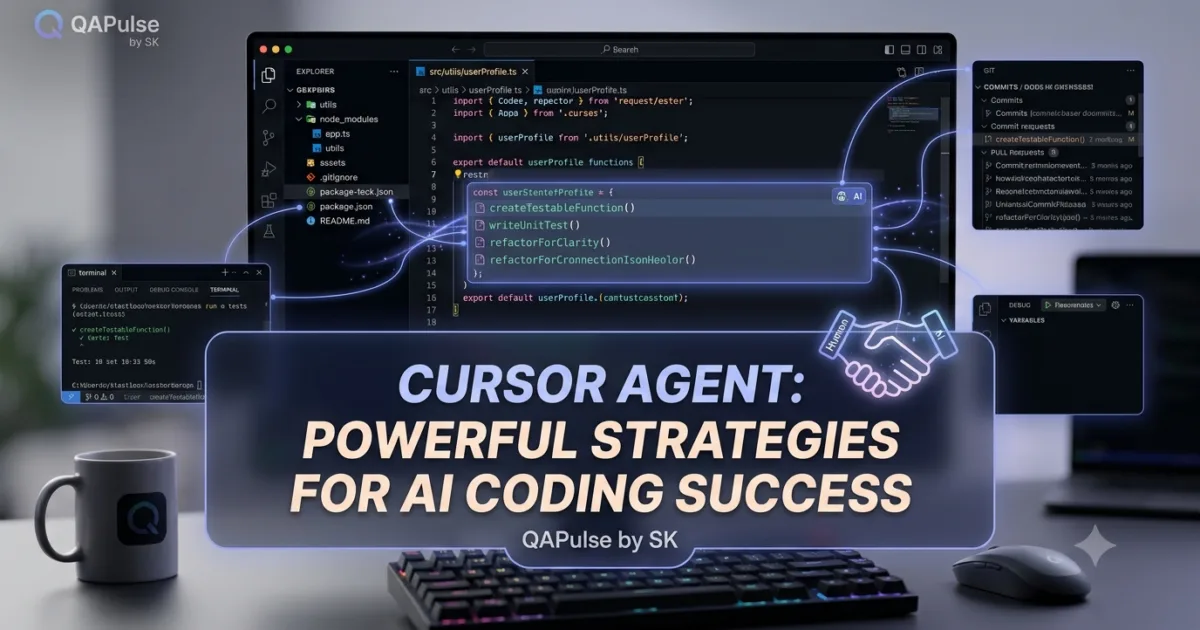
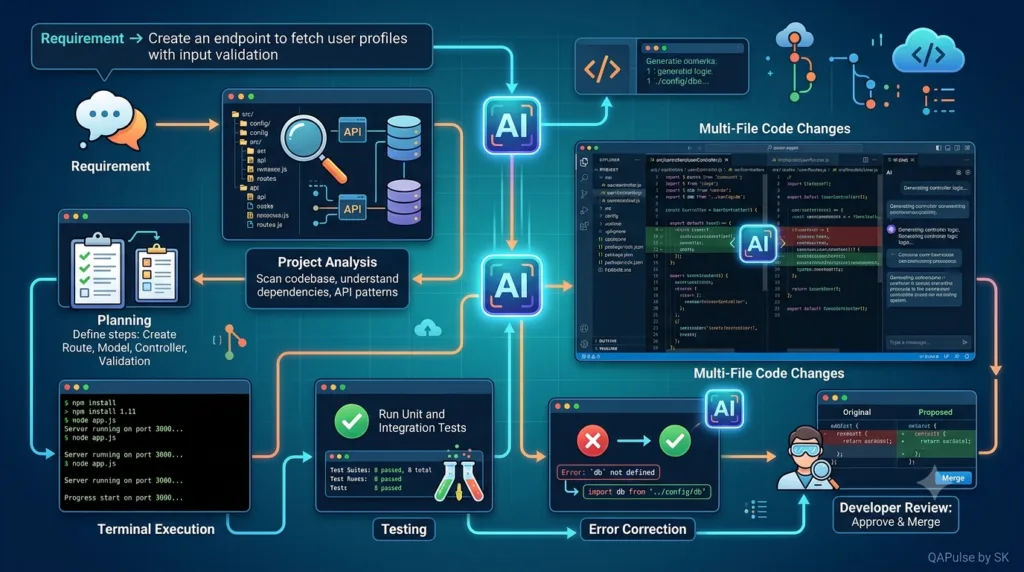
Cursor Agent changes the way developers use AI inside the editor. While traditional coding requires developers to manually decide each implementation step, Cursor Agent can take a higher-level development objective, reason about the required work, modify files, run commands, inspect results, and iterate toward a working solution.
This makes Cursor Agent fundamentally different from simple AI autocomplete.
With inline completion, the workflow is usually:
Developer types
      ↓
AI suggests
      ↓
Developer reviews
      ↓
Developer accepts
With an agentic workflow, the interaction can become:
Developer defines objective
      ↓
Cursor Agent analyzes the task
      ↓
Creates a plan
      ↓
Inspects project context
      ↓
Modifies files
      ↓
Runs tools / commands
      ↓
Checks results
      ↓
Fixes problems
      ↓
Developer reviews
The important change is autonomy.
The developer is no longer responsible for manually directing every individual code change. Instead, the developer provides an objective and supervises the implementation.
What is Cursor Agent?
Cursor Agent is an agentic coding capability that allows developers to delegate larger software-development tasks to AI, enabling the AI to inspect code, make changes across files, execute development commands, evaluate results, and continue working toward the requested outcome.
The difference between completion and agentic development can be understood through the size of the responsibility being delegated.
A completion feature might help write:
function calculateTotal(items: CartItem[]) {
An agentic request could be much broader:
Add shopping-cart discount support.

Requirements:
- Add a discount field to the cart model.
- Implement discount calculation.
- Update the checkout service.
- Add API support.
- Add unit tests.
- Run the test suite.
- Fix any failures.
The first task is a code-completion problem.
The second is a software-engineering workflow.
That distinction is at the heart of Cursor Agent.
Cursor Agent vs Cursor Tab
The two capabilities can work together, but they operate at different levels.
| Capability | Cursor Tab | Cursor Agent |
|---|---|---|
| Primary purpose | Inline code completion | Autonomous task execution |
| Typical scope | Lines/functions | Features/tasks |
| Multi-file work | Limited | Strong |
| Planning | Minimal | Important |
| Terminal interaction | Limited | Can be part of workflow |
| Test execution | Not the primary role | Important |
| Iterative problem solving | Limited | Core capability |
| Developer supervision | Very high | High but less granular |
| Best for | Repetitive coding | Larger implementation tasks |
A useful mental model is:
Cursor Tab
= "Help me write this code."

Cursor Agent
= "Help me complete this development task."
Neither approach replaces engineering judgment.
They simply operate at different levels of abstraction.
Interactive challenge
Look at these two requests:
A:
"Complete this function."

B:
"Add authentication to this application, update the API,
create tests, run them, and fix failures."
Which one is more appropriate for an agentic workflow?
The answer is B, because it involves multiple related activities rather than a single local code completion.
Why Cursor Agent Matters
Traditional software development often requires developers to switch between several tools:
Code editor
   ↓
Terminal
   ↓
Browser
   ↓
Documentation
   ↓
Test runner
   ↓
Git
   ↓
Code editor
Every transition introduces friction.
An agentic development workflow attempts to connect these activities:
Requirement
   ↓
Codebase
   ↓
Implementation
   ↓
Terminal
   ↓
Tests
   ↓
Results
   ↓
Fixes
This can reduce context switching.
The real productivity opportunity is therefore not simply “AI writes code faster.”
It is:
AI can coordinate multiple development actions around a single engineering objective.
Understanding Agentic Coding
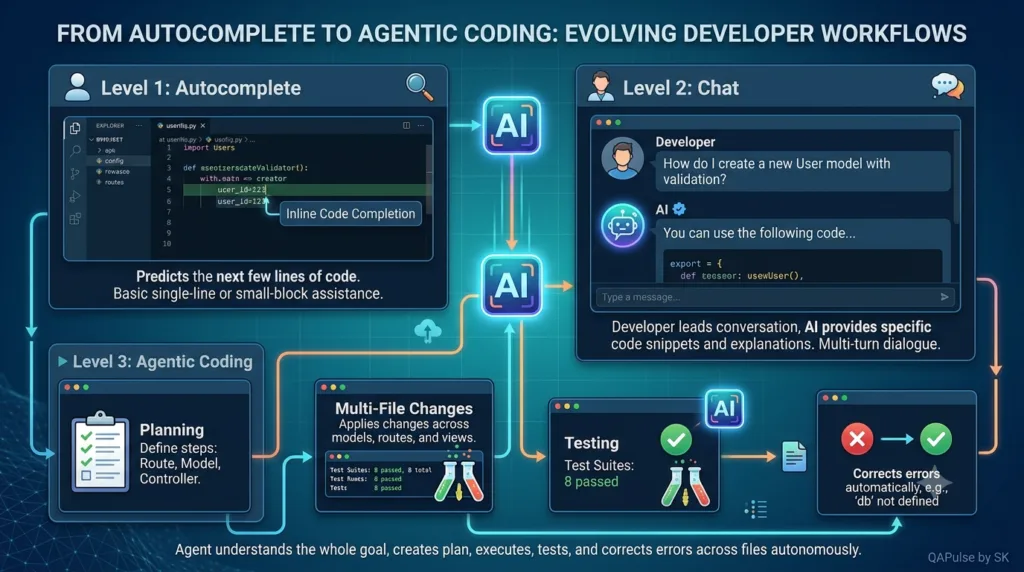
Agentic coding is easiest to understand by comparing three levels.
Level 1: Autocomplete
The developer writes most of the intent.
const users = await
The AI predicts:
const users = await userRepository.findAll();
The developer remains completely inside the implementation loop.
Level 2: Conversational Coding
The developer asks:
Explain how authentication currently works.
The AI explains the repository.
Or:
Refactor this function to improve readability.
The AI generates a proposed change.
Level 3: Agentic Coding
The developer gives a broader objective:
Refactor the authentication module,
update affected tests,
run the test suite,
and fix failures.
Now the AI may need to:
Inspect files
   ↓
Understand dependencies
   ↓
Plan changes
   ↓
Modify multiple files
   ↓
Run tests
   ↓
Read failures
   ↓
Modify implementation
   ↓
Run tests again
This is much closer to an engineering workflow than ordinary autocomplete.
The Agentic Development Loop
A reliable agent workflow can be represented as:
1. Understand
      ↓
2. Plan
      ↓
3. Modify
      ↓
4. Execute
      ↓
5. Observe
      ↓
6. Validate
      ↓
7. Correct
      ↓
8. Report
The critical difference is the feedback loop.
A basic generator might produce code once:
Prompt → Code
An agent can work iteratively:
Task
 ↓
Implementation
 ↓
Test
 ↓
Failure
 ↓
Diagnosis
 ↓
Correction
 ↓
Test
 ↓
Success
This feedback loop is what makes agentic coding substantially more powerful for complex development work.
A Simple Cursor Agent Task
Imagine a Node.js project containing:
src/
├── controllers/
├── services/
├── repositories/
├── models/
└── routes/

tests/
├── unit/
└── integration/
A developer could define a task such as:
Add a health-check endpoint.

Requirements:
- Create GET /health.
- Return HTTP 200.
- Return JSON containing status: "ok".
- Add an automated test.
- Follow the existing project architecture.
- Run the relevant tests.
This request is small enough to understand but large enough to demonstrate agentic behavior.
A potential implementation might involve:
routes/health.ts
controllers/health.controller.ts
tests/health.spec.ts
The important point is that the developer defines the desired outcome, rather than manually specifying every file edit.
Why Task Definition Matters
Agentic systems are only as effective as the instructions surrounding them.
Compare:
"Add health check."
with:
"Add GET /health.

Return HTTP 200 with:
{
  status: "ok"
}

Follow the existing controller and route patterns.
Do not introduce a new framework.
Add an automated API test.
Run the relevant tests after implementation."
The second request gives the agent significantly more useful constraints.
Better instructions reduce ambiguity.
A practical agent prompt should usually contain:
Goal
Context
Constraints
Expected behavior
Files / area involved
Testing requirements
Acceptance criteria
Agent Prompt Structure
A reusable structure is:
Goal:
[What should be built or changed?]

Context:
[What does the existing system do?]

Requirements:
[What behavior is required?]

Constraints:
[What must not change?]

Testing:
[What tests should be created or updated?]

Acceptance criteria:
[How will we know the task is complete?]
For example:
Goal:
Add password-reset API support.

Context:
The project uses Express, TypeScript, and a service/repository architecture.

Requirements:
- Add POST /auth/password-reset.
- Validate the email address.
- Generate a reset token.
- Store the token securely.
- Return an appropriate response.

Constraints:
- Follow existing authentication patterns.
- Do not expose reset tokens in API responses.
- Do not modify unrelated modules.

Testing:
- Add success and failure cases.
- Test invalid email input.
- Test unknown users.
- Test token expiration.

Acceptance criteria:
All authentication tests pass.
This is much stronger than asking an AI agent to “build password reset.”
Cursor Agent and Existing Codebases
Agentic coding becomes especially interesting inside established repositories.
A mature repository contains implicit knowledge:
Naming conventions
Architecture
Libraries
Testing patterns
Error handling
Configuration
API conventions
Folder structure
The agent needs to understand those patterns before changing the code.
For example, if every service follows:
export class UserService {
    constructor(
        private readonly repository: UserRepository
    ) {}

    async findById(id: string) {
        // implementation
    }
}
then a new service should generally follow the same architecture.
The objective is not:
Generate technically valid code.
The objective is:
Generate code that belongs in this codebase.
That distinction becomes increasingly important as agent autonomy increases.
Cursor Agent and Repository Exploration
Before making changes, an effective workflow starts with exploration.
Conceptually:
Repository
   ↓
Identify relevant files
   ↓
Inspect architecture
   ↓
Find related implementations
   ↓
Find existing tests
   ↓
Understand conventions
   ↓
Plan modification
For example, before implementing a new API endpoint, an agent may need to inspect:
Existing routes
Existing controllers
Existing services
Existing validation
Existing error handling
Existing API tests
This is why repository context is more valuable than simply providing a huge prompt.
The codebase itself contains information.
Cursor Agent and Multi-File Changes
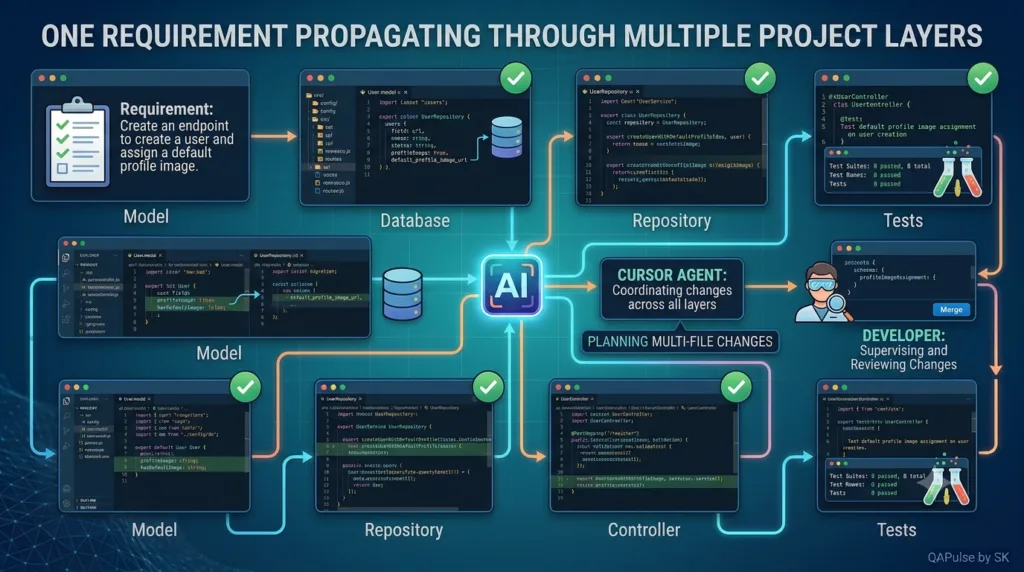
One of the strongest differences between local completion and agentic workflows is the ability to reason about related files.
Suppose a new field is required:
interface User {
    id: string;
    name: string;
    email: string;
    role: string;
}
Adding:
status: "active" | "inactive";
may affect:
Model
Database schema
Repository
Service
Controller
API response
Validation
Unit tests
Integration tests
Fixtures
Documentation
A local completion feature cannot automatically turn every architectural consequence into a complete feature.
An agentic workflow can reason about the broader change.
Cursor Agent and Test-Driven Validation
A major advantage of agentic coding is the ability to connect implementation with validation.
Suppose the requirement is:
Create an endpoint that returns 404
when a requested user does not exist.
The agent should not stop after writing the controller.
A stronger workflow is:
Implement
   ↓
Create test
   ↓
Run test
   ↓
Observe result
   ↓
Fix implementation
   ↓
Run again
Example test:
test("returns 404 when user does not exist", async ({ request }) => {
    const response = await request.get("/users/999999");

    expect(response.status()).toBe(404);
});
The test provides a feedback mechanism.
Without validation, the agent only knows what it generated.
With validation, it can observe whether the implementation behaves as expected.
Cursor Agent and the SDET Workflow
For SDETs, agentic development can become particularly powerful.
A developer might define:
Create Playwright coverage for the checkout flow.

Requirements:
- Login as an existing test user.
- Add a product to the cart.
- Proceed to checkout.
- Submit the order.
- Verify the confirmation message.
- Reuse existing fixtures.
- Follow the project's Page Object Model.
- Run the checkout tests.
An agentic workflow could involve:
Inspect existing fixtures
        ↓
Inspect checkout Page Objects
        ↓
Inspect existing tests
        ↓
Create missing methods
        ↓
Create test
        ↓
Run Playwright
        ↓
Read failure
        ↓
Fix implementation
        ↓
Run again
This is a natural fit for an AI-assisted SDET workflow because test automation already involves many repetitive implementation activities.
But the SDET still owns:
Risk
Coverage
Assertions
Test strategy
Boundary conditions
Negative scenarios
Flakiness analysis
Cursor Agent and Playwright
Imagine the project already contains:
tests/
├── fixtures/
│   └── test-fixtures.ts
├── pages/
│   ├── LoginPage.ts
│   ├── ProductPage.ts
│   └── CheckoutPage.ts
└── specs/
    ├── login.spec.ts
    └── product.spec.ts
A strong agent instruction is:
Add checkout regression coverage.

Use the existing fixture architecture.
Reuse CheckoutPage where possible.
Do not create duplicate selectors.
Follow existing test naming conventions.
Add positive and validation scenarios.
Run only the checkout test suite first.
This gives the agent boundaries.
The more precise the constraints, the less likely the implementation is to drift from the project’s architecture.
Cursor Agent and API Testing
The same principle applies to API automation.
Suppose your API has:
POST /users
GET /users/:id
PUT /users/:id
DELETE /users/:id
A task could be:
Add API regression coverage for user creation.

Cover:
- valid user
- missing email
- invalid email
- duplicate email
- missing required fields

Reuse existing API fixtures and assertion helpers.
Run the relevant tests after implementation.
This creates a much stronger testing objective than:
"Write user API tests."
The first defines coverage.
The second defines only implementation.
Cursor Agent and Failure Recovery
One of the most interesting characteristics of agentic development is failure recovery.
Suppose the agent writes:
await page.getByText("Checkout").click();
The test fails because the application uses:
button[aria-label="Proceed to checkout"]
A purely generative workflow may simply stop.
An agentic workflow can inspect the failure:
Test failure
     ↓
Read error
     ↓
Inspect DOM / existing code
     ↓
Identify incorrect locator
     ↓
Update locator
     ↓
Run test again
The ability to iterate based on feedback is a core part of agentic software development.
But Autonomous Does Not Mean Unsupervised
This distinction is critical.
Autonomous
≠
Unsupervised
An agent may be capable of taking multiple actions without asking for every individual instruction.
The developer should still establish:
What can be changed?
What cannot be changed?
What commands are acceptable?
What files are in scope?
What tests must pass?
What constitutes completion?
Think of the developer as the technical owner and the agent as the execution assistant.
Cursor Agent and Human Approval
A safe mental model is:
Human
   ↓
Defines objective
   ↓
Sets constraints
   ↓
Agent executes
   ↓
Agent reports
   ↓
Human reviews
   ↓
Human approves
This preserves accountability.
The agent can perform many mechanical actions.
The human remains responsible for the final software.
Interactive Exercise: Write a Better Agent Prompt
Weak prompt:
Build login.
Improve it.
A stronger version could be:
Implement login functionality using the existing authentication architecture.

Requirements:
- Accept email and password.
- Validate required fields.
- Return the existing authentication response format.
- Use the existing authentication service.
- Do not introduce another authentication library.
- Add unit tests for valid and invalid credentials.
- Add API coverage for missing credentials.
- Run the authentication tests.
- Do not modify unrelated modules.

Before making changes, inspect the existing authentication implementation
and follow its established conventions.
The difference is enormous.
The first prompt provides an objective.
The second provides an engineering contract.
Agentic Coding Strategy
A strong strategy for Cursor Agent is:
Start Small
Don’t begin with:
Rewrite the application.
Begin with a bounded task:
Add one endpoint.
Then:
Add tests.
Then:
Refactor the implementation.
This makes the agent’s behavior easier to inspect.
Define Acceptance Criteria
For example:
Acceptance criteria:
- Endpoint returns 201.
- Invalid input returns 400.
- Duplicate records return 409.
- Existing tests continue to pass.
Now the agent has measurable goals.
Limit Scope
Specify:
Modify only:
src/users/
tests/users/
This can reduce unintended changes.
Require Validation
Always include:
Run the relevant tests.
For appropriate tasks, also require:
Run linting.
Run type checking.
Review the Diff
After completion:
git diff
The final review remains human responsibility.
Cursor Agent and Code Quality
An agent can produce code that is:
Correct
Readable
Tested
but it can also produce:
Duplicated
Over-engineered
Poorly named
Inconsistent
Unnecessary
Therefore, validation should happen at multiple levels.
Syntax
 ↓
Type checking
 ↓
Unit tests
 ↓
Integration tests
 ↓
Linting
 ↓
Code review
 ↓
Architecture review
The appropriate layers depend on the task.
Cursor Agent and the “More Code” Trap
Agentic tools make it easier to produce large changes.
That can create a false productivity signal.
Consider:
Developer A
100 lines written manually
versus:
Developer B
2,000 lines generated by AI
Developer B is not automatically more productive.
The real question is:
Which implementation delivers the required business value
with acceptable quality, risk, and maintenance cost?
AI should optimize outcomes, not code volume.
Cursor Agent and Developer Skill
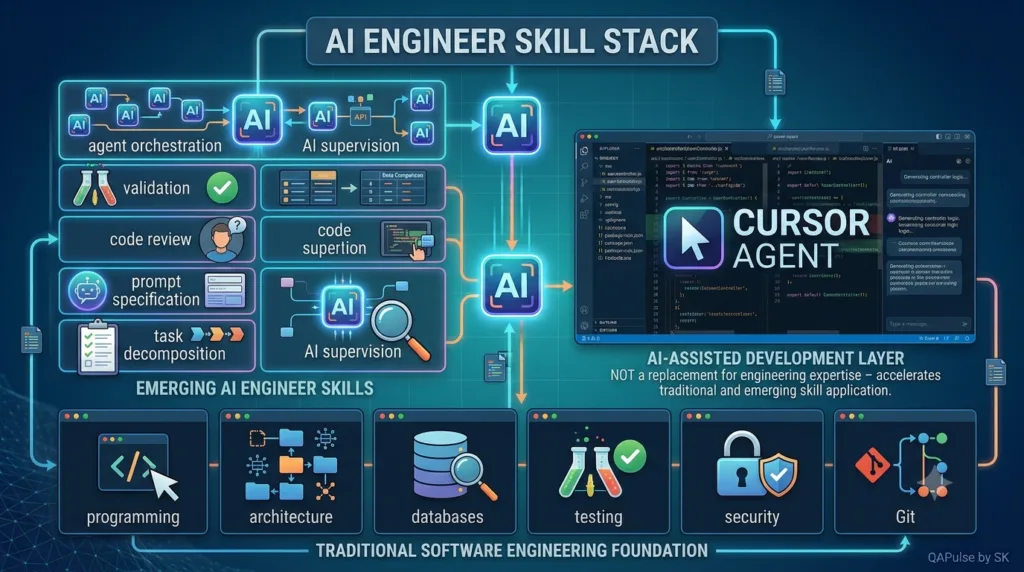
Agentic coding changes the skills developers need.
Traditional skills remain important:
Programming
Architecture
Debugging
Testing
Databases
Networking
Security
Git
But additional skills become increasingly valuable:
Task decomposition
Prompt specification
AI supervision
Code review
Validation
Context management
Risk assessment
The future developer is not simply someone who writes code.
It is someone who can direct, evaluate, and integrate multiple forms of engineering assistance.
Cursor Agent and Software Engineering Judgment
Consider this request:
"Optimize this database query."
An agent may modify the SQL.
But what does “optimize” mean?
It could mean:
Lower execution time
Reduce memory usage
Reduce database load
Improve concurrency
Reduce network transfer
Improve index usage
The developer must define the objective.
Otherwise, the agent may optimize for the wrong metric.
This principle applies everywhere:
A vague objective creates an uncertain implementation.
Cursor Agent and Requirements Engineering
Agentic development therefore increases the importance of requirements.
Good requirements contain:
Expected behavior
Constraints
Inputs
Outputs
Error conditions
Dependencies
Acceptance criteria
Poor requirements say:
Make it better.
Fix this.
Improve performance.
Clean this up.
Add authentication.
Those phrases may be understandable to a human who already knows the system.
They are poor specifications for autonomous execution.
Cursor Agent and Security
Agentic tools introduce additional security considerations because they may interact with:
Source code
Terminal
Files
Dependencies
Configuration
Environment
Development tools
Security-sensitive workflows require careful boundaries.
Never casually expose:
API keys
Passwords
Private credentials
Production secrets
Tokens
Sensitive customer data
And never assume that generated security code is automatically secure.
Authentication, authorization, encryption, payment processing, and secret handling require rigorous human review.
Cursor Agent and Terminal Commands
Agentic coding becomes more powerful when it can interact with development commands.
For example:
npm test
or:
npx playwright test
or:
npm run lint
The output becomes feedback.
Command
 ↓
Result
 ↓
Agent observes
 ↓
Agent reasons
 ↓
Agent modifies
 ↓
Command again
This feedback cycle is one of the fundamental differences between simple generation and agentic execution.
But command execution should always be treated as a controlled engineering capability.
Cursor Agent and Git
Git provides an important safety layer.
Before an agentic task:
git status
After the task:
git status
git diff
For larger changes:
git diff --stat
This lets developers understand:
Which files changed?
How many lines changed?
Were unexpected files modified?
Were tests changed?
Were configuration files touched?
The developer should never merge a large AI-generated change without understanding the resulting diff.
A Practical Agent Safety Checklist
Before giving an agent a significant task:
□ Is the working tree clean?
□ Is the task clearly defined?
□ Are acceptance criteria written?
□ Is the scope limited?
□ Are sensitive files excluded?
□ Are tests available?
□ Is there a rollback path?
□ Do I know what commands may be executed?
□ Can I review the resulting diff?
This turns agentic development from uncontrolled automation into controlled engineering.
Cursor Agent: The Core Mental Model
The simplest mental model is:
Cursor Tab
→
Predict my next code.

Cursor Chat
→
Help me reason about code.

Cursor Agent
→
Help me accomplish a development task.
That does not mean the boundaries are absolute.
Modern AI development environments increasingly combine these capabilities.
But the mental model remains useful because it helps developers choose the right tool for the right problem.
Practical Strategy for Developers
Use Cursor Agent when the task has:
Clear objective
+
Multiple implementation steps
+
Existing repository context
+
Defined validation criteria
Examples include:
Add a feature
Refactor a module
Create test coverage
Update related files
Fix a contained bug
Migrate a bounded component
Implement an API endpoint
Create automation coverage
Avoid giving an agent an enormous ambiguous objective such as:
"Improve the entire application."
Break it into measurable engineering tasks.
First Principles for Cursor Agent
The strongest principles can be summarized as:
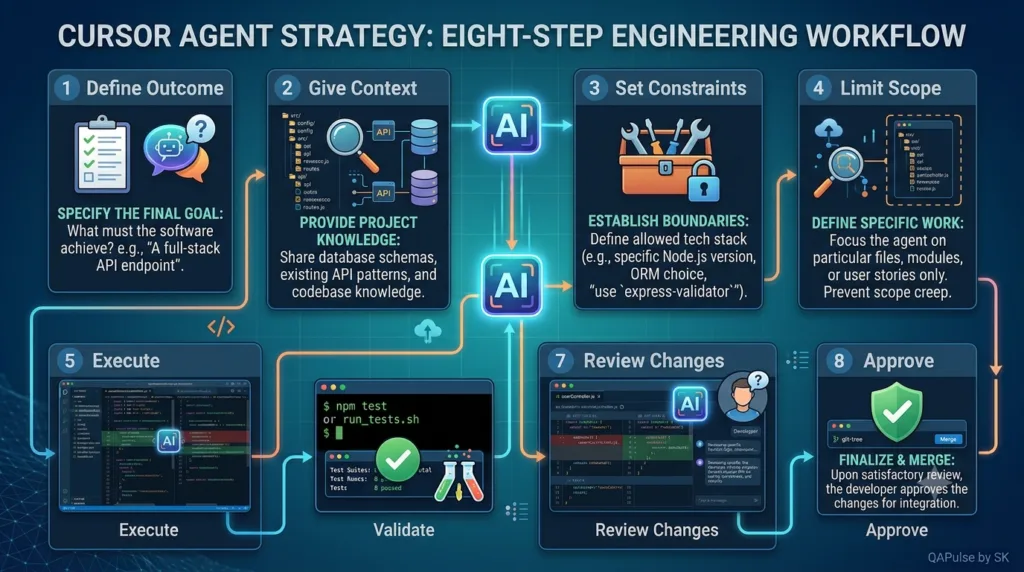
1. Define the outcome.
2. Give the agent context.
3. Establish constraints.
4. Keep scope bounded.
5. Require validation.
6. Inspect the changes.
7. Test the result.
8. Own the final decision.
This is the foundation of responsible agentic development.
Building Reliable Workflows with Cursor Agent
Cursor Agent becomes significantly more useful when developers stop treating it as a simple code generator and start treating it as an engineering collaborator with a defined operating boundary.
The biggest mistake is to give an agent a large objective and assume that autonomy automatically produces quality.
A better approach is:
Business requirement
        ↓
Engineering objective
        ↓
Repository context
        ↓
Constraints
        ↓
Agent execution
        ↓
Validation
        ↓
Human review
The agent can accelerate implementation, but the developer remains responsible for deciding whether the resulting software is actually correct.
From “Write Code” to “Complete a Task”
Consider this instruction:
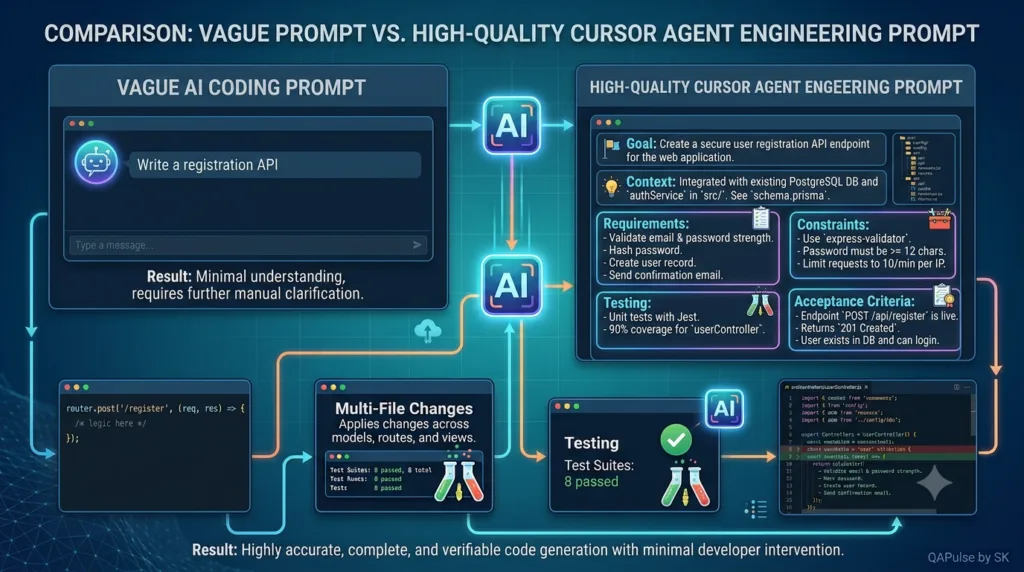
Create a user registration API.
It sounds reasonable, but it leaves many questions unanswered.
What framework?
What validation?
What database?
What response format?
What happens with duplicate users?
What status code should be returned?
What tests are required?
A stronger Cursor Agent instruction defines the engineering contract:
Implement user registration using the existing API architecture.

Requirements:
- Accept name, email, and password.
- Validate required fields.
- Reject invalid email addresses.
- Reject duplicate email addresses.
- Hash passwords using the existing authentication utility.
- Return the project's standard success response.
- Follow existing controller and service patterns.

Testing:
- Add successful registration coverage.
- Add validation coverage.
- Add duplicate-user coverage.
- Run the relevant API tests.

Constraints:
- Do not introduce a new authentication library.
- Do not modify unrelated modules.
- Reuse existing utilities wherever possible.
The second prompt does something important: it reduces the number of engineering decisions the agent has to guess.
Context Is the Agent’s Working Memory
An AI agent does not automatically understand every business decision that has ever been made inside a repository.
It needs useful context.
A project might contain:
src/
tests/
docs/
config/
package.json
README.md
.cursor/
Before implementing a feature, the agent should understand relevant:
- architecture
- naming conventions
- existing utilities
- test patterns
- API conventions
- configuration
- dependencies
- error handling
- authentication patterns
This is why repository-aware development is more powerful than copying isolated code into an AI chat window.
The project itself is part of the prompt.
Give Context Without Creating Noise
More context does not always mean better context.
A developer might provide 200 lines of unrelated documentation when only three files matter.
A better instruction is:
Focus on the existing user-management implementation.

Relevant areas:
- src/users/
- src/auth/
- tests/users/

First inspect the existing user service, repository, controller,
and related tests.

Follow those patterns rather than introducing a new architecture.
This tells the agent where to investigate.
The goal is relevant context, not maximum context.
Planning Before Modification
For complex tasks, asking the agent to inspect and plan before making extensive changes can improve reliability.
For example:
Before modifying files:

1. Inspect the existing authentication architecture.
2. Identify the files involved in password reset.
3. Find existing token-generation utilities.
4. Find authentication-related tests.
5. Explain the implementation approach.
6. Identify potential edge cases.

Do not modify files until the implementation approach is clear.
This creates a separation between:
Understanding
and:
Execution
That separation is valuable when the task affects multiple components.
Why Planning Matters
Suppose a developer asks an agent to migrate:
REST API → GraphQL
A careless implementation could focus only on controllers.
A proper analysis might discover dependencies across:
Routes
Controllers
Services
Repositories
Schemas
Validation
Authentication
Tests
Documentation
Clients
CI/CD
Planning helps expose the actual scope before code changes begin.
Cursor Agent and Existing Architecture
One of the strongest uses of agentic development is extending an existing system without unnecessarily redesigning it.
Imagine an application uses:
Controller
   ↓
Service
   ↓
Repository
   ↓
Database
A developer asks:
Add product search.
A weak implementation might place database queries directly inside the controller.
A stronger instruction says:
Implement product search using the existing
Controller → Service → Repository architecture.

Do not introduce database access inside controllers.

Reuse existing pagination and validation utilities.
Follow naming conventions used by the existing product module.
Now architecture becomes an explicit constraint.
Architecture Before Implementation
A good Cursor Agent workflow asks:
What pattern already exists?
before asking:
What code should I generate?
That small change in thinking can dramatically improve consistency.
Cursor Agent and Codebase Patterns
Suppose an existing project uses:
export class OrderService {
    constructor(
        private readonly orderRepository: OrderRepository
    ) {}

    async findById(id: string) {
        return this.orderRepository.findById(id);
    }
}
If a new InvoiceService is required, the preferred implementation should probably resemble the existing pattern:
export class InvoiceService {
    constructor(
        private readonly invoiceRepository: InvoiceRepository
    ) {}

    async findById(id: string) {
        return this.invoiceRepository.findById(id);
    }
}
The important achievement is not that AI generated TypeScript.
It is that the generated code follows the existing architecture.
Cursor Agent and Acceptance Criteria
Acceptance criteria turn a vague development objective into something measurable.
Without criteria:
"Improve checkout."
With criteria:
Checkout requirements:

- Users can add products to the cart.
- Cart totals include applicable discounts.
- Invalid coupon codes are rejected.
- Expired coupons are rejected.
- Checkout cannot proceed with an empty cart.
- Successful checkout creates an order.
- Existing checkout tests continue to pass.
Now the agent has observable outcomes.
Acceptance Criteria Example
For a REST endpoint:
Acceptance criteria:

- POST /users returns 201 for valid input.
- Invalid email returns 400.
- Duplicate email returns 409.
- Password is never returned in the response.
- Database failures use the existing error handler.
- Unit and API tests pass.
This is much more useful than:
Make the API robust.
Cursor Agent and Test Feedback
Agentic development becomes substantially stronger when the implementation has a feedback mechanism.
Consider:
Requirement
   ↓
Implementation
   ↓
Test
   ↓
Failure
   ↓
Diagnosis
   ↓
Correction
   ↓
Test
The test is not simply a final gate.
It becomes an information source.
For example:
npm test -- user.service.test.ts
If the output contains:
Expected: 409
Received: 500
the agent now has concrete evidence that the implementation does not satisfy the requirement.
That is far better than asking:
"Does this code look correct?"
Cursor Agent and Test-Driven Development
A useful agentic workflow can start with tests.
For example:
Implement password validation.

Expected behavior:
- Password shorter than 12 characters → reject.
- Missing uppercase → reject.
- Missing number → reject.
- Missing special character → reject.
- Valid password → accept.
The test could look like:
describe("password validation", () => {
    it("rejects passwords shorter than 12 characters", () => {
        expect(validatePassword("Short1!"))
            .toBe(false);
    });

    it("accepts a valid password", () => {
        expect(validatePassword("StrongPassword1!"))
            .toBe(true);
    });
});
The agent can then implement against observable behavior.
This reduces ambiguity.
Cursor Agent for Debugging
Debugging is another area where agentic workflows can be useful.
Imagine this failure:
Error: Expected 200 but received 500
Instead of simply asking:
Fix this.
provide the evidence:
The GET /users/:id test returns 500 instead of 200.

Please:
1. Reproduce the failure.
2. Inspect the stack trace.
3. Identify the root cause.
4. Fix the smallest appropriate area.
5. Run the failing test again.
6. Run related tests to detect regressions.
This creates a controlled debugging loop.
Root Cause vs Symptom
A dangerous AI workflow is:
Test fails
 ↓
Change random code
 ↓
Test passes
A better workflow is:
Test fails
 ↓
Understand failure
 ↓
Identify root cause
 ↓
Make targeted change
 ↓
Validate
Passing tests are important, but the reason they pass matters too.
Interactive Challenge: Debug the Prompt
Which request is stronger?
Prompt A
Fix the failing login test.
Prompt B
The login test fails with HTTP 401 when valid credentials are used.

Investigate:
- authentication service
- credential validation
- token generation
- test fixture

Determine the root cause before changing code.

Fix the smallest appropriate component.
Run the failing test and related authentication tests.
Do not modify unrelated authentication behavior.
Better answer: Prompt B.
It gives the agent:
Observed behavior
+
Investigation scope
+
Constraint
+
Validation requirement
Cursor Agent and Refactoring
Agentic workflows can also help with controlled refactoring.
Suppose a project contains:
function calculate(a, b, c, d, e) {
    // large implementation
}
The goal is to improve maintainability.
A poor request:
Refactor this code.
A stronger request:
Refactor calculate() for readability.

Constraints:
- Preserve existing behavior.
- Do not change the public API.
- Keep current test behavior unchanged.
- Extract logically independent operations into small functions.
- Do not introduce unnecessary abstractions.
- Run the existing unit tests after refactoring.
The word preserve is important.
Refactoring should generally change structure without unintentionally changing behavior.
Cursor Agent and Small Diffs
A useful strategy is to prefer focused changes.
Instead of:
Change 17 unrelated files.
prefer:
Implement the feature in the existing user module.
Only modify related files required for the feature.
Smaller diffs are easier to:
- review
- test
- understand
- revert
- merge
A useful Git workflow is:
git status
git diff --stat
git diff
For larger repositories, reviewing changed files before running a full test suite can quickly reveal unexpected modifications.
Cursor Agent and Git Safety
Git is not merely a version-control system in an AI-assisted workflow.
It is also a safety mechanism.
Before a significant agentic task:
git status
After implementation:
git diff --stat
git diff
If appropriate, create a branch:
git checkout -b feature/user-registration
Now the agent’s work is isolated from the main development line.
A developer can inspect the result before merging.
Cursor Agent and Pull Request Quality
AI-generated changes should be reviewed like changes from another developer.
A useful pull-request checklist is:
□ Does the implementation satisfy the requirement?
□ Are the changes limited to the intended scope?
□ Are tests included?
□ Are edge cases covered?
□ Is the architecture consistent?
□ Are errors handled correctly?
□ Are security implications understood?
□ Is unnecessary code present?
□ Does the diff contain unexpected changes?
Passing CI does not answer all of these questions.
CI verifies automated checks.
Code review verifies engineering intent.
Cursor Agent and Negative Testing
AI-generated happy-path tests are often not enough.
Suppose the requirement is:
Create a user.
A complete test strategy should consider:
Valid user
Missing name
Missing email
Invalid email
Duplicate email
Weak password
Unexpected input
Unauthorized request
Malformed payload
Database failure
For SDETs, this distinction is especially important.
The agent can accelerate test implementation, but the human tester should define meaningful risk coverage.
Cursor Agent for Playwright Test Generation
Consider:
Create Playwright tests for login.
A stronger task:
Add Playwright login coverage using the existing Page Object Model.

Cover:
- valid login
- invalid password
- unknown user
- empty email
- empty password
- locked account

Requirements:
- Reuse existing fixtures.
- Do not duplicate selectors.
- Follow existing Page Object conventions.
- Avoid hard waits.
- Use meaningful assertions.
- Run the login suite after implementation.
This is a much better agent task because it specifies both behavior and engineering standards.
Example generated structure:
test("user can log in successfully", async ({ loginPage }) => {
    await loginPage.login(
        process.env.TEST_EMAIL!,
        process.env.TEST_PASSWORD!
    );

    await expect(loginPage.dashboard)
        .toBeVisible();
});
The agent may accelerate implementation, but the test design still requires human judgment.
Cursor Agent and API Automation
For API automation, specify the behavior matrix.
Create tests for POST /users.

Cases:
- 201 with valid payload
- 400 with missing email
- 400 with malformed email
- 409 with duplicate email
- 401 without authentication
- 422 with invalid domain data
This produces more valuable coverage than asking an agent to “create API tests.”
A structured matrix can become:
| Scenario | Expected Result |
|---|---|
| Valid user | 201 |
| Missing email | 400 |
| Invalid email | 400 |
| Duplicate user | 409 |
| Unauthenticated | 401 |
| Invalid business data | 422 |
The table becomes both a testing plan and an agent instruction.
Cursor Agent and Documentation
Agentic workflows are not limited to implementation.
A task could be:
Update the API documentation for the new user-registration endpoint.

Include:
- HTTP method
- URL
- authentication requirement
- request body
- success response
- validation errors
- duplicate-user behavior

Follow the documentation format already used in the repository.
This helps keep implementation and documentation aligned.
But documentation should still be verified against the actual behavior.
Cursor Agent and CI/CD
Agentic coding can also interact with CI/CD configuration.
For example:
Add Playwright smoke tests to the existing GitHub Actions workflow.

Constraints:
- Follow the existing workflow structure.
- Do not replace the current test jobs.
- Reuse existing Node.js setup.
- Store artifacts only when tests fail.
- Keep secrets out of workflow files.
- Validate YAML syntax.
This is a good example of why constraints matter.
CI/CD files can affect the entire development pipeline.
An agent should not casually rewrite them.
Cursor Agent and Environment Awareness
Different environments may contain:
Development
Testing
Staging
Production
Agentic workflows should clearly distinguish them.
For example:
Run tests against the local test environment only.

Do not:
- deploy to production
- modify production configuration
- delete database records
- rotate credentials
Explicit boundaries are especially important whenever terminal access or automation can perform real actions.
Cursor Agent and Secrets
Never place sensitive values directly into prompts when they are unnecessary.
Avoid:
API_KEY=actual-secret-value
PASSWORD=real-password
TOKEN=real-production-token
Prefer:
Use the existing environment variable:
API_KEY
And:
Use the configured test credentials from the existing test environment.
Do not print secrets in logs.
The objective is to give the agent the interface to the secret, not the secret itself.
Cursor Agent and Human-in-the-Loop Development
A mature workflow does not attempt to remove the developer from the process.
It creates checkpoints.
Checkpoint 1
Requirement review
        ↓
Checkpoint 2
Implementation plan
        ↓
Checkpoint 3
Code changes
        ↓
Checkpoint 4
Automated validation
        ↓
Checkpoint 5
Human diff review
        ↓
Checkpoint 6
Merge
This creates a balance between speed and control.
Where Humans Should Stay Strongly Involved
Human review is especially important for:
- authentication
- authorization
- payments
- security controls
- database migrations
- infrastructure
- production configuration
- privacy-sensitive workflows
- business-critical algorithms
- destructive operations
The more severe the consequences of a mistake, the stronger the human approval requirement should be.
A Risk-Based Cursor Agent Strategy
Not every task deserves the same level of autonomy.
Consider this model:
| Task Risk | Example | Agent Autonomy |
|---|---|---|
| Low | Boilerplate | High |
| Low | Test scaffolding | High |
| Medium | Feature implementation | Moderate |
| Medium | Refactoring | Moderate |
| High | Authentication | Low |
| High | Database migration | Low |
| Very High | Production infrastructure | Very low |
The key idea is:
Agent autonomy should increase when risk decreases.
This is more practical than treating every task identically.
Cursor Agent as a Software Engineering Multiplier
The biggest productivity gain does not come from generating more lines.
It comes from reducing repetitive coordination work.
Without agentic assistance:
Read requirement
 ↓
Find files
 ↓
Open files
 ↓
Modify files
 ↓
Run tests
 ↓
Read failure
 ↓
Find related file
 ↓
Modify
 ↓
Run tests
With a well-scoped agent:
Define objective
 ↓
Agent investigates
 ↓
Agent implements
 ↓
Agent validates
 ↓
Developer reviews
The developer spends more time on:
Architecture
Requirements
Risk
Testing strategy
Design
Review
and less time on mechanical navigation.
Interactive Exercise: Build Your Own Agent Contract
Take a real development task and fill this structure:
Goal:
________________________________

Context:
________________________________

Relevant files:
________________________________

Requirements:
________________________________

Constraints:
________________________________

Tests:
________________________________

Acceptance criteria:
________________________________

Out of scope:
________________________________
For example:
Goal:
Add retry handling to the API client.

Context:
The project uses TypeScript and Axios.

Relevant files:
src/api/
tests/api/

Requirements:
Retry transient 5xx failures up to three times.

Constraints:
Do not retry 4xx errors.
Preserve existing timeout behavior.
Do not introduce another HTTP library.

Tests:
Add success-after-retry and exhausted-retry cases.

Acceptance criteria:
All API tests pass.

Out of scope:
Do not change authentication or request serialization.
This structure can be reused for almost any agentic development task.
The Difference Between Delegation and Abdication
Delegation means:
"I define the goal and let the agent execute part of the work."
Abdication means:
"I let the agent decide everything and assume the result is correct."
Good AI-assisted engineering is delegation.
Bad AI-assisted engineering is abdication.
The distinction becomes increasingly important as agents become more capable.
Cursor Agent and Developer Productivity
A productive developer does not necessarily type faster.
A productive developer reduces unnecessary work while maintaining quality.
Cursor Agent can help reduce:
Repetitive implementation
File navigation
Boilerplate
Test scaffolding
Routine refactoring
Mechanical debugging
Documentation updates
But developers still need to invest time in:
Problem definition
Architecture
Risk analysis
Validation
Code review
Business logic
Security
That is the real productivity equation.
A Practical Daily Workflow
A disciplined developer can use an agentic workflow like this:
1. Start with a clean Git state.
2. Define one bounded objective.
3. Give relevant repository context.
4. State constraints.
5. Define acceptance criteria.
6. Ask the agent to inspect the existing architecture.
7. Let it implement the change.
8. Run targeted tests.
9. Inspect the diff.
10. Run broader validation.
11. Review security and edge cases.
12. Commit only after understanding the change.
Example:
git status
Then after implementation:
git diff --stat
git diff
npm test
For Playwright:
npx playwright test tests/checkout
The exact commands depend on the project, but the principle remains the same:
Generate → Validate → Review → Integrate.
A Strong Cursor Agent Prompt Template
Keep this template available for recurring development work:
Act as an implementation assistant for this repository.

Goal:
[Describe the desired outcome.]

Context:
[Explain the relevant application behavior.]

First:
Inspect the existing implementation and identify relevant patterns.

Requirements:
- [Requirement 1]
- [Requirement 2]
- [Requirement 3]

Constraints:
- Follow existing architecture.
- Reuse existing utilities where appropriate.
- Do not modify unrelated files.
- Do not introduce unnecessary dependencies.

Testing:
- Add or update relevant tests.
- Include positive and negative scenarios.
- Run the targeted test suite.

Acceptance criteria:
- [Criterion 1]
- [Criterion 2]
- [Criterion 3]

Before finishing:
- Review the changed files.
- Check for unintended modifications.
- Report what changed.
- Report which tests were executed.
- Report any remaining risks or limitations.
This template transforms an informal request into a structured engineering task.
The Most Important Shift in Mindset
The traditional question is:
How can AI write this code for me?
A stronger question is:
How can I define this engineering task so an AI agent can execute it safely and verifiably?
That shift changes everything.
The developer becomes better at:
Specification
+
Decomposition
+
Supervision
+
Validation
+
Review
And the AI becomes useful as an execution layer rather than a mysterious code generator.
Cursor Agent Strategy: The Golden Rule
When working with an agent, remember:
Clear objective
+
Relevant context
+
Explicit constraints
+
Measurable acceptance criteria
+
Automated validation
+
Human review
=
Reliable AI-assisted development
The goal is not maximum autonomy.
The goal is maximum useful autonomy within controlled engineering boundaries.
Cursor Agent for Real-World Software Engineering
Cursor Agent becomes most valuable when it is used against realistic engineering problems rather than isolated code-generation exercises. Real projects contain dependencies, legacy code, incomplete tests, inconsistent assumptions, environment constraints, and business rules.
That means an effective agentic workflow must go beyond:
Prompt → Code
and move toward:
Requirement
    ↓
Repository investigation
    ↓
Architecture understanding
    ↓
Implementation
    ↓
Execution
    ↓
Validation
    ↓
Debugging
    ↓
Review
The objective is not simply to make Cursor Agent produce code.
The objective is to make the whole development loop more efficient without sacrificing engineering quality.
Cursor Agent for Feature Development
Consider a typical e-commerce requirement:
Add wishlist functionality.
That sounds simple.
But implementing it may involve:
User model
Wishlist model
Database
Repository
Service
API routes
Authentication
Authorization
Frontend
Validation
Tests
A weak request would be:
Build wishlist functionality.
A stronger request could be:
Implement wishlist functionality using the existing
application architecture.

Requirements:
- Authenticated users can add products to a wishlist.
- Users can remove products from their wishlist.
- Users can retrieve their wishlist.
- A product cannot appear twice.
- Unauthenticated users must receive the existing
  authentication error.
- Follow existing controller/service/repository patterns.

Testing:
- Add unit tests for the wishlist service.
- Add API tests for add, remove, list, duplicate,
  and unauthorized scenarios.

Constraints:
- Reuse the existing Product model.
- Do not modify unrelated product behavior.
- Follow existing database migration conventions.

Before implementing, inspect the existing product,
authentication, and repository architecture.
This gives the agent enough information to reason about the feature as a system.
Understanding Feature Scope Before Coding
A useful strategy is to ask the agent to identify dependencies first.
For example:
Before implementing wishlist functionality:

1. Find the existing Product model.
2. Find the User model.
3. Inspect authentication middleware.
4. Inspect existing repository patterns.
5. Find similar many-to-many relationships.
6. Find related API tests.
7. Identify the files that will likely require changes.
8. Explain the proposed implementation.
This creates an architectural discovery phase.
The developer can then evaluate whether the proposed approach makes sense.
Cursor Agent and Legacy Code
Modern projects are rarely completely clean.
You may encounter:
function getUser(id) {
    return db.query(
        "SELECT * FROM users WHERE id = " + id
    );
}
The requirement might be:
Add user profile support.
The agent may notice security and architectural problems.
This creates an important decision.
Should it:
A. Fix everything it discovers?
or:
B. Implement the requested feature only?
Usually, the safer answer is B, unless the task explicitly includes remediation.
A good instruction is:
Implement the requested profile feature.

If you discover unrelated technical debt,
do not modify it.

Report significant issues separately.
This prevents scope explosion.
The Scope Creep Problem
Agentic systems can identify many improvements.
For example:
Feature request
      ↓
Agent discovers
      ↓
Old validation
      ↓
Old database code
      ↓
Old logging
      ↓
Old authentication
      ↓
Old tests
The temptation becomes:
"Let's fix everything."
Suddenly a small feature becomes a 40-file refactor.
This creates unnecessary risk.
A disciplined agent workflow separates:
Required changes
from:
Discovered improvements
For example:
Required:
Implement wishlist.

Discovered:
Authentication middleware could be refactored.

Action:
Do not modify authentication middleware.
Report it separately.
This is a powerful technique for keeping AI-assisted development controlled.
Cursor Agent and Dependency Awareness
Changing one component can affect many others.
For example:
interface User {
    id: string;
    email: string;
}
Adding:
role: "admin" | "user";
may affect:
Database schema
Type definitions
Authentication
Authorization
API responses
Frontend state
Fixtures
Factories
Tests
Documentation
A good agent should investigate these dependencies.
A useful prompt:
Before modifying the User model,
identify all important consumers of User.

Search for:
- User imports
- User creation
- User serialization
- Authentication checks
- Authorization logic
- API responses
- Tests
- Fixtures

Do not modify files until the dependency impact
is understood.
This is much safer than directly editing the model.
Cursor Agent and Change Impact Analysis
Developers can think of this as an impact graph:
User model
   ↓
Authentication
   ↓
Authorization
   ↓
Controllers
   ↓
API responses
   ↓
Frontend
   ↓
Tests
When an agent changes a central component, the risk increases.
A practical rule is:
More dependencies
      ↓
More analysis
      ↓
Smaller changes
      ↓
Stronger validation
This is one of the most important strategies for agentic software development.
Cursor Agent for Bug Fixing
Bug fixing is another strong use case.
Imagine a production-like failure:
GET /orders/123
Expected: 200
Actual: 404
Instead of:
Fix order API.
provide evidence:
Investigate the GET /orders/:id 404 failure.

Observed:
- Order 123 exists in the test database.
- The endpoint returns 404.
- POST /orders works correctly.

Investigate:
- route parameter handling
- repository lookup
- authorization
- test fixture

Determine the root cause before changing code.

Make the smallest appropriate fix.

Run:
- failing test
- related order tests
- full order test suite
This encourages diagnosis instead of random modification.
Root-Cause Debugging with Cursor Agent
A disciplined debugging loop looks like:
Failure
  ↓
Evidence
  ↓
Reproduction
  ↓
Investigation
  ↓
Root cause
  ↓
Targeted fix
  ↓
Regression testing
The dangerous workflow is:
Failure
  ↓
Guess
  ↓
Change code
  ↓
Hope
Agentic development should strengthen the first workflow, not the second.
Cursor Agent and Logs
Logs can provide valuable context.
For example:
ERROR UserService:
Unable to retrieve user
userId=123
database timeout
A strong debugging request could be:
Investigate this failure using the available logs.

Do not assume the database query is the root cause.

Trace:
request
→ controller
→ service
→ repository
→ database

Identify where the failure originates.

After identifying the root cause,
make the smallest appropriate correction.
This encourages the agent to trace the system rather than patching the first suspicious line.
Cursor Agent for Refactoring Large Files
Suppose a service contains:
UserService.ts
├── registration
├── login
├── password reset
├── profile
├── notifications
├── permissions
├── reporting
└── administration
The file has become difficult to maintain.
A dangerous request:
Refactor UserService completely.
A better strategy:
Analyze UserService.ts.

Identify cohesive responsibilities that can be separated.

Do not change behavior.

First propose:
- candidate modules
- dependencies
- migration sequence
- testing strategy

Do not implement until the proposed structure
has been reviewed.
This separates architectural reasoning from execution.
Cursor Agent and Incremental Refactoring
A safer refactoring sequence is:
Analyze
  ↓
Select one responsibility
  ↓
Extract
  ↓
Run tests
  ↓
Review diff
  ↓
Extract another responsibility
  ↓
Run tests
Instead of:
Analyze
  ↓
Rewrite everything
  ↓
Run tests
  ↓
Discover 37 failures
Small iterations reduce debugging complexity.
Cursor Agent for Database Changes
Database changes require additional caution.
Imagine adding:
ALTER TABLE users
ADD COLUMN account_status VARCHAR(20);
The change may affect:
Application models
Queries
ORM mappings
API responses
Fixtures
Seed data
Tests
Indexes
Migrations
Rollback strategy
A useful task specification is:
Add account_status to users.

Requirements:
- Default existing users to "active".
- New users should default to "active".
- Allowed values are active and suspended.

Before implementation:
- Inspect existing migration conventions.
- Identify all code reading User.
- Identify tests involving User creation.

Create a reversible migration.
Update affected application code.
Update relevant tests.
Do not modify production data directly.
The words reversible migration and do not modify production data directly establish important safety boundaries.
Cursor Agent and API Contract Changes
Changing an API response can have unexpected consequences.
Existing:
{
  "id": 101,
  "name": "John"
}
New:
{
  "id": 101,
  "name": "John",
  "status": "active"
}
The change may affect:
Frontend clients
Mobile applications
API tests
Documentation
External consumers
Mock servers
Contract tests
A strong agent instruction should therefore include:
Before changing the API response,
identify consumers of this endpoint.

Determine whether the change is backward compatible.

Update:
- implementation
- tests
- API documentation

Do not silently break existing clients.
This is where agentic coding intersects with software architecture.
Cursor Agent and Contract Testing
For API-heavy systems, contract tests can provide valuable protection.
Example:
expect(response.body).toMatchObject({
    id: expect.any(Number),
    name: expect.any(String),
    status: expect.any(String)
});
The agent can help generate and update contract coverage.
But developers should decide whether the new contract is actually correct.
The agent verifies implementation against a specification.
It should not be the sole authority defining the specification.
Cursor Agent and Test Automation Strategy
AI can generate tests quickly.
That does not automatically create good testing.
Consider:
Login test
A generated test might only verify:
Valid credentials → Dashboard
A stronger strategy considers:
Valid credentials
Invalid password
Unknown account
Locked account
Empty email
Empty password
Expired session
Unauthorized access
Rate limiting
Session persistence
Logout
The test strategy comes first.
The agent can then accelerate implementation.
This distinction is particularly important for QA engineers and SDETs.
Cursor Agent for SDET Workflows
A strong SDET workflow could look like:
Requirement
   ↓
Risk analysis
   ↓
Test scenarios
   ↓
Automation architecture
   ↓
Agent implementation
   ↓
Execution
   ↓
Failure analysis
   ↓
Coverage review
The AI agent can assist with:
Page Objects
API clients
Fixtures
Assertions
Test data
Boilerplate
Test refactoring
Failure diagnosis
The SDET remains responsible for:
Risk coverage
Test design
Oracle definition
Boundary analysis
Flakiness assessment
Release confidence
Cursor Agent and Playwright Fixtures
Suppose a project already has:
export const test = base.extend({
    authenticatedPage: async ({ browser }, use) => {
        // existing setup
    }
});
Instead of creating another authentication mechanism, instruct the agent:
Use the existing authenticatedPage fixture.

Do not create a second login mechanism.

Follow existing Playwright fixture conventions.
This prevents duplicated infrastructure.
The principle is simple:
Reuse existing abstractions before creating new ones.
Cursor Agent and Test Data
Test data is another area where AI-generated code can create hidden problems.
Bad:
const email = "test@example.com";
Every test uses the same account.
Better:
const email = `test-${Date.now()}@example.com`;
Or, preferably, use the project’s existing test-data factory.
A good agent prompt:
Use the existing test-data factory.

Do not hard-code shared production-like accounts.

Ensure tests remain isolated and repeatable.
This addresses test reliability rather than merely test generation.
Cursor Agent and Flaky Tests
A test failure does not always mean application failure.
Possible causes include:
Timing
Network
Test data
Race conditions
Environment
Selectors
Shared state
External services
A weak agent workflow might add:
await page.waitForTimeout(5000);
just to make the test pass.
That may hide the actual problem.
A better instruction is:
Investigate the flaky test.

Do not add arbitrary fixed waits.

Determine whether the cause is:
- synchronization
- locator instability
- test-data dependency
- application behavior
- environment instability

Implement the smallest reliable correction.
Run the test repeatedly to validate stability.
This is especially valuable for Playwright automation.
Cursor Agent and Code Review
AI-generated code should receive the same scrutiny as human-generated code.
Ask:
Does this solve the requirement?
Then ask:
Does this belong in the architecture?
Then:
Is it secure?
Then:
Is it maintainable?
Then:
Is it adequately tested?
A useful review sequence is:
Correctness
→
Architecture
→
Security
→
Maintainability
→
Testing
→
Performance
Not every review requires every category, but critical changes should receive broader examination.
Interactive Exercise: Review an AI-Generated Change
Imagine Cursor Agent generates:
async function getUser(id: string) {
    const response = await fetch(`/api/users/${id}`);

    if (!response.ok) {
        return null;
    }

    return response.json();
}
Ask yourself:
1. Is null the correct error behavior?
2. Should 401 and 404 be treated differently?
3. What happens on 500?
4. Is response validation required?
5. Is logging required?
6. Does the project already have an API client?
7. Are tests covering failures?
The code may compile.
It may even pass a happy-path test.
But engineering quality requires asking whether the behavior is correct across the system.
Cursor Agent and Performance Optimization
Performance tasks require measurable goals.
Instead of:
Make this endpoint faster.
use:
The GET /products endpoint currently averages 850 ms
under the existing test workload.

Goal:
Reduce average response time below 300 ms
without changing API behavior.

Before modifying code:
- inspect query performance
- inspect indexes
- inspect N+1 patterns
- inspect serialization
- identify the actual bottleneck

Measure before and after.
Do not optimize unrelated components.
This turns optimization into an engineering experiment.
The agent should not optimize blindly.
Cursor Agent and Observability
For production-oriented systems, observability matters.
A feature may require:
Logging
Metrics
Tracing
Error reporting
A useful agent instruction:
Add error logging to the payment service.

Requirements:
- Follow the existing logging framework.
- Include correlation/request ID.
- Do not log payment credentials or sensitive card data.
- Preserve existing error propagation.
- Add tests for error handling.
The constraints are just as important as the requested feature.
Cursor Agent and Security Review
Security-sensitive code should receive additional scrutiny.
Suppose an agent creates:
const query =
    `SELECT * FROM users WHERE email = '${email}'`;
This should immediately raise concern.
A better implementation would use parameterization:
const query =
    "SELECT * FROM users WHERE email = $1";

const result = await db.query(query, [email]);
The agent can generate secure patterns, but developers must still understand why those patterns are necessary.
For security-critical changes, use:
AI implementation
+
Security review
+
Automated security testing
+
Human approval
rather than relying on AI alone.
Cursor Agent and Dependency Management
Agents may suggest new packages when existing dependencies could solve the problem.
Before accepting:
npm install some-new-library
ask:
Is this dependency actually necessary?
Does the project already have equivalent functionality?
Is the package maintained?
Does it introduce security or licensing concerns?
Does it increase bundle size?
A useful constraint is:
Do not add dependencies unless the existing project
cannot reasonably support the required behavior.
This simple rule can prevent unnecessary dependency growth.
Cursor Agent and “Do Not Invent”
One of the most useful instructions for agentic development is:
Do not invent APIs, utilities, configuration,
or architecture that do not exist.

If required information cannot be found,
stop and report the uncertainty.
This is valuable because an AI system may otherwise infer plausible but nonexistent components.
For example, instead of assuming:
authService.verifyToken()
the agent should search the repository.
Maybe the project actually uses:
tokenService.validate()
Repository inspection should win over model assumptions.
Cursor Agent and Uncertainty
An agent should not be forced to guess.
A strong workflow explicitly allows uncertainty:
If you cannot determine the intended behavior
from the repository or requirements,
do not invent behavior.

Identify the ambiguity and explain what information
is required.
This is an important principle for reliable AI-assisted engineering.
Cursor Agent and Documentation-Driven Development
Documentation can also provide context.
Suppose the repository contains:
docs/
├── architecture.md
├── authentication.md
├── API.md
└── testing.md
A task can explicitly instruct:
Read the relevant documentation before implementation.

Use documented architecture and API conventions
as the source of truth where applicable.
This can reduce incorrect assumptions.
However, documentation may be outdated.
Therefore, compare documentation with actual implementation when the difference matters.
Cursor Agent and the Source of Truth
A practical hierarchy is:
Explicit current requirement
        ↓
Current tested behavior
        ↓
Current architecture
        ↓
Repository documentation
        ↓
Historical patterns
        ↓
AI assumptions
The last item should have the least authority.
The agent should infer only when necessary.
Cursor Agent and Autonomous Iteration
A well-designed task can permit iterative work:
Implement
 ↓
Test
 ↓
Inspect failure
 ↓
Fix
 ↓
Test again
But iteration should have boundaries.
For example:
Run the targeted test suite.

If failures occur:
- investigate the root cause
- make targeted corrections
- rerun the tests

Do not make unrelated architectural changes
just to force tests to pass.
This prevents an agent from endlessly modifying the system.
Setting an Iteration Boundary
For difficult tasks, establish a stopping condition:
If the implementation still fails after
three focused correction attempts,
stop and report:
- failure
- evidence
- attempted changes
- likely root cause
- recommended next investigation
This is a powerful safety mechanism.
It prevents:
Failure
→
Change
→
Failure
→
Change
→
Failure
→
Massive uncontrolled rewrite
Instead:
Failure
→
Bounded investigation
→
Stop
→
Human decision
Cursor Agent and Engineering Metrics
AI productivity should be measured through outcomes.
Useful metrics include:
Cycle time
Defect rate
Test coverage
Review time
Build success rate
Mean time to repair
Deployment frequency
Regression rate
Less useful:
Lines of AI-generated code
Number of prompts
Number of files generated
More code is not automatically better engineering.
Comparing Traditional and Agentic Workflows
| Activity | Traditional Workflow | Agentic Workflow |
|---|---|---|
| Repository exploration | Manual | AI-assisted |
| Boilerplate | Manual | AI-assisted |
| Multi-file implementation | Manual | AI-assisted |
| Testing | Developer-driven | AI + developer |
| Debugging | Manual investigation | AI-assisted investigation |
| Architecture decisions | Human | Human-led |
| Risk analysis | Human | Human-led + AI support |
| Final review | Human | Human |
| Accountability | Human | Human |
The key insight is that agentic development changes execution, not ownership.
The Human Advantage
AI can inspect thousands of lines of code quickly.
Humans still have advantages in:
Business understanding
Product judgment
Risk perception
Organizational context
Ethical decisions
Architecture ownership
Stakeholder communication
That is why the best workflow is collaborative.
Human
  +
AI Agent
  =
AI-assisted engineering
Not:
Human
  →
AI replacement
A Practical Cursor Agent Playbook
For everyday development, this playbook works well:
1. Create a clean Git branch.
2. Define one measurable objective.
3. Identify relevant repository context.
4. Tell the agent what to inspect.
5. Define requirements.
6. Define constraints.
7. Define acceptance criteria.
8. Let the agent implement.
9. Run targeted tests.
10. Investigate failures.
11. Review the diff.
12. Run broader validation.
13. Review security and architecture.
14. Commit only after understanding the change.
Example:
git checkout -b feature/profile-settings
git status
After implementation:
git diff --stat
git diff
npm test
For browser automation:
npx playwright test tests/profile
The commands themselves are less important than the discipline surrounding them.
Interactive Exercise: Turn a Requirement into an Agent Task
Requirement:
"Users need profile picture support."
Turn it into:
Goal:
Add profile picture support.

Context:
The application uses an existing User service and
object-storage abstraction.

Requirements:
- Allow authenticated users to upload an image.
- Validate supported formats.
- Enforce the existing file-size limit.
- Store files through the existing storage service.
- Return the profile-image URL.

Constraints:
- Do not create a second storage abstraction.
- Do not expose internal storage credentials.
- Do not modify unrelated User functionality.

Testing:
- valid upload
- unsupported format
- oversized file
- unauthenticated request
- storage failure

Acceptance criteria:
All relevant tests pass.
Existing profile functionality remains unchanged.
This exercise demonstrates the difference between a feature statement and an executable engineering specification.
The Agentic Engineering Pyramid
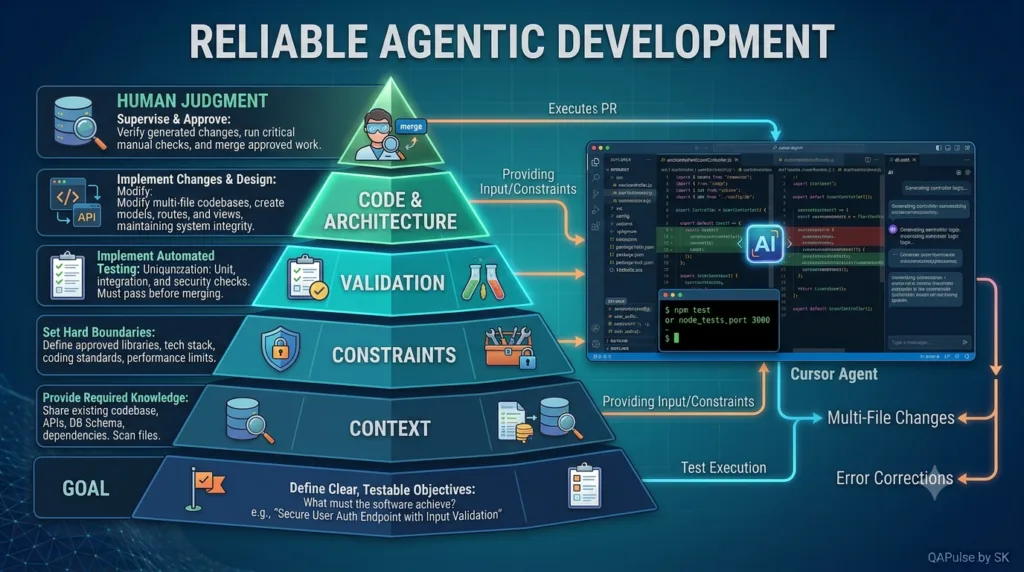
A useful way to think about reliable Cursor Agent usage is as a pyramid:
                 Human Judgment
                      ▲
                      │
              Code & Architecture
                      ▲
                      │
                 Validation
                      ▲
                      │
                 Constraints
                      ▲
                      │
                   Context
                      ▲
                      │
                    Goal
The goal is the foundation.
Context tells the agent what exists.
Constraints define boundaries.
Validation determines whether the result works.
Architecture determines whether it belongs.
Human judgment determines whether it should ship.
The Strategic Role of Cursor Agent
Cursor Agent should not be viewed simply as:
A faster autocomplete system.
Its more important role is:
An AI-assisted execution layer for software engineering tasks.
That distinction changes how developers work.
Instead of asking:
"What code should AI generate?"
developers increasingly ask:
"What outcome should AI help me achieve?"
The second question leads naturally to better task decomposition, testing, review, and engineering discipline.
A Reliable Agent Task Formula
A practical formula is:
Outcome
+
Context
+
Constraints
+
Acceptance Criteria
+
Validation
+
Review
For example:
Outcome:
Add checkout retry handling.

Context:
The application uses Axios and an existing API client.

Constraints:
Retry only transient 5xx failures.
Never retry authentication failures.

Acceptance criteria:
Three retries maximum.
Exponential delay.
Existing API behavior preserved.

Validation:
Unit tests + integration tests.

Review:
Inspect changed files and verify
no unrelated API behavior changed.
This formula can be reused across backend development, frontend development, API testing, DevOps, and test automation.
Cursor Agent as an SDET Multiplier
For an SDET, the workflow can become even more powerful:
Requirement
    ↓
Risk analysis
    ↓
Test design
    ↓
Agent implementation
    ↓
Execution
    ↓
Failure analysis
    ↓
Coverage assessment
    ↓
Human review
The agent can help produce:
Playwright tests
API tests
Fixtures
Page Objects
Mock data
Assertions
Test utilities
CI workflows
Reports
But it should not determine alone:
What must be tested
What risk matters
What constitutes sufficient coverage
Whether a defect is acceptable
Whether release confidence is high
Those remain engineering decisions.
A Final Interactive Test
Consider this prompt:
"Create a complete payment system.
Use Stripe.
Make it secure.
Add tests.
Deploy it."
Would you give this directly to an autonomous coding agent?
No.
It is too broad and contains high-risk operations.
Break it down:
Task 1:
Inspect existing payment architecture.

Task 2:
Design the payment integration.

Task 3:
Implement the payment client.

Task 4:
Add webhook handling.

Task 5:
Add unit tests.

Task 6:
Add integration tests.

Task 7:
Review security.

Task 8:
Validate deployment configuration.
Each task has:
Scope
+
Evidence
+
Validation
+
Review
That is how autonomy becomes manageable.
The Core Principle
The strongest Cursor Agent workflow is not:
Give AI everything.
It is:
Give AI enough authority to be useful,
but enough constraints to remain predictable.
That balance is the foundation of reliable agentic software development.
Cursor Agent Strategy: From AI Coding to Reliable Engineering
Cursor Agent is most powerful when it becomes part of a disciplined engineering system rather than being treated as an unlimited autonomous programmer.
The real advantage is not simply generating code faster. The advantage is compressing the repetitive parts of software development while keeping humans focused on architecture, risk, requirements, testing, and decisions.
A reliable model is:
Human defines intent
        ↓
Cursor Agent investigates
        ↓
Cursor Agent implements
        ↓
Automated tests provide evidence
        ↓
Agent diagnoses failures
        ↓
Human reviews the result
        ↓
Code is integrated
This model gives developers speed without giving up ownership.
Understanding Agentic Development as a System
A common mistake is measuring AI development by generated code.
For example:
AI generated 2,000 lines today.
That sounds productive.
But what if:
500 lines were unnecessary
300 lines duplicated existing utilities
200 lines introduced technical debt
100 lines created security problems
The number of generated lines becomes meaningless.
A better measurement is:
Useful outcome
───────────────
Time + Risk
The goal is to increase useful outcomes while controlling risk.
The Five Layers of Reliable Agentic Development
A practical system can be divided into five layers:
1. Intent
2. Context
3. Execution
4. Validation
5. Judgment
Intent defines what needs to happen.
Context tells the agent what already exists.
Execution is where the agent modifies or creates artifacts.
Validation determines whether the implementation actually works.
Judgment determines whether the implementation is appropriate for the product and architecture.
Removing any of these layers creates weaknesses.
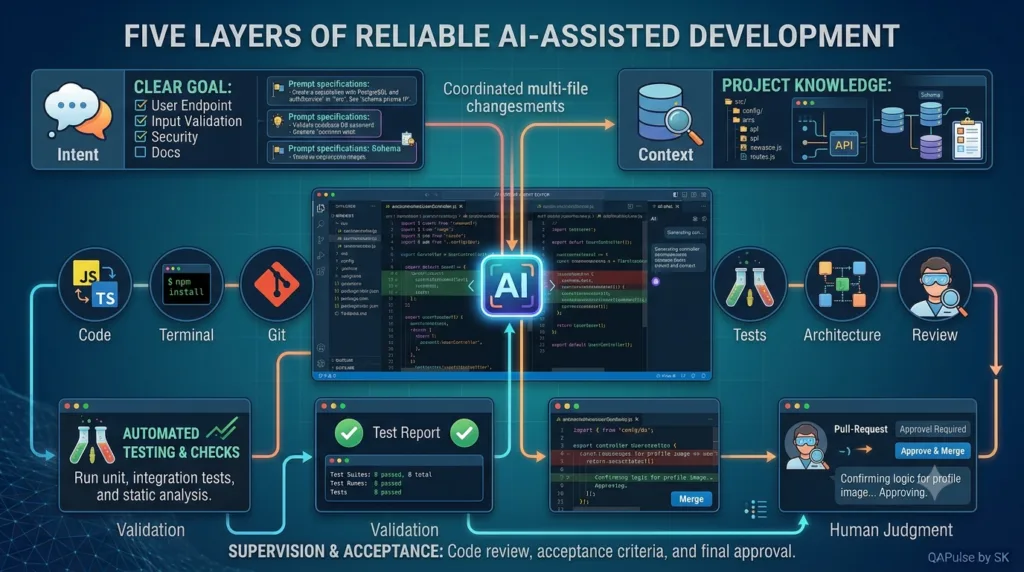
Strategy: Treat the Agent as an Execution Partner
The most productive mindset is not:
“Cursor should build my application.”
Instead:
“Cursor should execute clearly defined engineering work inside boundaries that I control.”
That distinction affects how tasks are written.
Compare:
Build a dashboard.
with:
Implement the analytics dashboard.

First inspect:
- existing dashboard components
- API client
- authentication
- chart components
- existing dashboard tests

Requirements:
- Show daily active users.
- Show weekly active users.
- Show monthly active users.
- Reuse existing chart components.
- Follow the current dashboard layout.

Constraints:
- Do not introduce a new chart library.
- Do not change authentication.
- Do not modify unrelated pages.

Validation:
- Add component tests.
- Verify loading and error states.
- Run the dashboard test suite.
The second task gives the agent a much smaller space of possible interpretations.
That is exactly what good engineering specifications should do.
Strategy: Make the Repository Part of the Prompt
One of the biggest advantages of Cursor Agent is repository awareness.
Instead of repeatedly explaining the entire architecture, developers can ask the agent to inspect the codebase.
For example:
Inspect the existing notification system.

Find:
- notification models
- notification services
- notification controllers
- notification repositories
- related tests
- configuration

Summarize the existing architecture before making changes.
This can expose patterns that would otherwise require significant manual exploration.
The important principle is:
Ask the agent to discover before asking it to modify.
Strategy: Use Progressive Autonomy
Not every task should receive the same level of agent autonomy.
A useful progression is:
Level 1 — Explain
↓
Level 2 — Inspect
↓
Level 3 — Plan
↓
Level 4 — Implement
↓
Level 5 — Test
↓
Level 6 — Iterate
↓
Level 7 — Prepare for review
For a simple formatting change, the agent can move quickly toward implementation.
For authentication or database migration, it may be better to stop after planning and require human approval before modification.
Risk-Based Autonomy
| Task | Risk | Recommended Approach |
|---|---|---|
| Rename local variable | Low | High autonomy |
| Generate unit tests | Low | High autonomy |
| Create boilerplate | Low | High autonomy |
| Implement feature | Medium | Supervised autonomy |
| Refactor shared service | Medium | Incremental autonomy |
| Change authentication | High | Strong human review |
| Database migration | High | Human approval |
| Production infrastructure | Very High | Highly restricted |
The principle is straightforward:
The higher the potential impact, the tighter the control.
Strategy: Use the Smallest Useful Task
Large prompts often sound efficient:
Build the entire SaaS platform.
But large tasks create ambiguity.
A better decomposition might be:
1. Create user registration.
2. Add authentication.
3. Add organization management.
4. Add role-based authorization.
5. Add project management.
6. Add billing.
7. Add reporting.
Each task becomes easier to:
- understand
- implement
- test
- review
- revert
This is essentially software decomposition applied to AI collaboration.
Strategy: Define “Done” Before Coding
An agent should know what success looks like.
For example:
Feature:
Password reset.
Done when:
- User can request reset.
- Valid reset token works.
- Expired token is rejected.
- Invalid token is rejected.
- Password is updated securely.
- Existing sessions follow the application's
expected behavior.
- Relevant tests pass.
This is much stronger than:
Implement password reset.
The first describes a verifiable outcome.
Strategy: Separate Requirements from Preferences
Not every statement has the same importance.
Consider:
Requirements:
- Password reset tokens expire.
- Invalid tokens must be rejected.
Preferences:
- Prefer a helper function.
- Keep functions reasonably small.
Requirements should be treated as mandatory.
Preferences allow the agent some implementation freedom.
This distinction can make prompts more flexible without making them vague.
Strategy: Give Explicit Boundaries
One of the most useful instructions is:
Do not modify unrelated files.
But boundaries can be more precise:
Modify only:
- src/users/
- tests/users/
- docs/users.md
Do not modify:
- authentication
- billing
- deployment configuration
- database infrastructure
This is especially useful in mature repositories where an apparently small change can trigger large-scale modifications.
Strategy: Create a Definition of Done
A reusable definition of done can look like:
Definition of Done
□ Requirement implemented
□ Existing architecture preserved
□ Positive tests added
□ Negative tests added
□ Edge cases considered
□ Targeted tests pass
□ Related tests pass
□ Diff reviewed
□ No unrelated files modified
□ Documentation updated where required
□ Security implications reviewed
This can become part of your team’s standard AI development workflow.
Strategy: Use Tests as Feedback, Not Just Gates
Traditional development often treats tests as the final checkpoint.
With an agent, tests can become an active feedback loop:
Implementation
↓
Test
↓
Failure
↓
Evidence
↓
Diagnosis
↓
Correction
↓
Test
For example:
Expected:
201 Created
Received:
500 Internal Server Error
Instead of immediately changing code, instruct the agent:
Investigate the 500 response.
Determine whether the cause is:
- validation
- database
- service logic
- error handling
Do not change code until the root cause
has been identified.
This encourages reasoning based on evidence.
Strategy: Require Evidence in Agent Reports
At the end of a task, ask the agent to report:
Implementation summary:
- ...
Files changed:
- ...
Tests executed:
- ...
Tests passed:
- ...
Tests failed:
- ...
Known limitations:
- ...
Potential risks:
- ...
This makes the interaction more transparent.
Instead of:
Done.
you receive an engineering summary.
That is far more useful during code review.
Strategy: Make the Agent Explain Unexpected Changes
If an agent modifies more files than expected:
Why were these additional files changed?
For each file:
- explain why it was required
- explain what changed
- explain whether the change is essential
This is a simple but powerful review technique.
Unexpected changes should trigger investigation rather than automatic acceptance.
Strategy: Protect Against Scope Expansion
Suppose you ask:
Add search filters.
The agent discovers:
Old API design
Old database schema
Old frontend state management
Old test utilities
It might attempt to modernize everything.
Instead:
Implement the requested search filters only.
If you discover architectural improvements,
do not implement them.
Report them separately under:
“Potential Future Improvements.”
This keeps the task bounded.
Strategy: Use “Out of Scope” Explicitly
A mature engineering prompt can include:
Out of scope:
- Authentication redesign
- Database optimization
- UI redesign
- Dependency upgrades
- CI/CD changes
This is particularly useful when working on large repositories.
The agent now knows that discovering an issue does not automatically authorize fixing it.
Interactive Challenge: Find the Better Prompt
Prompt A
Fix the checkout page.
Prompt B
Investigate the checkout-page test failure.
Observed:
The checkout button remains disabled
after a valid shipping address is entered.
Inspect:
- checkout component
- form validation
- shipping state
- existing checkout tests
Determine the root cause.
Requirements:
- Preserve existing checkout behavior.
- Do not redesign the checkout UI.
- Do not modify payment logic.
Validation:
- Run the failing test.
- Run related checkout tests.
- Report the root cause and changed files.
Prompt B is stronger.
It gives the agent:
Evidence
+
Scope
+
Constraints
+
Expected behavior
+
Validation
That is a repeatable pattern for debugging.
Strategy: Use Agentic Checkpoints
For complex tasks, introduce explicit checkpoints.
Checkpoint 1
Understand
Checkpoint 2
Plan
Checkpoint 3
Implement
Checkpoint 4
Validate
Checkpoint 5
Review
For example:
First inspect the architecture.
Do not modify files yet.
After inspection, provide:
- relevant files
- architecture summary
- proposed implementation
- risks
- testing strategy
Once the approach is accepted:
Implement the approved approach.
Do not introduce architectural changes
outside the agreed scope.
This creates a human-controlled feedback loop.
Strategy: Use Git as an AI Safety Net
Git becomes even more valuable when AI is modifying multiple files.
Before work:
git status
Create a feature branch:
git checkout -b feature/notification-preferences
After the agent finishes:
git diff --stat
git diff
Then:
git status
The developer should understand the diff before committing it.
Git provides reversibility.
That is extremely valuable in agentic development.
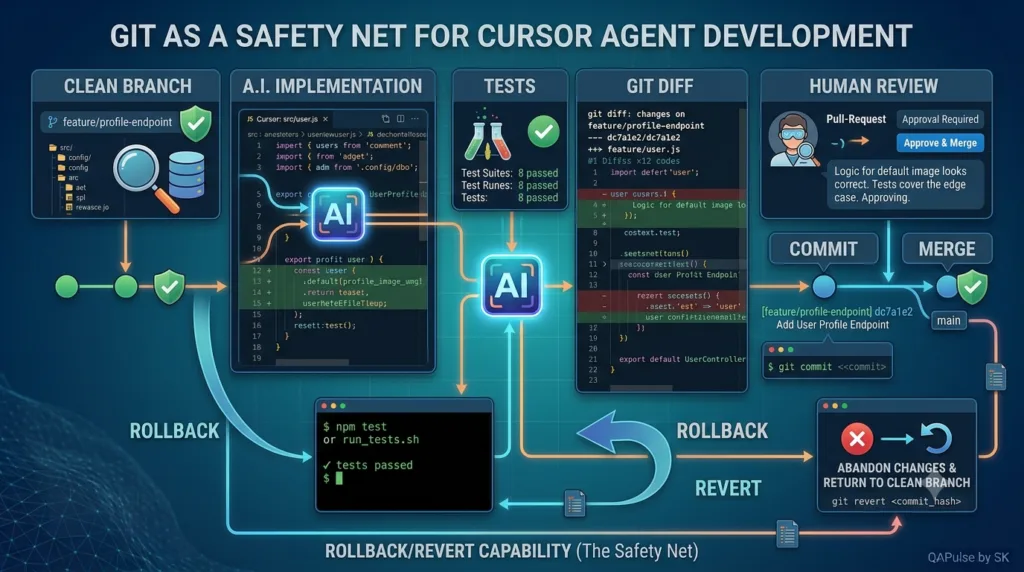
Strategy: Build an AI-Friendly Repository
Cursor Agent performs better when repositories have good engineering hygiene.
Useful foundations include:
README.md
CONTRIBUTING.md
docs/
tests/
clear naming
consistent architecture
standard scripts
environment documentation
CI configuration
A clean repository communicates intent.
A messy repository forces the agent to infer more.
Good Repository Signals
src/
users/
orders/
payments/
tests/
users/
orders/
payments/
docs/
architecture.md
testing.md
Clear boundaries reduce ambiguity.
Poor Repository Signals
src/
misc/
utils2/
old/
temp/
final/
final-new/
The agent has less reliable architectural information.
The lesson is important:
AI-assisted development rewards good software engineering practices.
It does not eliminate the need for them.
Strategy: Create Reusable Agent Instructions
Instead of repeating the same rules in every prompt:
Follow existing architecture.
Reuse existing utilities.
Do not add unnecessary dependencies.
Do not modify unrelated files.
Run relevant tests.
Review the diff.
these expectations can be standardized through project-level instructions and rules.
A reusable engineering policy might state:
Engineering Standards
- Follow existing project architecture.
- Prefer existing utilities.
- Avoid unnecessary dependencies.
- Use TypeScript strict typing.
- Add tests for behavior changes.
- Avoid arbitrary waits in browser tests.
- Never expose secrets.
- Do not modify unrelated modules.
- Run relevant validation before completion.
This creates consistency across agent tasks.
Strategy: Make AI Coding Standards Testable
Rules become more useful when they can be verified.
For example:
Rule:
Do not use fixed waits in Playwright.
Can be checked with:
grep -R "waitForTimeout" tests/
Another:
Rule:
Do not commit secrets.
Can be supported with secret scanning.
Another:
Rule:
Run lint before merging.
Can become a CI requirement.
The strongest engineering standards are not merely written.
They are enforced where possible.
Strategy: Combine Cursor Agent with CI
A mature workflow can look like:
Developer
↓
Cursor Agent
↓
Code
↓
Local tests
↓
Git commit
↓
CI
↓
Lint
↓
Unit tests
↓
Integration tests
↓
Security checks
↓
Human review
↓
Merge
The agent accelerates development.
CI provides repeatable verification.
Humans provide final judgment.
Each layer performs a different job.
Strategy: Never Let Passing Tests End the Review
Suppose all tests pass.
That does not automatically mean:
Correct
Secure
Maintainable
Performant
Architecturally appropriate
A feature can pass tests and still contain:
Duplicated code
Poor naming
Unnecessary dependency
Security weakness
Incorrect business assumption
Bad architecture
Therefore:
Tests passing
≠
Automatically ready to ship
Testing is evidence.
It is not the entire engineering decision.
Strategy: Add Risk Review to AI Workflows
A useful final review asks:
What could go wrong?
Then:
What happens if the input is invalid?
What happens if the database fails?
What happens if the API times out?
What happens if the user is unauthorized?
What happens if the request is duplicated?
What happens if the service is unavailable?
This is where QA and SDET thinking becomes extremely valuable.
AI often focuses on the expected path.
Engineering must also consider the unexpected path.
Cursor Agent for Failure-Oriented Thinking
A strong prompt can explicitly request failure analysis:
Before finishing, identify at least five
realistic failure scenarios for this feature.
For each:
- describe the failure
- explain whether the implementation handles it
- identify the relevant test
- recommend a correction if necessary
This turns the agent into a reasoning assistant rather than just a generator.
Strategy: Ask “What Did We Miss?”
After implementation, ask:
Review the completed feature as a critical engineer.
Look specifically for:
- missing edge cases
- security issues
- error-handling gaps
- test gaps
- unnecessary complexity
- architectural inconsistencies
- performance risks
Do not modify code yet.
Return findings first.
This creates a second-pass review.
It is especially useful for larger tasks.
Strategy: Separate Generation from Review
A useful pattern is:
Pass 1:
Implement
Pass 2:
Review
Pass 3:
Test
Pass 4:
Fix verified issues
Pass 5:
Final review
This is often better than asking the same agent interaction to generate everything and immediately declare success.
The second pass can be deliberately critical.
Interactive Exercise: Build a Review Prompt
Try this reusable prompt:
Review the current implementation critically.
Check:
- correctness
- architecture
- security
- performance
- maintainability
- error handling
- test coverage
- edge cases
Do not change code.
Return:
1. Critical issues
2. Medium-risk issues
3. Minor improvements
4. Missing tests
5. Recommended actions
This transforms an AI coding session into an AI-assisted code-review workflow.
Strategy: Use Cursor Agent for Documentation and Knowledge Transfer
A strong engineering workflow should leave the repository easier to understand.
After implementing a complex feature:
Document:
- architecture
- important decisions
- configuration
- testing
- known limitations
For example:
# Notification Preferences
Users can configure email and push notification preferences.
Architecture:
Controller
→ PreferenceService
→ PreferenceRepository
Testing:
- preference retrieval
- preference updates
- invalid preference values
- unauthorized requests
The value is not merely documentation.
It becomes future context for developers and agents.
Strategy: Turn Repeated Tasks into Workflows
If you repeatedly ask Cursor Agent to:
Create API tests.
Create fixtures.
Create Page Objects.
Update documentation.
Run tests.
Review changes.
you have discovered a candidate for standardization.
Instead of reinventing the prompt every time, create reusable workflows.
For an SDET team:
Requirement
↓
Generate test scenarios
↓
Create automation skeleton
↓
Implement tests
↓
Run tests
↓
Analyze failures
↓
Generate report
This transforms individual AI usage into an engineering process.
Strategy: Measure the Quality of AI Assistance
Useful measurements include:
| Metric | Why It Matters |
|---|---|
| Development cycle time | Measures speed |
| Review effort | Measures human overhead |
| Defect rate | Measures quality |
| Regression rate | Measures safety |
| Test coverage | Measures validation |
| Rework percentage | Measures AI reliability |
| Mean time to repair | Measures debugging efficiency |
One especially useful metric is:
Rework
──────
AI-generated change
If AI generates a large amount of code but requires significant rewriting, the apparent productivity gain may be misleading.
The goal is not maximum generation.
It is high-quality acceleration.
Strategy: Optimize for Reviewability
Code generated by an agent should be easy to review.
Prefer:
function calculateDiscount(
price: number,
percentage: number
) {
return price * (percentage / 100);
}
over an unnecessarily compressed implementation.
Readable code helps:
Human review
+
AI debugging
+
Future maintenance
Agentic development should optimize not just for generation speed, but for maintainability.
Strategy: Keep the Developer in the Decision Loop
There are decisions that should remain human-owned:
Should we build this?
Should this behavior exist?
Is this architecture appropriate?
Is this risk acceptable?
Should this change ship?
The agent can provide information.
It can compare approaches.
It can implement the selected approach.
But business and engineering accountability remain with the development team.
Cursor Agent and the Future SDET Workflow
For SDETs, agentic development creates an interesting shift.
Traditional workflow:
Requirement
↓
Manual test design
↓
Automation implementation
↓
Execution
↓
Failure analysis
↓
Reporting
AI-assisted workflow:
Requirement
↓
AI-assisted risk analysis
↓
Human-approved test strategy
↓
AI-assisted automation
↓
Automated execution
↓
AI-assisted failure investigation
↓
Human validation
↓
Quality decision
The SDET becomes less focused on repetitive automation code and more focused on:
Risk
Coverage
Architecture
Observability
Reliability
Quality strategy
That is a significant professional shift.
A Complete Cursor Agent Operating Model
A practical operating model can be summarized as:
DEFINE
What outcome do we need?
DISCOVER
What already exists?
PLAN
What should change?
CONSTRAIN
What must not change?
IMPLEMENT
What code is required?
VALIDATE
Does it work?
CHALLENGE
What could still be wrong?
REVIEW
Is it good engineering?
INTEGRATE
Can it safely enter the codebase?
This model can be applied to:
Frontend
Backend
APIs
Databases
DevOps
Testing
Automation
Documentation
Refactoring
Debugging
Final Interactive Challenge
Take this requirement:
Add two-factor authentication.
Before asking an agent to implement it, identify:
Architecture:
____________________________
Authentication flow:
____________________________
Existing libraries:
____________________________
Database impact:
____________________________
API impact:
____________________________
Security requirements:
____________________________
Negative scenarios:
____________________________
Tests:
____________________________
Out of scope:
____________________________
Human approval points:
____________________________
This is deliberately more difficult than simply writing:
Build 2FA.
The exercise demonstrates the central idea of agentic engineering:
The quality of the output depends heavily on the quality of the engineering problem definition.
Internal Links:
- Learn MCP – Zero to Hero
- Learn AI Agents for QA – Zero to Hero
- Playwright Automation – Zero to Hero
- LangGraph: Complete Zero to Hero
- Learn Python – Zero to Hero
- OpenAI Codex: Complete Zero to Hero
- Cursor AI: Complete Zero to Hero
- Claude Code Tutorial: Complete Zero to Hero
- AutoGen: Complete Zero to Hero Guide
- Free QA Resources Built From Real Experience
- QA Glossary: Test Automation Terms Every Engineer Should Know
External Resources:
- Model Context Protocol documentation
- Playwright documentation
- GitHub documentation
- TypeScript documentation
- Prompt Engineering Overview
- Git Documentation
- Visual Studio Code
- Cursor AI
- Cursor Documentation
People Asked Questions
What is Cursor Agent?
Cursor Agent is an AI-assisted coding capability designed to help developers investigate repositories, modify code, run tasks, debug problems, and work across multiple files.
How do I use Cursor Agent effectively?
Give Cursor Agent a clear goal, repository context, constraints, acceptance criteria, and validation requirements instead of relying on vague prompts.
Is Cursor Agent suitable for professional software development?
Yes. It can assist with implementation, debugging, refactoring, testing, documentation, and repository exploration, but professional development still requires human review and engineering judgment.
Can Cursor Agent write automated tests?
Yes. It can assist with generating and modifying unit, integration, API, and browser automation tests, while developers remain responsible for test strategy and coverage.
Can Cursor Agent replace software engineers?
Cursor Agent can automate parts of software development, but it does not eliminate the need for architecture, business understanding, risk assessment, code review, and engineering accountability.
Is Cursor Agent useful for SDETs?
Yes. It can accelerate test automation, fixtures, test data, debugging, API testing, Playwright work, and test maintenance while allowing SDETs to focus more on quality strategy and risk.
AI Overview / Answer Engine Optimization
Cursor Agent is an AI-assisted software engineering capability that can inspect a codebase, implement changes, run validation, investigate failures, and help developers complete multi-step coding tasks.
Conclusion
Cursor Agent can dramatically change how developers build software, but its greatest value does not come from surrendering development to AI.
It comes from creating a better division of labor.
Humans provide:
Intent
Architecture
Risk judgment
Business understanding
Quality decisions
Cursor Agent provides:
Repository exploration
Implementation
Boilerplate
Test scaffolding
Debugging assistance
Refactoring assistance
Documentation support
Automation provides:
Repeatability
Regression detection
Validation
CI feedback
Git provides:
Traceability
Isolation
Rollback
Reviewability
Together, these components create a much stronger development system.
The winning strategy is therefore not AI instead of engineering.
It is AI inside engineering.
Final Key Takeaways
- Cursor Agent should execute clearly defined engineering work, not replace engineering judgment.
- Give the agent context before asking it to modify a complex codebase.
- Use explicit requirements, constraints, acceptance criteria, and validation steps.
- Break large objectives into small, reviewable tasks.
- Use tests as an active feedback loop rather than merely a final gate.
- Keep Git branches and diffs as safety mechanisms around agent-generated changes.
- Do not allow discovered technical debt to automatically become scope.
- Increase human supervision as task risk increases.
- For SDETs, use AI to accelerate automation implementation while retaining human ownership of risk and coverage strategy.
- Measure AI productivity through outcomes, quality, rework, and defect reduction—not lines of generated code.
- Separate implementation from critical review whenever the task is complex or high-risk.
- The strongest agent workflow is:
Intent
→ Context
→ Constraints
→ Execution
→ Validation
→ Review
→ Integration
- The ultimate goal is not maximum AI autonomy.
It is maximum useful autonomy with controlled engineering risk.
Continue Learning
Explore more expert articles on n8n, Autogen, Postman AI, LangChain, CrewAI, MCP Servers, AI Agents, LlamaIndex, Docker, FastAPI, Playwright, Cypress, Test Automation, DevOps, and Software Engineering at www.skakarh.com.
QAPulse by SK delivers expert release analysis, AI engineering insights, enterprise automation strategies, migration guidance, DevOps best practices, and practical testing knowledge to help software professionals build scalable, intelligent, and production-ready software systems.