 QA
QA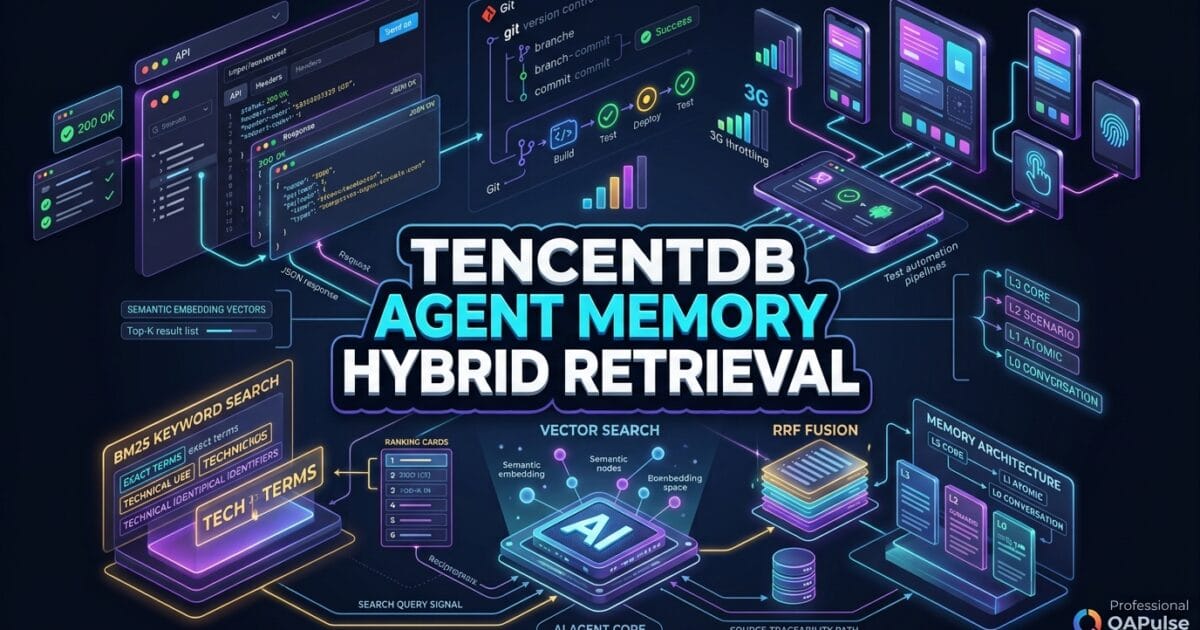
TencentDB Agent Memory Hybrid Retrieval is the retrieval architecture that combines keyword-based BM25 search, semantic vector search, and Reciprocal Rank Fusion (RRF) to give AI agents a more reliable way to recall relevant memories.
Instead of asking one retrieval method to solve every query, the architecture gives each method a different job.
BM25 is strong when the query contains exact names, identifiers, technical terms, error messages, project names, or other lexical signals.
Vector search is strong when the user expresses an idea differently from how it was originally stored. It can retrieve memories based on semantic similarity rather than exact word overlap.
RRF then combines the ranked results from both retrieval paths without requiring their raw scores to be directly comparable.
That combination is particularly useful for agent memory because human conversations contain both precise identifiers and implicit meaning.
Consider a memory containing:
“The user prefers Playwright with TypeScript and uses Page Object Model for enterprise automation.”
A later query might be:
“What automation framework and architecture does the user usually prefer?”
A vector search can recognize the semantic relationship between “automation framework and architecture” and the stored preference.
But another query might be:
“What did I decide about Playwright POM?”
Now the exact terms Playwright and POM become extremely valuable.
A semantic-only system can miss exact technical terminology.
A keyword-only system can miss paraphrased intent.
TencentDB Agent Memory hybrid retrieval addresses both problems by combining the two retrieval signals and then fusing their rankings.
Tencent Cloud’s current Agent Memory documentation describes hybrid retrieval as a combination of keyword search, vector semantic search, and RRF fusion, alongside a layered memory architecture designed to retrieve atomic facts, scenario patterns, and stable conclusions while preserving traceability to lower-level source records. (Tencent Cloud)
Key Architectural Takeaways for AI Engineers
- BM25 retrieval: Strong for exact words, names, identifiers, technical terminology, and lexical matches.
- Vector retrieval: Strong for semantic similarity, paraphrasing, concepts, and intent-level matching.
- RRF fusion: Combines ranked results from multiple retrieval systems without requiring their raw scores to be on the same scale.
- Hybrid recall: Reduces dependence on a single retrieval strategy.
- Layered memory: TencentDB Agent Memory organizes long-term memory into multiple levels, allowing high-level context to be recalled first and detailed source information to be retrieved when required. (Tencent Cloud)
- Traceable retrieval: Retrieved memories can be connected back toward lower-level source information, which is important for debugging and trustworthy agent behavior. (Tencent Cloud)
Executive Summary: Why Agent Memory Needs Hybrid Retrieval
Traditional search systems and modern AI retrieval systems solve different problems.
A keyword search engine asks:
“Which documents contain terms related to this query?”
A vector search engine asks:
“Which documents are semantically similar to this query?”
Agent memory has to answer both questions.
An agent may need to retrieve an exact project identifier from six months ago:
QAPulse-Playwright-v3
Or it may need to understand a conceptual preference:
“The user prefers maintainable automation architectures instead of large monolithic test suites.”
Those are fundamentally different retrieval problems.
The first benefits heavily from lexical matching.
The second benefits heavily from semantic matching.
This is why TencentDB Agent Memory hybrid retrieval is more interesting than simply adding a vector database to an agent.
The retrieval system is designed around multiple memory layers and multiple retrieval signals.
Tencent Cloud describes Agent Memory as an enterprise memory engine providing short-term, long-term, and team-memory capabilities. Its long-term memory uses a four-level structure ranging from core/persona information through scenarios and atomic memories to original conversations. (Tencent Cloud)
The public TencentDB Agent Memory implementation also documents three retrieval strategies:
keywordembeddinghybrid
The hybrid strategy combines keyword and embedding retrieval through RRF and is presented as the recommended mode in the project’s configuration. (UNPKG)
This matters because retrieval quality is not simply:
Better embeddings = better memory.
A production agent memory system needs to answer several additional questions:
- Did we retrieve the exact entity?
- Did we retrieve the right semantic context?
- Did both retrieval methods agree?
- What happens when only one retrieval method finds the memory?
- How many candidates should be retrieved before fusion?
- How should duplicate results be handled?
- How should stale memories be filtered?
- How do we prevent irrelevant memories from consuming context?
- Can the agent trace the retrieved fact back to its source?
Hybrid retrieval becomes the bridge between these requirements.
The Core Retrieval Problem: Exact Match vs Semantic Match
Imagine an agent has stored these memories:
- “The user uses Playwright for browser automation.”
- “The user’s preferred language for automation projects is TypeScript.”
- “The user prefers Page Object Model for larger Playwright projects.”
- “The user uses Cypress for selected frontend testing projects.”
- “The user’s automation repositories include CI/CD integration.”
Now the user asks:
“What framework do I normally use for browser testing?”
A vector search may rank memory #1 highly because “browser testing” is semantically close to “browser automation.”
Now ask:
“What did I say about Page Object Model?”
The exact phrase Page Object Model becomes highly valuable.
Now ask:
“Which automation architecture did I prefer for larger projects?”
The query may not contain the exact stored wording, but vector similarity can connect “architecture for larger projects” with the stored POM preference.
This is the fundamental reason TencentDB Agent Memory hybrid retrieval combines retrieval approaches.
The Antipattern: Vector Search as the Entire Memory System
A common architecture looks like this:
Query
↓
Embedding
↓
Vector Search
↓
Top 5 Memories
↓
LLM
It looks elegant.
But it creates a hidden assumption:
Semantic similarity is sufficient to determine relevance.
It is not.
Consider these queries:
Playwright 1.60TCVDBQAPulseOpenClawL1RRF k=60memory-tencentdb
Exact technical tokens can be extremely important.
A vector model may understand some of them well, but lexical retrieval gives the system another independent signal.
Hybrid retrieval therefore creates two parallel perspectives:
Query
→ Lexical retrieval
→ Semantic retrieval
→ Rank fusion
→ Final candidates
That architectural redundancy is the real advantage.
The 7 Core Pillars of TencentDB Agent Memory Hybrid Retrieval
1. BM25 Lexical Retrieval
BM25 is the lexical retrieval component.
It evaluates how relevant terms in a query are to documents or memories by considering factors such as term frequency, inverse document frequency, and document length.
In practical terms, BM25 is excellent when the query contains words that should appear in the target memory.
For example:
"Playwright POM TypeScript"
A memory containing those exact terms can receive a strong lexical ranking.
BM25 is especially useful for:
- Product names
- Framework names
- Error messages
- API names
- Version numbers
- Project identifiers
- User names
- Configuration keys
- Technical acronyms
- Exact phrases
TencentDB Agent Memory’s implementation includes a BM25-based keyword retrieval path, with tokenizer support for English and Chinese. (DeepWiki)
2. Vector Semantic Retrieval
Vector retrieval converts text into numerical embeddings.
Instead of asking whether the exact words match, it asks whether the meaning is similar.
For example:
Stored memory:
“The user prefers automated browser testing with Playwright.”
Query:
“Which web testing framework does the user normally rely on?”
There may be little exact word overlap.
Yet the semantic relationship is strong.
Vector search is therefore useful for:
- Paraphrased questions
- Conceptual queries
- Natural-language descriptions
- Similar experiences
- User preferences
- Behavioral patterns
- Related concepts
- Long-form memories
But vector search introduces its own risk.
Semantic similarity does not automatically mean factual relevance.
Two memories can be conceptually similar while referring to completely different projects.
That is why semantic retrieval should not automatically replace lexical retrieval.
3. Reciprocal Rank Fusion
RRF is the mechanism that combines the ranked lists.
Suppose BM25 produces:
| Rank | Memory |
|---|---|
| 1 | M1 |
| 2 | M3 |
| 3 | M7 |
| 4 | M5 |
Vector search produces:
| Rank | Memory |
|---|---|
| 1 | M3 |
| 2 | M8 |
| 3 | M1 |
| 4 | M9 |
Now M1 and M3 appear in both lists.
That is useful evidence.
RRF gives a memory a contribution based on its position in each ranking.
A common formulation is:
RRF(d) = Σ 1 / (k + rank(d))
where:
d= document or memoryrank(d)= its position in a retrieval listk= a ranking constant- the contributions are summed across retrieval systems
RRF is attractive because the underlying systems do not need to produce directly comparable scores.
For example:
BM25 might produce a score of 8.7.
Vector search might produce a cosine similarity of 0.82.
Those values do not naturally belong on the same scale.
RRF avoids the need to pretend that they do.
Instead, it works with rank positions.
MongoDB’s current hybrid-search documentation describes the same fundamental approach: retrieve results from different search methods and combine them using reciprocal rank positions, with a commonly used rank constant of 60. (MongoDB)
4. Candidate Over-Recall
A common mistake is to retrieve exactly the number of final results required from each retrieval method.
Suppose the agent needs five memories.
A naive architecture might request:
BM25 → top 5
Vector → top 5
Then fuse them.
But filtering and deduplication can reduce the final pool.
A better approach is to over-retrieve.
For example:
Requested results = 5
Candidate multiplier = 3
Each retrieval path:
5 × 3 = 15
Then:
BM25 → 15 candidates
Vector → 15 candidates
↓
Deduplicate
↓
RRF
↓
Filtering
↓
Top 5
The TencentDB Agent Memory implementation has been documented as using an over-retrieval approach before fusion and filtering in its search pipeline. (GitHub)
This is an important production detail because retrieval quality can degrade when aggressive filtering happens after a tiny candidate pool.
5. Layered Memory Retrieval
Hybrid retrieval becomes significantly more powerful when combined with layered memory.
TencentDB Agent Memory’s architecture describes long-term memory as a four-level hierarchy:
L3 Core / Persona
↓
L2 Scenario
↓
L1 Atomic Memory
↓
L0 Original Conversation
The layers have different purposes.
L0 — Original Conversation
This is the source-level evidence.
It contains the actual conversation history.
Useful when:
- Exact wording matters
- A memory needs verification
- The agent needs original context
- A generated summary is ambiguous
L1 — Atomic Memory
This layer represents extracted facts, preferences, constraints, and events.
For example:
“User prefers TypeScript for Playwright automation.”
This is easier to retrieve than searching the entire conversation history.
L2 — Scenario Memory
Scenario memory groups information around projects, tasks, or situations.
For example:
“Playwright migration project”
could contain:
- Existing framework
- Migration constraints
- Browser matrix
- CI strategy
- Known problems
- Architecture decisions
L3 — Core / Persona
This represents stable, high-level knowledge.
For example:
“User primarily works with QA automation and SDET technologies.”
The public TencentDB Agent Memory repository describes these four levels and explains that high-level memory can provide rapid context while BM25 and vector retrieval can drill into lower-level memory when specific facts are required. (GitHub)
This creates an important architectural principle:
Memory retrieval should not mean dumping the entire memory database into the prompt.
It should mean retrieving the smallest useful context at the appropriate level.
6. Retrieval Governance and Filtering
Retrieval quality is not only about finding candidates.
It is also about deciding which candidates should be allowed into the model context.
Potential filters include:
- Memory type
- Agent identity
- User scope
- Team scope
- Session
- Timestamp
- Confidence
- Relevance threshold
- Access permissions
- Character budget
- Maximum result count
This is especially important for team memory.
An enterprise agent should not retrieve a memory merely because it is semantically relevant.
It must also be authorized to use it.
TencentDB Agent Memory describes team memory with isolation and sharing controls, allowing memory assets to be scoped and shared between users and agents. (Tencent Cloud)
That makes retrieval a governance problem as well as a search problem.
7. Traceability From Retrieved Memory to Source
The final pillar is traceability.
Imagine an agent answers:
“You previously decided to use Playwright with TypeScript.”
The next question should be:
“When did I decide that?”
A trustworthy memory system needs a path back toward supporting evidence.
The layered model provides this:
L3 conclusion
↓
L2 scenario
↓
L1 atomic memory
↓
L0 original conversation
Tencent Cloud explicitly describes this white-box traceability as a core Agent Memory capability, allowing conclusions to be traced down toward original source records for auditing, correction, and compliance. (Tencent Cloud)
That is an important distinction between:
memory retrieval
and
auditable memory retrieval.
TencentDB Agent Memory Hybrid Retrieval Architecture
The complete architecture can be visualized as:
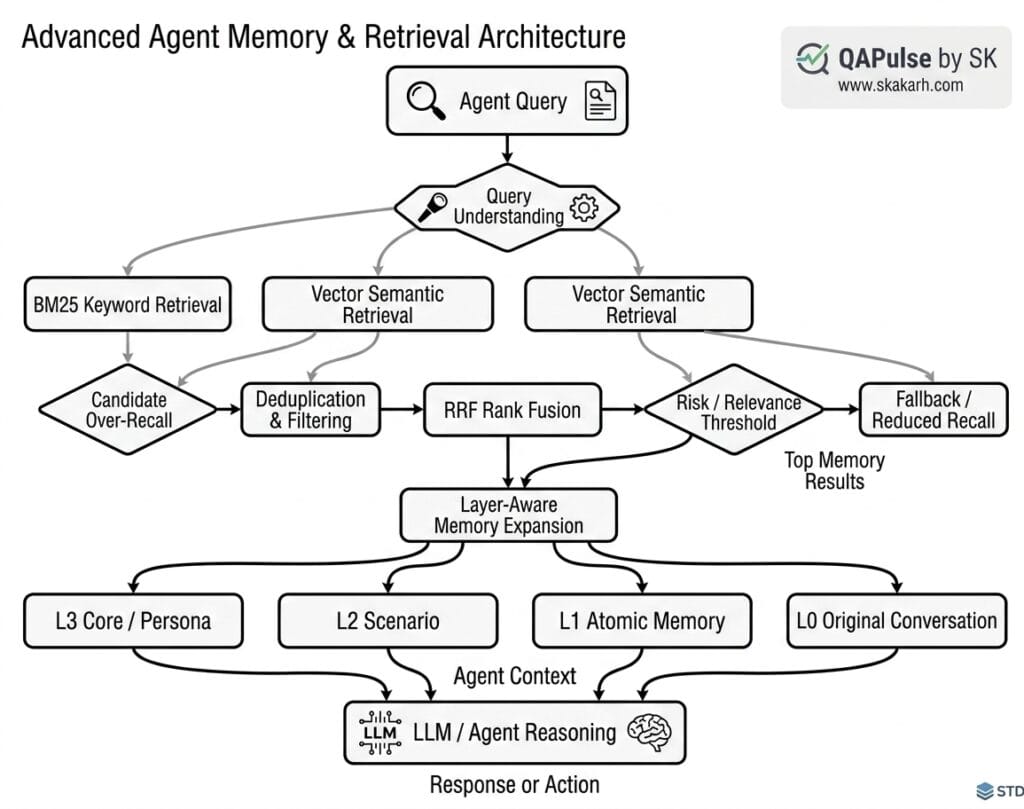
This is the flow you can draw yourself as the architecture diagram.
How BM25 and Vector Search Complement Each Other
Consider a memory store containing:
“The checkout service uses Stripe and retries failed transactions three times.”
Query A:
“Which payment provider does checkout use?”
BM25 can strongly benefit from:
payment
checkout
Stripe
Vector search can also identify the conceptual relationship.
Now Query B:
“What external system handles card payments?”
The exact word Stripe may not appear in the query.
Vector retrieval becomes more useful.
Now Query C:
“How many times does checkout retry Stripe failures?”
The exact entities and numbers matter.
BM25 becomes particularly valuable.
This is why hybrid retrieval is not about choosing a winner.
It is about giving the system two different ways to discover relevance.
RRF Example With Real Rankings
Suppose we use:
k = 60
BM25:
| Memory | Rank |
|---|---|
| A | 1 |
| B | 2 |
| C | 3 |
| D | 4 |
Vector:
| Memory | Rank |
|---|---|
| C | 1 |
| A | 2 |
| E | 3 |
| B | 4 |
Using the simplified formulation:
score = 1 / (60 + rank)
Memory A:
1/61 + 1/62
Memory B:
1/62 + 1/64
Memory C:
1/63 + 1/61
Memory D:
1/64
Memory E:
1/63
The important insight is not the absolute score.
It is that A, B, and C receive evidence from both retrieval systems.
C is especially interesting because it ranks first semantically and third lexically.
RRF allows that combined evidence to influence the final ordering.
Why RRF Is Useful for Agent Memory
A common hybrid-search mistake is to simply average raw scores.
For example:
final = 0.5 × BM25 + 0.5 × vector_score
This can be problematic because BM25 and vector similarity scores have different distributions.
RRF avoids requiring that normalization.
It effectively says:
“I care about where this memory appeared in each ranking.”
That makes the fusion layer comparatively simple and robust.
Current hybrid-search documentation from MongoDB also describes RRF as a method for combining full-text and vector-search result sets based on reciprocal rank rather than requiring the two retrieval scores to be identical. (MongoDB)
Configuration: Choosing Hybrid Retrieval
The TencentDB Agent Memory configuration exposes the retrieval strategy as:
{
  "recall": {
    "enabled": true,
    "maxResults": 5,
    "scoreThreshold": 0.3,
    "strategy": "hybrid",
    "timeoutMs": 5000
  }
}
The project documentation lists keyword, embedding, and hybrid as the available strategies, with hybrid using RRF fusion. (UNPKG)
This configuration illustrates an important point:
Hybrid retrieval is not simply:
“Run both searches.”
It also requires operational controls.
maxResults
Controls how many memories are ultimately returned.
Too many results can overwhelm the agent context.
Too few can cause important evidence to disappear.
scoreThreshold
Provides a relevance boundary.
Without a threshold, the system can be tempted to inject weakly related memories simply because something must fill the result slots.
timeoutMs
Memory retrieval should not become a bottleneck that prevents the agent from responding.
The documented implementation uses a retrieval timeout and can skip memory injection when the retrieval operation exceeds the configured limit. (UNPKG)
That is an excellent production principle:
Memory should improve the agent, not become a single point of failure.
Keyword-Only vs Vector-Only vs Hybrid
| Capability | Keyword / BM25 | Vector Search | Hybrid + RRF |
|---|---|---|---|
| Exact terminology | Excellent | Variable | Excellent |
| Paraphrased query | Limited | Excellent | Excellent |
| Technical identifiers | Excellent | Variable | Excellent |
| Semantic intent | Limited | Excellent | Excellent |
| Score normalization | Not needed | Not needed | Avoided across methods |
| Robustness | Medium | Medium | High |
| Implementation complexity | Lower | Medium | Higher |
| Best for agent memory | Partial | Partial | Strong general-purpose approach |
The important conclusion is not that hybrid retrieval wins every query.
There are cases where keyword-only retrieval is preferable.
There are also cases where semantic retrieval is sufficient.
The advantage of hybrid retrieval is that it reduces the probability that one retrieval failure mode determines the entire result set.
TencentDB Agent Memory Hybrid Retrieval in an Agent Loop
A practical agent loop can look like this:
User query
↓
Memory recall
↓
BM25 retrieval
Vector retrieval
↓
RRF
↓
Memory filtering
↓
Context injection
↓
LLM reasoning
↓
Tool execution
↓
New conversation
↓
Memory extraction
↓
Future retrieval
This creates a feedback cycle.
The agent does not simply read memory.
It creates new memory that later becomes searchable.
TencentDB Agent Memory’s documented architecture includes background extraction and layered memory processing, while its recall pipeline can automatically retrieve memories before agent responses. (UNPKG)
Example: Remembering a User’s Engineering Preference
Imagine a conversation:
User:
“For our Playwright projects, I want TypeScript, POM, API testing, visual testing, and CI/CD support.”
The memory extraction layer might create atomic memories such as:
[
  {
    "type": "preference",
    "content": "User prefers TypeScript for Playwright automation."
  },
  {
    "type": "preference",
    "content": "User prefers Page Object Model for larger automation projects."
  },
  {
    "type": "requirement",
    "content": "Playwright projects should include API testing and CI/CD support."
  }
]
Later:
“Build the automation framework the way I normally prefer.”
Vector retrieval can connect the broad preference.
BM25 can identify specific technical terms if they appear.
RRF combines the evidence.
The agent receives a compact context rather than the entire historical conversation.
That is where hybrid retrieval becomes useful beyond traditional document search.
Failure Modes You Need to Engineer For
Failure Mode 1: BM25 Finds Exact but Irrelevant Matches
A common term can appear in many memories.
For example:
Playwright
may exist in hundreds of memories.
Exact matching alone does not tell you which Playwright memory matters.
Mitigation:
Combine lexical ranking with semantic ranking and contextual filters.
Failure Mode 2: Vector Search Finds Conceptually Similar but Wrong Memories
A query about a payment failure may retrieve a memory about checkout architecture simply because the concepts are related.
Mitigation:
Use lexical signals, metadata filters, timestamps, memory types, and downstream relevance thresholds.
Failure Mode 3: Duplicate Memories Dominate the Result
BM25 and vector search may return the same memory.
Without deduplication, the final candidate pool can become artificially concentrated.
Mitigation:
Deduplicate by stable memory ID before or during fusion.
Failure Mode 4: Too Many Memories Enter the Prompt
A retrieval system can technically return relevant information and still damage agent performance by injecting too much context.
Mitigation:
Use:
- Result limits
- Character budgets
- Layer-aware retrieval
- Relevance thresholds
- Scenario summaries
- Source drill-down only when required
TencentDB Agent Memory explicitly describes limits around result count, character budgets, and timeout behavior to prevent memory retrieval from overwhelming the context window. (GitHub)
Failure Mode 5: Stale Memories
An old preference may no longer be valid.
For example:
“User uses Cypress.”
Six months later:
“The team migrated everything to Playwright.”
Both memories may be relevant.
Only one may represent the current state.
Mitigation:
Introduce:
- Timestamps
- Memory confidence
- Conflict detection
- Versioning
- Recency signals
- Explicit updates
- Source traceability
Hybrid Retrieval Does Not Solve Memory Conflicts Automatically
This is one of the most important architectural distinctions.
Suppose the memory system retrieves:
M1:
“User prefers Playwright.”
M2:
“User prefers Cypress.”
RRF can determine that both are relevant.
It cannot automatically determine which preference is currently authoritative.
That requires another layer.
Possible conflict-resolution signals include:
semantic relevance
recency
source reliability
explicit user statement
memory type
confidence
The retrieval layer finds candidates.
The memory-governance layer determines which candidate should influence behavior.
That separation is important for production agents.
Hybrid Retrieval and Long-Term Agent Memory
Long-term memory is fundamentally different from a normal document search index.
Documents are usually static.
Agent memory changes continuously.
The agent may learn:
- Preferences
- Constraints
- Project context
- Decisions
- Relationships
- Past failures
- Successful strategies
- User habits
- Team conventions
This means retrieval quality must evolve alongside memory creation.
A strong architecture therefore looks like:
Conversation
↓
Memory Extraction
↓
Memory Classification
↓
Layered Storage
↓
BM25 Index + Vector Index
↓
Hybrid Recall
↓
RRF
↓
Context Assembly
↓
Agent Reasoning
↓
New Experience
↓
Memory Update
The memory system becomes an evolving knowledge loop rather than a static vector database.
Benchmarking Hybrid Retrieval Without Fake Numbers
One mistake in AI-memory engineering is publishing arbitrary “hybrid search improves recall by 87%” claims without describing the evaluation dataset.
A meaningful benchmark should compare:
- Keyword-only
- Vector-only
- Hybrid RRF
against the same evaluation dataset.
Useful metrics include:
Recall@K
Did the relevant memory appear within the top K results?
Precision@K
How many of the retrieved memories were actually relevant?
MRR
How high did the first relevant memory appear?
NDCG@K
How well did the ranking reflect graded relevance?
Latency
How long did retrieval take?
Context Cost
How many tokens or characters were injected?
Answer Accuracy
Did the agent produce a better answer using the retrieved memory?
The final metric is especially important.
A retrieval system can achieve excellent Recall@10 while still giving the LLM poor context.
Therefore:
Retrieval evaluation should eventually connect to agent-task evaluation.
A Practical Evaluation Dataset
For a production TencentDB Agent Memory implementation, create a test dataset containing queries such as:
| Query Type | Example |
|---|---|
| Exact entity | “What is project Atlas?” |
| Technical identifier | “What did we decide about RRF k=60?” |
| Semantic | “What architecture do I prefer for browser automation?” |
| Paraphrase | “Which framework do I normally use for web testing?” |
| Temporal | “What did we decide last month?” |
| Conflict | “Which database did we choose after the migration?” |
| Multi-hop | “What testing framework does the current project use and why?” |
Then annotate:
- Relevant memories
- Highly relevant memories
- Partially relevant memories
- Irrelevant memories
- Current vs stale memories
Now you can objectively compare retrieval strategies.
When Keyword Retrieval May Be Better
Hybrid retrieval should not become dogma.
Keyword retrieval can be the better choice when:
- Exact identifiers dominate.
- Error messages matter.
- Queries contain unique product names.
- Configuration keys are important.
- Version numbers are critical.
- The corpus has strong lexical structure.
For example:
“What was the value of
recall.maxResults?”
A semantic search engine does not need to be creative.
Exact retrieval is the point.
When Vector Search May Be Better
Vector retrieval can be preferable when:
- Users ask natural-language questions.
- Exact wording changes frequently.
- The same concept has many expressions.
- User preferences are paraphrased.
- The memory contains descriptive narratives.
- Queries are conceptual rather than identifier-driven.
For example:
“How do I usually like my automation projects structured?”
The exact phrase may never have been stored.
Semantic retrieval can bridge the language gap.
When Hybrid Retrieval Is the Better Default
Hybrid retrieval becomes especially attractive when the memory corpus contains both:
structured technical information
and
natural-language experience.
That describes many AI-agent memory systems.
A memory database may contain:
- API names
- File paths
- Error messages
- User preferences
- Project decisions
- Conversations
- Summaries
- Technical documentation
- Constraints
- Historical events
No single retrieval mechanism is optimal for every one of those categories.
That is the core argument for TencentDB Agent Memory hybrid retrieval.
Production Architecture Recommendations
If you are implementing this architecture in an enterprise environment, separate the retrieval system into clear layers.
Query Layer
Responsible for:
- Query normalization
- Query classification
- Metadata extraction
- Optional query expansion
Retrieval Layer
Responsible for:
- BM25
- Vector search
- Candidate retrieval
- Timeouts
Fusion Layer
Responsible for:
- Deduplication
- RRF
- Ranking
- Candidate scoring
Governance Layer
Responsible for:
- Permissions
- Memory scope
- Freshness
- Conflict resolution
- Confidence
Context Layer
Responsible for:
- Result limits
- Token budgets
- Layer expansion
- Source citations
- Prompt assembly
Evaluation Layer
Responsible for:
- Recall@K
- Precision@K
- MRR
- NDCG
- Latency
- Agent answer quality
This separation makes the system easier to debug.
When an answer is wrong, you can ask:
Was the memory never retrieved?
Was the wrong memory ranked?
Was the correct memory filtered?
Was the memory stale?
Was the context assembly wrong?
Or did the LLM simply reason incorrectly?
Without architectural separation, these failures become difficult to diagnose.
Security Considerations for Agent Memory Retrieval
Hybrid retrieval also expands the security surface.
Memory may contain:
- Credentials accidentally mentioned in conversations
- Private project details
- Customer information
- Internal architecture
- Business decisions
- Personal preferences
Therefore, retrieval authorization must happen before context injection.
Do not assume:
“If search found it, the agent can use it.”
The correct model is:
Searchability ≠ Authorization
A memory may be technically searchable but still outside the current agent’s permissions.
TencentDB Agent Memory’s team-memory architecture explicitly considers memory asset isolation, sharing, roles, and permissions. (Tencent Cloud)
The Most Important Design Principle
The most important lesson from TencentDB Agent Memory hybrid retrieval is not actually BM25.
It is not vector search.
It is not even RRF.
The deeper principle is:
Different retrieval signals should contribute different kinds of evidence before the agent receives context.
BM25 provides lexical evidence.
Vector search provides semantic evidence.
RRF provides rank-level evidence fusion.
Layered memory provides contextual depth.
Governance provides authorization.
Traceability provides evidence.
Together, these create a more robust memory architecture.
Final Takeaway
AI agents do not become reliable simply because they have a vector database.
They become more reliable when their memory system understands that relevance has multiple dimensions.
A user can refer to something using its exact name.
They can describe the same thing indirectly.
They can ask about an old decision.
They can use a completely different phrase six months later.
They can ask for a high-level summary first and then demand the original evidence.
That is why TencentDB Agent Memory hybrid retrieval is architecturally interesting.
BM25 handles lexical precision.
Vector search handles semantic recall.
RRF combines their ranked evidence.
Layered memory provides progressively deeper context.
Filtering and governance control what reaches the agent.
Traceability provides a path back to the source.
The resulting architecture is not simply:
Query → Vector DB → LLM
It is closer to:
Query → Multiple Retrieval Signals → Candidate Fusion → Governance → Layered Memory → Context Assembly → Agent Reasoning
That difference matters.
As AI agents move from short conversational tasks toward long-running engineering, coding, research, and enterprise workflows, memory retrieval becomes part of the agent’s reasoning infrastructure.
And once memory becomes infrastructure, retrieval quality becomes a first-class engineering concern.
Engineering TencentDB Agent Memory Hybrid Retrieval
The practical value of TencentDB Agent Memory hybrid retrieval becomes clearer when you examine the retrieval pipeline as an engineering system rather than a collection of search algorithms.
A production implementation needs to answer four questions:
- What should be indexed?
- How should memories be retrieved?
- How should competing results be ranked?
- How should the final context be delivered to the agent?
The first mistake is to index every raw conversation equally.
Raw conversations are noisy.
They contain:
- Greetings
- Repetitions
- Temporary questions
- Corrections
- Contradictions
- Tool output
- Intermediate reasoning
- Final decisions
A layered memory architecture reduces that noise by extracting more useful representations.
TencentDB Agent Memory uses L0 through L3 memory layers for this purpose, with raw conversations at the bottom and progressively summarized memory at higher levels. (Tencent Cloud)
Memory Extraction Before Retrieval
A useful conceptual pipeline is:
Conversation
↓
Extract facts
↓
Detect preferences
↓
Detect constraints
↓
Detect events
↓
Detect scenarios
↓
Build stable memory
↓
Index searchable representations
This is important because retrieval quality depends heavily on what gets indexed.
Consider:
“Yeah, I think we’ll probably stick with Playwright for the next few projects because the team already has TypeScript expertise.”
The raw sentence is conversational.
An extracted memory might be:
{
  "type": "preference",
  "subject": "browser automation",
  "value": "Playwright",
  "language": "TypeScript",
  "reason": "existing team expertise"
}
Now retrieval can operate over a cleaner representation.
Designing a Memory Record
A production memory record can contain:
{
  "id": "mem_01842",
  "layer": "L1",
  "type": "preference",
  "content": "User prefers Playwright with TypeScript for browser automation.",
  "sourceSession": "session_2026_08_21_001",
  "createdAt": "2026-08-21T10:30:00Z",
  "updatedAt": "2026-08-21T10:30:00Z",
  "confidence": 0.94,
  "embedding": "...",
  "metadata": {
    "domain": "qa",
    "project": "automation"
  }
}
The exact schema can vary.
The architectural principle remains:
Search content + metadata + provenance should travel together.
Query Routing
Not every query needs identical retrieval behavior.
A query classifier can identify whether the user is asking for:
- Exact fact
- Semantic preference
- Historical event
- Current state
- Project context
- Multi-hop relationship
For example:
"What is the current Playwright version?"
may heavily favor lexical retrieval and recency.
Whereas:
"How do I normally structure automation projects?"
may favor semantic retrieval and preference memories.
A mature system can still run both retrieval paths and use query classification to influence filtering or weighting.
Weighted RRF
Standard RRF treats retrieval systems similarly.
But some applications may benefit from weighting.
Conceptually:
Weighted RRF = w_bm25 × BM25_RRF + w_vector × Vector_RRF
For example:
BM25 weight   = 0.55
Vector weight = 0.45
This can be useful when the memory corpus contains many technical identifiers.
However, weighting should be validated empirically.
Do not assume:
“BM25 should always be 60%.”
The correct weights depend on your query distribution.
Why You Should Not Tune RRF Blindly
Changing:
- RRF constant
- Candidate count
- Vector top-K
- BM25 top-K
- Score threshold
- Recency weighting
can change retrieval behavior significantly.
Tune them against a labeled dataset.
Otherwise, you may optimize for a handful of examples and degrade general retrieval.
Retrieval Observability
Every retrieval operation should ideally produce structured telemetry.
For example:
{
  "query": "What framework do I prefer for browser automation?",
  "strategy": "hybrid",
  "bm25Candidates": 15,
  "vectorCandidates": 15,
  "fusedCandidates": 21,
  "returned": 5,
  "latencyMs": 82,
  "topMemory": "mem_01842"
}
This allows engineers to diagnose retrieval failures.
Without observability, the only visible symptom may be:
“The agent gave the wrong answer.”
That is too late.
Retrieval Testing
Because this is an AI memory system, retrieval itself should be tested.
Create automated tests for:
Exact Retrieval
Given:
"TCVDB"
Expected:
The relevant TCVDB memory appears in top-K.
Semantic Retrieval
Given:
"Which vector database backend did we choose?"
Expected:
The memory mentioning TCVDB appears even if the query does not contain TCVDB.
Hybrid Retrieval
Given a query containing both conceptual language and technical identifiers:
Expected:
Results from both retrieval paths contribute useful candidates.
Conflict Retrieval
Given contradictory memories:
Expected:
The system does not blindly inject both without conflict handling.
Permission Retrieval
Given an unauthorized memory:
Expected:
The memory does not reach the agent context.
This is where QA engineering becomes essential for AI memory systems.
Operational Strategy and Advanced Retrieval Design
The difference between a prototype and a production memory system is usually operational discipline.
A prototype asks:
“Can I retrieve something relevant?”
A production system asks:
“Can I retrieve the right evidence consistently, quickly, securely, and explainably?”
Latency Budgets
Suppose your agent has a two-second response target.
You cannot spend 1.8 seconds retrieving memory before the model even starts reasoning.
Break the budget down:
Query processing      20 ms
BM25 retrieval         30 ms
Vector retrieval       60 ms
RRF fusion             5 ms
Filtering             10 ms
Context assembly      15 ms
----------------------------
Total                 140 ms
These numbers are illustrative rather than TencentDB benchmark results.
The principle is to establish a measurable retrieval budget.
The current TencentDB Agent Memory configuration exposes a recall timeout and documents behavior that allows retrieval to time out rather than blocking the conversation indefinitely. (UNPKG)
Graceful Degradation
A robust memory system should degrade gracefully.
If embeddings are temporarily unavailable:
BM25 → Continue
If keyword search is unavailable:
Vector → Continue
If both fail:
Agent → Continue without memory
That is significantly better than:
Memory failure → Entire agent failure
The public implementation supports keyword, embedding, and hybrid modes and includes capability-based fallback behavior in its retrieval architecture. (DeepWiki)
This is one of the strongest engineering characteristics to preserve when designing similar systems.
Context Budget Management
Even perfect retrieval can become harmful if too much context is injected.
Suppose retrieval returns:
Memory 1 = 1,200 tokens
Memory 2 = 900 tokens
Memory 3 = 700 tokens
Memory 4 = 600 tokens
Memory 5 = 500 tokens
That is 3,900 tokens before the current conversation and tool context are considered.
Instead, the system can:
- Retrieve candidates.
- Rank them.
- Compress or summarize.
- Inject only high-value evidence.
- Drill down only when necessary.
TencentDB Agent Memory’s layered design supports this concept by keeping higher-level memory available for quick context restoration and retaining lower-level records for deeper retrieval. (Tencent Cloud)
Hybrid Retrieval and Agentic Tool Use
Memory retrieval does not always have to happen automatically.
An agent can expose memory search as a tool:
tdai_memory_searchand use it when it determines that historical information is needed.
The public TencentDB Agent Memory architecture describes agent-callable memory search tools for targeted retrieval. (DeepWiki)
This creates two useful patterns:
Automatic recall
Useful for:
- User preferences
- Stable context
- Recent project information
Explicit memory search
Useful for:
- Historical investigations
- Specific project decisions
- Source verification
- Deep retrieval
The two approaches can coexist.
What RRF Cannot Fix
RRF is a ranking mechanism.
It cannot fix bad indexing.
It cannot fix bad embeddings.
It cannot fix incorrect memory extraction.
It cannot fix stale facts.
It cannot fix permission errors.
It cannot understand business truth.
If the correct memory never enters either candidate set, RRF cannot magically retrieve it.
This leads to a critical debugging rule:
Fusion quality is bounded by candidate quality.
When retrieval fails, inspect the pipeline in this order:
- Was the memory stored?
- Was it indexed?
- Did BM25 retrieve it?
- Did vector search retrieve it?
- Was it filtered?
- Was it fused?
- Was it ranked?
- Was it injected?
- Did the LLM use it correctly?
This makes retrieval debugging systematic.
Hybrid Retrieval Implementation Checklist
Before calling a TencentDB Agent Memory deployment production-ready, verify:
- BM25 retrieval is enabled where lexical precision matters.
- Vector retrieval is configured with an appropriate embedding model.
- Hybrid RRF retrieval is evaluated against keyword-only and vector-only baselines.
- Candidate over-retrieval is used where post-filtering could reduce recall.
- Duplicate memories are removed.
- Result limits are enforced.
- Context budgets are enforced.
- Retrieval timeouts are configured.
- Graceful degradation exists.
- Memory permissions are enforced before prompt injection.
- Stale memories can be identified.
- Conflicting memories can be detected.
- Retrieval latency is observable.
- Retrieval candidates can be inspected during debugging.
- Memory provenance is preserved.
- Retrieval quality is measured with a labeled dataset.
- Agent answer quality is evaluated separately from retrieval metrics.
Final Comparison: The Three Retrieval Strategies
| Capability | BM25 | Vector Search | Hybrid RRF |
|---|---|---|---|
| Exact terminology | Excellent | Moderate | Excellent |
| Semantic similarity | Weak | Excellent | Excellent |
| Technical identifiers | Excellent | Variable | Excellent |
| Paraphrased questions | Weak | Excellent | Excellent |
| Debuggability | High | Medium | High |
| Implementation simplicity | High | Medium | Medium |
| Robustness across query types | Medium | Medium | High |
| Best role | Lexical precision | Semantic recall | Combined retrieval |
The practical conclusion is straightforward.
BM25 is not obsolete because vector search exists.
Vector search is not unnecessary because BM25 exists.
And:
RRF is not a replacement for either one.
RRF is the mechanism that allows the two retrieval perspectives to work together.
AI Overview & Answer Engine Optimisation
TencentDB Agent Memory hybrid retrieval combines BM25 keyword search with vector semantic search and uses Reciprocal Rank Fusion (RRF) to merge their ranked results. BM25 helps retrieve exact technical terms, identifiers, and phrases, while vector search retrieves semantically similar memories even when the wording differs. RRF combines evidence from both ranking systems without requiring their raw scores to use the same scale. TencentDB Agent Memory further combines hybrid retrieval with layered long-term memory, filtering, context limits, and source traceability. (Tencent Cloud)
Key Architectural Rules:
- Use BM25 when exact terminology, identifiers, names, or technical phrases matter.
- Use vector search when semantic similarity and paraphrased intent matter.
- Use RRF to combine ranked results instead of directly averaging incompatible BM25 and vector scores.
- Over-retrieve candidates before filtering and fusion when a small final result set could otherwise reduce recall.
- Deduplicate candidates before producing the final memory context.
- Apply relevance, permission, freshness, and memory-type filtering before prompt injection.
- Keep high-level memory separate from detailed source memory so agents can retrieve context progressively.
- Preserve provenance so important memories can be traced toward their original source.
- Evaluate hybrid retrieval against keyword-only and vector-only baselines using a labeled dataset.
- Treat retrieval latency and context consumption as production constraints, not secondary concerns.
External Links
- Tencent Cloud — Agent Memory Documentation — primary reference for TencentDB Agent Memory architecture, layered memory, hybrid retrieval, RRF, and traceability. (Tencent Cloud)
- TencentCloud/TencentDB-Agent-Memory on GitHub — primary project repository and implementation reference for retrieval strategies and configuration. (GitHub)
- TencentDB Agent Memory README Configuration — useful for implementation and configuration details around hybrid retrieval.
- MongoDB Hybrid Search Documentation — useful independent reference for hybrid retrieval and Reciprocal Rank Fusion concepts. (MongoDB)
- MongoDB Hybrid Search Tutorial — practical reference showing keyword + vector retrieval and RRF-based result fusion. (MongoDB)
The Tencent Cloud documentation should be treated as the primary source for TencentDB Agent Memory-specific architecture and configuration claims, while independent hybrid-search documentation can support the general explanation of BM25/vector/RRF concepts. (Tencent Cloud)
Internal Blog Links
- TencentDB Agent Memory: Complete Zero to Hero
- Graph Engineering: The Powerful Layer After Loop Engineering
- Graph Testing: The Critical QA Layer After Loop-Based Test Automation
- Agentic Test Creation vs AI Test Generation: What’s the Real Difference?
- AI Test Automation With Humans in the Loop: Governance, Metrics, and the Practical Guide
- What is QA Engineering? A Practical Guide to Modern Software Quality
- QA Engineer vs SDET vs Quality Engineer: What’s the Difference?
Internal Series Links
- TencentDB Agent Memory: Complete Zero to Hero
- Learn AI Agents for QA – Zero to Hero
- Agentic QA & LLMs — AI Driven Quality Engineering
- LangGraph: Complete Zero to Hero
- Learn MCP – Zero to Hero
- Claude Code Tutorial: Complete Zero to Hero
- AutoGen: Complete Zero to Hero Guides
- Free QA Resources Built From Real Experiences
- QA Glossary: Test Automation Terms Every Engineer Should Know
Peopled Asked Questions
What is TencentDB Agent Memory hybrid retrieval?
TencentDB Agent Memory hybrid retrieval combines keyword retrieval using BM25 with semantic vector retrieval and merges their ranked results using Reciprocal Rank Fusion. The approach is designed to improve memory recall across both exact-term and semantic queries. (Tencent Cloud)
Why does TencentDB Agent Memory use BM25 and vector search together?
BM25 is effective for exact terms, identifiers, names, and technical vocabulary, while vector search is effective for semantic similarity and paraphrased queries. Combining them reduces dependence on either retrieval method alone.
What is RRF in hybrid search?
Reciprocal Rank Fusion is a ranking technique that combines results from multiple retrieval systems based on their rank positions. A commonly used formulation is:
RRF(d) = Σ 1 / (k + rank(d))
The technique is useful because the underlying search systems do not need directly comparable raw scores. (MongoDB)
What does BM25 do in TencentDB Agent Memory?
BM25 provides the keyword-based retrieval path. It is particularly useful when memories contain exact technical terminology, identifiers, project names, configuration values, or other lexical signals. TencentDB Agent Memory’s documented implementation supports BM25-based keyword retrieval. (DeepWiki)
What does vector search do in TencentDB Agent Memory?
Vector search retrieves memories based on semantic similarity between the query and stored memory representations. It is useful when users ask questions using different wording from the original memory.
Why is hybrid retrieval better than vector-only retrieval?
Vector-only retrieval can miss or under-prioritize exact identifiers and technical terminology. Hybrid retrieval adds a lexical signal so that exact matches and semantic relationships can both contribute to the final ranking.
Does RRF combine BM25 and vector scores directly?
No. RRF primarily combines the rank positions produced by the different retrieval systems. This avoids directly comparing incompatible score scales such as BM25 relevance scores and vector similarity values. (MongoDB)
What are the four memory layers in TencentDB Agent Memory?
The documented long-term memory architecture uses four layers: core/persona memory, scenario memory, atomic memory, and original conversation memory. These layers allow the system to use high-level context while retaining the ability to drill down toward detailed source evidence. (Tencent Cloud)
Can TencentDB Agent Memory work without hybrid retrieval?
Yes. The project’s configuration supports keyword, embedding, and hybrid retrieval strategies. Hybrid is the recommended general-purpose strategy in the documented configuration, but individual deployments can select another strategy when appropriate. (UNPKG)
What happens if vector retrieval is unavailable?
A robust implementation can fall back to keyword retrieval when the required vector capability is unavailable. The TencentDB Agent Memory retrieval architecture documents capability-aware retrieval and fallback behavior. (DeepWiki)
How should hybrid retrieval be tested?
Build a labeled retrieval dataset containing exact-term, semantic, paraphrase, temporal, conflict, and multi-hop queries. Compare BM25, vector, and hybrid RRF using Recall@K, Precision@K, MRR, NDCG, latency, and ultimately downstream agent-answer quality.
Is hybrid retrieval enough to solve agent memory?
No. Hybrid retrieval improves candidate discovery and ranking, but reliable agent memory also requires memory extraction, freshness management, conflict resolution, access control, context budgeting, provenance, observability, and evaluation.
Conclusion
TencentDB Agent Memory hybrid retrieval demonstrates an important direction for production-grade agent memory: retrieval should not depend on one definition of relevance.
BM25 provides lexical precision.
Vector search provides semantic recall.
RRF provides rank-level fusion.
Layered memory provides context at different levels of abstraction.
Governance determines what the agent is allowed to retrieve.
Traceability provides evidence for what the memory means and where it came from.
The result is a much more sophisticated architecture than a simple vector database attached to an LLM.
For engineers building long-running AI agents, the important lesson is to treat retrieval as an engineered subsystem.
- Measure it.
- Test it.
- Observe it.
Evaluate it against real queries.
And most importantly, make sure that the memory reaching the model is not merely similar to the query but actually useful, authorized, current, and explainable.
Continue Learning
Explore more expert articles on Mobile Testing, Backend & API, AI & Agentic, AI Tools, n8n, LangChain, CrewAI, MCP Servers, AI Agents, LlamaIndex, Docker, FastAPI, Playwright, Cypress, Test Automation, DevOps, and Software Engineering at www.skakarh.com.
QAPulse by SK delivers expert release analysis, AI engineering insights, enterprise automation strategies, migration guidance, DevOps best practices, and practical testing knowledge to help software professionals build scalable, intelligent, and production-ready software systems.