 QA
QA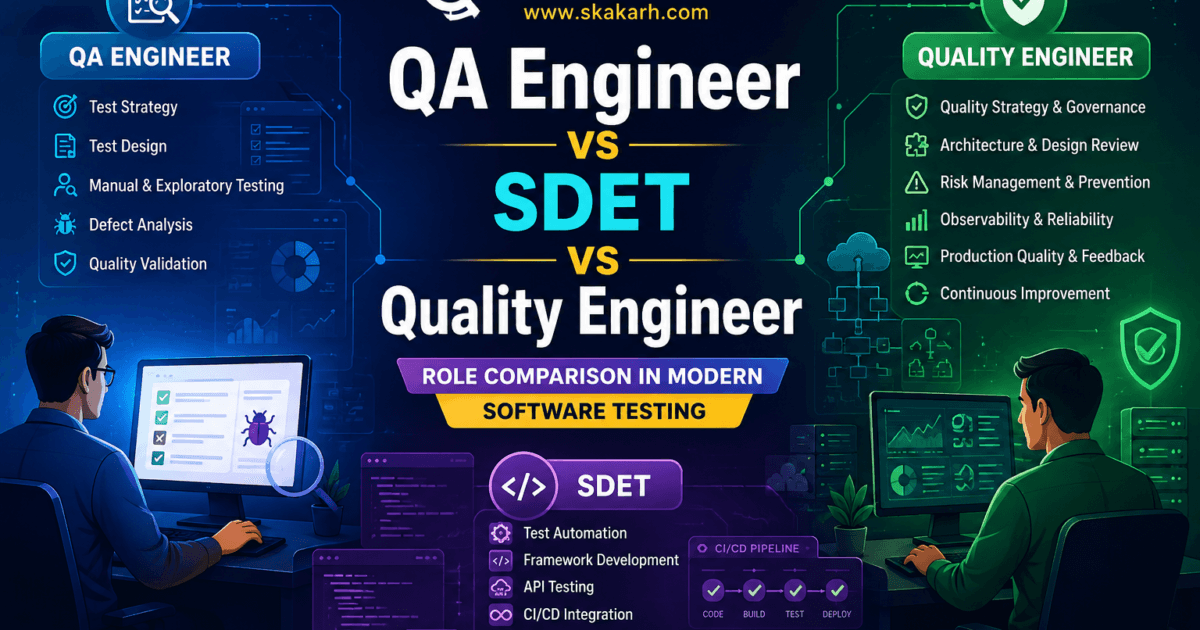
QA Engineer vs SDET vs Quality Engineer is one of those comparisons that looks simple until you examine what each role actually does inside a modern engineering organization. The titles often overlap, companies use them inconsistently, and two engineers with the same job title can have completely different responsibilities.
A QA Engineer might spend most of the day designing tests and automating API workflows. An SDET might build a complete automation framework and contribute production code. A Quality Engineer might work across architecture, CI/CD, observability, reliability, and quality strategy.
The important question is therefore not simply “Which title is better?”
The better question is:
Which engineering responsibilities does each role own, and where does each role create the most quality leverage?
This distinction matters because software quality has moved far beyond executing test cases at the end of development. Modern teams increasingly expect quality professionals to understand programming, automation architecture, APIs, CI/CD, cloud systems, observability, risk, data, and AI-assisted engineering.
QA Engineer vs SDET vs Quality Engineer: The Short Answer
At a high level, the three roles can be understood through their primary engineering emphasis.
| Role | Primary emphasis | Typical strength | Common contribution |
|---|---|---|---|
| QA Engineer | Software testing and quality validation | Test strategy + automation | Designs and implements tests across application layers |
| SDET | Software development for testing | Programming + test infrastructure | Builds automation frameworks, tools, libraries, and quality systems |
| Quality Engineer | Quality across the engineering lifecycle | Prevention + systems thinking | Moves quality earlier and across development, delivery, and production |
| Manual QA Engineer | Human-centered validation | Exploratory and functional testing | Investigates behavior, usability, requirements, and risks |
| Automation Engineer | Automated validation | Automation implementation | Builds and maintains automated test suites and frameworks |
These boundaries are not universal job-title definitions. Organizations frequently use the same title differently.
That is why evaluating the actual responsibilities is more useful than comparing job titles alone.
Why These Roles Became Difficult to Distinguish
Traditional software development often separated responsibilities into something resembling:
Requirements
    ↓
Development
    ↓
Testing
    ↓
Bug Fixing
    ↓
Release
In that model, testing was positioned primarily as a validation activity.
Modern engineering looks more like:
Requirements
     ↓
Risk Analysis
     ↓
Architecture
     ↓
Development
     ↓
Automated Validation
     ↓
CI/CD
     ↓
Deployment
     ↓
Observability
     ↓
Production Feedback
     ↓
Continuous Improvement
Quality is no longer created exclusively by the testing team.
It is influenced by architecture, code design, deployment strategy, observability, data, infrastructure, and product decisions.
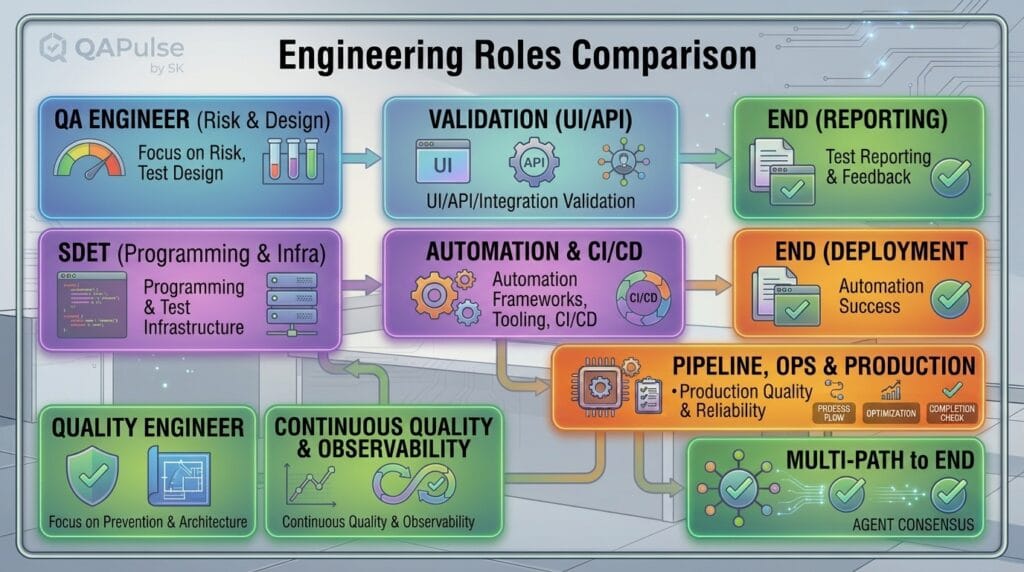
That change explains why the boundaries between QA Engineer, SDET, and Quality Engineer have become increasingly blurred.
What is a QA Engineer?
A QA Engineer is a software quality professional who applies testing knowledge, engineering practices, automation, and risk analysis to determine whether software behaves as expected and whether important quality risks are controlled.
The role can include both manual and automated testing.
A modern QA Engineer may work with:
- Functional testing
- Regression testing
- API testing
- UI automation
- Integration testing
- Database validation
- Mobile testing
- Performance testing
- Accessibility testing
- Risk-based testing
- CI/CD validation
- Defect investigation
- Test reporting
- Quality metrics
The key point is that QA engineering is not synonymous with manually clicking through an application.
Consider a simple login requirement:
User enters valid credentials
        ↓
Authentication service validates credentials
        ↓
Session/token is created
        ↓
User reaches dashboard
A weak testing approach might verify only:
Enter username
Enter password
Click Login
Expected: Dashboard appears
A stronger QA engineering approach asks:
What happens with invalid credentials?
What happens after repeated failures?
What happens when the authentication API is unavailable?
What happens when the token expires?
What happens if the user has no permission?
What happens when the backend returns a 500?
What happens when the network is slow?
What happens on mobile?
What happens when two sessions exist?
That difference demonstrates the engineering mindset.
The goal isn’t simply to increase the number of test cases.
The goal is to identify meaningful product risks and create efficient evidence that those risks are controlled.
What Does an SDET Do?
SDET traditionally means Software Development Engineer in Test.
The title emphasizes the software-development side of quality engineering.
An SDET is typically expected to be comfortable writing production-quality code for:
- Test frameworks
- Automation libraries
- Test utilities
- API clients
- Test data systems
- CI/CD integrations
- Reporting systems
- Test infrastructure
- Mocking and service virtualization
- Developer tooling
For example, an SDET might not simply write a Playwright test.
They might design the framework that allows dozens of engineers to write maintainable Playwright tests.
A simple test might look like:
import { test, expect } from '@playwright/test';

test('user can log in', async ({ page }) => {
  await page.goto('/login');

  await page.getByLabel('Email').fill('user@example.com');
  await page.getByLabel('Password').fill('password');

  await page.getByRole('button', { name: 'Login' }).click();

  await expect(page).toHaveURL(/dashboard/);
});
But an SDET-oriented responsibility might extend far beyond the test itself:
Test
 ↓
Page Object / Component Model
 ↓
Reusable Fixtures
 ↓
Authentication State
 ↓
Test Data Management
 ↓
Parallel Execution
 ↓
Retry Strategy
 ↓
Reporting
 ↓
CI/CD Integration
 ↓
Failure Diagnostics
The SDET therefore asks:
“How can we build a testing system that other engineers can use reliably?”
That is fundamentally different from asking only:
“Did this feature pass its test?”
What Is a Quality Engineer?
A Quality Engineer generally takes a broader systems-level view of quality.
Instead of treating quality as a separate testing phase, the Quality Engineer asks how quality can be engineered throughout the software lifecycle.
That can include:
Requirements
   ↓
Quality Risks
   ↓
Architecture
   ↓
Development Practices
   ↓
Automated Testing
   ↓
CI/CD
   ↓
Deployment
   ↓
Observability
   ↓
Production Reliability
A Quality Engineer may therefore become involved before a feature is implemented.
For example, suppose a team is developing a payment service.
A traditional test-focused question might be:
“How do we test payment processing?”
A broader quality-engineering question is:
“What could make this payment system unsafe, unreliable, difficult to diagnose, or impossible to recover?”
That immediately expands the engineering discussion.
You might investigate:
- Duplicate transactions
- Idempotency
- Timeout behavior
- Payment-provider failures
- Retry logic
- Data consistency
- Auditability
- Security
- Monitoring
- Alerting
- Recovery behavior
- Contract compatibility
- Performance under load
The quality role has moved closer to engineering risk management.
QA Engineer vs SDET vs Quality Engineer: Responsibility Comparison
The most useful comparison is not the job title. It is the type of engineering problem each role is expected to solve.
| Responsibility | QA Engineer | SDET | Quality Engineer |
|---|---|---|---|
| Functional testing | High | Medium–High | High |
| Exploratory testing | High | Medium | High |
| UI automation | High | High | High |
| API automation | High | High | High |
| Test framework development | Medium | Very High | High |
| Programming | Medium–High | Very High | High |
| CI/CD | Medium | High | High |
| Test infrastructure | Medium | Very High | High |
| Risk analysis | High | High | Very High |
| Architecture involvement | Medium | High | Very High |
| Observability | Medium | Medium–High | High |
| Production quality | Medium | Medium | Very High |
| Quality strategy | High | High | Very High |
| Defect prevention | High | High | Very High |
| AI-assisted testing | Increasing | High | High |
| Engineering-wide quality | Medium | High | Very High |
These are practical responsibility patterns, not rigid industry definitions. A company can legitimately expect a QA Engineer to perform many SDET or Quality Engineer responsibilities.
The Biggest Difference: Where You Apply Engineering Leverage
A useful way to understand the three roles is to examine where each one creates leverage.
QA Engineer: Test the Right Things
The QA Engineer tends to optimize for risk coverage.
The central question is:
“What should we test, and what evidence do we need?”
That leads to decisions such as:
Critical user journey
        ↓
Risk identification
        ↓
Test scenarios
        ↓
Automation / manual validation
        ↓
Evidence
SDET: Build the Testing Machine
The SDET tends to optimize for automation scalability.
The central question becomes:
“How can we build reliable systems that allow quality validation to scale?”
For example:
Test requirements
      ↓
Framework architecture
      ↓
Reusable components
      ↓
Parallel execution
      ↓
CI/CD
      ↓
Reports + diagnostics
Quality Engineer: Engineer Quality Into the System
The Quality Engineer tends to optimize for quality across the lifecycle.
The question becomes:
“How can we prevent quality problems instead of discovering all of them after implementation?”
That may produce:
Requirement
   ↓
Risk
   ↓
Architecture
   ↓
Development
   ↓
Testing
   ↓
Deployment
   ↓
Observability
   ↓
Feedback
This is one of the most important distinctions in modern software quality.
A Practical Example: Testing an E-Commerce Checkout
Imagine an e-commerce application introducing a new checkout process.
The three roles might approach the same feature differently.
QA Engineer Perspective
The QA Engineer may design scenarios such as:
Valid card
Invalid card
Expired card
Insufficient funds
Empty cart
Multiple products
Discount code
Shipping address
Failed payment
Successful payment
The emphasis is on behavioral coverage and risk.
SDET Perspective
The SDET may build reusable automation:
Checkout Page Object
Payment API Client
Test Data Factory
Authentication Fixture
Database Utility
Payment Mock
CI Pipeline
Reporting
The emphasis is on automation scalability and maintainability.
Quality Engineer Perspective
The Quality Engineer may additionally investigate:
What happens if payment succeeds but order creation fails?

What happens if the client retries the request?

Can the same transaction be processed twice?

How is payment failure observed?

Can support diagnose the failure?

What happens during provider downtime?

What happens under peak traffic?

Can the system recover safely?
The emphasis is on system-level quality and failure prevention.
This is where the roles begin to overlap—and where their different perspectives become valuable.
Don’t Confuse Automation With Quality Engineering
One of the most common misconceptions in modern testing is:
“If we automate everything, we are doing Quality Engineering.”
We are not.
Automation is a mechanism.
Quality engineering is a discipline and systems approach.
Consider two teams.
| Team A | Team B |
|---|---|
| 2,000 automated tests | 600 automated tests |
| High flaky-test rate | Low flaky-test rate |
| Slow execution | Fast feedback |
| Weak diagnostics | Strong failure evidence |
| No risk prioritization | Risk-based coverage |
| Frequent false failures | Actionable failures |
| Automation added after development | Quality considered throughout SDLC |
Team A has more automation.
Team B may have a stronger quality system.
This is why mature engineering organizations measure more than test count.
Useful metrics can include:
- Defect escape rate
- Flaky-test rate
- Mean time to diagnose failures
- Automation execution time
- Critical-path coverage
- Change failure rate
- Test failure signal quality
- Production incidents
- Recovery time
- Quality risks identified before release
Test Automation as an Engineering Product
A mature automation suite should be treated like an engineering product rather than a collection of scripts.
For example:
Automation Product
│
├── Architecture
├── Coding Standards
├── Test Data
├── Environment Management
├── Execution Strategy
├── Parallelization
├── Reporting
├── Observability
├── CI/CD
├── Maintenance
└── Documentation
This is where SDET thinking becomes particularly valuable.
A framework that works today but becomes impossible to maintain after six months is not a successful automation architecture.
Ask yourself:
Can another engineer understand this framework without asking its original author?
If the answer is no, you have created dependency—not engineering leverage.
Where QA Engineering, SDET, and Quality Engineering Overlap
The three roles should not be viewed as isolated boxes.
A mature organization may expect one person to operate across all three dimensions.
                 QUALITY
                    │
          ┌─────────┼─────────┐
          │         │         │
       Testing   Automation  Prevention
          │         │         │
      QA Engineer   SDET   Quality Engineer
          │         │         │
          └─────────┼─────────┘
                    │
             Engineering System
A senior QA Engineer may develop SDET-level programming skills.
An SDET may become deeply involved in architecture and quality strategy.
A Quality Engineer may build sophisticated automation infrastructure.
The career progression is therefore not always:
QA → SDET → Quality Engineer
It can also look like:
QA Engineer
    ↓
Automation Engineer
    ↓
SDET
    ↓
Senior SDET
    ↓
Quality Engineer
Or:
QA Engineer
    ↓
Senior QA Engineer
    ↓
Quality Engineer
Or:
Software Engineer
    ↓
SDET
    ↓
Quality Engineering
There is no universal ladder.
The more useful career strategy is to increase your engineering scope and quality impact.
A Practical Skill Matrix
If you want to understand where you currently fit, score yourself from 1 to 5.
| Skill | Score |
|---|---|
| Testing fundamentals | 1–5 |
| Exploratory testing | 1–5 |
| Programming | 1–5 |
| UI automation | 1–5 |
| API testing | 1–5 |
| Framework architecture | 1–5 |
| Git | 1–5 |
| CI/CD | 1–5 |
| Containers | 1–5 |
| Database testing | 1–5 |
| Performance testing | 1–5 |
| Observability | 1–5 |
| Cloud fundamentals | 1–5 |
| Security testing | 1–5 |
| System design | 1–5 |
| Risk analysis | 1–5 |
| AI-assisted testing | 1–5 |
Now look at your results.
If your strongest areas are functional testing, exploratory testing, and test design, you may currently be strongest in the traditional QA engineering dimension.
If programming, frameworks, infrastructure, and CI/CD dominate, your profile is closer to an SDET.
If architecture, prevention, reliability, observability, risk, and engineering-wide quality are becoming your strengths, you are moving toward Quality Engineering.
The goal is not to maximize every score simultaneously.
The goal is to identify the capability gap that limits your engineering impact.
Strategic Exercise: Identify Your Current Role
Try this exercise with your current work.
Complete these statements:
I primarily validate…
________________________________
I primarily automate…
________________________________
I primarily build engineering infrastructure for…
________________________________
I influence quality before coding begins by…
________________________________
I use production data or observability to improve testing by…
________________________________
Your answers are often more revealing than your job title.
A person officially called a “QA Engineer” who designs test infrastructure, contributes to architecture, builds CI/CD systems, and analyzes production reliability may already be operating as a Quality Engineer.
Likewise, someone called a “Quality Engineer” whose work is almost entirely writing UI automation may function operationally as an SDET.
The Modern Career Direction
The industry is increasingly rewarding engineers who can connect multiple quality layers.
A useful capability model is:
Testing Fundamentals
        ↓
Programming
        ↓
Automation
        ↓
API + Integration Testing
        ↓
Framework Architecture
        ↓
CI/CD
        ↓
Cloud + Containers
        ↓
Observability
        ↓
System Design
        ↓
AI-Assisted Engineering
        ↓
Quality Strategy
You don’t need to master everything immediately.
But every additional layer allows you to influence a larger portion of the engineering system.
That is the real career advantage.
The Most Important Question to Ask About Any Job Description
When comparing QA Engineer, SDET, and Quality Engineer positions, ignore the title initially.
Look for verbs.
Testing-oriented verbs
- Execute
- Validate
- Verify
- Investigate
- Document
- Design tests
SDET-oriented verbs
- Develop
- Build
- Architect
- Automate
- Integrate
- Framework
- Tooling
Quality Engineering-oriented verbs
- Prevent
- Influence
- Design
- Measure
- Optimize
- Govern
- Observe
- Improve
- Architect
The verbs reveal the expected level of engineering ownership.
Why the Distinction Matters for Your Career
Suppose three job advertisements offer:
Job A
Design test cases, execute regression testing, report defects, and automate critical workflows.
Job B
Develop test frameworks, build automation infrastructure, integrate testing into CI/CD, and create reusable testing tools.
Job C
Define quality strategy, influence architecture, establish continuous testing, improve observability, analyze production risks, and drive quality across engineering.
Even if all three companies use the titles “QA Engineer,” “SDET,” or “Quality Engineer” differently, the responsibilities reveal their real expectations.
This is why experienced engineers should evaluate:
Scope > title
Engineering ownership > title
Technical depth > title
Business impact > title
A Better Mental Model
Instead of thinking:
QA Engineer
      vs
SDET
      vs
Quality Engineer
Think:
                 QUALITY IMPACT
                       ↑
                       │
       Prevention ─────┼───── Detection
                       │
                       │
       System ─────────┼──────── Test
       Thinking        │        Execution
                       │
                       ↓
                 Technical Depth
The strongest modern quality professionals can move across these dimensions depending on the problem.
They can investigate a production incident.
They can design an API test strategy.
They can write automation.
They can debug application code.
They can improve a CI pipeline.
They can identify architectural risk.
They can analyze telemetry.
They can use AI tools responsibly.
And most importantly, they can explain why a particular quality investment matters.
That is much more valuable than simply knowing a particular testing tool.
The Strategic Shift From Tester to Quality Engineer
The biggest career transformation is not learning another automation framework.
It is changing the question you ask.
A traditional testing mindset asks:
“How do I test this feature?”
An automation mindset asks:
“How do I automate this test?”
An SDET mindset asks:
“How do I build a scalable system for testing this class of software?”
A Quality Engineering mindset asks:
“How do we engineer this system so that important quality risks are prevented, detected, measured, and continuously improved?”
Those questions represent increasing levels of engineering scope.
And that is ultimately the most useful way to understand QA Engineer vs SDET vs Quality Engineer.
A Practical Decision Framework
When evaluating your next role or career move, use this framework:
| If you enjoy… | Consider developing toward… |
|---|---|
| Test design and product behavior | QA Engineering |
| Automation and programming | SDET |
| Framework architecture | SDET / Quality Engineering |
| CI/CD and developer tooling | SDET / Quality Engineering |
| Risk and quality strategy | Quality Engineering |
| Architecture and prevention | Quality Engineering |
| Production reliability | Quality Engineering |
| Observability | Quality Engineering |
| AI-assisted engineering | SDET / Quality Engineering |
| Broad engineering ownership | Quality Engineering |
The goal is not to chase whichever title appears most prestigious.
The goal is to build a skill profile that makes you valuable regardless of the title a company chooses to put on the job description.
Where the Three Roles Start to Separate
The clearest way to understand QA Engineer vs SDET vs Quality Engineer is to look at the engineering problem each role is expected to solve.
The titles overlap, but the center of gravity is different.
A QA Engineer commonly focuses on quality validation and risk coverage. An SDET puts greater emphasis on software development, automation infrastructure, and engineering tools for testing. A Quality Engineer usually takes the broadest view, connecting quality with requirements, architecture, development, delivery, observability, and production behavior.
These are tendencies rather than universal definitions. Companies frequently use the same title for different responsibilities.
A practical model looks like this:
QA Engineer
    ↓
"What should we validate?"
    ↓
Risk + Coverage + Evidence


SDET
    ↓
"How can we build scalable validation?"
    ↓
Code + Frameworks + Infrastructure


Quality Engineer
    ↓
"How can we prevent and control quality risks?"
    ↓
Systems + Architecture + Delivery + Production
This distinction becomes especially useful when evaluating job descriptions because the title alone can be misleading.
QA Engineer vs SDET vs Quality Engineer: How the Work Differs
Consider a new customer-profile feature.
The QA Engineer might identify:
- Functional scenarios
- Negative scenarios
- Boundary conditions
- API behavior
- UI workflows
- Data-validation risks
- Regression impact
The SDET might then build:
- API clients
- Page objects
- Test fixtures
- Test-data factories
- Parallel execution
- CI integration
- Reporting and diagnostics
The Quality Engineer might additionally ask:
- What happens if the profile service is unavailable?
- Can inconsistent data reach downstream services?
- How will production failures be detected?
- What telemetry is required?
- Which quality risks should be prevented in the architecture?
- How quickly can the team diagnose a failed transaction?
- What happens when multiple services evolve independently?
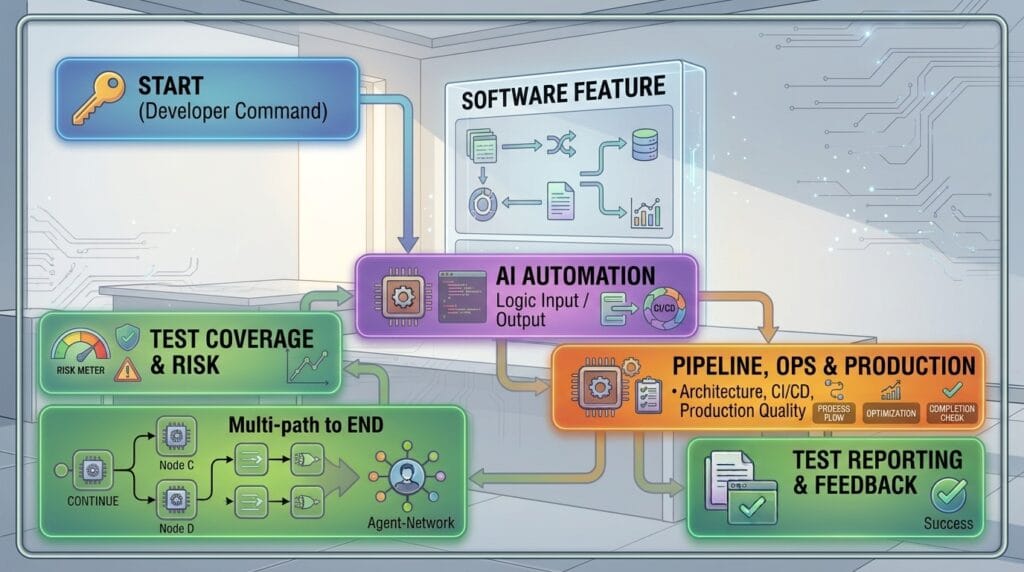
The same feature therefore produces three different engineering perspectives.
QA Engineer Responsibilities in a Modern Engineering Team
A modern QA Engineer is much more than someone who executes a predefined regression checklist.
The role often combines testing knowledge with technical investigation.
For example, an API test might validate more than an HTTP status code:
const response = await request.post('/api/orders', {
  data: {
    productId: 'P100',
    quantity: 2
  }
});

expect(response.status()).toBe(201);

const body = await response.json();

expect(body.orderId).toBeTruthy();
expect(body.status).toBe('created');
expect(body.total).toBeGreaterThan(0);
A stronger validation strategy could also examine:
HTTP status
    +
Response schema
    +
Business rules
    +
Database state
    +
Downstream event
    +
Audit record
This is where QA engineering becomes increasingly technical.
The objective isn’t simply to produce more assertions. It is to establish meaningful evidence that the system behaved correctly.
The QA Engineer’s Core Question
A useful mental model is:
What could go wrong, and what evidence would convince us that the important risks are controlled?
That question naturally leads into risk-based testing, exploratory testing, automation, API validation, integration testing, and production feedback.
SDET Responsibilities: Building the Quality Infrastructure
An SDET typically operates closer to software development than a traditional testing role.
Instead of writing isolated scripts, the SDET may create reusable infrastructure.
For example:
Automation Framework
│
├── Configuration
├── Fixtures
├── Authentication
├── API Clients
├── Page Objects
├── Test Data
├── Mock Services
├── Parallel Execution
├── Reporting
├── Trace Collection
└── CI/CD Integration
The difference is significant.
A test author asks:
“Can I automate this scenario?”
An SDET asks:
“How can the organization automate this class of scenarios reliably?”
That second question introduces engineering concerns such as maintainability, abstraction, execution speed, failure diagnosis, versioning, developer experience, and infrastructure cost.
Example: Framework Thinking
Imagine 400 tests independently implement login:
await page.goto('/login');
await page.fill('#email', email);
await page.fill('#password', password);
await page.click('button[type="submit"]');
A framework-oriented approach might centralize authentication:
await auth.loginAs('standardUser');
Now the underlying implementation can change without requiring hundreds of test files to change.
This is a small example of the engineering leverage expected from an SDET.
Quality Engineer Responsibilities: Expanding the Quality Boundary
Quality Engineering extends the quality boundary beyond the test suite.
Consider an order-processing system:
Web Application
      ↓
Order API
      ↓
Order Service
      ↓
Payment Service
      ↓
Inventory Service
      ↓
Message Broker
      ↓
Database
A test-focused approach might validate the expected successful workflow.
A Quality Engineer asks what happens when the system behaves unexpectedly.
Payment succeeds
      ↓
Order creation fails
      ↓
What happens to the payment?

Inventory update fails
      ↓
What state is the order left in?

Message delivery is delayed
      ↓
Can the system recover?

Database becomes unavailable
      ↓
Does the application fail safely?
These questions move beyond test execution.
They concern system behavior, failure modes, recoverability, observability, and architectural risk.
That is where the Quality Engineer role becomes strategically different.
A Side-by-Side Engineering Comparison
| Area | QA Engineer | SDET | Quality Engineer |
|---|---|---|---|
| Test strategy | Strong | Strong | Very strong |
| Test implementation | Strong | Very strong | Strong |
| Programming | Moderate–strong | Very strong | Strong |
| Automation | Strong | Very strong | Strong |
| Framework architecture | Moderate–strong | Very strong | Very strong |
| API testing | Strong | Very strong | Strong |
| CI/CD | Moderate | Very strong | Strong |
| Test infrastructure | Moderate | Very strong | Strong |
| Risk analysis | Strong | Strong | Very strong |
| Architecture | Moderate | Strong | Very strong |
| Observability | Developing–strong | Strong | Very strong |
| Production feedback | Moderate | Moderate–strong | Very strong |
| Quality strategy | Strong | Strong | Very strong |
| Prevention | Strong | Strong | Very strong |
| Developer tooling | Moderate | Very strong | Strong |
| System thinking | Strong | Strong | Very strong |
The important insight is that these aren’t three completely separate professions.
They are overlapping capability profiles.
A senior engineer can legitimately demonstrate characteristics of all three.
QA Engineer vs SDET: The Most Common Confusion
The distinction between QA Engineer and SDET is particularly blurry.
Both may:
- Write automated tests
- Review requirements
- Perform API testing
- Debug failures
- Work with CI/CD
- Write production-quality code
- Maintain test frameworks
The difference is usually emphasis.
A QA Engineer may spend more time deciding what needs validation and analyzing product risk.
An SDET may spend more time engineering the infrastructure that makes automated validation scalable.
For example:
QA Engineer:
Requirement
    ↓
Risk
    ↓
Test strategy
    ↓
Coverage


SDET:
Test strategy
    ↓
Automation architecture
    ↓
Framework
    ↓
Execution
    ↓
Diagnostics
In a mature team, both perspectives are valuable.
SDET vs Quality Engineer
The SDET and Quality Engineer often overlap even more.
An experienced SDET might already:
- Design test architecture
- Build CI/CD systems
- Create internal tooling
- Work with service virtualization
- Improve observability
- Analyze production failures
- Influence development practices
At that point, the engineer is already performing many Quality Engineering activities.
The distinction is primarily one of scope.
SDET work often centers around engineering systems for testing and quality validation.
Quality Engineering can extend that responsibility into the broader software lifecycle.
A useful progression is:
Test
 ↓
Automate
 ↓
Engineer the automation
 ↓
Integrate quality into delivery
 ↓
Prevent quality risks
 ↓
Measure quality in production
The farther right you move, the broader the engineering scope becomes.
Quality Engineering Is Not “More Automation”
This distinction is critical.
A company can have thousands of automated tests and still have poor quality engineering.
Consider this situation:
2,500 automated tests
       ↓
45-minute execution
       ↓
18% flaky failures
       ↓
Poor error diagnostics
       ↓
Developers ignore failures
The organization has automation.
But it does not necessarily have an effective quality system.
Now consider:
700 high-value tests
       ↓
8-minute execution
       ↓
Low flakiness
       ↓
Trace + logs + screenshots
       ↓
CI quality gates
       ↓
Actionable failures
The second system may provide substantially more engineering value.
Quality is about the signal produced by the system, not the number of scripts stored in a repository.
The Test Pyramid Still Matters
A strong engineering organization also considers where validation should occur.
             UI Tests
            /        \
           /          \
       API / Integration
         /              \
        /                \
       Unit / Component Tests
UI tests are valuable, but they are generally more expensive and slower than lower-level checks.
That means a mature strategy might place more validation closer to the code and service boundaries while reserving UI automation for important end-to-end behavior.
The QA Engineer may identify the required coverage.
The SDET may build the automation architecture.
The Quality Engineer may challenge whether the overall distribution provides sufficient risk coverage and feedback speed.
What Happens When the Three Roles Work Together?
The strongest engineering teams don’t necessarily force these responsibilities into isolated silos.
Imagine a critical checkout feature.
QA Engineer
Identifies:
Functional risks
Boundary cases
Negative scenarios
User journeys
Business rules
Regression impact
SDET
Builds:
API automation
UI automation
Fixtures
Test data
Parallel execution
CI pipeline
Diagnostics
Quality Engineer
Adds:
Failure-mode analysis
Architecture risks
Observability
Production signals
Reliability considerations
Quality gates
Prevention strategies
Together:
Risk
 ↓
Test Strategy
 ↓
Automation
 ↓
CI/CD
 ↓
Production Feedback
 ↓
Continuous Improvement
That is significantly stronger than asking one role to “own testing.”
How AI Is Changing These Roles
AI is adding another layer to this evolution.
AI-assisted tools can increasingly help engineers:
- Generate test cases
- Generate test code
- Create test data
- Analyze failures
- Summarize logs
- Suggest edge cases
- Identify coverage gaps
- Explain stack traces
- Generate API assertions
- Refactor repetitive automation
But generated code doesn’t eliminate engineering responsibility.
Consider an AI-generated test:
test('checkout works', async ({ page }) => {
  await page.goto('/checkout');
  await page.click('text=Pay');
  await expect(page.locator('.success')).toBeVisible();
});
The critical engineering questions remain:
What payment state is being tested?

Was the transaction actually created?

What if payment succeeds but the UI fails?

What happens after a timeout?

What happens with duplicate requests?

What evidence proves the transaction is correct?
AI can accelerate implementation.
It does not automatically provide risk judgment.
This is why the future of these roles is increasingly about combining engineering judgment with AI-assisted execution.
Skills That Differentiate the Three Roles
If you’re planning your career, don’t build your learning roadmap around job titles alone.
Build it around capabilities.
Foundation
Testing Fundamentals
Requirements Analysis
Risk-Based Testing
Defect Investigation
Automation
Programming
UI Automation
API Automation
Test Data
Framework Design
Engineering
Git
CI/CD
Containers
Databases
Cloud
Distributed Systems
Quality Engineering
Architecture
Observability
Reliability
Performance
Security
Production Feedback
Quality Strategy
AI
AI-Assisted Test Creation
LLM Evaluation
Agentic Testing
Failure Analysis
AI Test Orchestration
Human Oversight
The strongest career profile increasingly spans multiple layers rather than relying on one tool.
How to Decide Which Role Fits You
Ask yourself five questions.
1. Do you enjoy understanding product behavior?
If yes, strengthen your QA engineering capabilities.
2. Do you enjoy writing software that enables other engineers?
If yes, deepen your SDET capabilities.
3. Do you enjoy solving system-level quality problems?
If yes, move toward Quality Engineering.
4. Do you enjoy preventing failures rather than only detecting them?
That is a strong Quality Engineering signal.
5. Do you enjoy building reusable engineering systems?
That is a strong SDET signal.
Most experienced engineers will answer “yes” to several of these.
That’s normal.
The modern career path is becoming less about choosing one box and more about expanding your engineering range.
Job Titles Should Not Define Your Technical Identity
A common career mistake is becoming overly attached to a title.
One organization might call you:
QA Engineer
Another might call the same responsibilities:
SDET
Another might use:
Quality Engineer
And another might use:
Automation Engineer
The title changes.
Your capability doesn’t.
When evaluating opportunities, compare:
Responsibilities
+
Technical Scope
+
Engineering Ownership
+
Decision-Making Authority
+
Learning Opportunity
+
Business Impact
Those factors tell you considerably more than the title.
A Practical Career Map
A useful progression for someone starting in software testing might look like:
QA Fundamentals
       ↓
Programming
       ↓
Automation
       ↓
API + Integration Testing
       ↓
Framework Engineering
       ↓
CI/CD
       ↓
Cloud + Containers
       ↓
Observability
       ↓
System Design
       ↓
Quality Engineering
       ↓
AI-Driven Quality Engineering
This isn’t a mandatory career ladder.
Someone can enter from software development, DevOps, performance engineering, or another technical discipline.
The important principle is increasing scope.
Build Evidence, Not Just Skills
If you want employers to recognize the difference between these roles, don’t merely list technologies on your résumé.
Demonstrate engineering outcomes.
Instead of:
Playwright, Selenium, API Testing, Jenkins
Show:
Built a Playwright automation framework
with reusable fixtures, API setup, parallel
execution, trace diagnostics, and CI integration.
Instead of:
API Automation
Show:
Designed contract and API validation covering
critical service boundaries and negative scenarios.
Instead of:
CI/CD
Show:
Integrated automated quality gates into CI,
reducing feedback time and preventing unstable
builds from progressing through the pipeline.
This evidence demonstrates Experience and Expertise far more convincingly than a paragraph claiming expertise.
The Engineering Signal That Matters Most
When comparing QA Engineer vs SDET vs Quality Engineer, the strongest differentiator is ultimately not the tool stack.
It is the level of ownership.
Level 1
"I execute tests."

        ↓

Level 2
"I automate tests."

        ↓

Level 3
"I build automation systems."

        ↓

Level 4
"I engineer quality into delivery."

        ↓

Level 5
"I influence the system so important
quality risks are prevented, detected,
measured, and continuously improved."
This is why experienced QA professionals should think beyond the traditional definition of testing.
The career opportunity is not simply to become better at executing more tests.
It is to become better at engineering reliable quality systems.
A Simple Decision Matrix
| If your strongest interest is… | Your capability direction |
|---|---|
| Product behavior | QA Engineering |
| Exploratory testing | QA Engineering |
| Risk analysis | QA / Quality Engineering |
| Programming | SDET |
| Automation frameworks | SDET |
| Test infrastructure | SDET |
| CI/CD tooling | SDET / Quality Engineering |
| Architecture | Quality Engineering |
| Prevention | Quality Engineering |
| Reliability | Quality Engineering |
| Observability | Quality Engineering |
| Production quality | Quality Engineering |
| AI-assisted testing | SDET / Quality Engineering |
Think of these as capability directions, not permanent labels.
This can be the flow:
QA Engineer → Testing → Risk → Validation → Automation
SDET → Programming → Automation → Frameworks → CI/CD → Test Infrastructure
Quality Engineer → Prevention → Architecture → CI/CD → Observability → Reliability → Production Quality
Internal Blog Links
- 50 Playwright Commands Every QA Engineer Should Know
- What is QA Engineering? A Practical Guide to Modern Software Quality
- What is Playwright? A Powerful Guide to Modern Web Testing and QA Engineers
- QA Engineer Portfolio: 7 Powerful Projects That Get Interviews in 2026
- Graph Engineering: The Powerful Layer After Loop Engineering
- Graph Testing: The Critical QA Layer After Loop-Based Test Automation
- Agentic Test Creation vs AI Test Generation: What’s the Real Difference?
- AI Test Automation With Humans in the Loop: Governance, Metrics, and the Practical Guide
Internal Series Links
- Learn MCP – Zero to Hero
- Learn AI Agents for QA – Zero to Hero
- Playwright Automation – Zero to Hero
- TencentDB Agent Memory: Complete Zero to Hero
- LangGraph: Complete Zero to Hero
- Learn Python – Zero to Hero
- OpenAI Codex: Complete Zero to Hero
- Cursor AI: Complete Zero to Hero
- Claude Code Tutorial: Complete Zero to Hero
- AutoGen: Complete Zero to Hero Guide
- Free QA Resources Built From Real Experience
- QA Glossary: Test Automation Terms Every Engineer Should Know
External Links
- Official Playwright Documentation: Playwright documentation
- Git documentation — Git documentation
- GitHub Actions documentation — GitHub Actions documentation
- OpenTelemetry documentation — OpenTelemetry documentation
- Google Search Central — Google Search Essentials
People Asked Questions
What is the difference between a QA Engineer and an SDET?
A QA Engineer generally focuses on testing strategy, validation, risk analysis, and product quality. An SDET typically combines those responsibilities with stronger software-development skills and builds automation frameworks, tooling, and test infrastructure.
Is an SDET higher than a QA Engineer?
Not necessarily. They are different role profiles rather than universal levels in a hierarchy. Some companies use SDET for highly technical QA positions, while others use QA Engineer for essentially the same responsibilities.
What is the difference between an SDET and a Quality Engineer?
An SDET commonly focuses on software engineering for testing, including automation frameworks, tooling, CI/CD, and test infrastructure. A Quality Engineer can have a broader scope involving prevention, architecture, reliability, observability, delivery, and production quality.
Which role requires more coding: QA Engineer or SDET?
SDET roles typically have a stronger coding requirement because the engineer is expected to build and maintain automation frameworks, tooling, infrastructure, and supporting software.
Can a QA Engineer become an SDET?
Yes. A practical transition path includes learning programming, API testing, automation frameworks, Git, CI/CD, databases, test architecture, and software-engineering practices.
Is Quality Engineering replacing QA?
Quality Engineering is not simply a replacement for QA. It represents a broader approach in which quality responsibilities extend beyond testing into prevention, architecture, development, delivery, observability, and production feedback.
Which role is best for a career in AI testing?
All three can lead toward AI testing, but SDET and Quality Engineering paths can provide particularly strong foundations because AI testing increasingly involves automation, programming, evaluation frameworks, orchestration, data, and system-level quality controls.
What skills should a modern QA Engineer learn?
A modern QA Engineer can benefit from programming, API testing, UI automation, CI/CD, databases, cloud technologies, observability, performance testing, system thinking, and AI-assisted testing.
What skills does a Quality Engineer need?
A Quality Engineer benefits from testing expertise combined with software engineering, architecture, CI/CD, observability, reliability, automation, risk management, and production-quality practices.
Should I focus on a job title or skills?
Skills and engineering ownership are generally more valuable than the title itself because organizations define QA Engineer, SDET, and Quality Engineer differently. Evaluate the actual responsibilities, technical scope, decision-making, and growth opportunities.
AEO Optimization
What is the difference between a QA Engineer, SDET, and Quality Engineer?
A QA Engineer typically focuses on software quality validation, testing strategy, risk analysis, and product behavior. An SDET combines testing expertise with software development to build automation frameworks, test infrastructure, and engineering tools. A Quality Engineer generally has a broader scope, extending quality practices into architecture, CI/CD, observability, reliability, prevention, and production systems.
| Question | Short Answer |
|---|---|
| What does a QA Engineer do? | Validates software quality through testing, risk analysis, and test strategy. |
| What does an SDET do? | Builds software and automation infrastructure for scalable testing. |
| What does a Quality Engineer do? | Engineers quality across development, delivery, architecture, and production. |
| Is an SDET a QA Engineer? | An SDET can perform QA responsibilities but usually has deeper software-engineering ownership. |
| Is Quality Engineering the same as QA? | No. Quality Engineering generally expands quality responsibility beyond testing into prevention and the wider engineering lifecycle. |
| Which role requires more coding? | SDET roles typically have the strongest programming and automation emphasis. |
| Which role has the broadest scope? | Quality Engineering often has the broadest system-level quality scope. |
| Can a QA Engineer become an SDET? | Yes. Programming, automation architecture, APIs, CI/CD, and software-engineering skills are common transition areas. |
AI Overview Optimization
QA Engineer vs SDET vs Quality Engineer — in one sentence: A QA Engineer primarily validates and manages software quality risks, an SDET engineers scalable automated testing systems, while a Quality Engineer applies quality engineering across the broader software lifecycle.
Conclusion
The real difference in QA Engineer vs SDET vs Quality Engineer is not that one role tests, another automates, and another manages quality.
The boundaries are much more nuanced.
A QA Engineer typically brings strong expertise in risk, test strategy, validation, and product behavior.
An SDET adds deeper expertise in software development, automation architecture, frameworks, infrastructure, and tooling.
A Quality Engineer expands the perspective toward prevention, architecture, continuous delivery, observability, reliability, and quality across the entire engineering lifecycle.
The three roles overlap—and that overlap is becoming increasingly important.
A strong QA Engineer can write software.
A strong SDET understands product risk.
A strong Quality Engineer can design automation.
The strongest modern quality professionals combine all three perspectives when the problem demands it.
The career strategy, therefore, should not be:
“Which title should I get?”
It should be:
“How much of the software quality system can I understand, influence, automate, and improve?”
That is the capability that remains valuable even when companies change their job titles.
Final Key Takeaways
- QA Engineer vs SDET vs Quality Engineer is primarily a comparison of responsibilities and engineering scope, not fixed industry definitions.
- QA Engineers commonly emphasize testing strategy, risk analysis, validation, and product behavior.
- SDETs commonly emphasize programming, automation architecture, frameworks, tooling, and test infrastructure.
- Quality Engineers commonly operate across prevention, architecture, CI/CD, observability, reliability, and production quality.
- Automation alone does not equal Quality Engineering.
- The number of automated tests is less important than the quality of the feedback they produce.
- AI can accelerate test creation and analysis, but human engineering judgment remains essential.
- Job titles vary significantly between companies, so evaluate responsibilities rather than titles.
- Career growth comes from expanding engineering scope, technical depth, and quality ownership.
- The strongest modern quality professionals can move between testing, automation, engineering, and system-level quality thinking.
Continue Learning
Explore more expert articles on Mobile Testing, Backend & API, AI & Agentic, AI Tools, n8n, LangChain, CrewAI, MCP Servers, AI Agents, LlamaIndex, Docker, FastAPI, Playwright, Cypress, Test Automation, DevOps, and Software Engineering at www.skakarh.com.
QAPulse by SK delivers expert release analysis, AI engineering insights, enterprise automation strategies, migration guidance, DevOps best practices, and practical testing knowledge to help software professionals build scalable, intelligent, and production-ready software systems.