 QA
QA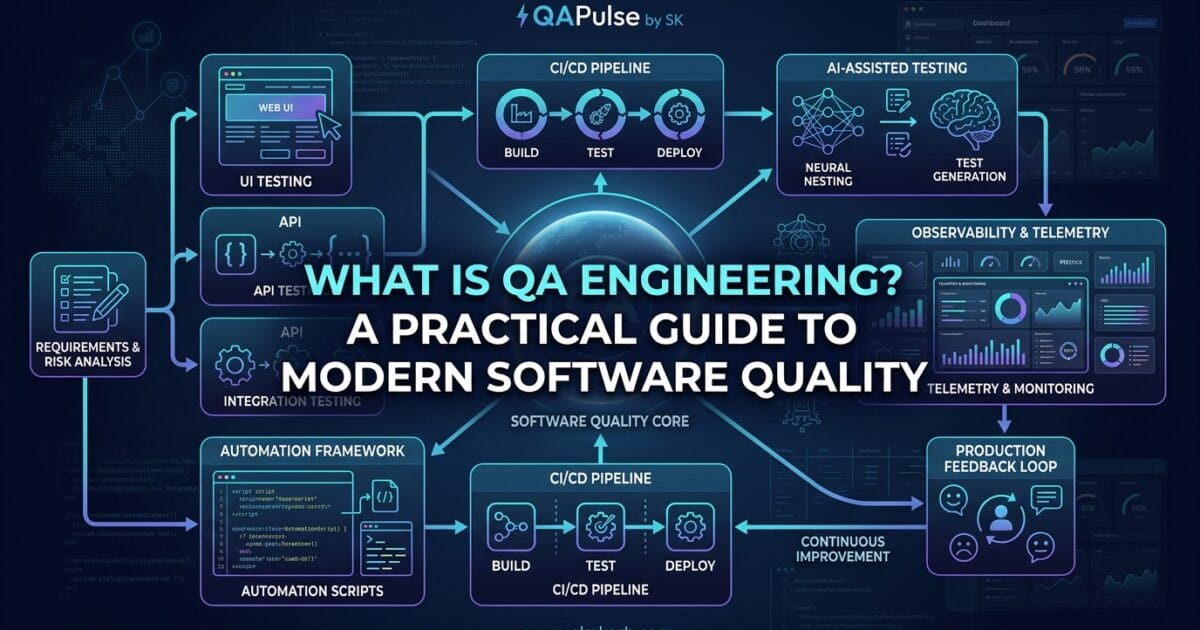
What is QA engineering? It is an engineering approach to software quality that combines testing, automation, risk analysis, software development practices, CI/CD, observability, and continuous feedback to prevent defects and improve how software behaves in real-world conditions.
That definition is important because modern QA engineering is not simply a renamed version of manual testing. A QA engineer is increasingly expected to understand how software is designed, where quality risks originate, how those risks can be detected automatically, and how testing can become part of the engineering lifecycle rather than an activity performed only after development is complete.
For teams building continuously delivered software, quality cannot depend on a final testing phase. A feature may pass functional tests and still fail because of an unstable integration, incorrect API contract, slow database query, browser-specific behavior, poor observability, or an automation suite that produces unreliable results.
That is where what is QA engineering becomes a useful question rather than just a definition to memorize.
What is QA Engineering?
QA engineering is the practice of applying engineering principles to software quality across the development lifecycle.
Instead of asking only:
“Does this feature work?”
a QA engineer asks:
- What could fail?
- Where could it fail?
- How would we detect the failure?
- Can the risk be tested automatically?
- Can the system make failures observable?
- What should be tested at the unit, API, integration, UI, and system levels?
- How quickly can the team receive trustworthy feedback?
- Can the test system scale with the product?
This changes the role of testing from defect detection at the end to quality engineering throughout delivery.
                 WHAT IS QA ENGINEERING?
                          │
        ┌─────────────────┼─────────────────┐
        ↓                 ↓                 ↓
   Test Automation    API Testing       UI Testing
        │                 │                 │
        ↓                 ↓                 ↓
   Playwright         API Assertions    Stable Tests
        │
        ↓
   CI/CD Testing
        │
        ↓
   AI Test Automation
        │
        ↓
   Agentic Testing
        │
        ↓
   Graph Testing
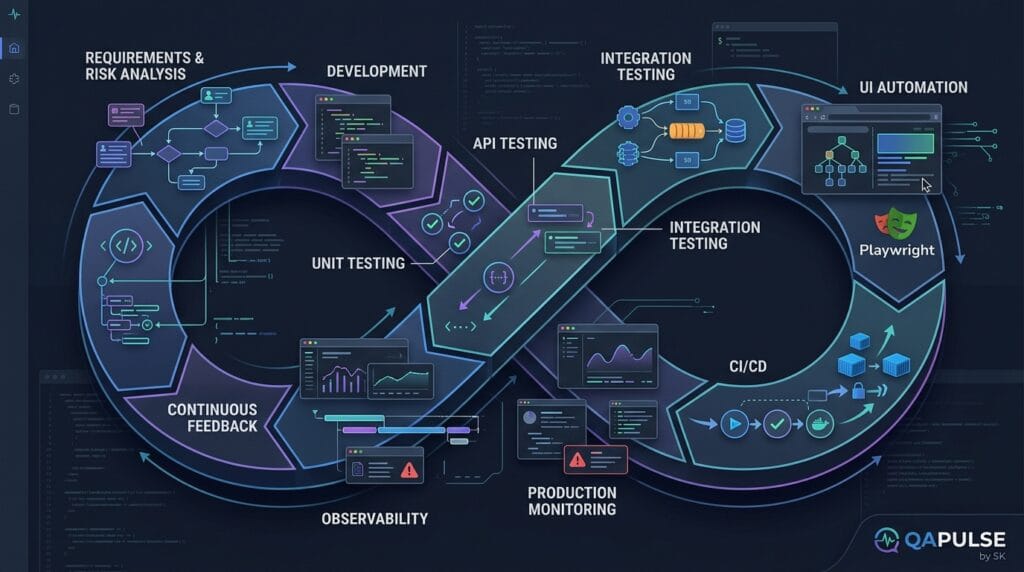
A useful mental model is:
Requirements
     ↓
Risk Analysis
     ↓
Test Strategy
     ↓
Development
     ↓
Unit + API + Integration + UI Testing
     ↓
CI/CD Validation
     ↓
Production Observability
     ↓
Feedback
     ↺
Continuous Improvement
The important word here is engineering.
A QA engineer does not merely execute predefined checks. The role involves designing systems that provide reliable evidence about software quality.
QA Engineering Is Broader Than Test Execution
Traditional testing activities often begin with a requirement and end with a test result.
QA engineering looks at the complete quality feedback loop.
| Traditional Testing Focus | QA Engineering Focus |
|---|---|
| Execute test cases | Engineer a quality strategy |
| Find defects | Prevent and detect risks |
| Test after development | Test throughout delivery |
| Manual regression | Risk-based automation |
| UI-heavy validation | Balanced testing layers |
| Test execution | Test infrastructure |
| Pass/fail results | Actionable engineering evidence |
| Test environment | Environment reliability |
| Defect reports | Root-cause feedback |
| End-of-cycle testing | Continuous quality |
This does not mean manual testing is obsolete. Exploratory testing, usability analysis, domain reasoning, and human judgment remain valuable.
The difference is that QA engineering combines those activities with engineering practices.
Why QA Engineering Matters in Modern Software Development
Software delivery has changed dramatically.
A team may deploy multiple times per day. Applications may depend on dozens of services, external APIs, databases, message queues, cloud infrastructure, feature flags, authentication providers, and third-party integrations.
A simple UI test cannot provide enough evidence about such a system.
Consider an e-commerce checkout.
A user clicks Pay.
The browser sends a request.
The application validates the order.
The payment service processes the transaction.
An inventory service reserves the product.
A database records the order.
A message is published.
An email service sends confirmation.
A monitoring system records telemetry.
A failure at any point can affect the customer’s experience.
A QA engineer therefore needs to think beyond the button.
User
  ↓
Web UI
  ↓
Application API
  ↓
Payment Service
  ↓
Inventory Service
  ↓
Database
  ↓
Message Broker
  ↓
Notification Service
  ↓
Observability
Testing only the UI might confirm that the button can be clicked.
QA engineering asks whether the entire behavior is trustworthy.
That distinction becomes increasingly important as systems become distributed.
QA Engineering vs Software Testing
These terms are related, but they are not interchangeable.
Software testing is a discipline within the broader quality engineering approach.
Think about it this way:
                 QA Engineering
                       │
       ┌───────────────┼────────────────┐
       ↓               ↓                ↓
    Testing        Prevention       Feedback
       │               │                │
   UI / API       Design quality    Observability
   Integration    Code quality      Production data
   Performance    Risk analysis     Defect trends
   Security       Standards         Reliability
Testing answers:
“Can we find evidence that this behavior is correct or incorrect?”
QA engineering additionally asks:
“How do we design the development and delivery system so that quality risks are identified earlier and feedback remains trustworthy?”
That is why a mature QA engineering function often touches architecture, CI/CD, test infrastructure, monitoring, release strategy, and developer workflows.
QA Engineer vs SDET vs Quality Engineer
Job titles can be confusing because companies use them differently.
A QA Engineer may focus heavily on testing and automation.
An SDET generally combines software development skills with test engineering.
A Quality Engineer often operates more broadly across the software lifecycle and quality strategy.
| Role | Typical Focus | Engineering Depth | Automation | Quality Strategy |
|---|---|---|---|---|
| QA Engineer | Testing + automation | High | High | Medium–High |
| SDET | Test software + automation infrastructure | Very High | Very High | High |
| Quality Engineer | End-to-end product quality | Very High | High | Very High |
| Manual Tester | Functional/exploratory testing | Variable | Low | Medium |
These are not strict industry standards. Organizations define these roles differently.
The useful distinction is the scope of responsibility, not the job title.
An engineer who owns only UI scripts may be doing valuable automation work, but an engineer who also designs test architecture, integrates quality checks into CI/CD, analyzes production failures, and improves feedback loops is operating at a broader quality-engineering level.
The Core Principles of QA Engineering
Several principles consistently appear in mature QA engineering practices.
Quality Starts Before Testing
Testing should not be the first activity where quality is discussed.
During requirement analysis, QA engineers should identify ambiguity, missing acceptance criteria, risky workflows, integration dependencies, and edge cases.
For example, consider:
“Users can reset their password.”
That requirement is incomplete from a quality perspective.
A QA engineer should immediately consider:
- What happens with an expired reset link?
- Can a reset token be reused?
- How long is the token valid?
- What happens if the email does not arrive?
- Can another user access the reset flow?
- What happens after multiple failed attempts?
- Is the old password immediately invalidated?
- What happens when the account is locked?
- Can the workflow be automated reliably?
The earlier these questions appear, the cheaper it is to resolve quality risks.
Automation Should Produce Trustworthy Evidence
Automation is not valuable simply because it executes quickly.
A 20,000-test suite that frequently produces false failures can be less valuable than a smaller suite that consistently provides reliable feedback.
A useful automation equation is:
Automation Value
=
Coverage
×
Reliability
×
Feedback Speed
×
Maintainability
If reliability approaches zero, the practical value of the automation system also approaches zero.
This is why stable test architecture matters.
A QA engineer should monitor:
- failure rate
- flaky-test rate
- execution duration
- retry frequency
- defect detection rate
- environment failures
- test maintenance effort
Those measurements turn automation from a collection of scripts into an engineering system.
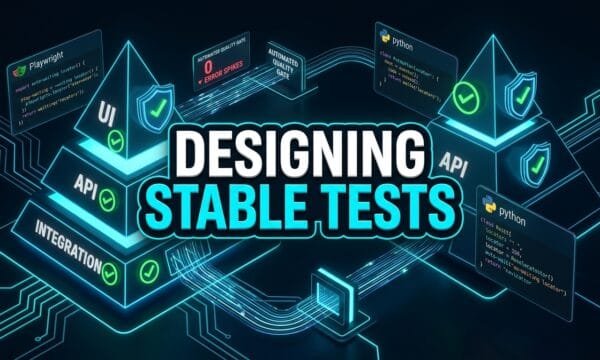
The Test Pyramid Still Matters
A mature QA engineering strategy does not automatically mean “automate everything through the UI.”
Different test layers provide different types of feedback.
              /\
             /UI\
            /----\
           / API  \
          /--------\
         /Integration\
        /--------------\
       /     Unit       \
      /------------------\
Unit tests are generally fast and provide focused feedback.
API tests can validate application behavior without the overhead of a browser.
Integration tests validate interactions between components.
UI tests validate critical user workflows from the outside.
The goal is not to maximize the number of UI tests.
The goal is to place each check at the most effective testing layer.
For example:
| Requirement | Appropriate Layer |
|---|---|
| Tax calculation | Unit |
| Authentication API behavior | API |
| Payment service integration | Integration |
| Complete checkout journey | UI |
| Response under heavy traffic | Performance |
| Accessibility behavior | UI/accessibility |
| Security authorization rules | API + security testing |
This layered approach makes automation faster, cheaper, and easier to maintain.
A Practical QA Engineering Example
Imagine an online banking application.
A traditional approach might create UI tests for:
Login
Transfer Money
Logout
A QA engineering approach breaks the behavior into risk layers.
                 Banking Transfer
                        │
       ┌────────────────┼────────────────┐
       ↓                ↓                ↓
   Unit Logic        API Layer       UI Workflow
       │                │                │
 Amount rules       Authentication     Login
 Balance rules      Authorization      Transfer
 Fee calculation    Validation         Confirmation
Then add:
Integration
    ↓
Database
    ↓
Payment / Banking Service
    ↓
Observability
This creates a much stronger quality signal than simply adding more UI scripts.
Where Playwright Fits Into QA Engineering
Tools are important, but tools are not the definition of QA engineering.
For example, Playwright can provide browser automation and end-to-end testing capabilities.
A simple test might look like:
import { test, expect } from '@playwright/test';

test('user can complete checkout', async ({ page }) => {
  await page.goto('/checkout');

  await page.getByLabel('Email').fill('customer@example.com');
  await page.getByRole('button', { name: 'Place order' }).click();

  await expect(
    page.getByText('Order confirmed')
  ).toBeVisible();
});
The code is useful, but the engineering decisions around it matter more.
A mature implementation should consider:
- locator strategy
- test isolation
- test data
- authentication
- environment configuration
- retries
- parallel execution
- reporting
- CI/CD
- failure diagnostics
- ownership
- maintenance
That is the difference between writing an automated test and engineering a test system.
QA Engineering vs Test Automation
Test automation is an important capability inside QA engineering, but the two should not be treated as synonyms.
| Test Automation | QA Engineering |
|---|---|
| Automates checks | Engineers the quality system |
| Focuses on execution | Focuses on risk and feedback |
| Often tool-centered | Product and system-centered |
| Test scripts | Architecture + infrastructure |
| Execution results | Quality evidence |
| Regression automation | Continuous quality strategy |
| Mostly pre-release | Development through production |
A strong QA engineer should understand automation.
A strong automation engineer should understand quality.
The next level is being able to connect both.
What Skills Does a QA Engineer Need?
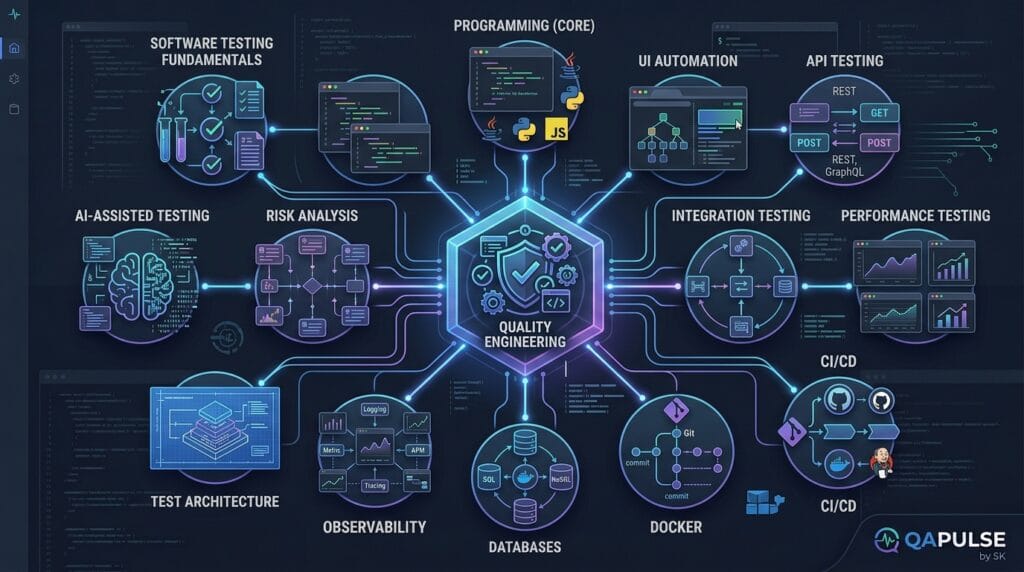
Modern QA engineering requires a combination of testing knowledge, programming, systems thinking, and communication.
Testing Skills
A foundation should include:
- test design
- exploratory testing
- boundary-value analysis
- equivalence partitioning
- risk-based testing
- regression strategy
- integration testing
- API testing
- UI testing
- performance testing
Programming Skills
Automation requires more than knowing how to record actions.
Engineers should understand:
Variables
Conditions
Functions
Objects
Modules
Exceptions
Data structures
Async programming
Version control
The specific language depends on the ecosystem.
Engineering Skills
Modern QA engineers increasingly need:
- Git
- CI/CD
- Docker
- APIs
- databases
- HTTP
- authentication
- cloud environments
- logging
- observability
- test architecture
Analytical Skills
This is often underestimated.
A good QA engineer should be able to look at a failure and ask:
“What evidence do I have?”
rather than:
“Which line of the test failed?”
For example:
Test failed
     ↓
Is application behavior incorrect?
     ↓
Was test data valid?
     ↓
Was environment healthy?
     ↓
Did dependency respond correctly?
     ↓
Did the locator change?
     ↓
Is the test flaky?
     ↓
What evidence confirms the root cause?
That mindset separates debugging from simply rerunning a test.
The Strategic Shift From Tester to Quality Engineer
The biggest career shift is not learning another automation tool.
It is changing how you think about quality.
A traditional mindset asks:
“What test cases should I execute?”
An engineering mindset asks:
“What are the highest risks, where can they occur, and what is the fastest reliable way to obtain evidence?”
That leads to better decisions.
Suppose a product has 500 automated UI tests and only five critical payment workflows.
Adding another 100 low-risk UI tests may provide less value than building:
- API coverage for payment failures
- contract validation
- integration tests
- payment observability
- reliable test data
- production monitoring
- risk-based UI coverage
This is why test count is a poor standalone measure of quality.
A Simple QA Engineering Maturity Model
You can evaluate an organization using five levels.
| Level | Characteristics |
|---|---|
| Level 1 — Reactive | Testing mainly happens after development |
| Level 2 — Automated | Regression automation exists |
| Level 3 — Integrated | Testing is integrated into CI/CD |
| Level 4 — Engineering | Quality is designed across the lifecycle |
| Level 5 — Intelligent | Quality uses analytics, AI, observability, and continuous feedback |
The goal is not necessarily to jump immediately to Level 5.
A team with unreliable tests should first improve test stability.
A team with stable automation but slow feedback should improve CI/CD.
A team with strong automation should improve observability and risk analysis.
Maturity is evolutionary.
A Practical Self-Assessment
If you work in QA or SDET, ask yourself:
Can I explain why each important test exists?
Can I identify which risks are not covered?
Can I debug a failed automation test without immediately rerunning it?
Can I design API tests instead of relying entirely on UI automation?
Can I integrate tests into CI/CD?
Can I distinguish an application failure from an environment failure?
Can I explain the trade-offs of different testing layers?
Can I measure whether an automation suite is actually valuable?
If several answers are “no,” that does not indicate failure. It gives you a practical learning roadmap.
The most valuable QA engineers are not necessarily the people who know the largest number of testing tools.
They are the engineers who understand why a particular quality technique should exist, where it belongs, what evidence it produces, and how that evidence influences software delivery.
That is the foundation of modern QA engineering.
How QA Engineering Works Across the Software Development Lifecycle
QA engineering becomes most valuable when it is integrated into the entire software development lifecycle rather than positioned as a final verification activity.
A useful way to understand what is QA engineering in practice is to follow the movement of a feature from an idea to production.
Requirement
    ↓
Risk Analysis
    ↓
Test Strategy
    ↓
Development
    ↓
Unit Testing
    ↓
API / Integration Testing
    ↓
UI Testing
    ↓
CI/CD Validation
    ↓
Release
    ↓
Production Observability
    ↓
Quality Feedback
Each stage creates an opportunity to prevent a defect, detect a risk, or generate evidence about the quality of the product.
Requirement Analysis Is a Quality Activity
Quality problems often begin before a developer writes the first line of code.
Consider this requirement:
“The system should allow users to upload documents.”
A test case might verify that a valid PDF can be uploaded.
A QA engineer should immediately ask more questions:
- What is the maximum file size?
- Which file types are supported?
- What happens when the file is corrupted?
- What happens when two users upload files with the same name?
- Can an unauthorized user upload a document?
- What happens when storage is unavailable?
- Is malware scanning required?
- What happens when the upload times out?
- Can the upload be resumed?
- How should the UI behave while processing?
The quality strategy therefore starts with risk discovery, not test execution.
This is one of the most important differences between simply performing testing and practicing QA engineering.
Risk-Based Testing Is at the Center of the Strategy
Not every feature deserves the same testing investment.
A profile-picture change and a payment-processing change may both be features, but their risk profiles are dramatically different.
A practical risk model can be expressed as:
Risk Score = Probability × Impact
For example:
| Feature | Probability | Impact | Priority |
|---|---|---|---|
| Profile theme | Low | Low | Low |
| Search filter | Medium | Medium | Medium |
| User authentication | Medium | High | High |
| Payment processing | Medium | Critical | Very High |
| Financial transaction | Low–Medium | Critical | Very High |
The objective is not to create thousands of tests simply because automation makes execution cheap.
The objective is to create the right evidence for the highest risks.
This principle should influence:
- test depth
- automation level
- environment selection
- regression coverage
- performance testing
- security testing
- monitoring
- release decisions
Test Automation Is an Engineering System
One of the easiest mistakes in modern QA is confusing automated tests with test automation engineering.
A test might be only a few lines:
test('login works', async ({ page }) => {
  await page.goto('/login');

  await page.getByLabel('Email').fill('user@example.com');
  await page.getByLabel('Password').fill('password');

  await page.getByRole('button', { name: 'Login' }).click();

  await expect(page).toHaveURL(/dashboard/);
});
Writing this test is straightforward.
Engineering the environment around it is considerably more important.
You need to think about:
Test
 ├── Test data
 ├── Authentication
 ├── Environment
 ├── Browser
 ├── Dependencies
 ├── Fixtures
 ├── Parallel execution
 ├── Reporting
 ├── Failure diagnostics
 ├── CI/CD
 └── Maintenance
A mature automation system should answer:
Who owns this test?
What risk does it cover?
How reliable is it?
How quickly does it execute?
What evidence does failure provide?
What happens when the application changes?
That is where automation becomes engineering rather than scripting.
Choosing the Right Testing Layer
A common mistake is putting too many checks at the UI layer.
Suppose an application calculates shipping charges.
You could test the calculation through a browser:
Open browser
    ↓
Login
    ↓
Add product
    ↓
Enter address
    ↓
Checkout
    ↓
Verify shipping amount
But the calculation itself may be better tested at a lower layer.
Input
  ↓
Shipping API
  ↓
Calculation
  ↓
Expected Response
For example:
const response = await request.post('/api/shipping/calculate', {
  data: {
    country: 'PK',
    postalCode: '54000',
    weight: 2
  }
});

expect(response.ok()).toBeTruthy();

const body = await response.json();

expect(body.shippingCost).toBeGreaterThan(0);
The UI test can then focus on whether the complete user journey correctly displays the calculated result.
This gives the team faster feedback and reduces unnecessary UI dependencies.
QA Engineering and the Test Pyramid
The testing pyramid remains useful because different layers provide different feedback speeds and failure signals.
| Layer | Primary Purpose | Typical Feedback |
|---|---|---|
| Unit | Business logic | Very fast |
| API | Service behavior | Fast |
| Integration | Component interaction | Moderate |
| UI | User workflows | Slower |
| Performance | System behavior under load | Specialized |
| Production monitoring | Real-world behavior | Continuous |
A healthy test strategy does not attempt to eliminate any layer.
Instead, it asks:
Where is the cheapest reliable place to detect this risk?
That single question can dramatically improve an automation strategy.
UI Tests Should Protect Critical User Journeys
UI automation still matters.
The mistake is using it for everything.
Consider an online shopping platform.
Critical workflows might include:
Login
  ↓
Search Product
  ↓
Add to Cart
  ↓
Checkout
  ↓
Payment
  ↓
Order Confirmation
A small number of reliable end-to-end tests can protect this journey.
Meanwhile, detailed business rules can be covered at API or unit level.
This produces a more maintainable structure:
             Critical UI Journeys
                    /\
                   /  \
                  /    \
             API /      \ Integration
                /        \
               /__________\
                  Unit
The objective is confidence, not simply a large automation count.
API Testing Gives QA Engineers a Faster Feedback Layer
Modern applications are heavily dependent on APIs.
A UI might look simple while dozens of API interactions happen underneath.
For example:
Browser
   ↓
GET /products
   ↓
POST /cart
   ↓
POST /checkout
   ↓
POST /payment
   ↓
GET /order/{id}
Testing these APIs directly can identify defects before a full browser workflow is executed.
Useful API checks include:
- status codes
- response schemas
- authentication
- authorization
- business rules
- error handling
- headers
- response time
- data consistency
- contract expectations
This is why modern QA engineering increasingly requires API knowledge even for engineers whose primary role is UI automation.
Integration Testing Finds Problems Between Components
A service may work perfectly in isolation and still fail when connected to another service.
Consider:
Order Service
      ↓
Payment Service
      ↓
Inventory Service
      ↓
Notification Service
Each component could pass its individual tests.
The system can still fail because:
- one service expects a different JSON field
- authentication tokens are handled differently
- timeout expectations differ
- a downstream service returns a new status code
- data formats are incompatible
- asynchronous events arrive in an unexpected order
Integration testing targets these boundaries.
This is particularly important in microservice architectures.
Contract Testing Reduces Integration Surprises
When teams independently develop services, contracts become important.
Imagine Service A expects:
{
  "customerId": "123",
  "status": "ACTIVE"
}
but Service B changes the response to:
{
  "id": "123",
  "state": "ACTIVE"
}
Both services might pass their own tests.
The integration can still break.
Contract testing helps detect these incompatibilities earlier.
A QA engineer therefore needs to think not only about:
“Does this service work?”
but also:
“Does this service continue to satisfy the expectations of its consumers?”
CI/CD Turns Testing Into Continuous Feedback
A test suite that runs only before release provides delayed information.
A CI/CD pipeline can provide feedback whenever code changes.
A simplified pipeline might look like:
name: Quality Pipeline

on:
  pull_request:
  push:

jobs:
  test:
    runs-on: ubuntu-latest

    steps:
      - uses: actions/checkout@v4

      - name: Install dependencies
        run: npm ci

      - name: Run unit tests
        run: npm test

      - name: Run API tests
        run: npm run test:api

      - name: Run UI tests
        run: npx playwright test
The exact pipeline depends on the project, but the engineering principle is consistent:
move trustworthy quality feedback closer to the code change.
A QA engineer should therefore understand CI/CD rather than treating it as somebody else’s responsibility.
Test Results Are Engineering Evidence
A green pipeline is not automatically proof of quality.
Suppose:
10,000 tests executed
9,950 passed
50 failed
That sounds impressive until you discover:
35 = environment failures
10 = flaky tests
5  = genuine product defects
The raw pass rate hides the important information.
A mature quality system separates failure categories.
| Failure Type | Meaning | Action |
|---|---|---|
| Product defect | Application behavior is incorrect | Fix product |
| Automation defect | Test is incorrect | Fix test |
| Environment failure | Infrastructure problem | Repair environment |
| Data failure | Test data is invalid | Repair data |
| Flaky behavior | Result is inconsistent | Investigate stability |
This is why trustworthy reporting is a core QA engineering capability.
Flaky Tests Are a Quality Problem
A flaky test can pass and fail without a meaningful application change.
For example:
await page.getByRole('button', { name: 'Submit' }).click();

await expect(page.getByText('Success')).toBeVisible();
If the application performs asynchronous processing, the test may become unstable if it relies on arbitrary timing.
A weak solution is:
await page.waitForTimeout(5000);
This may hide the underlying synchronization problem.
A better approach is to wait for meaningful application state:
await expect(page.getByText('Success')).toBeVisible();
Or wait for the relevant network response when that is the actual behavior being validated.
The broader lesson is important:
Reliable automation is more valuable than fast but unpredictable automation.
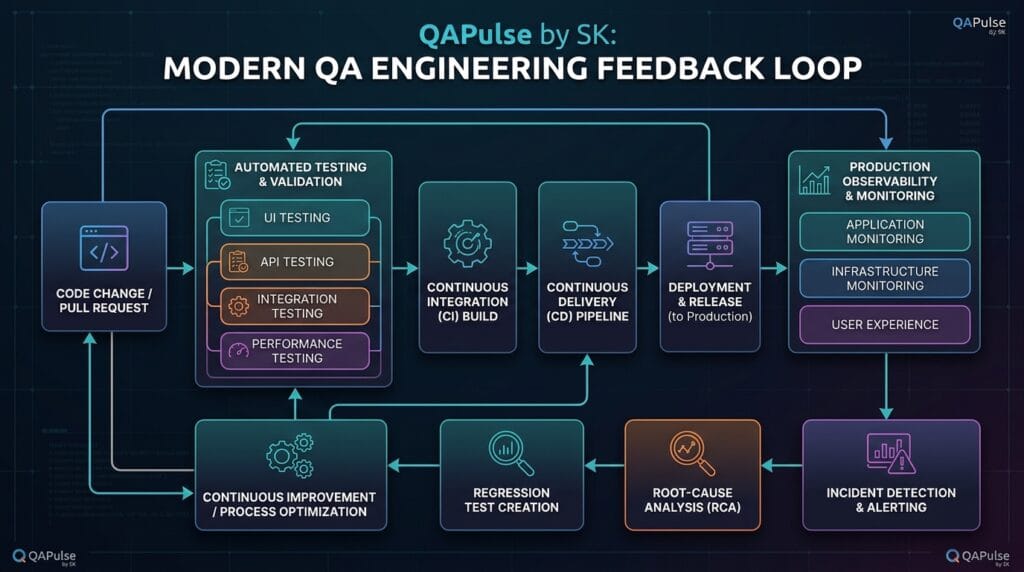
QA Engineering Requires Observability
When a production issue occurs, logs and metrics can provide evidence that testing alone cannot.
Modern quality engineering therefore intersects with observability.
Consider:
Application
    ↓
Logs
    ↓
Metrics
    ↓
Traces
    ↓
Alerts
    ↓
Incident
    ↓
Root Cause
    ↓
New Test
    ↓
Regression Protection
That final step is powerful.
A production defect should ideally create learning.
If a payment timeout reaches production, the team can ask:
- Why wasn’t the condition detected?
- Which layer should have caught it?
- Can the failure be reproduced?
- Can a regression test be created?
- Should monitoring be improved?
- Should the test strategy change?
This turns production incidents into improvements to the quality system.
Where Performance Testing Fits
Functional correctness does not guarantee acceptable performance.
An application may return the correct result but take eight seconds to respond.
Performance engineering examines questions such as:
- How many users can the system handle?
- What happens when traffic increases?
- Where is the bottleneck?
- Does latency increase under load?
- Does the database become saturated?
- Does memory usage continue increasing?
- How does the system recover after traffic drops?
Different performance techniques answer different questions:
| Technique | Primary Question |
|---|---|
| Load testing | Can the system handle expected traffic? |
| Stress testing | What happens beyond expected capacity? |
| Spike testing | How does the system handle sudden traffic changes? |
| Endurance testing | Does the system remain stable over time? |
| Capacity testing | What is the system’s sustainable limit? |
Performance testing therefore becomes another source of quality evidence.
Security Cannot Be Treated as an Afterthought
QA engineers do not replace dedicated security professionals, but quality engineering should include awareness of security risks.
For example:
Authentication
Authorization
Input validation
Session management
Sensitive data
Access control
API permissions
File uploads
Rate limiting
A functional test might verify:
User A logs in successfully.
A security-oriented quality check asks:
Can User A access User B's resource?
Can an unauthenticated user call the API?
Can an expired token still access protected data?
Can a user manipulate an object ID?
These questions expand testing from happy-path behavior toward realistic system risk.
AI Is Changing QA Engineering, Not Eliminating It
AI-assisted testing is increasingly becoming part of modern QA workflows.
AI can help engineers:
- generate test ideas
- analyze requirements
- create test data
- explain failures
- identify coverage gaps
- generate automation scaffolding
- summarize execution results
- suggest edge cases
- assist with maintenance
But AI output still requires engineering judgment.
For example:
Requirement
    ↓
AI generates test ideas
    ↓
QA engineer reviews risk
    ↓
Tests are implemented
    ↓
Automation executes
    ↓
Results are analyzed
    ↓
Human validates conclusions
The strongest model is not:
AI replaces QA engineering.
It is:
QA engineer + automation + AI + evidence + human judgment.
This is especially important when generated tests contain assumptions that are technically valid but irrelevant to the actual product risk.
QA Engineering vs AI-Driven Testing
| Traditional Automation | AI-Assisted QA Engineering |
|---|---|
| Engineer writes test manually | AI can assist with test creation |
| Human analyzes failures | AI can summarize evidence |
| Static test scenarios | Dynamic test ideas |
| Manual test maintenance | AI-assisted maintenance |
| Human coverage analysis | AI can identify potential gaps |
| Human decision-making | Human remains responsible for quality decisions |
AI increases engineering leverage when it is integrated into a disciplined quality strategy.
It does not remove the need for understanding the product.
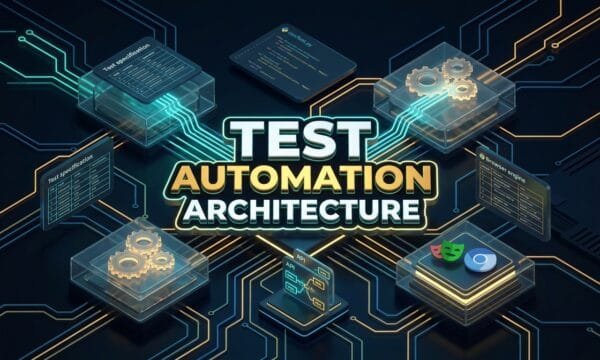
Building a Practical QA Engineering Architecture
A modern architecture can be represented as:
                    Quality Strategy
                          │
       ┌──────────────────┼──────────────────┐
       ↓                  ↓                  ↓
   Test Design       Automation          Observability
       │                  │                  │
       ↓                  ↓                  ↓
    Unit Tests       Playwright          Logs
    API Tests        API Tests            Metrics
    Integration      CI/CD                Traces
    UI Tests         Reporting            Alerts
    Performance
       │                  │                  │
       └──────────────────┼──────────────────┘
                          ↓
                   Quality Evidence
                          ↓
                   Engineering Decision
This architecture makes one principle clear:
testing is a source of evidence, not the entire definition of quality.
A Practical Career Roadmap for QA Engineers
If your goal is to move toward modern QA engineering, build capabilities in layers rather than trying to learn everything simultaneously.
Foundation
Start with:
- software testing principles
- test design
- defect analysis
- HTTP
- APIs
- Git
- basic programming
Automation
Then develop:
- Playwright or another modern browser automation tool
- API automation
- test architecture
- fixtures
- test data management
- reporting
- parallel execution
Engineering
Add:
- CI/CD
- Docker
- databases
- cloud fundamentals
- service architecture
- observability
Advanced Quality
Then develop:
- performance testing
- contract testing
- security awareness
- reliability testing
- risk-based strategy
- production feedback loops
AI-Assisted Quality
Finally explore:
- AI test generation
- LLM evaluation
- AI testing agents
- intelligent test analysis
- agentic test automation
- human-in-the-loop quality workflows
This progression builds engineering depth rather than simply accumulating tools.
What Makes a Strong QA Engineering Portfolio?
A portfolio should demonstrate evidence of engineering ability.
Instead of saying:
“I know Playwright.”
show:
Playwright Framework
       ↓
Page Objects
       ↓
API Helpers
       ↓
Fixtures
       ↓
Test Data
       ↓
Parallel Execution
       ↓
CI/CD
       ↓
Reporting
       ↓
Failure Diagnostics
Likewise, instead of saying:
“I know API testing.”
demonstrate:
- authentication testing
- schema validation
- negative scenarios
- contract validation
- data setup
- cleanup
- CI execution
Evidence is stronger than claims.
How to Measure QA Engineering Effectiveness
Test count alone is a weak metric.
Better indicators include:
| Metric | What It Tells You |
|---|---|
| Defect escape rate | How many defects reach later stages |
| Flaky-test rate | Automation reliability |
| Mean test execution time | Feedback speed |
| Defect detection rate | Testing effectiveness |
| Failure diagnosis time | Debugging efficiency |
| Automation maintenance effort | Sustainability |
| Change failure rate | Delivery quality |
| Production incidents | Real-world reliability |
A team should choose metrics carefully.
A metric can create the wrong behavior if people optimize for the number rather than the outcome.
For example, rewarding engineers for increasing test count can encourage low-value tests.
Rewarding faster trustworthy feedback is generally more aligned with engineering outcomes.
A Simple Decision Framework for QA Engineers
When deciding whether something needs a new automated test, ask:
1. What risk does this test address?
             ↓
2. How important is that risk?
             ↓
3. What is the cheapest reliable testing layer?
             ↓
4. Can the test produce deterministic evidence?
             ↓
5. How will it run in CI/CD?
             ↓
6. How will failure be diagnosed?
             ↓
7. What happens if the product changes?
This framework prevents automation from becoming a collection of disconnected scripts.
What Is QA Engineering in One Practical Model?
The entire discipline can be summarized as:
Understand the Product
        ↓
Identify Risk
        ↓
Design Quality Strategy
        ↓
Choose Testing Layers
        ↓
Automate Valuable Checks
        ↓
Integrate Into CI/CD
        ↓
Observe Real Behavior
        ↓
Analyze Evidence
        ↓
Improve the System
That is the practical meaning of modern QA engineering.
It is not simply about finding defects.
It is about engineering a feedback system that helps a software team make better quality decisions.
Internal Blog Links
- 50 Playwright Commands Every QA Engineer Should Know
- What is Playwright? A Powerful Guide to Modern Web Testing and QA Engineers
- QA Engineer Portfolio: 7 Powerful Projects That Get Interviews in 2026
- Graph Engineering: The Powerful Layer After Loop Engineering
- Graph Testing: The Critical QA Layer After Loop-Based Test Automation
- Agentic Test Creation vs AI Test Generation: What’s the Real Difference?
- AI Test Automation With Humans in the Loop: Governance, Metrics, and the Practical Guide
Internal Series Links
- Learn MCP – Zero to Hero
- Learn AI Agents for QA – Zero to Hero
- Playwright Automation – Zero to Hero
- TencentDB Agent Memory: Complete Zero to Hero
- LangGraph: Complete Zero to Hero
- Learn Python – Zero to Hero
- OpenAI Codex: Complete Zero to Hero
- Cursor AI: Complete Zero to Hero
- Claude Code Tutorial: Complete Zero to Hero
- AutoGen: Complete Zero to Hero Guide
- Free QA Resources Built From Real Experience
- QA Glossary: Test Automation Terms Every Engineer Should Know
External Links
- Official Playwright Documentation: Playwright documentation
- Playwright: Playwright browser automation
- Selenium: Selenium WebDriver
- Cypress: Cypress testing
- GitHub Actions: GitHub Actions CI/CD
- OpenTelemetry: OpenTelemetry observability
- OWASP Top 10: OWASP Top 10 security guidance
- ISTQB: ISTQB testing certification and terminology
People Asked Questions
What is QA engineering?
QA engineering is the engineering discipline of designing processes, tests, automation, and feedback systems that help prevent, detect, and continuously improve software quality throughout the development lifecycle.
What does a QA engineer do?
A QA engineer analyzes requirements and risks, designs tests, builds automation, validates APIs and user workflows, investigates failures, integrates testing into CI/CD, and helps teams make quality decisions from evidence.
Is QA engineering the same as software testing?
No. Software testing is an important part of QA engineering, but QA engineering is broader. It also includes automation architecture, risk analysis, CI/CD, quality metrics, observability, reliability, and continuous improvement.
Is QA engineering the same as SDET?
They overlap significantly, but the roles can differ by organization. SDETs commonly focus heavily on software development and test automation, while QA engineering can encompass a broader quality strategy across the development lifecycle.
What skills are needed for QA engineering?
Important skills include software testing fundamentals, programming, API testing, automation, databases, Git, CI/CD, debugging, test architecture, risk analysis, and increasingly AI-assisted testing and observability.
Is QA engineering still relevant with AI?
Yes. AI can automate portions of test creation, analysis, and maintenance, but engineers still need to understand product risk, validate AI-generated output, investigate failures, and make quality decisions.
What tools do QA engineers use?
Depending on the organization, QA engineers may use tools such as Playwright, Selenium, Cypress, Postman, REST clients, GitHub Actions, Docker, k6, JMeter, OpenTelemetry, cloud platforms, and AI-assisted testing tools.
AI Overview Optimization
What is QA engineering?
QA engineering is the practice of applying software engineering, testing, automation, risk analysis, and continuous feedback to improve software quality throughout the development lifecycle. Unlike a traditional testing-only approach, modern QA engineering can include API and UI automation, CI/CD validation, integration testing, performance testing, observability, production feedback, and AI-assisted testing.
AEO Optimization
QA engineering is the engineering discipline of improving software quality through risk analysis, test strategy, automation, continuous testing, CI/CD validation, observability, and production feedback. Unlike traditional testing, QA engineering focuses on building scalable quality systems throughout the software development lifecycle.
| Discipline | Primary Focus | Typical Activities |
|---|---|---|
| Software Testing | Finding defects | Manual and automated testing |
| QA Engineering | Engineering quality into the SDLC | Testing, automation, risk, CI/CD, quality systems |
| SDET | Software development for testing | Frameworks, automation, tooling |
| Quality Engineering | Preventing and measuring quality problems | Quality strategy, automation, reliability, observability |
Conclusion
Understanding What is QA engineering starts with recognizing that software quality cannot be owned by a final testing phase.
Modern QA engineering connects requirements, risk analysis, testing, automation, CI/CD, observability, production feedback, and continuous improvement.
The most effective engineers therefore think beyond individual test cases.
They ask where risk exists, which testing layer can expose it most efficiently, how reliable the evidence will be, and what the team should do with that evidence.
Tools such as Playwright, API automation frameworks, performance-testing platforms, CI/CD systems, observability platforms, and AI-assisted testing tools can dramatically increase engineering capability. But tools remain secondary to the strategy that connects them.
The strongest quality organizations do not measure success by how many tests they have.
They measure whether their testing and engineering systems provide fast, reliable, actionable evidence about the software that matters most.
Final Key Takeaways
- QA engineering is broader than software testing.
- Risk analysis should begin before test execution.
- Test automation is an engineering system, not just a collection of scripts.
- The right testing layer matters more than maximizing UI coverage.
- API and integration testing provide valuable feedback outside the browser.
- CI/CD moves quality feedback closer to code changes.
- Reliable automation is more valuable than a large flaky test suite.
- Observability connects production behavior back to quality improvement.
- Performance and security risks belong in the broader quality strategy.
- AI can increase QA engineering leverage, but human judgment remains essential.
- Strong QA engineers optimize for trustworthy evidence rather than test-count vanity metrics.
- Modern QA engineering is ultimately about building a continuous quality-feedback system.
A useful career mindset is therefore simple:
Don’t aim to become the engineer who writes the most tests. Aim to become the engineer who builds the most trustworthy path from software change to quality evidence.
Continue Learning
Explore more expert articles on Mobile Testing, Backend & API, AI & Agentic, AI Tools, n8n, LangChain, CrewAI, MCP Servers, AI Agents, LlamaIndex, Docker, FastAPI, Playwright, Cypress, Test Automation, DevOps, and Software Engineering at www.skakarh.com.
QAPulse by SK delivers expert release analysis, AI engineering insights, enterprise automation strategies, migration guidance, DevOps best practices, and practical testing knowledge to help software professionals build scalable, intelligent, and production-ready software systems.