 QA
QA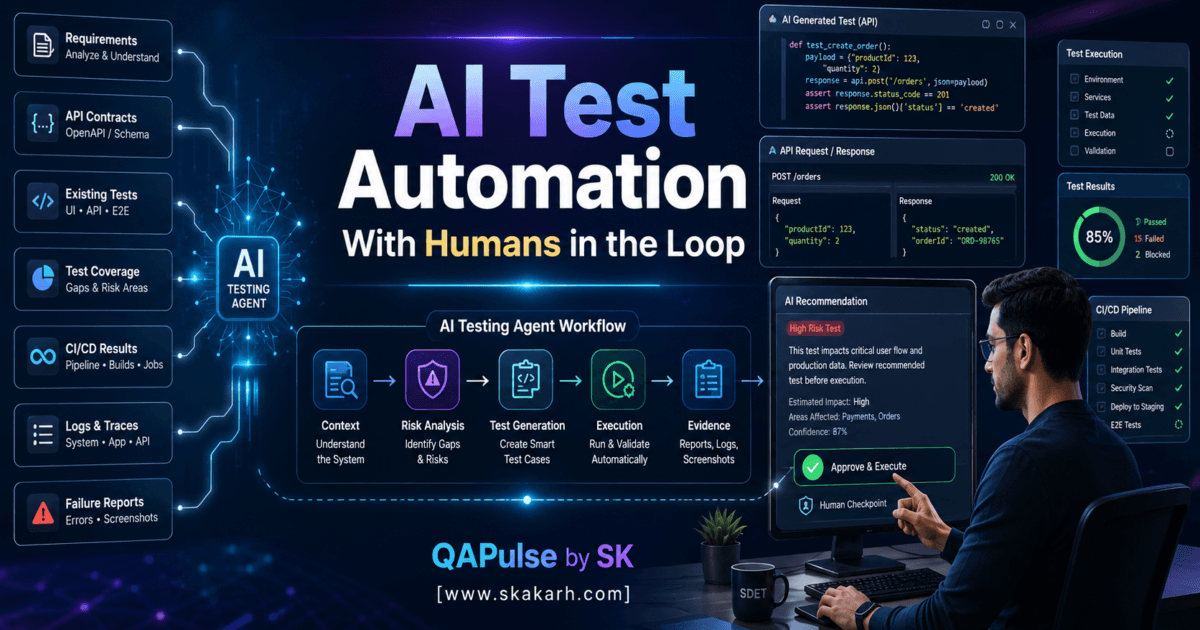
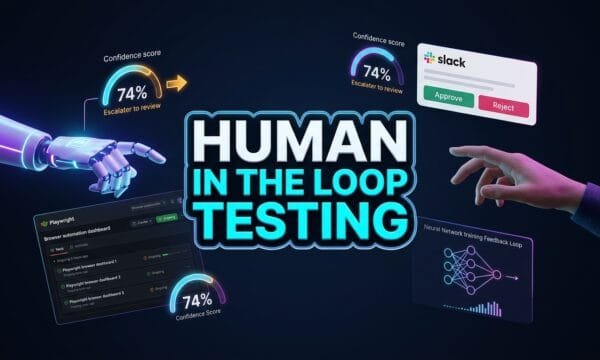
AI Test Automation With Humans in the Loop changes the role of the SDET from someone who primarily writes and maintains automated checks into someone who designs, supervises, validates, and continuously improves an intelligent testing system.
The important word is humans.
AI can generate test scenarios, write Playwright or API automation, analyze logs, identify potential coverage gaps, suggest assertions, investigate failures, and even propose changes to existing tests. But software quality is not simply a code-generation problem. A test must represent business intent, detect meaningful risk, produce trustworthy evidence, and remain valuable when the application changes.
That is why AI test automation with humans in the loop is fundamentally different from asking an AI model to generate a collection of tests and then committing whatever it produces.
The practical model is:
Requirement
    ↓
AI analyzes context
    ↓
AI proposes scenarios
    ↓
Human evaluates risk
    ↓
AI generates automation
    ↓
Automated execution
    ↓
AI analyzes evidence
    ↓
Human evaluates ambiguous results
    ↓
Approved test / defect / investigation
The objective is not to make humans approve every AI action.
The objective is to make humans responsible for the decisions that require engineering judgment while allowing AI to handle repetitive, high-volume work.
Why AI Test Automation With Humans in the Loop Matters for SDETs
Traditional test automation solved one major problem: repetitive execution.
Instead of manually opening an application, entering data, clicking buttons, and checking results, automation frameworks can execute those actions consistently.
A traditional workflow looks like this:
Requirement
    ↓
SDET designs scenarios
    ↓
SDET writes automation
    ↓
CI executes tests
    ↓
SDET investigates failures
This model remains effective, but significant engineering effort exists around the actual execution.
An SDET may spend hours:
- understanding requirements
- searching existing tests
- identifying missing scenarios
- creating test data
- writing repetitive assertions
- debugging failures
- reviewing logs
- maintaining selectors
- investigating flaky behavior
- updating tests after UI or API changes
AI can participate in many of these activities.
With AI test automation with humans in the loop, the workflow becomes more collaborative:
Requirement
    ↓
AI extracts possible scenarios
    ↓
SDET evaluates business risk
    ↓
AI generates candidate automation
    ↓
SDET validates implementation
    ↓
CI executes
    ↓
AI analyzes evidence
    ↓
SDET makes high-value decisions
This changes the economics of automation without assuming that AI is always correct.
AI-Assisted Testing is Not the Same as Autonomous Testing
One of the easiest mistakes is to treat every AI testing approach as autonomous testing.
They are not the same.
| Model | AI Responsibility | Human Responsibility | Typical Risk |
|---|---|---|---|
| Traditional automation | Execution | Design, maintenance, decisions | High manual effort |
| AI-assisted testing | Suggestions and generation | Most decisions | AI output quality |
| AI test automation with humans in the loop | Generation, analysis, investigation | Risk-based decisions | Poor approval boundaries |
| Autonomous testing | Planning, generation, execution, decisions | Limited supervision | Incorrect autonomous decisions |
A team does not automatically improve its quality strategy by moving from left to right.
More autonomy creates more responsibility for the system to understand context correctly.
For example, an AI system could generate 500 checkout tests. That sounds impressive.
But suppose:
- 200 tests duplicate existing coverage
- 100 contain weak assertions
- 50 use unrealistic data
- 30 test obsolete requirements
- 20 contain unstable selectors
- 10 incorrectly model business rules
The team has increased test volume, but not necessarily test quality.
A smaller set of carefully reviewed tests can provide considerably more value.
This is one reason AI test automation with humans in the loop should optimize for useful coverage rather than generated-test volume.
The Real Problem Is Not Test Generation
Test generation is one part of testing.
The harder problem is deciding what deserves to be tested and what evidence is sufficient.
Consider this requirement:
A customer cannot cancel an order after the order has shipped.
An AI model could quickly produce:
def test_cannot_cancel_shipped_order(client):
    order = create_order(status="shipped")

    response = client.post(
        f"/orders/{order['id']}/cancel"
    )

    assert response.status_code == 400
The test is syntactically reasonable.
But an experienced SDET should immediately ask additional questions.
What happens if cancellation is requested twice?

What happens when shipping changes the order state
while cancellation is being processed?

What happens if the UI says "shipped" but the API
still reports "processing"?

What happens if the customer does not own the order?

What happens if the cancellation request times out?

What happens if the backend processes cancellation
but the response never reaches the client?
These questions demonstrate why AI test automation with humans in the loop is more than code generation.
AI can suggest scenarios.
Human engineering judgment determines whether those scenarios represent the actual risk.
A Better Division of Labor Between AI and Humans
A mature system should explicitly decide which activities AI can perform independently and which activities require review.
| Testing Activity | AI Can Assist With | Human Should Own |
|---|---|---|
| Requirement analysis | Extract scenarios | Business interpretation |
| Test design | Suggest edge cases | Risk prioritization |
| Test generation | Write candidate code | Architecture approval |
| Assertions | Suggest expected behavior | Business correctness |
| Test data | Generate candidates | Data suitability |
| Execution | Run and classify results | Release risk |
| Failure analysis | Inspect evidence | Defect decision |
| Maintenance | Suggest modifications | Critical test changes |
| Regression | Recommend tests | Final release confidence |
The distinction is simple:
AI handles scale. Humans handle judgment.
That principle should guide every AI testing architecture.
Where Humans Should Intervene
Human involvement should not mean manually reviewing everything.
That would simply create a new bottleneck.
Instead, divide decisions into risk levels.
LOW RISK
Simple repetitive test
        ↓
AI can execute automatically


MEDIUM RISK
Generated test or modification
        ↓
AI proposes
        ↓
Human reviews


HIGH RISK
Security / payment / release-critical behavior
        ↓
AI proposes
        ↓
Human approval required
For example, automatically accepting a generated health-check test might be reasonable.
Automatically deleting a payment regression test because an AI agent considers it redundant is much more dangerous.
The latter should produce evidence such as:
Candidate duplicate:
    tests/payment/refund.spec.ts

Potential duplicate:
    tests/orders/refund-flow.spec.ts

Shared coverage:
    refund request
    authorization
    response status

Difference:
    first test validates ledger update
    second test validates customer notification

Recommendation:
    KEEP BOTH
The AI provides analysis.
The SDET makes the decision.
That is a practical example of AI test automation with humans in the loop rather than AI operating as an unquestioned authority.
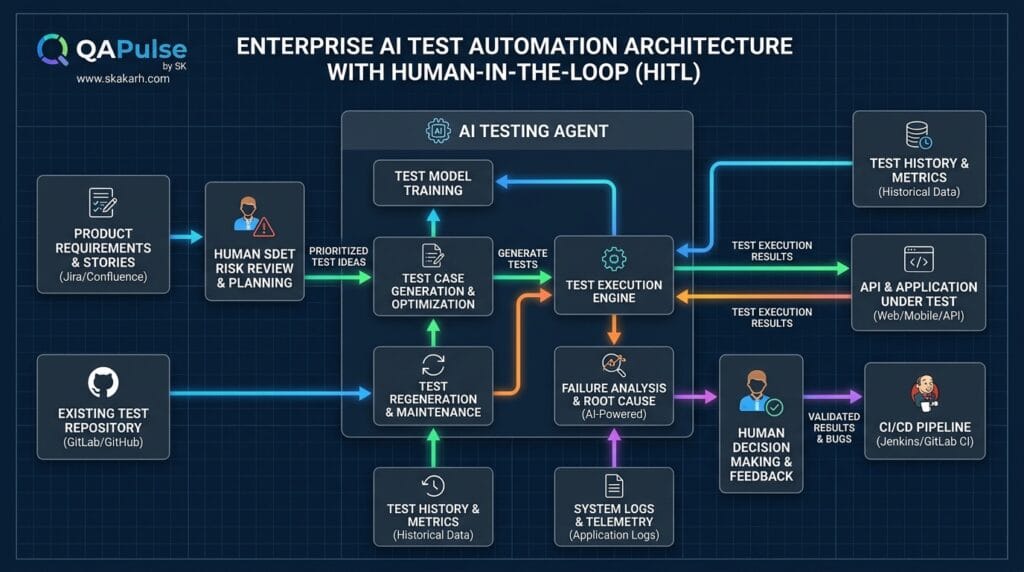
Building the Human-in-the-Loop Test Architecture
A useful architecture can contain several context sources.
                    ┌─────────────────────┐
                    │    Requirements     │
                    └──────────┬──────────┘
                               ↓
                    ┌─────────────────────┐
                    │     AI Testing      │
                    │       Agent         │
                    └──────────┬──────────┘
                               ↓
        ┌──────────────────────┼──────────────────────┐
        ↓                      ↓                      ↓
 Test Repository          API / Application       Test History
        │                      │                      │
        └──────────────────────┼──────────────────────┘
                               ↓
                     Scenario Generation
                               ↓
                       Human Risk Review
                               ↓
                       Test Generation
                               ↓
                           CI/CD
                               ↓
                         Test Results
                               ↓
                       Failure Analysis
                               ↓
                       Human Decision
The important architectural concept is context.
A model that only receives a requirement is operating with limited information.
A testing agent that can inspect:
- existing tests
- API specifications
- application behavior
- requirements
- logs
- traces
- screenshots
- historical failures
- defect records
- test results
can produce considerably more useful recommendations.
AI Test Automation With Humans in the Loop for UI Testing
UI testing provides an obvious example of where AI can accelerate automation while humans retain control.
Suppose a checkout requirement says:
A customer can successfully complete payment using a valid card.
An AI system might generate a Playwright test:
test("customer completes checkout", async ({ page }) => {
  await page.goto("/checkout");

  await page.getByLabel("Card number")
    .fill("4111111111111111");

  await page.getByLabel("Expiry")
    .fill("12/30");

  await page.getByLabel("CVV")
    .fill("123");

  await page.getByRole("button", {
    name: "Pay now"
  }).click();

  await expect(
    page.getByText("Payment successful")
  ).toBeVisible();
});
The code may work.
But an experienced SDET should evaluate:
- Is the locator stable?
- Is the payment data appropriate for the test environment?
- Does the success message prove payment completion?
- Should the order API also be checked?
- What happens if payment succeeds but order creation fails?
- Is this scenario already covered?
- Is the test independent?
- Is there unnecessary waiting?
- Does the environment support deterministic payment simulation?
The AI generated the implementation.
The human validates the testing strategy.
That distinction is central to AI test automation with humans in the loop.
AI Test Automation With Humans in the Loop for API Testing
API testing may offer even greater opportunities because requests and assertions are often structured.
For example:
response = client.post(
    "/api/orders",
    json={
        "customer_id": 1001,
        "product_id": 500,
        "quantity": 2
    }
)

assert response.status_code == 201
AI can extend this into:
body = response.json()

assert response.status_code == 201
assert body["status"] == "created"
assert body["order_id"] is not None
assert body["quantity"] == 2
But an SDET should ask:
Does the response contract represent the actual business requirement?
If the requirement is “the customer is charged exactly once,” checking HTTP 201 is not enough.
A stronger test might involve:
POST /orders
      ↓
201 Created
      ↓
Order created
      ↓
Payment captured once
      ↓
Inventory reserved
      ↓
Confirmation generated
This turns API automation from simple endpoint verification into meaningful system validation.
The AI can help construct the checks.
The engineer determines whether those checks prove the requirement.
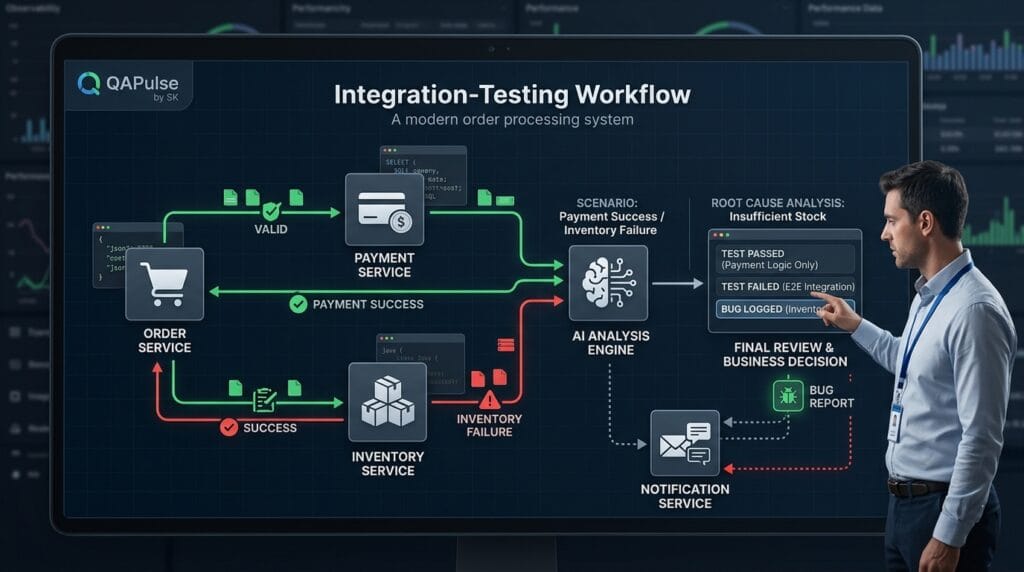
AI Test Automation With Humans in the Loop for Integration Testing
Integration testing exposes an even stronger reason for human involvement.
Imagine:
Order Service
      ↓
Payment Service
      ↓
Inventory Service
      ↓
Notification Service
Every individual service may pass its own tests.
The complete workflow can still fail.
Consider:
Payment succeeds
      ↓
Inventory reservation fails
      ↓
Order remains "created"
      ↓
Notification service receives success event
      ↓
Customer receives confirmation
A simplistic AI-generated test may validate only:
assert order.status == "created"
An experienced engineer asks:
Should an order remain created when inventory reservation failed?
That question requires domain understanding.
The answer may be:
Payment success
+
Inventory failure
        ↓
Transaction compensation
        ↓
Payment refund
        ↓
Order marked failed
        ↓
No shipment notification
This is precisely where AI test automation with humans in the loop becomes valuable: AI can investigate a complex workflow, but humans provide the contextual judgment needed to determine whether the observed behavior is acceptable.
A Passing Test Does Not Automatically Mean a Good Test
One of the most dangerous assumptions in AI-generated automation is:
“The test passes, therefore the test is good.”
That is false.
A test can pass because:
- the assertion is too weak
- the wrong element was checked
- the expected value is incorrect
- the test never reached the intended state
- test data is unrealistic
- an exception is being swallowed
- the test is validating implementation instead of behavior
Consider:
assert response.status_code == 200
This may be technically correct.
But if the requirement is:
A customer receives exactly one refund after cancellation.
then HTTP 200 is nowhere near enough evidence.
A better test might verify:
assert response.status_code == 200
assert refund["status"] == "completed"
assert refund["amount"] == expected_amount
assert refund["transaction_count"] == 1
The lesson is important:
Automation produces evidence. Engineering determines whether the evidence is sufficient.
An SDET Decision Framework
Before accepting an AI-generated test, use three questions:
1. Does this test cover a meaningful risk?

2. Do the assertions prove the intended behavior?

3. Would I trust this test to influence a release decision?
If the answer is “yes” to all three, the candidate is likely valuable.
If the answer is “no,” the AI output should remain a proposal.
This is a simple but powerful governance mechanism for AI test automation with humans in the loop.
Experience-Based Rule: Do Not Let AI “Fix” Flaky Tests Blindly
One of the most practical dangers is AI-generated maintenance.
Suppose a Playwright test fails because a button is sometimes unavailable.
An AI agent might propose:
await page.waitForTimeout(5000);
await page.locator("#submit").click();
The test may become green.
But the underlying synchronization problem may still exist.
An experienced SDET would investigate whether the application exposes a reliable state:
await expect(
  page.getByRole("button", { name: "Submit" })
).toBeEnabled();

await page.getByRole("button", {
  name: "Submit"
}).click();
The second solution communicates intent.
The first solution merely waits.
This is an important example of why AI-generated changes need engineering review.
A green pipeline should never be the only success criterion.
The Strategic Shift for Modern SDETs
AI does not eliminate the need for SDET expertise.
It increases the value of expertise.
When AI handles more repetitive implementation work, the engineer can spend more time on:
- risk modeling
- architecture
- business workflows
- coverage strategy
- assertion design
- integration behavior
- observability
- quality gates
- test-data architecture
- failure classification
- AI governance
The SDET increasingly becomes the person designing the quality system around the AI, rather than merely writing every individual test.
That is the strategic opportunity behind AI test automation with humans in the loop.
A Practical Exercise
Take one important automated test from your current framework.
Do not ask AI to rewrite it immediately.
First classify every activity:
Requirement interpretation       → Human
Scenario brainstorming           → AI + Human
Risk prioritization              → Human
Test code generation             → AI
Locator suggestion               → AI
Assertion proposal               → AI + Human
Execution                        → Automation
Failure investigation            → AI + Human
Release decision                 → Human
Now ask:
Which steps consume the most engineering time?
Those are your strongest candidates for AI assistance.
Then ask a second question:
Which steps would create unacceptable risk if AI made the wrong decision?
Those become your human approval boundaries.
That exercise gives you a practical starting point for introducing AI test automation with humans in the loop without attempting a risky “fully autonomous testing” transformation overnight.
The Core Principle
The future of intelligent test automation is not necessarily:
Human → AI → Everything
A better architecture is:
Human defines intent
        ↓
AI expands possibilities
        ↓
Human evaluates risk
        ↓
AI performs repetitive work
        ↓
Automation produces evidence
        ↓
AI investigates anomalies
        ↓
Human makes critical decisions
That model preserves what humans are best at while exploiting what AI is best at.
The strongest testing organizations will not be those that generate the largest number of AI-written tests.
They will be the teams that build the most trustworthy collaboration between AI, automation infrastructure, and engineering judgment.
Designing a Practical Human-in-the-Loop Testing Workflow
The practical value of AI test automation with humans in the loop becomes clearer when we move from the concept to the engineering workflow. The goal is not to place an AI chatbot beside an existing test suite. The goal is to create a controlled feedback loop in which AI can understand testing context, propose actions, use approved tools, inspect evidence, and escalate decisions that require engineering judgment.
A useful implementation model is:
Requirement
    ↓
Context retrieval
    ↓
AI test analysis
    ↓
Scenario proposal
    ↓
Risk classification
    ↓
Human approval when required
    ↓
Test creation
    ↓
Execution
    ↓
Evidence collection
    ↓
AI failure analysis
    ↓
Human decision for ambiguous cases
This architecture is more useful than simply connecting an LLM to a test-code generator because the AI has a defined responsibility at every stage.
For example, an AI system should not receive:
"Create Playwright tests for checkout."
and immediately create dozens of files.
A better request gives the system context:
Feature:
Checkout payment

Available context:
- checkout requirements
- existing Playwright tests
- API specification
- known defects
- supported payment scenarios
- test-data rules

Objective:
Identify missing high-risk scenarios before creating tests.

Constraints:
Do not modify existing tests.
Do not delete coverage.
Flag payment and financial scenarios for human review.
That difference is fundamental. The second workflow gives AI context, constraints, and an approval boundary.
Context Is the Missing Layer in Many AI Testing Experiments
A large language model can generate plausible automation without understanding your actual automation architecture.
It may not know:
- which framework your team uses
- which fixtures already exist
- which APIs are mocked
- which environments are safe
- which test data is valid
- which tests already cover the scenario
- which requirements are obsolete
- which assertions are business-critical
- which failures are historically flaky
That is why context retrieval should be treated as a first-class component.
context = {
    "requirement": requirement,
    "existing_tests": existing_tests,
    "api_contract": api_contract,
    "known_defects": defects,
    "test_data_rules": test_data_rules,
    "recent_failures": failures
}

analysis = testing_agent.analyze(context)
The agent can then produce a structured proposal rather than immediately modifying the repository.
{
  "risk": "high",
  "new_scenarios": [
    "payment succeeds but order creation fails",
    "duplicate payment submission",
    "payment timeout after authorization"
  ],
  "existing_coverage": [
    "successful payment",
    "declined payment"
  ],
  "human_review_required": true
}
This creates evidence that a human can inspect before automation changes are introduced.
Human Approval Should Be Based on Risk
A common mistake is to design human approval as a simple yes/no gate for every AI action.
That does not scale.
Instead, classify actions.
| AI Action | Risk | Approval |
|---|---|---|
| Generate a new low-risk test | Low | Optional |
| Suggest a locator | Low | Review during PR |
| Add an API assertion | Medium | Code review |
| Modify authentication tests | High | Required |
| Change payment assertions | Critical | Required |
| Delete regression coverage | Critical | Required |
| Mark production failure as flaky | Critical | Required |
| Change security validation | Critical | Required |
This approach turns human involvement into risk-based governance.
The engineer is not supervising the AI’s every keystroke.
The engineer supervises decisions where an incorrect action could damage test confidence.
A Useful Approval Contract
An AI testing agent should ideally return a proposal with structured evidence.
proposal = {
    "action": "modify_test",
    "target": "tests/checkout/payment.spec.ts",
    "reason": "Payment button locator changed",
    "evidence": [
        "Current locator failed in 7 CI runs",
        "New accessible role exists",
        "Equivalent locator found in checkout page"
    ],
    "risk": "medium",
    "requires_human_approval": True
}
The human reviewer can then understand:
- What the AI wants to change
- Why it wants to change it
- What evidence supports the change
- What risk is associated with the change
- Whether the proposed action is reversible
That is much safer than accepting an opaque AI-generated patch.
Building AI-Assisted UI Automation With Playwright
Consider a typical Playwright test:
test("customer completes checkout", async ({ page }) => {
  await page.goto("/checkout");

  await page.getByLabel("Card number")
    .fill("4111111111111111");

  await page.getByLabel("Expiry")
    .fill("12/30");

  await page.getByLabel("CVV")
    .fill("123");

  await page.getByRole("button", {
    name: "Pay now"
  }).click();

  await expect(
    page.getByText("Payment successful")
  ).toBeVisible();
});
An AI agent can help with several activities:
Requirement
    ↓
Identify user journey
    ↓
Find existing checkout tests
    ↓
Identify uncovered states
    ↓
Suggest test
    ↓
Generate Playwright implementation
    ↓
Run test
    ↓
Analyze result
But the agent should not assume that the visible success message proves the entire workflow.
An SDET may require additional verification:
const response = await request.get(
  `/api/orders/${orderId}`
);

expect(response.status()).toBe(200);

const order = await response.json();

expect(order.status).toBe("confirmed");
expect(order.paymentStatus).toBe("paid");
Now the UI test validates the user-facing behavior while the API check validates backend state.
That is a stronger quality signal than relying on a single UI assertion.
UI Tests Should Not Become AI-Generated Click Scripts
AI can easily produce tests that look impressive but behave like fragile click recordings:
await page.locator("div:nth-child(4) button").click();
await page.locator(".modal .input").fill("test");
await page.locator(".btn-primary").click();
This may work today.
It may fail tomorrow because an unrelated DOM change modifies the structure.
A more maintainable approach is:
await page.getByRole("button", {
  name: "Add product"
}).click();

await page.getByLabel("Product name")
  .fill("Laptop");

await page.getByRole("button", {
  name: "Save product"
}).click();
AI can suggest stable locators, but the automation architecture should still enforce locator standards.
This is an important E-E-A-T signal because the article is not simply claiming that AI makes automation better. It demonstrates the engineering conditions under which AI-generated automation becomes maintainable.
AI-Assisted API Test Creation
API testing provides another useful workflow.
Suppose the requirement is:
A customer cannot create an order with a quantity below one.
An AI agent might propose:
def test_order_rejects_zero_quantity(client):
    response = client.post(
        "/api/orders",
        json={
            "product_id": 101,
            "quantity": 0
        }
    )

    assert response.status_code == 400
That is a reasonable starting point.
But a stronger test design explores the boundary:
@pytest.mark.parametrize("quantity", [-10, -1, 0])
def test_invalid_quantities_are_rejected(client, quantity):
    response = client.post(
        "/api/orders",
        json={
            "product_id": 101,
            "quantity": quantity
        }
    )

    assert response.status_code == 400
Then the SDET can ask whether additional assertions are necessary:
body = response.json()

assert body["error"]["code"] == "INVALID_QUANTITY"
assert "quantity" in body["error"]["fields"]
The AI can accelerate this process, but the human engineer determines whether the assertions represent the actual API contract.
AI Should Understand Existing Test Architecture
One of the biggest sources of duplicate automation is allowing AI to create tests without examining the existing repository.
Imagine a project already contains:
tests/
├── auth/
├── checkout/
│   ├── payment.spec.ts
│   ├── refund.spec.ts
│   └── order-confirmation.spec.ts
├── orders/
├── api/
└── integration/
Before creating another payment test, an AI agent should search existing coverage.
A simple retrieval process could be:
matches = test_repository.search(
    query="successful payment checkout"
)

for test in matches:
    print(test.path)
    print(test.summary)
    print(test.assertions)
The agent can then determine:
Existing coverage:
✓ successful payment
✓ declined payment
✓ expired card

Potential gaps:
? duplicate submission
? payment timeout
? payment success + order failure
That is far more valuable than generating another copy of successful_payment.spec.ts.
Coverage Gaps Are More Valuable Than Test Volume
A mature AI testing workflow should ask:
“What important behavior is missing?”
rather than:
“How many tests can I generate?”
Consider this simplified coverage matrix:
| Scenario | Existing Test | AI Recommendation | Priority |
|---|---|---|---|
| Successful payment | Yes | None | Low |
| Declined card | Yes | None | Low |
| Expired card | Yes | None | Medium |
| Duplicate payment | No | Generate | High |
| Payment timeout | No | Generate | High |
| Payment succeeds/order fails | No | Generate | Critical |
| Refund twice | No | Generate | High |
The final three scenarios may provide substantially more value than generating another 50 happy-path tests.
This is where an experienced SDET can use AI as a coverage discovery engine rather than merely a code generator.
AI-Assisted Failure Investigation
Test execution is another area where AI can reduce repetitive investigation.
Suppose CI reports:
FAILED checkout/payment.spec.ts

Expected:
paymentStatus = "paid"

Received:
paymentStatus = "pending"

Duration:
31.8 seconds

Environment:
staging

Recent related failures:
4
An AI agent can correlate:
Test result
    ↓
Application logs
    ↓
API response
    ↓
Trace
    ↓
Recent deployments
    ↓
Historical failures
It might produce:
Likely cause:
Payment service response latency increased
after deployment 4f81c2.

Evidence:
- 4 similar failures in 20 minutes
- payment API latency increased from 800ms to 4.2s
- checkout UI timeout remains 3 seconds
- no corresponding application exception
That is useful.
But the agent should not automatically classify the test as flaky.
The SDET still needs to determine whether:
A. Application defect
B. Infrastructure problem
C. Test defect
D. Environment problem
E. Genuine intermittent behavior
Automatically labeling failures incorrectly can hide real defects.
That is exactly why human judgment remains important.
The Dangerous AI “Fix”: Making the Test Weaker
Consider a failing assertion:
await expect(
  page.getByText("Payment successful")
).toBeVisible();
The AI sees intermittent failures.
It proposes:
await expect(
  page.getByText("Payment successful")
).toBeVisible({
  timeout: 30000
});
The failure rate decreases.
The pipeline looks healthier.
But what if the real problem is that payment sometimes never completes?
Increasing the timeout may conceal the problem.
A better agent should first investigate:
Is the application actually slow?

Is the payment event missing?

Did the UI fail to update?

Is the test observing the wrong state?

Did the backend complete the transaction?

Is there a synchronization issue?
Only after identifying the cause should the automation be modified.
This is a crucial engineering rule:
Never optimize AI testing for green results alone. Optimize it for trustworthy evidence.
AI Test Automation With Humans in the Loop and CI/CD
The CI/CD pipeline can become the control plane for this workflow.
Pull Request
     ↓
AI analyzes changed files
     ↓
Identify affected tests
     ↓
Recommend regression scope
     ↓
Human reviews high-risk changes
     ↓
Tests execute
     ↓
AI analyzes failures
     ↓
Quality gate
For a small documentation change, the agent may recommend a narrow test scope.
For a payment-service change, it might recommend:
Affected areas:
- checkout
- payments
- refunds
- order creation
- notifications

Recommended:
✓ API regression
✓ payment integration
✓ checkout UI
✓ refund workflow
✓ contract validation
The human can then approve or adjust the regression scope.
This is much more strategic than running every test after every change.
AI-Assisted Regression Selection
A large test suite may contain thousands of tests.
Running all tests for every change can become expensive.
An AI system can analyze:
Changed files
+
Dependency graph
+
Test metadata
+
Historical failures
+
Coverage
+
Service ownership
and recommend:
Changed:
services/payment/refund.py

Potentially affected:
payments
orders
refunds
notifications

High-priority tests:
42

Medium-priority tests:
86

Unrelated tests:
1,742
The SDET can inspect the recommendation before the pipeline executes it.
The important principle is that AI should recommend test scope using evidence, not randomly reduce regression coverage to save CI minutes.
A Comparison With Traditional Regression Selection
| Strategy | Selection Method | Strength | Weakness |
|---|---|---|---|
| Full regression | Run everything | Maximum breadth | Expensive |
| Tag-based | Static tags | Simple | Can become outdated |
| File-based | Changed files | Fast | Misses indirect dependencies |
| Coverage-based | Code/test mapping | Better precision | Requires good coverage data |
| AI-assisted | Multiple signals | Context-aware | Needs validation |
| AI + human approval | AI recommendation + engineering review | Strong balance | Requires governance |
For high-risk applications, the last approach is often the safer model.
Designing an AI Testing Agent With Boundaries
An AI testing agent should not have unrestricted access to the entire environment.
Use explicit tools.
tools = [
    "search_requirements",
    "search_tests",
    "read_api_schema",
    "run_test",
    "read_test_results",
    "read_logs",
    "create_test_proposal"
]
Sensitive actions should require approval:
protected_tools = [
    "delete_test",
    "modify_release_gate",
    "disable_assertion",
    "change_security_test",
    "approve_production_release"
]
The agent can request:
{
  "action": "delete_test",
  "target": "tests/payment/refund.spec.ts",
  "reason": "Possible duplicate",
  "requires_approval": true
}
The human reviews the evidence before anything destructive happens.
This is an important distinction between an AI testing assistant and an uncontrolled autonomous agent.
Human Review Should Produce Evidence Too
Human approval should not become a meaningless “Approve” button.
A useful review interface could show:
AI Recommendation
-----------------
Action:
Modify checkout/payment.spec.ts

Reason:
Current selector fails after UI component update.

Evidence:
✓ 7 recent failures
✓ New accessible role detected
✓ Equivalent successful locator in another test

Risk:
Medium

Proposed change:
Replace CSS selector with role locator.

Reviewer:
SDET

Decision:
Approved
Now the system has an auditable quality decision.
That creates a stronger chain of trust:
AI observation
      ↓
Evidence
      ↓
Recommendation
      ↓
Human decision
      ↓
Recorded outcome
The feedback can later improve the agent.
If engineers repeatedly reject a particular recommendation type, the system can learn that those actions require stronger evidence or stricter approval.
Measuring Whether AI Actually Improves Testing
Introducing AI is not itself a success metric.
Track measurable outcomes.
| Metric | What It Tells You |
|---|---|
| Test creation time | Whether generation saves engineering effort |
| Review time | Whether AI creates excessive cleanup |
| Duplicate-test rate | Whether generated coverage is useful |
| Assertion defect rate | Whether generated checks are trustworthy |
| Flaky-test rate | Whether AI changes improve stability |
| Coverage-gap closure | Whether AI discovers meaningful scenarios |
| Failure triage time | Whether investigation becomes faster |
| Escaped defects | Whether quality actually improves |
| Human approval rate | Whether AI recommendations are useful |
| AI-generated change rejection rate | Whether the agent needs better context |
Suppose your team reports:
Before AI:
Test creation = 4 hours
Failure triage = 45 minutes
Flaky tests = 12%

After AI:
Test creation = 1.5 hours
Failure triage = 20 minutes
Flaky tests = 7%
That provides much stronger evidence than saying:
“Our team now uses AI for testing.”
The objective is measurable improvement.
A Practical Pilot Strategy
Do not begin by giving an AI agent unrestricted control over the entire test repository.
Start with a contained workflow.
Step 1: Select One High-Value Workflow
For example:
Checkout
Step 2: Give AI Read Access
Allow it to inspect:
requirements
existing tests
API specifications
test results
logs
Step 3: Generate Proposals
Require structured output:
Scenario
Risk
Existing coverage
Coverage gap
Proposed test
Expected assertions
Reasoning
Step 4: Require Human Approval
Initially, all generated changes go through normal pull-request review.
Step 5: Measure Results
Track:
time saved
review effort
accepted tests
rejected tests
duplicate tests
coverage improvements
escaped defects
Step 6: Increase Autonomy Gradually
Only after sufficient evidence should low-risk activities become automatic.
This progression is safer:
Read-only AI
    ↓
AI recommendations
    ↓
AI-generated pull requests
    ↓
Human-approved changes
    ↓
Automated low-risk actions
    ↓
Risk-based autonomy
That is a far more realistic adoption strategy than attempting fully autonomous testing on day one.
The SDET’s New Skill: Supervising Testing Intelligence
As AI becomes capable of writing more automation, the differentiating skill will increasingly be the ability to evaluate AI-generated testing decisions.
A strong SDET should be able to ask:
What evidence did the AI use?

What context was missing?

Is the scenario actually valuable?

Are the assertions meaningful?

Could this test hide a defect?

Is the generated implementation maintainable?

What happens if the AI is wrong?

Can I audit the decision later?
These questions are more important than knowing how to ask an AI model to “write 20 tests.”
The engineer is moving from test author toward test-system architect and reviewer.
The Practical Boundary Between AI and Human Expertise
The most useful mental model is not “AI versus human.”
It is:
AI Strengths
────────────
Scale
Speed
Pattern detection
Code generation
Log analysis
Data transformation
Candidate scenario discovery

Human Strengths
───────────────
Business context
Risk judgment
Architecture
Ethics
Release decisions
Ambiguous behavior
Quality strategy
Accountability
The strongest automation architecture combines both.
When the two responsibilities are mixed incorrectly, teams either underuse AI or overtrust it.
When they are separated intentionally, AI test automation with humans in the loop becomes a practical engineering model rather than an AI marketing slogan.
A Final Engineering Check Before Adoption
Before allowing an AI testing system to operate in a real repository, ask:
□ Does it know our test architecture?
□ Can it retrieve existing coverage?
□ Can it distinguish requirements from assumptions?
□ Can it explain why a test is needed?
□ Can it show evidence for recommendations?
□ Are destructive actions protected?
□ Are high-risk decisions human-approved?
□ Can every AI change be audited?
□ Can generated tests be rejected safely?
□ Are we measuring actual quality improvement?
If most answers are “no,” the team probably needs to improve its testing architecture before increasing AI autonomy.
The most successful implementation is unlikely to be the one with the most sophisticated agent.
It will be the one with the clearest boundaries, evidence, feedback loops, and engineering accountability.
Governance Is What Makes AI Test Automation Safe
AI test automation with humans in the loop becomes significantly more valuable when the workflow moves beyond test creation and begins operating as an engineering system. At that point, the central question changes from “Can AI write tests?” to “Can the team trust the decisions AI makes about testing?”
That distinction matters.
A generated test can compile, execute, and even pass while still providing almost no meaningful quality signal. An AI system can also correctly identify a failing test but recommend the wrong fix. The engineering challenge is therefore not simply generation. It is controlled decision-making backed by evidence.
A useful governance model looks like this:
                 TESTING INTELLIGENCE
                         │
          ┌──────────────┴──────────────┐
          │                             │
      AI Analysis                 Human Judgment
          │                             │
  ┌───────┼────────┐              ┌─────┼─────┐
  │       │        │              │     │     │
Context  Risk   Evidence        Risk  Policy  Impact
  │       │        │              │     │     │
  └───────┴────────┴──────┬───────┴─────┴─────┘
                          │
                    Final Decision
The AI should provide analysis and recommendations. Humans remain accountable for decisions whose consequences exceed the acceptable automation risk.
Not Every Testing Decision Needs a Human
One of the easiest mistakes is creating a system where every AI action requires manual approval.
That simply replaces traditional engineering work with AI review work.
A better model uses risk-based autonomy.
| Decision | Example | Suggested Autonomy |
|---|---|---|
| Low risk | Generate test-data variations | High |
| Low risk | Suggest locator alternatives | High |
| Medium risk | Create a new regression test | Review |
| Medium risk | Update an assertion | Review |
| High risk | Modify authentication coverage | Approval required |
| High risk | Change security assertions | Approval required |
| Critical | Disable a regression test | Explicit approval |
| Critical | Change release gates | Explicit approval |
This creates a practical principle:
The higher the potential impact of an AI decision, the stronger the human control should be.
For example, allowing an agent to generate a disposable API test is very different from allowing it to remove a payment-security assertion.
Both are “test automation” activities, but their risk profiles are completely different.
Use an Autonomy Ladder Instead of Full Automation
Teams should not jump directly from manual testing to autonomous agents.
A safer progression is:
Level 0
Manual testing
     ↓
Level 1
AI suggestions
     ↓
Level 2
AI-generated test code
     ↓
Level 3
AI-generated pull requests
     ↓
Level 4
Human-approved execution
     ↓
Level 5
Risk-based autonomous actions
At Level 1, the engineer remains responsible for almost everything.
At Level 3, AI can create a pull request, but the engineering workflow still controls whether that change enters the codebase.
At Level 5, only carefully classified low-risk activities should execute without direct approval.
This staged approach is particularly useful for organizations that are experimenting with AI testing for the first time.
Build an Evidence Chain for Every Important AI Decision
A testing agent should not simply return:
"Add this test."
It should explain the evidence behind the recommendation.
For example:
{
  "recommendation": "Add duplicate-payment scenario",
  "risk": "high",
  "evidence": [
    "Payment endpoint accepts repeated requests",
    "Existing tests cover only single submission",
    "Previous defect PAY-1842 involved duplicate charges",
    "Idempotency behavior is not covered"
  ],
  "existing_coverage": 0,
  "human_review_required": true
}
Now the SDET can challenge the recommendation.
Perhaps the API already enforces idempotency through infrastructure that the AI did not discover.
Perhaps the requirement has changed.
Perhaps the old defect is no longer relevant.
The evidence makes the conversation possible.
Without evidence, the engineer is effectively reviewing a black box.
Traceability Should Connect Requirements to Tests
One of the most useful applications of AI is building traceability between requirements, scenarios, tests, and results.
Consider:
Requirement R-421
       ↓
Checkout payment
       ↓
Risk analysis
       ↓
Scenarios
       ├── Successful payment
       ├── Declined payment
       ├── Timeout
       ├── Duplicate submission
       └── Payment/order inconsistency
                ↓
          Automated tests
                ↓
          Execution evidence
A system can store this relationship:
{
  "requirement": "R-421",
  "scenarios": [
    "PAY-001",
    "PAY-002",
    "PAY-003",
    "PAY-004"
  ],
  "automated_tests": [
    "checkout-payment-success",
    "checkout-payment-declined",
    "checkout-payment-timeout"
  ],
  "coverage_gap": [
    "duplicate-submission"
  ]
}
Now the AI is not simply generating code.
It is helping the team understand what the system is supposed to prove.
That is a much stronger engineering use case.
Compare AI Test Generation With AI Test Orchestration
These concepts should not be confused.
| Capability | AI Test Generation | AI Test Orchestration |
|---|---|---|
| Creates test code | Yes | Sometimes |
| Understands existing coverage | Limited | Strong |
| Selects tests | Usually no | Yes |
| Analyzes dependencies | Limited | Yes |
| Investigates failures | Sometimes | Yes |
| Uses historical evidence | Optional | Strong |
| Applies risk classification | Limited | Yes |
| Coordinates multiple tools | Limited | Yes |
| Requires governance | Yes | Critical |
AI test generation asks:
“What test code can I create?”
AI test orchestration asks:
“What testing action should happen, why, and what evidence supports it?”
The second question is much closer to how an experienced SDET thinks.
The Agent Should Know When It Does Not Know
A mature system needs an explicit uncertainty mechanism.
For example:
{
  "decision": "uncertain",
  "confidence": 0.54,
  "reason": [
    "Requirement conflicts with API documentation",
    "Existing tests indicate different expected behavior"
  ],
  "action": "request_human_review"
}
This is better than forcing the model to produce an answer.
An agent that confidently makes incorrect assumptions is dangerous.
An agent that can say:
“I found conflicting evidence and need an engineer to decide.”
is much more useful.
This is one of the most important design principles for AI-assisted quality engineering.
Prevent AI From Optimizing for Green Builds
A dangerous optimization target is:
Reduce failing tests
A better target is:
Increase trustworthy quality signals
These are not equivalent.
Imagine a pipeline with 100 tests and 10 failures.
An AI agent might discover that increasing timeouts makes eight failures disappear.
The dashboard now reports:
92 passed
8 failed
But if those eight failures represented genuine application defects, the system has not improved quality.
It has improved the appearance of quality.
A better investigation workflow is:
failure = analyze_failure(test_result)

if failure.is_application_defect:
    create_defect_report(failure)

elif failure.is_test_defect:
    propose_test_fix(failure)

elif failure.is_environment_issue:
    flag_environment_issue(failure)

elif failure.is_uncertain:
    request_human_review(failure)
The objective is diagnosis, not simply failure elimination.
Measure Quality, Not AI Activity
A team can generate 10,000 automated tests and still become less effective.
Useful metrics should measure outcomes.
Test Creation Efficiency
Test creation time =
time from approved scenario
to reviewed automated test
Compare:
Before AI: 3h 20m
After AI: 1h 25m
That indicates potential productivity improvement.
But it is not enough.
Generated Test Acceptance Rate
Accepted AI tests
----------------- × 100
Total AI test proposals
If 90% of generated tests require substantial rewriting, the generation system is not providing much value.
Duplicate Test Rate
Duplicate generated tests
------------------------- × 100
Total generated tests
A high number indicates inadequate repository context.
Meaningful Coverage Gain
The important question is not:
How many tests did AI generate?
It is:
How many meaningful risk scenarios became covered?
For example:
Generated tests:             120
Useful new scenarios:         17
Duplicate scenarios:          73
Rejected scenarios:           30
The 17 new scenarios may be more valuable than the entire headline number of 120.
Measure Human Review Efficiency
Human-in-the-loop systems can fail in another direction: the AI generates so many recommendations that engineers cannot review them effectively.
Track:
AI recommendations
        ↓
Reviewed recommendations
        ↓
Accepted recommendations
        ↓
Rejected recommendations
        ↓
Reworked recommendations
For example:
| Metric | Result |
|---|---|
| Recommendations | 200 |
| Reviewed | 190 |
| Accepted | 130 |
| Rejected | 40 |
| Reworked | 20 |
The team can then investigate why 40 were rejected.
Perhaps the AI lacks API context.
Perhaps the requirements are poorly structured.
Perhaps test metadata is incomplete.
The rejection data itself becomes training information for improving the testing workflow.
Feed Human Decisions Back Into the System
Human review should not be the end of the process.
It can become feedback.
AI recommendation
        ↓
Human review
        ↓
Approved / rejected
        ↓
Reason recorded
        ↓
Policy improvement
        ↓
Better future recommendations
For example:
{
  "recommendation": "Increase timeout to 30 seconds",
  "decision": "rejected",
  "reason": "Failure caused by missing payment event",
  "lesson": "Investigate backend synchronization before changing timeout"
}
Over time, these decisions can become rules.
IF payment test fails
AND backend event is missing
THEN investigate event processing
BEFORE modifying timeout
This is how an AI testing system becomes more aligned with an organization’s engineering practices.
Protect Secrets and Production Data
AI testing systems may access sensitive information.
Potentially exposed data includes:
- API credentials
- authentication tokens
- customer information
- internal URLs
- database records
- application logs
- production error messages
- source code
- infrastructure configuration
Therefore, the agent’s context pipeline should sanitize data.
def sanitize_context(data):
    data = remove_api_keys(data)
    data = redact_customer_data(data)
    data = remove_auth_tokens(data)
    data = filter_production_secrets(data)
    return data
The principle is simple:
Give the agent enough context to perform the task, but not unrestricted access to everything.
This is especially important when third-party AI services are involved.
Separate Test Environments From Production Authority
An AI testing agent should generally have much greater freedom in a disposable test environment than in production.
For example:
Development
    ↓
High AI autonomy

QA
    ↓
Moderate autonomy

Staging
    ↓
Risk-based approval

Production
    ↓
Strict human authorization
Even if an agent can technically execute an action, technical capability should not automatically imply authorization.
That distinction becomes increasingly important as testing agents gain access to browsers, APIs, databases, CI systems, and deployment tooling.
The Role of MCP and Tool-Based AI Testing
Modern AI agents can interact with external tools through structured interfaces.
A testing agent might have access to:
Requirement search
       ↓
Git repository
       ↓
Test framework
       ↓
API client
       ↓
Browser automation
       ↓
CI pipeline
       ↓
Logs
       ↓
Observability platform
Instead of asking the model to invent information, the agent can retrieve it.
A simplified tool definition might look like:
tools = [
    search_requirements,
    search_tests,
    read_api_contract,
    execute_playwright_test,
    execute_api_test,
    read_ci_results,
    read_application_logs
]
The important architectural principle is that tools provide grounded evidence.
The model should not guess whether a test exists when it can search the repository.
It should not guess whether an API returns 201 when it can inspect the API contract.
It should not guess why CI failed when it can inspect logs and execution traces.
AI Testing Agents Should Produce Reproducible Actions
A recommendation should be reproducible.
Instead of:
"Fix the checkout test."
the agent should produce:
{
  "file": "tests/checkout/payment.spec.ts",
  "line": 42,
  "problem": "CSS selector no longer matches",
  "evidence": [
    "Selector failed in 7 CI runs",
    "Accessible role exists",
    "Equivalent role locator passes locally"
  ],
  "proposed_change": {
    "from": ".payment-button",
    "to": "getByRole('button', {name: 'Pay now'})"
  },
  "validation": [
    "Run checkout smoke test",
    "Run payment regression suite"
  ]
}
This creates a reviewable engineering artifact.
The human can inspect exactly what will change.
Human Review Does Not Mean Human Rewriting
There is an important distinction.
Bad workflow:
AI generates code
      ↓
Engineer rewrites everything
Good workflow:
AI investigates
      ↓
AI proposes
      ↓
Human validates
      ↓
AI implements
      ↓
Automated validation
      ↓
Human approves
The goal is not to make humans manually redo AI’s work.
The goal is to move human effort toward judgment, architecture, risk, and accountability.
That is where human expertise provides the highest value.
Where AI Should Not Replace the SDET
There are several decisions where human ownership remains particularly important.
Business-Critical Risk
If a test validates financial transactions, healthcare workflows, identity, security, or regulatory behavior, an AI-generated recommendation should not automatically become the final decision.
Ambiguous Requirements
If two requirements contradict each other, the agent can identify the conflict.
The product or engineering team must resolve it.
Release Decisions
A test result is evidence.
A release decision is an engineering and business decision.
The two should not be treated as identical.
Quality Strategy
AI can suggest scenarios.
It should not independently define the organization’s entire quality strategy without appropriate governance.
A Practical Architecture for Enterprise Adoption
A mature implementation could look like this:
                    ┌─────────────────────┐
                    │   Requirements      │
                    └──────────┬──────────┘
                               │
                    ┌──────────▼──────────┐
                    │ Context Retrieval   │
                    └──────────┬──────────┘
                               │
              ┌────────────────▼────────────────┐
              │       AI Testing Agent           │
              │                                  │
              │ Risk Analysis                    │
              │ Coverage Analysis                │
              │ Scenario Discovery               │
              │ Failure Investigation            │
              └───────┬───────────────┬──────────┘
                      │               │
               Low-risk action   High-risk action
                      │               │
                      │        ┌──────▼──────┐
                      │        │ Human Review│
                      │        └──────┬──────┘
                      │               │
                      └───────┬───────┘
                              │
                    ┌─────────▼─────────┐
                    │ Test Execution    │
                    └─────────┬─────────┘
                              │
                    ┌─────────▼─────────┐
                    │ Evidence & Logs   │
                    └─────────┬─────────┘
                              │
                    ┌─────────▼─────────┐
                    │ Quality Decision  │
                    └───────────────────┘
This architecture is intentionally conservative.
The objective is not maximum autonomy.
The objective is maximum useful autonomy without sacrificing trust.
A 30-Day Adoption Experiment
Teams looking for a practical starting point can run a controlled experiment.
Week 1: Observe
Do not allow AI to modify tests.
Give it read-only access to:
requirements
test repository
API specifications
CI failures
test reports
Measure how accurately it identifies existing coverage and gaps.
Week 2: Recommend
Allow the system to produce:
test scenarios
coverage recommendations
failure hypotheses
regression recommendations
Keep implementation manual.
Week 3: Generate
Allow AI to create pull requests containing test changes.
Require normal code review.
Track:
accepted
rejected
rewritten
duplicate
Week 4: Automate Low-Risk Actions
Allow selected low-risk activities to execute automatically.
For example:
Generate test-data variations
Run targeted regression tests
Summarize failures
Create investigation reports
Keep destructive and high-risk operations behind explicit approval.
At the end of the experiment, compare the baseline against the AI-assisted workflow.
What Success Should Look Like
A successful implementation should produce something like:
                BEFORE              AFTER

Test creation   4h                  1.8h
Triage           45m                 18m
Coverage gaps    23                  9
Flaky tests      11%                 6%
Duplicate tests 18%                 5%
Review effort    100%                55%
These numbers are illustrative, not promises.
The actual values should come from your own repository and engineering workflow.
That distinction is important because responsible technical content should separate measured results from hypothetical examples.
The best evidence is your own experiment.
The Bigger Shift for SDETs
The rise of AI does not eliminate the need for test engineering.
It changes where the engineering effort is spent.
Traditional automation often emphasizes:
Write test
Run test
Fix test
Repeat
A more intelligent workflow becomes:
Understand risk
      ↓
Understand coverage
      ↓
Discover scenarios
      ↓
Automate valuable checks
      ↓
Validate evidence
      ↓
Investigate failures
      ↓
Improve the testing system
This means SDETs increasingly need skills in:
- test architecture
- API and UI automation
- AI agent design
- prompt and context engineering
- observability
- CI/CD
- risk modeling
- software architecture
- data handling
- AI governance
- evaluation of AI-generated output
The differentiating skill will not simply be “knows how to use an AI coding assistant.”
It will be:
Can this engineer design a testing system in which AI produces useful, verifiable, and controlled quality signals?
That is a much higher-value capability.
The Strategic Difference Between AI-Assisted and AI-Driven Testing
AI-assisted testing generally means:
Human
  ↓
AI assistance
  ↓
Human decision
AI-driven testing expands the workflow:
System event
      ↓
AI analysis
      ↓
Risk evaluation
      ↓
Tool execution
      ↓
Evidence collection
      ↓
AI recommendation
      ↓
Human decision when required
The second architecture can operate continuously, but it requires significantly stronger controls.
The correct objective is therefore not to make every testing task autonomous.
It is to identify which decisions benefit from autonomy and which decisions require human judgment.
Internal Blog Links
- 50 Playwright Commands Every QA Engineer Should Know
- FastAPI iter_route_contexts(): The Safer Way to Inspect Routes After FastAPI 0.137
- LangGraph Subgraphs: Building Modular and Reusable AI Workflows
- LangGraph Human in the Loop: Building AI Workflows That Collaborate with People
- LangGraph Nodes: Understanding the Building Blocks of AI Workflows
- LangGraph State Management: Understanding the Foundation of Stateful AI Applications
- LangGraph Send API: Building Dynamic Parallel AI Workflows for Enterprise Applications
Internal Series Links
- Learn MCP – Zero to Hero
- Learn AI Agents for QA – Zero to Hero
- Playwright Automation – Zero to Hero
- TencentDB Agent Memory: Complete Zero to Hero
- LangGraph: Complete Zero to Hero
- Learn Python – Zero to Hero
- OpenAI Codex: Complete Zero to Hero
- Cursor AI: Complete Zero to Hero
- Claude Code Tutorial: Complete Zero to Hero
- AutoGen: Complete Zero to Hero Guide
- Free QA Resources Built From Real Experience
- QA Glossary: Test Automation Terms Every Engineer Should Know
External Links
- Anthropic Claude Code / AI tooling: Anthropic
- LangGraph: LangGraph Documentation
- Model Context Protocol: Model Context Protocol
- Playwright: Playwright Documentation
- pytest: pytest Documentation
- OpenTelemetry: OpenTelemetry
- Google Search Central — AI Features: Google Search Central
AI Overview Optimization
AI test automation with humans in the loop combines AI agents with human engineering oversight. AI can analyze requirements, generate tests, investigate failures, identify coverage gaps, and execute low-risk testing actions, while humans approve high-risk changes, resolve ambiguity, and make critical quality decisions.
AEO Optimization
What is AI test automation with humans in the loop?
It is a testing approach where AI agents perform tasks such as test generation, coverage analysis, failure investigation, and execution, while human engineers retain control over high-risk decisions and quality governance.
FAQ
What is AI test automation with humans in the loop?
AI test automation with humans in the loop combines AI-driven testing tasks with human oversight. AI can generate tests, analyze failures, identify coverage gaps, and execute approved actions while engineers retain control over high-risk decisions.
Why is human oversight important in AI testing?
Human oversight is important because AI can misunderstand requirements, generate redundant tests, misinterpret failures, or recommend unsafe changes. Human engineers provide business context, risk judgment, and accountability.
Can AI testing agents create automated tests automatically?
Yes. AI testing agents can analyze requirements and existing automation, identify scenarios, generate test code, and propose changes. In production environments, generated changes should normally pass through appropriate validation and review controls.
Should AI be allowed to execute tests without human approval?
Low-risk test execution can often be automated. High-risk activities involving security, financial workflows, production systems, release gates, or destructive operations should have stronger authorization controls.
How do you measure AI test automation success?
Useful metrics include test creation time, meaningful coverage improvement, duplicate-test rate, AI recommendation acceptance rate, failure-triage time, flaky-test rate, review effort, and escaped defects.
What is the difference between AI test generation and AI test orchestration?
AI test generation focuses primarily on creating test code or scenarios. AI test orchestration goes further by deciding which tests should run, gathering context, analyzing failures, coordinating tools, evaluating risk, and recommending subsequent testing actions.
Will AI replace SDETs?
AI is more likely to change the SDET role than eliminate it. Engineers increasingly need to focus on test architecture, quality strategy, AI evaluation, risk management, observability, and governance while AI handles more repetitive testing tasks.
What should an SDET learn for AI-powered testing?
An SDET should build strong foundations in automation architecture, APIs, CI/CD, software engineering, AI agents, LLMs, context engineering, observability, test strategy, and AI governance.
Conclusion
AI test automation with humans in the loop is best understood as a controlled engineering architecture, not simply a method for generating test code faster.
The strongest implementations connect requirements, existing automation, APIs, execution data, logs, historical failures, and coverage information so that AI can make recommendations using real context.
Human engineers then provide what AI cannot reliably guarantee: business judgment, risk ownership, architectural understanding, ambiguity resolution, and accountability.
The practical strategy is straightforward:
Context
   +
AI analysis
   +
Evidence
   +
Risk classification
   +
Human judgment
   +
Automated validation
   =
Trustworthy AI-assisted testing
The goal should never be to maximize the number of tests an AI system can create.
The goal is to maximize the number of meaningful quality risks the engineering team can discover, validate, and control.
When AI is given context without boundaries, it can create noise at scale.
When AI is given tools without governance, it can create risk at scale.
But when AI is given the right context, measurable objectives, controlled tools, evidence requirements, and human oversight, it can become a powerful extension of the SDET workflow.
Final Key Takeaways
- AI test automation with humans in the loop should be designed around risk, evidence, and accountability rather than raw test-generation volume.
- Start with read-only analysis before allowing AI to modify automation.
- Give AI access to requirements, existing tests, API contracts, execution results, and relevant engineering context.
- Require evidence for important AI recommendations.
- Use risk-based approval instead of forcing humans to review every low-risk action.
- Never allow a green CI result to become the only optimization target.
- Measure meaningful coverage improvement, failure-triage time, duplicate-test rate, review effort, and escaped defects.
- Treat human rejection and approval decisions as feedback for improving the testing system.
- Protect credentials, customer information, production data, and other sensitive context.
- Use tool-based agents to retrieve facts instead of allowing models to guess.
- Keep destructive, security-sensitive, financial, and release-related actions behind explicit authorization.
- Increase autonomy gradually as evidence demonstrates that the system is reliable.
- The future SDET role is increasingly about designing and governing intelligent testing systems rather than manually producing every test.
- The strongest AI testing architecture is not the one with the most autonomy. It is the one that creates the most trustworthy quality evidence with the least unnecessary human effort.
Continue Learning
Explore more expert articles on Mobile Testing, Backend & API, AI & Agentic, AI Tools, n8n, LangChain, CrewAI, MCP Servers, AI Agents, LlamaIndex, Docker, FastAPI, Playwright, Cypress, Test Automation, DevOps, and Software Engineering at www.skakarh.com.
QAPulse by SK delivers expert release analysis, AI engineering insights, enterprise automation strategies, migration guidance, DevOps best practices, and practical testing knowledge to help software professionals build scalable, intelligent, and production-ready software systems.