QA
QA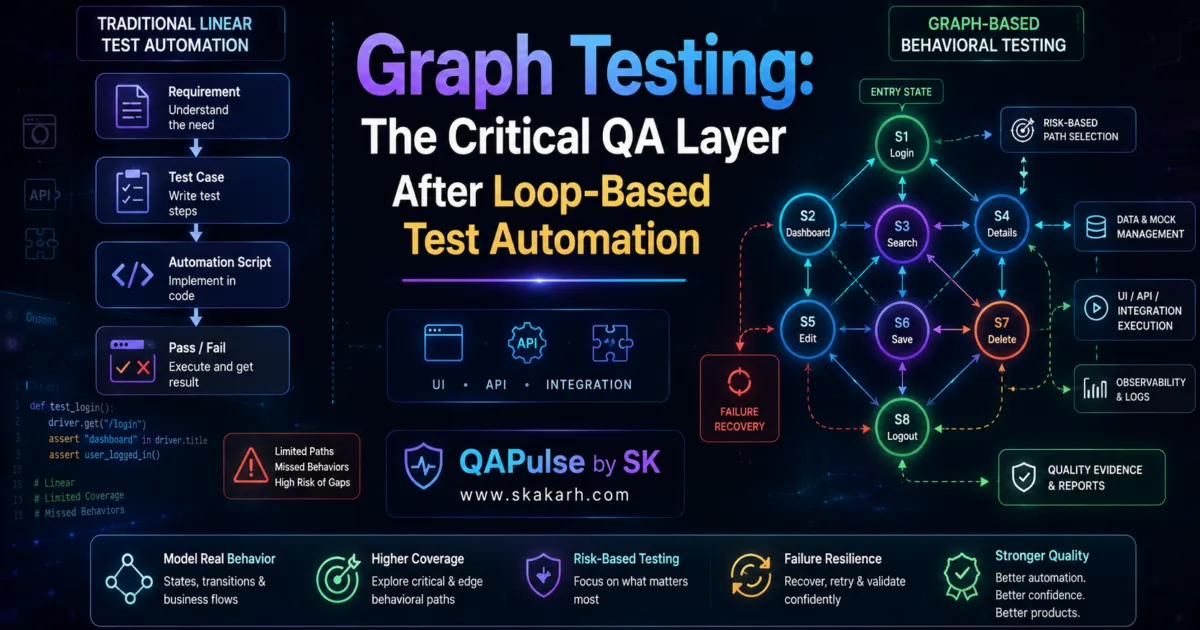
Graph Testing becomes increasingly important as modern applications move away from simple linear workflows and toward systems with branching, state transitions, retries, parallel paths, AI agents, tool calls, and human approval points. If your automation still thinks of an application as nothing more than “step 1 → step 2 → step 3,” you can achieve impressive execution counts while missing important behavior.
Traditional automation is very good at answering one question: “Did this expected sequence work?”
Complex systems require a broader question:
“Did every important state, transition, decision, recovery path, and dependency behave correctly?”
That difference is where graph testing becomes strategically useful.
Recent research in model-based testing demonstrates why this matters. Graph transformation systems can represent states and transitions explicitly, allowing testing strategies to consider state, transition, path, rule, and data-flow coverage rather than relying only on conventional execution sequences. A 2026 study also explored reinforcement learning to navigate such state spaces and generate test cases while optimizing coverage and test-suite size. (Springer)
For SDETs, this does not mean throwing away Playwright, Cypress, Selenium, pytest, REST clients, or existing CI pipelines. It means changing the model you use to reason about what should be tested.
Why Loop-Based Test Automation Starts Showing Its Limits
Consider a conventional checkout test:
def test_checkout(page):
    page.goto("/login")
    page.fill("#email", "qa@example.com")
    page.fill("#password", "secret")
    page.click("#login")

    page.goto("/products")
    page.click("#add-to-cart")
    page.click("#checkout")

    page.fill("#card", "4111111111111111")
    page.click("#pay")

    assert page.locator("#success").is_visible()
This test is perfectly reasonable.
It validates one important business journey.
But what happens when the real application behaves like this?
                    ┌── Payment Approved ──→ Confirmation
                    │
Checkout ──→ Payment
                    │
                    ├── 3DS Required ──→ Verification ──→ Confirmation
                    │
                    ├── Payment Retry ──→ Payment Provider
                    │
                    └── Payment Failed ──→ Recovery
Suddenly, one linear test represents only a fraction of the application’s behavior.
The problem isn’t necessarily that your test is badly written.
The problem is that the test model is incomplete.
A test can pass while important paths remain completely untested.
That is the fundamental reason to think about graph testing.


What Graph Testing Actually Means
Graph testing models application behavior as a collection of states, transitions, paths, dependencies, and decision points, then uses that model to determine what needs to be validated.
A simplified model might look like:
              ┌──────────────┐
              │   Logged Out │
              └──────┬───────┘
                     │ login
                     ▼
              ┌──────────────┐
              │ Logged In    │
              └──────┬───────┘
                     │ checkout
                     ▼
              ┌──────────────┐
              │ Payment      │
              └───┬──────┬───┘
                  │      │
             success    failure
                  │      │
                  ▼      ▼
            ┌────────┐ ┌─────────┐
            │Success │ │ Retry   │
            └────────┘ └────┬────┘
                             │
                             └────→ Payment
Here:
- Nodes represent states or meaningful testing points.
- Edges represent transitions or actions.
- Paths represent possible user or system journeys.
- Conditions determine which transition becomes available.
- Failures can create alternate paths.
- Loops represent retries or repeated behavior.
- Terminal states represent completion, failure, or abandonment.
This approach is closely related to model-based testing and state-transition testing. Research into graph transformation systems explicitly identifies state, transition, path, data-flow, and rule coverage as possible testing objectives. (Springer)
The important shift is simple:
Don’t measure your automation only by how many tests execute. Measure how much meaningful system behavior those tests explore.
Test Count Is Not Behavioral Coverage
This is one of the most dangerous misunderstandings in automation.
Imagine a team reports:
Automated tests: 1,850
Passed:          1,812
Failed:             38
Pass rate:        97.9%
That sounds excellent.
Now imagine the application’s behavioral model contains:
States:              47
Transitions:         126
Important paths:     310
Critical branches:    28
And your automated tests exercise:
States covered:       31 / 47
Transitions covered:  72 / 126
Critical branches:    17 / 28
Suddenly, the 97.9% pass rate tells a much smaller story.
The tests are passing.
But the system’s behavior is only partially explored.
This distinction is critical for SDETs because test execution coverage and behavioral coverage are not the same measurement.
| Traditional automation metric | Graph-oriented metric |
|---|---|
| Number of tests | States exercised |
| Pass rate | Transition coverage |
| Execution time | Path exploration |
| Failed tests | Failure-path coverage |
| Code coverage | Behavioral coverage |
| Regression count | Critical-path coverage |
| Test-suite size | Meaningful path diversity |
Neither column is useless.
The problem occurs when teams use only the left side.
Loop Engineering vs Graph Thinking
A traditional automation flow often looks like:
login()
search_product()
add_product()
checkout()
logout()
This is essentially a controlled sequence.
A graph-oriented approach asks:
What states can exist?

What transitions are possible?

Which transitions depend on conditions?

What happens when a transition fails?

What paths are business-critical?

Which states are unreachable?

Which transitions have never been tested?

Which paths become possible only after a previous failure?
That is a significantly different testing mindset.
| Loop-based automation | Graph-oriented testing |
|---|---|
| Sequence-focused | Behavior-focused |
| Usually linear | Branching |
| Explicit test flow | Model + executable paths |
| Easy to start | More strategic |
| Excellent for deterministic journeys | Better for complex state behavior |
| Can hide untested branches | Makes branches explicit |
| Test count is easy to report | Coverage requires behavioral metrics |
| Good for straightforward regression | Strong for stateful systems |
This doesn’t mean graph testing should replace ordinary automation.
In practice, the strongest architecture is often hybrid.
Use conventional automation to execute deterministic actions and graph-based reasoning to decide which behaviors deserve execution.
The Real Unit of Testing May Be the Transition
SDETs often think in terms of test cases.
Graph testing encourages you to think about transitions.
Suppose an application has:
Draft
  ↓ submit
Submitted
  ↓ approve
Approved
  ↓ activate
Active
Most teams create tests such as:
Test 1: Draft → Submitted
Test 2: Submitted → Approved
Test 3: Approved → Active
Test 4: Draft → Submitted → Approved → Active
A graph-oriented strategy additionally asks:
Can Draft → Active happen directly?
Can Submitted → Draft happen?
What happens if approval fails?
Can Approved be activated twice?
What happens when activation times out?
Can an expired Draft still be submitted?
What happens if two users approve simultaneously?
Now the test design becomes much more powerful.
You aren’t simply testing happy paths.
You are testing the rules governing movement through the system.
Example: Turning a User Journey Into a Graph
Consider an account-management workflow.
The traditional test might be:
def test_user_activation(api):
    response = api.create_user()
    assert response.status_code == 201

    response = api.activate_user()
    assert response.status_code == 200
The graph model exposes more possibilities:
                 ┌─────────────┐
                 │ User Created│
                 └──────┬──────┘
                        │
                activation request
                        │
              ┌─────────┴─────────┐
              ▼                   ▼
        Valid Request        Invalid Request
              │                   │
              ▼                   ▼
        Activating             Rejected
              │
        ┌─────┴──────┐
        ▼            ▼
    Activated      Timeout
                       │
                       ▼
                     Retry
                       │
                       └────→ Activating
Now your test strategy can explicitly target:
- Valid activation
- Invalid activation
- Duplicate activation
- Timeout
- Retry
- Recovery
- Terminal rejection
- State consistency
That is a much stronger model of behavior than a single API test.
Graph Testing Across UI, API, and Integration Layers
A major advantage of this approach is that the graph doesn’t have to belong exclusively to UI testing.
The same behavioral model can span multiple layers.
                 BUSINESS STATE
                      │
          ┌───────────┼───────────┐
          ▼           ▼           ▼
         UI          API      Integration
          │           │           │
          ▼           ▼           ▼
     Browser flow  REST call   Event/message
          │           │           │
          └───────────┼───────────┘
                      ▼
                 State Change
For example:
User submits order
        ↓
UI sends POST /orders
        ↓
Order Service creates order
        ↓
Event published
        ↓
Payment Service consumes event
        ↓
Payment succeeds
        ↓
Order becomes CONFIRMED
        ↓
UI displays confirmation
A UI-only test might validate the final screen.
An API-only test might validate the order endpoint.
An integration test might validate the event.
Graph-oriented thinking connects them.
The actual question becomes:
Did the expected state transition propagate correctly across the entire system?
That is where this approach becomes especially valuable for modern distributed applications.
A Practical Graph Model in Python
You don’t need a specialized graph database to begin.
A simple representation can be enough:
workflow = {
    "draft": ["submitted", "cancelled"],
    "submitted": ["approved", "rejected"],
    "approved": ["active"],
    "active": ["suspended"],
    "suspended": ["active", "closed"],
    "rejected": [],
    "cancelled": [],
    "closed": []
}
You can then inspect possible transitions:
def available_transitions(state):
    return workflow.get(state, [])


assert "submitted" in available_transitions("draft")
assert "approved" in available_transitions("submitted")
assert "active" in available_transitions("approved")
Now add a rule that prevents illegal transitions:
def can_transition(current, target):
    return target in workflow.get(current, [])


assert can_transition("draft", "submitted")
assert not can_transition("draft", "active")
This tiny model already gives you something valuable:
a machine-readable representation of expected behavior.
Your UI, API, and integration tests can then consume the same behavioral assumptions.
Why This Matters Even More for AI Agents
Graph thinking becomes particularly interesting when testing AI-powered systems.
A modern AI agent may behave like:
User Request
     ↓
Planner
     ↓
Retrieve Context
     ↓
Choose Tool
     ↓
Execute Tool
     ↓
Evaluate Result
   ↙       ↘
Retry       Continue
  ↓            ↓
Tool       Next Agent
  ↓            ↓
  └────────────┘
        ↓
    Final Answer
A traditional test may assert:
assert response.status_code == 200
assert "success" in response.text
But that can miss critical behavior.
The agent might have:
- Called the wrong tool
- Used invalid arguments
- Retried unnecessarily
- Entered an unintended loop
- Skipped a required validation step
- Accessed a tool it shouldn’t use
- Reached the correct answer through an invalid path
This is why testing agent trajectories is becoming important. Recent work and industry guidance around AI-agent testing emphasize evaluating not only final outputs but also the behavior of multi-step systems and their tool interactions. (IBM)
For an AI agent, the path can be part of the correctness criteria.
expected = [
    "planner",
    "retriever",
    "validator",
    "executor",
    "verifier"
]

assert actual_trace == expected
Or, for systems where multiple valid routes exist:
allowed = {
    "planner": {"retriever", "direct_answer"},
    "retriever": {"validator"},
    "validator": {"executor", "planner"},
    "executor": {"verifier"},
    "verifier": {"complete"}
}
Now the test isn’t asking only:
Did the agent produce an answer?
It asks:
Did the agent move through an allowed behavioral graph?
That is a much stronger quality question.
Graph Testing Is Not Just Another Test Case Generator
This distinction matters.
A weak implementation of graph testing would simply generate hundreds of tests from a graph.
That can create another problem:
Graph
  ↓
Thousands of paths
  ↓
Thousands of tests
  ↓
Slow CI
  ↓
Maintenance nightmare
Graph testing should therefore be combined with risk-based path selection.
For example:
critical_paths = [
    "login → checkout → payment → confirmation",
    "login → checkout → payment → retry → confirmation",
    "login → checkout → payment → failure → recovery"
]
You don’t necessarily need to execute every mathematically possible path.
You need to prioritize the paths that provide the greatest quality value.
A useful strategy is:
Business Risk
      +
Failure Probability
      +
Change Frequency
      +
User Impact
      +
Historical Defects
      ↓
Path Priority
This turns graph testing from a theoretical coverage exercise into an engineering strategy.
The State-Space Explosion Problem
There is an important limitation.
More states and more transitions can produce an enormous number of possible paths.
Imagine:
10 states
20 transitions
That may be manageable.
Now consider:
100 states
300 transitions
The number of possible paths can become enormous depending on loops and branching.
Research on graph-based model testing explicitly identifies state-space scalability as a major challenge. Recent work has explored heuristic and reinforcement-learning approaches to search large state spaces more efficiently rather than attempting exhaustive exploration. (Springer)
This leads to a critical principle:
Graph testing does not mean testing every path. It means making path selection intelligent.
That distinction should influence your architecture from day one.
A Better Strategy for SDETs
Instead of building an enormous graph and trying to execute everything, divide paths into categories:
                     ALL PATHS
                         │
             ┌───────────┴───────────┐
             │                       │
        Business Critical       Lower Risk
             │                       │
       ┌─────┴─────┐             Sampled
       │           │
    Happy Path   Failure Path
       │           │
       └─────┬─────┘
             ↓
        CI Regression
Then assign different execution frequencies.
| Path type | Suggested execution |
|---|---|
| Critical business path | Every CI run |
| High-risk failure path | Every regression |
| Security-sensitive path | Dedicated security pipeline |
| Frequently changed path | Every relevant PR |
| Low-risk path | Scheduled |
| Exploratory path | Periodically |
| Rare edge path | Targeted execution |
This is where experienced SDETs can add substantial value.
The graph is not the strategy.
The strategy determines how the graph is tested.
A Useful Mental Model
Think about traditional automation as a collection of roads.
Test A: Road 1
Test B: Road 2
Test C: Road 3
Graph-oriented testing creates a map first.
             Road B
           ↗
Start ─── Junction ─── Road C ─── Destination
           ↘
             Road D
Now you can ask:
- Which roads have never been traveled?
- Which junctions are dangerous?
- Which routes represent critical business behavior?
- Which routes fail most frequently?
- Which roads changed recently?
- Which routes contain recovery behavior?
- Which transitions have no automated validation?
That is a fundamentally more strategic way to think about automation.
And this is why graph testing should not be treated as simply another test framework or another way of writing test cases.
It is a behavioral testing model that can sit above your existing UI, API, integration, and AI-agent automation.


The strongest implementation is therefore not:
Graph Testing
      ↓
Replace Playwright
It is:
                 Behavioral Graph
                       │
          ┌────────────┼────────────┐
          ▼            ▼            ▼
       UI Tests      API Tests   Integration
          │            │            │
          └────────────┼────────────┘
                       ▼
                 Evidence + Trace
                       │
                       ▼
                Quality Decision
That architecture allows your existing automation investments to remain useful while giving your testing strategy a better representation of complex behavior.
And as applications increasingly adopt agents, event-driven workflows, branching orchestration, and stateful AI systems, that behavioral representation becomes much harder to ignore.
From Test Cases to Behavioral Models
The biggest shift in graph testing is not the introduction of a new framework. It is the change in how an SDET thinks about application behavior.
A traditional automation strategy usually begins with test cases:
Requirement
   ↓
Test Case
   ↓
Automation Script
   ↓
Execution
   ↓
Pass / Fail
A graph-oriented strategy begins one level higher:
Business Behavior
        ↓
States + Transitions
        ↓
Risk + Coverage Model
        ↓
Test Paths
        ↓
Automation
        ↓
Evidence
That difference matters because test cases are individual observations, while a behavioral graph represents the relationship between those observations.
Consider an order-management application.
A conventional test might say:
def test_approve_order():
    order = create_order()

    response = approve_order(order["id"])

    assert response.status_code == 200
    assert response.json()["status"] == "approved"
The test is useful, but it tells you almost nothing about the surrounding state model.
A stronger model asks:
Created
   │
   ├── approve ──────→ Approved
   │                       │
   │                       └── ship ─────→ Shipped
   │
   ├── cancel ───────→ Cancelled
   │
   └── expire ───────→ Expired
Now QA can ask questions that a simple test-count report cannot answer:
- Has every important transition been tested?
- Can an expired order be approved?
- Can an already approved order be cancelled?
- What happens if shipping fails?
- Can an order move backward into an invalid state?
- Which transitions are business-critical?
- Which transitions have never been exercised?
This is where graph testing becomes more than a testing technique. It becomes a way to reason about the quality of a stateful system.
Why State Matters More Than Individual Test Cases
A test case normally has a beginning and an expected ending.
A state model has a network of possible behavior.
That distinction becomes increasingly important in systems where the same operation produces different results depending on what happened previously.
For example:
             ┌─────────────┐
             │   Pending   │
             └──────┬──────┘
                    │
              payment request
                    │
          ┌─────────┴─────────┐
          ▼                   ▼
      Approved              Failed
          │                   │
          │                retry
          │                   │
          ▼                   ▼
       Completed ←──────── Processing
A payment API may return 200 OK in one scenario and still leave the system in an incorrect state.
For example:
{
  "status": "approved"
}
The response looks correct.
But if the event that should update the order never arrives, the actual business state might remain:
Order: PROCESSING
Payment: APPROVED
Shipment: NOT_READY
The API assertion passed.
The business workflow failed.
This is one of the reasons mature automation strategies need to move beyond isolated endpoint and UI assertions toward state-aware validation.
Graph Testing and the Three Layers of Modern Automation
A useful architecture is to think about UI, API, and integration tests as different execution mechanisms operating against the same behavioral model.
                    BUSINESS GRAPH
                         │
          ┌──────────────┼──────────────┐
          │              │              │
          ▼              ▼              ▼
         UI             API        Integration
          │              │              │
     Playwright       REST       Events / Queues
     Cypress          GraphQL    Services
     Selenium         gRPC       Databases
          │              │              │
          └──────────────┼──────────────┘
                         ▼
                  State Validation
                         │
                         ▼
                     Evidence
This avoids a common problem where every automation layer creates its own interpretation of the system.
For example:
UI team:
"Order is complete."

API team:
"Payment API returned 200."

Integration team:
"Payment event was published."

Business:
"Customer never received confirmation."
All three automated suites can technically pass.
The system can still be wrong.
A graph-based model gives the teams a shared behavioral vocabulary:
Order Created
      ↓
Payment Requested
      ↓
Payment Approved
      ↓
Order Confirmed
      ↓
Shipment Created
      ↓
Customer Notified
Each transition can have evidence from a different testing layer.
That makes graph testing particularly useful for distributed applications where correctness is not contained inside one browser page or one API response.
The Difference Between State Coverage and Path Coverage
One of the easiest mistakes is to treat state coverage as equivalent to behavioral coverage.
Imagine:
A → B → C
    │
    └── D
A test that executes:
A → B → C
has visited A, B, and C.
But D remains unexplored.
Now consider:
A → B → C
    │   │
    │   └── E
    │
    └── D → F
A suite could have excellent state coverage while still missing important transitions and paths.
For SDETs, it is useful to separate at least three concepts:
| Coverage type | Question |
|---|---|
| State coverage | Did we visit important states? |
| Transition coverage | Did we exercise important state changes? |
| Path coverage | Did we validate meaningful combinations of transitions? |
The third becomes difficult very quickly because possible paths can grow dramatically.
That is why exhaustive graph exploration is rarely the right production strategy.
Instead, use risk-driven path selection.
Risk-Based Path Selection
Suppose your application contains 500 possible paths.
Testing all 500 may be unnecessary.
Instead, score paths according to factors such as:
Business Impact
+
Failure History
+
Change Frequency
+
Technical Complexity
+
Security Sensitivity
+
Customer Exposure
+
Integration Count
=
Path Risk
You can represent that programmatically:
paths = [
    {
        "name": "payment_success",
        "business_impact": 10,
        "failure_history": 7,
        "change_frequency": 8,
        "integration_count": 6
    },
    {
        "name": "profile_update",
        "business_impact": 4,
        "failure_history": 2,
        "change_frequency": 3,
        "integration_count": 2
    }
]

for path in paths:
    path["risk_score"] = (
        path["business_impact"]
        + path["failure_history"]
        + path["change_frequency"]
        + path["integration_count"]
    )
Now your automation strategy can prioritize high-value behavior rather than blindly maximizing the number of generated tests.
This is a crucial distinction:
More paths do not automatically mean better testing.
Better path selection produces better testing.
Designing a Graph for a Real API Workflow
Consider a shopping API.
The workflow might contain:
POST /cart
     ↓
POST /cart/items
     ↓
POST /checkout
     ↓
POST /payment
     ↓
GET /order/{id}
A naive API automation suite may treat these as independent tests.
Graph-oriented API testing connects them:
workflow = {
    "cart_created": ["item_added"],
    "item_added": ["checkout_started"],
    "checkout_started": ["payment_pending"],
    "payment_pending": ["payment_success", "payment_failed"],
    "payment_failed": ["payment_retry"],
    "payment_retry": ["payment_success", "payment_failed"],
    "payment_success": ["order_confirmed"]
}
Now the payment failure branch becomes an explicit part of the behavioral model.
The test can validate the transition itself:
def assert_transition(graph, current_state, next_state):
    allowed = graph.get(current_state, [])

    assert next_state in allowed, (
        f"Invalid transition: {current_state} → {next_state}"
    )
Then:
assert_transition(
    workflow,
    "payment_pending",
    "payment_failed"
)
And:
assert_transition(
    workflow,
    "payment_failed",
    "payment_retry"
)
The API test is still responsible for sending requests and checking responses.
The graph adds a second responsibility:
Does the system move through the expected behavioral model?
UI Automation Can Use the Same Concept
The same model can guide browser automation.
Imagine a subscription application:
Visitor
  ↓ signup
Registered
  ↓ verify
Verified
  ↓ subscribe
Trial
  ↓ payment
Active
  ↓ cancel
Cancelled
Instead of creating dozens of disconnected UI scripts, your automation framework can associate each test with a transition.
For example:
transition = {
    "from": "Verified",
    "action": "subscribe",
    "to": "Trial"
}
The UI test executes the actual behavior:
page.goto("/pricing")
page.get_by_role("button", name="Start Trial").click()

expect(page.get_by_text("Trial Active")).to_be_visible()
The graph layer then verifies the intended state:
assert current_state == transition["to"]
This separation is valuable because the graph describes what behavior should happen, while Playwright or Cypress describes how the browser performs it.
That makes the architecture easier to evolve.
Don’t Put Business Logic Inside UI Locators
A common anti-pattern is embedding the entire behavioral model inside UI scripts.
For example:
if page.locator("#payment-failed").is_visible():
    page.click("#retry")
elif page.locator("#payment-success").is_visible():
    page.click("#continue")
As the application grows, this becomes difficult to maintain.
A better architecture separates:
Behavior Model
      ↓
Decision
      ↓
Automation Action
      ↓
UI/API/Integration Adapter
For example:
def handle_payment(state):
    if state == "payment_failed":
        return "retry_payment"

    if state == "payment_success":
        return "continue"

    return "investigate"
Then the browser layer performs the selected action.
This separation allows the same behavioral decision to be used by API or integration automation.
Graph Testing for Event-Driven Systems
Event-driven systems make behavioral modeling even more valuable.
Imagine:
Order Service
     │
     │ OrderCreated
     ▼
Message Broker
     │
     ├──────────────→ Payment Service
     │
     ├──────────────→ Inventory Service
     │
     └──────────────→ Notification Service
The system is no longer a simple request-response chain.
One event can create multiple downstream transitions.
A UI test might verify that the customer sees an order confirmation.
That does not prove:
- The event was published.
- Payment consumed it.
- Inventory reserved stock.
- Notification processing succeeded.
- Duplicate events were handled safely.
- Retry behavior worked.
- Event ordering was correct.
A graph model can represent these dependencies:
OrderCreated
   │
   ├── PaymentProcessed
   │       ↓
   │   PaymentConfirmed
   │
   ├── InventoryReserved
   │       ↓
   │   StockConfirmed
   │
   └── NotificationSent
           ↓
       CustomerNotified
The resulting test strategy becomes integration-aware rather than UI-centric.


Testing Failure Paths Is Where Graph Thinking Gets Powerful
Most automation suites naturally gravitate toward successful journeys.
That makes sense.
Happy paths are easy to understand and usually provide fast feedback.
But production failures often occur in transitions such as:
Request
  ↓
Timeout
  ↓
Retry
  ↓
Duplicate Request
  ↓
Idempotency Check
  ↓
Recovery
Consider an API client:
response = client.post("/payment")

if response.status_code == 504:
    response = client.post("/payment")
That test checks retry behavior.
But a stronger graph-oriented test asks:
Initial Request
      ↓
Timeout
      ↓
Retry
      ↓
Was payment already processed?
      │
   ┌──┴──┐
   │     │
  Yes    No
   │     │
Success  Process
Now idempotency becomes part of the behavioral model.
That can reveal defects that a simple status-code assertion will never detect.
Negative Paths Should Be First-Class Citizens
A mature graph model should deliberately represent invalid and unexpected transitions.
For example:
Authenticated
      │
      ├── valid checkout ──→ Payment
      │
      ├── session expired ─→ Login
      │
      ├── invalid cart ────→ Cart Error
      │
      └── unauthorized ────→ Access Denied
Then test both valid and invalid transitions:
assert can_transition("authenticated", "payment")
assert can_transition("authenticated", "access_denied")
assert not can_transition("anonymous", "payment")
This gives QA a more explicit way to model authorization and state rules.
It also makes security testing easier to integrate into functional automation.
Graph Testing vs Traditional Data-Driven Testing
These approaches solve different problems.
| Data-driven testing | Graph testing |
|---|---|
| Varies input values | Varies behavioral paths |
| Excellent for boundary conditions | Excellent for state transitions |
| Parameterizes existing tests | Models relationships between states |
| Easy to scale inputs | Handles branching behavior |
| Example: 100 customer types | Example: 20 customer states |
| Focuses on data combinations | Focuses on behavior combinations |
They can be combined.
For example:
@pytest.mark.parametrize(
    "customer_type",
    ["standard", "premium", "enterprise"]
)
def test_checkout_transition(customer_type):
    ...
The graph determines:
Which transition?
The data-driven layer determines:
With which data?
That combination can be considerably more powerful than either strategy alone.
Graph Testing vs Model-Based Testing
These terms overlap, but they should not automatically be treated as identical.
Model-based testing is a broader strategy in which an executable model describes expected system behavior and test cases are derived from that model.
A graph can be the structure used to represent that model.
Conceptually:
Model-Based Testing
        │
        ├── State Models
        ├── Decision Models
        ├── Rules
        └── Graphs
                │
                ▼
          Test Generation
So graph testing can be viewed as a graph-centric way of modeling and exploring behavior, while model-based testing is the broader methodology.
This distinction matters when choosing tooling and communicating strategy to an engineering team.
A Practical Architecture for SDETs
A maintainable implementation can be divided into five layers:
┌───────────────────────────────┐
│       Behavioral Model        │
│ states / transitions / rules  │
└───────────────┬───────────────┘
                ↓
┌───────────────────────────────┐
│        Path Selector           │
│ risk / coverage / priority    │
└───────────────┬───────────────┘
                ↓
┌───────────────────────────────┐
│       Test Orchestrator        │
│ scenario → executable test    │
└───────────────┬───────────────┘
                ↓
┌───────────────┼───────────────┐
│               │               │
▼               ▼               ▼
UI              API        Integration
And finally:
UI / API / Integration
          ↓
      Observability
          ↓
    Evidence Collection
          ↓
    Behavioral Verdict
The critical architectural principle is that the graph should not become another giant test framework.
Keep the behavioral model lightweight.
Keep execution adapters independent.
Keep evidence explicit.
Keep path selection configurable.
That separation prevents the graph layer from becoming a maintenance burden.
Where AI Can Strengthen Graph Testing
AI can add another layer, particularly when applications have large behavioral spaces.
An AI-assisted system could analyze:
Requirements
     +
Existing Tests
     +
Production Traces
     +
Defect History
     +
API Contracts
     +
System Events
and suggest:
Missing Transitions
      ↓
Uncovered Paths
      ↓
High-Risk Scenarios
      ↓
Candidate Tests
For example:
Observed production behavior:

checkout
   ↓
payment_timeout
   ↓
retry
   ↓
payment_success

Existing automated coverage:

checkout
   ↓
payment_success

AI recommendation:

Add coverage for:
checkout → payment_timeout → retry → payment_success
That is a much more useful application of AI than simply asking an LLM to generate another hundred test scripts.
The intelligence is being applied to behavior discovery and prioritization.
The actual test execution can remain deterministic.
The Human SDET Still Owns the Quality Decision
This is particularly important for AI-assisted graph testing.
AI can suggest:
"Transition X appears uncovered."

"Path Y has high production frequency."

"Failure path Z changed after the latest deployment."

"These three paths appear redundant."
But the SDET should determine:
Is this behavior actually required?

Is this path safe to automate?

Is the model correct?

Is this business-critical?

Should the path run on every pull request?

What evidence is sufficient?
That creates a useful separation:
AI
↓
Discover
Analyze
Prioritize
Suggest

SDET
↓
Validate
Approve
Design
Govern
The goal is not autonomous test generation for its own sake.
The goal is better behavioral coverage with less wasted automation effort.
An Interactive Exercise for SDETs
Take one important workflow from your current application.
Do not start with its existing test cases.
Instead, write only the states.
For example:
Anonymous
Logged In
Cart Empty
Cart Ready
Checkout
Payment Pending
Payment Failed
Payment Approved
Order Confirmed
Now draw the transitions.
Anonymous
   ↓ login
Logged In
   ↓ add product
Cart Ready
   ↓ checkout
Checkout
   ↓ payment
Payment Pending
   ├── success → Payment Approved
   └── failure → Payment Failed
                       │
                     retry
                       ↓
                Payment Pending
Then ask five questions:
- Which state has the highest business risk?
- Which transition has never been automated?
- Which failure path is missing?
- Which transition changed most recently?
- Which path would cause the greatest customer impact if broken?
The answers should influence your automation backlog.
That is a far more strategic use of QA engineering time than simply asking:
“How many more tests should we automate?”
A Simple Graph Coverage Report
Instead of reporting only:
1,240 tests
1,205 passed
35 failed
97.2% pass rate
consider adding:
Behavioral Coverage
────────────────────────────
States:             42 / 45
Transitions:        91 / 118
Critical paths:     18 / 20
Failure paths:      13 / 21
High-risk paths:    11 / 12
Now engineering leadership can see where the automation actually provides confidence.
The report can even identify the missing behavior:
Uncovered Critical Transitions

1. Payment Pending → Payment Timeout
2. Payment Failed → Payment Retry
3. Inventory Reserved → Inventory Release
4. Session Expired → Re-authentication
That turns a test report into a quality intelligence report.
What a Mature Graph Testing Strategy Looks Like
A mature implementation does not attempt to turn every business workflow into an enormous graph.
Instead, start with systems where state and branching genuinely create risk.
Good candidates include:
- Payment workflows
- Authentication
- Authorization
- Order lifecycle
- Subscription management
- Approval workflows
- Event-driven systems
- Distributed transactions
- Retry-heavy APIs
- AI-agent workflows
- Multi-step business processes
Avoid introducing graph complexity simply because the technique is fashionable.
A straightforward CRUD application with minimal state may gain very little from an elaborate behavioral graph.
The strategy should always begin with:
Business Complexity
        +
Behavioral Risk
        +
Statefulness
        +
Branching
        ↓
Need for Graph Modeling
not:
New technology
      ↓
Use everywhere
That distinction separates engineering strategy from tooling enthusiasm.
The Strategic Shift
The future of automation is unlikely to be defined simply by how many UI scripts, API tests, or generated cases an organization owns.
The more important question is:
How accurately does the automation represent the behavior of the system?
A large suite can still have blind spots.
A smaller suite built around meaningful states, transitions, critical paths, recovery behavior, and cross-system dependencies can provide substantially stronger confidence.
That is the real value of graph testing.
It gives SDETs a way to move from:
"These tests passed."
toward:
"These important behaviors were explored,
these critical transitions were validated,
these failure paths were exercised,
and these remaining risks are known."
That is a much stronger definition of test automation quality.
Building Graph Testing Into a Real Automation Architecture
Graph testing becomes genuinely valuable when it moves from a conceptual diagram into the architecture of your automation platform.
A common mistake is to create a graph on a whiteboard, discuss coverage, and then return to the same collection of independent Playwright, Cypress, Selenium, API, and integration scripts.
That creates two disconnected systems:
Behavior Model
      ↓
Nice diagram
      ✕

Automation
      ↓
Independent test scripts
A stronger design connects them:
Requirements
     ↓
Behavior Model
     ↓
Graph
     ↓
Risk-Based Path Selection
     ↓
Test Scenario
     ↓
UI / API / Integration Execution
     ↓
Evidence
     ↓
State + Transition Validation
     ↓
Quality Decision
The graph should therefore become a decision layer, not another execution framework.
Your existing automation tools remain responsible for interacting with the system.
The graph determines which behavior matters, which transitions need coverage, and which evidence should be collected.
This distinction keeps the architecture practical.
A Graph-Aware Test Repository
A conventional repository might look like this:
tests/
├── ui/
│   ├── login.spec.ts
│   ├── checkout.spec.ts
│   └── payment.spec.ts
├── api/
│   ├── users.py
│   ├── orders.py
│   └── payments.py
└── integration/
    ├── events.py
    └── messaging.py
There is nothing inherently wrong with this structure.
But behavioral relationships are often hidden inside individual files.
A graph-aware repository can add an explicit model:
tests/
├── models/
│   ├── order_graph.py
│   ├── payment_graph.py
│   └── subscription_graph.py
├── paths/
│   ├── critical_paths.py
│   └── failure_paths.py
├── ui/
├── api/
├── integration/
├── validators/
└── reports/
Now the architecture communicates an important distinction:
models/
    What behavior exists?

paths/
    What behavior should we test?

tests/
    How do we execute it?

validators/
    How do we prove it worked?

reports/
    What risk remains?
This is much easier to scale than embedding every behavioral decision inside UI scripts.
Keep the Graph Independent From the UI
One of the most important architectural decisions is keeping the behavioral model independent from implementation details.
Avoid this:
if page.locator("#payment-error").is_visible():
    page.get_by_role("button", name="Retry").click()
inside the graph definition itself.
Instead:
payment_graph = {
    "payment_pending": [
        "payment_success",
        "payment_failed",
        "payment_timeout"
    ],
    "payment_failed": [
        "payment_retry"
    ]
}
The graph describes behavior.
The UI adapter knows how to interact with the browser:
class PaymentUI:
    def retry(self, page):
        page.get_by_role(
            "button",
            name="Retry Payment"
        ).click()
The API adapter does the equivalent through HTTP:
class PaymentAPI:
    def retry(self, client, payment_id):
        return client.post(
            f"/payments/{payment_id}/retry"
        )
Now both layers can execute the same conceptual transition.
              Payment Graph
                    │
          payment_failed
                    │
              retry_payment
             /            \
            ↓              ↓
       UI Adapter       API Adapter
            │              │
        Browser          HTTP API
This is one of the strongest reasons to introduce graph thinking above the automation layer.
Graph Testing Should Use a Canonical State Model
If different teams use different definitions of system state, your coverage numbers quickly become meaningless.
Suppose the UI team says:
"Order Complete"
The API team says:
"Payment Captured"
And the integration team says:
"Order Event Published"
These may represent three different states.
Create a canonical model instead:
ORDER_STATES = {
    "created",
    "payment_pending",
    "payment_failed",
    "payment_captured",
    "confirmed",
    "shipped",
    "cancelled"
}
Then define valid transitions:
ORDER_TRANSITIONS = {
    "created": ["payment_pending", "cancelled"],
    "payment_pending": [
        "payment_captured",
        "payment_failed"
    ],
    "payment_failed": ["payment_pending"],
    "payment_captured": ["confirmed"],
    "confirmed": ["shipped"],
    "shipped": [],
    "cancelled": []
}
This creates a shared vocabulary across QA, development, product, and automation.
It also makes invalid behavior easier to detect.
Detecting Illegal Transitions Automatically
Once transitions are represented as data, you can test them systematically.
def is_valid_transition(current, target):
    return target in ORDER_TRANSITIONS.get(current, [])
Then:
assert is_valid_transition(
    "payment_pending",
    "payment_captured"
)

assert not is_valid_transition(
    "cancelled",
    "shipped"
)
That second assertion is particularly valuable.
Traditional test suites often validate expected behavior without explicitly checking whether unexpected transitions are impossible.
A mature automation strategy needs both.
Expected Behavior
       +
Forbidden Behavior
       ↓
Complete Behavioral Contract
This is where graph testing starts contributing to negative testing, security testing, and business-rule validation at the same time.
Transition Contracts Are More Valuable Than Status Codes Alone
Consider:
response = client.post("/orders/123/approve")

assert response.status_code == 200
This is useful, but incomplete.
A stronger validation might be:
response = client.post("/orders/123/approve")

assert response.status_code == 200

order = client.get("/orders/123").json()

assert order["status"] == "approved"
Now add the behavioral contract:
assert is_valid_transition(
    previous_state="submitted",
    target_state=order["status"]
)
And validate that forbidden states are not reached:
assert order["status"] not in {
    "draft",
    "cancelled",
    "rejected"
}
The test is now validating:
- Transport behavior
- API behavior
- Business state
- Transition validity
That is significantly stronger than checking HTTP success alone.
Graph Testing and Contract Testing Can Work Together
Graph testing does not replace API contract testing.
The two solve different problems.
Contract testing asks:
Does this service respect the agreed interface?
Graph testing asks:
Does the system move through the expected behavioral states?
For example:
API Contract
     ↓
POST /orders
     ↓
HTTP 201
     ↓
Order Created
     ↓
Graph Transition
     ↓
Payment Pending
You can therefore combine:
Contract Assertions
        +
State Assertions
        +
Transition Assertions
This is particularly useful in microservice environments where an API can remain contract-compatible while its downstream behavior becomes incorrect.
Finding Dead States
One practical advantage of graph modeling is the ability to detect states that are technically defined but never reachable.
Consider:
A → B → C

D
If nothing points to D, it may be unreachable.
You can detect this programmatically:
def find_reachable(graph, start):
    visited = set()
    stack = [start]

    while stack:
        state = stack.pop()

        if state in visited:
            continue

        visited.add(state)
        stack.extend(graph.get(state, []))

    return visited
Then:
reachable = find_reachable(
    ORDER_TRANSITIONS,
    "created"
)

print(reachable)
Compare the reachable states with the declared model:
all_states = set(ORDER_STATES)

unreachable = all_states - reachable

print("Unreachable:", unreachable)
If an important business state is unreachable, you have discovered a potential design, configuration, or test-model problem before waiting for a production defect.
Finding Dead-End Behavior
The reverse problem also matters.
Suppose:
Created
   ↓
Payment Pending
   ↓
Payment Failed
and nothing can leave Payment Failed.
If that is not intentional, the graph reveals the defect immediately.
You can identify terminal states:
terminal_states = [
    state
    for state, transitions in ORDER_TRANSITIONS.items()
    if not transitions
]
Then classify them:
Expected terminal states:
- shipped
- cancelled

Unexpected terminal states:
- payment_failed
- payment_pending
This turns structural analysis into a QA activity.
Detecting Cycles and Infinite Retry Risks
Loops are not inherently bad.
Retries are often necessary.
The problem is an uncontrolled loop.
For example:
Payment Pending
      ↓
Payment Failed
      ↓
Retry
      ↓
Payment Pending
      ↓
Payment Failed
      ↓
Retry
      ↓
...
The automation must distinguish between:
Controlled Retry
and:
Unbounded Retry
A simple model can include retry metadata:
transitions = {
    "payment_failed": {
        "retry": {
            "target": "payment_pending",
            "max_attempts": 3
        }
    }
}
Then your test can verify the limit:
assert retry_count <= 3
The graph now becomes useful for reliability testing.
You can test:
- Retry limits
- Backoff behavior
- Duplicate requests
- Timeout handling
- Circuit-breaker transitions
- Recovery states
- Permanent failure states
This is particularly valuable in distributed systems where retry logic can accidentally amplify failures.
Graph Testing for Authentication and Authorization
Authentication is another excellent candidate.
Consider:
Anonymous
   ↓ login
Authenticating
   ├── success → Authenticated
   └── failure → Login Failed
                       │
                       └── retry
Now add session behavior:
Authenticated
   ↓ timeout
Session Expired
   ↓ re-authenticate
Authenticated
And authorization:
Authenticated
      │
      ├── authorized resource → Resource
      │
      └── unauthorized resource → 403
This allows security-related transitions to become explicit test targets.
For example:
assert response.status_code == 403

assert current_state != "resource_access_granted"
You can then combine role-based testing with behavioral paths:
roles = ["viewer", "editor", "admin"]

for role in roles:
    ...
The role represents one dimension.
The graph represents another.
That produces much richer coverage than simply adding more test cases.
Graph Testing for Role and Permission Combinations
Imagine:
Viewer
  ├── Read → Allowed
  ├── Edit → Denied
  └── Delete → Denied

Editor
  ├── Read → Allowed
  ├── Edit → Allowed
  └── Delete → Denied

Admin
  ├── Read → Allowed
  ├── Edit → Allowed
  └── Delete → Allowed
Instead of manually writing every combination, represent the authorization rules as data.
permissions = {
    "viewer": {
        "read": True,
        "edit": False,
        "delete": False
    },
    "editor": {
        "read": True,
        "edit": True,
        "delete": False
    },
    "admin": {
        "read": True,
        "edit": True,
        "delete": True
    }
}
Then your automation can validate the graph of allowed and forbidden transitions.
This approach also makes policy changes easier to detect.
If a requirement changes from:
Editor → Delete = Denied
to:
Editor → Delete = Allowed
the behavioral model changes explicitly.
That change can trigger the relevant automation.
Graph Testing in CI/CD
A graph model becomes even more useful when integrated into CI/CD.
Don’t execute every possible path on every pull request.
Instead, classify paths.
Pull Request
     ↓
Changed Components
     ↓
Affected Graph Nodes
     ↓
Affected Transitions
     ↓
Relevant Test Paths
     ↓
Targeted Execution
For example, if a developer changes payment retry logic, there is little reason to execute every profile-management path.
The pipeline can identify:
Changed:
payment-service/retry.py

Affected:
Payment Failed
Payment Pending
Payment Retry
Payment Success

Execute:
Critical payment paths
Failure paths
Retry paths
Idempotency tests
This can reduce unnecessary CI execution while increasing the relevance of the tests that do run.
That is where graph testing can contribute to test selection, not just test design.
Change Impact Analysis
Suppose a developer modifies:
PaymentService.retry()
The graph can reveal:
Payment Failed
      ↓
Retry
      ↓
Payment Pending
      ↓
Payment Success
The affected paths become obvious.
Without a behavioral model, teams often depend on:
- Folder ownership
- Test tags
- Developer knowledge
- Manual regression lists
- Broad regression suites
Those approaches work until the system becomes sufficiently complex.
A graph provides another source of truth.
Code Change
    ↓
Behavioral Dependency
    ↓
Affected Transition
    ↓
Affected Paths
    ↓
Relevant Tests
This is a particularly promising direction for AI-assisted test orchestration.
Combining Graph Testing With Production Observability
The graph does not have to be based exclusively on requirements.
Production telemetry can reveal how users actually move through the system.
For example:
Requirement Model:

Checkout
 ↓
Payment
 ↓
Confirmation
Production traces reveal:
Checkout
 ↓
Payment
 ↓
3DS
 ↓
Payment
 ↓
Confirmation
Your documentation may never have described the 3DS transition clearly.
Production behavior did.
Observability data can therefore help identify:
- Frequently executed paths
- Rare paths
- High-failure transitions
- Unexpected loops
- Abandoned workflows
- Retry-heavy behavior
- Unusual state combinations
The strongest strategy can combine:
Requirements
+
Architecture
+
Existing Tests
+
Production Traces
+
Defect History
to continuously improve the behavioral model.
From Static Graph to Living Quality Model
This is where the concept becomes much more interesting.
A static graph says:
This is how the system should behave.
A living quality model can compare:
Expected Behavior
        VS
Observed Behavior
For example:
Expected:

Payment Pending
      ↓
Payment Approved
      ↓
Order Confirmed
Observed:
Payment Pending
      ↓
Payment Approved
      ↓
Payment Approved
      ↓
Order Confirmed
The duplicate transition may indicate an idempotency problem.
Another example:
Expected:

Payment Failed
      ↓
Retry

Observed:

Payment Failed
      ↓
Payment Failed
      ↓
Payment Failed
The graph reveals that the recovery transition never occurred.
This makes the behavioral model useful beyond automated regression.
It can become a foundation for production-quality analysis.


Where Graph Testing Should Not Be Used
An expert strategy also needs boundaries.
Graph testing is not automatically better than conventional automation.
Consider a simple page:
Open Page
   ↓
Enter Search
   ↓
Click Search
   ↓
Verify Results
Creating an elaborate behavioral graph here may add more maintenance than value.
Traditional automation is probably sufficient.
Graph testing becomes more compelling when you have:
- Multiple states
- Significant branching
- Complex dependencies
- Stateful APIs
- Retry behavior
- Event-driven workflows
- Long-running processes
- Multiple actors
- Approval flows
- Distributed transactions
- AI-agent decisions
A useful decision rule is:
Complexity Low
    ↓
Traditional Automation

Complexity Medium
    ↓
State-Based Modeling

Complexity High
    ↓
Graph + Risk + Observability
Don’t introduce graph infrastructure merely to claim that your organization uses advanced testing.
Introduce it where it solves an actual coverage or reasoning problem.
Common Mistakes When Adopting Graph Testing
Mistake 1: Modeling Everything
If every click becomes a graph node, the model becomes unreadable.
Use meaningful business or system states.
Bad:
ButtonClicked
DropdownOpened
InputFocused
ButtonClickedAgain
Better:
Checkout Started
Payment Pending
Payment Approved
Order Confirmed
Mistake 2: Testing Every Possible Path
Exhaustive path execution can become computationally expensive and operationally useless.
Prioritize based on risk.
Mistake 3: Replacing Existing Automation
Your Playwright, Cypress, Selenium, API, and integration tools are execution mechanisms.
Keep them.
Use the graph to coordinate and reason about behavior.
Mistake 4: Measuring Only Graph Size
A graph with 1,000 nodes is not automatically better than one with 100.
Measure:
Critical State Coverage
Critical Transition Coverage
Failure Path Coverage
Risk Coverage
Defect Detection
Mistake 5: Ignoring Negative Transitions
A good behavioral model must describe what must not happen.
Mistake 6: Treating the Model as Permanent
Applications change.
Requirements change.
Production behavior changes.
The graph must evolve with them.
A Practical Adoption Roadmap
If your current automation is entirely sequence-based, don’t rebuild everything.
Start small.
Step 1: Select One Stateful Workflow
Choose something such as:
Payment
Authentication
Order Lifecycle
Subscription
Approval
Step 2: Identify States
Write down the meaningful states.
Created
Pending
Approved
Failed
Completed
Step 3: Identify Transitions
Created → Pending
Pending → Approved
Pending → Failed
Failed → Pending
Approved → Completed
Step 4: Identify Forbidden Transitions
Completed → Pending
Failed → Completed
Cancelled → Approved
Step 5: Map Existing Tests
Determine which existing tests already cover each transition.
Step 6: Find the Gaps
For example:
Covered:
Created → Pending
Pending → Approved
Approved → Completed

Missing:
Pending → Failed
Failed → Pending
Step 7: Automate the Missing Risk
Use your existing API, UI, or integration framework.
Step 8: Add the Model to CI
Run critical paths frequently and lower-risk paths on scheduled pipelines.
Step 9: Add Production Evidence
Compare real-world behavior with the expected model.
This incremental approach prevents graph testing from becoming a giant transformation project.
A Useful Graph Testing Maturity Model
You can assess your organization using five levels.
| Level | Capability |
|---|---|
| Level 1 | Linear automated tests |
| Level 2 | State-aware test design |
| Level 3 | Explicit behavioral graph |
| Level 4 | Risk-based path selection |
| Level 5 | Graph + production evidence + intelligent orchestration |
At Level 1, the team primarily asks:
Did the test pass?
At Level 3:
Did we cover the important transitions?
At Level 4:
Are we prioritizing the right behavioral paths?
At Level 5:
Does observed production behavior agree with our expected model, and are our tests continuously adapting to meaningful risk?
That final question is much closer to modern quality engineering.
What This Means for SDETs
The rise of graph-oriented systems does not make traditional automation skills irrelevant.
It changes where those skills fit.
A modern SDET can increasingly operate across:
Test Automation
      +
API Engineering
      +
Distributed Systems
      +
Observability
      +
State Modeling
      +
AI-Assisted Analysis
      +
Risk Engineering
That is a significant evolution from simply writing more scripts.
An SDET who understands behavioral graphs can communicate more effectively with developers and architects because the discussion moves from:
“We need more automated tests.”
to:
“The payment failure-to-retry transition has no automated coverage, it is high risk, and production traces show it occurs frequently.”
That is a much stronger engineering conversation.
The Future: From Test Suites to Behavioral Coverage Systems
The long-term opportunity is not simply generating more tests.
It is building systems that understand:
What can the application do?
        ↓
What should it do?
        ↓
What paths matter?
        ↓
What has been tested?
        ↓
What actually happened?
        ↓
Where is the remaining risk?
Graph testing provides a useful foundation for that model.
AI can help discover paths.
Observability can provide evidence.
Automation frameworks can execute scenarios.
CI/CD can prioritize execution.
SDETs can govern the quality model.
The resulting architecture looks like:
                 REQUIREMENTS
                      │
                      ▼
              BEHAVIORAL MODEL
                      │
                      ▼
               GRAPH / STATES
                      │
          ┌───────────┴───────────┐
          ▼                       ▼
      RISK ENGINE             AI ANALYSIS
          │                       │
          └───────────┬───────────┘
                      ▼
                PATH SELECTION
                      │
          ┌───────────┼───────────┐
          ▼           ▼           ▼
         UI          API      INTEGRATION
          │           │           │
          └───────────┼───────────┘
                      ▼
                  EVIDENCE
                      │
          ┌───────────┴───────────┐
          ▼                       ▼
    Expected State          Observed State
          │                       │
          └───────────┬───────────┘
                      ▼
                QUALITY DECISION
That is a much more powerful vision of test automation than a repository containing thousands of scripts.
Internal Blog Links
- 50 Playwright Commands Every QA Engineer Should Know
- Claude Code v2.1.233: GitLab MRs, Safer Builds, Smarter Sessions and MCP Fixes
- Mobile Regression Testing: A Practical Strategy for Reliable App Releases
- Kubernetes Upgrade Testing: How to Catch API Breaks Before Production
- Agentic Test Creation vs AI Test Generation: What’s the Real Difference?
- AI Test Automation With Humans in the Loop: Governance, Metrics, and the Practical Guide
Internal Series Links
- Learn MCP – Zero to Hero
- Learn AI Agents for QA – Zero to Hero
- Playwright Automation – Zero to Hero
- TencentDB Agent Memory: Complete Zero to Hero
- LangGraph: Complete Zero to Hero
- Learn Python – Zero to Hero
- OpenAI Codex: Complete Zero to Hero
- Cursor AI: Complete Zero to Hero
- Claude Code Tutorial: Complete Zero to Hero
- AutoGen: Complete Zero to Hero Guide
- Free QA Resources Built From Real Experience
- QA Glossary: Test Automation Terms Every Engineer Should Know
External Links
- Graph theory — Wikipedia — useful for basic graph terminology.
- Graphviz Documentation — useful if demonstrating graph visualization.
- Playwright Documentation — supports UI automation examples.
- Cypress Documentation — useful when discussing browser automation.
- Selenium Documentation — supports Selenium-related comparisons.
- OpenTelemetry Documentation — particularly relevant to the observability section.
- Google’s Site Reliability Engineering resources — useful for reliability, production behavior, and risk discussions.
People Asked Questions
What is graph testing?
Graph testing is a software testing approach that represents application behavior as states and transitions, allowing QA teams to validate important workflows, branches, and paths rather than relying only on isolated test cases.
How is graph testing different from traditional test automation?
Traditional automation generally executes predefined scenarios. Graph testing models the relationships between states and transitions, making it easier to identify missing paths, invalid transitions, recovery behavior, and behavioral coverage gaps.
Is graph testing the same as model-based testing?
Not exactly. Model-based testing is the broader methodology of deriving tests from a behavioral model. Graphs can be used as the structure for that model, making graph-based testing one practical form of model-based testing.
Can graph testing work with API testing?
Yes. API requests can trigger transitions between application states, allowing tests to validate both the API response and the resulting business state.
Can graph testing be used with Playwright?
Yes. Playwright can execute the UI actions associated with graph transitions while the behavioral model remains independent of browser-specific implementation details.
What is transition coverage?
Transition coverage measures whether important state changes in a behavioral model have been exercised by tests.
What is path coverage in graph testing?
Path coverage evaluates whether meaningful sequences of transitions through the application have been exercised. Because exhaustive paths can become extremely large, risk-based path selection is usually more practical.
Does graph testing replace UI and API testing?
No. Graph testing provides a behavioral modeling and orchestration layer. UI, API, and integration frameworks can continue to execute the actual scenarios.
When should QA teams use graph testing?
Graph testing is particularly useful for stateful, branching, event-driven, distributed, or workflow-heavy applications such as payments, authentication, subscriptions, approvals, and order management.
Can AI be used with graph testing?
Yes. AI can help identify potential missing transitions, analyze production behavior, prioritize risky paths, detect redundant tests, and recommend candidate scenarios. Human validation should remain part of the quality process.
AEO Optimization
What is graph testing?
Graph testing models application states and transitions so QA teams can validate behavioral paths, including successful, failed, recovery, and forbidden transitions.
Why use graph testing?
Graph testing helps identify behavioral coverage gaps that can remain hidden when automation is organized only as independent UI, API, or integration test cases.
When should you use graph testing?
Use graph testing when an application has significant state, branching, retries, workflows, event-driven behavior, or complex dependencies between actions.
AI Overview Optimization
Graph testing is a software testing approach that models application states, transitions, and behavioral paths so QA teams can validate complex workflows beyond isolated automated test cases.
| Approach | Main Question | Primary Strength |
|---|---|---|
| Test case automation | Does this scenario work? | Repeatable execution |
| State-based testing | What states exist? | State validation |
| Model-based testing | What behavior should be tested? | Model-driven coverage |
| Graph testing | Which states and transitions matter? | Behavioral path analysis |
| Risk-based testing | What should we test first? | Risk prioritization |
| Observability | What actually happened? | Production evidence |
Conclusion
Graph testing is not about replacing traditional test automation with diagrams.
It is about giving complex systems a behavioral structure that automation can reason about.
Linear tests remain excellent for deterministic workflows. API tests remain essential for service validation. UI automation remains valuable for customer journeys. Integration tests remain critical for distributed behavior.
The problem appears when these tests exist without a shared understanding of how the system moves between states.
A graph provides that missing layer.
It lets teams model states, transitions, branches, retries, recovery paths, forbidden behavior, and cross-system dependencies. It also creates a foundation for risk-based path selection, change impact analysis, CI optimization, production trace comparison, and AI-assisted test orchestration.
The most important lesson is therefore not:
“Use graphs because they are more advanced.”
It is:
Model the behavior that matters, then automate the paths that create the most confidence.
That is where graph testing becomes a practical QA strategy rather than another testing buzzword.
Final Key Takeaways
- Graph testing shifts attention from individual test cases toward system behavior.
- A graph represents meaningful states and transitions, not merely UI clicks.
- State coverage, transition coverage, and path coverage answer different questions.
- Test count and pass rate alone cannot demonstrate behavioral coverage.
- Existing Playwright, Cypress, Selenium, API, and integration automation can remain the execution layer.
- A behavioral graph should remain independent from UI and implementation details.
- Risk-based path selection is more practical than attempting exhaustive path execution.
- Failure, retry, recovery, and forbidden transitions deserve explicit coverage.
- Graph models can expose unreachable states, dead ends, invalid transitions, and uncontrolled loops.
- API contract testing and graph testing complement rather than replace each other.
- Production traces can reveal behavioral paths missing from requirements and test suites.
- AI is most valuable when it helps discover, prioritize, and analyze behavioral paths—not simply generate more scripts.
- The SDET’s role increasingly includes behavioral modeling, risk analysis, observability, and quality governance.
- The strongest architecture connects requirements → graph → risk → automation → evidence → quality decision.
- The goal is not the largest graph or the largest test suite. The goal is the highest-confidence coverage of meaningful system behavior.
Continue Learning
Explore more expert articles on Mobile Testing, Backend & API, AI & Agentic, AI Tools, n8n, LangChain, CrewAI, MCP Servers, AI Agents, LlamaIndex, Docker, FastAPI, Playwright, Cypress, Test Automation, DevOps, and Software Engineering at www.skakarh.com.
QAPulse by SK delivers expert release analysis, AI engineering insights, enterprise automation strategies, migration guidance, DevOps best practices, and practical testing knowledge to help software professionals build scalable, intelligent, and production-ready software systems.