 QA
QA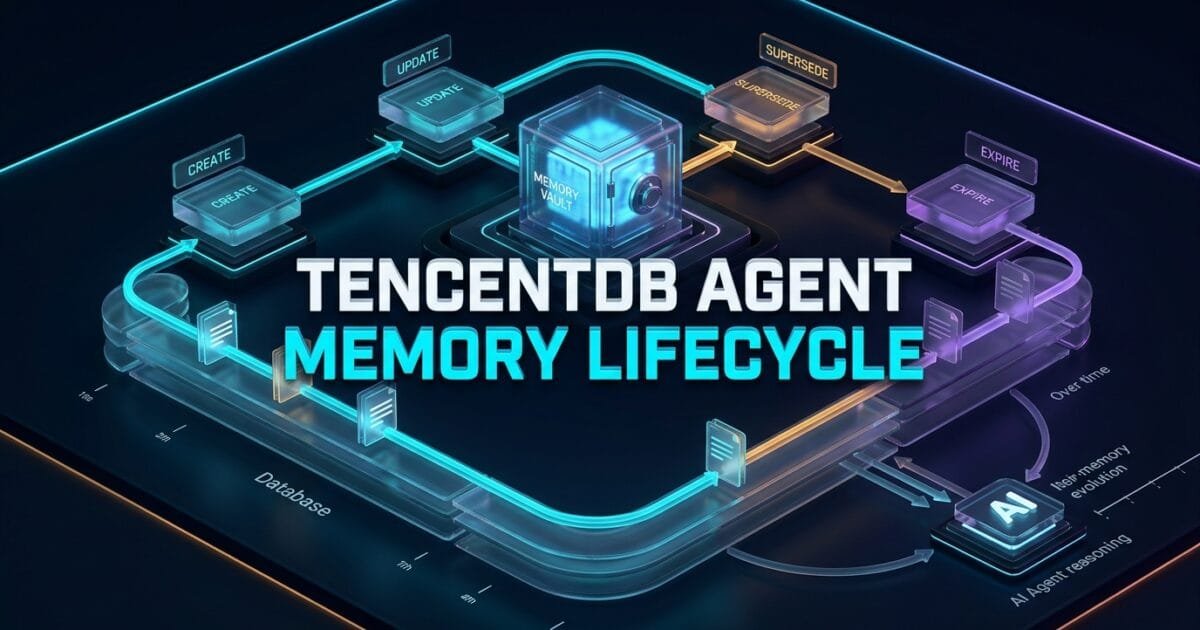
TencentDB Agent Memory Lifecycle defines how an Agent turns information into durable memory, determines whether an existing memory should change, replaces outdated knowledge, and eventually removes or archives information that should no longer influence future decisions.
That distinction matters because production Agent memory is not simply a database with an insert() operation.
A real Agent continuously receives new information:
User says:
"I prefer Playwright."

Later:

"Actually, this project has moved to Cypress."

Later:

"We migrated the project back to Playwright."
If every statement becomes an independent permanent record, retrieval can eventually return:
Playwright
Cypress
Playwright
The database may be perfectly healthy.
The Agent can still be wrong.
The real engineering problem is therefore memory state management: deciding which information is current, which information has been replaced, which information remains historically useful, and which information should no longer participate in retrieval.
Tencent Cloud’s current Agent Memory documentation describes TencentDB Agent Memory as an enterprise memory engine providing short-term, long-term, and team memory capabilities, with long-term memory organized into multiple layers and retrieval/governance capabilities. (Tencent Cloud)
For SDETs and AI engineers, this changes the testing question from:
“Was the memory successfully saved?”
to:
“After memory changes over time, does the Agent retrieve the correct version of reality?”
Key Architectural Takeaways for SDETs
- Memory creation must be selective: every conversation message should not automatically become permanent memory.
- Updates need identity resolution: the system must recognize when new information refers to an existing fact.
- Supersession must preserve correctness: obsolete memories should stop competing with active memories while historical information can remain available for audit and debugging.
- Expiration needs policy: temporary information should not remain permanently retrievable.
- Retrieval is the final quality gate: lifecycle metadata matters only if retrieval respects it.
⚡ Executive Summary: Memory Is a Lifecycle, Not CRUD
A simplistic Agent-memory implementation looks like this:
Conversation
     ↓
Save Memory
     ↓
Retrieve Memory
     ↓
LLM
A production implementation is more sophisticated:
Conversation
     ↓
Memory Candidate
     ↓
Identity + Relevance + Confidence
     ↓
Create / Update / Supersede / Ignore
     ↓
Active Memory
     ↓
Retrieve
     ↓
Inject Into Agent Context
     ↓
Agent Decision
     ↓
Lifecycle Evaluation
     ↓
Expire / Archive / Retain
Tencent Cloud’s Agent Memory integration guidance similarly describes the core Agent integration around recall + write: memories can be recalled before the user message reaches the LLM, while the completed conversation can be written back so facts, preferences, and instructions can be extracted and accumulated. (Tencent Cloud)
That creates an important architectural boundary:
Writing memory is not the end of the lifecycle.
The lifecycle continues through future retrievals, corrections, replacements, expiration, and governance.

The Core Problem: Why Permanent Memory Without Lifecycle Management Fails
Imagine an Agent supporting an engineering team.
On Monday:
database = MySQLOn Wednesday:
database = PostgreSQLOn Friday:
database = PostgreSQL
version = 17
If the system simply appends every observation, the Agent’s memory becomes an accumulation of historical statements rather than a representation of the current environment.
That creates several failure modes.
Duplicate Memory
The same fact can be stored repeatedly:
preferred_language = Python
preferred_language = Python
preferred_language = Python
This increases storage and retrieval noise without adding knowledge.
Contradictory Memory
Two values can remain active:
framework = Selenium
framework = Playwright
The retrieval layer now has to resolve a conflict that the memory lifecycle should have handled earlier.
Stale Memory
A fact may have been correct when stored but become invalid later:
active_release = 4.7A month later, the Agent still retrieves 4.7.
Temporary Memory Becoming Permanent
Some information has a naturally short lifetime:
current_incident = payment-api-degraded
current_environment = staging-17
current_sprint = sprint-42
These records should not necessarily remain active forever.
Incorrect Historical Retrieval
History itself can be valuable.
The problem occurs when historical information is presented to the Agent as if it were current.
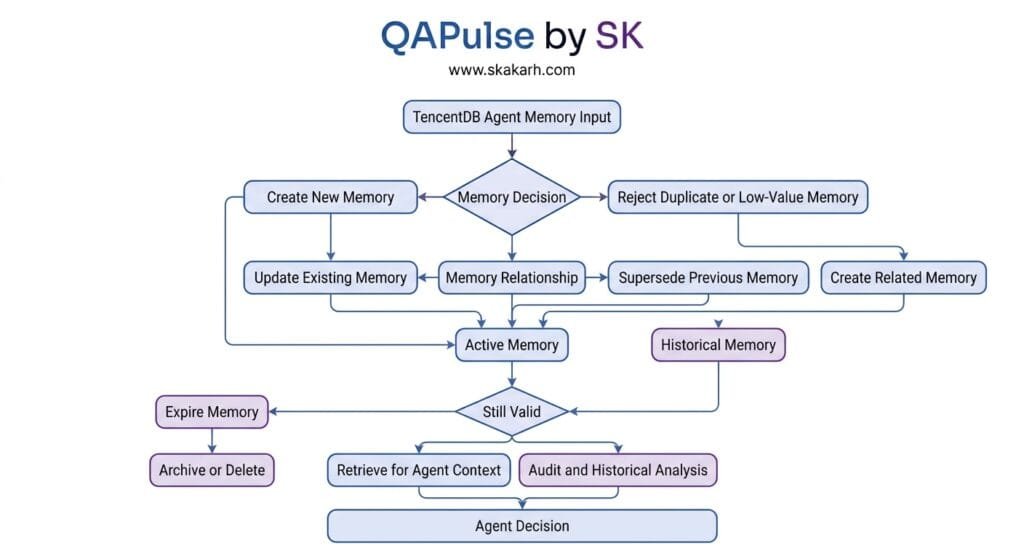
This is why a mature memory system needs explicit lifecycle states.
6 Core Pillars of TencentDB Agent Memory Lifecycle
1. Create Only Memories That Have Future Value
Memory creation is the first lifecycle decision.
An Agent can encounter hundreds of pieces of information during one interaction:
"Hi"

"I am working on a Playwright project."

"The login endpoint is /api/login."

"Today is Friday."

"I prefer TypeScript."

"The staging environment is currently broken."
Storing all of these as long-term memories would be a poor design.
The lifecycle should first determine whether a piece of information has future utility.
A useful memory candidate might be:
{
  "key": "preferred_language",
  "value": "TypeScript"
}
Another might be:
{
  "key": "preferred_test_framework",
  "value": "Playwright"
}
But:
{
  "key": "greeting_received",
  "value": true
}
probably has little long-term value.
The memory admission process should therefore evaluate:
Is it reusable?
Is it reliable?
Is it relevant beyond this interaction?
Is it specific?
Is it worth storage?
This is particularly important when memory is used as Agent context.
Bad memory creates bad context.
2. Match New Information Against Existing Memory
Before inserting new information, the Agent should determine whether an equivalent memory already exists.
Suppose the active memory is:
{
  "key": "testing_framework",
  "value": "Playwright",
  "status": "active"
}
The next conversation contains:
"We've moved the project to Cypress."The correct operation is probably not:
INSERT testing_framework = Cypresswithout examining the existing record.
The system first needs to establish the relationship:
Incoming Information
        ↓
Semantic / Key Match
        ↓
Existing Memory?
    ↙          ↘
   Yes          No
    ↓            ↓
Evaluate       Create
Relationship
This identity-resolution stage is what separates memory management from ordinary event logging.
Tencent Cloud’s V3 Agent Memory API documentation describes memory organization across conversation records, atomic memories, scenario memories, and core memories, with interfaces for querying, correcting, deleting, and maintaining longer-term information. (Tencent Cloud)
3. Update When the Memory Identity Remains the Same
An update is appropriate when the underlying concept remains the same but its current value changes.
Example:
Before:

preferred_editor = VS Code
New information:
"I switched to Cursor."The semantic identity is still:
preferred_editorThe value changes:
VS Code
   ↓
Cursor
A lifecycle-aware record can therefore become:
{
  "key": "preferred_editor",
  "value": "Cursor",
  "status": "active",
  "updated_at": "2026-08-22T10:30:00Z"
}
The key idea is:
Update the current representation when the identity remains the same.
This avoids unnecessary duplication.
But there are cases where simply overwriting the previous value is not enough.
That is where supersession becomes useful.
4. Supersede When a New Memory Replaces an Old Reality
Supersession is particularly useful when historical state matters.
Consider:
Memory A:
framework = Selenium
Later:
Memory B:
framework = Playwright
Instead of deleting Memory A, the lifecycle can express:
Memory A
Selenium
status = superseded

        ↓

Memory B
Playwright
status = active
This produces a clear temporal relationship.
The retrieval layer should normally favor:
ACTIVEwhile audit and debugging systems can still inspect:
SUPERSEDEDThis distinction becomes extremely valuable when debugging an Agent.
Suppose an Agent recommended Selenium yesterday.
An engineer can ask:
Why did the Agent make that recommendation?If the previous memory was physically deleted, the answer may be lost.
If the previous memory was superseded, the lifecycle history can explain the transition.
5. Expire Information That Has a Limited Lifetime
Not every memory should remain active indefinitely.
Some information has a natural expiration boundary:
temporary_environment = staging-17or:
current_release = v4.8.1or:
active_incident = payment-api-outageThe memory lifecycle should be capable of expressing:
CREATED
   ↓
ACTIVE
   ↓
EXPIRING
   ↓
EXPIRED
Expiration can be implemented using:
- explicit timestamps;
- TTL policies;
- domain events;
- replacement events;
- scheduled cleanup;
- confidence decay;
- business-defined validity windows.
The critical point is that expiration is a semantic decision, not merely a storage operation.
An expired memory may be:
deletedor:
archiveddepending on operational requirements.
For production systems, archival can be preferable when auditability matters.
6. Observe and Test Every Lifecycle Transition
A memory system without observability is extremely difficult to debug.
For each important memory transition, capture enough metadata to answer:
What memory changed?
What was its previous value?
What is its current value?
Why did it change?
When did it change?
What caused the change?
Who or what created it?
Was it retrieved later?
A conceptual lifecycle event might look like:
{
  "memory_id": "mem_8472",
  "event": "superseded",
  "previous_value": "Selenium",
  "new_value": "Playwright",
  "reason": "explicit user update",
  "timestamp": "2026-08-22T10:40:00Z"
}
This transforms memory from an opaque database into an observable Agent subsystem.
Memory State Model: Active Is Not the Same as Stored
A production memory system should distinguish storage existence from retrieval eligibility.
A useful conceptual state model is:
CREATED
   ↓
ACTIVE ───────────────┐
   ↓                  │
UPDATED ──────────────┘
   ↓
SUPERSEDED
   ↓
ARCHIVED

ACTIVE
   ↓
EXPIRED
   ↓
ARCHIVED / DELETED
This distinction is crucial.
A record can exist in the database but still be ineligible for normal Agent retrieval.
That is one of the most important design rules for preventing stale context.
Production Memory Record
A production-oriented memory object might contain lifecycle metadata such as:
{
  "memory_id": "mem_01JXYZ",
  "namespace": "user_123",
  "key": "preferred_testing_framework",
  "value": "Playwright",
  "status": "active",
  "confidence": 0.97,
  "source": "explicit_user_statement",
  "created_at": "2026-08-22T10:00:00Z",
  "updated_at": "2026-08-22T10:00:00Z",
  "expires_at": null,
  "supersedes": null,
  "metadata": {
    "project": "qa-platform"
  }
}
The exact schema will depend on the application and TencentDB Agent Memory integration, but the conceptual fields are valuable because they separate:
- identity;
- value;
- status;
- provenance;
- confidence;
- timing;
- relationships;
- scope.
Tencent Cloud’s current Agent Memory API documentation describes V3 as the recommended API and adds a team_id dimension for team-level isolation and sharing alongside user, Agent, and task dimensions. (Tencent Cloud)
That makes scope isolation another important consideration when designing lifecycle tests.
A memory should not accidentally migrate from:
User Ato:
User Bor from:
Project Ato:
Project Bsimply because the semantic content looks similar.
How Memory Reaches the Agent After Lifecycle Processing
The lifecycle does not exist independently from retrieval.
A simplified production path is:
User Message
     ↓
Memory Recall
     ↓
Filter Active / Valid Memories
     ↓
Rank Relevant Memories
     ↓
Context Construction
     ↓
LLM
     ↓
Agent Decision
     ↓
Conversation Result
     ↓
Memory Write
     ↓
Lifecycle Evaluation
Tencent Cloud’s self-developed Agent integration guidance explicitly describes active recall as retrieving relevant atomic, scenario, and core memories before the LLM call and injecting them into the prompt; it also describes tool-based recall when the Agent needs additional information. (Tencent Cloud)
This means lifecycle correctness directly affects prompt correctness.
If an obsolete memory survives lifecycle filtering, it can reach the model.
The LLM may then produce a perfectly reasonable answer based on incorrect context.
That is why memory bugs can look like model-quality problems when the actual defect exists in the persistence and retrieval layer.
SDET Test Strategy for Memory Lifecycle
SDETs should test the lifecycle as a state machine.
Creation Test
def test_memory_is_created():
    memory = create_memory(
        key="framework",
        value="Playwright"
    )

    assert memory["status"] == "active"
    assert memory["value"] == "Playwright"
Update Test
def test_memory_is_updated():
    memory = update_memory(
        key="framework",
        value="Cypress"
    )

    assert memory["status"] == "active"
    assert memory["value"] == "Cypress"
Supersession Test
def test_previous_memory_is_superseded():
    old_memory = create_memory(
        key="framework",
        value="Selenium"
    )

    new_memory = supersede_memory(
        old_memory,
        value="Playwright"
    )

    assert old_memory["status"] == "superseded"
    assert new_memory["status"] == "active"
Expiration Test
def test_expired_memory_is_not_retrieved():
    create_memory(
        key="environment",
        value="staging-17",
        expires_at="2026-08-01T00:00:00Z"
    )

    results = retrieve_memory("environment")

    assert all(
        item["status"] != "expired"
        for item in results
    )
Retrieval Correctness Test
This is arguably the most important test:
def test_agent_receives_current_memory():
    create_memory(
        key="framework",
        value="Selenium"
    )

    supersede_memory(
        key="framework",
        value="Playwright"
    )

    memories = retrieve_memory("framework")

    assert memories[0]["value"] == "Playwright"
The test is not simply checking the database.
It verifies the information that reaches the Agent.
Production Edge Cases SDETs Must Cover
Concurrent Memory Updates
Two Agent processes may update the same memory simultaneously:
Agent A → framework = Playwright

Agent B → framework = Cypress
Without concurrency controls, the final state may depend on timing rather than business rules.
Test:
- optimistic concurrency;
- version numbers;
- timestamps;
- conflict resolution;
- last-write-wins behavior;
- explicit conflict detection.
Duplicate Writes
A retry can execute the same memory-write operation twice.
Therefore memory creation should be tested for idempotency.
Request
   ↓
Timeout
   ↓
Retry
   ↓
Same memory write
The result should not unintentionally create duplicate active memories.
Expiration During Retrieval
An Agent may retrieve a memory immediately before it expires.
Test the boundary:
expires_at = nowand:
expires_at = now + 1 secondThis is where clock precision and timezone assumptions often become defects.
Cross-Scope Leakage
Test that:
user_A + project_Acannot retrieve:
user_B + project_Bmemory simply because the semantic query is similar.
Superseded Memory Leakage
A particularly important regression test is:
Old memory = Selenium
New memory = Playwright
Then ask the Agent:
"What framework should I use?"The answer should reflect the active memory, not merely the most similar historical record.
Benchmark and Architecture Comparison
| Memory Strategy | Duplicate Risk | Stale Memory Risk | History | Expiration | Production Suitability |
|---|---|---|---|---|---|
| Append-only records | High | High | Excellent | Manual | Low |
| Hard overwrite | Low | Medium | Poor | Limited | Medium |
| Versioned memory | Low | Low | Excellent | Strong | High |
| Active + superseded states | Low | Low | Excellent | Strong | High |
| Active + TTL + archival | Low | Very Low | Excellent | Excellent | Very High |
The strongest architecture is generally not the one that stores the least data.
It is the one that makes memory validity explicit.
A Practical Lifecycle Contract
For an enterprise Agent, define a contract before implementing the database layer.
CREATE
A memory can become active only when it passes admission rules.

UPDATE
An update changes the current representation of an existing memory.

SUPERSEDE
A new memory replaces an older representation while preserving history.

EXPIRE
A memory becomes ineligible for normal retrieval after its validity period.

ARCHIVE
Historical information remains available for audit without participating in normal context construction.

DELETE
Information is physically removed when retention or privacy requirements require it.
This gives developers and SDETs a shared vocabulary.
It also makes automated testing much easier.
Conclusion: Treat Agent Memory as a State Machine
The biggest mistake in Agent memory architecture is assuming that memory management ends when information is successfully written to a database.
It does not.
The real lifecycle is:
Discover
   ↓
Evaluate
   ↓
Create
   ↓
Activate
   ↓
Update
   ↓
Supersede
   ↓
Expire
   ↓
Archive / Delete
A reliable TencentDB agent memory lifecycle therefore needs more than storage.
It needs:
- identity;
- scope;
- validity;
- lifecycle state;
- provenance;
- retrieval filtering;
- conflict resolution;
- expiration;
- observability;
- automated testing.
Tencent Cloud’s current Agent Memory architecture supports multiple memory layers and provides APIs for writing, retrieving, correcting, and deleting memory, making lifecycle management an important part of how Agents maintain useful long-term context. (Tencent Cloud)
For SDETs, the final quality gate is simple:
Can the Agent retrieve the right memory after that memory has changed over time?
If the answer is yes, you have a memory system.
If the Agent can also explain, recover, audit, and safely discard obsolete knowledge, you have a production-grade memory lifecycle.
Best-Practice Checklist
- Create: Store only information with meaningful future value.
- Identify: Match incoming information against existing memories.
- Update: Change current values when the memory identity remains the same.
- Supersede: Preserve history when new information replaces old information.
- Expire: Remove temporary information from normal retrieval after its validity window.
- Scope: Enforce user, Agent, task, project, and team boundaries.
- Retrieve: Filter lifecycle state before memory reaches the LLM.
- Observe: Record important lifecycle transitions.
- Test: Validate the complete lifecycle rather than isolated CRUD operations.
Production Perspective: What SDETs Should Actually Verify
A memory lifecycle is only production-ready when its state transitions remain correct under real-world pressure.
The highest-value tests are therefore not:
POST memory → 200 OK
GET memory → 200 OK
Those tests prove that an API works.
They do not prove that an Agent remembers correctly.
Instead, build scenarios around time, change, failure, and competing information.
For example:
Day 1
User: "I use Selenium."

Day 7
User: "We migrated to Playwright."

Day 30
Agent asks:
"What framework does this project use?"
Expected:
PlaywrightNow add a second dimension:
Day 31
Memory expires because project was archived.
Expected:
The expired project memory must not be injected
into the Agent's active context.
Now introduce concurrency:
Agent A → Playwright
Agent B → Cypress
Expected:
Deterministic conflict-resolution behaviorNow introduce a retry:
Write request
    ↓
Network timeout
    ↓
Retry
Expected:
No unintended duplicate active memoriesThis is the difference between testing a memory API and testing an Agent memory system.
The latter requires state-transition testing.
A useful SDET coverage model is:
| Test Layer | What It Validates |
|---|---|
| API tests | Memory operations and contracts |
| Database tests | Persistence and state integrity |
| Lifecycle tests | Create/update/supersede/expire transitions |
| Retrieval tests | Correct memories reach the Agent |
| Prompt tests | Memory is injected into the intended context |
| Agent tests | Agent behavior reflects current memory |
| Concurrency tests | Competing updates remain deterministic |
| Recovery tests | Retries do not corrupt lifecycle state |
| Security tests | Memory isolation is preserved |
| Observability tests | Lifecycle transitions can be diagnosed |
That layered approach is particularly important because TencentDB Agent Memory is intended to serve enterprise Agent applications where memory can span conversations, tasks, users, and teams. (Tencent Cloud)
The goal is not simply to prove that memory exists.
The goal is to prove that the right memory exists, has the right lifecycle state, belongs to the right scope, and reaches the Agent at the right time.
AI Overview & Answer Engine Optimisation
Direct Answer: The TencentDB agent memory lifecycle manages how Agent memories are created, updated, superseded, retrieved, and expired. A reliable lifecycle prevents stale and contradictory information from reaching the Agent by combining memory identity, lifecycle state, validity rules, scope, retrieval filtering, and automated testing.
Key Architectural Rules
- Create memories selectively instead of storing every interaction.
- Resolve existing memory before creating a potentially duplicate record.
- Update current facts when their identity remains unchanged.
- Supersede outdated facts when historical traceability matters.
- Expire temporary memories instead of allowing indefinite retrieval.
- Filter lifecycle state before constructing Agent context.
- Test memory transitions and Agent behavior together.
Internal Blog Links
- What Is TencentDB Agent Memory? A Practical Guide to AI Agent Memory
- TencentDB Agent Memory Architecture: How Persistent AI Memory Actually Works
- TencentDB Agent Memory Storage: How Short Term and Long Term Memories Are Stored
- TencentDB Memory Retrieval Design: How AI Agents Find the Right Context
- Building TencentDB Agent Memory Layers: L0 to L3 Explained
- TencentDB Agent Memory SDK: Build Persistent Memory Into Your AI Agent
- TencentDB Agent Memory Setup: Configure Your First Working Environment
- TencentDB Agent Memory Configuration: Essential Settings Explained
- TencentDB Agent Memory Search: Find Context Fast
- TencentDB Agent Memory Hybrid Retrieval: BM25, Vector Search and RRF Explained
- TencentDB Agent Memory Context: How Retrieved Memory Reaches the Agent
Internal Series Links
- Learn MCP – Zero to Hero
- Learn AI Agents for QA – Zero to Hero
- Playwright Automation – Zero to Hero
- TencentDB Agent Memory: Complete Zero to Hero
- LangGraph: Complete Zero to Hero
- Learn Python – Zero to Hero
- OpenAI Codex: Complete Zero to Hero
- Cursor AI: Complete Zero to Hero
- Claude Code Tutorial: Complete Zero to Hero
- AutoGen: Complete Zero to Hero Guide
- Free QA Resources Built From Real Experience
- QA Glossary: Test Automation Terms Every Engineer Should Know
External Links
- Tencent Cloud Agent Memory Documentation — official Tencent Cloud documentation for TencentDB Agent Memory architecture and memory capabilities.
- Tencent Cloud Agent Memory API Documentation — official V3 API reference covering memory organization and lifecycle operations.
- Tencent Cloud Agent Integration Guide — official integration guidance covering memory recall and writing from an Agent.
- LangGraph Persistence Documentation — useful architectural reference for checkpoint-based Agent persistence and fault tolerance. (Docs by LangChain)
- LangGraph Memory Documentation — official documentation covering short-term and long-term Agent memory. (Docs by LangChain)
- LangChain Long-Term Memory Documentation — official reference for cross-session Agent memory. (Docs by LangChain)
Frequently Asked Questions (FAQ Schema Ready)
Q1: What is the TencentDB agent memory lifecycle?
Answer: The TencentDB agent memory lifecycle describes how Agent memories are created, updated, superseded, retrieved, and eventually expired or removed. It ensures that current and relevant information reaches the Agent while outdated or invalid memories are prevented from influencing future responses.
Q2: What is the difference between updating and superseding Agent memory?
Answer: An update changes the current representation of an existing memory, while supersession indicates that a newer memory has replaced an older one. Supersession is useful when historical versions must remain available for auditing, debugging, or analysis.
Q3: When should an Agent create a new memory?
Answer: An Agent should create a new memory when information has meaningful future value, is sufficiently reliable, and does not duplicate or contradict an existing memory. Temporary conversational details should generally remain short-term context rather than becoming permanent memory.
Q4: How does Agent memory expiration work?
Answer: Memory expiration makes information ineligible for normal retrieval after its defined validity period. Depending on retention requirements, an expired memory can be archived for historical analysis or permanently deleted.
Q5: How can SDETs test Agent memory lifecycle management?
Answer: SDETs should test the complete state transition rather than only individual API operations. Important scenarios include memory creation, duplicate prevention, updates, supersession, expiration, concurrent updates, retry behavior, scope isolation, and verifying that only the correct active memory reaches the Agent.
Q6: Why is superseded memory important for AI Agents?
Answer: Superseded memory preserves the history of information that was once valid but has been replaced. This allows normal retrieval to prioritize the current memory while engineers can still investigate previous states when debugging Agent behavior.
Q7: How do you prevent stale memories from reaching an Agent?
Answer: The retrieval layer should filter memories according to lifecycle state, validity, scope, and relevance before constructing the Agent’s context. Expired and superseded memories should normally be excluded from active context unless the Agent explicitly requests historical information.
Q8: Can TencentDB Agent Memory support different memory scopes?
Answer: Yes. Tencent Cloud’s Agent Memory architecture supports memory dimensions such as users, Agents, tasks, and teams. Proper scope isolation is essential to prevent information belonging to one user, project, or team from being incorrectly retrieved by another.
Q9: Why should Agent memory be tested as a state machine?
Answer: Agent memory changes over time, so correctness depends on transitions rather than isolated CRUD operations. Testing states such as active, updated, superseded, expired, and archived helps detect stale-context, concurrency, duplicate-write, and incorrect-retrieval defects that ordinary API tests can miss.
Continue Learning
Explore more expert articles on Mobile Testing, Backend & API, AI & Agentic, AI Tools, n8n, LangChain, CrewAI, MCP Servers, AI Agents, LlamaIndex, Docker, FastAPI, Playwright, Cypress, Test Automation, DevOps, and Software Engineering at www.skakarh.com.
QAPulse by SK delivers expert release analysis, AI engineering insights, enterprise automation strategies, migration guidance, DevOps best practices, and practical testing knowledge to help software professionals build scalable, intelligent, and production-ready software systems.