 QA
QA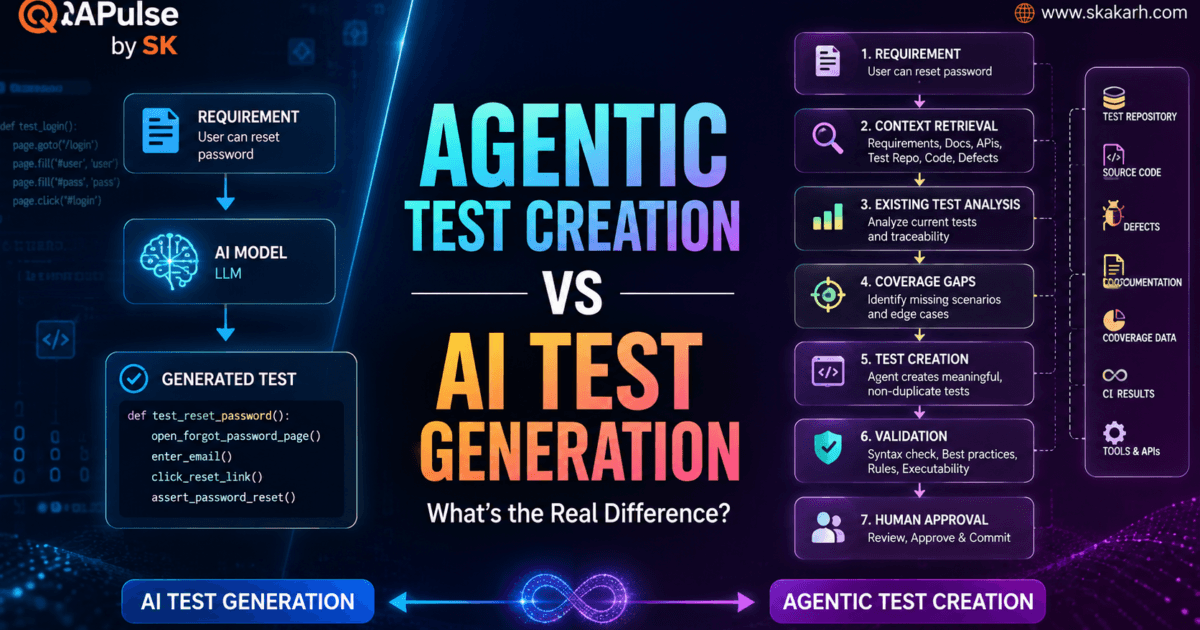
Agentic test creation is becoming one of the most important shifts in AI-powered software testing, but the term is increasingly being used for capabilities that are very different from simple AI test generation.
That distinction matters.
A tool that takes a Jira story, sends it to an LLM, and returns ten test cases is doing something useful. But it is not necessarily performing agentic test creation.
An agentic system goes further. It can gather context, inspect existing test assets, reason about coverage, identify gaps, use testing tools, generate or modify tests, validate the result, and potentially ask a human to review the proposed changes.
This difference is becoming especially important as modern QA platforms move from AI-assisted authoring toward agent-driven quality engineering. Recent industry discussions distinguish a simple prompt-to-output model from an agent that gathers context and works through a multi-step testing workflow.
For QA engineers and SDETs, the important question is therefore not:
“Does this tool use AI?”
The better question is:
“What does the AI actually do before it creates or changes my tests?”
AI Test Generation and Agentic Test Creation Start From Different Ideas
Traditional AI test generation usually follows a relatively simple pipeline:
Requirement
    ↓
Prompt
    ↓
LLM
    ↓
Generated Test Cases
For example, you might provide:
As a returning customer,
I want to apply a promotional code during checkout
so that my order receives the correct discount.
An AI model may generate:
1. Apply a valid promotional code
2. Apply an invalid promotional code
3. Apply an expired promotional code
4. Submit an empty promotional code
5. Enter a promotional code with lowercase characters
6. Enter a promotional code with uppercase characters
The output may look impressive.
But there is a fundamental problem.
The model may not know what already exists.
Your test repository might already contain:
TC-1042 → Valid promo code
TC-1043 → Invalid promo code
TC-1091 → Expired promo code
TC-1120 → Empty promo code
The model can generate four additional tests that duplicate existing coverage.
Nothing is technically wrong with the generated text.
The problem is that the AI was given insufficient context.
This is one of the most important distinctions between AI-assisted generation and agentic test creation.
What Makes Agentic Test Creation Different?
Agentic test creation treats test development as a workflow rather than a single generation request.
A simplified architecture looks like this:
Requirement
     ↓
Understand Intent
     ↓
Collect Context
     ↓
Inspect Existing Tests
     ↓
Analyze Coverage
     ↓
Identify Gaps
     ↓
Create Tests
     ↓
Validate Tests
     ↓
Human Review
     ↓
Commit / Execute
The agent is not simply producing text.
It is performing a sequence of actions toward a testing objective.
That distinction is consistent with current descriptions of agentic testing systems, where agents can use existing test assets, requirements, attachments, execution information, or other project context instead of starting from an isolated prompt. (Merito)
The Critical Difference
Think of it this way:
AI Test Generation

"Generate tests for this requirement."
                ↓
              Output
versus:
Agentic Test Creation

"Determine what needs to be tested."
                ↓
Understand requirement
                ↓
Inspect existing coverage
                ↓
Find missing scenarios
                ↓
Create missing tests
                ↓
Validate
                ↓
Request review
The second workflow is much closer to how an experienced QA engineer actually works.
That is why the word agentic matters.
Agentic Test Creation Is About Context, Not Just Generation
One of the easiest mistakes is assuming that a more powerful model automatically creates better tests.
It does not.
Consider this requirement:
Users can upgrade from the Basic plan to the Pro plan.
A generic model might generate:
Test 1: Upgrade from Basic to Pro
Test 2: Verify Pro features
Test 3: Verify payment
Test 4: Cancel upgrade
Test 5: Invalid payment
Those cases may be reasonable.
But an agent with access to your engineering context might discover:
Existing tests:
- Basic → Pro with credit card
- Basic → Pro with PayPal

Recent defect:
- Currency conversion failed for EUR accounts

Architecture:
- Subscription service
- Payment service
- Feature entitlement service

Acceptance criteria:
- Upgrade is immediate
- Existing invoices remain unchanged
- Pro features activate immediately
Now the agent can identify a more valuable gap:
Basic → Pro
       +
EUR account
       +
existing invoice
       +
immediate entitlement activation
That scenario is much more useful than generating another generic “upgrade successfully” test.
This is the real strategic value of agentic test creation.
It can move the system from test generation toward coverage reasoning.


A Practical Comparison
| Capability | AI Test Generation | Agentic Test Creation |
|---|---|---|
| Reads requirement | Yes | Yes |
| Generates test cases | Yes | Yes |
| Inspects existing tests | Usually limited | Core capability |
| Detects duplicate coverage | Limited | Stronger potential |
| Identifies coverage gaps | Basic | Central objective |
| Uses external tools | Usually limited | Often integral |
| Uses repository context | Depends on implementation | Typically important |
| Maintains workflow state | Usually no | Often yes |
| Executes validation steps | Limited | Can be part of workflow |
| Human review | Optional | Common governance pattern |
| Traceability | Often manual | Can be built into workflow |
| Failure recovery | Basic | Workflow-dependent |
| Cost per task | Usually lower | Usually higher |
| Latency | Usually lower | Usually higher |
| Engineering complexity | Lower | Higher |
The important point is not that agentic systems are automatically better.
They solve a different problem.
If you only need five draft test cases from a stable requirement, a simple AI generator may be perfectly adequate.
If you need to understand thousands of existing tests, identify gaps, connect requirements to coverage, and continuously maintain test assets, an agentic approach becomes much more interesting.
The Test Repository Becomes Part of the AI’s Context
This is one of the biggest architectural changes.
With simple AI test generation:
Prompt
  +
Requirement
  ↓
LLM
With agentic test creation:
Requirement
    +
Acceptance Criteria
    +
Existing Tests
    +
Defects
    +
Application Context
    +
Test Data
    +
Repository
    +
Execution Results
    ↓
Agent
The quality of the result now depends heavily on the quality of that context.
This creates a new engineering principle:
Better context can be more valuable than simply using a larger model.
Imagine your test repository contains 3,000 cases.
But:
400 = duplicates
250 = obsolete
150 = poorly documented
100 = unrelated
An agent analyzing that repository may inherit those problems.
The system does not magically transform bad test knowledge into good test knowledge.
It may simply process the mess faster.
That means organizations considering agentic test creation should first understand the quality of their existing test assets.
Garbage In, Garbage Out Becomes Even More Important
Suppose your existing test suite contains:
TC-001 Login test
TC-002 Login test new
TC-003 Login final
TC-004 Login final updated
TC-005 Login regression
TC-006 Login regression new
An agent may interpret these as six pieces of historical knowledge.
A human engineer may immediately recognize that they represent two or three real scenarios buried under poor organization.
Therefore, before deploying an agentic workflow, perform a repository health check.
Look for:
- Duplicate tests
- Obsolete tests
- Missing requirements
- Broken traceability
- Unclear test ownership
- Inconsistent naming
- Stale expected results
- Tests that no longer execute
- Tests with no meaningful assertions
A clean repository gives an agent better information from which to reason.
The Architecture Behind an Agentic Testing Workflow
A practical architecture might look like this:
def agentic_test_creation(requirement):

    context = collect_requirement_context(requirement)

    existing_tests = search_test_repository(
        requirement= requirement
    )

    coverage = analyze_coverage(
        requirement=requirement,
        tests=existing_tests
    )

    gaps = identify_missing_scenarios(
        requirement=requirement,
        coverage=coverage
    )

    tests = generate_tests(
        gaps=gaps,
        context=context
    )

    validated_tests = validate_tests(tests)

    return request_human_review(validated_tests)
The important part is not the Python syntax.
The important part is the sequence of responsibilities.
A mature workflow separates:
Context collection
        ↓
Coverage analysis
        ↓
Gap identification
        ↓
Test creation
        ↓
Validation
        ↓
Review
That separation also gives QA engineers more places to test the AI system itself.
How SDETs Should Test the Agent
This is where the subject becomes especially interesting for SDETs.
You are not merely testing the generated test cases.
You are testing the agentic decision process.
For example:
Requirement
     ↓
Did the agent retrieve the correct context?
     ↓
Did it find existing tests?
     ↓
Did it classify coverage correctly?
     ↓
Did it identify genuine gaps?
     ↓
Did it generate valid tests?
     ↓
Did it preserve traceability?
     ↓
Did it request human review?
Each stage becomes a potential test boundary.
Consider a requirement with an existing test:
Requirement:
Users can reset their password.

Existing:
TC-501 → Valid password reset
The agent should not blindly generate another:
TC-900 → Valid password reset
Instead, it should recognize that the happy path is already covered and investigate missing scenarios such as:
Expired reset token
Multiple reset requests
Invalid email
Already-used reset token
Password policy violation
Concurrent reset requests
This is a fundamentally different quality objective.
The goal is no longer:
“Generate more tests.”
The goal becomes:
“Improve meaningful coverage without unnecessarily increasing test-suite noise.”
Why More Tests Can Actually Make Quality Worse
This is an important point that AI testing marketing often overlooks.
Suppose your suite grows from:
1,000 tests
to:
3,000 tests
That sounds like an improvement.
But imagine:
1,000 meaningful tests
1,000 duplicates
500 obsolete tests
500 low-value tests
Your regression suite has become three times larger without becoming three times better.
Execution time increases.
Maintenance increases.
CI failures increase.
Debugging becomes harder.
Developers begin ignoring failures.
Eventually, the team loses confidence in the automation suite.
That means a successful agentic system should optimize for useful coverage, not raw test count.
Agentic Test Creation vs Test Generation: A Better Mental Model
Think about the difference between a junior test author and a senior SDET.
A junior engineer might receive:
"Test the checkout feature."
and immediately begin writing:
Valid checkout
Invalid card
Empty card
Expired card
A senior SDET is more likely to ask:
What changed?
What is already covered?
Which integrations are affected?
What production defects have occurred?
What business risks exist?
What happens when payment succeeds but order creation fails?
What happens during retry?
Which scenarios are worth automating?
That second approach is closer to the purpose of agentic test creation.
The value is not simply producing test cases faster.
The value is reasoning about what should be tested.
Human Review Still Matters
A common misconception is that an agentic workflow eliminates the QA engineer.
In reality, human review becomes even more important when the system can make multi-step decisions.
A strong workflow might be:
Agent
  ↓
Generate proposed tests
  ↓
Coverage report
  ↓
Confidence / reasoning evidence
  ↓
Human review
  ├── Approve
  ├── Edit
  └── Reject
This creates an important governance boundary.
The agent can propose.
The engineer remains accountable for what enters the official test suite.
Current testing platforms are increasingly emphasizing this combination of agentic capabilities with human governance rather than treating autonomous output as automatically trustworthy. (virtuosoqa.com)
Measuring Whether the Agent Is Actually Helping
Do not evaluate an agentic system using only:
"How many tests did it create?"
That is a weak metric.
Track:
| Metric | What it tells you |
|---|---|
| Duplicate rate | Whether the system creates redundant tests |
| Reviewer rejection rate | How often humans reject output |
| Coverage gap closure | Whether meaningful gaps are being addressed |
| Requirement traceability | Whether tests remain connected to requirements |
| Time to test | How much faster teams move |
| Maintenance effort | Whether generated tests remain usable |
| Execution pass rate | Whether generated tests actually work |
| False-positive rate | Whether failures are trustworthy |
| Defect detection | Whether additional coverage finds real defects |
A particularly useful metric is:
Reviewer rejection rate
If an agent proposes 100 tests and engineers reject 60, the headline “100 tests generated” is meaningless.
The real result is:
40 accepted
60 rejected
Now investigate why.
Perhaps the repository lacks context.
Perhaps requirements are ambiguous.
Perhaps the model is overly aggressive.
Perhaps your acceptance criteria are poor.
This turns AI testing into an engineering measurement problem rather than a marketing claim.
A Practical Pilot Strategy
Do not introduce an agentic testing system across your entire organization immediately.
Start with one workflow.
For example:
Checkout
Collect:
100 existing tests
20 recent defects
10 requirements
Acceptance criteria
Test execution history
Then measure the agent against your existing process.
Track:
Before:
Time to create tests = X
Duplicate rate = Y
Reviewer effort = Z

After:
Time to create tests = X
Duplicate rate = Y
Reviewer effort = Z
Coverage gaps found = N
Now you have evidence.
This is much stronger than adopting an AI testing product because its demo generated 50 test cases in ten seconds.
E-E-A-T: How to Evaluate Agentic Testing Like an Engineer
A technically credible evaluation should distinguish between capability claims and measured outcomes.
Ask the vendor or internal platform:
What context does the agent inspect?

Can it access existing tests?

Can it identify duplicates?

How does it determine coverage?

How does it validate generated tests?

Can humans modify proposed tests?

Are decisions auditable?

What happens when repository data is incomplete?

Can the agent execute tests?

How are failures handled?

Can we measure rejection and duplication rates?
One especially revealing question is:
“What does the system read before generating the test?”
If the answer is essentially:
Your prompt
you are probably looking at AI-assisted generation.
If the system can reason over:
Requirements
+
Existing test assets
+
Application context
+
Execution history
+
Defects
+
Attachments
you are much closer to an agentic workflow.
That does not automatically make it better.
But it tells you that the architecture is fundamentally different.
The Strategic Shift for QA Engineers
The rise of agentic test creation does not mean QA engineers stop writing tests tomorrow.
The more realistic shift is from:
Manual test author
        ↓
Automation script writer
toward:
Quality strategist
        ↓
Coverage designer
        ↓
AI workflow reviewer
        ↓
Risk analyst
        ↓
Test architecture owner
The engineer increasingly becomes responsible for deciding:
What should be tested?
Why should it be tested?
What context should the agent use?
What should remain deterministic?
What requires human approval?
How do we measure AI quality?
This is a much more valuable role than simply generating another batch of test cases.
The strongest teams will not ask AI to replace QA judgment.
They will use AI to amplify it.
The Core Difference in One Example
Imagine a new requirement:
Customers can apply a gift card and promotional code
to the same order.
A basic AI generator might produce:
Test valid gift card
Test valid promo code
Test invalid gift card
Test invalid promo code
Test expired promo code
Test expired gift card
An agentic workflow could discover:
Existing coverage:
✓ Gift card alone
✓ Promo code alone

Missing:
✗ Gift card + promo combination
✗ Gift card balance lower than order value
✗ Promo applied before gift card
✗ Gift card applied before promo
✗ Partial gift card balance
✗ Currency conversion
✗ Refund after combined payment
The difference is not merely that one system generates more tests.
The difference is that one system can potentially reason from the current testing landscape.
That is the strategic promise of agentic test creation.
A Decision Framework for Teams
Use simple AI test generation when:
- You need quick test-case drafts.
- Requirements are relatively self-contained.
- Existing coverage is small.
- Human review is already strong.
- You do not need automated repository analysis.
Consider agentic test creation when:
- The test repository is large.
- Duplicate coverage is a problem.
- Requirements have complex dependencies.
- Existing test assets contain valuable context.
- Traceability matters.
- Coverage-gap discovery is important.
- You want AI to interact with testing tools.
- You can measure and govern agent decisions.
The key is to match architecture to the problem.
More AI does not automatically mean better testing.
Better context, stronger validation, meaningful metrics, and appropriate human control matter more.
A Practical SDET Experiment
Take one real requirement from your backlog.
Ask a normal AI generator:
Generate 20 test cases for this requirement.
Then use an agentic workflow with access to:
Requirement
Acceptance criteria
Existing tests
Recent defects
Application documentation
Compare the results.
Measure:
Number of duplicates
Number of valid new scenarios
Number of invalid assumptions
Requirement traceability
Reviewer rejection rate
Time saved
Do not decide which approach is better based on how impressive the generated text looks.
Decide based on test-suite value.
That is the mindset that separates AI experimentation from engineering.
From Generated Tests to a Test-Engineering Workflow
The real value of agentic test creation appears when the system stops treating a test as an isolated piece of generated code and starts treating quality as a workflow.
A useful architecture looks like this:
Requirement
    ↓
Context Discovery
    ↓
Existing Coverage Analysis
    ↓
Risk & Gap Analysis
    ↓
Test Design
    ↓
Test Generation
    ↓
Validation
    ↓
Human Review
    ↓
Execution
    ↓
Feedback
This model is fundamentally different from asking an LLM to produce a test file.
The agent has a goal, access to tools, contextual information, and a sequence of decisions to make. The exact capabilities vary between products, so teams should evaluate what a system actually does rather than accepting the label “agentic” at face value. Current industry discussions similarly distinguish context-aware, multi-step agent workflows from simple prompt-driven generation. (HackerNoon)
For an SDET, this changes the testing problem.
You are no longer asking only:
“Is the generated test correct?”
You also need to ask:
“Did the agent make the correct decisions before generating this test?”
That creates an additional layer of quality engineering.
The Agent Needs Tools, Not Just a Better Prompt
A sophisticated prompt cannot compensate for missing engineering context.
Imagine an agent receives:
Requirement:
A customer can cancel an active subscription.
With only the requirement, it may generate:
def test_cancel_subscription():
    login()
    open_subscription()
    click_cancel()
    assert_subscription_cancelled()
But what if the real application has:
Subscription Service
       ↓
Billing Service
       ↓
Payment Provider
       ↓
Notification Service
       ↓
Entitlement Service
Cancellation could trigger:
- subscription state changes
- payment adjustments
- entitlement removal
- email notification
- invoice updates
- audit events
- webhook delivery
A useful testing system therefore needs access to more than the requirement.
It may need tools for:
Test repository search
Requirement retrieval
Source-code inspection
API discovery
Test execution
Defect lookup
Application exploration
Coverage analysis
CI results
This is where agentic test creation becomes an architectural problem rather than simply an LLM prompt-engineering problem.
The quality of the agent depends partly on the quality and accessibility of the information it can retrieve.
Agentic Test Creation Should Be Context-Aware
Consider two approaches.
Approach A: Prompt-only generation
prompt = """
Generate tests for subscription cancellation.
"""

tests = llm.generate(prompt)
The model starts with almost no project-specific knowledge.
Approach B: Context-aware workflow
requirement = get_requirement("SUB-102")

existing_tests = search_tests(
    requirement_id="SUB-102"
)

recent_defects = search_defects(
    feature="subscription cancellation"
)

api_contract = get_api_contract(
    service="subscription"
)

tests = agent.create_tests(
    requirement=requirement,
    existing_tests=existing_tests,
    defects=recent_defects,
    api_contract=api_contract
)
The second approach gives the agent evidence before it makes decisions.
That does not guarantee correctness.
But it gives the system a much stronger foundation for reasoning.
The Biggest Opportunity Is Coverage Gap Detection
Generating another happy-path test is easy.
Finding a meaningful gap is harder.
Suppose the existing repository contains:
| Scenario | Existing coverage |
|---|---|
| Active subscription cancellation | Yes |
| Already cancelled subscription | Yes |
| Invalid subscription ID | Yes |
| Unauthorized cancellation | Yes |
| Cancellation during payment processing | No |
| Cancellation after failed renewal | No |
| Cancellation with pending invoice | No |
| Concurrent cancellation requests | No |
A basic generator may produce another valid cancellation test.
An agentic workflow should instead recognize:
Existing coverage
        ↓
Map scenarios
        ↓
Identify missing risk areas
        ↓
Prioritize gaps
        ↓
Generate only valuable tests
That distinction is critical.
More tests are not automatically better tests.
The objective should be meaningful risk coverage.
Why Test-Suite Duplication Is a Strategic Problem
A large test repository can create a dangerous illusion of quality.
Imagine:
10,000 test cases
Sounds impressive.
Now classify them:
3,000 meaningful
2,000 duplicates
1,500 obsolete
1,000 flaky
1,000 poorly documented
1,500 low-value
The repository is large, but its effective quality is much smaller.
If an AI system consumes that repository without understanding its quality, it can amplify the problem.
That is why repository hygiene should be part of an agentic test creation strategy.
Before introducing an agent, examine:
- duplicate scenarios
- obsolete test cases
- broken traceability
- inconsistent naming
- stale expected results
- abandoned automation
- missing ownership
- flaky tests
- tests without meaningful assertions
The agent should not become a machine for multiplying technical debt.
Agentic Test Creation Needs Deterministic Validation
There is an important distinction between generating a test and proving that the test is useful.
An agent may produce:
def test_checkout_discount(page):
    page.goto("/checkout")
    page.fill("#discount", "SAVE20")
    page.click("#apply")
    assert page.locator(".discount").is_visible()
The code looks reasonable.
But a validation layer should ask:
Does #discount exist?
Does #apply exist?
Is SAVE20 valid in this environment?
Is the assertion meaningful?
Does the test actually verify the requirement?
Does this scenario already exist?
Can the test run independently?
Does it leave test data behind?
This suggests a useful architecture:
AI reasoning
     ↓
Generated artifact
     ↓
Deterministic validation
     ↓
Human review
     ↓
Repository
The agent can help with reasoning, but deterministic checks should remain responsible for facts that can be verified mechanically.
This hybrid approach is particularly important for SDETs because generated intent and executable correctness are not the same thing.
Agentic Test Creation vs Runtime Agentic Testing
There is another distinction worth making.
Agentic test creation focuses on creating or improving test assets.
Agentic runtime testing focuses on what happens while the test is executing.
These can overlap, but they are not identical.
Agentic Test Creation
Requirement
   ↓
Analyze
   ↓
Create tests
   ↓
Review
   ↓
Store
versus:
Agentic Runtime Testing
Goal
 ↓
Explore application
 ↓
Take action
 ↓
Observe result
 ↓
Adapt
 ↓
Continue
The industry is increasingly using “agentic” across both areas, which makes capability-level evaluation important. Some current descriptions of agentic QA emphasize runtime perception, planning, tool use, and adaptation rather than merely generating static test scripts.
For your architecture, define exactly which layer you are implementing.
The Human Should Remain the Quality Gate
One of the most practical mistakes would be allowing an agent to automatically commit every generated test.
A safer workflow is:
Agent
  ↓
Proposed tests
  ↓
Coverage evidence
  ↓
Risk classification
  ↓
QA/SDET review
  ├── Approve
  ├── Modify
  └── Reject
This makes the human reviewer responsible for quality decisions while allowing the agent to handle repetitive analysis.
Human-in-the-loop governance is especially valuable during early adoption because it creates feedback that can be measured.
Track:
Generated: 100
Approved:    72
Modified:    18
Rejected:    10
Now the organization has a useful signal.
If rejection rises to 40%, investigate.
Perhaps:
- requirements are incomplete
- repository search is poor
- test metadata is inconsistent
- the agent lacks application context
- the model is over-generating
- the validation layer is weak
This is much more useful than reporting:
“Our AI generated 100 tests.”
Measure Quality, Not Generation Volume
A mature agentic test creation program should measure outcomes.
| Metric | Why it matters |
|---|---|
| Duplicate rate | Measures redundant output |
| Acceptance rate | Measures usefulness |
| Modification rate | Measures review effort |
| Coverage-gap closure | Measures actual testing value |
| Traceability rate | Measures requirement linkage |
| Execution success | Measures executable quality |
| Defect detection | Measures business value |
| Time saved | Measures productivity |
| Maintenance cost | Measures long-term sustainability |
Consider two systems.
System A
Generated: 1,000
Accepted:  300
Duplicates: 500
System B
Generated: 200
Accepted:  170
Duplicates: 10
System B is probably creating more useful value despite producing five times fewer tests.
That is the metric shift QA leaders need to make.
How to Evaluate an AI Testing Vendor
Do not start with:
“Does your platform support AI test generation?”
Almost every modern testing platform can make some version of that claim.
Instead ask:
What context does the system retrieve?

Can it inspect existing tests?

Can it identify duplicate coverage?

Can it access requirements and acceptance criteria?

Can it analyze historical defects?

Can it execute generated tests?

Can it validate generated assertions?

Can humans approve or reject output?

Can we measure rejection rates?

Can we trace generated tests back to requirements?

What happens when the available context is incomplete?
The most revealing question may be:
“What does the system actually read before it generates the test?”
If the answer is essentially:
User prompt → LLM → Test
you are looking at AI-assisted generation.
If the workflow is closer to:
Requirement
   +
Existing tests
   +
Application context
   +
Defects
   +
Execution history
   ↓
Agent
   ↓
Coverage analysis
   ↓
Test creation
   ↓
Validation
you have a substantially richer architecture.
That does not mean the second system will automatically outperform the first. It means you are evaluating different capabilities.
A Practical Pilot for SDETs
Do not begin with the entire regression suite.
Choose one feature.
For example:
Feature:
Checkout
Collect:
20 requirements
100 existing tests
10 recent defects
Recent execution results
API contracts
Relevant application documentation
Run the existing process first.
Record:
Manual test-design time
Duplicate scenarios
Coverage gaps
Reviewer effort
Defects found
Then introduce the agent.
Measure the same metrics.
For example:
                    Before       After
Test design time      8 hrs       3 hrs
Duplicate rate        18%          7%
Review effort          4 hrs       2 hrs
New useful scenarios    12          19
Defects discovered       3           5
Now you have evidence.
This is a much stronger evaluation than saying:
“The AI feels faster.”
Where Agentic Test Creation Can Fail
The technology has real limitations.
Poor Context
If the agent cannot access the right requirements, tests, defects, or application information, its reasoning will be constrained.
Bad Repository Data
An agent can inherit duplication and outdated assumptions from the repository it analyzes.
Hallucinated Application Behavior
The agent may assume a button, API, field, or workflow exists when it does not.
Excessive Test Generation
The agent may optimize for quantity instead of risk coverage.
Weak Assertions
A test can execute successfully while failing to prove the intended behavior.
Reviewer Fatigue
Human review becomes meaningless if engineers approve hundreds of generated cases without examining them.
Cost and Latency
A multi-step agent can require more model calls, retrieval operations, and tool interactions than a single generation request.
These limitations matter because agentic test creation adds intelligence and context, but it also adds architectural complexity.
The Future Role of the SDET
The SDET role is not disappearing because AI can write a Playwright test.
The valuable part of the role is moving upward.
Instead of spending most of the time doing:
Requirement
    ↓
Write test
    ↓
Write code
    ↓
Fix locator
    ↓
Repeat
the engineer increasingly works on:
Quality strategy
      ↓
Risk modeling
      ↓
Coverage architecture
      ↓
Agent governance
      ↓
Test validation
      ↓
Observability
      ↓
Quality metrics
This is a significant opportunity.
An engineer who understands both test automation and AI-agent architecture can evaluate whether an AI system is actually improving quality rather than merely increasing test output.
A Simple Decision Framework
Use conventional AI test generation when:
- You need quick drafts.
- Requirements are straightforward.
- The repository is small.
- Human review is already strong.
- You mainly want productivity improvements.
Consider agentic test creation when:
- Your test repository is large.
- Duplicate coverage is a serious problem.
- Requirements have complex dependencies.
- Existing tests contain valuable historical context.
- Coverage-gap analysis matters.
- Traceability is important.
- The system needs to interact with testing tools.
- You can measure agent performance.
The important lesson is not:
“Agentic is always better.”
The better lesson is:
Choose the lowest-complexity architecture that solves the actual testing problem.
A simple generator may be exactly what a small project needs.
A large enterprise with thousands of test assets and complex dependencies may benefit from a context-aware agent.
The Practical SDET Experiment
Take one real Jira story and run two experiments.
Experiment 1: AI Generation
Give an AI model only the requirement:
Generate 20 tests for this feature.
Experiment 2: Agentic Workflow
Give the system access to:
Requirement
Acceptance criteria
Existing tests
Recent defects
Application documentation
Execution history
Then compare:
Duplicate tests
New meaningful scenarios
Invalid assumptions
Traceability
Reviewer rejection
Execution success
Time saved
Do not judge the systems by the number of tests they produce.
Judge them by how much meaningful quality coverage they add.
That is the difference between using AI as a writing assistant and engineering an AI-driven quality workflow.
Internal Blog Links
- 50 Playwright Commands Every QA Engineer Should Know
- FastAPI iter_route_contexts(): The Safer Way to Inspect Routes After FastAPI 0.137
- LangGraph Subgraphs: Building Modular and Reusable AI Workflows
- LangGraph Human in the Loop: Building AI Workflows That Collaborate with People
- LangGraph Nodes: Understanding the Building Blocks of AI Workflows
- LangGraph State Management: Understanding the Foundation of Stateful AI Applications
- LangGraph Send API: Building Dynamic Parallel AI Workflows for Enterprise Applications
Internal Series Links
- Learn MCP – Zero to Hero
- Learn AI Agents for QA – Zero to Hero
- Playwright Automation – Zero to Hero
- TencentDB Agent Memory: Complete Zero to Hero
- LangGraph: Complete Zero to Hero
- Learn Python – Zero to Hero
- OpenAI Codex: Complete Zero to Hero
- Cursor AI: Complete Zero to Hero
- Claude Code Tutorial: Complete Zero to Hero
- AutoGen: Complete Zero to Hero Guide
- Free QA Resources Built From Real Experience
- QA Glossary: Test Automation Terms Every Engineer Should Know
External Links
- Anthropic — Building Effective Agents — useful for explaining agent architectures and the distinction between workflows and agents.
- OpenAI — Agents SDK — useful for understanding tool-using agent workflows.
- LangGraph Documentation — useful for agent orchestration, state, and human-in-the-loop workflows.
- Playwright Documentation — useful when discussing generated browser automation and executable validation.
- Selenium Documentation — useful for traditional browser automation comparison.
- Cypress Documentation — useful for comparing AI-generated tests with established automation frameworks.
AI Overview Optimization
What Is Agentic Test Creation?
Agentic test creation is an AI-driven testing workflow in which an agent can analyze requirements, inspect testing context, identify coverage gaps, create tests, use tools, validate results, and involve humans before changes are accepted.
How Is Agentic Test Creation Different From AI Test Generation?
AI test generation primarily focuses on producing test cases or automation code from a prompt or supplied context. Agentic test creation extends this process by adding contextual retrieval, reasoning, tool usage, validation, feedback, and potentially human approval.
Is Agentic Test Creation Better Than AI Test Generation?
Not automatically. AI test generation is often simpler and faster for straightforward test-authoring tasks. Agentic test creation becomes more valuable when teams need repository analysis, coverage-gap detection, tool interaction, traceability, and multi-step testing workflows.
What Should SDETs Measure?
SDETs should measure meaningful outcomes such as duplicate-test rate, accepted tests, coverage-gap closure, reviewer rejection rate, execution success, maintenance effort, traceability, and defects discovered.
AEO Optimization
Agentic test creation vs AI test generation: AI test generation primarily creates test cases or automation from supplied instructions, while agentic test creation can reason through a broader testing workflow involving context discovery, coverage analysis, tool use, validation, and human review.
People Asked Questions
What is agentic test creation?
Agentic test creation is an AI-driven approach where an agent can analyze requirements, retrieve relevant testing context, inspect existing tests, identify coverage gaps, generate tests, validate results, and potentially request human approval.
What is AI test generation?
AI test generation uses artificial intelligence, commonly an LLM, to produce test cases, test scenarios, assertions, or automation code from requirements, prompts, source code, or other supplied information.
What is the difference between agentic test creation and AI test generation?
AI test generation mainly focuses on producing tests. Agentic test creation focuses on completing a broader testing objective through multiple steps such as context discovery, coverage analysis, test creation, validation, tool usage, and feedback.
Does agentic test creation replace SDETs?
No. Agentic test creation can automate repetitive analysis and test-authoring tasks, but SDETs remain important for risk analysis, test architecture, validation, exploratory testing, governance, and quality strategy.
Can AI agents create Playwright tests?
Yes. An AI agent can potentially inspect requirements and application context and generate Playwright automation. However, generated code still needs validation because the agent may use incorrect locators, assumptions, test data, or assertions.
Can agentic testing reduce duplicate test cases?
It can, provided the agent has reliable access to existing test assets and can analyze them effectively. Duplicate detection should be measured rather than assumed.
How should companies evaluate an AI testing agent?
Evaluate it using measurable outcomes such as accepted-test rate, duplicate rate, coverage-gap closure, reviewer effort, execution success, maintenance cost, traceability, and defects discovered.
Is AI test generation cheaper than agentic test creation?
Usually, a simple generation workflow can require fewer model calls and tool interactions than a multi-step agentic workflow. However, the overall business value depends on the quality of the output and the amount of engineering effort saved.
Should every automated test be generated by an AI agent?
No. Critical, deterministic, stable automation may be better created and maintained through conventional engineering practices. AI should be introduced where it provides measurable value.
What is the biggest risk of agentic test creation?
One major risk is trusting generated output without validating the agent’s assumptions. An agent can produce plausible tests that duplicate existing coverage, misunderstand requirements, use incorrect application behavior, or contain weak assertions.
Conclusion
Agentic test creation represents an important evolution beyond simple AI test generation, but its value should not be measured by how much code an AI model can produce.
The real advantage comes from context, reasoning, tool use, validation, and feedback.
A generator can answer:
“What tests could I write for this requirement?”
A well-designed agentic workflow can move toward:
“What is already covered, what is missing, what matters most, which tests should be created, and how can I validate them?”
That is a much more valuable question.
For QA engineers and SDETs, the opportunity is not to surrender testing judgment to AI. It is to use AI to handle repetitive analysis while engineers focus on risk, coverage, architecture, exploratory thinking, and quality decisions.
The strongest implementation will likely be neither completely manual nor completely autonomous.
It will be context-aware, measurable, validated, and human-governed.
Final Key Takeaways
- Agentic test creation is more than asking an LLM to generate test cases.
- The key difference is the ability to work through a multi-step workflow using context, tools, and feedback.
- Existing tests, requirements, defects, and application context can significantly improve the quality of proposed coverage.
- More generated tests do not necessarily mean better testing.
- Duplicate and obsolete test assets can reduce the value of an AI-driven workflow.
- Coverage-gap detection is often more valuable than raw test generation.
- Deterministic validation should verify generated tests wherever possible.
- Human review remains an important quality and governance boundary.
- Measure acceptance rate, duplication, coverage-gap closure, execution success, reviewer effort, and defects found.
- Evaluate AI testing vendors by asking what information they actually inspect before generating tests.
- Start with a controlled pilot instead of deploying an agent across the entire regression suite.
- Keep deterministic automation for critical paths where predictable execution and assertions matter.
- Use AI agents where contextual reasoning, exploration, analysis, and repetitive decision-making provide measurable value.
- The SDET’s role increasingly moves toward quality strategy, AI governance, test architecture, and risk analysis.
- The goal is not to generate more tests. The goal is to create better evidence about software quality.
Continue Learning
Explore more expert articles on Mobile Testing, Backend & API, AI & Agentic, AI Tools, n8n, LangChain, CrewAI, MCP Servers, AI Agents, LlamaIndex, Docker, FastAPI, Playwright, Cypress, Test Automation, DevOps, and Software Engineering at www.skakarh.com.
QAPulse by SK delivers expert release analysis, AI engineering insights, enterprise automation strategies, migration guidance, DevOps best practices, and practical testing knowledge to help software professionals build scalable, intelligent, and production-ready software systems.