TencentDB Agent Memory Storage: How Short Term and Long Term Memories Are Stored
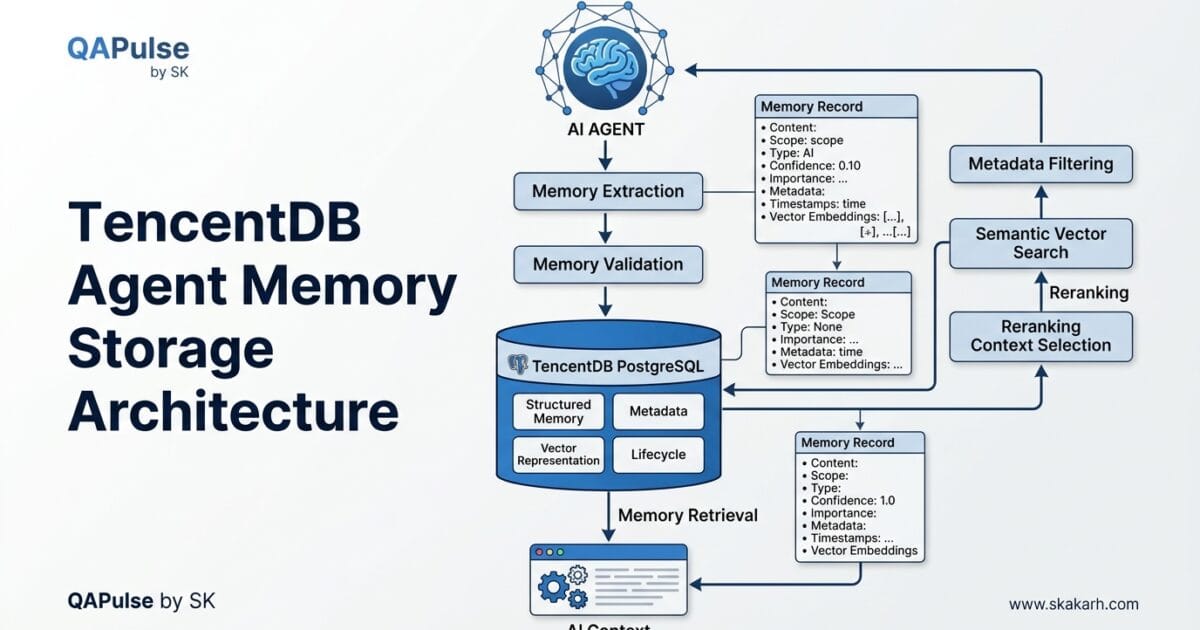
TencentDB agent memory storage gives AI agents a persistent foundation for retaining useful facts, preferences, procedures, and experiences. Learn how to design memory schemas, manage metadata, combine relational and vector retrieval, handle…
TencentDB agent memory storage converts an AI agent's temporary observations into valuable, persistent memories by intelligently identifying information with future relevance. For QA engineers and SDETs, this system ensures AI agents can recall crucial project details and debugging insights, not just chat history, to enhance testing efficiency and knowledge reuse. It prioritizes information value over mere storage capacity, building a useful knowledge base for automated quality assurance.
TencentDB Agent Memory Storage is the layer that turns an AI agent’s temporary observations into persistent information that can be reused later. If an agent needs to remember a user’s preference, a previous interaction, a project fact, or a useful experience, the system needs more than a prompt. It needs a deliberate way to represent, store, identify, update, and eventually remove that memory.
That distinction matters because storing agent memory is not the same as simply saving chat history.
Consider a QA agent working on a Playwright project. During a debugging session, it may observe hundreds of events:
User reported a checkout failure
Test started
Browser launched
Login succeeded
API request returned 200
Checkout page loaded
Payment button timed out
Authentication state was refreshed
Test passed
Should all of these become permanent memories?
Probably not.
A useful memory system should identify information that can provide future value.
For example:
The checkout tests require refreshed authentication state
before payment validation.
This is potentially reusable knowledge.
The individual browser-launch event usually is not.
That is the fundamental problem TencentDB agent memory storage needs to solve:
How do we convert useful agent experiences into structured, persistent memories without turning the database into an unlimited dump of conversations?
What Does Agent Memory Storage Actually Mean?
Agent memory storage refers to the process of persisting information that an AI agent may need beyond its immediate context.
This is why TencentDB agent memory storage should be designed around information value rather than storage capacity.
A database can store millions of records.
That does not mean an AI agent should remember millions of irrelevant events.
What Should an Agent Memory Record Contain?
A useful memory record normally contains more than a piece of text.
At minimum, you may need:
Memory ID
Agent ID
User/Tenant ID
Memory Type
Memory Content
Created Time
Updated Time
Importance
Confidence
Expiration
Metadata
Embedding
A conceptual record could look like this:
{
  "id": "mem_001",
  "agent_id": "qa_agent",
  "tenant_id": "tenant_123",
  "memory_type": "preference",
  "content": "The team prefers API-based test data setup.",
  "importance": 0.91,
  "confidence": 0.96,
  "created_at": "2026-08-14T10:30:00Z",
  "updated_at": "2026-08-14T10:30:00Z",
  "expires_at": null
}
Now the memory is not just text.
It has identity, ownership, meaning, lifecycle, and context.
That additional information becomes extremely important when the agent has thousands or millions of memories.
Why Metadata Matters
Imagine the agent retrieves this memory:
The user prefers concise reports.
That sounds useful.
But which user?
Which project?
When was this preference recorded?
Is it still valid?
Was it explicitly stated by the user or inferred by the model?
Without metadata, the memory system cannot answer those questions reliably.
A stronger representation is:
{
  "content": "The user prefers concise reports.",
  "memory_type": "preference",
  "scope": "user",
  "confidence": 0.93,
  "source": "explicit_user_statement",
  "created_at": "2026-08-14T10:30:00Z"
}
Now retrieval can become much more intelligent.
The agent can distinguish:
User preference
vs
Project preference
vs
Temporary session information
That is one of the most important design principles behind TencentDB agent memory storage.
Relational Storage Gives Memory Structure
One natural foundation for agent memory is relational storage.
TencentDB for PostgreSQL provides PostgreSQL capabilities that can be used to represent structured memory records.
A simplified schema might look like:
CREATE TABLE agent_memories (
    id UUID PRIMARY KEY,
    tenant_id UUID NOT NULL,
    agent_id UUID NOT NULL,
    memory_type VARCHAR(50) NOT NULL,
    content TEXT NOT NULL,
    importance NUMERIC(4,3),
    confidence NUMERIC(4,3),
    created_at TIMESTAMPTZ DEFAULT NOW(),
    updated_at TIMESTAMPTZ DEFAULT NOW(),
    expires_at TIMESTAMPTZ
);
This is not intended as a complete production schema. It is a teaching model showing an important principle:
Memory should have structure around the content.
You can now perform deterministic queries.
For example:
SELECT id, content, importance
FROM agent_memories
WHERE agent_id = '00000000-0000-0000-0000-000000000001'
  AND memory_type = 'preference'
ORDER BY importance DESC;
This is fundamentally different from semantic retrieval.
The database is answering:
“Give me preference memories belonging to this agent.”
That kind of filtering becomes valuable before semantic search even begins.
Structured Memory vs Conversation Logs
A common beginner implementation is to store the entire conversation:
{
  "session_id": "123",
  "messages": [
    {"role": "user", "content": "Run the checkout tests"},
    {"role": "assistant", "content": "Running them now"},
    {"role": "user", "content": "The payment button failed"}
  ]
}
This can be useful for conversation history.
But conversation history and agent memory are not identical.
Feature
Conversation History
Agent Memory
Primary purpose
Preserve interaction
Preserve useful knowledge
Scope
Usually session
Can span sessions
Structure
Messages
Memory records
Retrieval
Chronological/contextual
Relevance-based
Lifecycle
Session-oriented
Memory-oriented
Example
“Run the test”
“Project uses Playwright”
A conversation log answers:
“What did we say?”
Agent memory answers:
“What should I remember from what we said?”
That difference is critical.
Memory Types Influence Storage Design
A memory system can store different categories of information.
Episodic memory represents a past event or experience.
Example:
During the previous checkout debugging session,
the payment test failed because the authentication state expired.
This is useful when the agent needs historical context.
Semantic Memory
Semantic memory represents knowledge.
Example:
The checkout service requires an authenticated session.
This is less about what happened and more about what the agent knows.
Procedural Memory
Procedural memory represents a method or process.
Example:
Create checkout test data through the API before launching the UI workflow.
It tells the agent how to perform a task.
Preference Memory
Preference memory represents how a user or team wants something done.
Example:
The team prefers concise failure summaries.
These distinctions make storage more useful because the application can retrieve memories according to their purpose.
Why One Giant Memory Table Can Become a Problem
You could technically put everything into one table:
agent_memories
and store every memory there.
That can work for an initial prototype.
But production systems need to think about:
Indexing
Filtering
Ownership
Retention
Memory types
Retrieval performance
Access control
Updates
Duplicate memories
Expired memories
Semantic search
A useful conceptual design might therefore separate the logical responsibilities even if they remain physically within the same PostgreSQL environment.
For example:
Memory Core
   │
   ├── Identity
   ├── Content
   ├── Type
   ├── Metadata
   ├── Lifecycle
   └── Retrieval Data
The important thing is not whether you have one table or ten tables.
The important thing is that the memory model is deliberately designed.
Where Embeddings Enter Memory Storage
Text alone cannot provide semantic similarity.
Suppose you store:
The developer prefers API-based test data generation.
Later, the user asks:
“Should we create test records through the UI or backend?”
The wording is different, but the meaning is related.
An embedding can represent the semantic meaning of the memory as a vector.
Conceptually:
memory_text = """
The developer prefers API-based test data generation.
"""

embedding = embedding_model.embed(memory_text)

memory = {
    "content": memory_text,
    "embedding": embedding
}
The embedding can then be stored alongside the memory record or in a vector-capable representation.
TencentDB for PostgreSQL supports PostgreSQL-based vector capabilities, including extensions such as pgvector, which can be used for vector search workloads.
Production memory reconciliation can require much richer logic.
The key lesson is:
A memory system must manage change, not just storage.
Avoid Storing Everything
Consider this agent interaction:
User: Run the tests.
Agent: Which browser?
User: Chromium.
Agent: Running now.
Agent: 17 tests passed.
User: Great.
Saving all of this permanently creates noise.
Instead, the system might extract:
No durable memory
Now consider:
User: From now on, always use Chromium for this project.
That is a strong memory candidate.
The application could produce:
{
  "memory_type": "preference",
  "content": "Use Chromium for this project's browser tests.",
  "importance": 0.92,
  "confidence": 0.99
}
The difference is not the length of the message.
It is the future value of the information.
A Useful Storage Decision Framework
Before writing a memory to TencentDB, ask:
1. Is this information reusable?
2. Is it stable?
3. Is it important?
4. Is it sufficiently trustworthy?
5. Who owns it?
6. What scope does it belong to?
7. When should it expire?
8. Could it conflict with an existing memory?
9. Does it contain sensitive information?
10. Will storing it improve future agent decisions?
If the answer to most of these questions is unclear, blindly persisting the information is usually a poor design choice.
This turns TencentDB agent memory storage into an engineering discipline rather than a simple INSERT operation.
Try This: Design One Memory Record
Imagine you are building an AI SDET assistant.
The user says:
“For our checkout tests, create test users through the API rather than the UI because it makes the suite faster.”
Design the memory.
A good starting point could be:
{
  "memory_type": "procedural",
  "scope": "project",
  "content": "Create checkout test users through the API rather than the UI.",
  "importance": 0.90,
  "confidence": 0.96,
  "source": "explicit_user_instruction"
}
Now ask yourself:
Should this memory expire?
Probably not immediately.
Should it be associated with the user?
Possibly, but project scope may be more appropriate.
Should it be embedded?
Yes, if semantic retrieval will be used.
Should it be searchable by project ID?
Absolutely.
That is the type of thinking required when designing TencentDB agent memory storage.
The Most Important Design Principle
There is a temptation to measure a memory system by how much information it can retain.
That is the wrong metric.
A better question is:
How much useful information can the agent retrieve accurately at the moment it needs it?
A memory system with 10,000 highly relevant memories can be more useful than one containing 10 million noisy records.
When those principles are applied, TencentDB becomes more than a place to put conversation data. It can serve as a structured persistence layer for agent memories, with PostgreSQL capabilities providing the foundation for relational information and vector-enabled retrieval.
The agent-memory application layer decides what that memory should mean, when it should be written, how it should evolve, and when it should no longer be trusted.
That is the foundation for designing reliable persistent memory rather than simply accumulating historical data.
Designing the Memory Record for TencentDB Agent Memory Storage
TencentDB agent memory storage becomes significantly more useful when the memory record is designed as a structured data model instead of treating every memory as a plain text string. A production AI agent needs to know not only what it remembers, but also who the memory belongs to, what type of information it represents, how trustworthy it is, how important it is, and whether it is still valid.
A weak implementation might store:
"The user prefers API-based test data."
A stronger implementation stores the same knowledge with context:
{
  "content": "The user prefers API-based test data.",
  "memory_type": "preference",
  "scope": "user",
  "importance": 0.91,
  "confidence": 0.97,
  "source": "explicit_instruction"
}
The second representation gives the agent much more control.
It can retrieve preferences without retrieving project knowledge. It can prioritize high-confidence memories. It can distinguish user-level information from project-level information. It can also determine whether a memory should be updated or removed.
That is the difference between storing text and designing memory.
Start With the Memory Data Model
Before creating database tables, define what a memory means in your application.
{
"content": "The user probably prefers Playwright.",
"source": "llm_inference",
"confidence": 0.62
}
This gives your memory system an additional quality signal.
It also makes debugging easier.
When the agent produces an incorrect answer, you can inspect:
Where did this memory originate?
When was it created?
What confidence did it have?
What source produced it?
That is much harder to determine if your database contains nothing but anonymous text blobs.
Memory IDs Enable Lifecycle Management
Every persistent memory should have a stable identifier.
For example:
mem_7c4e9a...
Why?
Because eventually the system will need to perform operations such as:
Create
Read
Update
Merge
Expire
Delete
Audit
For example:
UPDATE agent_memories
SET
content = :new_content,
confidence = :confidence,
updated_at = NOW()
WHERE id = :memory_id;
Without stable identifiers, updating a specific memory becomes much more difficult.
This becomes particularly important when two memories express related but slightly different information.
Duplicate Memories Are a Real Problem
Suppose the agent stores this:
The team prefers API-based test data.
Then later stores:
The team prefers creating test data through APIs.
Semantically, these may represent the same memory.
A naive system creates two records.
After months of operation, you could have:
10,000 memories
↓
3,000 are duplicates or near-duplicates
This increases retrieval noise.
A smarter workflow is:
New Memory
↓
Semantic Similarity Check
↓
Existing Related Memory?
├── No → Create
└── Yes
↓
Compare Facts
↓
Update / Merge / Preserve
A conceptual implementation might look like:
similar = find_similar_memories(
embedding=new_embedding,
threshold=0.90
)
if not similar:
create_memory(new_memory)
else:
reconcile_memory(new_memory, similar)
This is one of the places where semantic retrieval becomes useful during storage, not just during retrieval.
TencentDB Agent Memory Storage vs Redis
Redis can be excellent for fast temporary state.
For example:
Agent Session
↓
Redis
↓
Short-lived Context
That makes sense when you need:
Fast reads
Session state
Temporary context
Caching
Short-lived data
But persistent agent memory may require:
Relational structure
Durable records
Complex filtering
Metadata
Transactions
Vector retrieval
Lifecycle management
A simplified comparison:
Requirement
Redis
TencentDB for PostgreSQL
Temporary state
Excellent
Good
Relational data
Limited
Excellent
SQL querying
No
Yes
Durable structured memory
Possible
Strong fit
Vector capability
Available through ecosystem
PostgreSQL vector capabilities
Complex relationships
Application-dependent
Relational model
Session caching
Excellent
Not primary purpose
This does not make Redis inferior.
It means the two systems solve different problems.
A mature agent may even use both:
AI Agent
│
┌─────────┴─────────┐
↓ ↓
Redis TencentDB
Working State Persistent Memory
The strategic decision is based on memory lifetime and access pattern, not popularity.
Memory Storage Should Support Expiration
Not every memory should live forever.
Consider:
The staging API currently uses version 2.
That information may become obsolete.
Your record can include:
expires_at TIMESTAMPTZ
Then a cleanup operation might look like:
DELETE FROM agent_memories
WHERE expires_at IS NOT NULL
AND expires_at < NOW();
In production, you may choose a softer approach:
Active
↓
Stale
↓
Low priority
↓
Archived
↓
Deleted
This can be better than immediately deleting everything.
The right strategy depends on the application’s requirements.
Design Memory Ownership Before Production
A multi-tenant AI system may look like:
Tenant A
├── Agent 1
└── Agent 2
Tenant B
├── Agent 3
└── Agent 4
Memory must respect those boundaries.
A memory belonging to Tenant A must never become retrievable by Tenant B.
That makes:
tenant_id
more than a convenience field.
It becomes a security boundary.
A query should therefore be scoped appropriately:
SELECT *
FROM agent_memories
WHERE tenant_id = :tenant_id
AND agent_id = :agent_id
ORDER BY created_at DESC;
For stronger protection, PostgreSQL Row-Level Security can also be incorporated into the design.
The exact security model should follow your tenancy architecture, but the principle is straightforward:
Never rely only on the AI model to enforce memory isolation.
Database-level controls should participate in the security design.
Try an Engineering Challenge
Imagine these memories exist:
M1:
Project A uses Playwright.
M2:
Project B uses Cypress.
M3:
The user prefers concise reports.
M4:
Project A test data should be created through APIs.
M5:
The staging API currently uses v2.
Now the user asks:
“How should I prepare test data for Project A?”
Which memories should be retrieved?
A strong candidate set is:
M4 → Highly relevant
M1 → Potentially relevant
M3 → Not relevant
M2 → Irrelevant
M5 → Possibly relevant depending on the task
Notice what happened.
The database did not simply retrieve “all memories for the user.”
the retrieval layer has significantly more signals to work with.
That means TencentDB agent memory storage should be designed backward from the questions your agent will eventually need to answer.
Ask:
What will the agent need to retrieve?
Then determine:
What information must be stored to make that retrieval accurate?
Then design:
What schema, indexes, metadata, vectors, and lifecycle rules support that requirement?
That approach is far more effective than starting with a database table and deciding what to put inside it afterward.
Retrieving the Right Memories From TencentDB
TencentDB agent memory storage becomes truly useful when the stored information can be found accurately at the moment an AI agent needs it. Writing memories into a database is only half of the problem. The other half is deciding which memories deserve to be retrieved for a particular request.
Imagine an AI testing assistant has accumulated these memories:
Project A uses Playwright.
Project B uses Cypress.
The user prefers concise reports.
Checkout test data should be created through APIs.
The staging API currently uses version 2.
A previous checkout failure was caused by expired authentication.
Now the user asks:
“How should I prepare checkout data for Project A?”
A naive implementation might retrieve every memory associated with that user.
That would be a mistake.
The useful memories are likely:
Project A uses Playwright.
Checkout test data should be created through APIs.
The staging API version might become relevant later.
The reporting preference is irrelevant.
Project B’s Cypress configuration is unrelated.
This gives us an important principle:
Good memory storage is not measured by how much information is retained. It is measured by how accurately relevant information can be found.
Storage and Retrieval Are Two Different Problems
It helps to separate the lifecycle into two independent operations:
A memory can be extremely valuable in general but irrelevant to the current task.
That is why TencentDB agent memory storage needs to be designed together with retrieval logic.
Exact Matching Is Not Enough
Suppose the database contains:
The developer prefers API-based test data creation.
The user later asks:
“Should I create checkout users through the backend before starting the browser test?”
There may be no exact keyword match.
The stored memory says:
API-based test data
while the query says:
backend
browser test
create checkout users
A traditional SQL query such as:
SELECT content
FROM agent_memories
WHERE content ILIKE '%backend%';
could fail to find the memory.
This is where semantic retrieval becomes valuable.
Instead of comparing only words, the system can compare the semantic representation of the query with the semantic representation of stored memories.
Semantic Search Changes the Retrieval Model
Conceptually:
User Question
↓
Embedding Model
↓
Query Vector
↓
Vector Search
↓
Similar Memory Vectors
↓
Relevant Memories
A simplified Python example:
query = "Should checkout users be created through the backend?"
query_embedding = embedding_model.embed(query)
results = search_memory_vectors(
vector=query_embedding,
top_k=5
)
for result in results:
print(result["content"])
The result could include:
The team prefers API-based test data creation.
even though the words are not identical.
This is one reason PostgreSQL-based vector capabilities can be useful in TencentDB agent memory storage. Tencent Cloud documents vector search capabilities for TencentDB for PostgreSQL, including pgvector-based approaches for AI workloads.
But Vector Similarity Alone Is Not Enough
Here is a subtle but important problem.
Suppose your database contains:
Memory A:
Project A uses Playwright.
Memory B:
Project B uses Playwright.
Memory C:
The user prefers Playwright.
Memory D:
The company previously used Playwright.
The user asks:
“How should I configure tests for Project A?”
All four memories may be semantically similar.
But only one is directly associated with Project A.
One useful strategy is to narrow the candidate set before performing expensive ranking.
For example:
SELECT id, content, memory_type, importance, confidence
FROM agent_memories
WHERE tenant_id = :tenant_id
AND project_id = :project_id
AND expires_at IS NULL
OR expires_at > NOW();
The exact SQL should include proper parentheses in production to ensure the intended boolean precedence.
A clearer version is:
SELECT id, content, memory_type, importance, confidence
FROM agent_memories
WHERE tenant_id = :tenant_id
AND project_id = :project_id
AND (
expires_at IS NULL
OR expires_at > NOW()
);
Now the retrieval system is not searching the entire memory universe.
It is searching memories that already satisfy basic constraints.
Then semantic ranking can operate on that smaller candidate set.
The conceptual flow becomes:
All Memories
↓
Tenant Filter
↓
Agent / Project Filter
↓
Memory Type Filter
↓
Expiration Filter
↓
Semantic Search
↓
Ranking
↓
Top Memories
This can improve both relevance and efficiency.
Top-K Retrieval is a Starting Point, Not a Complete Strategy
But the five closest memories are not automatically the five most useful memories.
Imagine the results:
1. Similarity = 0.94 → Project B uses Playwright
2. Similarity = 0.93 → User prefers Playwright
3. Similarity = 0.92 → Project A uses Playwright
4. Similarity = 0.91 → Company previously used Playwright
5. Similarity = 0.90 → Playwright was used in an old project
For a Project A request, memory #3 may be much more useful than #1.
But even five may be too many depending on memory length.
A better production strategy can impose both:
Maximum memory count
+
Maximum memory token budget
For example:
MAX_MEMORY_TOKENS = 1200
Then the system selects memories until the budget is reached.
This makes memory retrieval part of context engineering, not simply database querying.
Memory Compression Can Reduce Noise
Suppose the agent has stored:
The user asked for Playwright examples.
The user prefers Playwright.
The user selected Playwright for the project.
The project uses Playwright.
The developer chose Playwright.
Five memories may actually represent one broader fact.
A memory consolidation process could produce:
The project uses Playwright as its primary browser automation framework.
The system can then retain the consolidated memory while reducing duplicates.
Conceptually:
Memory A ─┐
Memory B ─┤
Memory C ─┼──→ Consolidation → Canonical Memory
Memory D ─┤
Memory E ─┘
This is especially valuable as memory volume increases.
Deduplication Should Happen Before Context Injection
Suppose retrieval returns:
1. Team prefers API test data.
2. API-based test data is preferred by the team.
3. Test data should be created using APIs.
Giving all three to the LLM wastes context.
A simple application-level deduplication strategy could be:
unique = []
for memory in memories:
if not is_semantically_duplicate(memory, unique):
unique.append(memory)
The final context could contain:
The team prefers API-based test data creation.
One strong memory is better than three repetitive memories.
Agent memory can look similar, but the information lifecycle is different.
Traditional RAG
Agent Memory
Usually retrieves external knowledge
Retrieves learned/persistent agent context
Documents are primary source
Experiences, facts, preferences, procedures
Chunking is common
Memory extraction is common
Retrieval is often query-driven
Retrieval can be task + identity + scope driven
Source documents are relatively stable
Memories can change
Memory ownership is less central
User/agent/tenant ownership is critical
Expiration may be uncommon
Memory lifecycle can be essential
This distinction prevents another common design mistake:
Agent memory is not simply RAG with a different name.
RAG retrieves knowledge from a corpus.
Agent memory manages information that the agent is expected to retain and reuse across interactions.
There can be overlap, but the lifecycle is different.
Build Retrieval Around the User’s Actual Question
Consider three requests.
Request 1
“What framework does Project A use?”
Retrieve:
semantic
project-scoped
high-confidence
current
Request 2
“What happened during yesterday’s checkout incident?”
Retrieve:
episodic
project-scoped
recent
Request 3
“How do I want the final report?”
Retrieve:
preference
user-scoped
high-confidence
The same database can support all three.
The retrieval strategy changes according to the question.
That is the key.
Interactive Challenge: Choose the Correct Memories
Assume these memories exist:
M1:
Project Alpha uses Playwright.
M2:
Project Beta uses Cypress.
M3:
The user prefers concise reports.
M4:
Project Alpha creates test users through APIs.
M5:
The user previously debugged a checkout timeout.
M6:
Project Alpha staging currently uses API v3.
Question:
“Generate a strategy for preparing checkout tests in Project Alpha.”
The crucial point is that TencentDB agent memory storage should not end at the SELECT or vector-search operation.
The retrieval pipeline determines whether stored information becomes useful knowledge or simply becomes database noise.
A Production-Oriented Retrieval Checklist
Before calling your memory retrieval system production-ready, ask:
□ Can memories be filtered by tenant?
□ Can memories be filtered by agent?
□ Can memories be filtered by project?
□ Can memories be filtered by type?
□ Are expired memories excluded?
□ Can semantic similarity be used?
□ Are importance and confidence considered?
□ Are stale memories penalized?
□ Are duplicates removed?
□ Is there a context/token budget?
□ Can conflicting memories be detected?
□ Can memory sources be inspected?
□ Can retrieval decisions be logged?
If several answers are “no,” the storage layer may work technically while the overall agent memory experience remains unreliable.
The recommended H1 for the article remains “TencentDB Agent Memory Storage: How Memories Are Stored”. This section deliberately continues that exact storage-focused search topic rather than turning the article into a generic architecture or RAG tutorial.
The most important idea is simple:
Store memories with enough structure that the retrieval layer can distinguish what is relevant, current, trustworthy, and allowed to reach the agent’s context.
A well-designed memory database does not merely answer “What have we stored?”
It enables the much more valuable question:
“Which stored memory should this agent use for this request, right now?”
Building a Production-Ready TencentDB Agent Memory Storage Workflow
TencentDB agent memory storage becomes valuable in a real AI application only when the complete lifecycle works reliably: a memory must be identified, validated, stored, retrieved, updated, and eventually removed when it is no longer useful.
A simple prototype might do this:
memory_db.insert("The project uses Playwright.")
That is enough to demonstrate persistence.
It is not enough to build dependable agent memory.
A production-oriented implementation needs to answer questions such as:
Who owns this memory?
What project does it belong to?
How confident are we?
How important is it?
Is it still valid?
Could another memory contradict it?
How will we retrieve it?
Should it be included in the agent context?
When should it disappear?
The user says:
"Please always create test data through the API."
The application should not immediately write the raw sentence into the database.
Instead, it can transform it into:
{
"memory_type": "preference",
"scope": "project",
"content": "Create test data through the API.",
"importance": 0.91,
"confidence": 0.99,
"source": "explicit_user_instruction"
}
Now the memory has meaning beyond its original wording.
That normalization step is particularly important when building TencentDB agent memory storage because consistent records make later retrieval and maintenance much easier.
Separate Memory Extraction From Database Writes
One of the strongest architectural decisions is to avoid allowing the LLM to directly control database writes without validation.
candidate = extract_memory(conversation)
if not candidate:
return
if not validate_memory(candidate):
return
if is_duplicate(candidate):
reconcile_memory(candidate)
else:
save_memory(candidate)
This creates a boundary between AI-generated decisions and database persistence.
That boundary matters because an LLM can misunderstand a statement.
Suppose a user says:
“We are testing whether Cypress could replace Playwright.”
The agent should not automatically create:
The project uses Cypress.
The conversation describes an experiment, not a confirmed project fact.
A validation layer can prevent this kind of incorrect persistence.
Use Memory Policies
A practical memory system should define rules for what can be stored.
These values are examples, not universal standards.
The important idea is that not all memory candidates should receive equal treatment.
You could classify information as:
Memory Candidate
Storage Policy
Explicit user preference
Usually store
Confirmed project fact
Store
Temporary observation
Usually avoid
Model speculation
Validate carefully
Sensitive information
Apply stricter controls
Contradictory fact
Reconcile before storing
Expired information
Remove or archive
This makes the memory system predictable.
Memory Validation Should Happen Before Persistence
Consider:
User:
"We might migrate to Playwright next quarter."
A naive extraction model might produce:
{
"content": "The team uses Playwright."
}
That is incorrect.
A better extraction result is:
{
"content": "The team may migrate to Playwright next quarter.",
"memory_type": "planned_change",
"confidence": 0.70,
"expires_at": "2026-12-01T00:00:00Z"
}
The wording preserves uncertainty.
This is an important principle:
Memory should preserve the certainty of the information it represents.
Do not convert:
might
probably
considering
possibly
into:
is
uses
always
requires
just because the database needs a clean sentence.
Design Idempotent Memory Writes
A production system may process the same conversation multiple times.
rather than forcing vector similarity to solve every retrieval problem.
Do Not Treat Vector Similarity as Truth
Suppose the vector search returns:
Memory A:
Project Alpha uses Playwright.
Memory B:
Project Beta uses Playwright.
Memory C:
The user previously used Playwright.
Memory D:
The company migrated away from Playwright last year.
All four could be semantically similar to:
“What browser automation framework does Alpha use?”
Similarity tells you:
“These memories are related.”
It does not necessarily tell you:
“This is the correct answer.”
That is why metadata, scope, freshness, confidence, and conflict resolution remain important.
The database provides retrieval capabilities.
Your application must define the meaning of the retrieved results.
Older:
"The project uses Cypress."
Newer explicit instruction:
"The project migrated to Playwright."
The system might mark the first memory as superseded.
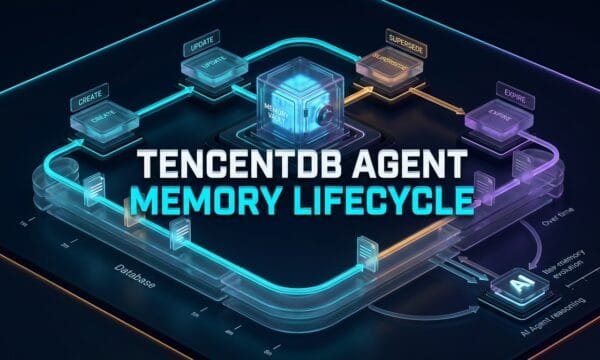
Use Memory Status Instead of Immediate Deletion
Rather than immediately deleting an old memory, you can maintain status:
active
superseded
expired
archived
deleted
A schema might contain:
ALTER TABLE agent_memories
ADD COLUMN status VARCHAR(20) NOT NULL DEFAULT 'active';
Then retrieval can use:
SELECT content
FROM agent_memories
WHERE tenant_id = :tenant_id
AND agent_id = :agent_id
AND status = 'active';
This gives you historical traceability without allowing stale information into normal retrieval.
For debugging an AI agent, that history can be extremely useful.
Memory Reconciliation Is More Important Than Memory Creation
A common beginner workflow is:
New information
↓
INSERT
A mature workflow is:
New information
↓
Find related memories
↓
Determine relationship
↓
Create / update / merge / supersede
The relationship might be:
NEW
DUPLICATE
UPDATE
CONTRADICTION
ADDITION
TEMPORARY
For example:
Existing:
"Project uses Playwright."
New:
"Project uses Playwright with TypeScript."
This may be an addition rather than a contradiction.
Another example:
Existing:
"Project uses Cypress."
New:
"Project migrated to Playwright."
This is probably a superseding update.
The ability to distinguish these cases determines whether the memory store becomes increasingly intelligent or increasingly noisy.
Use Transactions for Related Updates
Suppose one memory is being replaced by another.
You may need to:
1. Insert new memory
2. Mark old memory as superseded
3. Record relationship
These operations should ideally be atomic.
A conceptual transaction:
BEGIN;
INSERT INTO agent_memories (
tenant_id,
agent_id,
memory_type,
content,
status
)
VALUES (
:tenant_id,
:agent_id,
'semantic',
'Project migrated to Playwright.',
'active'
);
UPDATE agent_memories
SET status = 'superseded',
updated_at = NOW()
WHERE id = :old_memory_id;
COMMIT;
If something fails, the transaction can roll back.
This is one area where a relational database foundation can be particularly useful.
Keep Memory Relationships
Sometimes the new memory does not simply replace the old one.
You may want to know:
Memory B supersedes Memory A
Memory C supports Memory B
Memory D contradicts Memory B
A relationship table can model this:
CREATE TABLE memory_relationships (
source_memory_id UUID NOT NULL,
target_memory_id UUID NOT NULL,
relationship_type VARCHAR(30) NOT NULL,
PRIMARY KEY (
source_memory_id,
target_memory_id,
relationship_type
)
);
Then:
Memory A
│
└── superseded_by → Memory B
This turns the memory system into more than a collection of independent records.
It becomes a connected knowledge structure.
TencentDB Agent Memory Storage vs Redis for Production Memory
A useful production architecture may use both TencentDB and Redis rather than choosing one universally.
For example:
AI Agent
│
┌────────────┴────────────┐
↓ ↓
Redis TencentDB
Working Context Persistent Memory
│ │
Fast / Temporary Durable / Structured
Redis can hold:
Current conversation state
Temporary tool results
Short-lived agent state
Caching
TencentDB can hold:
Persistent preferences
Project knowledge
Long-term procedural memories
Memory metadata
Historical records
Relational application data
The comparison is therefore architectural:
Requirement
Redis
TencentDB
Temporary state
Excellent
Good
Persistent relational memory
Limited fit
Strong fit
SQL
No
Yes
Complex metadata
Possible
Strong
Transactional updates
Available
Strong relational support
Vector-enabled PostgreSQL workflow
Not its primary model
Strong fit for PostgreSQL-based designs
Cache
Excellent
Not primary purpose
A hybrid architecture is often more realistic than forcing one system to handle every type of state.
Add Observability to Memory Operations
If your AI agent gives a wrong answer, you need to know why.
A memory retrieval log could capture:
{
"request_id": "req_123",
"agent_id": "agent_001",
"query": "How should checkout data be created?",
"candidate_count": 18,
"retrieved_count": 5,
"top_similarity": 0.93,
"filtered_expired": 2,
"filtered_wrong_scope": 7,
"deduplicated": 1
}
Now debugging becomes possible.
You can ask:
Did retrieval fail?
Did filtering remove the correct memory?
Was the memory stale?
Was the wrong memory ranked higher?
Did the LLM ignore correct context?
Without observability, AI memory failures can become extremely difficult to diagnose.
Vector Search
↓
Hope the results belong to the user
This distinction is critical.
An embedding similarity score does not understand your authorization model.
Your application and database controls must enforce it.
Be Careful With Sensitive Memory
A strong memory system should ask:
Does this information actually need to be persisted?
Before storing any sensitive information, consider:
Is persistence necessary?
Who should access it?
How long should it exist?
Can it be minimized?
Can it be anonymized?
Can it be deleted later?
Memory should follow the principle of minimum necessary persistence.
More memory is not automatically better memory.
A Practical Memory Service
Instead of allowing every application component to write directly to TencentDB, create a dedicated memory service.
For example:
AI Agent
↓
Memory Service
├── Extract
├── Validate
├── Normalize
├── Deduplicate
├── Authorize
├── Store
├── Retrieve
├── Rank
└── Expire
↓
TencentDB
A simplified API could look like:
memory_service.store(
tenant_id=tenant_id,
agent_id=agent_id,
memory_type="procedural",
scope="project",
content="Create checkout users through the API.",
importance=0.90,
confidence=0.97
)
Retrieval:
memories = memory_service.retrieve(
tenant_id=tenant_id,
agent_id=agent_id,
query="How should checkout users be created?",
limit=5
)
The application no longer needs to understand every database detail.
That abstraction becomes useful as the system grows.
A Complete Simplified Workflow
Putting everything together:
def process_conversation(conversation, context):
candidates = extract_memory_candidates(conversation)
for memory in candidates:
if not validate_memory(memory):
continue
memory = normalize(memory)
if not authorize_memory(context, memory):
continue
related = find_related_memories(
memory,
context
)
if related:
reconcile(memory, related)
else:
save_to_tencentdb(memory)
What Makes This Different From a Simple Chat History Table?
A chat history table might look like:
CREATE TABLE messages (
id UUID,
session_id UUID,
role VARCHAR(20),
content TEXT,
created_at TIMESTAMPTZ
);
That is useful.
But it does not automatically answer:
What should the agent remember?
What is important?
What is current?
What is a preference?
What belongs to this project?
What contradicts previous knowledge?
What should be retrieved?
Agent memory requires another abstraction.
Chat History
Agent Memory
Stores messages
Stores reusable knowledge
Session-oriented
Cross-session
Chronological
Relevance-oriented
Usually raw
Usually normalized
Limited lifecycle
Explicit lifecycle
Conversation retrieval
Semantic + contextual retrieval
Message identity
Memory identity
This distinction should remain clear throughout the system.
Your Architecture Decision Checklist
Before implementing TencentDB agent memory storage in a real project, make these decisions explicitly:
□ What counts as a memory?
□ Which memory types exist?
□ Which scopes exist?
□ Who owns each memory?
□ What requires validation?
□ How are duplicates detected?
□ How are conflicts resolved?
□ Which memories expire?
□ Which memories can be deleted?
□ How is semantic retrieval implemented?
□ Which relational fields need indexes?
□ What is the context/token budget?
□ How is tenant isolation enforced?
□ How are retrieval failures measured?
□ How are memory operations monitored?
If these decisions are undefined, adding more database capacity will not solve the fundamental problem.
Test the System With Failure Scenarios
A strategic way to validate your implementation is to deliberately create difficult cases.
Scenario 1: Contradiction
Old:
Project uses Cypress.
New:
Project migrated to Playwright.
Expected:
New memory becomes active.
Old memory becomes superseded.
Scenario 2: Different Projects
Project A → Playwright
Project B → Cypress
Query:
What framework does Project A use?
Expected:
Playwright
Scenario 3: Expired Memory
API version 2
expires_at = yesterday
Expected:
Do not retrieve as active memory.
Scenario 4: Duplicate
Team prefers API test data.
Team prefers creating test data through APIs.
Expected:
One canonical memory.
Scenario 5: Low Confidence
The user might prefer Cypress.
Expected:
Do not treat it as an authoritative preference.
These tests reveal weaknesses much faster than simply checking whether an INSERT statement succeeds.
What is TencentDB agent memory storage? TencentDB agent memory storage is a structured approach for persisting reusable AI agent information in TencentDB for PostgreSQL so it can be retrieved across sessions using metadata and, where appropriate, semantic vector search.
People Asked Questions
These questions match the article’s informational intent:
What is TencentDB agent memory storage?
TencentDB agent memory storage is an approach for persisting structured AI agent memories using TencentDB for PostgreSQL, allowing useful information to survive beyond an individual conversation or session.
How can TencentDB store AI agent memory?
AI agent memories can be represented as structured PostgreSQL records containing content, memory type, scope, metadata, timestamps, importance, confidence, and potentially vector embeddings.
Can TencentDB be used for vector-based agent memory?
TencentDB for PostgreSQL can support PostgreSQL-based vector workloads, including pgvector-oriented approaches, making it possible to combine relational metadata with semantic retrieval.
What should an AI agent memory record contain?
A useful record can contain an identifier, tenant or user ownership, agent and project scope, memory type, content, confidence, importance, metadata, timestamps, expiration information, and potentially an embedding.
What is the difference between agent memory and chat history?
Chat history preserves conversation messages, while agent memory extracts and persists reusable knowledge such as preferences, project facts, procedures, and experiences.
How does an AI agent retrieve relevant memories?
A retrieval system can combine metadata filtering, keyword or vector search, relevance ranking, freshness, confidence, importance, and deduplication before passing selected memories to the AI model.
Should every AI agent interaction be saved as memory?
No. Saving every interaction creates noisy and potentially stale memory. A better system identifies information with future value and applies validation, scope, importance, and lifecycle rules before persistence.
Can TencentDB agent memory storage work with Redis?
Yes. A hybrid architecture can use Redis for temporary working state or caching while TencentDB handles durable structured memory and related application data.
Conclusion
TencentDB agent memory storage should be treated as a complete memory-management system rather than a simple database table.
The strongest implementations combine structured PostgreSQL data with semantic retrieval, metadata filtering, lifecycle management, validation, deduplication, conflict resolution, authorization, and observability.
The strategic lesson is that persistent memory quality depends on the entire lifecycle, not merely on the database technology.
A powerful database cannot rescue a memory system that stores unreliable information, ignores scope, retrieves stale records, or floods the LLM with irrelevant context.
Conversely, a carefully designed memory model can turn PostgreSQL-based infrastructure into a practical foundation for long-term AI agent knowledge.
Final Key Takeaways
TencentDB agent memory storage should store structured memories, not just raw conversations.
Memory type and scope are essential for distinguishing preferences, facts, procedures, experiences, users, and projects.
Metadata filtering and vector search solve different problems and work best together.
Semantic similarity is a retrieval signal, not a guarantee of correctness.
Confidence, importance, freshness, and expiration should influence memory usage.
Duplicate and conflicting memories must be reconciled, not blindly inserted.
Tenant and project isolation must be enforced before memories reach the AI model.
Redis and TencentDB can complement each other when temporary working state and durable memory have different requirements.
Memory retrieval should have a context budget so irrelevant information does not overwhelm the model.
Production memory systems need observability and evaluation, not just database monitoring.
The best memory architecture is task-driven: first determine what the agent needs to know, then design how that knowledge should be stored and retrieved.
The ultimate goal is not to make the agent remember everything. It is to make the agent remember the right things and retrieve them at the right time.
Continue Learning
Explore more expert articles on Mobile Testing, Backend & API, AI & Agentic, AI Tools, n8n, LangChain, CrewAI, MCP Servers, AI Agents, LlamaIndex, Docker, FastAPI, Playwright, Cypress, Test Automation, DevOps, and Software Engineering at www.skakarh.com.
QAPulse by SK delivers expert release analysis, AI engineering insights, enterprise automation strategies, migration guidance, DevOps best practices, and practical testing knowledge to help software professionals build scalable, intelligent, and production-ready software systems.
Frequently Asked Questions
What is TencentDB Agent Memory Storage, and how does it benefit a QA agent?
TencentDB Agent Memory Storage transforms an AI agent's temporary observations into persistent information for later reuse. For a QA agent, this system allows it to remember crucial details like user preferences, project facts, or useful experiences, going beyond simple prompt interactions.
How does agent memory storage determine which observations to retain, especially given the volume of events a QA agent might encounter?
A useful memory system aims to identify information that can provide future value, rather than storing every observation. Not every event, such as hundreds of debugging events from a QA agent, should become a permanent memory. TencentDB agent memory storage is designed around information value, not just storage capacity.
What essential components should an agent memory record contain besides just textual content?
Beyond simple text, a useful memory record should include several key components. At minimum, these are Memory ID, Agent ID, User/Tenant ID, Memory Type, Memory Content, Created Time, Updated Time, Importance, Confidence, Expiration, Metadata, and Embedding.
10+ years in software development and QA, with the last 5 years focused on test automation. Building production-grade frameworks with Playwright, Cypress, Selenium and PyTest for clients worldwide. PhD candidate. Founder of QA Pulse.
 QA
QA