 QA
QA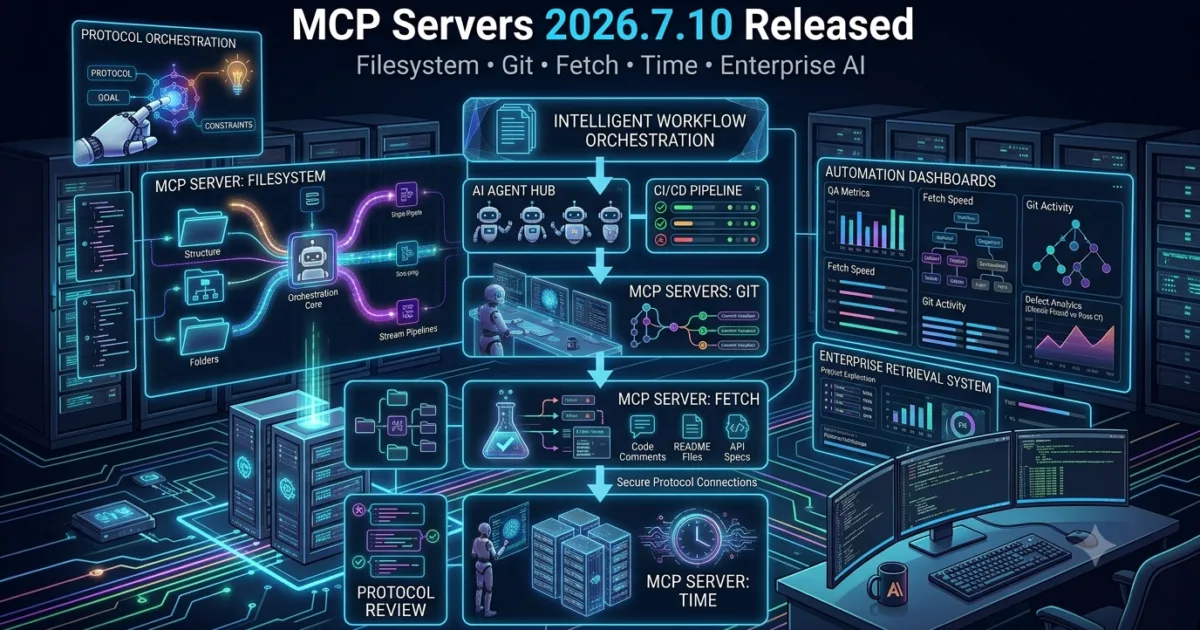
The Model Context Protocol (MCP) ecosystem is rapidly becoming one of the most important foundations for enterprise AI applications. As organizations move beyond isolated Large Language Models (LLMs) and begin building intelligent AI agents capable of interacting with real-world systems, MCP Servers provide the standardized communication layer that connects AI models with filesystems, APIs, Git repositories, databases, cloud services, developer tools, and enterprise platforms.
For QA Engineers, SDETs, Automation Engineers, DevOps professionals, Platform Engineers, and AI Engineers, MCP Servers are no longer just an experimental technology. They are becoming a critical component of modern software testing, autonomous automation, AI-assisted development, and intelligent workflow orchestration.
Released on July 10, 2026, MCP Servers 2026.7.10 is a focused maintenance release that updates several of the project’s most widely used servers, including the Filesystem Server, Time Server, Fetch Server, and Git Server. While the release does not introduce major architectural changes or new protocol features, it ensures that these core servers remain synchronized with the latest MCP specification, dependency updates, and runtime improvements.
Maintenance releases like this often receive less attention than feature-heavy releases, yet they play an essential role in keeping enterprise AI ecosystems stable, secure, and production-ready. Organizations building AI-powered developer tools, autonomous QA agents, retrieval-augmented generation (RAG) systems, coding assistants, CI/CD automation, and intelligent documentation workflows should consider this release an important update to maintain compatibility across their AI infrastructure.
Official Release Highlights
According to the official release notes, MCP Servers 2026.7.10 updates four official server implementations:
Updated MCP Server Packages
- @modelcontextprotocol/server-filesystem@2026.7.10
- mcp-server-time@2026.7.10
- mcp-server-fetch@2026.7.10
- mcp-server-git@2026.7.10
Although these updates appear modest, each server represents a fundamental capability within the broader MCP ecosystem. Keeping these components aligned ensures consistent communication between AI agents and the external tools they depend upon.
MCP Servers 2026.7.10 at a Glance
| Updated Server | Primary Purpose | QA Engineering Benefit |
|---|---|---|
| Filesystem Server | Secure file and directory access | Reliable validation of AI-generated files and reports |
| Time Server | Date, time, and timezone operations | Consistent testing of scheduling and time-sensitive workflows |
| Fetch Server | HTTP and web resource access | Stable API validation and external service testing |
| Git Server | Repository interaction | Improved testing of AI-powered development workflows |
Why This Release Matters
The value of MCP Servers 2026.7.10 lies not in introducing flashy features but in strengthening the infrastructure that AI agents rely on every day. Modern AI systems rarely operate in isolation—they need controlled access to files, repositories, web resources, and system utilities to perform meaningful work.
Every AI-powered coding assistant, QA automation agent, documentation generator, or DevOps copilot depends on reliable MCP server implementations to execute tasks safely and consistently. By updating the core servers together, this release helps maintain compatibility across the rapidly evolving MCP ecosystem and reduces the likelihood of version mismatches between clients and servers.
For engineering teams adopting the Model Context Protocol as part of their AI architecture, staying current with these synchronized server releases helps ensure predictable behavior, smoother upgrades, and fewer integration issues across development, testing, and production environments.
Deep Dive into the Updated Servers
Filesystem Server
The Filesystem Server remains one of the most widely deployed MCP components because nearly every AI workflow involves reading or writing files.
Common use cases include:
- Generating automation reports
- Updating configuration files
- Managing test artifacts
- Reading documentation
- Producing code
- Creating release notes
- Processing datasets
- Maintaining project assets
QA Engineers building AI-assisted automation frameworks benefit from reliable filesystem operations because they form the backbone of many continuous testing workflows.
Time Server
Time-sensitive testing continues to grow in importance as distributed systems become more complex.
The Time Server provides standardized access to:
- Current timestamps
- Timezone conversions
- Scheduling logic
- Date calculations
- Temporal validation
This simplifies testing scenarios involving:
- Scheduled automation
- Token expiration
- Certificate validation
- Time-based authentication
- Cron-driven workflows
- Global applications
Fetch Server
The Fetch Server enables AI agents to retrieve external resources securely through standardized HTTP operations.
Typical use cases include:
- REST API validation
- Documentation retrieval
- External service integration
- Knowledge acquisition
- Configuration downloads
- Monitoring endpoints
For QA teams validating AI-powered workflows, consistent HTTP behavior is essential for reliable automated testing.
Git Server
Version control has become central to AI-assisted software engineering.
The Git Server allows AI agents to interact with repositories for operations such as:
- Reading project history
- Reviewing pull requests
- Generating commit summaries
- Creating documentation
- Understanding code context
- Supporting autonomous development workflows
This capability is increasingly valuable as AI coding assistants become integrated into everyday development pipelines.
Why QA Engineers Should Care
Modern QA is expanding beyond browser automation and API testing. AI agents are now capable of generating tests, reviewing code, analyzing failures, producing documentation, and assisting with debugging. These advanced workflows rely on stable MCP server implementations to interact safely with development environments.
By updating the Filesystem, Fetch, Git, and Time servers together, MCP Servers 2026.7.10 improves consistency across the tools that power AI-assisted quality engineering. Teams experimenting with autonomous testing agents, AI-driven regression analysis, or intelligent CI/CD pipelines should view this release as an important maintenance update that helps keep foundational infrastructure aligned with the latest protocol expectations.
What MCP Servers 2026.7.10 Means for QA Engineers
Artificial Intelligence is rapidly changing the role of Quality Assurance. Modern QA Engineers are no longer validating only user interfaces or REST APIs—they are increasingly responsible for testing AI agents, LLM-powered workflows, retrieval pipelines, tool integrations, developer assistants, and autonomous software systems. The foundation that enables these AI applications to interact safely with external systems is the Model Context Protocol (MCP).
Although MCP Servers 2026.7.10 is primarily a maintenance release, it strengthens four of the most frequently used official MCP servers: Filesystem, Fetch, Git, and Time. These servers power thousands of interactions every day between AI agents and real-world resources. For organizations adopting AI-assisted development, intelligent automation, and autonomous testing, ensuring these foundational components remain synchronized is essential for long-term stability.
For QA Engineers, SDETs, AI Engineers, Platform Engineers, DevOps professionals, and Software Architects, this release reinforces the reliability of the infrastructure that supports modern AI ecosystems without introducing disruptive breaking changes.
Enterprise Impact
The adoption of the Model Context Protocol continues to accelerate across enterprise software engineering.
Organizations are integrating MCP with technologies including:
- Claude Desktop
- OpenAI
- Google Gemini
- LangChain
- CrewAI
- AutoGen
- Microsoft Copilot
- Cursor AI
- VS Code AI extensions
- MCP-enabled IDEs
- GitHub repositories
- Docker environments
- Kubernetes clusters
- Enterprise knowledge bases
- Internal developer portals
Every interaction between an AI agent and an external system typically passes through one or more MCP Servers.
Keeping these servers updated ensures:
- Better compatibility
- Stable tool communication
- Improved security
- Reliable AI workflows
- Reduced operational risk
- Easier maintenance
For enterprise engineering teams managing dozens of AI-powered services, these maintenance releases help reduce version drift across production environments.
Key Improvements for QA Teams
Stronger Filesystem Reliability
Many AI-powered automation workflows generate:
- Test reports
- Screenshots
- Log files
- Trace files
- JSON results
- Configuration files
- Documentation
The updated Filesystem Server ensures that AI agents continue interacting reliably with project assets while remaining compatible with the evolving MCP specification.
For QA Engineers building autonomous testing agents, stable filesystem access remains one of the most critical capabilities.
Improved Repository Automation
AI coding assistants increasingly interact directly with Git repositories.
Common operations include:
- Reviewing pull requests
- Reading project history
- Understanding code context
- Generating documentation
- Creating release notes
- Summarizing commits
- Producing test cases
The updated Git Server helps maintain compatibility with these workflows, reducing the likelihood of failures caused by protocol mismatches or outdated implementations.
As AI becomes more deeply integrated into software delivery, repository automation will continue to play a central role in developer productivity.
More Reliable External Integrations
The Fetch Server remains one of the most valuable MCP components for QA teams.
AI agents frequently retrieve information from:
- REST APIs
- Internal services
- Documentation portals
- Knowledge bases
- Monitoring systems
- Web resources
- Cloud platforms
Keeping the Fetch Server aligned with the latest MCP release helps ensure consistent communication between AI workflows and external systems.
This is especially important for Retrieval-Augmented Generation (RAG), API automation, and enterprise integration testing.
Better Time-Based Validation
The Time Server supports workflows involving:
- Scheduling
- Authentication
- Expiration
- Certificates
- Timezone conversion
- Automation windows
- Distributed systems
Although often overlooked, accurate time handling is essential for testing authentication flows, cron jobs, API rate limits, session management, and enterprise scheduling systems.
Feature Comparison
| Server | Previous Version | MCP Servers 2026.7.10 |
|---|---|---|
| Filesystem | Existing implementation | Updated and synchronized |
| Fetch | Existing implementation | Latest protocol alignment |
| Git | Existing implementation | Updated compatibility |
| Time | Existing implementation | Latest maintenance update |
| Protocol Support | Stable | Improved ecosystem consistency |
Practical Testing Scenarios
The updated MCP Servers improve several real-world QA workflows.
| Testing Scenario | Benefit |
|---|---|
| AI Test Generation | Stable filesystem operations |
| Documentation Validation | Reliable file access |
| Git Repository Analysis | Improved repository integration |
| API Automation | Consistent Fetch Server behavior |
| RAG Validation | Stable document retrieval |
| Autonomous QA Agents | Better MCP compatibility |
| CI/CD Automation | Reduced version inconsistencies |
| Enterprise AI Platforms | Easier long-term maintenance |
These improvements help engineering teams build dependable AI-assisted testing pipelines while reducing infrastructure-related failures.
Migration Recommendations
The official release notes report no breaking changes, making MCP Servers 2026.7.10 a straightforward maintenance upgrade.
Before updating production environments, validate:
- Filesystem operations
- Fetch requests
- Git repository integrations
- Time-based workflows
- AI agent execution
- Claude Desktop integrations
- LangChain tools
- CrewAI workflows
- MCP clients
- CI/CD pipelines
- Regression automation
- Security policies
- Docker deployments
- Kubernetes workloads
- Enterprise AI platforms
Organizations already following staged deployment practices should first validate development and staging environments before promoting the update to production.
Upgrade Best Practices
Verify Installed MCP Server Versions
npm list @modelcontextprotocol/server-filesystem
npm list @modelcontextprotocol/server-fetch
npm list @modelcontextprotocol/server-git
npm list mcp-server-time
Upgrade Official MCP Servers
npm update @modelcontextprotocol/server-filesystem
npm update @modelcontextprotocol/server-fetch
npm update @modelcontextprotocol/server-git
npm update mcp-server-time
Validate AI Workflows
After upgrading, execute your existing:
- AI agent workflows
- Tool integrations
- Repository operations
- File generation tests
- API automation
- Documentation pipelines
- Regression suites
Ensuring these workflows execute successfully confirms compatibility across your MCP ecosystem.
Should You Upgrade?
Yes.
Although MCP Servers 2026.7.10 does not introduce major protocol features, it delivers an important synchronization update for the official server ecosystem. Organizations using Claude Desktop, Cursor, LangChain, CrewAI, OpenAI tools, Gemini integrations, or any MCP-compatible client should adopt this release as part of their normal maintenance cycle.
The updated Filesystem, Fetch, Git, and Time servers strengthen the foundation of AI-assisted development by improving ecosystem consistency, reducing compatibility risks, and supporting long-term platform stability. For QA teams building intelligent automation frameworks, autonomous testing systems, or enterprise AI workflows, keeping MCP infrastructure current is a best practice that minimizes operational issues and simplifies future upgrades.
MCP Servers 2026.7.10 Released: Key Takeaways
MCP Servers 2026.7.10 Released is a focused but strategically important maintenance release that updates the official Filesystem, Fetch, Git, and Time server packages. While there are no headline protocol changes or breaking modifications, the synchronized updates help preserve compatibility across the rapidly growing Model Context Protocol ecosystem and ensure that AI agents continue interacting reliably with external systems.
For QA Engineers, SDETs, AI Engineers, DevOps teams, Platform Engineers, and Enterprise Software Architects, this release reinforces the infrastructure required for autonomous testing, AI-assisted development, Retrieval-Augmented Generation (RAG), intelligent workflow automation, and modern developer tooling. Keeping official MCP Servers aligned with the latest release improves stability today while preparing organizations for future protocol enhancements.
Internal Links of Series
- Day 1: What is MCP?
- Day 2: Why MCP Matters for AI Agents
- Day 3: MCP vs REST APIs vs Plugins
- Day 4: MCP Architecture Deep Dive
- Day 5: Build Your First Production-Ready MCP Development Environment (Python & VS Code)
- Day 6: Build Your First MCP Server in Python: A Production-Ready Guide for Beginners
- Day 7: Master the 4 MCP Transport Layer Options: STDIO vs HTTP vs SSE vs WebSockets
- Day 8: MCP Client Lifecycle: From Initialization to Tool Execution
- Day 9: MCP Server Lifecycle: From Startup to Graceful Shutdown
- Day 10: MCP Tools Explained: Building the Core Capabilities of an MCP Server
Official Resources
- Official Release Notes: https://github.com/modelcontextprotocol/servers/releases#release-2026.7.10
- Model Context Protocol Documentation: https://modelcontextprotocol.io
Internal Links of MCP releases
- MCP Servers 2026.7.4 Released: Essential Server Updates Every QA Engineer Should Know
- MCP Servers 2026.1.26 Released: Essential Updates AI Testing Engineers Should Track
People Asked Questions
Is MCP Servers 2026.7.10 a major feature release?
No. It is primarily a maintenance and synchronization release that updates the official server packages without introducing new protocol capabilities.
Are there any breaking changes?
No. The official release notes do not mention any breaking changes, making this a low-risk upgrade for existing MCP deployments.
Which server update is most valuable for QA Engineers?
The combination of the Filesystem, Fetch, and Git server updates provides the greatest value because these servers are widely used in AI-assisted testing, automation frameworks, and development workflows.
Should enterprise teams upgrade immediately?
Yes. Teams already using MCP-compatible applications should include this release in their regular maintenance schedule after completing standard regression testing.
Does this release improve AI workflow reliability?
Yes. By keeping the core official MCP servers synchronized and compatible with the latest protocol expectations, the release helps improve consistency, maintainability, and long-term reliability across enterprise AI ecosystems.
Continue Learning with QAPulse by SK
AI-native software engineering is evolving rapidly, and QAPulse by SK helps you stay ahead with expert analysis, practical tutorials, and release breakdowns focused on Model Context Protocol (MCP), AI Agents, LangChain, CrewAI, Claude, OpenAI, Gemini, n8n, FastAPI, Playwright, Docker, Node.js, Python, DevOps, Cloud Computing, and Test Automation.
Whether you’re building autonomous QA agents, AI-powered developer tools, intelligent workflow automation, or enterprise AI platforms, QAPulse by SK delivers actionable insights that help QA professionals and software engineers design, test, and deploy reliable AI systems with confidence.