 QA
QA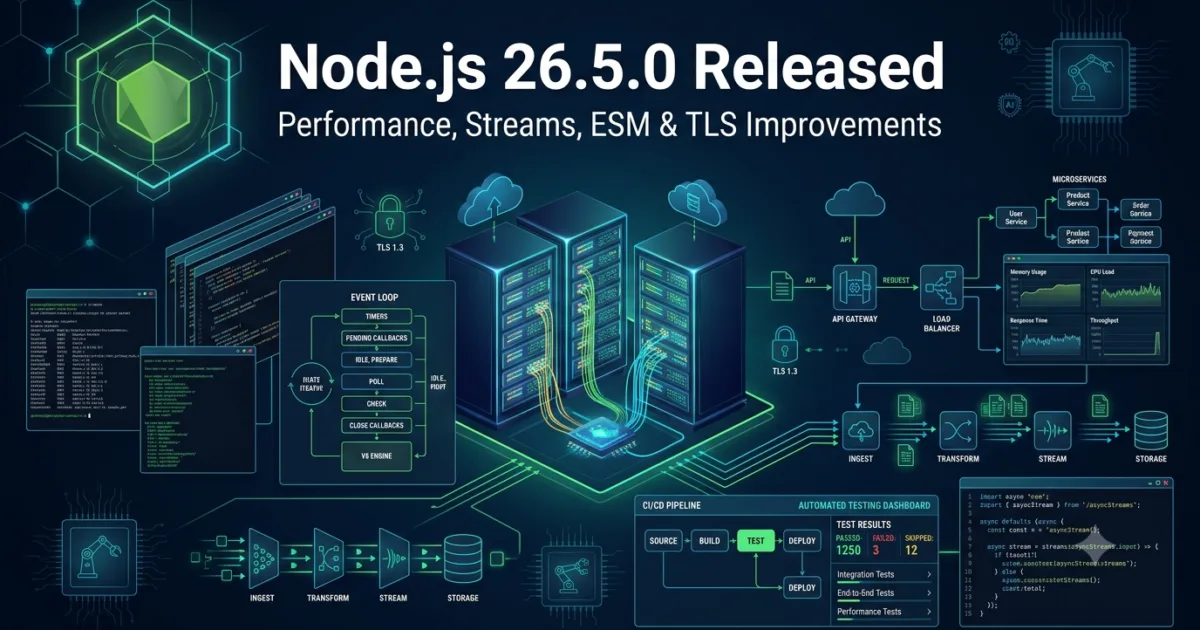
JavaScript continues to dominate modern software development, powering everything from enterprise web applications and backend APIs to AI platforms, automation frameworks, serverless functions, and cloud-native microservices. At the heart of this ecosystem lies Node.js, the runtime that enables developers and QA teams to build fast, scalable, and event-driven applications. Every Node.js release has the potential to influence development workflows, automated testing strategies, CI/CD pipelines, performance engineering, and production reliability.
Node.js 26.5.0, released on July 8, 2026, is a SEMVER-MINOR release that introduces several meaningful enhancements across Buffers, ECMAScript Modules (ESM), Streams, Performance Hooks, and TLS, while continuing to strengthen the platform’s performance, observability, and standards compliance. Although this release doesn’t introduce disruptive API changes, it provides new capabilities that developers, QA Engineers, and SDETs can leverage to build more reliable applications and more sophisticated testing strategies.
For teams maintaining Playwright, Cypress, Selenium, WebDriverIO, Jest, Vitest, Mocha, Express.js, Fastify, NestJS, or AI-powered Node.js applications, this release is worth understanding because it improves several core runtime components that influence testing accuracy, diagnostics, streaming workflows, and secure communications.
Whether you’re testing REST APIs, validating authentication systems, benchmarking asynchronous workloads, or building AI-powered automation pipelines, Node.js 26.5.0 introduces refinements that improve both developer productivity and application quality.
Official Release Highlights
According to the official Node.js release notes, Node.js 26.5.0 introduces multiple SEMVER-MINOR improvements across the runtime.
Major Runtime Improvements
- Buffer now supports blob.textStream()
- ECMAScript Modules gain the new –experimental-import-text flag
- Performance Hooks improve event loop delay sampling
- Streams expose ReadableStreamTee
- TLS reports negotiated TLS groups
- Various benchmark, documentation, and runtime optimizations
- New official Node.js release signing key added
These enhancements continue Node.js’ long-term investment in web platform compatibility, runtime performance, security, and developer experience.
Release Highlights at a Glance
| Component | What’s New | QA Engineering Benefit |
|---|---|---|
| Buffer API | blob.textStream() support | Improved testing of streaming uploads and file processing |
| ESM | --experimental-import-text flag | Simplifies loading text resources during development and testing |
| Performance Hooks | Better event loop delay sampling | More accurate performance benchmarking |
| Streams | ReadableStreamTee exposed | Easier validation of duplicated streaming data |
| TLS | Negotiated TLS group reporting | Better SSL/TLS debugging and security testing |
| Runtime | Internal optimizations | Improved stability and long-term maintainability |
Why Node.js 26.5.0 Matters
Modern JavaScript applications are no longer limited to simple REST APIs.
Today’s Node.js applications frequently power:
- AI Agents
- LLM integrations
- MCP Servers
- Streaming APIs
- GraphQL platforms
- WebSockets
- Financial systems
- Authentication services
- Event-driven microservices
- Serverless platforms
- Cloud-native applications
- Enterprise SaaS platforms
QA Engineers are increasingly responsible for validating not only functionality but also scalability, security, performance, streaming behavior, and observability.
Many of the enhancements introduced in Node.js 26.5.0 directly support these modern engineering requirements.
Rather than adding large new APIs, this release strengthens foundational runtime capabilities that benefit every JavaScript application running on Node.js.
Deep Dive into the New Features
Buffer API Enhancements
One of the most practical additions in Node.js 26.5.0 is support for:
blob.textStream()
This aligns Node.js more closely with modern browser APIs, making it easier for developers to write cross-platform JavaScript that behaves consistently in both client-side and server-side environments.
For QA Engineers, this improves testing scenarios involving:
- File uploads
- Blob processing
- Streaming responses
- Binary content validation
- AI document ingestion
- File transformation pipelines
Applications processing large files can now adopt more memory-efficient streaming techniques instead of loading entire payloads into memory.
Experimental Import of Text Resources
Node.js now introduces:
node --experimental-import-text
This feature enables direct importing of text resources within ECMAScript Modules, reducing boilerplate code and simplifying configuration-driven applications.
Potential QA use cases include:
- Loading test fixtures
- Importing SQL scripts
- Reading prompt templates for AI testing
- Managing configuration files
- API payload validation
- Snapshot testing resources
Although still experimental, it demonstrates Node.js’ ongoing evolution toward a richer module ecosystem.
Improved Performance Monitoring
Performance engineering has become a core responsibility for many QA teams.
Node.js 26.5.0 improves the Performance Hooks API by enhancing event loop delay sampling.
This provides more accurate visibility into:
- Event loop latency
- CPU bottlenecks
- Asynchronous blocking
- Performance regressions
- Runtime responsiveness
Teams building performance dashboards or executing load testing with k6, Locust, Artillery, or custom benchmarking tools can use these metrics to better understand application behavior under load.
Better Streaming Support
The introduction of ReadableStreamTee brings another Web Streams capability into Node.js.
This allows a single readable stream to be duplicated into two identical streams.
Example scenarios include:
- Logging while processing data.
- Streaming AI responses to multiple consumers.
- Simultaneous validation and persistence.
- Comparing transformed output.
- Running parallel processing pipelines.
Streaming applications continue growing across AI, media processing, and real-time analytics, making this enhancement increasingly valuable.
Enhanced TLS Diagnostics
Security testing continues becoming more sophisticated.
Node.js 26.5.0 now reports negotiated TLS groups, providing greater transparency during secure connection establishment.
QA Engineers performing:
- SSL validation
- Security testing
- Certificate verification
- HTTPS diagnostics
- API security testing
- Compliance validation
can obtain better visibility into encrypted communication behavior.
This improvement also benefits organizations operating highly regulated environments requiring detailed TLS auditing.
What This Means for QA Engineers
For modern QA teams, Node.js is no longer just a development runtime—it is the foundation of countless automation frameworks, testing tools, and backend services. Enhancements introduced in Node.js 26.5.0 improve several areas that directly influence software quality, including streaming APIs, runtime observability, security diagnostics, and standards compliance.
If your organization develops or tests applications using Playwright, Cypress, Jest, Vitest, Express.js, Fastify, NestJS, Next.js, AI SDKs, or custom Node.js services, this release provides meaningful benefits without requiring major codebase changes. Improved performance metrics help identify bottlenecks earlier, enhanced stream APIs simplify validation of modern web applications, and stronger TLS diagnostics support more comprehensive security testing.
These updates also contribute to better maintainability of automated testing frameworks. As web standards continue evolving, Node.js increasingly aligns its runtime APIs with browser implementations, reducing inconsistencies between frontend and backend environments. That means fewer platform-specific workarounds and more predictable behavior during automated testing.
Node.js 26.5.0 Feature Comparison
| Feature | Previous Version | Node.js 26.5.0 | QA Benefit |
|---|---|---|---|
| Blob Streaming | Limited support | blob.textStream() | Better file and upload testing |
| Text Module Imports | Not available | Experimental support | Easier fixture management |
| Event Loop Metrics | Existing monitoring | Improved sampling | Better performance analysis |
| Stream Duplication | Manual implementation | ReadableStreamTee | Cleaner stream validation |
| TLS Diagnostics | Basic reporting | Negotiated TLS groups | Enhanced security verification |
Practical Testing Example
Testing Stream-Based APIs
const blob = new Blob(["QA Pulse by SK"]);

for await (const chunk of blob.textStream()) {
  console.log(chunk);
}
This enables automated tests that validate streaming behavior without loading entire files into memory, making performance testing more realistic for large payloads.
Measuring Event Loop Performance
import { monitorEventLoopDelay } from "node:perf_hooks";

const histogram = monitorEventLoopDelay();

histogram.enable();

// Execute workload

histogram.disable();

console.log(histogram.mean);
QA teams can integrate similar monitoring into benchmark suites to detect event loop regressions during CI/CD execution.
Are There Any Breaking Changes?
The official release notes do not report any breaking changes for Node.js 26.5.0.
This is a SEMVER-MINOR release, meaning:
- Existing Node.js applications should continue working.
- Automation frameworks require no immediate migration.
- Most libraries remain compatible.
- Upgrading risk is relatively low.
As always, organizations should execute regression testing before rolling out runtime upgrades to production environments.
Upgrade Recommendations
Before adopting Node.js 26.5.0, QA teams should validate:
- Playwright automation suites
- Cypress test execution
- Jest and Vitest unit tests
- Express.js applications
- Fastify services
- NestJS APIs
- GraphQL endpoints
- REST API testing
- Streaming endpoints
- File upload functionality
- TLS-secured services
- Docker containers
- CI/CD pipelines
- Performance benchmarks
- AI agent workflows
- MCP Server implementations
Performing these validations ensures a smooth transition while preserving application stability and testing reliability.
How to Upgrade
Using Node Version Manager (Recommended)
nvm install 26.5.0
nvm use 26.5.0
Verify Installed Version
node --version
npm --version
Update Project Dependencies
npm update
npm audit
After upgrading, rerun your complete regression suite, performance benchmarks, security validation, and CI/CD workflows to confirm compatibility across your engineering ecosystem before promoting the runtime into production.
What Node.js 26.5.0 Means for QA Engineers
While Node.js 26.5.0 is classified as a SEMVER-MINOR release, its improvements extend beyond routine maintenance. The enhancements to Buffer APIs, Web Streams, ECMAScript Modules (ESM), Performance Hooks, and TLS diagnostics collectively strengthen the runtime that powers thousands of automated testing frameworks, backend services, API platforms, and AI-powered applications.
For QA Engineers, SDETs, Automation Engineers, DevOps Engineers, Performance Test Engineers, and Platform Engineers, this release provides more than incremental improvements—it delivers better observability, stronger standards compliance, enhanced streaming capabilities, and richer security diagnostics that improve both development and testing workflows.
Modern testing is no longer limited to validating REST APIs or browser interactions. Today’s engineering teams routinely test asynchronous processing, large file uploads, streaming AI responses, event-driven architectures, serverless functions, and secure communication channels. The improvements introduced in Node.js 26.5.0 help QA professionals validate these increasingly sophisticated workloads with greater confidence.
Enterprise Impact
Node.js continues to serve as the runtime behind many enterprise technologies, including:
- Express.js
- NestJS
- Fastify
- Next.js
- Playwright
- Cypress
- Jest
- Vitest
- AI SDKs
- MCP Servers
- LangChain integrations
- n8n workflows
- GraphQL gateways
- WebSocket services
- Serverless platforms
A runtime improvement at the Node.js level often benefits every application built on top of it.
Node.js 26.5.0 strengthens multiple core runtime components, allowing engineering organizations to build more reliable applications while giving QA teams better tooling for debugging, benchmarking, and validating modern software systems.
For enterprises operating dozens—or even hundreds—of Node.js services, adopting the latest stable runtime also helps reduce technical debt and maintain long-term compatibility with the evolving JavaScript ecosystem.
Key Improvements for QA Teams
Better Testing of Streaming Applications
Streaming has become a standard architectural pattern across modern applications.
Examples include:
- AI chat responses
- Large file downloads
- Video processing
- Event streaming
- Server-Sent Events (SSE)
- Real-time analytics
- Incremental API responses
The addition of blob.textStream() and the exposure of ReadableStreamTee improve Node.js’ implementation of modern Web Streams APIs.
For QA Engineers, this enables more realistic automated testing of:
- Streaming endpoints
- Incremental response validation
- Chunked HTTP transfers
- Binary payload processing
- File upload pipelines
- AI-generated streaming content
These improvements also reduce the need for custom workarounds when testing browser-compatible APIs in server-side environments.
More Accurate Performance Testing
Performance testing extends beyond measuring response times.
Understanding event loop behavior is essential for diagnosing:
- CPU bottlenecks
- Blocking operations
- High concurrency issues
- Memory pressure
- Asynchronous performance regressions
The enhancements to Performance Hooks improve event loop delay sampling, giving developers and QA engineers more precise runtime metrics.
This is particularly valuable for organizations using:
- k6
- Locust
- Artillery
- Autocannon
- Custom benchmarking tools
- Production observability platforms
Better runtime metrics ultimately lead to better optimization decisions.
Improved Security Validation
Security testing increasingly requires visibility into encrypted communications.
Node.js 26.5.0 introduces reporting for negotiated TLS groups, giving engineering teams deeper insight into secure connection establishment.
This benefits teams responsible for:
- HTTPS validation
- SSL/TLS compliance
- Certificate verification
- Security audits
- API encryption testing
- Enterprise compliance requirements
Although this enhancement targets diagnostics rather than functionality, improved visibility often reduces troubleshooting time during production incidents.
Feature Comparison
| Area | Before Node.js 26.5.0 | Node.js 26.5.0 |
|---|---|---|
| Blob Streaming | Partial Web API compatibility | Native blob.textStream() support |
| Module Loading | Standard ESM features | Experimental text imports |
| Performance Monitoring | Existing event loop metrics | More accurate delay sampling |
| Streams | Manual duplication patterns | Built-in ReadableStreamTee |
| TLS Diagnostics | Limited visibility | Negotiated TLS group reporting |
Practical QA Testing Scenarios
The improvements in Node.js 26.5.0 directly support several real-world testing scenarios.
| Testing Scenario | Benefit |
|---|---|
| API Automation | Better stream validation |
| AI Response Testing | Improved streaming support |
| Performance Testing | More accurate runtime metrics |
| Security Testing | Enhanced TLS diagnostics |
| File Upload Validation | Native Blob streaming |
| Integration Testing | Improved standards compliance |
| Regression Testing | Stable runtime improvements |
| Cloud Applications | Better asynchronous diagnostics |
These capabilities help QA teams build more comprehensive automated testing strategies while reducing implementation complexity.
Migration Recommendations
Since Node.js 26.5.0 introduces no reported breaking changes, migration should be straightforward.
Before upgrading production environments, execute:
- Complete regression testing
- API automation suites
- Browser automation
- Performance benchmarks
- Streaming endpoint validation
- File upload testing
- Authentication workflows
- TLS verification
- Containerized deployments
- Kubernetes workloads
- Docker images
- CI/CD pipeline validation
- AI workflow testing
- MCP Server compatibility checks
- Dependency compatibility review
Organizations following gradual deployment strategies should promote the new runtime through development, staging, and pre-production environments before full production rollout.
Upgrade Best Practices
Verify the Installed Runtime
node --version
npm --version
Update Dependencies
npm update
npm audit
Validate Existing Projects
npm test
npm run lint
npm run build
Execute Automation Suites
npx playwright test
or
npx cypress run
Running complete regression suites after every Node.js upgrade helps detect compatibility issues early and ensures production stability.
Should You Upgrade?
Yes.
Node.js 26.5.0 is a recommended upgrade for most engineering teams because it delivers meaningful runtime improvements without introducing breaking changes.
Upgrade is particularly recommended for organizations using:
- Playwright
- Cypress
- Selenium
- Express.js
- Fastify
- NestJS
- Next.js
- AI SDKs
- LangChain
- CrewAI
- MCP Servers
- n8n
- GraphQL
- REST APIs
- WebSockets
- Serverless Functions
- Cloud-native applications
The migration effort is minimal while the long-term benefits include improved standards compliance, enhanced runtime diagnostics, stronger streaming APIs, and better support for modern JavaScript applications.
Node.js 26.5.0 Released: Key Takeaways
Node.js 26.5.0 Released delivers meaningful runtime enhancements that strengthen the JavaScript ecosystem without disrupting existing applications. Support for blob.textStream(), improved Performance Hooks, new ReadableStreamTee capabilities, experimental text imports, and enhanced TLS diagnostics make this release particularly valuable for organizations building scalable backend services, AI-powered applications, automation frameworks, and cloud-native platforms.
For QA Engineers, SDETs, Automation Engineers, Performance Test Engineers, DevOps Engineers, and Software Architects, these improvements provide better observability, stronger standards compliance, enhanced security diagnostics, and more powerful tools for validating modern distributed applications. With no reported breaking changes, Node.js 26.5.0 is a low-risk, production-ready upgrade that should be included in regular maintenance cycles.
Suggested Internal Links
- Node.js 26.5.0 Released: Performance, Streams & ESM Improvements for QA Engineers
- Node.js 26.4.0 Released: Powerful Runtime Improvements Every QA Engineer Should Know
- Node.js 26.3.0 Released: Important Performance and Security Improvements QA Engineers Should Know
Authoritative External Resources
- Official Node.js Website: https://nodejs.org/
- Node.js Documentation: https://nodejs.org/docs/latest-v26.x/api/
- Node.js Security Releases: https://nodejs.org/en/security
People Asked Questions
Is Node.js 26.5.0 a major release?
No. Node.js 26.5.0 is a SEMVER-MINOR release that introduces new runtime capabilities while maintaining backward compatibility.
Are there any breaking changes?
No. The official release notes do not report any breaking changes, making this a low-risk upgrade for most applications.
Which feature is most useful for QA Engineers?
The improvements to Performance Hooks, Web Streams, and TLS diagnostics provide the greatest value by improving performance analysis, streaming validation, and security testing.
Should enterprise teams upgrade immediately?
Yes. Most organizations can safely upgrade after executing standard regression testing and validating CI/CD pipelines.
Will existing Node.js applications continue working?
Yes. Existing applications, automation frameworks, and testing tools should remain compatible because this release preserves backward compatibility while adding new capabilities.
Continue Learning with QAPulse by SK
Stay ahead of the rapidly evolving software engineering landscape with QAPulse by SK, your trusted source for expert insights on Node.js, Playwright, Cypress, FastAPI, Docker, LangChain, CrewAI, MCP Servers, n8n, Locust, k6, AI Agents, DevOps, Cloud Computing, Performance Engineering, and Test Automation.
Whether you’re building enterprise automation frameworks, optimizing CI/CD pipelines, testing AI-powered applications, or mastering modern backend development, QAPulse by SK provides practical tutorials, release analyses, implementation guides, and best practices to help QA professionals and software engineers build faster, more secure, and more reliable applications.