 QA
QA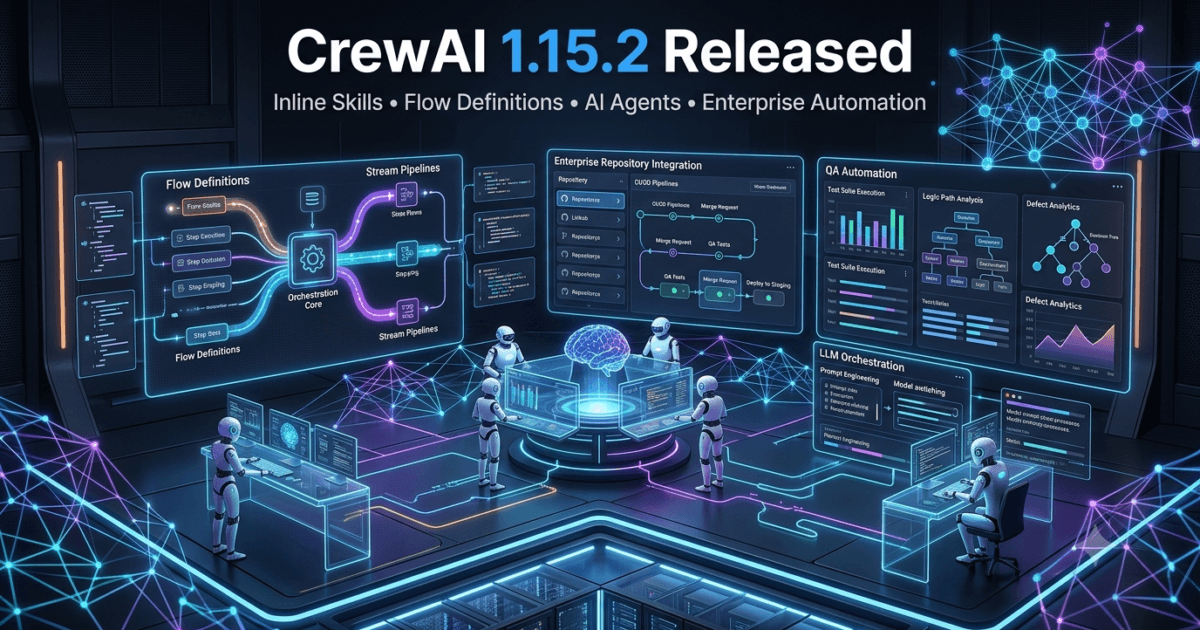
The rapid evolution of AI agents is transforming how software is designed, tested, deployed, and maintained. From autonomous testing assistants and intelligent bug triage to workflow orchestration and enterprise automation, AI agents are becoming an essential part of modern engineering teams. CrewAI has established itself as one of the leading open-source frameworks for building collaborative, multi-agent AI systems that can reason, plan, execute tasks, and coordinate complex workflows.
CrewAI 1.15.2, released on July 8, 2026, continues this momentum with a feature-rich update focused on Flow Definitions, agent orchestration, streaming, inline skills, templating, model management, security fixes, and developer experience improvements. Rather than introducing a single headline capability, this release enhances multiple areas of the framework that collectively improve scalability, maintainability, observability, and enterprise readiness.
For QA Engineers, SDETs, AI Engineers, Automation Engineers, DevOps teams, Platform Engineers, and software architects, these improvements make CrewAI workflows easier to test, easier to maintain, and more reliable in production environments. Organizations building AI-powered automation platforms, intelligent testing assistants, customer support agents, DevOps copilots, or multi-agent enterprise systems should pay close attention to this release.
CrewAI 1.15.2 is particularly valuable because it strengthens the framework’s declarative Flow architecture while improving runtime stability, reducing configuration complexity, and providing better tooling for enterprise AI development.
Official Release Highlights
According to the official release notes, CrewAI 1.15.2 introduces enhancements across several major areas:
Major Feature Additions
- Dynamic retrieval of the latest LLM models in the Crew Wizard
- Support for inline skill definitions
- Generated Flow Definition authoring skill
- Templated Flow action inputs
- Text helper utilities for Flow CEL prompts
- Repository agents inside Flow Definitions
- Streaming frame protocol for flows
- Improved AgentExecutor messaging and feedback handling
- Typed tools and applications inside CrewDefinition
Stability Improvements
- Improved model catalog cache behavior
- Better flow input resolution
- Multiple dependency security fixes
- Improved Bedrock support
- Flow version consistency
- Better validation for flow methods
Documentation Improvements
- Streaming documentation
- Updated Flow agent documentation
- Policy terminology updates
- Agent Control Plane enhancements
- Improved Datadog documentation
Collectively, these improvements continue CrewAI’s transition toward becoming a production-ready framework for enterprise AI agent orchestration.
CrewAI 1.15.2 at a Glance
| Area | Improvement | Benefit for QA Teams |
|---|---|---|
| Flow Definitions | Inline skills & repository agents | Easier workflow maintenance |
| LLM Integration | Dynamic model retrieval | Reduced configuration overhead |
| Streaming | New frame protocol | Better testing of streaming AI workflows |
| Agent Execution | Improved feedback handling | Easier debugging and observability |
| Security | Dependency vulnerability fixes | Stronger enterprise compliance |
| Documentation | Expanded guides | Faster onboarding for engineering teams |
Why This Release Matters
Modern AI systems rarely consist of a single language model.
Instead, enterprise applications increasingly combine multiple specialized agents responsible for:
- Planning
- Tool execution
- Memory
- Retrieval
- Validation
- API integration
- Decision making
- Workflow routing
- Human approval
- Monitoring
Managing these interactions manually quickly becomes difficult.
CrewAI addresses this challenge through Flows, Crews, Agents, Tasks, and Skills, enabling developers to build structured AI workflows rather than isolated prompts.
Version 1.15.2 focuses heavily on making these workflows more modular, reusable, and easier to manage at enterprise scale.
For QA Engineers, this means AI workflows become significantly easier to validate through automated testing.
Deep Dive into the New Features
Dynamic LLM Model Discovery
One of the most practical additions is the ability for the Crew Wizard to automatically retrieve the latest supported language models.
Instead of manually updating configuration files whenever providers introduce new models, CrewAI can now dynamically surface available options.
Benefits include:
- Faster experimentation
- Simplified onboarding
- Reduced maintenance
- Better compatibility
- Improved developer experience
For QA teams validating multiple LLM providers, this reduces configuration drift between environments.
Inline Skill Definitions
Previous CrewAI projects often required separate files for reusable skills.
Version 1.15.2 introduces support for inline skill definitions, allowing skills to be embedded directly inside Flow definitions.
Advantages include:
- Smaller projects
- Easier reviews
- Better portability
- Simpler debugging
- Improved readability
This is particularly useful for prototype workflows and smaller automation projects.
Improved Flow Definitions
Flow Definitions continue evolving into CrewAI’s primary orchestration mechanism.
This release introduces:
- Repository agents
- Generated authoring skills
- Templated inputs
- Better helper utilities
- Typed applications
- Improved Flow metadata
These capabilities significantly reduce boilerplate while increasing workflow flexibility.
For enterprise projects managing dozens of agents across multiple teams, these improvements simplify long-term maintenance.
Streaming Protocol Enhancements
Streaming AI responses have become standard for:
- Chat assistants
- Coding copilots
- Customer support bots
- AI search
- Enterprise knowledge assistants
CrewAI 1.15.2 introduces a dedicated streaming frame protocol, improving how streamed information is exchanged between agents.
QA teams can now build more reliable automated tests for:
- Partial responses
- Incremental generation
- Agent conversations
- Long-running workflows
- Interactive AI systems
Streaming support continues becoming one of the most important aspects of modern AI engineering.
Better AgentExecutor Feedback
Agent execution is no longer treated as a simple request-response interaction.
CrewAI now improves:
- Setup messaging
- Feedback handling
- Runtime coordination
This provides richer execution visibility during debugging.
For SDETs, better execution telemetry translates into easier root cause analysis when validating complex AI workflows.
Security Improvements
Enterprise adoption increasingly depends on secure software supply chains.
CrewAI 1.15.2 resolves multiple dependency-related security concerns, including updates affecting:
- ONNX
- NLTK
- pip-audit
- aiobotocore
Although these updates may not directly affect application logic, they reduce risk and improve compliance with organizational security policies.
Organizations operating regulated environments should prioritize these dependency updates during their maintenance cycles.
What This Means for QA Engineers
CrewAI is becoming much more than an AI experimentation framework—it is evolving into a production-grade orchestration platform capable of supporting enterprise-scale autonomous systems. The enhancements introduced in version 1.15.2 significantly improve the testing experience by making AI workflows more deterministic, modular, observable, and maintainable.
For QA Engineers and SDETs, inline skill definitions reduce configuration complexity, while templated Flow inputs enable broader test coverage using reusable data-driven scenarios. The new streaming protocol opens opportunities to automate validation of real-time AI responses, incremental outputs, and conversational workflows that were previously difficult to test consistently.
The improvements to AgentExecutor feedback handling also simplify debugging by exposing richer execution details during runtime. Instead of treating AI agents as opaque black boxes, testing teams gain better visibility into execution flow, making it easier to identify failures, trace agent interactions, and validate expected decision paths.
These improvements collectively reduce the effort required to build reliable regression suites for AI-powered applications while increasing confidence in production deployments.
Feature Comparison
| Capability | Previous Versions | CrewAI 1.15.2 |
|---|---|---|
| LLM Discovery | Manual configuration | Dynamic model retrieval |
| Skills | Separate files | Inline skill definitions |
| Flow Inputs | Static definitions | Templated inputs |
| Streaming | Basic support | Dedicated streaming protocol |
| Repository Integration | Limited | Repository agents |
| Agent Feedback | Standard execution | Enhanced messaging & feedback |
| Security | Existing dependencies | Updated secure dependency chain |
Example Flow Definition
crew:
  agents:
    - researcher
    - reviewer

flow:
  input:
    topic: "{{ user_topic }}"

  tasks:
    - researcher
    - reviewer
Templated Flow inputs make automated testing easier by allowing QA teams to execute the same workflow across hundreds of datasets without modifying the Flow definition itself.
Migration Recommendations
CrewAI 1.15.2 introduces no reported breaking changes, making it a low-risk upgrade for most organizations.
Before upgrading production AI systems, validate:
- Multi-agent workflows
- Flow Definitions
- Agent memory
- Tool integrations
- Streaming outputs
- API integrations
- Repository agents
- Bedrock integrations
- LLM provider compatibility
- Security scans
- Regression suites
- Performance benchmarks
- CI/CD automation
- Prompt templates
- Human approval workflows
Testing these areas ensures existing automation continues functioning correctly while benefiting from the latest improvements.
How to Upgrade
Upgrade CrewAI
pip install --upgrade crewai
Verify Installation
crewai version
Upgrade Project Dependencies
pip install --upgrade -r requirements.txt
Execute Your Regression Suite
pytest
After upgrading, validate AI agent behavior, Flow execution, tool integrations, prompt templates, streaming responses, and production pipelines before promoting the new version into live environments. CrewAI 1.15.2 is a mature maintenance and feature release that strengthens the framework without introducing disruptive migration requirements, making it an excellent upgrade for organizations building modern AI-powered automation systems.
What CrewAI 1.15.2 Means for QA Engineers
As AI-powered software continues to evolve, QA Engineers are increasingly responsible for validating not just application functionality but also the behavior of autonomous AI agents, multi-agent collaboration, decision-making logic, prompt execution, memory management, tool integrations, and workflow orchestration. Traditional testing techniques alone are no longer sufficient. Teams now require frameworks that make AI systems observable, deterministic, and testable.
CrewAI 1.15.2 addresses many of these enterprise challenges by strengthening its Flow architecture, improving agent communication, enhancing streaming capabilities, and simplifying workflow authoring. While the release introduces several new developer-focused features, the real value for QA teams lies in improved reliability, maintainability, and testability across complex AI workflows.
Whether your organization is building AI coding assistants, intelligent customer support agents, DevOps copilots, QA automation agents, document processing pipelines, or enterprise knowledge assistants, CrewAI 1.15.2 provides enhancements that reduce operational complexity while making automated validation significantly easier.
Enterprise Impact
CrewAI is increasingly becoming part of enterprise AI stacks that integrate with technologies such as:
- LangChain
- MCP Servers
- OpenAI APIs
- Anthropic Claude
- Google Gemini
- Amazon Bedrock
- Azure OpenAI
- FastAPI
- Docker
- Kubernetes
- n8n
- Python automation frameworks
- Playwright MCP
- CI/CD pipelines
As organizations deploy AI agents into production, maintaining reliability becomes just as important as building new capabilities. CrewAI 1.15.2 focuses on improving the underlying infrastructure required to operate these systems at scale, ensuring that engineering teams can confidently develop, monitor, and test increasingly sophisticated AI workflows.
For QA professionals, this means fewer environment inconsistencies, more reusable workflows, and better visibility into agent execution.
Key Improvements for QA Teams
Better Flow Testing and Reusability
One of the most valuable additions in this release is support for templated Flow action inputs combined with inline skill definitions.
Instead of maintaining multiple copies of nearly identical workflows, QA teams can now create reusable Flow Definitions that accept different datasets, prompts, environments, and configurations without modifying the workflow itself.
This greatly simplifies:
- Data-driven testing
- Regression testing
- Cross-model validation
- Environment-specific execution
- Continuous integration testing
- Automated workflow verification
Reusable Flow Definitions also reduce maintenance costs as AI projects grow.
Improved Streaming Validation
Streaming responses have become a standard feature across modern AI applications.
Examples include:
- AI chatbots
- Coding assistants
- Research agents
- Customer support systems
- Document analysis platforms
- Enterprise copilots
CrewAI 1.15.2 introduces a dedicated stream frame protocol, making streamed communication more structured and predictable.
For QA Engineers, this enables more comprehensive testing of:
- Partial responses
- Streaming latency
- Incremental content generation
- Long-running workflows
- Multi-agent conversations
- Response ordering
- Real-time UI updates
These improvements make automated validation of streaming AI considerably more reliable.
Better Debugging Through Enhanced Agent Feedback
AI workflows can be difficult to troubleshoot because multiple autonomous agents often collaborate behind the scenes.
CrewAI improves AgentExecutor messaging and feedback handling, providing richer execution context during runtime.
Benefits include:
- Faster root cause analysis
- Improved debugging
- Better workflow visibility
- Easier execution tracing
- More informative logs
- Improved observability
Rather than treating AI workflows as opaque systems, engineering teams gain clearer insight into why agents made particular decisions and how information flowed throughout the execution process.
Security and Stability Improvements
Production AI platforms must remain secure as well as intelligent.
CrewAI 1.15.2 resolves multiple dependency-related issues involving packages such as:
- ONNX
- NLTK
- aiobotocore
- pip-audit
Although these updates may appear minor, they reduce exposure to known vulnerabilities while improving long-term maintainability of enterprise AI platforms.
Organizations with strict compliance requirements should view these dependency updates as an important reason to upgrade.
Feature Comparison
| Area | Previous Versions | CrewAI 1.15.2 |
|---|---|---|
| Flow Inputs | Mostly static | Fully templated |
| Skills | External definitions | Inline support |
| Agent Communication | Standard messaging | Improved feedback handling |
| Streaming | Basic implementation | Dedicated stream protocol |
| Repository Integration | Limited | Repository agents |
| Model Selection | Manual updates | Dynamic model discovery |
| Security | Previous dependency versions | Updated secure packages |
Practical Testing Scenarios
The improvements introduced in CrewAI 1.15.2 directly benefit several real-world testing scenarios.
| Testing Scenario | Benefit |
|---|---|
| Multi-Agent Testing | Better execution visibility |
| AI Workflow Validation | Reusable Flow Definitions |
| Streaming Response Testing | Dedicated stream protocol |
| Prompt Testing | Templated Flow inputs |
| Regression Testing | Reduced workflow duplication |
| Security Validation | Updated dependency chain |
| Enterprise Deployments | Improved runtime consistency |
| CI/CD Automation | Easier automated validation |
These capabilities allow QA teams to expand beyond traditional software testing and build comprehensive validation strategies for AI-native applications.
Migration Recommendations
CrewAI 1.15.2 introduces no officially reported breaking changes, making it a safe upgrade for most organizations.
Before upgrading production systems, validate:
- Crew Definitions
- Flow Definitions
- Agent communication
- Streaming workflows
- Repository agents
- Skill execution
- Tool integrations
- Memory handling
- Prompt templates
- API integrations
- Bedrock connectivity
- CI/CD pipelines
- Automated regression suites
- Performance benchmarks
- Production deployment pipelines
Organizations adopting staged deployments should first validate development and staging environments before promoting the update into production.
Upgrade Best Practices
Verify Current Version
crewai version
Upgrade CrewAI
pip install --upgrade crewai
Update Project Dependencies
pip install --upgrade -r requirements.txt
Execute Regression Tests
pytest
Validate AI Workflow Execution
After upgrading, verify:
- Agent coordination
- Flow execution
- Streaming responses
- Prompt templates
- Memory operations
- Tool integrations
- LLM provider compatibility
- Production monitoring
Completing these validation steps helps ensure that newly introduced Flow capabilities and runtime improvements integrate smoothly with existing AI systems.
Should You Upgrade?
Yes.
CrewAI 1.15.2 is a highly recommended upgrade for teams developing or testing AI agent applications. The combination of dynamic model discovery, inline skills, templated Flow inputs, repository agents, streaming protocol improvements, enhanced AgentExecutor feedback, and security updates makes this one of the most practical releases for engineering teams focused on production AI systems.
Organizations building AI copilots, autonomous testing platforms, enterprise assistants, workflow automation systems, and multi-agent architectures will benefit from improved maintainability, stronger observability, easier debugging, and more reliable automated testing. Since no breaking changes have been reported, most teams can adopt this version after completing standard regression and integration testing.
CrewAI 1.15.2 Released: Key Takeaways
CrewAI 1.15.2 Released continues the platform’s evolution into a mature enterprise framework for orchestrating collaborative AI agents. Instead of introducing disruptive architectural changes, this release focuses on strengthening the developer and testing experience through inline skill definitions, templated Flow inputs, dynamic LLM model discovery, repository agents, streaming protocol enhancements, improved AgentExecutor feedback, and important security updates.
For QA Engineers, SDETs, AI Engineers, DevOps professionals, and Platform Teams, these enhancements translate into better workflow reusability, easier debugging, more comprehensive automation, improved observability, and stronger production readiness. With no reported breaking changes, CrewAI 1.15.2 is a low-risk upgrade that provides meaningful benefits for organizations building scalable, maintainable, and enterprise-grade AI agent ecosystems.
Internal Links
- CrewAI 1.15.1 Released: What QA Engineers Need to Know About the Latest AI Agent Update
- CrewAI 1.15.0 Released: Agentic AI Workflow Improvements Every QA Engineer Should Know
- CrewAI 1.14.7 Released: Powerful Agentic AI Improvements QA Engineers Must Know
- CrewAI 1.14.6 Released: Powerful Agent Reliability Improvements QA Engineers Should Know
Official Resources
- Official Release Notes: https://docs.crewai.com/v1.15.2/en/changelog#v1-15-2
- Official Documentation: https://docs.crewai.com
People Asked Questions
Is CrewAI 1.15.2 a major release?
No. It is a feature-rich incremental release that improves Flow capabilities, AI agent orchestration, streaming support, and runtime stability while maintaining backward compatibility.
Are there any breaking changes?
No official breaking changes have been reported for CrewAI 1.15.2.
Which feature is most valuable for QA Engineers?
The combination of templated Flow inputs, inline skill definitions, streaming protocol support, and improved AgentExecutor feedback offers the greatest value because these features make AI workflows easier to automate, debug, and validate.
Should enterprise AI teams upgrade immediately?
Yes. Most organizations can safely upgrade after completing regression testing, validating Flow Definitions, verifying LLM integrations, and confirming compatibility across their CI/CD pipelines.
Does this release improve production readiness?
Yes. Enhancements to workflow modularity, runtime stability, dependency security, streaming communication, and developer tooling make CrewAI 1.15.2 a stronger choice for enterprise AI deployments.
Continue Learning with QAPulse by SK
Stay ahead in the rapidly evolving world of AI Engineering, Test Automation, and Software Quality with QAPulse by SK. Explore expert tutorials, release breakdowns, hands-on implementation guides, and engineering best practices covering CrewAI, LangChain, MCP Servers, n8n, FastAPI, Playwright, Docker, Node.js, Python, AI Agents, LLMs, RAG, DevOps, Cloud Computing, and Performance Testing. Whether you’re building intelligent automation systems, validating enterprise AI workflows, or modernizing your software delivery pipeline, QAPulse by SK helps you stay informed with practical, QA-focused insights.