 QA
QA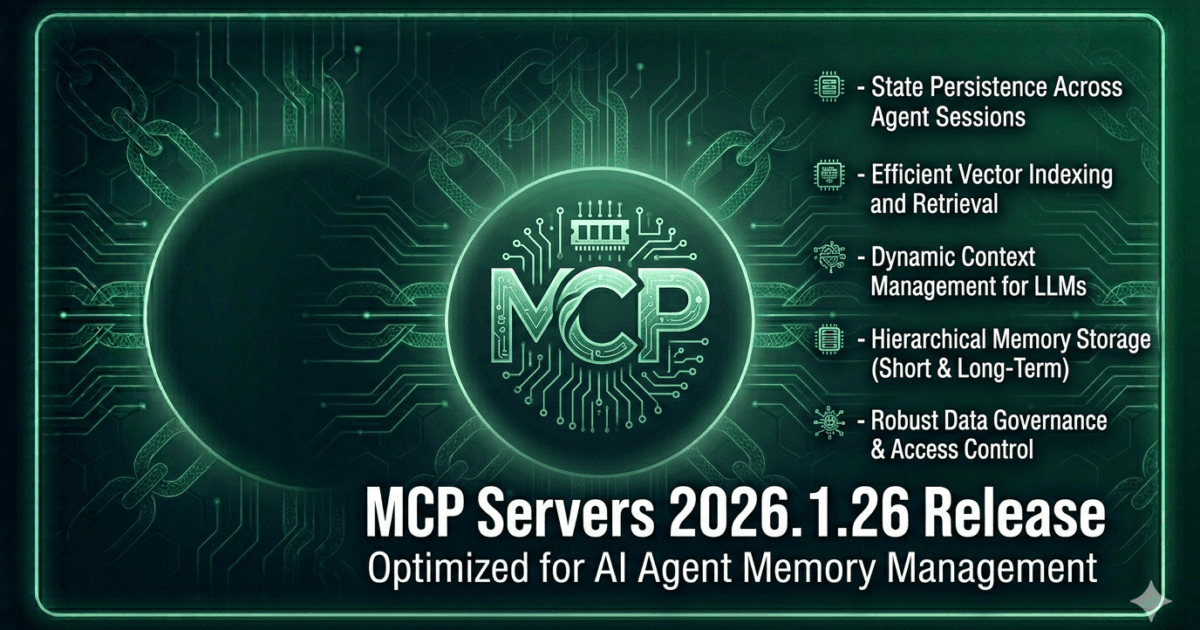
The Model Context Protocol ecosystem continues to evolve rapidly, and the release of MCP Servers 2026.1.26 brings updates to several core server packages used throughout the MCP ecosystem.
Although this release does not introduce publicly documented new features, it updates important MCP server components that many organizations rely on when building AI agents, tool integrations, memory systems, and enterprise automation platforms.
For QA Engineers, SDETs, AI Test Engineers, and Agentic AI teams, staying current with MCP Server releases helps ensure compatibility, stability, and long-term maintainability.
What is MCP?
The Model Context Protocol (MCP) is an open standard designed to allow AI models to securely interact with:
- External tools
- Databases
- APIs
- Enterprise systems
- Memory stores
- Development platforms
- Business applications
MCP has quickly become one of the most important standards for Agentic AI development.
Organizations use MCP to build:
- AI Agents
- Multi-Agent Systems
- RAG Platforms
- Autonomous Workflows
- AI-Powered Testing Tools
- Enterprise AI Integrations
Official Documentation:
https://modelcontextprotocol.io
Official MCP Servers Repository:
https://github.com/modelcontextprotocol/servers
Official Release Notes:
https://github.com/modelcontextprotocol/servers/releases/tag/2026.1.26
What’s New in MCP Servers 2026.1.26?
The release updates the following packages:
Updated Packages
| Package | Version |
|---|---|
| @modelcontextprotocol/server-everything | 2026.1.26 |
| @modelcontextprotocol/server-memory | 2026.1.26 |
| mcp-server-time | 2026.1.26 |
The release notes do not currently describe feature-level changes.
However, package updates in MCP ecosystems are often released to improve:
- Compatibility
- Reliability
- Internal architecture
- Dependency alignment
- Long-term maintainability
Why MCP Servers Matter for QA Engineers
Traditional software testing focuses on:
- UI Testing
- API Testing
- Database Testing
Agentic AI systems introduce entirely new testing challenges.
Examples include:
- Tool invocation testing
- Context management validation
- Memory consistency verification
- Agent workflow testing
- Multi-agent orchestration testing
MCP sits at the center of these capabilities.
Understanding server-memory
One of the updated packages is:
@modelcontextprotocol/server-memory
This server provides memory capabilities for AI applications.
Typical use cases include:
- Conversation persistence
- Agent memory
- User context retention
- Knowledge storage
For QA engineers, memory systems introduce new testing requirements:
Memory Validation
Verify:
- Memory creation
- Memory retrieval
- Memory updates
- Memory deletion
Context Consistency
Validate that:
- Agents receive correct context
- Context remains accurate across sessions
- Data isolation is maintained
Understanding mcp-server-time
The updated:
mcp-server-time
package provides time-related tools.
Examples include:
- Current time retrieval
- Timezone operations
- Date calculations
- Scheduling support
For AI testing teams, time services are critical because many workflows depend on:
- Deadlines
- Scheduling
- Time-sensitive decisions
- Event-driven automation
Understanding server-everything
The package:
@modelcontextprotocol/server-everything
is commonly used for testing and experimentation.
It exposes numerous MCP capabilities in a single environment.
This makes it valuable for:
- Integration testing
- Tool discovery testing
- Agent validation
- MCP learning environments
QA teams frequently use it as a sandbox before production deployment.
Why Maintenance Releases Matter
Many organizations only pay attention to major releases.
However, maintenance releases often provide:
- Better stability
- Improved compatibility
- Reduced technical debt
- Dependency synchronization
These improvements can have a significant impact on production systems.
Impact on AI Testing
Organizations building:
- CrewAI platforms
- LangChain applications
- OpenAI-compatible systems
- Custom AI agents
- Enterprise copilots
should continuously validate MCP compatibility.
Key testing areas include:
Tool Invocation Testing
Verify agents can:
- Discover tools
- Execute tools
- Process results
Memory Testing
Validate:
- Persistence
- Recall
- Consistency
Workflow Testing
Confirm:
- Agent coordination
- Multi-step execution
- Context propagation
MCP Servers and Agentic AI in 2026
The rise of Agentic AI has increased demand for:
- Reliable tool integration
- Persistent memory
- Context-aware execution
- Enterprise-grade governance
MCP is rapidly becoming the preferred interoperability layer.
For QA engineers, this creates new opportunities to specialize in:
- AI Testing
- Agent Testing
- MCP Validation
- LLM Evaluation
- Autonomous Workflow Testing
MCP Servers 2026.1.26 vs Previous Release
| Area | Previous Release | 2026.1.26 |
|---|---|---|
| MCP Compatibility | Stable | Updated |
| Memory Server | Existing | Updated |
| Time Server | Existing | Updated |
| Testing Environment | Existing | Updated |
| Breaking Changes | None Announced | None Announced |
Testing Checklist After Upgrading
MCP Validation
✅ Tool registration
✅ Tool discovery
✅ Tool execution
Memory Testing
✅ Context storage
✅ Context retrieval
✅ Session persistence
Time Services
✅ Date calculations
✅ Timezone support
✅ Scheduling workflows
AI Workflow Validation
✅ Agent execution
✅ Multi-agent coordination
✅ RAG workflows
Upgrade Guide
Node.js
npm update @modelcontextprotocol/server-everything
npm update @modelcontextprotocol/server-memory
Verify Installation
npm list @modelcontextprotocol/server-memory
Should Teams Upgrade?
Upgrade Immediately If
✅ You actively use MCP servers
✅ You build AI agents
✅ You maintain Agentic AI platforms
✅ You use MCP in production
Additional Validation Recommended
⚠️ Memory-heavy workflows
⚠️ Multi-agent systems
⚠️ Enterprise integrations
⚠️ Custom MCP implementations
How QA Engineers Can Build an MCP Testing Strategy in 2026
As MCP adoption grows across AI platforms, QA engineers need to move beyond traditional API and UI testing approaches. Testing an MCP-powered application requires validating not only the user-facing functionality but also the interaction between AI models, tools, memory systems, and external services.
A modern MCP testing strategy should focus on four key areas:
Tool Integration Testing
Every MCP server exposes tools that can be consumed by AI agents. QA teams should verify:
- Tool registration
- Tool discovery
- Parameter validation
- Error handling
- Response consistency
For example, if an AI agent uses an MCP Time Server to schedule tasks, testers should validate behavior across different time zones, daylight saving transitions, and invalid date inputs.
Memory Validation Testing
Memory is one of the most powerful capabilities in Agentic AI systems. However, it also introduces new risks.
QA engineers should verify:
- Long-term memory persistence
- Context recall accuracy
- Data isolation between users
- Memory deletion workflows
- Recovery after system restarts
Testing memory systems becomes increasingly important in enterprise environments where AI assistants handle customer conversations, support tickets, and business workflows.
Multi-Agent Workflow Testing
Many organizations are now deploying multiple agents that collaborate using MCP tools and shared context.
Test scenarios should include:
- Agent-to-agent communication
- Shared memory access
- Concurrent workflow execution
- Tool invocation sequencing
- Failure recovery mechanisms
Without proper testing, one failing agent can create cascading failures across an entire workflow.
Security and Governance Testing
Enterprise MCP deployments often connect AI systems with internal databases, APIs, and business applications.
QA teams should validate:
- Access control
- Permission enforcement
- Audit logging
- Data masking
- Sensitive information handling
As Agentic AI adoption accelerates throughout 2026, organizations that invest in comprehensive MCP testing strategies will be better positioned to deliver secure, reliable, and scalable AI-powered solutions.
My QA Assessment of MCP Servers 2026.1.26
Biggest Benefit
Package alignment across MCP server ecosystem.
Most Valuable Outcome
Improved long-term compatibility.
Breaking Changes
None announced.
Upgrade Risk
Very Low.
Enterprise Recommendation
Recommended upgrade after standard validation.
Overall Rating
8.9/10
While this release does not introduce major user-facing features, keeping MCP infrastructure current is essential for organizations investing in Agentic AI and enterprise automation.
More Related Blogs
- Cypress 15.17.0 Released: Valuable Stability Improvements QA Engineers Should Know
- FastAPI 0.137.1 Released: Important API Routing Fixes QA Engineers Should Upgrade For
- PyTest 9.1.0 Released: Critical Fixture Changes QA Engineers Must Understand
- Playwright 1.61.0 Released: Powerful Authentication Testing Features QA Engineers Must Know
- LangChain 1.4.6 Released: Valuable AI Agent Observability Improvements QA Engineers Must Know
External Resources
Model Context Protocol Official Documentation: https://modelcontextprotocol.io
MCP Servers GitHub Repository: https://github.com/modelcontextprotocol/servers
MCP Servers Release Notes: https://github.com/modelcontextprotocol/servers/releases/tag/2026.1.26
Anthropic MCP Announcement: https://www.anthropic.com/news/model-context-protocol
Frequently Asked Questions
What is MCP Servers 2026.1.26?
It is a maintenance release updating core MCP server packages including server-memory, server-everything, and mcp-server-time.
Does this release introduce new features?
No major user-facing features were documented in the official release notes.
Should QA teams upgrade?
Most organizations can safely upgrade after standard validation testing.
Does this affect Agentic AI systems?
Yes. MCP servers are commonly used as the integration layer for AI agents and autonomous workflows.
What should QA engineers test first?
Tool execution, memory persistence, context handling, and agent workflows.
Are there breaking changes?
No breaking changes were announced in the release notes.
Final Thoughts
MCP Servers 2026.1.26 may appear to be a small maintenance release, but it updates critical infrastructure used throughout the MCP ecosystem. As more organizations adopt Agentic AI, AI agents, and autonomous workflows, maintaining MCP compatibility becomes increasingly important.
QA engineers who understand MCP testing, memory validation, and AI workflow verification will be well-positioned as enterprise AI adoption accelerates throughout 2026.