QA
QA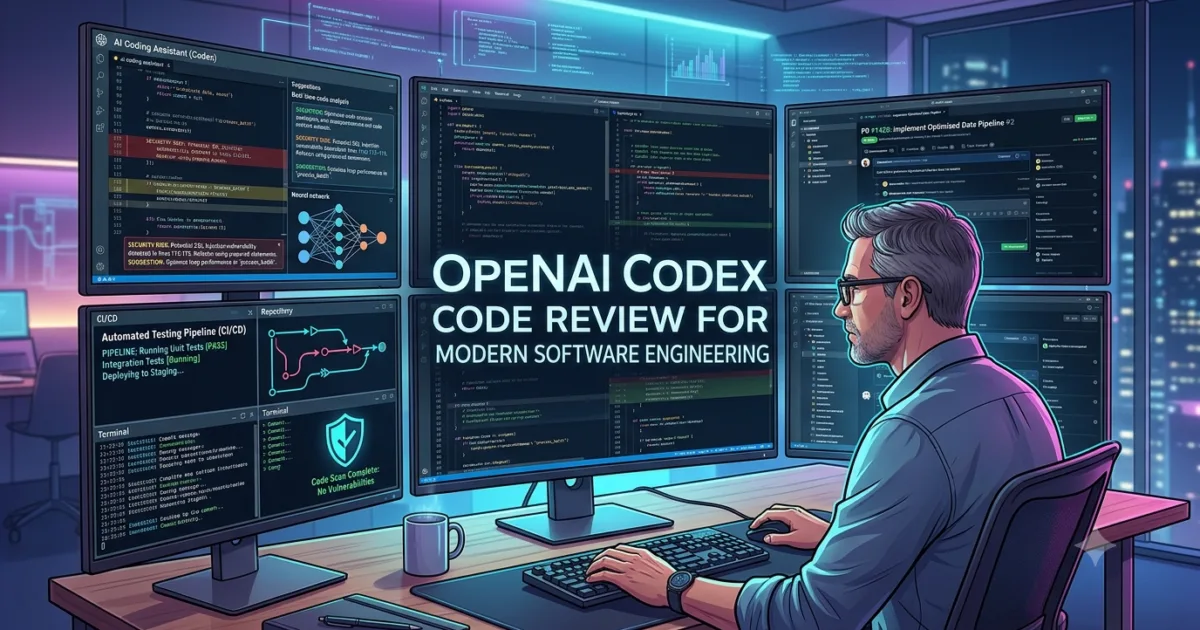
Why Code Reviews Matter in Modern Software Development
Writing functional code is only one part of building high-quality software. Every professional software team relies on code reviews to ensure new changes meet engineering standards before they are merged into the main branch. A well-executed review catches defects early, improves maintainability, encourages knowledge sharing, and helps developers continuously improve their coding practices.
As software systems become larger and more complex, manually reviewing every line of code becomes increasingly challenging. Reviewers must understand business requirements, project architecture, coding standards, security considerations, testing strategies, and long-term maintainability. This is where AI-powered development tools are changing the software engineering landscape.
OpenAI Codex Code Review introduces a smarter approach by assisting developers during the review process. Instead of replacing human reviewers, Codex acts as an intelligent engineering partner that analyzes code changes, explains implementation decisions, highlights potential issues, and recommends improvements before software reaches production.
Understanding AI-Assisted Code Reviews
Traditional code reviews focus on identifying syntax mistakes, logical errors, and adherence to coding standards. Modern AI-assisted reviews extend far beyond these basic checks by providing contextual understanding of the entire repository.
Instead of reviewing a single file in isolation, OpenAI Codex Code Review can evaluate how a modification affects surrounding modules, existing APIs, test coverage, documentation, and software architecture.
A modern review workflow looks like this:
Developer Creates Feature

↓

Implement Changes

↓

Generate Pull Request

↓

OpenAI Codex Analysis

↓

Human Review

↓

Testing Validation

↓

Merge Approval

↓

Production Deployment
This collaborative process helps engineering teams identify issues much earlier in the software delivery lifecycle.
Benefits of AI-Assisted Code Reviews
Professional engineering organizations perform thousands of code reviews every year. AI assistance helps reviewers spend more time evaluating design decisions instead of searching for common implementation mistakes.
Key advantages include:
- Faster review cycles
- Improved code consistency
- Better documentation quality
- Reduced review fatigue
- Earlier bug detection
- Better onboarding for new developers
- Increased engineering productivity
Rather than replacing senior engineers, AI provides additional insights that improve review quality.
The Role of OpenAI Codex During Reviews
Code review involves much more than checking whether software compiles successfully.
A reviewer typically evaluates:
- Business logic
- Architecture
- Naming conventions
- Error handling
- Performance
- Security
- Test coverage
- Maintainability
OpenAI Codex Code Review can assist by analyzing these areas and presenting observations that help reviewers make informed decisions.
For example, instead of simply identifying a missing null check, Codex can explain why the issue may occur, what impact it could have in production, and recommend safer implementation patterns.
Understanding Code Changes in Context
One of the most valuable capabilities of AI-assisted reviews is contextual reasoning.
Consider a pull request modifying:
- Authentication services
- User management
- Payment processing
- Notification systems
These changes may span dozens of files.
Instead of reviewing each modification independently, OpenAI Codex Code Review helps developers understand how every change relates to the overall system.
Example workflow:
Pull Request

↓

Repository Analysis

↓

Dependency Analysis

↓

Business Logic Review

↓

Architecture Validation

↓

Recommendations
Understanding repository context significantly improves review quality.
Reviewing Code Readability
Readable software is easier to maintain, debug, and extend.
During reviews, developers should evaluate whether code:
- Uses meaningful names
- Follows consistent formatting
- Separates responsibilities
- Avoids unnecessary complexity
- Includes appropriate documentation
Codex can identify areas where implementation may become difficult for future developers to understand.
For example, AI may recommend:
- Breaking large methods into smaller functions
- Renaming unclear variables
- Removing duplicate logic
- Improving comments
- Simplifying conditional statements
These improvements contribute to long-term maintainability rather than immediate functionality alone.
Architecture Review with AI
Good architecture allows applications to grow without becoming difficult to maintain.
During reviews, architecture questions include:
- Does this implementation follow existing design patterns?
- Are responsibilities properly separated?
- Are new dependencies justified?
- Will this solution scale?
OpenAI Codex Code Review helps developers compare proposed implementations with existing architectural patterns already present in the repository.
Example architecture review process:
Review New Feature

↓

Compare Existing Design

↓

Identify Violations

↓

Recommend Improvements

↓

Developer Decision
Architecture consistency is especially important in enterprise applications maintained by multiple teams.
Reviewing Business Logic
Even perfectly written code can fail if business requirements are misunderstood.
AI-assisted reviews help developers verify whether implementation aligns with functional expectations.
Examples include:
- Validation rules
- User permissions
- Workflow transitions
- Pricing calculations
- Notification triggers
- API behavior
By understanding the surrounding context, Codex can identify inconsistencies between implementation and expected application behavior.
Supporting Human Reviewers
The goal of OpenAI Codex Code Review is not automation for its own sake. Human engineers remain responsible for architectural decisions, business understanding, and production approval.
Instead, Codex supports reviewers by:
- Explaining unfamiliar code
- Highlighting potential risks
- Suggesting improvements
- Identifying overlooked scenarios
- Reducing repetitive review tasks
This allows reviewers to concentrate on higher-value engineering discussions rather than routine implementation checks.
Common Misconceptions About AI Code Reviews
Many developers assume AI can completely replace human code reviews. This is not the case.
AI cannot fully understand:
- Business priorities
- Organizational policies
- Customer expectations
- Team-specific conventions
- Long-term product strategy
Human reviewers continue to provide the judgment, experience, and decision-making required for production-quality software.
The strongest engineering workflows combine AI analysis with experienced human reviewers.
Preparing for Practical AI Review Workflows
Understanding the principles of OpenAI Codex Code Review provides the foundation for more advanced review techniques.
In the next section, we will explore practical workflows including pull request analysis, security reviews, performance evaluation, automated testing recommendations, documentation validation, and enterprise review strategies using OpenAI Codex.
Summary
OpenAI Codex Code Review enables engineering teams to improve software quality by combining AI-assisted analysis with professional engineering expertise. By understanding repository context, reviewing architecture, validating business logic, and improving maintainability, developers can perform faster and more effective code reviews while maintaining high software quality standards.
Rather than replacing experienced engineers, OpenAI Codex enhances the review process by providing intelligent insights that help teams deliver more secure, maintainable, and reliable software.
Performing Practical Code Reviews with OpenAI Codex
Understanding the theory behind OpenAI Codex Code Review is important, but the real value comes from applying it to real-world development workflows. In this section, we’ll explore practical examples of how developers can use Codex to review code, identify issues, and improve software quality.
Example 1: Reviewing a New Feature
Suppose a teammate submits the following Python function in a pull request:
def calculate_discount(price, discount):
    return price - (price * discount / 100)
At first glance, the code appears correct. However, a code review should consider edge cases.
Using OpenAI Codex, you might prompt:
Review this function for correctness, edge cases, readability, and production readiness.

def calculate_discount(price, discount):
    return price - (price * discount / 100)
Codex may recommend improvements such as:
- Validate that
priceis not negative. - Ensure
discountis between 0 and 100. - Add type hints.
- Improve documentation.
- Handle invalid input gracefully.
An improved implementation could look like this:
def calculate_discount(price: float, discount: float) -> float:
    """
    Calculate the discounted price.

    Args:
        price: Original product price.
        discount: Discount percentage (0–100).

    Returns:
        Discounted price.

    Raises:
        ValueError: If inputs are invalid.
    """
    if price < 0:
        raise ValueError("Price cannot be negative.")

    if not 0 <= discount <= 100:
        raise ValueError("Discount must be between 0 and 100.")

    return round(price * (1 - discount / 100), 2)
Instead of only identifying problems, Codex explains why the revised implementation is safer and easier to maintain.
Example 2: Reviewing API Code
Consider a simple FastAPI endpoint:
@app.get("/users/{user_id}")
def get_user(user_id: int):
    return database.get(user_id)
Prompt Codex with:
Review this FastAPI endpoint for production readiness.
Possible review observations:
- Missing error handling
- No authentication
- No authorization
- Missing response model
- No logging
- No input validation
- Missing documentation
A more production-ready version might be:
from fastapi import HTTPException

@app.get("/users/{user_id}")
def get_user(user_id: int):
    user = database.get(user_id)

    if user is None:
        raise HTTPException(status_code=404, detail="User not found")

    return user
This demonstrates how AI-assisted reviews help improve both reliability and user experience.
Example 3: Reviewing TypeScript Code
Imagine reviewing a utility function:
function fullName(first, last) {
    return first + " " + last;
}
Codex can identify several improvements:
- Missing type annotations
- Lack of input validation
- No documentation
- Inconsistent formatting
Improved version:
function fullName(first: string, last: string): string {
    return `${first} ${last}`;
}
Small improvements like these make a codebase more consistent and maintainable.
Reviewing Pull Requests
A typical pull request review workflow with OpenAI Codex looks like this:
Open Pull Request

↓

Summarize Changes

↓

Identify Modified Files

↓

Review Business Logic

↓

Review Tests

↓

Review Security

↓

Suggest Improvements

↓

Developer Approval
Instead of manually reading every file from scratch, developers can first ask Codex to summarize the pull request and highlight areas that deserve special attention.
Practical Prompt Library
Here are some prompts you can use during code reviews:
General Review
Review this code for readability, maintainability, security, and performance.
Security Review
Identify potential security vulnerabilities in this implementation.
Performance Review
Suggest optimizations without changing functionality.
Refactoring Review
Refactor this code to improve readability while preserving behavior.
Testing Review
Generate unit tests for this implementation and identify missing test cases.
Saving a prompt library like this helps teams maintain consistent review standards across projects.
Common Mistakes During AI-Assisted Reviews
Even with AI support, developers should avoid:
- Accepting every suggestion without verification.
- Ignoring project-specific coding standards.
- Reviewing only changed lines without considering surrounding context.
- Skipping automated tests after applying AI recommendations.
- Assuming AI fully understands business requirements.
The best results come from combining Codex’s analysis with human engineering judgment.
Best Practices
To get the most from OpenAI Codex Code Review:
- Review small pull requests instead of very large ones.
- Provide sufficient repository context.
- Ask focused review questions.
- Validate all AI-generated recommendations.
- Run the complete test suite before merging.
- Use AI as an assistant, not as the final reviewer.
Advanced Code Review Techniques with OpenAI Codex
After learning how to review individual functions and pull requests, the next step is using OpenAI Codex Code Review to evaluate software from a broader engineering perspective. Professional code reviews don’t stop at syntax or formatting—they examine architecture, scalability, security, performance, testing, and long-term maintainability.
This section explores practical review techniques used by experienced software engineers and demonstrates how Codex can accelerate the process while keeping humans responsible for the final engineering decisions.
Reviewing Large Pull Requests
One of the biggest mistakes in software engineering is reviewing very large pull requests containing hundreds or thousands of changed lines.
Instead, break reviews into logical sections.
Example strategy:
Pull Request

↓

Configuration Changes

↓

Backend Logic

↓

Frontend Components

↓

Database Changes

↓

Tests

↓

Documentation

↓

Final Approval
You can ask Codex:
This pull request contains 42 modified files.

Group the changes by functionality, summarize each group, identify potential risks, and recommend the order in which I should review them.
Instead of overwhelming the reviewer, Codex creates a structured review roadmap.
Reviewing Architecture Changes
Imagine a teammate submits this implementation.
class UserService:

    def create_user(self):
        ...

    def send_email(self):
        ...

    def generate_invoice(self):
        ...

    def export_csv(self):
        ...

    def delete_user(self):
        ...
The code works, but does it follow good architecture?
Ask Codex:
Review this service using SOLID principles.

Suggest architectural improvements without changing business behavior.
Possible recommendation:
Separate responsibilities.
Example:
UserService

├── UserManagementService

├── NotificationService

├── BillingService

└── ExportService
Following the Single Responsibility Principle improves maintainability and makes future development significantly easier.
Performance Review Example
Consider the following Python implementation.
users = []

for user in database:
    if user.is_active:
        users.append(user)
Prompt:
Review this code for performance improvements.
Codex may recommend:
users = [user for user in database if user.is_active]
While both implementations produce the same result, the second version is cleaner, more Pythonic, and often easier to read.
Performance reviews should also evaluate:
- Algorithm complexity
- Database queries
- Network requests
- Memory usage
- Caching opportunities
Reviewing SQL Queries
Poor database queries are a common source of performance problems.
Example:
for user in users:
    orders = get_orders(user.id)
Prompt:
Identify database performance issues.
Codex may recognize the classic N+1 Query Problem and suggest batch loading or joins instead of executing a separate query for every user.
Possible improvement:
orders = get_orders_for_users(user_ids)
Reviewing database interactions is just as important as reviewing application code.
Reviewing Security
Security should always be part of every pull request.
Example:
query = f"SELECT * FROM users WHERE email='{email}'"
Prompt:
Review this code for security vulnerabilities.
Codex should immediately identify:
- SQL Injection risk
Recommended solution:
cursor.execute(
    "SELECT * FROM users WHERE email = ?",
    (email,)
)
Other security review areas include:
- Authentication
- Authorization
- File uploads
- Input validation
- Secrets management
- Session handling
- Encryption
AI-assisted security reviews help developers detect common vulnerabilities before production deployment.
Reviewing API Endpoints
Consider this FastAPI endpoint.
@app.post("/orders")
def create_order(order: Order):
    database.save(order)
    return order
Prompt:
Review this endpoint for production readiness.
Codex might recommend:
- Request validation
- Exception handling
- Logging
- Authentication
- Response models
- Status codes
- API documentation
A more robust implementation could be:
from fastapi import HTTPException

@app.post("/orders", status_code=201)
def create_order(order: Order):

    try:
        database.save(order)

    except Exception as ex:
        raise HTTPException(
            status_code=500,
            detail=str(ex)
        )

    return order
These improvements make APIs more reliable in production environments.
Reviewing Automated Tests
Many pull requests include implementation changes but insufficient testing.
Example test:
def test_login():
    assert login("admin", "1234")
Prompt:
Review this unit test.

Suggest missing test scenarios.
Codex may recommend adding tests for:
- Invalid credentials
- Empty username
- Empty password
- Locked account
- Expired password
- SQL injection attempts
- Rate limiting
AI helps reviewers think beyond the “happy path.”
Using Codex to Generate Review Checklists
Instead of manually remembering every review step, developers can ask Codex to generate a structured checklist.
Example prompt:
Generate a professional pull request review checklist for a FastAPI project.
Example output:
Architecture

□ Follows project structure

□ No duplicated logic

Security

□ Input validation

□ Authentication

□ Authorization

Performance

□ Efficient database queries

□ No unnecessary loops

Testing

□ Unit tests added

□ Edge cases covered

Documentation

□ API documentation updated

□ README updated if required
This creates consistency across engineering teams.
Before-and-After Review Example
Original Code
def divide(a, b):
    return a / b
Prompt
Review this function for production use.
Improved Version
def divide(a: float, b: float) -> float:

    if b == 0:
        raise ValueError("Division by zero.")

    return a / b
The revised version introduces:
- Type hints
- Error handling
- Better reliability
Small improvements like these significantly increase software quality over time.
Enterprise Review Workflow
Large organizations often follow structured review processes.
Developer

↓

OpenAI Codex Analysis

↓

Static Code Analysis

↓

Security Review

↓

QA Validation

↓

Technical Lead Review

↓

Merge Approval

↓

Production Deployment
This layered review model reduces production defects while maintaining engineering velocity.
Practical Prompt Collection
Use these prompts during daily development.
Architecture
Review whether this implementation follows SOLID principles.
Maintainability
Identify areas that will become difficult to maintain in six months.
Documentation
Review this pull request and identify missing documentation.
Performance
Suggest optimizations without changing application behavior.
Security
Identify OWASP-related vulnerabilities in this implementation.
Testing
Generate missing unit, integration, and edge-case tests.
Keeping a reusable prompt library helps engineering teams perform consistent, high-quality reviews.
Real-World Best Practices
When using OpenAI Codex Code Review, experienced engineering teams typically follow these recommendations:
- Keep pull requests under 300–400 lines whenever possible.
- Review architecture before implementation details.
- Validate AI recommendations with project requirements.
- Always execute automated tests after applying AI-generated changes.
- Treat AI suggestions as recommendations rather than final decisions.
- Include security and performance reviews in every major feature.
- Document significant architectural decisions within the pull request.
Following these practices results in faster reviews, better collaboration, and higher software quality.
Enterprise Code Review Workflows with OpenAI Codex
By now, you’ve seen how OpenAI Codex Code Review can improve individual functions, API endpoints, database queries, automated tests, and pull requests. However, the true value of AI-assisted code reviews becomes evident when applied across enterprise software projects involving multiple teams, large repositories, and continuous software delivery.
Enterprise organizations may process hundreds of pull requests every week. Reviewing every change manually with the same level of detail is difficult, leading to review fatigue, inconsistent quality, and overlooked issues. Integrating OpenAI Codex into the review process helps engineering teams maintain consistency while allowing human reviewers to focus on business logic, architecture, and strategic technical decisions.
A typical enterprise review workflow looks like this:
Developer Creates Feature Branch
            │
            ▼
 Local Testing & Linting
            │
            ▼
   Open Pull Request
            │
            ▼
 OpenAI Codex Review
            │
            ▼
 Static Code Analysis
            │
            ▼
 Automated Unit Tests
            │
            ▼
 Security Scanning
            │
            ▼
 Human Code Review
            │
            ▼
 QA Validation
            │
            ▼
 Merge Approval
            │
            ▼
 Production Deployment
This layered review process significantly reduces the likelihood of introducing defects into production.
Using OpenAI Codex to Review an Entire Pull Request
Rather than asking Codex to review individual files, developers can provide the complete pull request description and modified files.
Example prompt:
You are a Senior Staff Software Engineer.

Review this pull request as if you were performing a production code review.

Focus on:

• Business logic
• Software architecture
• Performance
• Security
• Readability
• Testing
• Maintainability

Categorize findings into:

Critical
High
Medium
Low

Finally, provide an approval recommendation.
This prompt produces structured feedback similar to what experienced technical reviewers provide during enterprise code reviews.
Reviewing Repository-Wide Changes
Large software projects often include changes affecting multiple services.
Example:
backend/
├── api/
├── auth/
├── payments/
├── notifications/

frontend/
├── dashboard/
├── checkout/
├── profile/

tests/
docs/
Instead of reviewing modules independently, ask Codex:
Analyze how these changes impact the entire application.

Identify:

• Breaking changes
• Architectural risks
• Missing tests
• Documentation updates
• Cross-module dependencies
Repository-wide analysis provides context that traditional line-by-line reviews often miss.
Detecting Technical Debt
Every project accumulates technical debt over time.
Examples include:
- Large service classes
- Duplicate business logic
- Unused methods
- Deprecated APIs
- Poor naming conventions
- Inconsistent folder structures
- Legacy helper functions
Prompt example:
Review this repository for technical debt.

Rank findings from highest impact to lowest impact.

Recommend a phased refactoring strategy.
Codex can help engineering teams prioritize improvements instead of attempting large-scale rewrites.
Example output:
Critical

• Duplicate authentication logic

High

• 2,100-line UserService class

Medium

• Outdated utility helpers

Low

• Variable naming inconsistencies
This enables engineering managers to schedule technical debt reduction as part of regular sprint planning.
AI-Assisted Documentation Reviews
Documentation should evolve alongside the codebase.
Suppose a developer adds a new authentication endpoint but forgets to update the documentation.
Prompt:
Review this pull request.

Identify documentation that should be updated.
Codex may recommend updating:
- README
- API documentation
- OpenAPI specification
- Deployment guide
- Configuration documentation
- Changelog
Keeping documentation synchronized improves onboarding and reduces operational issues.
Reviewing GitHub Actions
Many repositories include automated workflows.
Example:
name: CI

on:
  push:

jobs:
  test:
    runs-on: ubuntu-latest
Prompt:
Review this GitHub Actions workflow.

Suggest improvements for reliability, performance, and security.
Codex might recommend:
- Dependency caching
- Matrix builds
- Python version testing
- Secret validation
- Parallel execution
- Build artifact storage
Small workflow improvements often reduce build times and increase deployment reliability.
Code Review for QA Engineers
AI-assisted reviews are valuable for Quality Assurance teams as well.
Consider a Playwright test:
test("Login", async ({ page }) => {

    await page.goto("/login");

    await page.fill("#username", "admin");

    await page.fill("#password", "password");

    await page.click("#login");
});
Prompt:
Review this Playwright test.

Suggest reliability improvements and additional assertions.
Possible recommendations:
- Wait for page readiness
- Verify successful login
- Assert dashboard visibility
- Use Page Object Model
- Replace hardcoded credentials
- Improve locator strategy
Improved example:
test("User can log in successfully", async ({ page }) => {

    await page.goto("/login");

    await page.getByLabel("Username").fill("admin");

    await page.getByLabel("Password").fill("password");

    await page.getByRole("button", { name: "Login" }).click();

    await expect(page).toHaveURL(/dashboard/);

    await expect(page.getByRole("heading")).toContainText("Dashboard");
});
This demonstrates how Codex supports test automation engineers in writing more stable and maintainable tests.
Integrating OpenAI Codex into CI/CD
AI-assisted code reviews can complement automated quality gates within a CI/CD pipeline.
Example workflow:
Developer Pushes Code
          │
          ▼
GitHub Actions Trigger
          │
          ▼
Run Unit Tests
          │
          ▼
Static Analysis
          │
          ▼
OpenAI Codex Review
          │
          ▼
Security Scan
          │
          ▼
Human Approval
          │
          ▼
Deploy to Staging
Codex does not replace automated tools such as linters or security scanners. Instead, it adds contextual reasoning that complements traditional quality checks.
Building a Team-Wide Review Prompt Library
Consistency is important when multiple engineers review code.
A shared prompt library helps standardize reviews.
Security Review
Review this code against OWASP Top 10 vulnerabilities.
Performance Review
Identify performance bottlenecks and recommend optimizations without changing functionality.
API Review
Review this REST API for validation, error handling, HTTP status codes, and documentation.
Testing Review
Generate missing unit tests, integration tests, and edge-case scenarios.
Architecture Review
Evaluate this implementation against SOLID principles and Clean Architecture practices.
Using standardized prompts improves review quality across the organization.
Common Mistakes When Using AI for Code Reviews
Despite its capabilities, OpenAI Codex should not be treated as an infallible reviewer.
Avoid these common mistakes:
- Accepting every AI suggestion without validation.
- Ignoring existing project architecture.
- Reviewing only modified lines instead of understanding surrounding context.
- Skipping automated testing after applying recommendations.
- Assuming AI understands undocumented business requirements.
- Using AI to bypass peer reviews.
The best engineering teams combine AI analysis with experienced human judgment.
Best Practices for OpenAI Codex Code Review
To maximize the value of OpenAI Codex Code Review, follow these recommendations:
- Keep pull requests focused on a single objective.
- Provide sufficient repository context when requesting reviews.
- Ask specific review questions rather than generic prompts.
- Validate AI recommendations through testing.
- Include security, performance, and documentation reviews in every major feature.
- Maintain a reusable prompt library for consistent reviews.
- Encourage collaborative discussions around AI-generated feedback.
- Continue using human reviewers for architectural and business decisions.
Key Takeaways
Throughout this lesson, you’ve learned that OpenAI Codex Code Review extends far beyond syntax checking. It enables developers to analyze architecture, identify technical debt, review APIs, evaluate automated tests, improve documentation, strengthen security, and support enterprise-scale software engineering workflows.
When integrated thoughtfully into existing development practices, OpenAI Codex becomes a powerful engineering assistant that enhances—not replaces—professional code reviews. By combining AI-powered analysis with human expertise, development teams can deliver software that is more secure, maintainable, and reliable while accelerating the overall review process.
Internal Links:
- Learn MCP – Zero to Hero
- Learn AI Agents for QA – Zero to Hero
- Playwright Automation – Zero to Hero
- LangGraph: Complete Zero to Hero
- Learn Python – Zero to Hero
- OpenAI Codex: Complete Zero to Hero
- Cursor AI: Complete Zero to Hero
- Claude Code Tutorial: Complete Zero to Hero
- Free QA Resources Built From Real Experience
- QA Glossary: Test Automation Terms Every Engineer Should Know
External Resources:
- OpenAI Codex – Get Started:OpenAI Codex Get Started
- OpenAI Codex CLI – Getting Started:OpenAI Codex CLI Guide
- OpenAI Codex GitHub Repository:OpenAI Codex GitHub Repository
- Using OpenAI Codex with ChatGPT:Using Codex with ChatGPT
- OpenAI Codex CLI Authentication:Codex CLI Sign-in Guide
Frequently Asked Questions
What is OpenAI Codex Code Review?
OpenAI Codex Code Review is the process of using OpenAI Codex to analyze source code, review pull requests, detect bugs, improve readability, recommend security enhancements, and assist software engineers during the review process.
Can OpenAI Codex replace human code reviewers?
No. OpenAI Codex assists reviewers by identifying potential issues and recommending improvements, but experienced engineers should always make the final approval decisions.
Which programming languages can OpenAI Codex review?
OpenAI Codex can assist with many languages including Python, JavaScript, TypeScript, Java, Go, C#, C++, PHP, Ruby, Rust, and others.
Can OpenAI Codex identify security vulnerabilities?
Yes. It can highlight common issues such as SQL injection risks, missing input validation, insecure authentication flows, exposed secrets, and other coding concerns. Human verification remains essential.
Is OpenAI Codex suitable for enterprise software development?
Yes. Many teams use OpenAI Codex to improve pull request reviews, documentation, testing strategies, refactoring, and overall software quality within enterprise development workflows.
Conclusion
OpenAI Codex Code Review enables developers to build higher-quality software by combining AI-powered analysis with professional engineering expertise. Throughout this guide, you learned how to review pull requests, evaluate architecture, identify security risks, improve testing, detect technical debt, and streamline enterprise code review workflows using practical prompts and real-world examples.
As AI becomes an integral part of modern software engineering, mastering OpenAI Codex Code Review will help developers deliver more secure, maintainable, and reliable applications while accelerating collaboration across development teams.
Enjoyed this article? Explore more in-depth guides on AI engineering, automation testing, Model Context Protocol, Playwright, and intelligent software quality at www.skakarh.com. Follow QAPulse by SK for practical, production-focused tutorials designed for QA engineers, SDETs, and AI developers.