QA
QA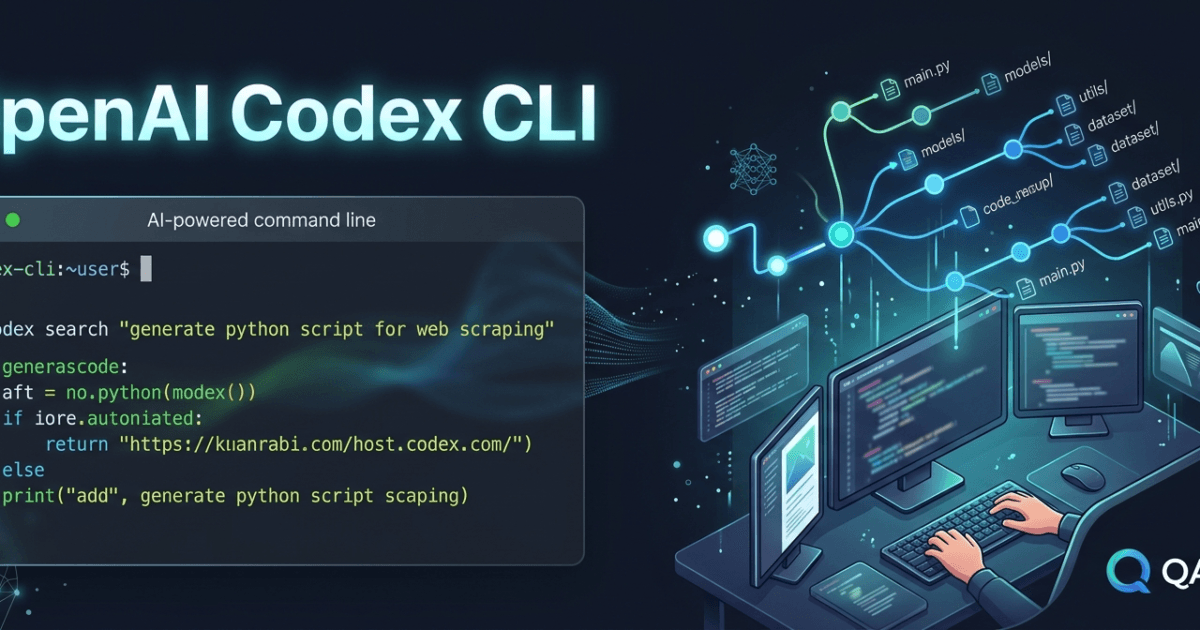
Why Learn the OpenAI Codex CLI?
Graphical interfaces are convenient, but professional software developers spend a significant portion of their day inside a terminal. Whether managing Git repositories, installing packages, running tests, deploying applications, or debugging production issues, the command line remains one of the most powerful development environments.
The OpenAI Codex CLI extends this familiar workflow by bringing AI-powered software engineering directly into the terminal. Instead of switching between an IDE, browser, and AI chat application, developers can collaborate with OpenAI Codex without leaving the command line.
Learning the OpenAI Codex CLI allows developers to automate repetitive work, understand unfamiliar codebases, generate implementations, explain complex code, and accelerate development while staying inside their preferred workflow.
What is the OpenAI Codex CLI?
The OpenAI Codex CLI (Command Line Interface) is a terminal-based application that enables developers to interact with OpenAI Codex using natural language commands directly from their operating system.
Unlike traditional command-line utilities that perform predefined tasks, the OpenAI Codex CLI combines conversational AI with repository awareness, allowing developers to ask programming questions, generate code, analyze projects, review implementations, and perform development tasks from the terminal.
It acts as an intelligent engineering assistant that understands both your instructions and the structure of your software project.
Why Developers Prefer the CLI
Many experienced engineers prefer terminal-based workflows because they reduce context switching and improve productivity.
Using the OpenAI Codex CLI, developers can:
- Work without leaving the terminal
- Generate production-ready code
- Understand large repositories
- Debug applications
- Explain unfamiliar functions
- Create automated tests
- Review existing implementations
- Improve documentation
- Accelerate development tasks
For developers already comfortable with the command line, the CLI integrates naturally into existing workflows.
How the OpenAI Codex CLI Works
Every interaction with the CLI follows a structured process.
Developer Command

↓

OpenAI Codex CLI

↓

Repository Analysis

↓

AI Processing

↓

Generated Response

↓

Developer Validation

↓

Project Update
Rather than simply executing commands, the CLI analyzes project context before generating intelligent responses.
Core Components of the OpenAI Codex CLI
The OpenAI Codex CLI consists of several key elements that work together during development.
Terminal Environment
The terminal serves as the primary workspace where developers launch the CLI, navigate repositories, and communicate with OpenAI Codex.
Because the CLI integrates directly with the operating system, it fits naturally into existing development workflows.
AI Processing Engine
When a request is submitted, OpenAI Codex interprets the developer’s intent, analyzes the available repository context, and generates a relevant response.
This process allows the AI to provide project-aware assistance instead of isolated code snippets.
Repository Context
One of the biggest strengths of the OpenAI Codex CLI is its understanding of repository structure.
Instead of examining only the current file, it can analyze:
- Project hierarchy
- Source code
- Documentation
- Configuration files
- Existing coding patterns
- Dependencies
This context enables more accurate code generation and recommendations.
Common Development Tasks
Developers use the OpenAI Codex CLI for a wide range of engineering activities.
Typical examples include:
- Creating new features
- Explaining legacy code
- Reviewing pull requests
- Refactoring applications
- Debugging runtime issues
- Writing documentation
- Generating unit tests
- Building API endpoints
- Improving performance
- Learning unfamiliar frameworks
These capabilities make the CLI valuable across the entire software development lifecycle.
Benefits of Using the OpenAI Codex CLI
Compared to browser-based AI tools, the CLI provides several advantages.
These include:
- Faster workflow
- Reduced context switching
- Direct repository access
- Better developer productivity
- Seamless terminal integration
- Natural Git workflows
- Easier automation
- Improved collaboration with AI
Developers who already spend most of their day in a terminal often find the CLI to be the most efficient way to interact with OpenAI Codex.
Who Should Use the OpenAI Codex CLI?
The OpenAI Codex CLI is suitable for developers across multiple disciplines.
Examples include:
- Backend Developers
- Frontend Developers
- Full-Stack Engineers
- QA Automation Engineers
- SDETs
- DevOps Engineers
- Cloud Engineers
- AI Engineers
- Platform Engineers
- Computer Science Students
Whether working on personal projects or enterprise software, the CLI provides an efficient interface for AI-assisted development.
Real-World Applications
Organizations are increasingly integrating the OpenAI Codex CLI into their daily engineering workflows.
Typical use cases include:
- Enterprise application development
- Test automation
- CI/CD pipeline support
- Infrastructure scripting
- API development
- Legacy system modernization
- Code review assistance
- Documentation generation
- Developer onboarding
As AI becomes a standard part of modern software engineering, mastering the OpenAI Codex CLI equips developers with a practical skill that improves productivity while maintaining complete control over the software development process.
OpenAI Codex CLI: Installation, Configuration, and Essential Terminal Commands
Getting Started with the OpenAI Codex CLI
Once you understand what the OpenAI Codex CLI is and why developers use it, the next step is learning how to configure it correctly and use it efficiently in daily software development.
Although the OpenAI Codex CLI is designed to be simple, spending time configuring your environment properly ensures better repository awareness, smoother authentication, and a more productive AI-assisted workflow.
Whether you are building web applications, automation frameworks, APIs, or enterprise software, a properly configured CLI becomes an indispensable part of your development toolkit.
Preparing Your Development Environment
Before using the OpenAI Codex CLI, verify that your machine meets the required prerequisites.
Ensure you have:
- Node.js installed
- npm available
- Git installed
- An OpenAI account
- Internet connectivity
- A supported terminal application
- A cloned project repository
A stable development environment minimizes installation and runtime issues.
Verifying the Installation
After installing the CLI, confirm that it is available globally.
Run:
codex --version
The terminal should display the currently installed version.
If the command is not recognized, verify that the installation completed successfully and that the global npm binary directory is available in your system’s PATH.
Authenticating the OpenAI Codex CLI
Authentication is required before using AI-powered features.
Start the authentication process by running:
codex login
The CLI opens a browser window where you can sign in using your OpenAI account.
Once authentication succeeds, the CLI securely stores your session, allowing future interactions without repeated logins until the session expires.
Opening a Project
For the best results, launch the OpenAI Codex CLI from the root directory of your project.
Example:
cd my-project
codex
Starting from the project root allows Codex to analyze the repository structure, configuration files, dependencies, and documentation before generating responses.
Repository awareness leads to significantly better suggestions than working with isolated files.
Understanding the CLI Workflow
A typical development session follows this sequence:
Open Terminal

↓

Navigate to Repository

↓

Launch OpenAI Codex CLI

↓

Analyze Repository

↓

Submit Request

↓

Review AI Response

↓

Implement Changes
Following a consistent workflow improves productivity and keeps development sessions organized.
Essential Terminal Commands
Although most interactions occur through natural language, developers should become familiar with common terminal commands used alongside the OpenAI Codex CLI.
Check Version
codex --version
Displays the installed version.
Start the CLI
codex
Launches an interactive AI session.
Authenticate
codex login
Authenticates your OpenAI account.
Update the CLI
npm update -g @openai/codex
Installs the latest available version.
Remove the CLI
npm uninstall -g @openai/codex
Uninstalls the application from your system.
Organizing Your Repository
The OpenAI Codex CLI performs best when repositories are well structured.
A recommended layout is:
project/

├── src/

├── tests/

├── docs/

├── scripts/

├── package.json

├── README.md

└── .gitignore
A consistent directory structure helps Codex understand relationships between modules and generate more relevant code.
Working with Existing Codebases
Most developers use the OpenAI Codex CLI to enhance existing applications rather than creating entirely new projects.
Before requesting code generation:
- Explore the repository.
- Read the README.
- Understand the folder structure.
- Review existing coding standards.
- Identify reusable components.
Providing sufficient context allows Codex to generate code that integrates naturally into the project.
Improving Command-Line Productivity
Developers can make better use of the OpenAI Codex CLI by adopting a few practical habits.
Examples include:
- Keep repositories organized.
- Work from the project root.
- Commit changes frequently.
- Review generated code before applying it.
- Run automated tests after modifications.
- Update dependencies regularly.
Small improvements to daily workflows often produce significant productivity gains over time.
Common Setup Mistakes
Several common mistakes can reduce the effectiveness of the OpenAI Codex CLI.
Launching from the Wrong Directory
Starting the CLI inside a subfolder limits repository awareness.
Always launch it from the root directory whenever possible.
Ignoring Authentication Status
Expired or incomplete authentication sessions prevent AI requests from succeeding.
Verify authentication whenever unexpected errors occur.
Skipping Repository Review
Understanding the existing project before requesting code generation helps produce more accurate and maintainable implementations.
Delaying Updates
Using outdated CLI versions may prevent access to newer capabilities, bug fixes, and performance improvements.
Keeping the CLI updated ensures compatibility with the latest OpenAI enhancements.
Practical Recommendations
Developers who consistently get the best results with the OpenAI Codex CLI establish a repeatable workflow that begins with a properly configured environment, an organized repository, and a clear understanding of the current task. They verify installations, authenticate correctly, launch the CLI from the project root, provide meaningful context, review every AI-generated response, and validate changes through testing before integrating them into production code. These habits transform the OpenAI Codex CLI into a dependable engineering assistant for modern software development.
OpenAI Codex CLI: Real-World Workflows, Practical Examples, and Everyday Development
Using the OpenAI Codex CLI in Daily Development
Learning the commands of the OpenAI Codex CLI is only one part of becoming productive with AI-assisted software development. Professional developers integrate the CLI into their existing workflow rather than treating it as a separate tool.
Instead of switching between documentation, search engines, chat applications, and multiple IDE windows, developers use the OpenAI Codex CLI directly from the terminal to understand projects, generate code, review implementations, and solve programming problems while remaining focused on the task at hand.
The goal is not to replace engineering knowledge but to accelerate repetitive tasks and improve development efficiency.
Starting a Typical Development Session
A productive workflow begins before the first prompt is written.
Developers usually follow these steps:
- Open the terminal.
- Navigate to the project root.
- Pull the latest repository changes.
- Review the assigned task.
- Launch the OpenAI Codex CLI.
- Understand the existing implementation.
- Begin feature development.
This preparation ensures that both the developer and the AI have sufficient project context.
Understanding an Existing Codebase
One of the most valuable capabilities of the OpenAI Codex CLI is helping developers understand unfamiliar projects.
Instead of immediately requesting new code, begin by asking questions about the current implementation.
Examples include:
- Explain the authentication flow.
- Describe the API architecture.
- Where is user validation implemented?
- How does this service communicate with the database?
- Which module handles file uploads?
Understanding the existing architecture first leads to more accurate feature development later.
Building Features Incrementally
Rather than generating an entire application in one request, professional developers divide work into smaller tasks.
Example feature:
User Profile Management
Break the feature into:
- Database model
- API endpoints
- Business logic
- Validation
- Unit tests
- Documentation
Smaller development tasks produce more focused AI responses and simplify code reviews.
Practical Development Workflow
A typical workflow using the OpenAI Codex CLI looks like this:
Understand Requirements

↓

Review Existing Code

↓

Launch OpenAI Codex CLI

↓

Generate Initial Solution

↓

Review Output

↓

Refine Implementation

↓

Run Tests

↓

Commit Changes
Each iteration improves both code quality and developer understanding.
Generating Code Responsibly
The OpenAI Codex CLI can assist with many development activities, including:
- Creating REST APIs
- Writing utility functions
- Building automation scripts
- Developing test cases
- Generating documentation
- Refactoring existing code
- Explaining complex algorithms
Although AI accelerates implementation, every generated solution should be validated before it becomes part of the production codebase.
Refactoring Legacy Applications
Many organizations maintain software that has evolved over several years.
Developers frequently use the OpenAI Codex CLI to modernize legacy code by requesting assistance with:
- Simplifying complex functions
- Removing duplicated logic
- Improving naming conventions
- Updating deprecated syntax
- Increasing readability
- Optimizing performance
Incremental refactoring reduces technical debt while preserving application stability.
Improving Test Coverage
Testing remains one of the most practical applications of AI-assisted development.
Developers commonly ask the OpenAI Codex CLI to generate:
- Unit tests
- Integration tests
- API tests
- Mock objects
- Edge-case scenarios
- Regression tests
Generating tests immediately after implementing a feature helps maintain software reliability throughout the development lifecycle.
Collaborating During Code Reviews
The OpenAI Codex CLI can also support peer review activities.
Developers may request:
- Code explanations
- Bug identification
- Refactoring suggestions
- Performance improvements
- Security observations
- Readability enhancements
Using AI as an additional reviewer often helps identify issues before human code review begins.
Working with Large Repositories
Enterprise applications often contain thousands of source files.
Before requesting AI assistance:
- Explore the folder structure.
- Read the project documentation.
- Identify reusable modules.
- Understand architectural patterns.
- Review coding conventions.
Repository awareness allows the OpenAI Codex CLI to generate recommendations that integrate naturally into existing systems.
Common Workflow Mistakes
Developers new to AI-assisted development frequently encounter similar challenges.
Asking Multiple Unrelated Questions
Large prompts covering unrelated features often produce inconsistent responses.
Instead, complete one task before moving to the next.
Skipping Repository Context
Providing little or no project context limits the quality of AI-generated code.
Always work from the project root whenever possible.
Blindly Accepting Generated Code
Every response should be reviewed for:
- Correctness
- Business logic
- Security
- Performance
- Maintainability
- Coding standards
Human validation remains an essential part of professional software engineering.
Forgetting Documentation
Whenever significant code changes are introduced:
- Update the README.
- Document configuration changes.
- Explain new APIs.
- Record architectural decisions.
Well-maintained documentation benefits both developers and future AI interactions.
Building a Sustainable Workflow
The developers who gain the greatest benefit from the OpenAI Codex CLI establish consistent habits rather than relying on one-time prompts.
A productive routine includes:
- Understanding requirements before coding.
- Reviewing existing implementations.
- Working on one feature at a time.
- Writing clear and specific prompts.
- Reviewing every AI-generated response.
- Running automated tests after each major change.
- Committing small, meaningful updates.
- Keeping project documentation current.
By combining disciplined engineering practices with AI assistance, the OpenAI Codex CLI becomes a reliable partner for building scalable, maintainable, and production-ready software while allowing developers to remain in the command-line environment they use every day.
OpenAI Codex CLI: Best Practices, Common Mistakes, and Enterprise Adoption
Why Following Best Practices Matters
The OpenAI Codex CLI is much more than a command-line application that generates code. It is an AI-powered development assistant capable of understanding repositories, explaining existing implementations, generating new features, reviewing code, creating documentation, and assisting throughout the software development lifecycle.
However, the quality of its output depends largely on how developers use it. Teams that follow structured workflows consistently achieve better results than those who rely on random prompts or treat the CLI as a simple code generator.
Understanding professional workflows and common mistakes will help you maximize productivity while maintaining software quality, security, and long-term maintainability.
Best Practices for Using the OpenAI Codex CLI
Start from the Project Root
Always launch the OpenAI Codex CLI from the root directory of your repository.
This allows the CLI to analyze:
- Project structure
- Configuration files
- Dependencies
- Documentation
- Existing source code
- Build configuration
Repository awareness enables more accurate and context-aware AI responses.
Understand Existing Code Before Generating New Code
One of the most common mistakes developers make is asking the AI to implement new functionality before understanding the existing application.
Instead, begin by asking questions such as:
- How is authentication implemented?
- Which service manages user accounts?
- Where are API routes defined?
- How does data validation work?
Understanding the current architecture results in cleaner integrations and fewer implementation conflicts.
Write Precise Prompts
The OpenAI Codex CLI performs best when prompts include sufficient technical context.
Useful information includes:
- Programming language
- Framework
- Current implementation
- Expected behavior
- Error messages
- Performance requirements
- Architectural constraints
Specific prompts consistently produce more accurate responses than vague requests.
Work in Small Iterations
Large requests often generate inconsistent or difficult-to-review implementations.
Instead, divide work into manageable tasks.
Example workflow:
Understand Requirement

↓

Generate Component

↓

Review Output

↓

Improve Logic

↓

Run Tests

↓

Commit Changes
Incremental development simplifies debugging, testing, and code reviews.
Review Every AI Response
Although the OpenAI Codex CLI can generate high-quality code, developers remain responsible for validating every implementation.
Review generated code for:
- Business logic
- Security
- Performance
- Maintainability
- Error handling
- Scalability
- Coding standards
AI should assist engineering decisions—not replace them.
Integrate Testing into Your Workflow
Testing should accompany every meaningful code change.
The OpenAI Codex CLI can assist in creating:
- Unit tests
- Integration tests
- API tests
- Regression tests
- Mock objects
- Edge-case scenarios
Run these tests immediately after implementation to detect issues early.
Common Mistakes
Treating the CLI Like a Search Engine
The OpenAI Codex CLI is designed for interactive software development rather than isolated question-and-answer sessions.
Instead of asking generic programming questions, provide project-specific context so the AI can generate solutions that fit your repository.
Ignoring Repository Context
Launching the CLI from a subdirectory or providing incomplete project information limits repository awareness.
Whenever possible, work from the project’s root directory to maximize context.
Requesting Entire Applications
Generating a complete application in one prompt often produces inconsistent architecture and makes reviewing the output difficult.
A better approach is to develop one feature, module, or service at a time.
Skipping Documentation
Documentation should evolve alongside the application.
Whenever features are added or modified:
- Update README files.
- Document configuration changes.
- Explain new APIs.
- Record architectural decisions.
- Provide usage examples where appropriate.
Well-maintained documentation benefits both developers and future AI interactions.
Enterprise Adoption
Many organizations are beginning to integrate the OpenAI Codex CLI into their engineering workflows.
Common enterprise use cases include:
- Accelerating feature development
- Supporting legacy application modernization
- Assisting with code reviews
- Generating technical documentation
- Creating automated tests
- Improving developer onboarding
- Enhancing internal engineering productivity
To ensure consistent adoption, organizations often define internal guidelines covering prompt quality, security reviews, testing requirements, and documentation standards.
Measuring Success
The effectiveness of the OpenAI Codex CLI can be evaluated using measurable engineering metrics.
Useful indicators include:
| Metric | Why It Matters |
|---|---|
| Development Time | Measures productivity improvements |
| Code Review Feedback | Evaluates code quality and consistency |
| Test Coverage | Confirms adequate testing practices |
| Defect Rate | Tracks software reliability |
| Documentation Quality | Ensures knowledge remains current |
| Prompt Efficiency | Measures how effectively developers communicate with AI |
| Developer Satisfaction | Indicates adoption and workflow improvements |
Tracking these metrics helps teams refine how they use AI within their development process.
Long-Term Development Strategy
The OpenAI Codex CLI delivers the greatest value when it becomes part of a disciplined engineering workflow rather than an occasional utility.
Successful teams typically:
- Launch the CLI from the project root.
- Understand the existing architecture before making changes.
- Write clear, context-rich prompts.
- Work in small, reviewable iterations.
- Validate all AI-generated code.
- Run automated tests after every significant modification.
- Keep documentation synchronized with the codebase.
- Follow established coding standards across the entire repository.
These practices allow developers to benefit from AI-powered assistance while maintaining complete ownership of software quality and engineering decisions.
Key Takeaways
The OpenAI Codex CLI combines the speed of command-line development with the intelligence of modern AI. Developers who understand repository context, write precise prompts, review every response, integrate testing into their workflow, and follow consistent engineering practices can significantly improve productivity without compromising maintainability or software quality.
By treating the OpenAI Codex CLI as a collaborative engineering assistant rather than an automated replacement for developer expertise, teams can confidently incorporate AI into everyday software development while preserving the principles of reliable and scalable engineering.
Internal Links:
- Learn MCP – Zero to Hero
- Learn AI Agents for QA – Zero to Hero
- Playwright Automation – Zero to Hero
- Learn Python – Zero to Hero
- OpenAI Codex: Complete Zero to Hero
- Cursor AI: Complete Zero to Hero
- Claude Code Tutorial: Complete Zero to Hero
- Free QA Resources Built From Real Experience
- QA Glossary: Test Automation Terms Every Engineer Should Know
External Resources:
- OpenAI Codex – Get Started: OpenAI Codex Get Started
- OpenAI Codex CLI – Getting Started: OpenAI Codex CLI Guide
- OpenAI Codex GitHub Repository: OpenAI Codex GitHub Repository
- Using OpenAI Codex with ChatGPT: Using Codex with ChatGPT
- OpenAI Codex CLI Authentication: Codex CLI Sign-in Guide
People Also Ask
What is the OpenAI Codex CLI?
The OpenAI Codex CLI is a command-line interface that enables developers to interact with OpenAI Codex directly from the terminal. It provides repository-aware AI assistance for coding, debugging, refactoring, documentation, and software development workflows.
Can beginners use the OpenAI Codex CLI?
Yes. Although familiarity with the terminal is helpful, beginners can use the OpenAI Codex CLI to learn programming concepts, generate code, understand repositories, and automate repetitive development tasks.
Does the OpenAI Codex CLI work with existing projects?
Yes. The OpenAI Codex CLI analyzes existing repositories and generates context-aware responses that align with the current project structure and coding standards.
Is the OpenAI Codex CLI suitable for enterprise development?
Absolutely. Development teams use the OpenAI Codex CLI for feature implementation, code reviews, documentation generation, testing assistance, and productivity improvements while maintaining engineering oversight.
Why should developers learn the OpenAI Codex CLI?
Learning the OpenAI Codex CLI allows developers to integrate AI directly into terminal-based workflows, reducing context switching and improving efficiency throughout the software development lifecycle.
Featured Snippet
What Is the OpenAI Codex CLI?
The OpenAI Codex CLI is an AI-powered command-line interface that allows developers to interact with OpenAI Codex from the terminal. It understands repository context, assists with coding, debugging, documentation, testing, and refactoring, enabling faster and more efficient software development without leaving the command line.
AI Overview Answer
The OpenAI Codex CLI combines the flexibility of terminal-based development with AI-powered coding assistance. Developers can generate code, understand complex repositories, review implementations, automate documentation, and improve productivity while remaining within their existing command-line workflow.
Enjoyed this article? Explore more in-depth guides on AI engineering, automation testing, Model Context Protocol, Playwright, and intelligent software quality at www.skakarh.com. Follow QAPulse by SK for practical, production-focused tutorials designed for QA engineers, SDETs, and AI developers.