 QA
QA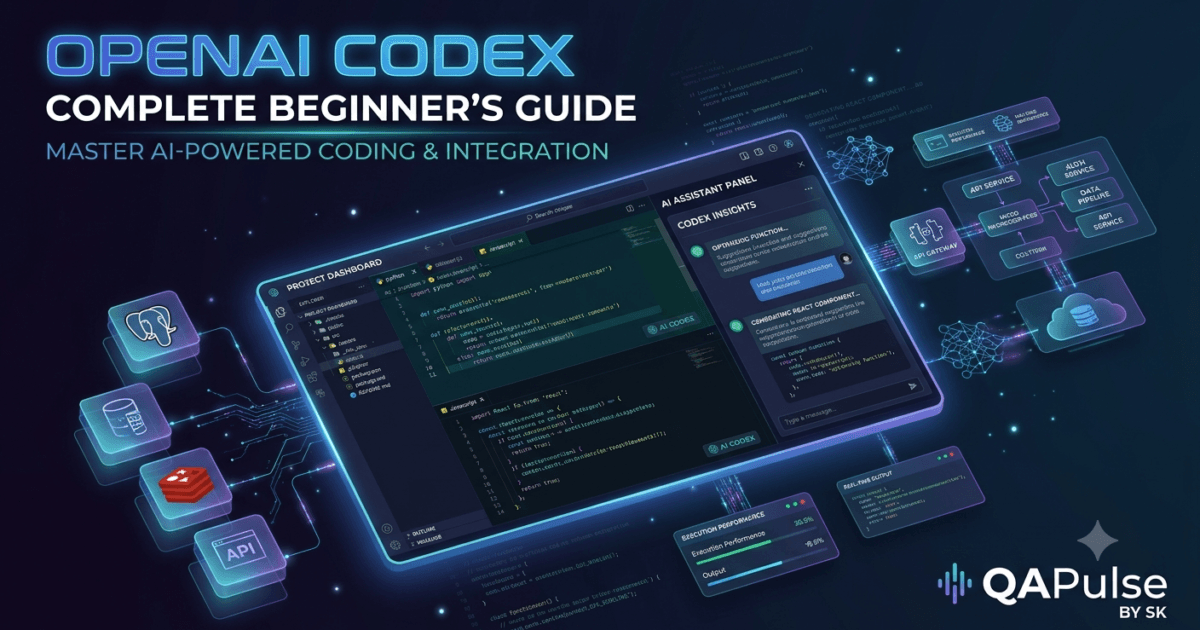
Why OpenAI Codex Is Transforming Software Development
Artificial intelligence has fundamentally changed how developers build software. Tasks that once required hours of manual coding, debugging, documentation, and testing can now be completed significantly faster with the help of AI-powered coding assistants. Among the technologies that sparked this transformation, OpenAI Codex stands out as one of the most influential innovations in modern software engineering.
Unlike traditional autocomplete tools that simply predict the next few characters, OpenAI Codex understands programming languages, natural language instructions, project context, and developer intent. This enables it to generate functions, explain existing code, create automated tests, suggest improvements, and assist throughout the software development lifecycle.
Whether you’re a beginner writing your first program or an experienced engineer maintaining enterprise applications, learning OpenAI Codex provides valuable insight into how AI is reshaping software development.
What Is OpenAI Codex?
OpenAI Codex is an artificial intelligence model designed specifically for programming tasks. It can interpret natural language instructions and convert them into executable code across multiple programming languages.
Instead of requiring developers to remember every syntax rule or API, Codex allows them to describe what they want to build in plain English. The AI then generates code that aligns with those instructions.
OpenAI Codex supports a wide variety of software engineering activities, including:
- Writing new code
- Explaining existing code
- Refactoring applications
- Debugging errors
- Generating automated tests
- Creating documentation
- Assisting with code reviews
- Learning new programming languages
This makes it much more than a simple code completion engine—it acts as an AI programming assistant.
How OpenAI Codex Works
At a high level, OpenAI Codex analyzes your request, understands the available context, and generates code based on patterns learned from programming languages and software engineering practices.
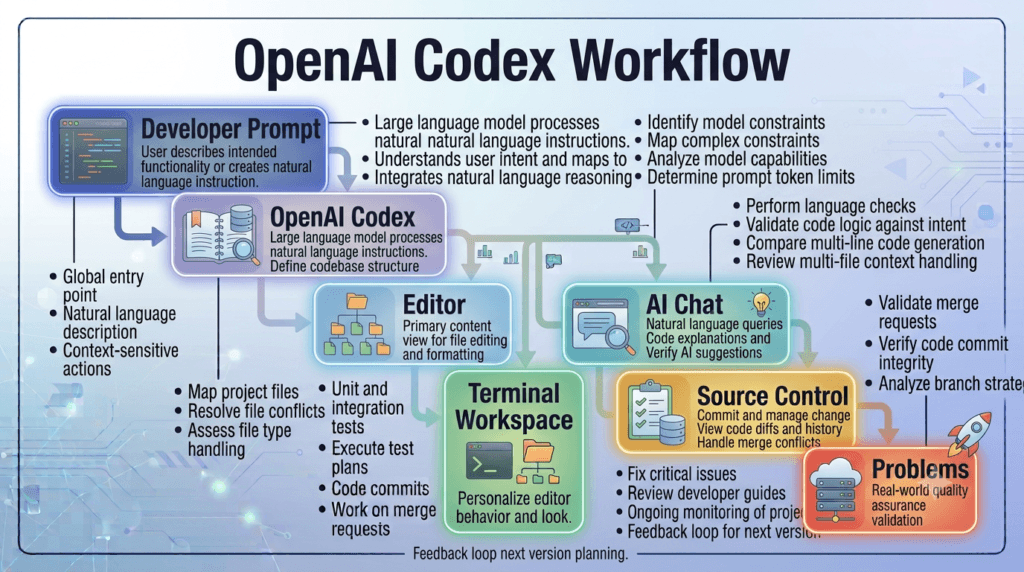
A simplified workflow looks like this:
Developer Request

↓

Natural Language Understanding

↓

Programming Context Analysis

↓

Code Generation

↓

Developer Review

↓

Testing

↓

Implementation
Unlike rule-based programming tools, Codex relies on advanced machine learning to predict the most appropriate solution based on the available information.
Key Capabilities of OpenAI Codex
OpenAI Codex offers a broad set of capabilities that support developers during different stages of software development.
Code Generation
Developers can describe functionality in natural language, and Codex generates corresponding source code.
Common examples include:
- Functions
- Classes
- APIs
- Database queries
- Automation scripts
- Configuration files
Code Explanation
Understanding unfamiliar code is often as challenging as writing new code.
Codex can explain:
- Functions
- Algorithms
- Design patterns
- Complex logic
- Error messages
- Programming concepts
This capability is especially valuable when joining existing projects or learning new technologies.
Code Refactoring
Maintaining clean code is essential for long-term software quality.
OpenAI Codex assists by suggesting:
- Simpler implementations
- Better naming conventions
- Reduced code duplication
- Improved readability
- Modular designs
- Cleaner architecture
Developers remain responsible for reviewing and validating every recommendation before integrating it into production systems.
Automated Test Generation
Software quality depends heavily on effective testing.
Codex can help generate:
- Unit tests
- Integration tests
- API tests
- End-to-end tests
- Edge-case scenarios
- Mock data
Generating tests alongside implementation encourages more reliable software development practices.
Documentation Assistance
Documentation is frequently overlooked during development.
OpenAI Codex can assist in creating:
- README files
- API documentation
- Installation guides
- Technical documentation
- Code comments
- Usage examples
Well-maintained documentation improves collaboration and reduces onboarding time for new team members.
Programming Languages Supported
One of the strengths of OpenAI Codex is its ability to work with multiple programming languages.
Popular languages include:
- Python
- JavaScript
- TypeScript
- Java
- C#
- C++
- Go
- Rust
- PHP
- Ruby
- SQL
- Bash
This broad language support makes Codex useful for developers working across different technology stacks.
Who Should Learn OpenAI Codex?
OpenAI Codex is valuable for professionals across the software industry.
It is particularly useful for:
- Software Developers
- QA Engineers
- Automation Test Engineers
- SDETs
- DevOps Engineers
- Data Engineers
- Students
- Technical Trainers
- Engineering Managers
Because Codex supports both learning and professional development, it appeals to developers at every experience level.
Real-World Applications
Organizations use OpenAI Codex in a variety of practical scenarios.
Common applications include:
- Building web applications
- Creating automation scripts
- Developing APIs
- Generating test cases
- Refactoring legacy systems
- Explaining enterprise codebases
- Accelerating code reviews
- Improving documentation
- Supporting developer onboarding
- Learning unfamiliar programming frameworks
As AI-assisted development continues to evolve, tools powered by Codex are becoming an increasingly important part of modern engineering workflows.
OpenAI Codex Architecture: How It Understands, Generates, and Improves Code
Understanding the Architecture of OpenAI Codex
To use OpenAI Codex effectively, it is important to understand how it processes requests and generates code. Many developers assume Codex simply predicts the next line of code like an advanced autocomplete tool. In reality, it performs multiple stages of analysis before producing a response.
When you provide a prompt, Codex analyzes the natural language instruction, understands the programming context, identifies the task, and generates code that best matches your intent. This enables developers to communicate using plain English instead of relying solely on programming syntax.
The better you understand how Codex works internally, the better prompts you can write and the higher the quality of the generated code.
High-Level OpenAI Codex Architecture
At a high level, the workflow can be represented as follows:
Developer Prompt

↓

Prompt Processing

↓

Context Understanding

↓

Code Reasoning

↓

Code Generation

↓

Response Validation

↓

Developer Review
Each stage contributes to producing code that is relevant to the developer’s request.
Prompt Processing
Everything begins with a prompt.
A prompt may contain:
- A programming question
- A coding task
- Existing source code
- Error messages
- Project requirements
- Documentation
- Comments
- Expected output
Codex analyzes both the written instructions and any accompanying code before generating a response.
The more detailed and structured the prompt, the more accurate the output is likely to be.
Natural Language Understanding
One of the defining strengths of OpenAI Codex is its ability to understand natural language.
For example, instead of writing implementation details, a developer can describe a requirement such as:
- Create a REST API.
- Generate Playwright tests.
- Explain this Python function.
- Refactor this class.
- Optimize this SQL query.
Codex interprets the objective and converts it into programming logic.
This significantly reduces the need to remember syntax while allowing developers to focus on solving problems.
Context Analysis
Modern software projects rarely consist of isolated files.
When context is available, Codex examines:
- Existing source code
- Function definitions
- Variable names
- Class relationships
- Comments
- Documentation
- Programming language
- Coding patterns
Understanding context helps generate code that is more consistent with the surrounding implementation.
Without sufficient context, responses become more generic.
Code Generation Pipeline
After understanding the request, OpenAI Codex generates code step by step.
A simplified pipeline looks like this:
Understand Request

↓

Analyze Context

↓

Predict Solution

↓

Generate Code

↓

Format Response

↓

Return Output
Although this process happens within seconds, multiple internal stages contribute to producing the final response.
Multi-Language Intelligence
One reason OpenAI Codex became popular is its ability to work across multiple programming languages.
Examples include:
- Python
- JavaScript
- TypeScript
- Java
- C#
- Go
- Rust
- PHP
- SQL
- Bash
Rather than memorizing language-specific syntax, developers can describe the desired functionality and allow Codex to generate language-appropriate implementations.
Understanding Existing Code
Software engineers spend a significant amount of time reading code written by others.
OpenAI Codex assists by explaining:
- Functions
- Classes
- APIs
- Algorithms
- Database queries
- Configuration files
- Framework usage
- Design patterns
This capability is particularly useful when joining unfamiliar projects or maintaining legacy applications.
Supporting the Software Development Lifecycle
OpenAI Codex contributes to nearly every stage of software engineering.
Requirements

↓

Planning

↓

Implementation

↓

Testing

↓

Debugging

↓

Documentation

↓

Code Review

↓

Maintenance
Rather than focusing only on code generation, Codex acts as an assistant throughout the complete development lifecycle.
Advantages of Context-Aware Code Generation
Traditional code completion tools generate suggestions based primarily on nearby lines of code.
OpenAI Codex goes further by considering:
- Developer intent
- Programming language
- Existing implementation
- Project context
- Coding style
- Functional requirements
This produces suggestions that are generally more useful for solving real engineering problems.
Limitations Developers Should Understand
Although OpenAI Codex is highly capable, it is not infallible.
Developers should remember:
- Generated code may contain logical mistakes.
- Security considerations must be reviewed.
- Performance should always be evaluated.
- Business requirements require human validation.
- Automated tests remain essential.
- Production code should always undergo code review.
AI accelerates software development, but engineering responsibility still belongs to the developer.
Best Practices for Better Results
Developers consistently obtain better responses from OpenAI Codex when they:
- Write clear requirements.
- Provide sufficient context.
- Include existing code where appropriate.
- Define expected outputs.
- Break large tasks into smaller requests.
- Review generated code carefully.
- Test every implementation before deployment.
A structured workflow enables Codex to produce more accurate, maintainable, and production-ready code.
OpenAI Codex in Action: Building Your First AI-Assisted Application
Applying OpenAI Codex to Real-World Software Development
Understanding the concepts and architecture behind OpenAI Codex is important, but the real value becomes evident when you use it to solve actual software engineering problems. Instead of thinking of Codex as a tool that simply writes code, consider it an AI development partner that assists throughout the entire software development lifecycle.
Professional developers use OpenAI Codex to understand unfamiliar projects, generate new features, debug applications, create automated tests, review code, and improve documentation. The key is learning how to collaborate with the AI rather than expecting it to build complete applications without guidance.
A Typical Development Workflow
Most software projects follow a structured development process. OpenAI Codex fits naturally into each stage of that workflow.
Understand Requirements

↓

Plan the Solution

↓

Write Initial Code

↓

Review Implementation

↓

Generate Tests

↓

Debug Issues

↓

Improve Documentation

↓

Deploy Application
Using Codex throughout the workflow produces better results than relying on it only for code generation.
Starting a New Project
Imagine you are building a simple Task Management application.
Before writing code, define the project requirements.
Example requirements:
- User registration
- User login
- Create tasks
- Update tasks
- Delete tasks
- Mark tasks as completed
- Search tasks
- Responsive user interface
Once the requirements are clear, OpenAI Codex can help break the project into smaller, manageable components.
Planning Before Coding
One common mistake is asking AI to build an entire application in a single prompt.
A better approach is to divide the work into logical modules.
Example project structure:
Task Manager

├── Authentication

├── Dashboard

├── Task Module

├── Database

├── API

├── Testing

└── Documentation
Developing one module at a time makes the code easier to understand, review, and maintain.
Generating Individual Components
Rather than requesting a complete application, ask OpenAI Codex to generate individual pieces.
Examples include:
Authentication
Generate:
- Login functionality
- Registration
- Password validation
- Session management
Database
Generate:
- Database models
- Relationships
- Queries
- Migrations
API
Generate:
- CRUD endpoints
- Validation
- Error handling
- Response formatting
Frontend
Generate:
- Components
- Forms
- Navigation
- State management
Working incrementally improves code quality and simplifies debugging.
Reviewing AI-Generated Code
Every suggestion produced by OpenAI Codex should be reviewed before it becomes part of the application.
Review the following areas:
- Business logic
- Readability
- Naming conventions
- Error handling
- Security
- Performance
- Scalability
- Maintainability
AI can accelerate implementation, but human judgment is essential for producing reliable software.
Debugging with OpenAI Codex
Debugging is one of the most valuable use cases for AI-assisted development.
When an issue occurs, provide:
- Error message
- Relevant code
- Expected behavior
- Actual behavior
- Framework information
Codex can help explain the cause of the issue and suggest possible solutions, making troubleshooting faster and more efficient.
Generating Automated Tests
Testing should be part of feature development rather than an afterthought.
OpenAI Codex can assist in creating:
- Unit tests
- Integration tests
- API tests
- End-to-end tests
- Mock objects
- Test data
- Edge-case scenarios
Generating tests while implementing features helps maintain software quality and reduces regression risks.
Improving Existing Applications
OpenAI Codex is equally valuable for maintaining existing projects.
Developers frequently use it to:
- Refactor legacy code
- Improve readability
- Simplify complex methods
- Remove duplication
- Optimize performance
- Modernize outdated implementations
These improvements make applications easier to maintain over time.
Daily Development Workflow
A practical workflow using OpenAI Codex might look like this:
Open Project

↓

Understand Existing Code

↓

Plan Feature

↓

Generate Implementation

↓

Review Changes

↓

Write Tests

↓

Run Application

↓

Commit Code
This structured process encourages consistent engineering practices while benefiting from AI assistance.
Common Mistakes to Avoid
Developers who are new to OpenAI Codex often encounter similar challenges.
Requesting Complete Applications
Large prompts frequently produce inconsistent or incomplete implementations.
Instead, divide the work into smaller features.
Accepting Code Without Review
Always inspect AI-generated code before integrating it into production.
Ignoring Existing Architecture
Generated code should follow the project’s existing design patterns and coding standards.
Skipping Testing
Every new feature should include appropriate automated tests.
Writing Vague Prompts
Clear, detailed instructions consistently produce better results than generic requests.
Practical Tips for Better Results
To maximize the value of OpenAI Codex, adopt these habits:
- Define clear requirements before coding.
- Build features incrementally.
- Provide project context whenever possible.
- Review every generated implementation.
- Generate tests alongside new functionality.
- Update documentation after significant changes.
- Commit small, focused changes to version control.
Following these practices helps developers produce software that is easier to maintain, test, and extend while taking full advantage of AI-assisted development.
OpenAI Codex Best Practices: Common Mistakes, Professional Workflows, and Developer Tips
Why Best Practices Matter
Learning the features of OpenAI Codex is only the first step. The real productivity gains come from knowing when and how to use it effectively. Experienced developers don’t ask AI to write an entire application from scratch—they use it strategically to accelerate development while maintaining full control over design, security, testing, and code quality.
OpenAI Codex should be viewed as a development partner that assists with repetitive tasks, explains unfamiliar code, and improves developer productivity. The final responsibility for software quality always remains with the engineering team.
Following proven best practices helps you produce cleaner code, reduce bugs, and integrate AI naturally into your daily development workflow.
Best Practices for Using OpenAI Codex
Understand the Problem Before Writing Code
The quality of AI-generated code depends heavily on the quality of the problem definition.
Before asking OpenAI Codex to generate code, identify:
- Business requirements
- Functional requirements
- Technical constraints
- Expected output
- Performance expectations
- Security requirements
A clear understanding of the problem results in more accurate implementations.
Write Specific Prompts
Avoid vague instructions.
Instead of asking:
Create a login system.
Provide more context, such as:
- Programming language
- Framework
- Authentication method
- Database
- Validation rules
- Error handling requirements
The more context provided, the more relevant the generated code becomes.
Build Features Incrementally
Large prompts often generate inconsistent or difficult-to-maintain code.
A better workflow is:
Define Feature

↓

Generate Small Component

↓

Review Code

↓

Test Functionality

↓

Improve Implementation

↓

Commit Changes
Breaking work into smaller tasks makes debugging, testing, and reviewing significantly easier.
Always Review AI-Generated Code
OpenAI Codex accelerates development, but developers should never assume the generated code is production-ready.
Review every implementation for:
- Logic
- Readability
- Security
- Performance
- Scalability
- Coding standards
- Error handling
Code review remains an essential engineering practice.
Integrating OpenAI Codex into Daily Development
Professional developers use OpenAI Codex throughout the software development lifecycle instead of limiting it to code generation.
Common use cases include:
Understanding Existing Code
Ask Codex to explain:
- Complex functions
- Algorithms
- Business logic
- API endpoints
- Database queries
- Configuration files
This is particularly useful when working with unfamiliar or legacy projects.
Writing New Features
Generate individual components such as:
- Services
- Controllers
- Utility functions
- Database models
- API endpoints
- Configuration files
Building one component at a time improves maintainability.
Debugging Problems
Provide:
- Error messages
- Relevant source code
- Expected behavior
- Actual behavior
OpenAI Codex can help identify possible causes and recommend solutions more quickly than manual investigation alone.
Generating Automated Tests
Testing should accompany every new feature.
Generate:
- Unit tests
- Integration tests
- API tests
- End-to-end tests
- Edge-case scenarios
Well-tested applications are easier to maintain and less likely to introduce regressions.
Common Mistakes Developers Make
Treating AI as an Autocomplete Tool
OpenAI Codex is capable of much more than predicting the next line of code.
Use it to:
- Analyze code
- Explain architecture
- Review implementations
- Suggest improvements
- Create documentation
Leveraging its broader capabilities delivers greater productivity gains.
Depending Entirely on AI
AI assists developers—it does not replace engineering judgment.
Developers remain responsible for:
- Architectural decisions
- Security reviews
- Business logic
- Performance optimization
- Production readiness
Human expertise is still essential.
Ignoring Project Context
Generic prompts produce generic answers.
Whenever possible, include:
- Existing code
- Project structure
- Framework
- Dependencies
- Coding conventions
Context-aware prompts produce significantly better results.
Skipping Documentation
As applications evolve, documentation should evolve as well.
Use OpenAI Codex to help maintain:
- README files
- API documentation
- Setup guides
- Architecture documentation
- Code comments
Accurate documentation improves collaboration and onboarding.
Professional Workflow
Many experienced teams follow a repeatable AI-assisted development process.
Understand Requirements

↓

Analyze Existing Code

↓

Plan Solution

↓

Generate Implementation

↓

Review Code

↓

Generate Tests

↓

Run Validation

↓

Commit Changes

↓

Deploy
This workflow keeps developers in control while benefiting from AI assistance at every stage.
Team Collaboration Tips
Organizations adopting OpenAI Codex should establish shared development practices.
Recommended guidelines include:
- Maintain consistent coding standards.
- Use descriptive prompts.
- Review AI-generated code through pull requests.
- Keep automated testing mandatory.
- Update documentation regularly.
- Monitor code quality metrics.
- Encourage knowledge sharing within the team.
A standardized approach ensures that AI enhances collaboration rather than introducing inconsistency.
Measuring Success
The success of AI-assisted development should be measured using engineering outcomes rather than the amount of code generated.
Useful metrics include:
| Metric | Why It Matters |
|---|---|
| Development Speed | Measures productivity improvements |
| Code Quality | Indicates maintainability and reliability |
| Test Coverage | Reflects application stability |
| Bug Rate | Evaluates implementation quality |
| Code Review Feedback | Identifies maintainability issues |
| Deployment Frequency | Tracks delivery efficiency |
| Developer Satisfaction | Measures workflow effectiveness |
Monitoring these metrics provides a clearer understanding of how OpenAI Codex contributes to software engineering success.
Key Takeaways
Using OpenAI Codex effectively requires more than learning its features. Developers achieve the best results by defining clear requirements, writing detailed prompts, building features incrementally, reviewing every AI-generated implementation, generating tests alongside code, and maintaining high engineering standards.
When integrated thoughtfully into a structured development workflow, OpenAI Codex becomes a powerful productivity tool that helps developers spend less time on repetitive tasks and more time designing, building, and delivering high-quality software.
Internal Links:
- Learn MCP – Zero to Hero
- Learn AI Agents for QA – Zero to Hero
- Playwright Automation – Zero to Hero
- Learn Python – Zero to Hero
- Cursor AI: Complete Zero to Hero
- Claude Code Tutorial: Complete Zero to Hero
- Free QA Resources Built From Real Experience
- QA Glossary: Test Automation Terms Every Engineer Should Know
External Resources:
- OpenAI Codex – Get Started: OpenAI Codex Get Started
- OpenAI Codex CLI – Getting Started: OpenAI Codex CLI Guide
- OpenAI Codex GitHub Repository: OpenAI Codex GitHub Repository
- Using OpenAI Codex with ChatGPT: Using Codex with ChatGPT
- OpenAI Codex CLI Authentication: Codex CLI Sign-in Guide
People Also Ask
What is OpenAI Codex?
OpenAI Codex is an AI-powered coding model that understands natural language and programming languages, helping developers generate code, explain existing code, debug applications, create automated tests, and improve software development productivity.
Is OpenAI Codex suitable for beginners?
Yes. OpenAI Codex is useful for both beginners and experienced developers. Beginners can learn programming concepts faster, while professionals can automate repetitive development tasks and improve productivity.
Which programming languages does OpenAI Codex support?
OpenAI Codex supports many popular programming languages, including Python, JavaScript, TypeScript, Java, C#, Go, Rust, PHP, SQL, Bash, and more.
Can OpenAI Codex generate automated tests?
Yes. OpenAI Codex can generate unit tests, integration tests, API tests, and end-to-end tests, helping developers improve software quality and reduce manual testing effort.
Is OpenAI Codex a replacement for developers?
No. OpenAI Codex is an AI development assistant that enhances developer productivity. Human developers remain responsible for software architecture, business logic, security, testing, and production readiness.
Featured Snippet
What Is OpenAI Codex?
OpenAI Codex is an AI coding assistant that converts natural language instructions into executable code. It helps developers write, explain, debug, refactor, document, and test software across multiple programming languages, making software development faster and more efficient.
AI Overview Answer
OpenAI Codex is an advanced AI model built for software development. It assists developers by understanding natural language prompts, generating code, explaining existing implementations, producing automated tests, and supporting the complete software development lifecycle. It enables developers to focus more on solving problems while reducing repetitive coding tasks.
Enjoyed this article? Explore more in-depth guides on AI engineering, automation testing, Model Context Protocol, Playwright, and intelligent software quality at www.skakarh.com. Follow QAPulse by SK for practical, production-focused tutorials designed for QA engineers, SDETs, and AI developers.