QA
QA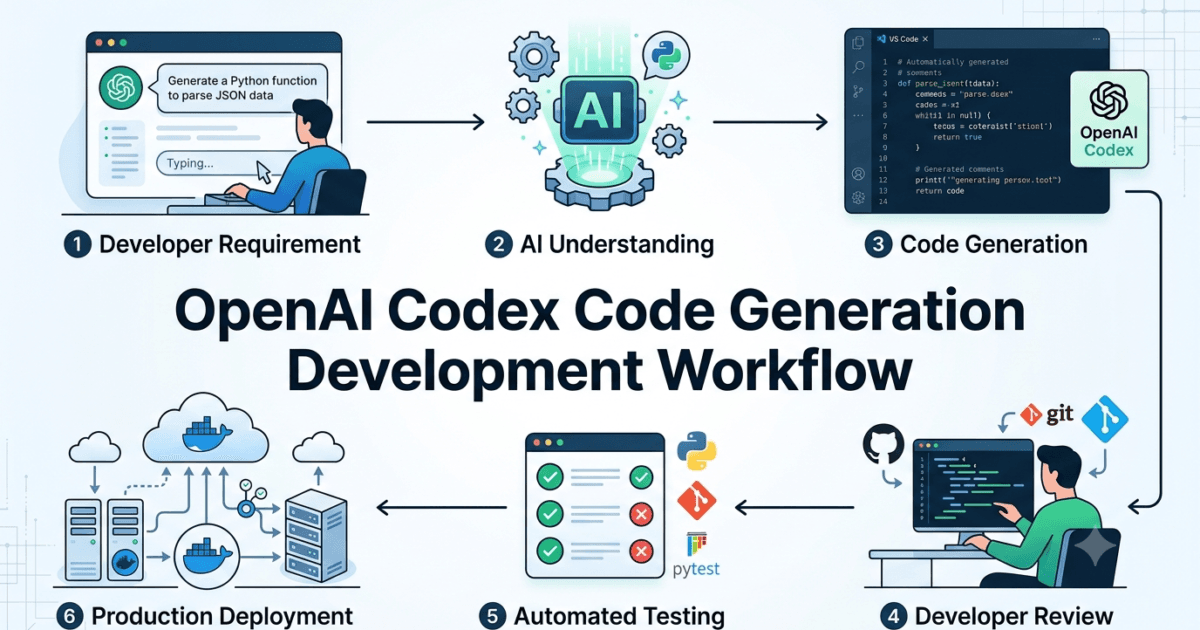
What is OpenAI Codex Code Generation?
Software development has traditionally required developers to manually write every function, class, module, and configuration file. While experienced engineers can build complex systems efficiently, repetitive coding tasks often consume significant time and reduce focus on higher-value activities such as architecture design, problem-solving, and innovation.
This is where OpenAI Codex Code Generation changes the development experience.
OpenAI Codex Code Generation refers to the ability of Codex models to transform natural language instructions into functional programming solutions. Developers can describe what they want to build, explain technical requirements, provide project context, and receive AI-generated code that can be reviewed, modified, and integrated into real applications.
Instead of replacing developers, Codex works as an intelligent programming assistant that accelerates implementation while keeping engineers responsible for design decisions, security, testing, and quality.
Why OpenAI Codex Code Generation Matters
Modern applications require developers to handle many repetitive implementation tasks.
Examples include:
- Creating project structures
- Writing boilerplate code
- Building API endpoints
- Generating database models
- Creating utility functions
- Writing configuration files
- Developing test cases
- Producing documentation
These activities are necessary but often consume valuable engineering time.
With OpenAI Codex Code Generation, developers can reduce repetitive work and spend more time on complex engineering decisions.
Key benefits include:
- Faster development cycles
- Reduced boilerplate coding
- Improved developer productivity
- Faster prototyping
- Easier experimentation
- Better learning experience
- Consistent implementation patterns
- Support for multiple programming languages
How OpenAI Codex Code Generation Works
At a high level, Codex follows a process similar to an experienced developer analysing a requirement.
Developer Requirement

↓

Context Understanding

↓

Code Planning

↓

Implementation Generation

↓

Developer Review

↓

Testing and Integration
The developer provides the intent, requirements, and constraints. Codex analyses the request and generates a possible implementation.
However, professional developers should always validate generated code before using it in production systems.
From Idea to Implementation
One of the biggest advantages of OpenAI Codex Code Generation is converting ideas into working prototypes quickly.
For example, instead of manually starting from an empty project, a developer can describe:
“Create a Python FastAPI service for managing customer records with authentication, validation, and database support.”
Codex can help generate:
- Project structure
- API routes
- Data models
- Validation logic
- Error handling
- Configuration templates
- Testing examples
The developer can then refine the generated solution according to business requirements.
Generating Application Architecture
Before writing code, developers need a strong architecture.
Codex can assist with:
- Breaking applications into modules
- Suggesting folder structures
- Designing service layers
- Creating reusable components
- Identifying dependencies
- Explaining architectural trade-offs
Example application structure:
customer-management-system

├── api
│   ├── routes
│   └── controllers
│
├── models
│
├── services
│
├── database
│
├── tests
│
└── configuration
This helps developers start projects with a cleaner foundation.
Generating Code Components
Large applications are built from smaller reusable components.
OpenAI Codex Code Generation can help create:
- Functions
- Classes
- Modules
- API handlers
- Data processing pipelines
- Authentication components
- Utility libraries
For example, a developer can request:
“Create a Python function that validates email addresses and handles invalid input safely.”
Codex can generate an initial implementation that developers can improve and integrate.
Code Generation Across Programming Languages
One of the strengths of Codex is supporting different programming ecosystems.
Examples include:
Python
Common use cases:
- Backend services
- Data processing
- Automation scripts
- AI applications
- Testing frameworks
JavaScript and TypeScript
Common use cases:
- Frontend applications
- Node.js APIs
- Web frameworks
- Full-stack development
Java
Common use cases:
- Enterprise applications
- Backend systems
- Android development
C#
Common use cases:
- Enterprise software
- .NET applications
- Game development
SQL
Common use cases:
- Database queries
- Data transformations
- Reporting logic
This flexibility allows teams to integrate AI assistance into different technology stacks.
Generating Backend Applications
Backend development often contains repetitive patterns.
Codex can assist with:
- API creation
- Authentication flows
- Database operations
- Request validation
- Error handling
- Logging
- Configuration management
Example workflow:
Requirement

↓

API Design

↓

Generate Backend Code

↓

Add Validation

↓

Create Tests

↓

Deploy
Developers can use Codex to accelerate implementation while maintaining control over architecture.
Generating Frontend Components
Frontend development also benefits from AI assistance.
Codex can help create:
- React components
- UI layouts
- Form handling
- State management logic
- API integrations
- Styling structures
For example:
“Create a React dashboard displaying user analytics with reusable components.”
Codex can generate an initial component structure that developers can customise.
Building Reusable Code Libraries
Professional software teams often maintain internal libraries.
Codex can help create:
- Shared utilities
- Helper functions
- Validation libraries
- API clients
- Testing utilities
- Developer tools
Reusable components improve consistency and reduce duplicate implementation effort.
OpenAI Codex Code Generation for Prototyping
Rapid prototyping is one of the strongest use cases.
Developers can quickly test ideas such as:
- New application concepts
- API experiments
- Automation scripts
- AI workflows
- Proof-of-concept systems
Instead of spending days building a basic prototype, teams can explore solutions much faster.
Common Mistakes When Using AI Code Generation
Although OpenAI Codex Code Generation improves productivity, developers should avoid several mistakes.
Blindly Accepting Generated Code
AI-generated code may contain:
- Logical errors
- Security weaknesses
- Incorrect assumptions
- Performance issues
Always review and test before integration.
Providing Poor Requirements
A vague request produces vague results.
Better prompts include:
- Technology stack
- Functional requirements
- Expected behaviour
- Constraints
- Security requirements
Ignoring Existing Architecture
Generated code should match the project’s:
- Design patterns
- Naming conventions
- Coding standards
- Dependencies
Best Practices
To use OpenAI Codex Code Generation effectively:
- Describe requirements clearly.
- Provide relevant project context.
- Define technical constraints.
- Review every generated solution.
- Write automated tests.
- Validate security-sensitive code.
- Maintain coding standards.
- Use version control.
- Improve generated code through iteration.
- Combine AI assistance with engineering judgement.
Preparing for Advanced OpenAI Codex Techniques
Understanding OpenAI Codex Code Generation provides the foundation for AI-assisted software development. However, generating individual functions and components is only the beginning. Professional developers use Codex to build complete applications, integrate APIs, automate workflows, and accelerate engineering tasks across the entire software lifecycle.
In the next lesson, we will explore how OpenAI Codex Code Generation can be applied to real-world application development, including backend systems, APIs, databases, authentication, and full-stack projects.
Summary
OpenAI Codex Code Generation enables developers to transform ideas into working software by using natural language instructions to generate code, architecture suggestions, reusable components, and application structures. By combining AI-generated solutions with human review, testing, and engineering expertise, developers can build software faster while maintaining quality, security, and maintainability. Codex is not a replacement for developers—it is a powerful assistant that expands what engineers can create.
OpenAI Codex Application Development: Building Real-World Software with AI Assistance
Using OpenAI Codex for Application Development
Generating small code snippets is useful, but professional software engineering requires much more than writing isolated functions. Real applications contain multiple layers, including user interfaces, backend services, databases, authentication systems, APIs, testing frameworks, and deployment configurations.
This is where OpenAI Codex Code Generation becomes significantly more valuable.
Developers can use Codex to accelerate complete application development by generating project structures, implementing features, creating integrations, and assisting throughout the software lifecycle.
Instead of manually building every component from scratch, engineers can collaborate with Codex to move from an idea to a functional application faster while maintaining full control over architecture and quality.
The Application Development Workflow
A typical AI-assisted application development process looks like this:
Business Requirement

↓

Application Design

↓

Project Structure

↓

Backend Development

↓

Frontend Development

↓

Database Integration

↓

Testing

↓

Deployment
Each stage can benefit from AI assistance while developers remain responsible for technical decisions.
Creating Project Structures with OpenAI Codex
Every application begins with a well-organised structure.
A poorly designed project becomes difficult to maintain as it grows. Codex can help developers create logical structures based on application requirements.
For example, a backend API project may include:
ecommerce-api

├── app

│   ├── routes

│   ├── models

│   ├── services

│   ├── middleware

│   └── utils

│

├── database

├── tests

├── config

├── requirements.txt

└── README.md
Codex can suggest appropriate folder organisation based on:
- Programming language
- Framework
- Application size
- Development standards
- Team requirements
Building Backend Applications
Backend systems contain business logic, data processing, authentication, and external integrations.
OpenAI Codex Code Generation can assist developers with:
- REST APIs
- GraphQL services
- Authentication systems
- Database operations
- Business logic
- Background jobs
- API integrations
- Error handling
For example, a developer can request:
“Create a FastAPI backend for a task management application with user authentication, CRUD operations, and PostgreSQL integration.”
Codex can generate an initial implementation containing:
- API routes
- Request models
- Database schemas
- Service functions
- Authentication logic
- Error handling
The generated code should then be reviewed and adjusted according to project requirements.
Creating REST APIs
APIs are one of the most common areas where AI-assisted coding provides value.
Codex can help generate:
- Endpoint definitions
- Request validation
- Response models
- Authentication middleware
- API documentation
- Error responses
Example API workflow:
User Request

↓

API Endpoint

↓

Validation

↓

Business Logic

↓

Database Operation

↓

Response
Developers can focus more on API design decisions while Codex assists with implementation details.
Database Integration
Modern applications depend heavily on data storage.
Codex can help developers create:
- Database models
- SQL queries
- ORM classes
- Migration scripts
- Data validation logic
- Repository layers
Supported technologies may include:
- PostgreSQL
- MySQL
- SQLite
- MongoDB
- Redis
Example request:
“Create SQLAlchemy models for a customer management system with users, orders, and payments.”
Codex can generate a starting point that developers can refine.
Authentication and Security Features
Security is a critical part of application development.
Codex can assist with implementing common security patterns such as:
- User registration
- Login systems
- Password hashing
- JWT authentication
- Role-based access control
- API security middleware
However, security-related code requires careful human review.
Developers should validate:
- Authentication flows
- Encryption methods
- Permission handling
- Data protection
- Vulnerability risks
AI can accelerate implementation, but security decisions require expert judgement.
Building Frontend Applications
Frontend development involves creating user experiences, interfaces, and interactions.
Codex can assist with:
- React components
- TypeScript interfaces
- UI layouts
- Form validation
- State management
- API communication
- Responsive design structures
Example:
“Create a React dashboard component displaying user analytics with charts and API integration.”
Codex can generate:
- Component structure
- State handling
- Data fetching logic
- UI elements
Developers can then customise the design according to product requirements.
Full-Stack Application Development
One of the strongest use cases of OpenAI Codex Code Generation is accelerating full-stack development.
A complete workflow may include:
Frontend

↓

API Layer

↓

Backend Services

↓

Database

↓

Authentication

↓

Testing

↓

Deployment
Codex can assist across every layer.
Example full-stack project:
Customer Management Platform
Frontend:
- React dashboard
- User forms
- Data tables
Backend:
- FastAPI services
- Authentication
- Business logic
Database:
- PostgreSQL models
- Queries
- Migrations
Testing:
- API tests
- Unit tests
- Integration tests
Generating Background Services
Many applications require tasks that run outside normal user requests.
Examples:
- Email processing
- Report generation
- Data synchronisation
- Scheduled jobs
- Notification systems
Codex can help create:
- Worker processes
- Queue consumers
- Scheduled scripts
- Automation services
Example workflow:
Application Event

↓

Queue Message

↓

Background Worker

↓

Process Data

↓

Update System
Creating Microservices
Large applications often use multiple independent services.
Codex can assist with:
- Service templates
- API contracts
- Communication patterns
- Configuration files
- Docker setup
- Testing strategies
Example architecture:
Client

↓

API Gateway

↓

Service A

↓

Service B

↓

Database
This helps teams quickly prototype and expand distributed systems.
Real-World Development Examples
E-Commerce Platform
Codex can assist with:
- Product management
- Shopping carts
- Payment integration
- Order processing
- Customer accounts
SaaS Application
Codex can help build:
- User management
- Subscription systems
- Dashboards
- Analytics
Internal Business Tools
Codex can accelerate:
- Admin panels
- Reporting systems
- Workflow automation
- Data management applications
Common Challenges
Although OpenAI Codex Code Generation improves development speed, developers should consider several challenges.
Maintaining Architecture Consistency
Generated code should follow existing project patterns.
Managing Complexity
Large applications should be developed incrementally instead of requesting the entire system at once.
Reviewing Dependencies
AI suggestions may introduce unnecessary libraries.
Always evaluate dependencies carefully.
Testing Generated Features
Every generated feature should pass appropriate tests before production use.
Best Practices
For effective AI-assisted application development:
- Start with a clear architecture.
- Break applications into smaller components.
- Provide detailed requirements.
- Review generated code carefully.
- Follow secure coding practices.
- Maintain automated tests.
- Use version control.
- Validate third-party dependencies.
- Document important decisions.
- Iterate continuously.
Preparing for Automation and Testing
Building applications with Codex is only one part of modern AI-assisted development. The next step is applying OpenAI Codex Code Generation to automation engineering, software testing, and quality assurance workflows.
In the next lesson, we will explore how Codex can help generate test automation frameworks, API tests, Playwright scripts, PyTest suites, CI/CD pipelines, and quality engineering solutions.
Summary
OpenAI Codex Code Generation enables developers to accelerate real-world application development by assisting with project structures, backend systems, APIs, databases, authentication, frontend components, and full-stack solutions. When combined with proper architecture, security reviews, automated testing, and developer expertise, Codex becomes a powerful engineering assistant capable of reducing development effort while improving productivity and innovation.
OpenAI Codex Code Generation for Automation and Testing: Building AI-Assisted Quality Engineering Solutions
Using OpenAI Codex for Software Testing and Automation
Modern software development is incomplete without a strong testing strategy. As applications become more complex, engineering teams need reliable automation frameworks to validate functionality, performance, security, and user experience.
Writing automated tests can be time-consuming because it requires developers and QA engineers to create test structures, maintain frameworks, handle edge cases, and continuously update scripts as applications evolve.
This is where OpenAI Codex Code Generation becomes valuable for quality engineering.
OpenAI Codex Code Generation can assist QA engineers, SDETs, and developers by generating test cases, automation scripts, API validation logic, test data, CI/CD configurations, and framework components. Instead of manually creating every test from scratch, teams can use Codex to accelerate automation while maintaining professional testing standards.
Why AI-Assisted Testing Matters
Software teams face increasing pressure to:
- Release faster
- Improve application quality
- Reduce production defects
- Increase test coverage
- Automate repetitive validation
- Support continuous delivery
Traditional manual creation of every test scenario does not scale efficiently.
AI-assisted testing helps teams:
- Generate initial test implementations faster
- Discover missing test scenarios
- Create automation templates
- Improve regression coverage
- Reduce repetitive coding effort
- Support faster debugging
However, AI-generated tests still require validation from experienced QA professionals.
OpenAI Codex Testing Workflow
A typical AI-assisted testing workflow looks like this:
Requirement Analysis

↓

Generate Test Strategy

↓

Create Test Cases

↓

Generate Automation Code

↓

Execute Tests

↓

Analyse Failures

↓

Improve Coverage
This workflow allows QA teams to combine human testing expertise with AI-powered productivity.
Generating Test Cases with OpenAI Codex
Before automation begins, teams need clear test scenarios.
Codex can help generate:
- Functional test cases
- Negative scenarios
- Boundary conditions
- Edge cases
- Regression scenarios
- User acceptance scenarios
Example requirement:
“Create test cases for a user login system.”
Codex can suggest scenarios such as:
| Scenario | Expected Result |
|---|---|
| Valid username and password | User successfully logs in |
| Invalid password | Error message displayed |
| Empty fields | Validation triggered |
| Locked account | Access denied |
| Expired session | User redirected to login |
This helps testers build stronger coverage before writing automation code.
Generating Playwright Automation Scripts
Modern web automation frameworks such as Playwright require developers to write:
- Browser setup
- Page navigation
- Locators
- Assertions
- Test structure
- Reporting integration
OpenAI Codex Code Generation can accelerate Playwright development by generating:
- Test files
- Page Object Models
- Reusable utilities
- Locator strategies
- Test fixtures
Example request:
“Create a Playwright TypeScript test for a login page using Page Object Model architecture.”
Codex can generate an initial automation structure that engineers can refine.
Example architecture:
tests

├── login.spec.ts

pages

├── LoginPage.ts

fixtures

├── testFixture.ts

utils

├── helpers.ts
This allows teams to build maintainable automation frameworks faster.
Generating Selenium Automation
Many enterprise applications still rely on Selenium-based frameworks.
Codex can assist with:
- Selenium WebDriver setup
- Page Object Model classes
- TestNG/JUnit tests
- Python Selenium scripts
- Java automation frameworks
Example use cases:
- Creating browser interactions
- Writing reusable components
- Generating assertions
- Creating test utilities
AI assistance can reduce repetitive automation coding while allowing SDETs to focus on framework design.
Generating API Automation Tests
API testing is essential for validating backend systems.
Codex can help generate API automation using tools such as:
- Python Requests
- PyTest
- Postman scripts
- REST Assured
- Playwright API testing
Example API testing workflow:
API Requirement

↓

Generate Test Scenarios

↓

Create API Tests

↓

Validate Responses

↓

Check Error Handling

↓

Generate Reports
Common validations include:
- Status codes
- Response schemas
- Authentication
- Headers
- Payload validation
- Performance checks
Generating PyTest Framework Components
Python testing frameworks are widely used in automation and AI projects.
Codex can generate:
- PyTest fixtures
- Test classes
- Parameterised tests
- Mock implementations
- Configuration files
- Reporting integrations
Example request:
“Create a PyTest framework for testing a FastAPI application with fixtures and HTML reporting.”
Codex can provide an initial framework structure.
Example:
tests

├── conftest.py

├── test_users.py

├── test_orders.py

reports

config

requirements.txt
Creating Test Data
Good automation requires reliable test data.
Codex can help generate:
- JSON test payloads
- Database seed scripts
- Mock users
- API request bodies
- Edge-case datasets
Examples:
- Invalid email formats
- Boundary values
- Large datasets
- Special characters
- Missing fields
This improves test coverage and reduces manual preparation effort.
Generating CI/CD Testing Pipelines
Continuous integration requires automated validation whenever code changes.
Codex can assist with:
- GitHub Actions workflows
- Jenkins pipelines
- Docker test environments
- Test execution scripts
- Reporting configuration
Example workflow:
Developer Push

↓

CI Pipeline Starts

↓

Install Dependencies

↓

Run Tests

↓

Generate Reports

↓

Deploy
AI-generated pipeline templates can help teams establish automation faster.
AI-Assisted Regression Testing
Regression testing becomes challenging as applications grow.
Codex can help teams:
- Identify regression areas
- Generate missing tests
- Update outdated scripts
- Improve test coverage
- Refactor duplicate automation code
This is especially useful for large enterprise applications with thousands of existing test cases.
Supporting QA Engineers and SDETs
OpenAI Codex Code Generation provides significant value for QA professionals.
SDETs can use Codex for:
- Framework creation
- Script generation
- Debugging automation failures
- Reviewing code quality
- Learning new testing tools
- Generating documentation
Instead of replacing automation engineers, Codex acts as a productivity multiplier.
Common Mistakes in AI-Generated Testing
Trusting Generated Tests Without Review
Generated tests may:
- Miss important scenarios
- Contain incorrect assertions
- Validate implementation instead of behaviour
Always review test quality.
Creating Too Many Low-Value Tests
More tests do not always mean better quality.
Focus on meaningful coverage.
Ignoring Maintenance
Automation code requires continuous improvement as applications change.
Missing Security Validation
Generated security-related tests should be reviewed carefully.
Best Practices
To use OpenAI Codex Code Generation for testing effectively:
- Define clear testing objectives.
- Provide application context.
- Review generated automation code.
- Validate assertions.
- Maintain clean test architecture.
- Follow automation framework standards.
- Integrate tests into CI/CD.
- Track test reliability.
- Avoid unnecessary duplication.
- Combine AI assistance with QA expertise.
Preparing for Production-Ready AI Development
Testing is one of the strongest areas where AI-assisted development can improve engineering productivity. However, generating automation scripts is only part of the journey. Professional teams must also ensure generated code is secure, maintainable, scalable, and aligned with production standards.
In the next lesson, we will explore how OpenAI Codex Code Generation supports code quality improvement, security validation, performance optimisation, and production readiness.
Summary
OpenAI Codex Code Generation enables QA engineers and developers to accelerate software testing by generating test cases, automation scripts, API validations, CI/CD pipelines, and framework components. When combined with human expertise, proper testing strategies, and continuous validation, Codex helps teams build faster, more reliable, and maintainable quality engineering solutions.
OpenAI Codex Code Quality: Making AI-Generated Code Production Ready
Improving AI-Generated Code with OpenAI Codex
Generating code quickly is one of the biggest advantages of AI-assisted development, but professional software engineering requires more than speed. Production applications must be secure, maintainable, scalable, readable, and reliable.
This is where OpenAI Codex Code Generation moves from simple code creation into advanced engineering practices.
AI-generated code should not be treated as the final solution. Instead, developers should use Codex as a collaborative engineering assistant that helps create initial implementations, identify improvements, analyse potential issues, and optimise existing solutions.
The final responsibility for software quality remains with engineers who review, test, and validate every implementation.
Why Code Quality Matters in AI-Assisted Development
Traditional software engineering already requires strong quality practices. AI-assisted development makes these practices even more important.
Generated code may sometimes contain:
- Incorrect assumptions
- Security vulnerabilities
- Inefficient implementations
- Poor architecture decisions
- Missing error handling
- Unnecessary dependencies
- Difficult-to-maintain structures
A strong review process ensures that AI-generated solutions meet professional engineering standards.
The AI Code Quality Workflow
A production-ready workflow looks like this:
Generate Code

↓

Review Implementation

↓

Analyse Security

↓

Improve Architecture

↓

Optimise Performance

↓

Write Tests

↓

Deploy Safely
This approach combines AI productivity with human engineering judgement.
Reviewing AI-Generated Code
Code review is one of the most important steps after using OpenAI Codex Code Generation.
Developers should evaluate:
Correctness
Does the code solve the intended problem?
Questions to ask:
- Does it handle expected scenarios?
- Are edge cases covered?
- Does it produce correct output?
- Does it follow requirements?
Readability
Good code should be understandable.
Review:
- Variable names
- Function names
- Comments
- Code organisation
- Complexity
Readable code reduces future maintenance costs.
Maintainability
Production systems evolve continuously.
Review whether the generated code:
- Follows project architecture
- Uses reusable components
- Avoids duplication
- Supports future changes
Performance
AI-generated code may work correctly but still be inefficient.
Consider:
- Database queries
- Memory usage
- Algorithm complexity
- API response time
- Resource consumption
Refactoring AI-Generated Code
Initial AI-generated solutions often require refinement.
Codex can assist developers with:
- Simplifying complex functions
- Improving naming conventions
- Removing duplicate code
- Applying design patterns
- Improving modularity
Example:
Before:
Large function

↓

Multiple responsibilities

↓

Difficult testing
After:
Small functions

↓

Clear responsibilities

↓

Easy maintenance
Refactoring transforms generated code into production-quality software.
Applying Software Design Principles
Professional applications benefit from established engineering principles.
Codex can help developers apply concepts such as:
SOLID Principles
Single Responsibility Principle
Each component should have one clear purpose.
Open/Closed Principle
Software should allow extension without modifying existing behaviour.
Liskov Substitution Principle
Objects should be replaceable without breaking functionality.
Interface Segregation Principle
Components should avoid unnecessary dependencies.
Dependency Inversion Principle
High-level modules should not tightly depend on low-level implementations.
Applying these principles improves long-term maintainability.
Security Validation of AI-Generated Code
Security should always be considered when using AI-generated solutions.
Developers should review:
- Authentication logic
- Authorization rules
- Input validation
- Data handling
- Encryption practices
- API security
- Dependency vulnerabilities
Common security issues include:
- SQL injection risks
- Weak authentication
- Exposed secrets
- Unsafe input processing
- Missing access controls
Codex can help identify potential risks, but security experts and developers must validate the final implementation.
Managing Dependencies
AI-generated solutions may introduce external libraries.
Before adding dependencies, evaluate:
- Is the package necessary?
- Is it actively maintained?
- Does it have security issues?
- Does it increase application complexity?
- Does it match project standards?
A smaller dependency footprint often results in easier maintenance.
Performance Optimisation
Applications must not only work—they must perform efficiently.
Codex can help analyse and improve:
- Slow algorithms
- Database queries
- API performance
- Memory usage
- Application architecture
Example optimisation areas:
Before:
Repeated database calls

↓

Slow response time
After:
Optimised queries

↓

Improved performance
Performance improvements should always be measured through testing and monitoring.
Improving Error Handling
Reliable applications require strong error management.
Codex can help developers implement:
- Exception handling
- Logging
- Retry mechanisms
- Validation systems
- User-friendly error responses
Example:
Request

↓

Validation

↓

Process Data

↓

Handle Errors

↓

Return Response
Good error handling improves debugging and user experience.
Code Documentation
Documentation is essential for team collaboration.
Codex can help generate:
- Function documentation
- API documentation
- Architecture explanations
- Setup guides
- Code comments
However, generated documentation should be reviewed to ensure accuracy.
Using Codex for Code Reviews
Beyond generating code, Codex can assist during review activities.
Developers can ask Codex to:
- Explain complex implementations
- Identify possible bugs
- Suggest improvements
- Review coding standards
- Find duplicated logic
Example prompt:
“Review this Python service and identify security issues, performance concerns, and maintainability improvements.”
This creates an additional review layer before human approval.
Production Readiness Checklist
Before deploying AI-generated code, verify:
Functionality
- Requirements implemented
- Expected behaviour confirmed
- Edge cases handled
Quality
- Code reviewed
- Standards followed
- Architecture validated
Security
- Vulnerabilities checked
- Secrets protected
- Authentication verified
Testing
- Unit tests created
- Integration tests completed
- Regression coverage maintained
Operations
- Logging implemented
- Monitoring configured
- Deployment validated
Common Mistakes
Deploying Generated Code Immediately
AI output should always pass through engineering review.
Ignoring Security
Fast development should never compromise application security.
Over-Optimising Too Early
Improve performance based on measurements, not assumptions.
Removing Human Review
AI accelerates engineering but does not replace professional judgement.
Best Practices
To make OpenAI Codex Code Generation effective for production software:
- Review every generated implementation.
- Follow established coding standards.
- Apply secure development practices.
- Write automated tests.
- Perform code reviews.
- Monitor application behaviour.
- Refactor continuously.
- Document important decisions.
- Validate dependencies.
- Keep humans involved in critical decisions.
Preparing for Advanced OpenAI Codex Workflows
Understanding code quality and production readiness completes the foundation of advanced coding techniques with Codex. Developers can now generate applications, automate testing, and improve existing implementations while maintaining professional engineering standards.
The next stage of the OpenAI Codex journey will focus on advanced integrations, including repository workflows, collaboration patterns, AI-assisted reviews, and enterprise development practices.
Summary
OpenAI Codex Code Generation becomes truly powerful when combined with strong software engineering practices. Generating code is only the beginning; reviewing quality, improving architecture, validating security, optimising performance, and maintaining reliable testing processes are essential for production success.
By treating Codex as an engineering partner rather than an automatic code generator, developers can achieve faster delivery while building secure, scalable, and maintainable software systems.
Key Takeaways
- OpenAI Codex Code Generation accelerates software development by transforming natural language instructions into programming solutions.
- AI-assisted coding helps developers build applications faster.
- Generated code requires human review and validation.
- Testing, security, and architecture remain essential.
- Codex can support developers, QA engineers, and SDETs across the entire software lifecycle.
- Effective AI usage depends on strong engineering practices.
Future of OpenAI Codex Code Generation
The future of software development will likely involve deeper collaboration between developers and AI systems. Future workflows may include:
- Autonomous coding agents
- AI-powered architecture design
- Intelligent debugging
- Automated testing strategies
- Continuous code optimisation
- AI software maintenance
Developers who learn how to effectively collaborate with AI will have a significant advantage in modern engineering environments.
Internal Links:
- Learn MCP – Zero to Hero
- Learn AI Agents for QA – Zero to Hero
- Playwright Automation – Zero to Hero
- LangGraph: Complete Zero to Hero
- Learn Python – Zero to Hero
- OpenAI Codex: Complete Zero to Hero
- Cursor AI: Complete Zero to Hero
- Claude Code Tutorial: Complete Zero to Hero
- Free QA Resources Built From Real Experience
- QA Glossary: Test Automation Terms Every Engineer Should Know
External Resources:
- OpenAI Codex – Get Started:OpenAI Codex Get Started
- OpenAI Codex CLI – Getting Started:OpenAI Codex CLI Guide
- OpenAI Codex GitHub Repository:OpenAI Codex GitHub Repository
- Using OpenAI Codex with ChatGPT:Using Codex with ChatGPT
- OpenAI Codex CLI Authentication:Codex CLI Sign-in Guide
People Also Ask
What is OpenAI Codex Code Generation?
OpenAI Codex Code Generation is the process of using Codex models to create software code from natural language instructions, technical requirements, and project context.
Can OpenAI Codex Code Generation build complete applications?
Yes. Codex can assist with application architecture, backend development, frontend components, databases, testing, and deployment workflows.
Is AI-generated code production ready?
AI-generated code should always be reviewed, tested, and validated before being used in production systems.
How can QA engineers use OpenAI Codex Code Generation?
QA engineers can use Codex to generate automation scripts, test cases, API tests, framework components, and CI/CD testing workflows.
Does OpenAI Codex replace software developers?
No. Codex acts as an AI development assistant that improves developer productivity while humans remain responsible for engineering decisions.
Conclusion
OpenAI Codex Code Generation represents a new approach to software engineering where developers collaborate with AI to design, build, test, and improve applications faster. The strongest results come from combining AI capabilities with professional engineering practices, including architecture planning, code review, testing, security validation, and continuous improvement.
Developers who learn to effectively use Codex will not simply write code faster—they will build better software systems with greater efficiency and confidence.
Enjoyed this article? Explore more in-depth guides on AI engineering, automation testing, Model Context Protocol, Playwright, and intelligent software quality at www.skakarh.com. Follow QAPulse by SK for practical, production-focused tutorials designed for QA engineers, SDETs, and AI developers.