 QA
QA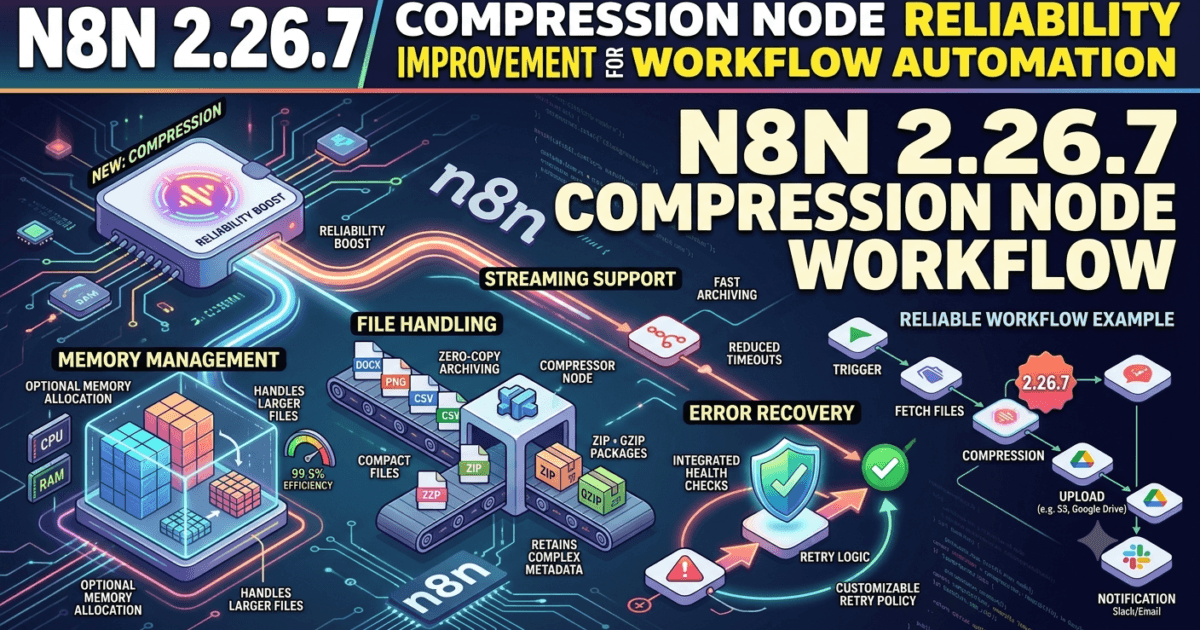
The n8n team has released n8n 2.26.7, a maintenance update focused on improving the behavior of the Compression Node.
At first glance, the release appears small, containing only a single bug fix. However, for organizations that automate file handling, ETL pipelines, document processing, AI workflows, and integration testing, this update resolves an important issue that could affect workflow reliability.
If your automation workflows process ZIP archives, compressed datasets, reports, logs, screenshots, or AI-generated artifacts, this release deserves attention.
What is n8n?
n8n is an open-source workflow automation platform used to connect applications, APIs, databases, cloud services, AI agents, and enterprise systems.
Popular use cases include:
- Test Automation
- API Orchestration
- DevOps Workflows
- Agentic AI Systems
- MCP Integrations
- CI/CD Automation
- Data Engineering Pipelines
- Business Process Automation
Because n8n serves as the orchestration layer for many enterprise systems, even small fixes can have significant downstream impact.
What’s New in n8n 2.26.7?
According to the official release notes:
Compression Node:
Decompress only the archive members
Release Date:
June 18, 2026
Official Release Notes:
https://github.com/n8n-io/n8n/releases/tag/n8n%402.26.7
Understanding the Compression Node Fix
The Compression Node is commonly used to:
- Extract ZIP files
- Process archives
- Handle uploaded documents
- Import datasets
- Unpack generated reports
- Move files between systems
Before this update, decompression behavior could potentially include processing elements beyond the intended archive members.
The new fix ensures that only actual archive members are decompressed.
Conceptually:
Before
Archive
   ↓
Decompression Logic
   ↓
Potentially Broader Processing
After
Archive
   ↓
Archive Members Only
   ↓
Expected Output
This results in more predictable workflow execution.
Why QA Engineers Should Care
Many QA teams now automate file-processing scenarios.
Examples include:
- Download Validation
- Report Verification
- Log Analysis
- Test Artifact Processing
- Build Package Validation
- Performance Test Result Analysis
An issue in archive extraction can cause:
- Failed Tests
- Missing Files
- Incorrect Assertions
- Workflow Errors
- Data Corruption
The n8n 2.26.7 update improves confidence when testing workflows that depend on compressed files.
Impact on Test Automation Teams
Modern automation frameworks often generate ZIP artifacts containing:
- Playwright Reports
- Cypress Results
- Selenium Logs
- k6 Performance Reports
- Locust Statistics
- Test Evidence
Many organizations use n8n to automatically process these artifacts.
A more reliable Compression Node means fewer failures when handling automated test outputs.
Impact on Agentic AI Workflows
AI workflows increasingly exchange compressed datasets.
Examples include:
- RAG Document Bundles
- Training Data Archives
- Generated Reports
- Knowledge Base Exports
- MCP Tool Outputs
When an archive is processed incorrectly, an AI pipeline may:
- Miss Documents
- Produce Incorrect Results
- Fail Retrieval Operations
- Generate Incomplete Responses
The fix in n8n 2.26.7 reduces this risk.
Why This Matters for MCP Integrations
Model Context Protocol (MCP) adoption continues to grow across enterprise environments.
Many MCP workflows exchange:
- Configuration Files
- Documentation Bundles
- Data Archives
- Tool Outputs
Reliable archive extraction is essential for successful MCP orchestration.
This release improves confidence when handling compressed resources inside automation pipelines.
Real-World QA Testing Scenarios
After upgrading to n8n 2.26.7, QA teams should validate:
Compression Testing
✅ ZIP archives
✅ Nested folders
✅ Multiple file types
✅ Large archives
Regression Testing
✅ Existing workflows
✅ Scheduled jobs
✅ Imported workflows
Security Testing
✅ Unexpected file structures
✅ Invalid archives
✅ Corrupted ZIP files
AI Workflow Testing
✅ Document ingestion
✅ RAG pipelines
✅ MCP integrations
✅ Agent workflows
n8n 2.26.7 vs n8n 2.26.6
| Area | n8n 2.26.6 | n8n 2.26.7 |
|---|---|---|
| Compression Handling | Previous Behavior | Improved |
| Archive Processing | Standard | More Predictable |
| Workflow Reliability | Good | Better |
| File Automation | Good | Improved |
| Upgrade Risk | Low | Very Low |
What This Means for Enterprise Automation
Many organizations underestimate the importance of file-processing reliability.
In reality, archives often sit at the center of:
- ETL Pipelines
- CI/CD Systems
- Reporting Platforms
- Data Transfers
- AI Knowledge Pipelines
A single extraction issue can cause failures across multiple downstream systems.
The Compression Node fix improves reliability throughout the automation chain.
Upgrade Guide
Docker
docker pull n8nio/n8n:latest
npm
npm install n8n@latest
Verify Version
n8n --version
Expected output:
2.26.7My QA Assessment of n8n 2.26.7
Biggest Improvement
Compression Node extraction reliability.
Enterprise Impact
Medium.
AI Workflow Impact
Positive.
MCP Impact
Positive.
Breaking Changes
None announced.
Upgrade Risk
Very Low.
Recommendation
Recommended upgrade for organizations processing archives, reports, datasets, and compressed artifacts.
Overall Rating
8.8/10
Why Small File-Processing Fixes Matter More Than They Appear
Maintenance releases are often ignored because they lack flashy features.
However, experienced QA engineers know that production incidents frequently originate from:
- File Handling Errors
- Data Parsing Issues
- Archive Extraction Problems
- Unexpected Edge Cases
A failure in file processing can cascade through an entire automation platform.
For example:
- ZIP extraction fails.
- Data ingestion stops.
- AI workflow receives incomplete data.
- Reports become inaccurate.
- Business processes fail.
The Compression Node fix in n8n 2.26.7 helps eliminate one such risk before it reaches production.
More Relevant Articles
- n8n 2.23.2 Released: Important Workflow Automation Fixes QA Engineers Should Know
- n8n 2.33.4 Released: Improved Task Runner Reliability & AI Fixes
- n8n 2.33.3 Released: Bug Fixes, MCP Improvements & Upgrade Guide
- n8n 2.32.7 Released: Security Audit Improvements Strengthen Enterprise Workflow Automation
- n8n 2.32.6 Released: Smarter Scheduling Improvements Every QA Engineer Should Know
- n8n 2.32.5 Released: Why This Security-Focused Update Matters for QA Engineers and Automation Teams
- n8n 2.31.4 Improves Workflow Stability and Editor Reliability for QA Engineers
- n8n 2.30.8 Strengthens AI Agent Reliability and Workflow Integrity for Enterprise Automation
- n8n 2.30.7 Strengthens Package Security and AWS SES Reliability for Enterprise Workflow Automation
- n8n 2.30.5 Brings Better AI Assistant Analytics, Node Alias Preservation, and Editor Improvements Workflow
External Resources
Official n8n Website: https://n8n.io
Official Documentation: https://docs.n8n.io
GitHub Repository: https://github.com/n8n-io/n8n
n8n 2.26.7 Release Notes: https://github.com/n8n-io/n8n/releases/tag/n8n%402.26.7
Model Context Protocol: https://modelcontextprotocol.io
OWASP File Upload Security: https://cheatsheetseries.owasp.org/cheatsheets/File_Upload_Cheat_Sheet.html
Frequently Asked Questions
What is n8n 2.26.7?
n8n 2.26.7 is a maintenance release that improves Compression Node decompression behavior.
Is this a major release?
No. It is a targeted bug-fix release.
Should organizations upgrade?
Yes. The upgrade risk is very low and the reliability improvement is valuable.
Are there breaking changes?
No breaking changes were announced.
Does this affect AI workflows?
Yes. AI pipelines frequently process compressed files and datasets.
Does this affect MCP integrations?
Yes. MCP workflows often exchange archived resources that require reliable extraction.
Final Thoughts
n8n 2.26.7 may contain only a single bug fix, but it addresses a foundational capability used throughout modern automation platforms: archive processing. By ensuring that the Compression Node decompresses only intended archive members, the release improves workflow reliability, strengthens file-processing behavior, and reduces operational risk.
Organizations using n8n for workflow automation, Agentic AI orchestration, MCP integrations, ETL pipelines, and enterprise automation should consider upgrading during their next maintenance window.