QA
QA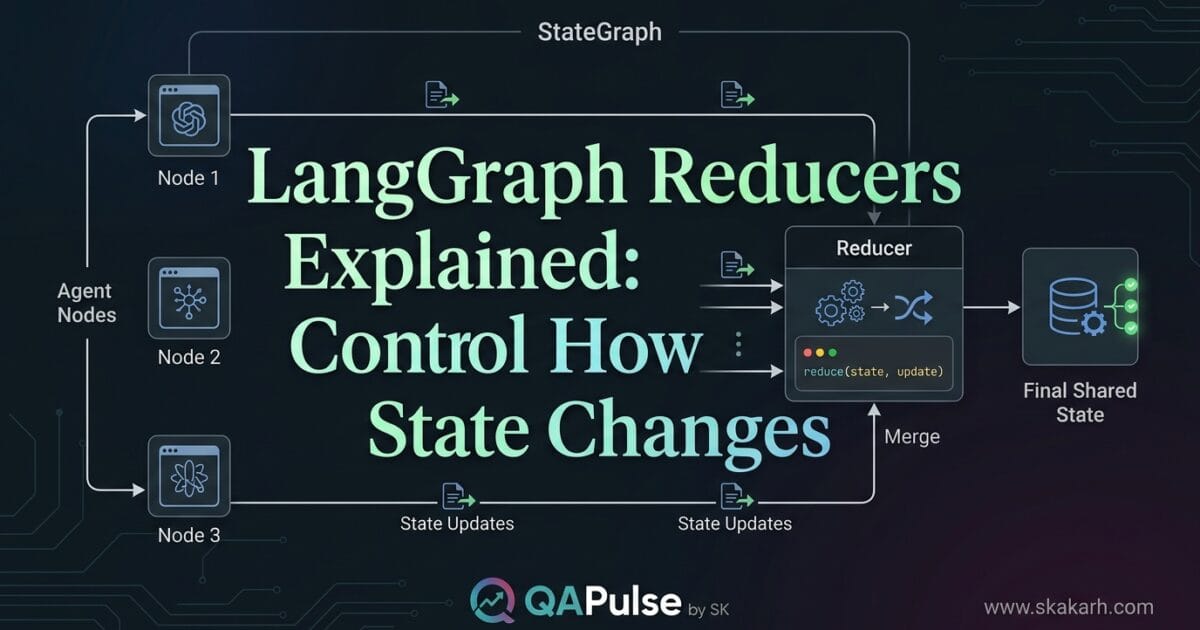
LangGraph Reducers are one of the most important concepts to understand when building reliable stateful AI agents with LangGraph. If you understand nodes but still find state updates, parallel execution, message history, or conflicting writes confusing, reducers are usually the missing piece.
A useful way to think about them is simple:
A LangGraph node produces a state update. A reducer decides how that update is combined with the existing state.
That distinction becomes extremely important once a graph has multiple nodes writing to the same state field.
What are LangGraph Reducers?
In a simple LangGraph workflow, a node can return a dictionary containing new state values:
from typing_extensions import TypedDict
from langgraph.graph import StateGraph, START, END


class State(TypedDict):
    question: str
    answer: str


def generate_answer(state: State):
    return {
        "answer": f"Answering: {state['question']}"
    }


builder = StateGraph(State)

builder.add_node("generate_answer", generate_answer)

builder.add_edge(START, "generate_answer")
builder.add_edge("generate_answer", END)

graph = builder.compile()
Here, the node returns:
{
    "answer": "Answering: ..."
}
LangGraph can update the answer field directly because there is no complicated merge strategy involved.
But consider a more realistic agent.
You might have:
User Request
     ↓
Research Agent
     ↓
 ┌───────────────┐
 ↓               ↓
Web Research   Documentation Research
 ↓               ↓
 └───────┬───────┘
         ↓
    Synthesis Agent
Both research nodes may produce information that needs to be stored in the same state field.
Now the question changes:
What should happen when two nodes update the same field?
That is where LangGraph reducers become strategically important.


Why LangGraph Reducers Matter in Agent Workflows
Without a deliberate merge strategy, you cannot assume that multiple state updates should simply be appended together.
Imagine this state:
class State(TypedDict):
    findings: list[str]
One node returns:
{
    "findings": ["Login API is slow"]
}
Another returns:
{
    "findings": ["Authentication token expires after 30 minutes"]
}
If both nodes contribute to the same findings field, the desired result might be:
[
    "Login API is slow",
    "Authentication token expires after 30 minutes"
]
You need a rule that tells the graph how those values should be combined.
That rule is the reducer.
A reducer therefore acts like a state merge policy.
This is particularly important for AI agents because modern agent architectures frequently contain:
- parallel research agents
- tool-calling nodes
- planner/executor workflows
- human approval nodes
- message histories
- validation agents
- memory
- multi-agent collaboration
As the graph becomes more concurrent, state merging becomes a design problem rather than an implementation detail.
The Simplest Reducer: Append Values
Python’s operator.add is a convenient way to express list concatenation.
import operator
from typing import Annotated
from typing_extensions import TypedDict


class State(TypedDict):
    findings: Annotated[list[str], operator.add]
Now the findings field has an explicit merge behavior.
If one update contains:
{
    "findings": ["Finding A"]
}
and another contains:
{
    "findings": ["Finding B"]
}
the reducer conceptually combines them as:
["Finding A"] + ["Finding B"]
producing:
[
    "Finding A",
    "Finding B"
]
This is much more useful than treating every state field as if it were a simple variable assignment.
Assignment vs Reduction
This distinction is worth remembering.
| Behavior | Normal State Update | Reducer-Based Update |
|---|---|---|
| Basic assignment | New value replaces old value | New value is merged |
| Multiple writers | Can create conflicts | Defines merge behavior |
| Lists | Usually replace unless configured otherwise | Can append/merge |
| Parallel workflows | Requires careful handling | Explicit merge strategy |
| Message history | Needs specialized handling | Can use message-aware reducer |
| Agent collaboration | Limited | Better suited to accumulating results |
Think of a normal state field as:
state["status"] = new_status
Whereas a reducer-based field behaves more like:
state["findings"] = merge(
    state["findings"],
    new_findings
)
The important word is merge.
A Practical QA Example
Suppose you are building an AI-powered test analysis graph.
Three agents independently analyze a failed test:
             Failed Test
                  │
       ┌──────────┼──────────┐
       ↓          ↓          ↓
   Log Agent   API Agent   UI Agent
       │          │          │
       └──────────┼──────────┘
                  ↓
            Root Cause Agent
Each agent could produce findings:
def analyze_logs(state):
    return {
        "findings": ["Timeout occurred in checkout service"]
    }


def analyze_api(state):
    return {
        "findings": ["Checkout API returned HTTP 504"]
    }


def analyze_ui(state):
    return {
        "findings": ["Checkout button remained in loading state"]
    }
Your state can define:
import operator
from typing import Annotated
from typing_extensions import TypedDict


class TestAnalysisState(TypedDict):
    test_name: str
    findings: Annotated[list[str], operator.add]
Now the graph has a clear contract:
Every analysis node contributes findings rather than replacing the findings produced by another node.
That is exactly the kind of state behavior you want in an AI-powered QA workflow.
LangGraph Reducers vs Ordinary Python Assignment
It is tempting to think that reducers are simply a fancy way of manipulating Python dictionaries.
They are more important than that.
Consider ordinary Python:
findings = []

findings = ["API failed"]
findings = ["UI failed"]
The second assignment replaces the first value.
With a merge strategy:
findings = ["API failed"]

findings = findings + ["UI failed"]
you preserve both pieces of information.
The difference becomes significant when the updates originate from different graph nodes rather than from two statements executed sequentially in one function.
Think in Terms of State Ownership
A useful design question for every LangGraph state field is:
Who is allowed to write this field, and what should happen if several nodes write it?
For example:
| State Field | Possible Writers | Recommended Strategy |
|---|---|---|
user_query | Input node | Replace |
current_plan | Planner | Replace |
findings | Multiple agents | Accumulate |
errors | Multiple validation nodes | Accumulate |
messages | Conversation nodes | Message-aware merge |
status | Workflow controller | Replace |
metrics | Multiple measurement nodes | Custom merge |
This simple design exercise can prevent many state-management problems.
Custom Reducers Give You More Control
You are not limited to operator.add.
Suppose you want to avoid duplicate findings.
You could create a custom reducer:
from typing import Annotated
from typing_extensions import TypedDict


def merge_unique(
    existing: list[str],
    incoming: list[str]
) -> list[str]:
    return list(dict.fromkeys(existing + incoming))


class State(TypedDict):
    findings: Annotated[list[str], merge_unique]
Now:
existing = [
    "API returned 500"
]

incoming = [
    "API returned 500",
    "Database timeout"
]
can become:
[
    "API returned 500",
    "Database timeout"
]
This illustrates an important engineering principle:
The reducer should represent the business meaning of the state, not merely the data type.
If duplicate findings are meaningful, append them.
If duplicates are noise, deduplicate them.
If values need to be prioritized, sort or rank them.
If state represents counters, addition may make sense.
If state represents configuration, replacement may be correct.
A Reducer Is Not Automatically the Right Choice
One of the mistakes developers make is assuming that every list should use an accumulating reducer.
That can create subtle bugs.
For example:
class State(TypedDict):
    selected_environment: Annotated[list[str], operator.add]
If the intended behavior is:
["staging"]
then later:
["production"]
should replace the environment rather than produce:
["staging", "production"]
The data type alone does not tell you the correct state semantics.
The question is:
What does this field represent?
If it represents a collection of independent contributions, accumulation makes sense.
If it represents the current value of something, replacement may be correct.
LangGraph Reducers and Message State
One of the most important real-world applications is conversation state.
AI agents frequently maintain:
messages
A naïve list merge is not always enough because messages have structure, identities, roles, and update semantics.
For example:
Human → "Investigate this API failure"
AI    → "I'll inspect the logs."
Tool  → "HTTP 500 returned"
AI    → "The database appears unavailable."
A message-aware state strategy can understand that these are structured messages rather than arbitrary strings.
This is why LangGraph provides message-oriented state handling rather than expecting developers to reinvent conversation merging.
A simplified state might look like:
from typing import Annotated
from typing_extensions import TypedDict
from langgraph.graph.message import add_messages


class State(TypedDict):
    messages: Annotated[list, add_messages]
The key lesson for SDETs is that message state deserves different testing from ordinary list state.
You should test:
- message ordering
- duplicate messages
- message IDs
- updates
- tool messages
- AI messages
- human messages
- concurrent message production
Interactive Check: Which Reducer Would You Choose?
Imagine three nodes produce these updates:
Node A:
{"errors": ["API timeout"]}

Node B:
{"errors": ["Database unavailable"]}

Node C:
{"errors": ["API timeout"]}
Ask yourself:
Should the final state contain two errors or three?
There is no universally correct answer.
If every occurrence matters:
[
    "API timeout",
    "Database unavailable",
    "API timeout"
]
may be correct.
If the field represents unique root causes:
[
    "API timeout",
    "Database unavailable"
]
may be better.
This is why reducer design belongs in architecture discussions, not merely syntax tutorials.
Testing LangGraph Reducers Like an SDET
Reducers themselves should be tested.
A useful test matrix might look like this:
| Scenario | Expected Result |
|---|---|
| One update | Correct state |
| Two updates | Both merged correctly |
| Empty incoming list | Existing state preserved |
| Empty existing list | Incoming state accepted |
| Duplicate values | Defined duplicate behavior |
| Parallel writers | Deterministic expected behavior |
| Invalid value | Validation/error behavior |
| Large state | Acceptable performance |
| Message updates | Correct message semantics |
For example:
def test_merge_unique():
    existing = ["API timeout"]
    incoming = ["API timeout", "Database unavailable"]

    result = merge_unique(existing, incoming)

    assert result == [
        "API timeout",
        "Database unavailable"
    ]
This is a small test, but it protects an important state contract.
The Strategic Difference: State Storage vs State Semantics
A beginner often asks:
“How do I store this value in LangGraph?”
An experienced engineer asks:
“What does this value mean, who can modify it, and how should competing updates be resolved?”
That second question is where robust agent architecture begins.
A reducer gives you a formal place to encode that decision.
Instead of allowing state behavior to emerge accidentally from node execution, you explicitly define how updates should interact.
For AI agents, that makes the workflow easier to reason about, test, debug, and evolve.


A Practical Design Rule for LangGraph Reducers
Before adding a reducer to a field, answer these four questions:
- Who writes this field?
- Can multiple nodes write it during the same workflow step?
- Should a new value replace or merge with the existing value?
- If values are merged, what does “correct merge” actually mean?
If you cannot answer those questions, adding operator.add simply because the field is a list is premature.
The strongest LangGraph designs treat state as a contract.
That contract tells every node what information exists and tells the graph how competing updates should be reconciled.
For QA and SDET teams, this creates another valuable testing boundary: test the state contract independently from the agent’s reasoning.
An agent may produce a perfectly reasonable result, but if the reducer merges that result incorrectly, the final workflow can still be wrong.
Building Reliable LangGraph Reducers for Parallel and Multi-Agent Workflows
The real value of LangGraph reducers appears when a graph becomes concurrent, stateful, and multi-agent. A single-node workflow can often get away with straightforward state replacement. A production agent usually cannot.
Consider a QA investigation workflow in which three agents independently inspect the same failure:
                    Failed Test
                        │
          ┌─────────────┼─────────────┐
          ↓             ↓             ↓
      Log Agent      API Agent     Browser Agent
          │             │             │
          └─────────────┼─────────────┘
                        ↓
                 Root Cause Agent
                        ↓
                 Final QA Report
Each agent may discover different evidence. If all three write to findings, the graph needs a predictable way to combine those updates.
That is where LangGraph reducers become an architectural tool rather than merely a syntax feature.
Designing State Around Reducer Semantics
A strong state definition starts by deciding what each field means.
For example:
import operator
from typing import Annotated
from typing_extensions import TypedDict


class QAState(TypedDict):
    test_name: str
    findings: Annotated[list[str], operator.add]
    status: str
Here, findings represents independent contributions from different nodes, while status represents the current workflow state.
Those two fields therefore need different update semantics.
| State field | Meaning | Typical behavior |
|---|---|---|
test_name | Current test being analyzed | Replace |
status | Current workflow status | Replace |
findings | Evidence collected by agents | Merge |
errors | Errors discovered by validators | Merge |
messages | Conversation history | Message-aware merge |
current_plan | Latest execution plan | Replace |
metrics | Aggregated measurements | Custom merge |
This distinction prevents a common architectural mistake: choosing a reducer based only on the Python data type.
A list does not automatically mean append.
The business meaning of the field determines the correct reducer.
Parallel Nodes Are Where State Design Gets Serious
Suppose the graph contains three independent analysis nodes:
def analyze_logs(state: QAState):
    return {
        "findings": [
            "Checkout service returned a timeout"
        ]
    }


def analyze_api(state: QAState):
    return {
        "findings": [
            "Checkout API returned HTTP 504"
        ]
    }


def analyze_browser(state: QAState):
    return {
        "findings": [
            "Checkout page remained in loading state"
        ]
    }
With:
class QAState(TypedDict):
    findings: Annotated[list[str], operator.add]
the graph can treat each result as a contribution.
Conceptually:
Existing state
      │
      ├── Log finding
      ├── API finding
      └── Browser finding
             │
             ↓
       Reducer combines
             │
             ↓
       Updated findings
The important point is that the nodes do not need to know about each other’s output.
That separation is valuable in multi-agent architectures.
The Log Agent focuses on logs.
The API Agent focuses on API evidence.
The Browser Agent focuses on UI evidence.
The reducer is responsible for the state-merging contract.
Why operator.add Is Useful but Not Universal
For lists, operator.add is convenient:
from typing import Annotated
import operator

findings: Annotated[list[str], operator.add]
But blindly applying it can produce incorrect application behavior.
Imagine:
class State(TypedDict):
    environment: Annotated[list[str], operator.add]
One node returns:
{"environment": ["staging"]}
Another returns:
{"environment": ["production"]}
Appending them produces:
["staging", "production"]
But perhaps your workflow should have exactly one active environment.
In that case, replacement is more appropriate:
class State(TypedDict):
    environment: str
with:
return {
    "environment": "production"
}
The lesson is simple:
Use a reducer when the state represents accumulated information, not simply because the underlying value happens to be a list.
Custom Reducers for Production-Grade State
Real applications often need more sophisticated merging.
Suppose multiple agents can discover the same root cause.
A simple append operation could generate:
[
    "Database timeout",
    "API timeout",
    "Database timeout"
]
If your reporting system expects unique findings, define that behavior explicitly.
from typing import Annotated
from typing_extensions import TypedDict


def merge_unique(
    existing: list[str],
    incoming: list[str]
) -> list[str]:
    return list(dict.fromkeys(existing + incoming))


class QAState(TypedDict):
    findings: Annotated[list[str], merge_unique]
Now the state contract expresses the actual business requirement.
existing = [
    "Database timeout"
]

incoming = [
    "API timeout",
    "Database timeout"
]
Result:
[
    "Database timeout",
    "API timeout"
]
This is considerably more intentional than simply accumulating everything.
Reducer Design Should Consider Ordering
Deduplication is only one consideration.
Ordering can matter too.
Suppose an agent produces:
[
    "Request sent",
    "Response received",
    "Database query failed"
]
Another agent produces:
[
    "Authentication succeeded"
]
If the final analysis depends on chronological ordering, a basic list concatenation may not represent the true event sequence.
In that situation, a reducer may need to merge structured records rather than plain strings.
For example:
from dataclasses import dataclass


@dataclass
class Finding:
    timestamp: float
    source: str
    message: str
A custom reducer could then merge and sort findings according to timestamp.
This illustrates an important engineering principle:
The richer the state semantics, the more carefully the reducer should model those semantics.
LangGraph Reducers vs Other State-Merging Approaches
It is useful to understand how this compares with conventional application architectures.
| Approach | State Merge | Parallel Workflows | AI Agent State | Explicit Merge Rules |
|---|---|---|---|---|
| Plain Python assignment | Replace | Weak | Limited | No |
| Dictionary update | Replace by key | Limited | Limited | No |
| Database transaction | Transaction-dependent | Strong | Possible | Yes |
| Redux-style reducers | Explicit | Strong | Possible | Yes |
| LangGraph reducers | Graph-state aware | Strong | Strong | Yes |
| Message-specific state handling | Structured | Strong | Excellent for conversations | Yes |
The key advantage is that the merge behavior becomes part of the graph’s state model.
That gives developers a clear contract instead of scattering merge logic across individual nodes.
Testing Reducers Independently
If a reducer affects production behavior, it deserves its own tests.
For example:
def test_merge_unique():
    existing = [
        "API timeout"
    ]

    incoming = [
        "API timeout",
        "Database unavailable"
    ]

    result = merge_unique(existing, incoming)

    assert result == [
        "API timeout",
        "Database unavailable"
    ]
But a production test suite should go further.
def test_merge_unique_empty_existing():
    assert merge_unique(
        [],
        ["API timeout"]
    ) == ["API timeout"]


def test_merge_unique_empty_incoming():
    assert merge_unique(
        ["API timeout"],
        []
    ) == ["API timeout"]


def test_merge_unique_multiple_duplicates():
    assert merge_unique(
        ["API timeout"],
        ["API timeout", "API timeout"]
    ) == ["API timeout"]
For an SDET, these tests are valuable because they turn state behavior into an executable contract.
Test Parallel State Updates, Not Just Individual Nodes
Testing each node independently is not enough.
Imagine:
def test_log_agent():
    ...


def test_api_agent():
    ...
Both tests can pass while the complete graph still produces an incorrect final state.
You also need an integration test around the state transition:
def test_parallel_findings_are_combined():
    result = graph.invoke({
        "test_name": "checkout_should_complete",
        "findings": [],
        "status": "investigating"
    })

    assert "Checkout service returned a timeout" in result["findings"]
    assert "Checkout API returned HTTP 504" in result["findings"]
The test is now checking the actual contract:
Multiple node outputs
        ↓
     Reducer
        ↓
Final state
That is the level at which reducer bugs become visible.

Testing Conflict Scenarios
One of the most valuable tests is a conflict test.
Imagine two agents return contradictory information:
Agent A:
{
    "status": "healthy"
}

Agent B:
{
    "status": "failed"
}
If status is a normal state field, what should happen?
You cannot answer that from Python syntax alone.
Your application needs a policy.
Possible strategies include:
Latest value wins
First value wins
Failure wins
Priority-based selection
Manual review required
Merge into a collection
For example, if the state represents production health, a safer business rule might be:
def merge_status(existing: str, incoming: str) -> str:
    if "failed" in {existing, incoming}:
        return "failed"

    return incoming
Then:
merge_status("healthy", "failed")
produces:
failed
This demonstrates why LangGraph reducers can encode business rules rather than simply concatenate values.
Reducers and AI Agent Reliability
AI agents introduce another layer of uncertainty.
A model might produce an incomplete, duplicated, or contradictory result.
For example:
Agent 1:
"Authentication failed."

Agent 2:
"Authentication succeeded."

Agent 3:
"Authentication token expired."
The reducer cannot determine the truth merely by merging strings.
This is an important architectural boundary.
A reducer should generally be responsible for state combination, while a validation or reasoning node should determine whether the combined evidence supports a conclusion.
A robust architecture might therefore look like:
Agent outputs
     ↓
Reducer
     ↓
Combined evidence
     ↓
Validation Agent
     ↓
Validated conclusion
Do not turn the reducer into an enormous business-logic engine simply because multiple nodes can write to the same field.
Keep responsibilities clear.
Reducers and QA Test Evidence
This architecture becomes especially powerful for AI-powered QA.
Imagine a test-analysis graph with:
class QAState(TypedDict):
    findings: Annotated[list[str], merge_unique]
    screenshots: Annotated[list[str], operator.add]
    logs: Annotated[list[str], operator.add]
    api_errors: Annotated[list[str], merge_unique]
    root_cause: str
    confidence: float
Different agents can contribute evidence:
Browser Agent
    ↓
screenshots

Log Agent
    ↓
logs

API Agent
    ↓
api_errors

All analysis agents
    ↓
findings

Root Cause Agent
    ↓
root_cause

Confidence Evaluator
    ↓
confidence
This creates a clean separation between:
Evidence collection
and
Conclusion generation
That separation is extremely useful when building trustworthy AI testing systems.
A Reducer Testing Matrix for SDETs
Before considering a state design production-ready, test at least these scenarios:
| Scenario | What to Verify |
|---|---|
| Single writer | State is updated correctly |
| Multiple writers | Contributions are merged correctly |
| Empty update | Existing state behaves correctly |
| Duplicate update | Duplicate policy works |
| Conflicting values | Conflict policy works |
| Parallel execution | Final state remains valid |
| Large state | Performance remains acceptable |
| Invalid input | Failure behavior is predictable |
| Retry | Duplicate or repeated writes behave correctly |
| Agent failure | Partial state does not corrupt the workflow |
The retry case is particularly important.
Suppose an agent executes successfully but the workflow retries the node.
Without careful state semantics, you could accidentally accumulate:
[
    "API timeout",
    "API timeout",
    "API timeout"
]
A reducer that understands uniqueness can protect the state from this kind of duplication.
Common Reducer Mistakes
Using operator.add Everywhere
This is probably the easiest mistake to make.
A field being a list does not automatically mean it should accumulate.
Ask:
Is this field history, evidence, configuration, or current state?
The answer determines the update strategy.
Putting Too Much Logic Inside the Reducer
A reducer should not become a miniature workflow engine.
Bad architecture:
Reducer
 ├── validates API response
 ├── calls database
 ├── invokes LLM
 ├── calculates confidence
 └── merges state
Better architecture:
Nodes
 ↓
Validation
 ↓
Reducer
 ↓
State
Keep the reducer focused.
Forgetting Retry Behavior
AI workflows often retry tools and model calls.
Always ask:
What happens if the same update arrives twice?
That question can expose serious state bugs before production.
Testing Only the Happy Path
A reducer can appear correct when tested with:
["A"] + ["B"]
but fail with:
[] + ["A"]
or:
["A"] + []
or:
["A"] + ["A"]
or concurrent/conflicting updates.
State tests should intentionally include those cases.
A Practical Reducer Checklist
Before committing a state design, walk through this checklist:
[ ] What does this state field represent?
[ ] Who can write it?
[ ] Can multiple nodes write it?
[ ] Should updates replace or merge?
[ ] Can updates arrive more than once?
[ ] Can values conflict?
[ ] Does ordering matter?
[ ] Are duplicates allowed?
[ ] Does retry change the result?
[ ] Can the reducer be unit tested?
[ ] Can the complete graph be integration tested?
[ ] Is the merge behavior deterministic?
If you can answer all twelve questions, your state model is much easier to reason about.
LangGraph Reducers Are a State Contract
The most important conceptual shift is to stop thinking about a reducer as a small Python function attached to a field.
It is better understood as a state contract.
That contract answers:
“When another part of this graph produces a value for this field, how should that value interact with what already exists?”
Once you think about reducers this way, parallel agents become easier to design.
Your nodes can remain focused.
Your state remains explicit.
Your merge behavior becomes testable.
And your QA strategy gains a precise boundary for validating state transitions.
For AI agents, this is particularly important because correctness is not determined only by whether an individual node produces a good answer. The final result depends on how information from multiple nodes is combined.
LangGraph Reducers vs Other State Management Patterns
| Pattern | Main Idea | Best Use |
|---|---|---|
| LangGraph reducer | Defines how state updates combine | Stateful agent graphs |
| Direct assignment | Replace existing value | Single authoritative state |
| Python list append | Mutate a local collection | Simple local logic |
| Database update | Persist external state | Durable application data |
| Event sourcing | Store state changes as events | Audit/history-heavy systems |
Internal Links
- Learn MCP – Zero to Hero
- Learn AI Agents for QA – Zero to Hero
- Playwright Automation – Zero to Hero
- TencentDB Agent Memory: Complete Zero to Hero
- LangGraph: Complete Zero to Hero
- Learn Python – Zero to Hero
- OpenAI Codex: Complete Zero to Hero
- Cursor AI: Complete Zero to Hero
- Claude Code Tutorial: Complete Zero to Hero
- AutoGen: Complete Zero to Hero Guide
- Free QA Resources Built From Real Experience
- QA Glossary: Test Automation Terms Every Engineer Should Know
External Links
- LangGraph Documentation
- LangGraph GitHub Repository
- Python `typing.Annotated` Documentation
- LangChain Documentation
People Asked Questions
What are LangGraph Reducers?
LangGraph reducers define how updates to a shared state field are combined when graph nodes return new values.
Why are reducers needed in LangGraph?
Reducers are useful when multiple nodes can update the same state field and those updates need to be merged rather than simply replacing the existing value.
How do reducers work in LangGraph?
A reducer receives the existing state value and a new update and determines the resulting value stored in the graph state.
What is Annotated used for with LangGraph reducers?
Annotated can associate a state field with reducer metadata so LangGraph knows how updates to that field should be combined.
Can LangGraph reducers handle lists?
Yes. A reducer can define list-accumulation behavior, allowing updates from different nodes to be combined instead of replacing the existing list.
Can I create a custom reducer in LangGraph?
Yes. Custom reducer functions can implement application-specific state-merging behavior.
Do LangGraph reducers matter for parallel nodes?
Yes. Reducers become particularly important when multiple nodes can produce updates to the same state field during graph execution.
What is the difference between a reducer and normal state assignment in LangGraph?
Normal state assignment generally replaces the field’s current value, while a reducer defines how the existing value and new update are combined.
AI Overview Optimization
LangGraph reducers control how state updates are combined inside a LangGraph workflow. Instead of automatically treating every new value as a replacement, a reducer can define merge behavior for fields that receive updates from multiple nodes. This is especially useful for accumulated results, messages, and parallel agent workflows.
LangGraph reducer = existing state + new update → reducer-defined final state
Conclusion
LangGraph reducers become increasingly important as an agent moves from a simple sequential workflow to a parallel, stateful, multi-agent system.
The key lesson is not simply how to write:
Annotated[list[str], operator.add]
The important question is why that merge behavior is correct for your application.
A reliable LangGraph architecture separates responsibilities:
Node
 ↓
Produces state update
 ↓
Reducer
 ↓
Combines state
 ↓
Validation
 ↓
Final decision
For QA engineers and SDETs, this creates a powerful testing strategy. Test individual nodes, but also test the state contract that connects them. Validate duplicates, conflicts, retries, empty updates, parallel execution, and failure scenarios.
The goal is not merely to make the graph execute.
The goal is to make its state transitions predictable, explainable, and testable.
Final Key Takeaways
- LangGraph reducers define how state updates are combined.
- A reducer should reflect the meaning of the state, not merely its Python data type.
operator.addis useful for accumulating independent list contributions but should not be applied blindly.- Custom reducers are valuable when you need deduplication, prioritization, ordering, or domain-specific merge behavior.
- Parallel agent workflows make explicit state-merging rules significantly more important.
- Message state often requires message-aware handling rather than generic list concatenation.
- Reducers should remain focused on state combination rather than becoming complex workflow engines.
- Always test duplicate updates, conflicting values, empty updates, retries, and parallel execution.
- Unit testing the reducer is useful, but integration testing the complete graph is essential.
- AI-generated evidence should be validated after it has been merged into state.
- The strongest agent architectures treat state and its reducer behavior as an explicit contract.
- For SDETs, state-transition testing is just as important as testing individual agent nodes.
A reliable AI workflow is not only about what each agent produces. It is about whether the system combines those results correctly.
Continue Learning
Explore more expert articles on Mobile Testing, Backend & API, AI & Agentic, AI Tools, n8n, LangChain, CrewAI, MCP Servers, AI Agents, LlamaIndex, Docker, FastAPI, Playwright, Cypress, Test Automation, DevOps, and Software Engineering at www.skakarh.com.
QAPulse by SK delivers expert release analysis, AI engineering insights, enterprise automation strategies, migration guidance, DevOps best practices, and practical testing knowledge to help software professionals build scalable, intelligent, and production-ready software systems.