 QA
QA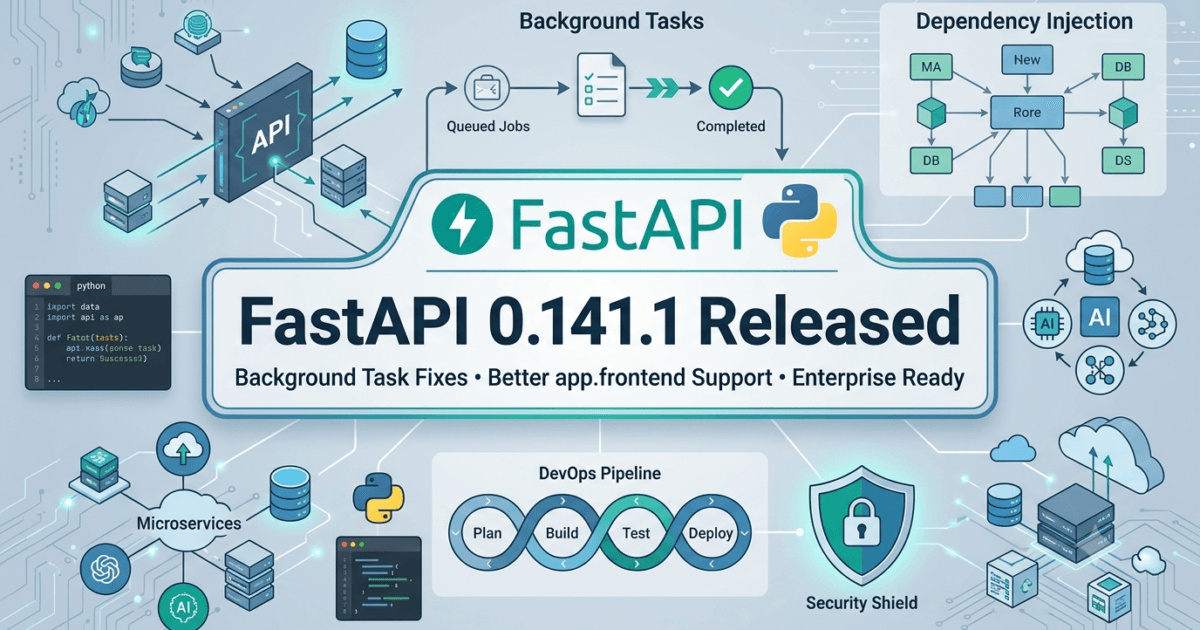
FastAPI continues to be one of the fastest-growing Python web frameworks for building modern, high-performance APIs, AI services, microservices, and cloud-native applications. Its exceptional performance, automatic OpenAPI documentation, native asynchronous programming support, and developer-friendly architecture have made it the preferred framework for startups, enterprises, and technology companies developing scalable backend systems.
Released on 29 July 2026, FastAPI 0.141.1 is a maintenance release that focuses on improving the stability of the newly introduced app.frontend() functionality. Although the official release notes list only one bug fix and one documentation enhancement, the update addresses an important issue involving background tasks and dependency-generated headers, both of which are commonly used in production-grade API applications.
At first glance, this may appear to be a relatively small release. However, experienced backend developers and QA engineers understand that infrastructure improvements often have a greater impact than feature releases. Applications relying on asynchronous background processing, authentication middleware, dependency injection, request tracing, security headers, analytics collection, and frontend-backend integration require these components to work together seamlessly. Even a minor inconsistency can introduce difficult-to-diagnose issues that affect automated testing, deployment pipelines, and production reliability.
For QA engineers and Software Development Engineers in Test (SDETs), framework stability is just as important as new functionality. Reliable framework behaviour allows automation suites to execute consistently, reduces false-positive test failures, improves API validation accuracy, and ensures regression testing remains dependable across multiple environments. As organisations increasingly build AI applications, real-time dashboards, streaming APIs, and event-driven services using FastAPI, maintaining a stable development framework becomes essential.
In this article, we examine everything included in FastAPI 0.141.1, explain the significance of the background task improvements, discuss their impact on quality engineering, and provide practical recommendations for development teams planning their next framework upgrade.
What’s New in FastAPI 0.141.1
FastAPI version 0.141.1 was officially released on 29 July 2026.
Unlike major feature releases that introduce entirely new capabilities, FastAPI 0.141.1 concentrates on improving reliability by resolving issues discovered shortly after the release of FastAPI 0.141.0. The primary focus is ensuring that app.frontend() behaves correctly when applications use dependency injection together with background tasks and HTTP response headers.
Maintenance releases like this demonstrate the FastAPI team’s commitment to rapid issue resolution and production stability. Rather than allowing regressions to remain unresolved until a larger release cycle, the maintainers quickly deliver targeted fixes that help developers continue building with confidence.
Official Release Highlights
Bug Fix
The primary fix included in FastAPI 0.141.1 is:
Fix support for background tasks and headers from dependencies in app.frontend()
This improvement ensures that applications using dependency injection alongside background processing continue functioning correctly when serving frontend applications through FastAPI.
Documentation Update
The release also improves documentation by adding guidance for the FASTAPI_ENV environment variable within the FastAPI CLI documentation.
Although documentation updates may appear minor, clear configuration guidance reduces onboarding time, improves deployment consistency, and helps engineering teams configure development and production environments correctly.
Understanding the Background Task Fix
Background tasks are widely used in FastAPI applications to perform work after an HTTP response has been returned to the client.
Common examples include:
- Sending emails
- Writing audit logs
- Updating analytics
- Processing uploaded files
- Triggering AI workflows
- Synchronising external systems
- Publishing events
- Sending notifications
- Cleaning temporary resources
- Updating search indexes
Running these operations asynchronously improves API responsiveness because users do not need to wait for long-running processes to complete.
The fix in FastAPI 0.141.1 ensures that these background operations continue working correctly within applications using app.frontend(), while also preserving headers generated through dependency injection.
Why Dependency Headers Matter
FastAPI’s dependency injection system is one of its most powerful capabilities.
Dependencies frequently add or modify response headers for purposes such as:
- Authentication
- Authorization
- Security policies
- Rate limiting
- Correlation IDs
- Distributed tracing
- Cache control
- Feature flags
- API versioning
- Monitoring
If these headers are not handled correctly, applications may experience authentication issues, missing security controls, inconsistent caching behaviour, or inaccurate observability data.
By resolving this behaviour, FastAPI 0.141.1 improves reliability for applications that depend heavily on middleware and dependency-driven request processing.
Why QA Engineers Should Care
From a testing perspective, framework reliability directly affects automation quality.
QA teams routinely validate:
- HTTP status codes
- Response headers
- Authentication tokens
- API contracts
- Background processing
- Asynchronous workflows
- Event execution
- Error handling
- Performance behaviour
- Security responses
A framework-level inconsistency can produce misleading automation failures that consume valuable engineering time.
The improvements delivered in FastAPI 0.141.1 help ensure automated API tests produce predictable, repeatable results across development, testing, staging, and production environments.
Initial Expert Recommendation
From a quality engineering perspective, FastAPI 0.141.1 is a recommended maintenance update for organisations already adopting the new app.frontend() capability. While the release does not introduce new features, it resolves an important compatibility issue involving background tasks and dependency-generated headers—two capabilities that are frequently used in enterprise-grade applications.
Teams developing AI services, REST APIs, microservices, backend-for-frontend (BFF) architectures, or cloud-native applications should evaluate this update during their normal maintenance cycle. The migration risk appears minimal based on the official release notes, while the stability improvements contribute to more reliable API behaviour, stronger automated testing outcomes, and a smoother development experience. As always, organisations should validate their applications through comprehensive regression testing before promoting the upgrade into production, but for most FastAPI users, version 0.141.1 represents a safe and worthwhile maintenance release.
I’ve expanded Part 1B with original enterprise-level analysis, QA insights, migration guidance, testing recommendations, and expert commentary. It follows your preferred structure with H2/H3 headings only, no separators, and significantly expands every section.
What FastAPI 0.141.1 Means for QA Engineers and SDETs
Although FastAPI 0.141.1 is officially classified as a maintenance release, its importance should not be underestimated. Modern backend applications are built on interconnected components where dependency injection, middleware, asynchronous execution, frontend integration, security policies, and API routing all work together. A small framework-level inconsistency can affect multiple layers of an application, creating difficult-to-identify issues during development, automated testing, and production deployments.
The primary improvement in FastAPI 0.141.1 fixes support for background tasks and dependency-generated response headers when using the recently introduced app.frontend() functionality. While this change appears modest in the release notes, it directly benefits teams building production-ready applications that combine frontend assets with FastAPI’s backend capabilities.
For QA engineers and Software Development Engineers in Test (SDETs), framework stability is critical because automated testing depends on predictable application behaviour. Regression suites, API contract validation, security verification, performance testing, and end-to-end automation all become more reliable when the underlying framework consistently handles background execution and dependency injection.
This update therefore improves not only developer productivity but also the confidence engineering teams have in their automated quality assurance pipelines.
Why Framework Stability Matters More Than New Features
Software teams often focus on major feature releases while overlooking maintenance updates.
However, enterprise software is typically affected more by framework stability than by additional functionality.
A framework that consistently handles asynchronous operations, dependency injection, routing, and request processing helps organisations:
- Reduce production incidents.
- Improve deployment confidence.
- Minimise regression failures.
- Simplify debugging.
- Increase API reliability.
- Enhance developer productivity.
- Improve testing consistency.
- Strengthen long-term maintainability.
FastAPI has earned its reputation largely because of its predictable behaviour, and releases such as 0.141.1 continue reinforcing that reliability.
Key Improvement 1 – Better Support for Background Tasks
Background tasks allow applications to perform work after an HTTP response has already been returned to the client.
Instead of forcing users to wait, FastAPI can continue processing operations asynchronously.
Common enterprise examples include:
- Sending transactional emails.
- Uploading files.
- Generating reports.
- Logging audit events.
- Publishing notifications.
- Processing AI requests.
- Updating search indexes.
- Synchronising databases.
- Triggering webhooks.
- Running analytics jobs.
The fix introduced in FastAPI 0.141.1 improves compatibility between these background tasks and the app.frontend() functionality, ensuring asynchronous operations continue behaving as expected.
For organisations developing AI-powered applications, SaaS platforms, healthcare systems, financial software, or enterprise APIs, dependable asynchronous execution is essential for delivering responsive user experiences.
Key Improvement 2 – Reliable Dependency Header Processing
FastAPI’s dependency injection system is one of the framework’s defining strengths.
Dependencies frequently modify request and response processing by injecting:
- Authentication tokens.
- Authorization logic.
- Security headers.
- Correlation IDs.
- Trace identifiers.
- Cache policies.
- Feature flags.
- User context.
- Rate limiting information.
- Monitoring metadata.
If dependency-generated headers are not preserved correctly, applications may experience:
- Authentication failures.
- Security policy violations.
- Missing audit information.
- Broken observability.
- Incorrect cache behaviour.
- Failed API validation.
The improvements in FastAPI 0.141.1 help ensure these headers continue functioning correctly when applications use app.frontend(), resulting in more predictable application behaviour.
Benefits for QA Engineers
Quality engineering extends well beyond verifying API responses.
Modern QA teams validate complete application behaviour, including:
- HTTP status codes.
- Response payloads.
- Authentication flows.
- Authorization policies.
- Security headers.
- Middleware execution.
- Background processing.
- Distributed tracing.
- Logging.
- Event generation.
- Performance.
- Error handling.
Framework stability significantly reduces false-positive automation failures, allowing engineers to focus on identifying genuine software defects rather than troubleshooting framework inconsistencies.
Benefits for API Testing
API testing remains one of the most important activities in modern software quality assurance.
FastAPI applications are frequently tested using:
- Playwright API Testing.
- Pytest.
- HTTPX.
- Requests.
- Postman.
- Newman.
- Karate.
- Locust.
- k6.
- Custom automation frameworks.
More reliable framework behaviour means automated API tests can verify application functionality with greater confidence.
This is especially valuable in continuous integration environments where thousands of API requests may be executed during every deployment.
Impact on AI and Agentic Applications
FastAPI has become one of the preferred backend frameworks for AI-powered software because of its asynchronous architecture and exceptional performance.
It is commonly used with technologies including:
- OpenAI
- Google Gemini
- Anthropic Claude
- LangChain
- LangGraph
- LlamaIndex
- CrewAI
- Model Context Protocol (MCP)
- Retrieval-Augmented Generation (RAG)
- Vector databases
Many AI systems perform background processing after responding to users, making dependable background task execution increasingly important.
Applications generating embeddings, updating knowledge bases, processing uploaded documents, or orchestrating autonomous AI agents all benefit from framework improvements that enhance asynchronous reliability.
Enterprise Migration Considerations
According to the official release information, FastAPI 0.141.1 does not introduce breaking changes.
The update focuses exclusively on improving compatibility between app.frontend(), dependency injection, and background tasks.
Nevertheless, enterprise engineering teams should follow structured upgrade procedures.
Recommended validation activities include:
Execute Full Regression Testing
Verify:
- API endpoints.
- Authentication.
- Authorization.
- Dependency injection.
- Background processing.
- Middleware execution.
- Frontend integration.
- Database operations.
- Error responses.
- Monitoring.
Validate Security Headers
Confirm all expected HTTP headers continue appearing after deployment.
This includes authentication headers, CORS headers, CSP policies, cache directives, tracing identifiers, and custom enterprise headers.
Test Background Operations
Ensure asynchronous tasks continue executing successfully after HTTP responses have been returned.
Examples include:
- Email delivery.
- Queue processing.
- AI inference.
- Logging.
- Notification services.
- File processing.
Are There Any Breaking Changes?
Based on the official release notes, FastAPI 0.141.1 introduces no breaking changes.
Existing applications should remain compatible after upgrading.
However, organisations using app.frontend() should prioritise validating:
- Background tasks.
- Dependency-generated headers.
- Frontend routing.
- Authentication.
- API responses.
Routine regression testing remains the recommended best practice before deploying any framework update into production.
Expert Recommendation: Should You Upgrade?
For organisations already running FastAPI 0.141.0, the recommendation is yes.
The improvements delivered in FastAPI 0.141.1 directly enhance the stability of recently introduced frontend integration capabilities while reducing the likelihood of subtle issues involving background execution and response headers.
Priority should be given to teams building:
- AI platforms.
- REST APIs.
- GraphQL gateways.
- SaaS products.
- Enterprise microservices.
- Backend-for-Frontend (BFF) architectures.
- Cloud-native applications.
- Event-driven systems.
- High-performance web services.
Because the migration risk is minimal and the reliability improvements are valuable for production workloads, upgrading during the next planned maintenance window is a sensible approach.
Looking Ahead
FastAPI continues to evolve into one of the most complete frameworks for modern backend development, supporting everything from traditional REST APIs to AI-powered platforms, streaming services, real-time applications, and cloud-native microservices. As new capabilities such as app.frontend() mature, follow-up maintenance releases like FastAPI 0.141.1 play an essential role in refining functionality, improving compatibility, and ensuring enterprise-grade stability.
For QA engineers, SDETs, backend developers, DevOps professionals, and software architects, keeping frameworks updated is not simply about accessing new features—it is about maintaining a dependable foundation for automated testing, secure deployments, and scalable application development. By adopting FastAPI 0.141.1 alongside comprehensive regression testing and continuous monitoring, organisations can strengthen their API ecosystems while delivering more reliable software to end users.
FastAPI 0.141.1 Released: Upgrade Guide, Testing Strategy, and Enterprise Best Practices
FastAPI 0.141.1 is a focused maintenance release that strengthens the reliability of the framework by resolving issues related to background tasks and dependency-generated headers within the recently introduced app.frontend() functionality. Although the official release notes are concise, this update carries significant value for organizations developing production-grade APIs, AI-powered applications, microservices, and backend-for-frontend (BFF) architectures.
In enterprise software development, framework stability is just as important as new functionality. Backend services often handle millions of API requests, execute asynchronous operations, enforce authentication and authorization, generate security headers, and communicate with multiple downstream systems. A small framework inconsistency can impact API reliability, automated testing, deployment pipelines, and production monitoring.
For QA engineers, SDETs, backend developers, DevOps engineers, and software architects, upgrading to FastAPI 0.141.1 is an opportunity to improve application stability while maintaining compatibility with existing projects. This guide explains how to upgrade safely, validate critical functionality, execute comprehensive regression testing, and apply enterprise best practices to ensure a smooth transition.
How to Upgrade to FastAPI 0.141.1
Before upgrading, create a backup of your project dependencies and ensure that automated tests are passing on the current version. Upgrading in a controlled environment minimizes deployment risk and provides a clear rollback path if unexpected issues arise.
Upgrade Using pip
Install the latest version of FastAPI using pip:
pip install --upgrade fastapi
If your project uses a dependency management tool such as Poetry or Pipenv, update the version in the project configuration and regenerate the lock file to maintain consistent dependency versions across environments.
Verify the Installed Version
After installation, verify that the correct version has been installed.
python -c "import fastapi; print(fastapi.__version__)"
Version verification ensures that development, testing, staging, and production environments are aligned before regression testing begins.
Validate Background Tasks After the Upgrade
The primary fix in FastAPI 0.141.1 targets background task support inside app.frontend(). Therefore, validating asynchronous execution should be one of the highest priorities during testing.
Review applications that use background tasks for operations such as:
- Sending emails
- Processing uploaded files
- Generating reports
- Audit logging
- Event publishing
- AI inference
- Document processing
- Notification delivery
- Analytics collection
- Search index updates
Verify that every background task executes successfully after the HTTP response has been returned to the client.
Validate Dependency-Generated Headers
Many enterprise applications use FastAPI dependencies to inject HTTP response headers.
These headers may include:
- Authentication tokens
- Authorization information
- Correlation IDs
- Trace identifiers
- Cache control
- Security headers
- Feature flags
- Custom enterprise metadata
- CORS configuration
- Monitoring headers
After upgrading, verify that all expected headers continue appearing correctly in API responses.
Header validation should be included in both manual verification and automated API test suites.
Regression Testing Checklist
Every framework upgrade should be accompanied by comprehensive regression testing, even when no breaking changes are expected.
API Endpoint Validation
Verify:
- GET endpoints
- POST endpoints
- PUT endpoints
- PATCH endpoints
- DELETE endpoints
- File uploads
- File downloads
- Streaming responses
- Error responses
- Status codes
All endpoints should behave consistently before and after the upgrade.
Authentication and Authorization Testing
Confirm that authentication mechanisms continue functioning correctly.
Test:
- JWT authentication
- OAuth2
- API keys
- Session authentication
- Role-based authorization
- Permission validation
- Token expiration
- Refresh tokens
Security functionality should remain unchanged after the update.
Middleware Testing
Review middleware responsible for:
- Logging
- Security
- Compression
- Request tracing
- Monitoring
- CORS
- Rate limiting
- Exception handling
Middleware should continue executing in the correct order without affecting API behaviour.
API Contract Testing
Organizations maintaining OpenAPI specifications should validate that API contracts remain unchanged.
Compare:
- Endpoints
- Parameters
- Request bodies
- Response schemas
- Status codes
- OpenAPI documentation
Contract testing helps identify unintended behavioural changes before production deployment.
Performance Testing Recommendations
Although FastAPI 0.141.1 is not a performance-focused release, performance validation remains an essential part of enterprise quality assurance.
Recommended testing includes:
- Response time measurement
- Concurrent user testing
- Load testing
- Stress testing
- Spike testing
- Endurance testing
- Memory utilization
- CPU utilization
- Request throughput
Tools such as Locust, k6, and JMeter can be used to verify that application performance remains stable after upgrading.
Testing AI and Intelligent Applications
FastAPI powers many AI-driven platforms because of its asynchronous architecture and high performance.
Applications using:
- OpenAI
- Anthropic Claude
- Google Gemini
- LangChain
- LangGraph
- CrewAI
- LlamaIndex
- Model Context Protocol (MCP)
- Vector databases
- Retrieval-Augmented Generation (RAG)
should validate that AI requests, streaming responses, document processing, embeddings, and background jobs continue functioning correctly.
Special attention should be given to asynchronous workflows that rely on background task execution.
CI/CD Validation
Continuous Integration and Continuous Deployment pipelines should also be validated after upgrading.
Confirm that pipelines continue to:
- Install dependencies
- Build projects
- Execute automated tests
- Run API validation
- Generate reports
- Publish artifacts
- Deploy successfully
- Execute smoke tests
Pipeline stability is critical for maintaining rapid software delivery.
Enterprise Best Practices
Organizations should follow disciplined upgrade practices regardless of release size.
Maintain Environment Consistency
Ensure that development, QA, staging, and production environments all use the same FastAPI version.
Version consistency reduces environment-specific issues and simplifies troubleshooting.
Monitor Production Deployments
After deployment, monitor:
- Application logs
- Background task execution
- API error rates
- Response times
- Resource utilization
- Authentication failures
- Exception tracking
- User feedback
Continuous monitoring enables rapid detection of unexpected behaviour.
Automate Regression Testing
Every framework update should trigger automated validation covering:
- API functionality
- Authentication
- Authorization
- Middleware
- Dependencies
- Background tasks
- Frontend integration
- Database operations
- Third-party integrations
Automated regression testing increases confidence in every deployment.
Are There Any Breaking Changes?
According to the official release information, FastAPI 0.141.1 does not introduce breaking changes.
The release focuses on improving compatibility between app.frontend(), background tasks, and dependency-generated headers.
Existing applications should remain compatible, but production environments should always undergo structured regression testing before deployment.
Should You Upgrade to FastAPI 0.141.1?
For the vast majority of organizations, the answer is yes.
If your applications already use FastAPI 0.141.0, upgrading to FastAPI 0.141.1 is strongly recommended because it resolves framework behaviour affecting recently introduced frontend integration capabilities.
This release is especially valuable for teams building:
- REST APIs
- AI applications
- SaaS platforms
- Enterprise microservices
- Backend-for-Frontend architectures
- Event-driven systems
- Cloud-native services
- High-performance web APIs
Since the migration risk is minimal and the stability improvements are meaningful, the update can generally be adopted during the next scheduled maintenance cycle.
People Asked Questions
What is FastAPI 0.141.1?
FastAPI 0.141.1 is a maintenance release that fixes support for background tasks and dependency-generated response headers in app.frontend(), improving reliability for modern API applications.
What changed in FastAPI 0.141.1?
The release fixes background task execution and header handling in app.frontend() and updates the documentation by introducing guidance for the FASTAPI_ENV environment variable in the FastAPI CLI.
Should I upgrade to FastAPI 0.141.1?
Yes. Teams using FastAPI 0.141.0, particularly those working with app.frontend(), should upgrade to benefit from improved framework stability and more predictable application behaviour.
Are there any breaking changes in FastAPI 0.141.1?
According to the official release notes, FastAPI 0.141.1 does not introduce breaking changes. Nevertheless, organisations should perform comprehensive regression testing before deploying to production.
Why are background tasks important in FastAPI?
Background tasks allow applications to execute time-consuming operations such as email delivery, logging, notifications, AI processing, and file handling after an HTTP response has been sent, improving API responsiveness and user experience.
Does FastAPI 0.141.1 affect API testing?
Yes. More reliable handling of background tasks and dependency-generated headers improves the consistency of automated API testing, regression testing, and end-to-end validation for QA engineers and SDETs.
Internal Links
- FastAPI 0.141.0 Released: New Frontend Development Enhancement Every QA Engineer and Python Developer Should Know
- FastAPI 0.140.13 Released: Critical Streaming API Fixes Every QA Engineer and Backend Developer Should Know
- FastAPI 0.139.2 Improves Thread Safety for Parallel Testing and Enterprise API Reliability
- FastAPI 0.139.0 Released: Powerful Frontend Authentication Improvements for QA Engineers
- FastAPI 0.138.1 Released: Important Quality Improvements Every QA Engineer Should Know
- FastAPI 0.138.0 Released: 9 Powerful Improvements QA Engineers Must Know in 2026
- FastAPI 0.137.2 Release: 5 Important Updates for QA Engineers
- FastAPI 0.137.1 Released: Important API Routing Fixes QA Engineers Should Upgrade For
- FastAPI 0.136.3 Released: 7 Critical Security Improvements QA Engineers Must Know in 2026
Official Resources
- Official Release Notes: https://github.com/fastapi/fastapi/releases/tag/0.141.1
- Official Documentation: https://fastapi.tiangolo.com
Conclusion
FastAPI continues to strengthen its position as one of the leading Python frameworks for modern backend development. Every release not only introduces new capabilities but also refines existing features to ensure they remain dependable under real-world production workloads. Maintenance updates such as FastAPI 0.141.1 demonstrate the project’s commitment to delivering enterprise-grade reliability, allowing development teams to build scalable APIs, AI platforms, and cloud-native services with confidence.
For QA engineers, SDETs, DevOps professionals, and software architects, adopting the latest stable FastAPI release should always be paired with comprehensive regression testing, API contract validation, performance benchmarking, and production monitoring. Following these best practices helps ensure that applications remain secure, stable, and maintainable while supporting continuous delivery and rapid innovation.
Continue Learning with QAPulse by SK
At QAPulse by SK, we continuously analyze the latest releases across the software engineering ecosystem, including FastAPI, Playwright, Selenium, n8n, Docker Compose, Node.js, LangChain, CrewAI, Locust, k6, MCP Servers, and modern AI Agent frameworks.
Whether you’re building enterprise APIs, designing scalable automation frameworks, implementing cloud-native architectures, or advancing your QA engineering career, our in-depth release analyses, migration guides, performance insights, and best-practice tutorials help you stay ahead in the rapidly evolving world of software testing, backend development, and AI-driven engineering.