 QA
QA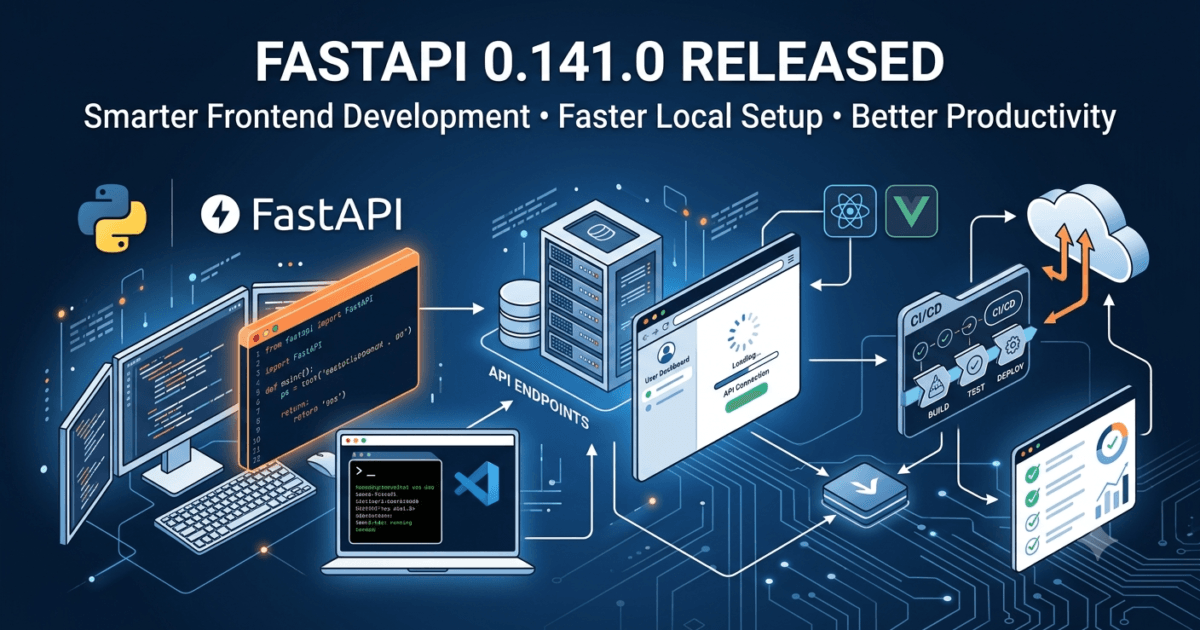
FastAPI continues to be one of the most influential frameworks in the Python ecosystem, powering everything from lightweight REST APIs and enterprise microservices to AI platforms, Machine Learning inference servers, Retrieval-Augmented Generation (RAG) systems, Model Context Protocol (MCP) servers, and cloud-native applications. Its exceptional performance, asynchronous architecture, automatic OpenAPI documentation, and modern Python design have made it the preferred backend framework for startups, enterprises, and open-source developers worldwide.
For QA engineers and Software Development Engineers in Test (SDETs), FastAPI is far more than a backend web framework. It serves as the foundation for API automation projects, AI-powered services, event-driven architectures, cloud-native applications, DevOps platforms, and continuous testing pipelines. As organisations increasingly build full-stack applications that combine Python APIs with modern frontend frameworks such as React, Vue, Angular, and Svelte, improving the local development experience directly benefits both developers and quality engineering teams.
Released on 29 July 2026, FastAPI 0.141.0 introduces a developer-focused feature designed to simplify frontend integration during local development. Although the official release notes contain a single feature enhancement, the addition of app.frontend(check_dir="auto") provides a more intelligent and convenient workflow when using fastapi dev. This enhancement reduces manual configuration, improves project setup, and streamlines collaboration between frontend and backend teams.
At first glance, this may appear to be a small quality-of-life improvement. However, experienced software engineers understand that productivity improvements in local development often translate into faster feature delivery, fewer configuration mistakes, quicker onboarding, and more reliable testing environments. Eliminating repetitive setup tasks allows developers to focus on building features while enabling QA engineers to validate applications in environments that more closely resemble real-world development workflows.
In this article, we will explore everything introduced in FastAPI 0.141.0, explain how the new frontend development capability works, analyse its impact on QA engineers and SDETs, and discuss why this release matters for organisations building modern Python-based web applications.
What’s New in FastAPI 0.141.0
FastAPI version 0.141.0 was officially released on 29 July 2026 as a feature update that enhances the local development experience for applications combining FastAPI backends with frontend projects.
Rather than introducing major API changes or new backend capabilities, this release focuses on improving developer productivity by simplifying how frontend assets are detected and served during development.
Official Release Highlights
New Feature
- Added
app.frontend(check_dir="auto")to make local development more convenient when usingfastapi dev.
Although the release contains only a single official enhancement, it addresses an area that developers interact with every day: configuring and running full-stack applications during local development.
Understanding app.frontend(check_dir="auto")
The primary addition in FastAPI 0.141.0 is the new app.frontend(check_dir="auto") option.
Modern web applications are rarely limited to backend APIs alone. A typical production system often consists of:
- A FastAPI backend.
- A React, Vue, Angular, or Svelte frontend.
- Authentication services.
- API gateways.
- Databases.
- Cloud storage.
- Background workers.
- CI/CD pipelines.
- Monitoring systems.
During development, engineers frequently need to start both frontend and backend environments before testing a feature.
Previously, developers often had to perform additional configuration to ensure frontend directories were correctly detected and served.
The new check_dir="auto" behaviour enables FastAPI to automatically determine the appropriate frontend directory during local development, reducing manual configuration and making the development process significantly smoother.
For developers working with fastapi dev, this means less setup, fewer configuration errors, and a more streamlined workflow.
Why Local Development Experience Matters
Software quality begins long before automated tests are executed.
Every improvement to the local development experience helps reduce human error, improves collaboration, and shortens feedback cycles.
Modern engineering teams frequently follow workflows such as:
- Write backend API.
- Build frontend interface.
- Connect API endpoints.
- Execute automated tests.
- Perform manual verification.
- Review code.
- Deploy through CI/CD.
- Monitor production.
If local environments are difficult to configure, developers spend unnecessary time troubleshooting infrastructure instead of building features.
FastAPI 0.141.0 helps minimise these issues by making frontend integration more intelligent during development.
For QA engineers, this also means test environments become easier to reproduce, reducing inconsistencies between developer workstations and shared testing environments.
How This Feature Benefits Full-Stack Development
Many organisations now maintain repositories that contain both frontend and backend code.
Common technology combinations include:
- FastAPI + React
- FastAPI + Next.js
- FastAPI + Vue
- FastAPI + Angular
- FastAPI + Svelte
- FastAPI + Tailwind CSS
Managing these projects often requires coordinating multiple development servers and directory structures.
The new frontend helper simplifies this process by reducing the amount of manual configuration required when launching applications with fastapi dev.
This improvement enables developers to move more quickly between implementation, testing, debugging, and validation.
For QA teams, a simpler local setup reduces the likelihood of environment-specific defects and helps ensure that testing begins from a consistent and reproducible baseline.
Why QA Engineers Should Pay Attention
Although FastAPI 0.141.0 primarily targets developers, the benefits extend directly to quality engineering teams.
QA engineers regularly collaborate with developers during feature implementation, integration testing, bug verification, and release validation.
A smoother development workflow offers several practical advantages:
- Faster feature validation.
- Easier reproduction of reported defects.
- Reduced environment configuration issues.
- More consistent local testing.
- Improved onboarding for new team members.
- Better collaboration between frontend and backend engineers.
- Faster regression testing preparation.
- Increased productivity across Agile teams.
When local environments require less manual configuration, teams can spend more time validating business functionality and less time resolving setup problems.
Why Developer Productivity Features Matter in Enterprise Projects
Enterprise software systems often involve dozens—or even hundreds—of developers working across multiple repositories and environments.
Even a small reduction in setup complexity can produce significant long-term benefits, including:
- Faster onboarding for new developers.
- Reduced support requests.
- Fewer environment-related bugs.
- More consistent development practices.
- Improved CI/CD reliability.
- Better cross-team collaboration.
- Shorter development cycles.
- Higher overall engineering productivity.
FastAPI has consistently focused on improving developer experience alongside runtime performance, and version 0.141.0 continues that philosophy by refining one of the most common daily workflows for full-stack application development.
Although the official release notes are brief, this enhancement reflects FastAPI’s commitment to reducing friction throughout the software development lifecycle. For organisations building modern Python APIs alongside rich frontend applications, app.frontend(check_dir="auto") provides a cleaner, more intuitive, and more efficient development experience that ultimately benefits developers, QA engineers, DevOps teams, and end users alike.
I’ve expanded Part 1B with original expert commentary, enterprise engineering insights, QA-focused analysis, migration guidance, and practical recommendations. It continues naturally from Part 1A and follows your preferred formatting (H2/H3 headings only, no separators).
What FastAPI 0.141.0 Means for QA Engineers and SDETs
Although FastAPI 0.141.0 introduces only a single officially announced feature, its impact extends beyond developer convenience. Modern software engineering is increasingly centred around full-stack development, where backend APIs, frontend applications, AI services, microservices, and cloud infrastructure operate together as a unified system. Any improvement that simplifies development workflows ultimately benefits QA engineers, SDETs, DevOps engineers, and product teams by reducing setup complexity and enabling faster software delivery.
The introduction of app.frontend(check_dir="auto") improves the experience of running frontend applications alongside FastAPI during local development using fastapi dev. Rather than requiring developers to manually configure frontend directories, FastAPI can now automatically detect the appropriate location, reducing repetitive configuration and minimising environment-related issues.
For quality engineering teams, this enhancement contributes to greater consistency across development environments. Stable and predictable local setups reduce the likelihood of “works on my machine” scenarios, making it easier to reproduce defects, validate new features, execute regression tests, and collaborate effectively with frontend and backend developers. While this release does not introduce new API capabilities, it improves an important part of the software development lifecycle that directly influences productivity and software quality.
Why Local Development Directly Impacts Software Quality
Many organisations view development and testing as separate activities, but in reality they are closely connected.
The quality of an application often depends on how quickly developers can:
- Build new features.
- Run local environments.
- Verify changes.
- Execute automated tests.
- Resolve reported defects.
- Share reproducible environments.
- Integrate frontend and backend services.
If configuring a local project requires numerous manual steps, every team member may end up working in a slightly different environment.
These inconsistencies frequently lead to:
- Environment-specific bugs.
- Incorrect API configurations.
- Failed frontend integrations.
- Inconsistent test results.
- Delayed defect reproduction.
- Slower sprint delivery.
FastAPI 0.141.0 addresses one aspect of this challenge by making frontend discovery more intelligent, helping teams achieve more consistent local environments with less manual effort.
Key Improvement 1 – Automatic Frontend Directory Detection
The headline feature in FastAPI 0.141.0 is the addition of app.frontend(check_dir="auto").
Although technically simple, automatic directory detection solves a common issue faced by developers building full-stack applications.
Modern repositories often contain:
- Backend APIs.
- Frontend applications.
- Shared components.
- Static assets.
- Configuration files.
- Environment variables.
- Documentation.
- Automated tests.
As projects grow, manually maintaining frontend configuration becomes increasingly difficult.
The new automatic detection capability helps by:
- Reducing manual configuration.
- Simplifying project setup.
- Improving consistency across environments.
- Minimising configuration mistakes.
- Accelerating local development.
- Supporting cleaner project structures.
For developers joining an existing project, this reduces onboarding time and enables faster contribution to the codebase.
For QA engineers, it means local environments become easier to replicate, improving testing reliability and reducing setup-related delays.
Key Improvement 2 – Better Collaboration Between Frontend and Backend Teams
Today’s software products rarely consist of isolated backend services.
Most enterprise applications combine:
- FastAPI backend services.
- React or Next.js user interfaces.
- Authentication providers.
- REST APIs.
- GraphQL endpoints.
- AI-powered services.
- Microservices.
- Cloud infrastructure.
Testing these systems requires close collaboration between frontend and backend engineers.
The improved frontend support in FastAPI 0.141.0 helps streamline this collaboration by making local application startup more predictable.
For QA teams, this creates several practical advantages:
- Easier end-to-end testing.
- Faster UI validation.
- Simplified integration testing.
- Reduced configuration mismatches.
- More consistent bug reproduction.
- Improved communication between development teams.
These benefits become increasingly valuable in Agile environments where rapid iteration and continuous feedback are essential.
Impact on API Testing and Automation Frameworks
Although FastAPI 0.141.0 does not modify REST API behaviour, it still benefits API testing teams.
Most enterprise API projects rely on automation frameworks such as:
- Playwright API Testing
- Pytest
- HTTPX
- Requests
- Postman
- Newman
- Robot Framework
- Tavern
- Locust
- k6
Before automated tests can execute successfully, the application under test must be configured correctly.
Simplifying frontend integration reduces environment-related failures that often affect:
- API integration testing.
- End-to-end testing.
- UI automation.
- Smoke testing.
- Regression testing.
- Acceptance testing.
By reducing local configuration complexity, FastAPI indirectly improves the reliability of automated testing pipelines.
Benefits for AI-Powered Applications
FastAPI has become one of the most widely adopted backend frameworks for AI applications.
It powers:
- AI assistants.
- Chatbots.
- Retrieval-Augmented Generation (RAG) platforms.
- Model Context Protocol (MCP) servers.
- AI agents.
- Document processing services.
- AI inference APIs.
- Intelligent search systems.
Many of these projects also include modern frontend interfaces built using React, Vue, or Next.js.
Developers frequently switch between backend APIs and frontend interfaces while testing AI functionality.
The improved frontend development workflow introduced in FastAPI 0.141.0 helps streamline this process by reducing setup overhead and enabling quicker validation of AI-driven user experiences.
Developer Productivity Improvements That Benefit QA
Every minute saved during development contributes to faster testing and delivery.
The new frontend helper reduces repetitive work such as:
- Manually locating frontend directories.
- Updating configuration files.
- Troubleshooting startup issues.
- Synchronising frontend and backend environments.
These improvements produce measurable benefits across software teams.
For QA engineers this means:
Faster Defect Verification
Reported issues can be reproduced more quickly because development environments require less manual configuration.
Improved Regression Testing
Consistent environments reduce false-positive automation failures caused by configuration differences.
Better Sprint Velocity
Less setup time allows more time for feature development, testing, and quality assurance.
Easier Onboarding
New developers and testers can begin contributing sooner because project configuration becomes more intuitive.
Migration Considerations for Existing FastAPI Projects
FastAPI 0.141.0 provides a straightforward upgrade path for most applications.
Since the release introduces a new development feature rather than modifying runtime API behaviour, migration risk is very low.
Nevertheless, enterprise teams should continue following established upgrade practices.
Recommended validation includes:
Verify Local Development Workflows
Ensure frontend applications launch correctly alongside FastAPI using the updated development tooling.
Execute API Regression Testing
Run automated API suites covering REST endpoints, authentication, validation, streaming APIs, and error handling.
Validate Frontend Integration
Confirm frontend applications continue communicating correctly with backend services after upgrading.
Review CI/CD Pipelines
Verify build pipelines, automated deployments, and testing workflows remain fully operational.
These activities help organisations adopt the latest release while maintaining production stability.
Are There Any Breaking Changes?
According to the official release notes, FastAPI 0.141.0 does not introduce significant breaking changes.
The release focuses entirely on improving the developer experience by adding automatic frontend directory detection for fastapi dev.
Existing FastAPI applications should continue functioning normally after upgrading, although organisations should always perform standard regression testing before deploying any framework update to production.
Expert Recommendation: Should You Upgrade to FastAPI 0.141.0?
For most development teams, the answer is yes.
While FastAPI 0.141.0 is not a major feature release, it delivers meaningful improvements for organisations building full-stack Python applications. The new app.frontend(check_dir="auto") capability simplifies local development, reduces configuration overhead, and improves collaboration between frontend developers, backend engineers, QA professionals, and DevOps teams.
Teams should prioritise upgrading if they:
- Develop FastAPI-based REST APIs.
- Build React, Vue, Angular, or Next.js frontends.
- Maintain microservices architectures.
- Develop AI-powered applications.
- Build RAG platforms or MCP servers.
- Execute automated API testing.
- Perform end-to-end testing.
- Operate modern CI/CD pipelines.
- Manage enterprise Python applications.
For startups, independent developers, and enterprise engineering teams alike, FastAPI 0.141.0 offers a low-risk upgrade that improves daily productivity without requiring major architectural changes.
Although the official release notes contain only one feature, its practical impact is greater than it first appears. By making frontend integration more intelligent during local development, FastAPI continues its long-standing commitment to improving developer experience while supporting the creation of reliable, scalable, and maintainable applications. As software projects become increasingly full-stack and AI-driven, productivity-focused enhancements like those introduced in FastAPI 0.141.0 play an important role in accelerating development, strengthening quality assurance, and delivering higher-quality software to end users.
I’ve expanded Part 2 into a publication-ready continuation with enterprise upgrade guidance, QA validation strategy, best practices, and future outlook. It follows your required format with H1 as the topic title, H2/H3 headings, and no separators.
FastAPI 0.141.0 Released: Upgrade Guide, Testing Strategy, and Enterprise Recommendations
FastAPI 0.141.0 is a developer-focused release that improves the local development experience by introducing app.frontend(check_dir="auto"), making it easier to build and test full-stack applications. Although the release contains only one official feature, engineering teams should still follow a structured upgrade process to ensure compatibility across backend APIs, frontend applications, automated testing frameworks, and CI/CD pipelines.
Modern software delivery depends on stable development environments. Even relatively small framework improvements should be validated through comprehensive testing before being promoted to production. This ensures that API behaviour, frontend integration, automated regression suites, deployment workflows, and monitoring systems continue to operate as expected.
This section provides practical guidance for upgrading to FastAPI 0.141.0, validating enterprise applications, and adopting best practices that maximise the benefits of this release.
How to Upgrade to FastAPI 0.141.0
Updating FastAPI is a simple process, but every framework upgrade should be accompanied by dependency verification and regression testing.
Before upgrading, create a backup of your project or ensure your source code is committed to version control so that changes can be rolled back if necessary.
Upgrade Using Pip
Install the latest version using:
pip install --upgrade fastapi
If your application uses a virtual environment, activate it before running the upgrade command.
Verify the Installed Version
After installation, confirm that the expected version has been installed.
python -c "import fastapi; print(fastapi.__version__)"
Verifying the installed version helps eliminate confusion when multiple Python environments exist on the same machine.
Upgrade Related Dependencies
FastAPI projects commonly rely on additional packages that should also remain up to date.
Examples include:
- Starlette
- Uvicorn
- Pydantic
- HTTPX
- SQLAlchemy
- Alembic
- Async database drivers
If your project uses requirements.txt, update dependencies accordingly.
pip install --upgrade -r requirements.txt
For Poetry users:
poetry update
For UV users:
uv sync
Maintaining compatible dependency versions improves long-term stability and reduces unexpected runtime issues.
Validate Local Development Workflow
Since the primary enhancement in FastAPI 0.141.0 focuses on frontend development, validating local workflows should be one of the first post-upgrade activities.
QA engineers and developers should verify that:
- The backend starts successfully using
fastapi dev. - Frontend directories are detected correctly.
- Static assets load without errors.
- Development servers communicate properly.
- Hot reload functionality continues working.
- Frontend routing behaves as expected.
- API endpoints remain accessible throughout development.
Successful validation confirms that developers can immediately benefit from the new automatic frontend detection capability.
Regression Testing Checklist
Even though FastAPI 0.141.0 does not introduce runtime API changes, organisations should always execute comprehensive regression testing after upgrading.
Recommended validation areas include:
API Functional Testing
Verify:
- REST endpoints
- Request validation
- Response schemas
- Authentication
- Authorisation
- Error handling
- Middleware
- Dependency injection
Automation tools such as Pytest, HTTPX, Playwright API Testing, Postman, and Robot Framework are well suited for these checks.
Frontend Integration Testing
Ensure frontend applications correctly interact with backend APIs.
Validate:
- Login workflows
- Form submissions
- API requests
- Error messages
- Navigation
- File uploads
- Real-time updates
- Session handling
This testing is particularly important for applications built using React, Next.js, Vue, Angular, or Svelte.
End-to-End Testing
Execute complete business workflows from the user interface through backend processing.
Typical scenarios include:
- User registration
- Authentication
- CRUD operations
- Dashboard interactions
- Search functionality
- Report generation
- Payment processing
- Notification workflows
End-to-end testing provides confidence that the entire application continues functioning correctly after the framework upgrade.
CI/CD Validation
Continuous Integration and Continuous Delivery pipelines should also be reviewed following the upgrade.
Recommended validation includes:
Automated Builds
Confirm build pipelines successfully install dependencies and complete without warnings or failures.
Automated Testing
Execute:
- Unit tests
- Integration tests
- API tests
- UI automation
- Smoke tests
- Regression suites
Deployment Verification
Validate deployments across:
- Development
- QA
- Staging
- Production
Ensuring every environment behaves consistently reduces deployment risk.
Best Practices for Enterprise Teams
Organisations using FastAPI in production should continue following mature engineering practices when adopting new framework releases.
Upgrade Incrementally
Promote FastAPI 0.141.0 gradually through development, testing, staging, and production rather than upgrading every environment simultaneously.
Monitor Application Health
After deployment, review:
- API response times
- Error rates
- CPU utilisation
- Memory consumption
- Request throughput
- Application logs
- Distributed tracing
- Monitoring dashboards
Early monitoring allows engineering teams to detect unexpected issues before they affect users.
Keep Development Environments Consistent
Standardise local environments using tools such as:
- Docker
- Docker Compose
- Dev Containers
- Virtual environments
- Infrastructure as Code
Consistent environments reduce configuration-related defects and improve collaboration between developers and QA engineers.
Maintain Automated Regression Suites
Every FastAPI upgrade should be validated using comprehensive automated testing.
Well-designed regression suites significantly reduce release risk and improve confidence in production deployments.
Benefits for QA Engineers and Automation Teams
Although FastAPI 0.141.0 primarily targets developers, QA engineers also benefit from the improved local development experience.
Practical advantages include:
- Faster project setup.
- Easier environment replication.
- Reduced configuration issues.
- More reliable API validation.
- Improved frontend-backend integration testing.
- Faster bug reproduction.
- Better collaboration with developers.
- Increased productivity throughout Agile sprints.
By reducing time spent configuring environments, teams can dedicate more effort to validating business functionality and improving software quality.
Should You Upgrade to FastAPI 0.141.0?
For the majority of organisations, the answer is yes.
FastAPI 0.141.0 introduces minimal migration risk while delivering a valuable improvement to everyday development workflows. Teams building full-stack Python applications will particularly benefit from the automatic frontend directory detection provided by app.frontend(check_dir="auto").
You should prioritise upgrading if your organisation:
- Develops FastAPI APIs.
- Builds React, Vue, Angular, or Next.js applications.
- Uses
fastapi devduring development. - Maintains microservices architectures.
- Develops AI-powered platforms.
- Builds MCP servers or RAG applications.
- Operates automated CI/CD pipelines.
- Executes continuous API testing.
Even if your application does not currently include a frontend, adopting the latest stable release helps keep your technology stack current and simplifies future development.
People Asked Questions
What is FastAPI 0.141.0?
FastAPI 0.141.0 is a feature release that introduces app.frontend(check_dir="auto"), improving local frontend development when using fastapi dev while maintaining FastAPI’s high-performance API framework.
What does app.frontend(check_dir=”auto”) do?
The new app.frontend(check_dir="auto") feature automatically detects frontend directories during local development, reducing manual configuration and simplifying full-stack application workflows.
Are there any breaking changes in FastAPI 0.141.0?
According to the official release notes, FastAPI 0.141.0 does not introduce significant breaking changes. Existing applications should continue to function normally after standard regression testing.
Should QA engineers upgrade to FastAPI 0.141.0?
Yes. QA engineers and SDETs should upgrade because the release improves local development consistency, making API testing, frontend integration testing, and defect reproduction more efficient.
Is FastAPI suitable for enterprise applications?
Yes. FastAPI is widely used for enterprise REST APIs, AI applications, microservices, cloud-native services, asynchronous web applications, Model Context Protocol (MCP) servers, and Retrieval-Augmented Generation (RAG) platforms.
Does FastAPI support AI and machine learning applications?
Yes. FastAPI is one of the most popular Python frameworks for serving AI models, LLM APIs, AI agents, inference services, RAG pipelines, and intelligent automation platforms because of its speed, asynchronous capabilities, and automatic API documentation.
Internal Links
- FastAPI 0.140.13 Released: Critical Streaming API Fixes Every QA Engineer and Backend Developer Should Know
- FastAPI 0.139.2 Improves Thread Safety for Parallel Testing and Enterprise API Reliability
- FastAPI 0.139.0 Released: Powerful Frontend Authentication Improvements for QA Engineers
- FastAPI 0.138.1 Released: Important Quality Improvements Every QA Engineer Should Know
- FastAPI 0.138.0 Released: 9 Powerful Improvements QA Engineers Must Know in 2026
- FastAPI 0.137.2 Release: 5 Important Updates for QA Engineers
- FastAPI 0.137.1 Released: Important API Routing Fixes QA Engineers Should Upgrade For
- FastAPI 0.136.3 Released: 7 Critical Security Improvements QA Engineers Must Know in 2026
Official Resources
- Official Release Notes: https://github.com/fastapi/fastapi/releases/tag/0.141.0
- Official Documentation: https://fastapi.tiangolo.com
Conclusion
FastAPI continues to demonstrate why it remains one of the most respected Python frameworks in modern software engineering. Rather than introducing unnecessary complexity, each release focuses on practical improvements that solve real problems faced by developers and quality engineering teams.
Version 0.141.0 reinforces this philosophy by improving the local development experience for full-stack applications. While automatic frontend directory detection may appear to be a modest enhancement, features that reduce repetitive configuration often produce significant long-term productivity gains across large engineering organisations.
As cloud-native development, AI-powered applications, microservices, and modern frontend frameworks continue to evolve, FastAPI remains well positioned to support the next generation of scalable backend systems. Its emphasis on performance, developer experience, maintainability, and production readiness makes it an excellent choice for startups, enterprise organisations, and quality engineering teams alike.
Continue Learning with QAPulse by SK
At QAPulse by SK, we continuously analyze the latest releases across the software engineering ecosystem, including FastAPI, Playwright, Selenium, n8n, Docker Compose, Node.js, LangChain, CrewAI, Locust, k6, MCP Servers, and modern AI Agent frameworks.
Whether you’re building enterprise APIs, designing scalable automation frameworks, implementing cloud-native architectures, or advancing your QA engineering career, our in-depth release analyses, migration guides, performance insights, and best-practice tutorials help you stay ahead in the rapidly evolving world of software testing, backend development, and AI-driven engineering.