 QA
QA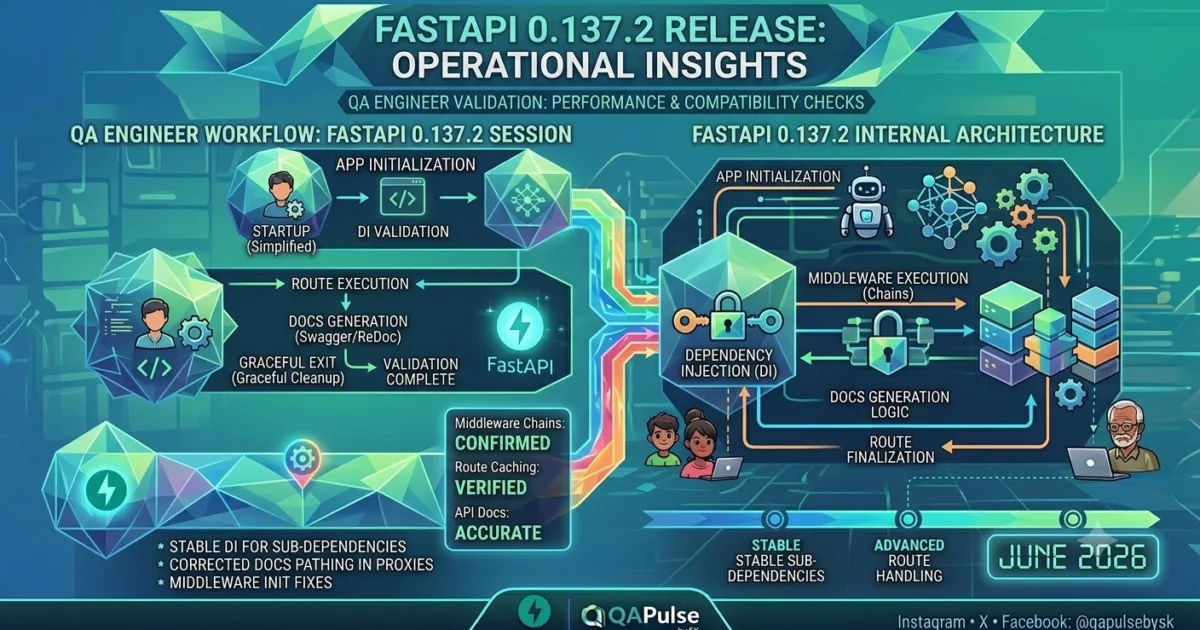
FastAPI continues to be one of the most popular Python frameworks for building modern APIs, microservices, AI backends, and cloud-native applications. The FastAPI 0.137.2 Release, announced on June 18, 2026, is not a massive feature-packed update, but it introduces an important routing enhancement while also improving documentation quality across multiple languages.
For many teams, these smaller releases often have a larger long-term impact than major feature launches. Better routing APIs improve framework extensibility, while documentation improvements reduce onboarding friction for global development teams.
If your organization builds API automation frameworks, backend services, AI platforms, or test environments using FastAPI, understanding what changed in the FastAPI 0.137.2 Release can help you decide whether to upgrade immediately or wait for a future release.
In this article, we’ll examine:
- What’s new in FastAPI 0.137.2
- Why the new routing capability matters
- What QA engineers should test
- Upgrade recommendations
- Potential risks and migration considerations
- Practical guidance for SDETs and automation engineers
What is FastAPI?
FastAPI is a modern Python framework designed for building APIs using standard Python type hints. It is widely used for:
- REST API development
- AI and ML services
- Microservices architectures
- Backend-for-frontend applications
- Test automation support services
- Internal tooling platforms
FastAPI has gained popularity because of:
- High performance
- Automatic OpenAPI generation
- Strong typing support
- Easy integration with Python ecosystems
- Excellent developer experience
Many QA teams now build:
- Test data services
- Mock APIs
- Automation dashboards
- AI testing utilities
using FastAPI.
What’s New in FastAPI 0.137.2?
According to the official release notes, the major functional enhancement in the FastAPI 0.137.2 Release is:
| Category | Update |
|---|---|
| Feature | Added iter_route_contexts() |
| Documentation | Korean markdown fixes |
| Translations | French updates |
| Translations | German updates |
| Translations | Korean updates |
| Translations | Traditional Chinese updates |
| Translations | Simplified Chinese updates |
| Translations | Turkish updates |
| Translations | Ukrainian updates |
The release is intentionally lightweight and focused on framework maintainability.
Key Improvement #1: New iter_route_contexts() API
The most important change in the FastAPI 0.137.2 Release is:
iter_route_contexts()
This new capability supports advanced use cases that previously depended on directly accessing:
router.routes
Historically, many framework extensions and tooling integrations inspected routing information by traversing internal route structures.
The new API provides a cleaner and more maintainable approach.
Why Does iter_route_contexts() Matter?
For normal application developers, the impact may be minimal.
For advanced users, however, this is important.
Examples include:
- Custom API gateways
- Plugin systems
- Documentation generators
- Runtime route inspection
- Dynamic endpoint discovery
- Framework extensions
- Interactive notebook environments such as Jupyverse
The addition provides a more official mechanism for interacting with routing contexts.
QA Engineer Perspective
From a testing standpoint, this change improves:
Framework Stability
Accessing internal structures directly often creates fragile integrations.
When frameworks evolve, direct route inspection can break unexpectedly.
A dedicated API reduces that risk.
Better Tooling Support
Teams building:
- API inventory tools
- Endpoint validation frameworks
- Dynamic test generation utilities
can adopt a more future-proof implementation strategy.
Reduced Maintenance Cost
Automation frameworks relying on route discovery may require fewer updates during future FastAPI upgrades.
Key Improvement #2: Documentation Quality Improvements
A large portion of the release focuses on translation maintenance.
Updates include:
| Language | Status |
|---|---|
| Korean | Updated |
| German | Updated |
| French | Updated |
| Turkish | Updated |
| Ukrainian | Updated |
| Chinese (Simplified) | Updated |
| Chinese (Traditional) | Updated |
There was also a fix for broken Markdown formatting within Korean documentation.
Why Documentation Updates Matter
Many organizations operate globally.
Better documentation helps:
- Faster onboarding
- Reduced developer confusion
- Better knowledge sharing
- Improved adoption across teams
For QA leaders managing distributed teams, documentation quality can directly impact productivity.
What Does the FastAPI 0.137.2 Release Mean for QA Engineers?
Let’s break down the practical impact.
Impact Assessment
| Area | Impact |
|---|---|
| Functional APIs | Low |
| Existing applications | Low |
| Test automation | Low |
| Framework extensions | Medium |
| Route inspection tools | Medium |
| Dynamic test generation tools | Medium |
| Production risk | Very Low |
If You Use FastAPI for API Automation
Most SDETs use FastAPI to create:
- Mock services
- Test environments
- Synthetic APIs
- Data provisioning tools
In these scenarios:
No significant changes are required.
Existing automation suites should continue functioning normally.
If You Build Custom Framework Extensions
This is where attention is needed.
If your code contains logic similar to:
router.routes
you should review the new API.
Future FastAPI versions may increasingly encourage use of:
iter_route_contexts()
instead.
Testing Checklist for QA Teams
Before upgrading, validate the following:
API Functionality
- Verify endpoint responses
- Validate request schemas
- Validate response schemas
- Check authentication flows
Route Discovery
If custom route discovery exists:
- Verify endpoint enumeration
- Verify dynamic route generation
- Verify plugin integrations
- Verify middleware compatibility
Documentation
Validate:
- OpenAPI generation
- Swagger UI rendering
- ReDoc rendering
- API metadata
Regression Testing
Run:
- Unit tests
- API automation suites
- Integration tests
- Contract tests
- Performance smoke tests
Example Regression Test Strategy
| Test Type | Priority |
|---|---|
| Unit Tests | High |
| API Tests | High |
| Integration Tests | High |
| Contract Tests | Medium |
| Load Tests | Medium |
| Security Tests | Medium |
Because the release is relatively small, a full performance re-certification is generally unnecessary unless routing internals are heavily customized.
Are There Any Breaking Changes?
Based on the official release notes, there are:
No Reported Breaking Changes
The release primarily contains:
- New routing capability
- Documentation improvements
- Translation updates
No API removals were announced.
No compatibility warnings were issued.
No migration requirements were documented.
This makes the FastAPI 0.137.2 Release one of the lower-risk upgrades in recent months.
Migration Guidance
Recommended Upgrade Path
Upgrade in a staging environment first.
Python
pip install fastapi --upgrade
Verify:
pytest
and API automation suites.
Dependency Validation
Check compatibility with:
- Starlette
- Pydantic
- Uvicorn
- Testing frameworks
Especially if your organization pins dependencies tightly.
Should QA Teams Upgrade Immediately?
Recommendation: Yes
For most organizations:
✅ Low risk
✅ No breaking changes
✅ Improved framework extensibility
✅ Better long-term route management
✅ Updated documentation ecosystem
Upgrade Priority Matrix
| Team Type | Recommendation |
|---|---|
| Small Startup | Upgrade Now |
| Enterprise API Team | Upgrade After Staging Validation |
| SDET Team | Upgrade Now |
| Internal Tooling Team | Upgrade Now |
| Mission-Critical Systems | Staging Validation First |
FastAPI 0.137.2 Release Verdict
The FastAPI 0.137.2 Release is a maintenance-focused update rather than a transformative release.
However, the introduction of iter_route_contexts() signals continued investment in framework extensibility and cleaner routing abstractions.
For most QA engineers, there is little immediate impact. Existing test suites should continue operating normally.
Teams building advanced tooling, route discovery mechanisms, dynamic API testing frameworks, or FastAPI extensions should pay close attention to the new routing API because it offers a more maintainable alternative to direct route inspection.
Overall Rating:
| Category | Rating |
|---|---|
| Stability | 9/10 |
| Upgrade Risk | 9/10 |
| QA Impact | 7/10 |
| Enterprise Readiness | 9/10 |
| Recommended Upgrade | Yes |
Frequently Asked Questions
What is the biggest feature in FastAPI 0.137.2?
The biggest functional addition is the new iter_route_contexts() API that supports advanced route inspection and framework extension use cases.
Does FastAPI 0.137.2 contain breaking changes?
No. The official release notes do not report any breaking changes.
Should SDETs upgrade immediately?
Yes. Most teams can safely upgrade after standard regression testing.
Do existing API automation suites need updates?
In most cases, no changes are required.
Who benefits most from this release?
Teams building:
- Custom FastAPI extensions
- Dynamic API discovery tools
- Runtime route analysis utilities
- Advanced backend platforms
External Resources
Official FastAPI Release Notes:
https://github.com/fastapi/fastapi/releases/tag/0.137.2
FastAPI Documentation:
https://fastapi.tiangolo.com/
GitHub Repository:
https://github.com/fastapi/fastapi
More Related Blogs
- FastAPI 0.137.1 Released: Important API Routing Fixes QA Engineers Should Upgrade For
- PyTest 9.1.0 Released: Critical Fixture Changes QA Engineers Must Understand
- Playwright 1.61.0 Released: Powerful Authentication Testing Features QA Engineers Must Know
- LangChain 1.4.6 Released: Valuable AI Agent Observability Improvements QA Engineers Must Know
Final Thoughts
The FastAPI 0.137.2 Release may appear small at first glance, but it continues FastAPI’s reputation for careful, incremental improvements that strengthen the ecosystem without introducing unnecessary risk.
For QA engineers and SDETs, the release is a straightforward upgrade with minimal disruption and potential long-term benefits for teams building sophisticated API testing and route management solutions.