QA
QA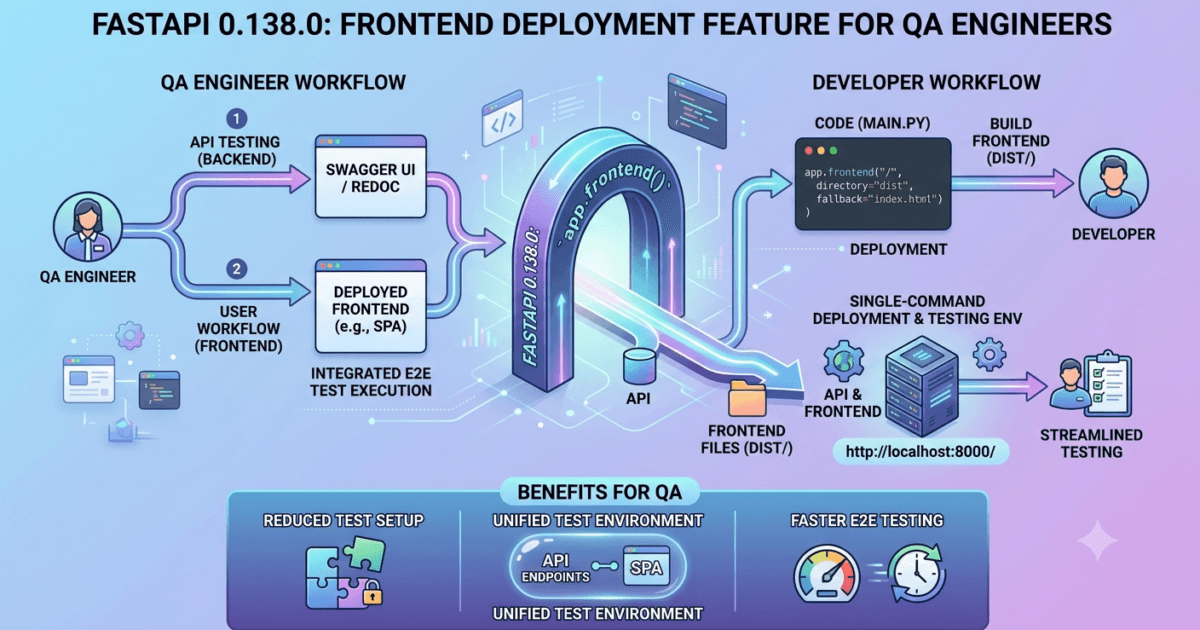
The FastAPI team has officially released FastAPI 0.138.0, introducing one of the most practical features added to the framework in recent releases: built-in frontend serving support through app.frontend() and router.frontend().
Although the release notes appear relatively small compared to major framework updates, FastAPI 0.138.0 has significant implications for developers, QA engineers, SDETs, DevOps teams, and organizations building full-stack applications, AI services, MCP servers, and modern API platforms.
For teams running automated testing pipelines around FastAPI applications, this release simplifies deployment architectures and introduces new testing scenarios that quality engineers should understand before upgrading.
What is FastAPI?
FastAPI is one of the most popular Python frameworks for building:
- REST APIs
- GraphQL Services
- AI Applications
- Agentic AI Platforms
- MCP Servers
- Microservices
- Backend Systems
- Cloud-Native Applications
Built on Python type hints and ASGI standards, FastAPI is widely adopted because of:
- Exceptional Performance
- Automatic OpenAPI Generation
- Strong Validation
- Modern Python Support
- Excellent Developer Experience
Official Website:
Official Documentation:
Official Release Notes:
https://github.com/fastapi/fastapi/releases/tag/0.138.0
What’s New in FastAPI 0.138.0?
The headline feature is:
app.frontend("/", directory="dist")
and
router.frontend("/", directory="dist")
This allows FastAPI applications to directly serve frontend assets from a specified build directory.
Previously, teams often relied on:
- Nginx
- Apache
- CDN Layers
- Separate Static Servers
to serve frontend applications.
FastAPI 0.138.0 now simplifies this process significantly.
FastAPI 0.138.0 vs FastAPI 0.137.1
| Area | FastAPI 0.137.1 | FastAPI 0.138.0 |
|---|---|---|
| API Functionality | Stable | Stable |
| Frontend Hosting | Limited | Native Support |
| Deployment Simplicity | Good | Better |
| Full Stack Support | Moderate | Improved |
| Testing Complexity | Higher | Reduced |
| Enterprise Readiness | High | Higher |
For organizations deploying both frontend and backend components together, FastAPI 0.138.0 offers meaningful operational improvements.
1. Native Frontend Hosting Support
The most important change is:
app.frontend("/", directory="dist")
This allows FastAPI to serve frontend applications directly.
Supported frontend frameworks include:
- React
- Vue
- Angular
- Svelte
- Next.js Static Exports
- Vite Applications
Instead of deploying:
Frontend → Nginx
Backend → FastAPI
organizations can now consider:
Frontend + Backend → FastAPI
for simpler architectures.
Why This Matters for QA Engineers
Historically, testing environments required:
- Separate Frontend Deployments
- Reverse Proxy Configuration
- Additional Infrastructure
- Environment Synchronization
Now QA teams can test:
- Frontend Assets
- APIs
- Authentication
- Routing
from a single deployment.
Benefits include:
✅ Simpler Test Environments
✅ Reduced Infrastructure Complexity
✅ Faster Test Setup
✅ Easier Local Development
2. Improved End-to-End Testing Workflows
FastAPI 0.138.0 is particularly valuable for teams using:
- Playwright
- Cypress
- Selenium
- WebdriverIO
Previously, E2E tests often targeted:
Frontend URL
Backend URL
separately.
Now many teams can test:
Single Application URL
This reduces environment-related failures.
QA Impact
High.
Especially beneficial for CI/CD pipelines.
3. Better Support for AI Applications
FastAPI remains one of the most widely used frameworks for AI applications.
Common deployments include:
- OpenAI Integrations
- LangChain APIs
- CrewAI Platforms
- Agentic AI Systems
- MCP Servers
- RAG Applications
Many AI products also include web dashboards.
FastAPI 0.138.0 makes it easier to deploy:
- AI Backend
- Frontend Interface
within a single application.
4. Improved MCP Server Deployments
Model Context Protocol adoption continues accelerating.
Many MCP solutions include:
- Web UIs
- Configuration Dashboards
- Monitoring Interfaces
With FastAPI 0.138.0, these assets can be hosted alongside API endpoints.
Benefits include:
- Fewer Infrastructure Components
- Easier Deployment
- Simpler Automation Testing
For organizations building MCP tools, this release is particularly relevant.
5. Reduced DevOps Complexity
One of the hidden benefits of FastAPI 0.138.0 is operational simplification.
Before:
Frontend Server
Reverse Proxy
FastAPI Backend
After:
FastAPI
Fewer moving parts often means:
- Lower Costs
- Easier Monitoring
- Simpler Security Reviews
- Faster Deployments
6. New Testing Scenarios QA Teams Should Add
After upgrading, QA engineers should validate:
Frontend Routing
- Deep Links
- Browser Refreshes
- Nested Routes
Static Asset Delivery
- CSS
- JavaScript
- Images
- Fonts
Error Handling
- Missing Assets
- Invalid Paths
- Cache Behavior
Security Testing
- Directory Traversal
- Asset Access Controls
- Unauthorized Requests
7. Documentation Improvements
FastAPI 0.138.0 includes several documentation enhancements.
Highlights include:
- Frontend Documentation
- Agent Library Skill Updates
- Grammar Fixes
- Broken Link Fixes
- Improved Release Notes
Documentation improvements matter because they:
- Reduce Onboarding Time
- Improve Developer Productivity
- Lower Configuration Errors
8. Hindi Documentation Support
An underrated addition is:
Hindi Documentation Translation Support
This improves accessibility for:
- Students
- Junior Developers
- Emerging Markets
- Global Engineering Teams
Organizations operating internationally may benefit from improved adoption and training opportunities.
9. Internal Testing Improvements
The FastAPI team also fixed:
- Failing Tests
- Error Formatting
- Build Validation
Although these changes are internal, they indicate a healthy project focused on maintaining engineering quality.
For QA professionals, mature internal testing practices often correlate with higher framework reliability.
FastAPI 0.138.0 vs Flask 3.x
| Feature | FastAPI 0.138.0 | Flask 3.x |
|---|---|---|
| Async Support | Excellent | Moderate |
| OpenAPI Generation | Built-In | Extensions |
| Type Safety | Strong | Limited |
| AI Ecosystem | Excellent | Good |
| Frontend Hosting | Improved | Available |
| Performance | Higher | Lower |
FastAPI continues to strengthen its position for modern API development.
Upgrade Guide
Upgrade FastAPI
pip install --upgrade fastapi
Verify version:
pip show fastapi
Expected output:
Version: 0.138.0Recommended Regression Testing Checklist
After upgrading:
API Testing
✅ GET Endpoints
✅ POST Endpoints
✅ Validation Rules
✅ Authentication
Frontend Testing
✅ Asset Loading
✅ Route Navigation
✅ SPA Behavior
Performance Testing
✅ Response Times
✅ Concurrent Requests
✅ Static Asset Delivery
Security Testing
✅ Authorization
✅ Input Validation
✅ File Access Controls
My QA Engineer Verdict
| Category | Rating |
|---|---|
| New Feature Value | 9/10 |
| Enterprise Impact | 9/10 |
| Upgrade Risk | Very Low |
| AI Application Impact | 9.5/10 |
| QA Relevance | 9/10 |
Recommendation
Recommended upgrade for:
- FastAPI Teams
- AI Platform Builders
- MCP Developers
- DevOps Engineers
- QA Automation Teams
Relevant Articles
- What is Playwright and Why Everyone is Talking About It
- The Hidden Architecture Behind Scalable QA Platforms in 2026
- AI-Powered Test Automation Framework: Powerful Complete Guide for 2026
External Resources
FastAPI Official Website: https://fastapi.tiangolo.com
FastAPI Documentation: https://fastapi.tiangolo.com/tutorial
FastAPI GitHub Repository: https://github.com/fastapi/fastapi
FastAPI 0.138.0 Release Notes: https://github.com/fastapi/fastapi/releases/tag/0.138.0
ASGI Specification:https://asgi.readthedocs.io
Frequently Asked Questions
What is the biggest feature in FastAPI 0.138.0?
Native frontend hosting support using app.frontend() and router.frontend().
Should QA engineers upgrade?
Yes. The upgrade risk is very low and the operational benefits are significant.
Does FastAPI 0.138.0 introduce breaking changes?
No major breaking changes were announced.
Does this help AI applications?
Absolutely. AI dashboards and APIs can now be deployed more easily together.
Is FastAPI still the best Python framework for APIs?
For modern async APIs, AI services, and MCP servers, FastAPI remains one of the strongest choices available in 2026.
Final Thoughts
FastAPI 0.138.0 is a deceptively important release. While it introduces only one major feature, native frontend hosting significantly simplifies deployment architectures, reduces infrastructure complexity, improves end-to-end testing workflows, and strengthens FastAPI’s position as a full-stack platform for APIs, AI applications, MCP servers, and modern web systems.
For organizations already using FastAPI, this is one of the most practical upgrades of 2026 and is highly recommended.