QA
QA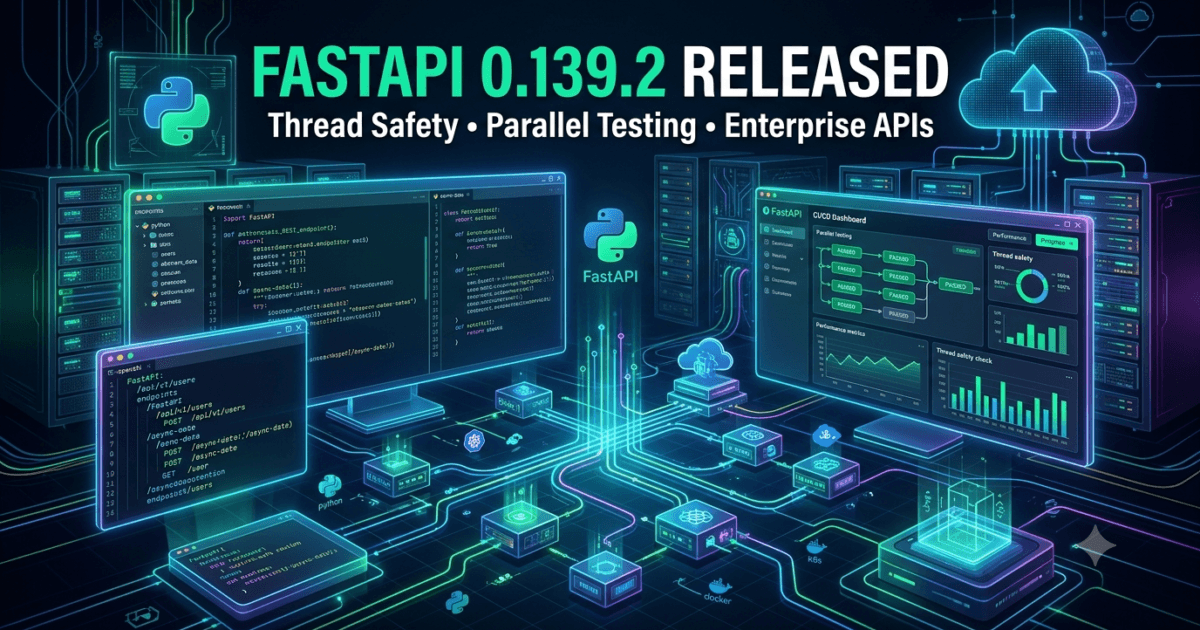
FastAPI 0.139.2, released on July 16, 2026, is a focused maintenance update that delivers an important improvement for developers building and testing high-performance Python APIs. While the official changelog contains only a single bug fix, its impact is significant for teams running parallel test execution, CI/CD pipelines, API automation frameworks, and enterprise backend services.
The highlight of this release is a thread-safe refactor of the router route-building mechanism, addressing issues that could occur when tests execute simultaneously across multiple threads. Although the FastAPI maintainers describe this scenario as relatively uncommon, it becomes highly relevant in modern software engineering environments where organizations continuously optimize test execution speed through parallel testing, distributed CI pipelines, and high-concurrency automation frameworks.
For QA Engineers, SDETs, Automation Engineers, Backend Developers, DevOps Engineers, Platform Engineers, Cloud Architects, and Python Developers, this release enhances framework stability without changing existing API behavior or introducing breaking changes.
As organizations increasingly adopt microservices, containerized deployments, Kubernetes, GitHub Actions, GitLab CI, Azure DevOps, and parallelized test execution, even subtle improvements to framework internals can eliminate intermittent failures that are otherwise difficult to reproduce and diagnose.
Official Release Highlights
According to the official FastAPI release notes, FastAPI 0.139.2 includes one important framework improvement.
Bug Fix
- Refactor router route building to make it thread-safe, primarily benefiting applications and test suites executing in parallel threads.
Although concise, this update improves internal framework reliability and helps eliminate race-condition scenarios during concurrent test execution.
FastAPI 0.139.2 Release Overview
| Category | Details |
|---|---|
| Version | FastAPI 0.139.2 |
| Release Date | July 16, 2026 |
| Release Type | Maintenance Release |
| Breaking Changes | None Reported |
| Performance Impact | Improved Stability |
| Parallel Testing Support | Enhanced |
| API Compatibility | Fully Compatible |
| Upgrade Recommendation | Recommended |
Why This Release Matters
Modern API development rarely happens in a single-threaded environment.
Today’s engineering teams routinely execute:
- Parallel API testing
- Distributed regression suites
- Multi-threaded integration tests
- CI/CD validation pipelines
- Containerized deployments
- Cloud-native microservices
- Kubernetes workloads
- High-concurrency backend systems
- Automated API contract testing
- Performance and load testing
As test execution becomes increasingly parallelized, framework internals must safely support concurrent operations.
FastAPI 0.139.2 directly addresses this need by making router route construction thread-safe, reducing the likelihood of intermittent failures caused by concurrent route initialization.
Although many smaller projects may never encounter this issue, enterprise organizations running thousands of automated tests every day benefit from a more stable and predictable framework.
Thread-Safe Router Construction Improves Test Reliability
The primary enhancement in FastAPI 0.139.2 focuses on the framework’s internal router-building process.
When applications or automated test suites initialize routes across multiple threads, shared resources can occasionally become vulnerable to synchronization issues if thread safety is not carefully managed.
The updated implementation improves how routes are built internally, making the process safer for concurrent execution.
For development teams, this provides several practical benefits:
- Reduced intermittent test failures
- Better support for parallel execution
- Improved CI/CD reliability
- More predictable regression testing
- Stronger framework stability
- Increased confidence in concurrent environments
These improvements are especially valuable for organizations using pytest-xdist, GitHub Actions matrix builds, Azure DevOps parallel jobs, or distributed testing infrastructures.
Better Stability for Enterprise API Development
FastAPI has become one of the most widely adopted Python frameworks for building:
- REST APIs
- AI model serving
- Machine Learning APIs
- LLM backends
- Agentic AI platforms
- Microservices
- Authentication services
- Internal developer platforms
- SaaS applications
- Cloud-native backend systems
Enterprise applications frequently initialize multiple API instances simultaneously during automated testing or container orchestration.
The thread-safe router improvements introduced in 0.139.2 help ensure these environments remain stable as applications scale.
While end users may never directly notice this enhancement, engineering teams benefit from fewer sporadic failures and more reliable deployment pipelines.
What This Means for QA Engineers
For QA Engineers and SDETs, FastAPI 0.139.2 reinforces the importance of validating framework behavior under concurrent execution rather than focusing solely on functional correctness.
After upgrading, QA teams should validate:
- Parallel API regression testing
- Route initialization
- Concurrent request handling
- CI/CD pipeline execution
- Integration testing
- API contract validation
- Authentication endpoints
- Background task execution
- Performance testing
- Load testing
- Multi-threaded application startup
Even though application logic remains unchanged, ensuring stable execution under concurrency provides greater confidence in production deployments.
Comparison with FastAPI 0.139.0
| Capability | FastAPI 0.139.0 | FastAPI 0.139.2 |
|---|---|---|
| Frontend Dependency Support | Added | Maintained |
| Router Thread Safety | Standard | Improved |
| Parallel Test Reliability | Standard | Enhanced |
| Enterprise Stability | Excellent | Further Strengthened |
| Breaking Changes | None | None |
| Production Readiness | Excellent | Improved |
Upgrade Commands
Python
pip install --upgrade fastapi
Verify Installed Version
pip show fastapi
Upgrade Inside a Virtual Environment
python -m pip install --upgrade fastapi
After upgrading, execute regression tests covering API endpoints, authentication flows, OpenAPI schema generation, middleware behavior, dependency injection, concurrent request processing, integration tests, and parallel CI pipeline execution.
Upgrade Recommendation
FastAPI 0.139.2 is a recommended maintenance upgrade for organizations already using the 0.139.x release series.
Although the release introduces only a single bug fix, it addresses an important aspect of framework reliability—thread safety during router construction.
Teams that will benefit the most include:
- QA Engineers executing parallel test suites
- SDETs maintaining API automation frameworks
- DevOps teams running distributed CI/CD pipelines
- Platform Engineers managing containerized services
- Organizations deploying large-scale FastAPI microservices
Since no breaking changes have been reported, the upgrade risk remains extremely low after standard regression testing.
For enterprises prioritizing reliable automation, stable API testing, and scalable backend infrastructure, FastAPI 0.139.2 is a worthwhile maintenance update that strengthens the framework’s internal architecture while preserving full backward compatibility.
Enterprise Upgrade Strategy for FastAPI 0.139.2
Although FastAPI 0.139.2 is categorized as a maintenance release, organizations should not underestimate the importance of its improvements. The framework’s internal router construction has been redesigned to be thread-safe, reducing the possibility of race conditions during concurrent application startup and parallel test execution. These are precisely the kinds of issues that often appear only in enterprise-scale environments and are notoriously difficult to reproduce.
Today’s engineering teams deploy FastAPI applications across Docker containers, Kubernetes clusters, serverless platforms, multi-region cloud environments, and microservice ecosystems where dozens—or even hundreds—of API instances may initialize simultaneously. Combined with parallel CI/CD pipelines, distributed regression suites, and automated integration testing, thread safety becomes a foundational requirement for long-term platform stability.
Rather than upgrading production immediately, enterprise teams should follow a structured rollout strategy:
- Upgrade a development environment to FastAPI 0.139.2.
- Execute the complete unit and integration test suite.
- Validate OpenAPI schema generation.
- Verify middleware and dependency injection behavior.
- Execute parallel regression tests using pytest-xdist or equivalent tooling.
- Deploy to staging and perform User Acceptance Testing (UAT).
- Run performance, load, and stress tests.
- Monitor application startup behavior under concurrent deployments.
- Gradually promote the release into production.
- Monitor logs, latency, error rates, and infrastructure metrics during the first 48 hours.
This deployment methodology minimizes operational risk while ensuring production APIs continue delivering reliable performance throughout the upgrade process.
QA Regression Testing Checklist
After upgrading to FastAPI 0.139.2, QA Engineers and Automation Teams should validate both functional correctness and concurrent execution stability.
| Test Area | Validation Required |
|---|---|
| API Endpoints | Verify all GET, POST, PUT, PATCH, DELETE operations |
| Route Initialization | Validate route registration during application startup |
| Parallel Test Execution | Execute concurrent regression suites |
| Dependency Injection | Confirm dependencies initialize correctly |
| Middleware | Validate request and response middleware behavior |
| Authentication | Test JWT, OAuth2, API Keys, Session Authentication |
| Authorization | Verify role-based access control |
| Background Tasks | Ensure asynchronous tasks execute successfully |
| OpenAPI Documentation | Confirm Swagger UI and OpenAPI generation |
| Async Endpoints | Validate concurrent async request handling |
| WebSocket APIs | Test connection lifecycle and message handling |
| Database Integration | Validate ORM transactions and connection pooling |
| Error Handling | Verify exception handlers and validation responses |
| Performance | Compare response times before and after upgrade |
| CI/CD Pipelines | Execute complete automated deployment workflows |
Completing this regression checklist ensures that enterprise APIs remain stable, scalable, and production-ready after upgrading.
Real-World Impact for Enterprise API Development
FastAPI powers thousands of production systems across industries including fintech, healthcare, logistics, telecommunications, retail, education, and AI-driven software platforms.
Typical enterprise implementations include:
- AI and LLM APIs
- Machine Learning inference services
- Authentication and Identity Providers
- Customer Management APIs
- Payment Processing Services
- Notification Platforms
- Internal Enterprise APIs
- Kubernetes-native microservices
- GraphQL gateways
- IoT backend services
- High-performance REST APIs
- Agentic AI orchestration platforms
In these environments, application instances are frequently created and destroyed automatically by orchestration platforms. The improved thread safety introduced in FastAPI 0.139.2 helps ensure that route construction remains predictable even during concurrent deployments or heavily parallelized automated testing.
While end users may never directly notice this improvement, development teams gain increased confidence that intermittent startup failures and difficult-to-debug concurrency issues are less likely to occur.
Best Practices After Upgrading
Execute Parallel Regression Testing
Since this release specifically targets concurrent execution, organizations should intentionally execute parallel regression tests instead of relying solely on sequential validation.
Recommended tools include:
- pytest-xdist
- GitHub Actions Matrix Builds
- GitLab Parallel Jobs
- Azure DevOps Parallel Pipelines
- Jenkins Distributed Agents
Running multiple concurrent API tests helps verify the effectiveness of the updated router implementation.
Validate Containerized Deployments
Many production FastAPI applications are deployed using containers.
After upgrading, verify:
- Docker image startup
- Kubernetes pod initialization
- Health check endpoints
- Readiness probes
- Liveness probes
- Rolling updates
- Horizontal Pod Autoscaling
- Service discovery
Container orchestration environments are ideal places to identify concurrency-related startup behavior.
Monitor API Performance
Although this release is not performance-focused, organizations should still compare key metrics before and after deployment.
Monitor:
- Average response time
- P95 latency
- P99 latency
- CPU utilization
- Memory consumption
- Thread usage
- Startup duration
- Request throughput
- Error rate
- Concurrent request handling
Establishing performance baselines helps ensure no unintended regressions are introduced.
Strengthen API Automation
QA teams should use this opportunity to enhance API automation coverage by including:
- Schema validation
- Contract testing
- Authentication testing
- Security scanning
- Parallel execution
- Load testing
- Chaos engineering scenarios
- Infrastructure testing
- Retry logic validation
- Rate limiting verification
Modern API quality extends well beyond functional testing alone.
Migration Considerations
One of the strongest aspects of FastAPI 0.139.2 is its excellent backward compatibility.
Existing Applications
Applications built on earlier 0.139.x releases should upgrade without requiring code modifications.
API Contracts
Existing REST endpoints, request models, response schemas, middleware, dependencies, and OpenAPI documentation remain fully compatible.
Third-Party Libraries
Popular ecosystem libraries—including Pydantic, SQLAlchemy, Alembic, Uvicorn, Starlette, HTTPX, and Pytest—continue to function normally with this release.
Infrastructure
Docker images, Kubernetes manifests, CI/CD pipelines, reverse proxies, ingress controllers, and cloud deployments require no configuration changes solely because of this update.
Should You Upgrade?
Yes.
If your organization is already using the 0.139.x release series, FastAPI 0.139.2 is a recommended maintenance upgrade.
Although the changelog lists only one fix, it targets an area that becomes increasingly important as software systems grow in complexity—safe concurrent initialization.
This update is particularly valuable for:
- QA Engineers
- SDETs
- Backend Engineers
- Python Developers
- DevOps Engineers
- Platform Engineers
- Cloud Architects
- AI Application Developers
- Enterprise API Teams
Because no breaking changes have been introduced, the overall upgrade risk remains extremely low after standard regression testing.
Internal Links
- FastAPI 0.139.0 Released: Powerful Frontend Authentication Improvements for QA Engineers
- FastAPI 0.138.1 Released: Important Quality Improvements Every QA Engineer Should Know
- FastAPI 0.138.0 Released: 9 Powerful Improvements QA Engineers Must Know in 2026
- FastAPI 0.137.2 Release: 5 Important Updates for QA Engineers
- FastAPI 0.137.1 Released: Important API Routing Fixes QA Engineers Should Upgrade For
- FastAPI 0.136.3 Released: 7 Critical Security Improvements QA Engineers Must Know in 2026
Official Resources
- Official Release Notes: https://github.com/fastapi/fastapi/releases/tag/0.139.2
- Official Documentation: https://fastapi.tiangolo.com
Frequently Asked Questions
Is FastAPI 0.139.2 a major release?
No. It is a maintenance release focused on improving the framework’s internal thread safety during router construction.
Are there any breaking changes?
No. The official release notes report no breaking changes, making this a safe upgrade for existing FastAPI applications.
Who benefits most from this release?
Teams running parallel test execution, distributed CI/CD pipelines, containerized microservices, and high-concurrency FastAPI deployments will benefit the most.
Do I need to modify my API code?
No. Existing API routes, dependencies, middleware, and request handlers continue to work without modification.
Should enterprise teams upgrade immediately?
Yes. After completing standard regression testing, this release is recommended because it improves framework stability while maintaining full backward compatibility.
Final Thoughts
FastAPI 0.139.2 demonstrates that even small maintenance releases can deliver meaningful value for enterprise software engineering. By strengthening the framework’s thread safety during router construction, the FastAPI team continues to improve reliability for organizations building scalable APIs, cloud-native applications, and distributed backend systems.
For QA Engineers, SDETs, Automation Engineers, Backend Developers, and Platform Teams, this release reinforces an important principle: long-term software quality depends not only on visible features but also on the stability of the underlying framework.
As organizations continue adopting parallel testing, microservices, AI-powered applications, and high-performance cloud APIs, improvements like those introduced in FastAPI 0.139.2 contribute to more predictable deployments, stronger CI/CD pipelines, and greater confidence in production systems.
Continue Learning with QAPulse by SK
At QAPulse by SK, we continuously analyze the latest releases across the software engineering ecosystem, including FastAPI, Playwright, Selenium, n8n, Docker Compose, Node.js, LangChain, CrewAI, Locust, k6, MCP Servers, and modern AI Agent frameworks.
Whether you’re building enterprise APIs, designing scalable automation frameworks, implementing cloud-native architectures, or advancing your QA engineering career, our in-depth release analyses, migration guides, performance insights, and best-practice tutorials help you stay ahead in the rapidly evolving world of software testing, backend development, and AI-driven engineering.