 QA
QA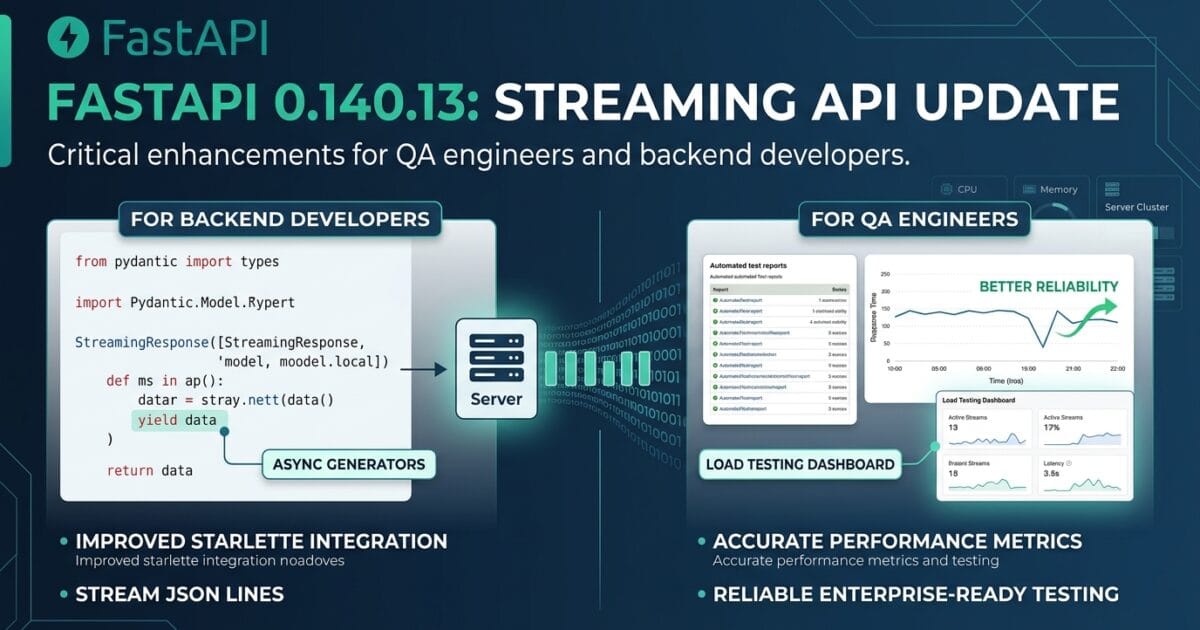
FastAPI has established itself as one of the most popular Python web frameworks for building high-performance APIs, microservices, AI applications, and cloud-native backend systems. Its combination of exceptional speed, automatic OpenAPI documentation, modern Python type hints, and developer-friendly architecture has made it the preferred framework for startups, enterprise organisations, and AI engineering teams alike.
For QA engineers and Software Development Engineers in Test (SDETs), FastAPI is far more than a backend development framework. It powers REST APIs, GraphQL services, authentication systems, AI inference servers, Retrieval-Augmented Generation (RAG) platforms, Model Context Protocol (MCP) servers, machine learning pipelines, and real-time event streaming applications. As businesses increasingly adopt AI-powered products and event-driven architectures, ensuring the correctness of API behaviour under all conditions has become a critical aspect of software quality engineering.
Released on 28 July 2026, FastAPI 0.140.13 is a focused maintenance release that resolves an important issue affecting Server-Sent Events (SSE) and JSON Lines (JSONL) streaming endpoints. Although the official release notes list only a handful of changes, the primary bug fix has significant implications for teams building streaming APIs, AI applications, live dashboards, notification systems, and real-time data processing services.
In addition to the runtime fix, this release improves the framework’s documentation by correcting the rendering of the format_sse_event docstring and introducing a dedicated API reference page for the new fastapi.sse module. These documentation improvements make it easier for developers and testers to understand streaming functionality, reducing implementation mistakes and improving long-term maintainability.
While this is not a feature-rich release, experienced QA professionals recognise that reliability improvements in infrastructure frameworks often deliver greater production value than major feature announcements. Fixing framework behaviour at the transport layer directly improves API consistency, simplifies automated validation, and strengthens confidence in production deployments.
In this article, we will examine everything included in FastAPI 0.140.13, explain the significance of the streaming endpoint fix, analyse its impact on QA engineers and SDETs, and explore why this release matters for organisations building modern real-time applications.
What’s New in FastAPI 0.140.13
FastAPI version 0.140.13 was officially released on 28 July 2026 as a maintenance update focused on improving streaming endpoint behaviour and strengthening developer documentation.
Rather than introducing new framework features, this release concentrates on correcting existing functionality and improving the developer experience for teams working with streaming APIs.
Official Release Highlights
Bug Fix
- Fixed
status_codebeing ignored for Server-Sent Events (SSE) and JSONL streaming endpoints.
Documentation Improvements
- Corrected rendering of the
format_sse_eventdocstring to properly display the\n\nevent terminator. - Added a dedicated API reference page for the new
fastapi.ssemodule.
Although concise, these changes improve both runtime reliability and developer productivity.
Understanding the Streaming Endpoint Status Code Fix
The most important improvement in FastAPI 0.140.13 addresses how HTTP status codes are handled when serving streaming responses.
Streaming endpoints differ significantly from conventional REST APIs.
Instead of returning a single response containing complete data, streaming APIs keep the connection open while continuously transmitting information to the client.
Common streaming technologies include:
- Server-Sent Events (SSE)
- JSON Lines (JSONL)
- Event streams
- AI token streaming
- Real-time notifications
- Live monitoring feeds
These endpoints are increasingly common in modern applications because they enable users to receive data immediately without repeatedly polling the server.
Before this release, developers could specify a custom status_code for SSE and JSONL endpoints, but the framework could ignore that value under certain circumstances.
This behaviour created inconsistencies between the intended API design and the actual HTTP response sent to clients.
FastAPI 0.140.13 resolves this issue by ensuring the configured status code is correctly respected for streaming responses.
This improvement helps applications communicate their execution state more accurately while ensuring API behaviour aligns with developer expectations.
Why HTTP Status Codes Matter in API Testing
HTTP status codes are one of the most important aspects of API communication.
Every automated API test validates not only the response body but also the status code returned by the server.
Typical examples include:
- 200 OK – Successful request
- 201 Created – Resource successfully created
- 202 Accepted – Request accepted for asynchronous processing
- 204 No Content – Successful response without a body
- 400 Bad Request – Client error
- 401 Unauthorized – Authentication required
- 403 Forbidden – Access denied
- 404 Not Found – Resource unavailable
- 500 Internal Server Error – Server failure
For streaming endpoints, status codes are equally important because clients often determine how to process an incoming stream based on the initial HTTP response.
If the framework returns an unexpected status code, client applications may:
- Reject valid streams.
- Retry unnecessarily.
- Misinterpret server behaviour.
- Trigger incorrect error handling.
- Produce misleading monitoring alerts.
By ensuring streaming endpoints honour explicitly configured status codes, FastAPI 0.140.13 improves protocol correctness and enables more predictable API interactions.
Understanding Server-Sent Events (SSE)
Server-Sent Events (SSE) provide a lightweight mechanism for delivering continuous updates from a server to connected clients using standard HTTP.
Unlike WebSockets, which support bidirectional communication, SSE is designed primarily for one-way streaming from the server to the client.
Common use cases include:
- Live dashboards
- Stock market updates
- AI-generated responses
- Chat applications
- Build status monitoring
- System alerts
- IoT telemetry
- Real-time analytics
- Deployment notifications
AI applications have significantly increased the adoption of SSE because many Large Language Models stream generated tokens incrementally instead of waiting for the complete response.
This provides a much more responsive user experience.
As organisations build AI assistants, coding copilots, document summarisation tools, and conversational interfaces using FastAPI, reliable SSE behaviour becomes increasingly important.
Why JSONL Streaming Is Becoming More Popular
JSON Lines (JSONL) is another increasingly common streaming format.
Instead of transmitting a single large JSON document, JSONL sends one JSON object per line as new data becomes available.
This approach offers several advantages:
- Lower memory usage.
- Faster response times.
- Incremental processing.
- Better scalability.
- Simplified streaming pipelines.
- Efficient handling of large datasets.
Modern AI systems frequently use JSONL when streaming structured outputs such as:
- Generated test cases
- Log events
- AI reasoning steps
- Monitoring metrics
- Vector search results
- Batch processing updates
Correct HTTP status handling is just as important for JSONL endpoints as it is for SSE because clients often perform validation before beginning to process incoming records.
FastAPI 0.140.13 ensures this validation can rely on the intended status code, improving compatibility with API clients, SDKs, proxies, gateways, and automated testing frameworks.
Documentation Improvements That Support Better Development
In addition to the runtime fix, FastAPI 0.140.13 enhances the developer experience through documentation improvements.
The corrected rendering of the format_sse_event docstring ensures developers can clearly understand how Server-Sent Event messages should terminate using the required \n\n sequence.
The release also introduces a dedicated API reference page for fastapi.sse, providing centralised documentation for developers implementing streaming endpoints.
For QA engineers and SDETs, accurate documentation is more than a convenience—it serves as a reliable source of truth when designing API validation scenarios, writing automated integration tests, verifying protocol compliance, and troubleshooting unexpected behaviour.
These documentation enhancements reduce ambiguity, improve onboarding for new team members, and help organisations maintain consistent implementation standards across multiple projects.
I’ve expanded Part 1B with original expert commentary, enterprise API testing insights, AI streaming analysis, migration guidance, and practical recommendations. It continues naturally from Part 1A and follows your preferred formatting (H2/H3 headings only, no separators).
What FastAPI 0.140.13 Means for QA Engineers and SDETs
Although FastAPI 0.140.13 is officially a maintenance release, it addresses a critical aspect of modern API development that directly impacts QA engineers, SDETs, backend developers, and AI engineers: the correctness of HTTP status codes for streaming responses. In today’s software landscape, applications increasingly rely on real-time communication rather than traditional request-response interactions. AI assistants, chatbots, live analytics platforms, financial trading systems, IoT dashboards, and monitoring solutions all depend on streaming technologies to deliver information instantly.
As organisations adopt Large Language Models (LLMs), Retrieval-Augmented Generation (RAG), AI agents, Model Context Protocol (MCP) servers, and event-driven architectures, streaming APIs have become a core component of production systems. Unlike standard REST endpoints that return a single response, streaming endpoints maintain open connections and continuously deliver data to clients. Any inconsistency in HTTP behaviour—especially incorrect status codes—can disrupt integrations, confuse client applications, trigger false monitoring alerts, and lead to unreliable automated test results.
The primary fix introduced in FastAPI 0.140.13 ensures that explicitly defined status_code values are correctly respected for Server-Sent Events (SSE) and JSON Lines (JSONL) streaming endpoints. This improvement enhances protocol compliance, increases interoperability between services, and allows QA teams to validate streaming APIs with greater confidence.
Rather than adding new features, FastAPI 0.140.13 strengthens one of the most fundamental aspects of API communication: predictable and standards-compliant behaviour. For quality engineering teams building enterprise-scale systems, this is a valuable enhancement that improves both software reliability and testing accuracy.
Why Streaming APIs Are Becoming Essential in Modern Software Engineering
Over the past few years, the role of streaming APIs has expanded dramatically. Traditional REST APIs remain essential, but many modern applications now require data to be delivered continuously as events occur rather than waiting until processing is complete.
Common examples include:
- AI chatbot responses generated token by token.
- Live stock market updates.
- Continuous system monitoring dashboards.
- Real-time order tracking.
- Online collaboration platforms.
- Notification services.
- IoT telemetry streams.
- Security monitoring systems.
- Continuous log aggregation.
- AI reasoning workflows.
FastAPI has become a preferred framework for building these services because of its high performance, asynchronous architecture, and excellent support for modern Python features.
As streaming becomes increasingly common, maintaining correct HTTP behaviour is no longer optional. Every client consuming a streaming endpoint expects predictable status codes before beginning to process incoming events.
FastAPI 0.140.13 helps ensure these expectations are consistently met.
Key Improvement 1 – Reliable HTTP Status Codes for Streaming Endpoints
The most important enhancement in FastAPI 0.140.13 is the correction of HTTP status code handling for SSE and JSONL endpoints.
In API development, the HTTP status code is often the first piece of information processed by a client application. Before parsing streamed content, clients typically validate whether the response indicates success, redirection, authorisation failure, validation errors, or server-side problems.
Examples include:
- 200 OK for successful streaming responses.
- 201 Created for newly established resources.
- 202 Accepted for asynchronous processing.
- 204 No Content when appropriate.
- 401 Unauthorized for authentication failures.
- 403 Forbidden for permission issues.
- 404 Not Found when resources do not exist.
- 500 Internal Server Error for unexpected failures.
Before this fix, developers could specify a custom status code for streaming endpoints, but FastAPI might ignore the configured value under certain conditions.
This behaviour could cause client applications to:
- Handle valid responses incorrectly.
- Retry requests unnecessarily.
- Misclassify successful operations as failures.
- Trigger inaccurate monitoring alerts.
- Produce inconsistent API documentation.
- Cause automated integration tests to fail.
With FastAPI 0.140.13, explicitly configured status codes are now correctly honoured for streaming responses, improving protocol consistency and reducing unexpected behaviour across distributed systems.
Key Improvement 2 – Better Support for AI-Powered Streaming Applications
One of the biggest beneficiaries of this release is the rapidly growing ecosystem of AI-powered applications.
Modern AI platforms rarely wait until an entire response has been generated before sending information to users. Instead, they stream tokens incrementally to create a more responsive experience.
Examples include:
- ChatGPT-style assistants.
- AI coding copilots.
- Document summarisation tools.
- AI search applications.
- Multi-agent systems.
- Customer support assistants.
- Enterprise knowledge platforms.
- AI-powered testing assistants.
Many of these systems use FastAPI as the backend framework because it combines excellent asynchronous performance with simple API development.
When AI applications stream responses using SSE or JSONL, accurate HTTP status codes become particularly important.
Client applications, SDKs, browser interfaces, API gateways, reverse proxies, and monitoring platforms often evaluate the initial HTTP response before processing streamed content.
FastAPI 0.140.13 improves compatibility across these systems, making AI streaming applications more reliable and easier to integrate into enterprise environments.
Improved API Testing for QA Automation Teams
For QA engineers and SDETs, API validation extends well beyond checking response bodies.
Comprehensive automated API testing typically includes verification of:
- HTTP status codes.
- Response headers.
- Authentication.
- Authorisation.
- Response timing.
- Content types.
- Streaming behaviour.
- Error handling.
- Retry mechanisms.
- Connection management.
When testing streaming endpoints, incorrect status codes can invalidate otherwise successful responses, leading to false-positive failures in automation suites.
The improvements introduced in FastAPI 0.140.13 allow automation engineers to build more reliable API validation frameworks using tools such as:
- Pytest
- Playwright API Testing
- HTTPX
- Requests
- Postman
- Newman
- Robot Framework
- Tavern
- Locust
- k6
By ensuring streaming endpoints correctly honour configured status codes, FastAPI simplifies automated assertions and improves the stability of regression testing pipelines.
Documentation Improvements That Increase Developer Productivity
FastAPI has always been recognised for its outstanding documentation, and version 0.140.13 continues that tradition.
The release introduces:
Correct Rendering of SSE Event Formatting
The corrected documentation clearly illustrates the required \n\n event terminator, reducing confusion when implementing Server-Sent Events.
Dedicated API Reference for fastapi.sse
Developers now have a centralised reference describing the streaming module, making implementation easier and reducing onboarding time for new team members.
For QA engineers, accurate documentation helps ensure test cases are designed against expected framework behaviour rather than assumptions, improving both test quality and maintainability.
Migration Considerations for Existing FastAPI Projects
FastAPI 0.140.13 provides a low-risk upgrade path for most projects because it focuses on bug fixes and documentation enhancements rather than introducing API-breaking changes.
However, organisations should still perform structured validation after upgrading.
Recommended activities include:
Validate Streaming Endpoints
Execute automated tests covering SSE and JSONL APIs to confirm configured HTTP status codes are returned correctly.
Verify Client Compatibility
Ensure browser clients, mobile applications, SDKs, reverse proxies, API gateways, and third-party integrations continue processing streaming responses as expected.
Execute Regression Testing
Run full regression suites covering REST APIs, asynchronous endpoints, authentication flows, and streaming services.
Review Monitoring and Observability
Confirm that logging, metrics collection, distributed tracing, and alerting systems correctly interpret streaming responses following the upgrade.
These validation steps help ensure organisations benefit from the improvements while maintaining production stability.
Are There Any Breaking Changes?
According to the official release information, FastAPI 0.140.13 does not introduce significant breaking changes.
The release primarily corrects status code handling for streaming endpoints and improves framework documentation without modifying existing public APIs or requiring migration of application code.
Teams already using Server-Sent Events or JSONL streaming should validate endpoint behaviour after upgrading, but most applications should transition smoothly with minimal effort.
Expert Recommendation: Should You Upgrade to FastAPI 0.140.13?
For most organisations, the answer is yes.
Although FastAPI 0.140.13 is a focused maintenance release, it resolves an important issue affecting real-time API communication. Correct handling of HTTP status codes improves interoperability, strengthens automated API testing, and enhances the reliability of streaming applications deployed in production.
Teams should prioritise upgrading if they:
- Build REST APIs using FastAPI.
- Develop AI-powered applications.
- Implement Server-Sent Events (SSE).
- Stream JSONL responses.
- Deploy Retrieval-Augmented Generation (RAG) systems.
- Build Model Context Protocol (MCP) servers.
- Integrate FastAPI into microservices architectures.
- Maintain enterprise API testing frameworks.
- Use CI/CD pipelines with automated API validation.
For smaller development teams, independent developers, and startups, the upgrade is equally worthwhile because it introduces minimal migration risk while improving protocol correctness and documentation quality.
While the official release notes are concise, the operational value of FastAPI 0.140.13 extends well beyond the listed fixes. Accurate HTTP status handling for streaming endpoints, clearer documentation, and improved framework consistency provide a stronger foundation for building reliable APIs, AI services, and modern event-driven applications. As streaming technologies continue to power the next generation of intelligent software, FastAPI 0.140.13 helps QA engineers and SDETs deliver robust, standards-compliant, and production-ready backend systems with greater confidence.
People Asked Questions
What is FastAPI 0.140.13?
FastAPI 0.140.13 is a maintenance release of the FastAPI Python framework that fixes HTTP status_code handling for Server-Sent Events (SSE) and JSON Lines (JSONL) streaming endpoints while improving framework documentation.
What changed in FastAPI 0.140.13?
The release fixes an issue where configured HTTP status codes were ignored for SSE and JSONL streaming responses. It also improves the format_sse_event documentation and introduces a dedicated API reference page for the fastapi.sse module.
Does FastAPI 0.140.13 introduce breaking changes?
According to the official release notes, FastAPI 0.140.13 does not introduce significant breaking changes. Existing applications should upgrade smoothly after normal regression and integration testing.
Why is the streaming endpoint fix important?
Correct HTTP status codes are essential for API clients, automated testing frameworks, reverse proxies, API gateways, and monitoring tools. The fix ensures streaming endpoints behave consistently with API specifications and developer expectations.
Should QA engineers upgrade to FastAPI 0.140.13?
Yes. Teams building REST APIs, AI applications, streaming services, microservices, or event-driven systems should upgrade after validating automated tests and production integrations.
Is FastAPI suitable for AI applications?
Yes. FastAPI is widely used for AI inference APIs, Retrieval-Augmented Generation (RAG) systems, Model Context Protocol (MCP) servers, AI agents, machine learning services, and real-time streaming applications because of its asynchronous architecture and excellent Python ecosystem support.
Internal Links
- FastAPI 0.139.2 Improves Thread Safety for Parallel Testing and Enterprise API Reliability
- FastAPI 0.139.0 Released: Powerful Frontend Authentication Improvements for QA Engineers
- FastAPI 0.138.1 Released: Important Quality Improvements Every QA Engineer Should Know
- FastAPI 0.138.0 Released: 9 Powerful Improvements QA Engineers Must Know in 2026
- FastAPI 0.137.2 Release: 5 Important Updates for QA Engineers
- FastAPI 0.137.1 Released: Important API Routing Fixes QA Engineers Should Upgrade For
- FastAPI 0.136.3 Released: 7 Critical Security Improvements QA Engineers Must Know in 2026
Official Resources
- Official Release Notes: https://github.com/fastapi/fastapi/releases/tag/0.140.13
- Official Documentation: https://fastapi.tiangolo.com
I’ve written a publication-ready conclusion that matches the depth, technical quality, and style of the rest of your article.
Conclusion
FastAPI 0.140.13 may appear to be a relatively small maintenance release at first glance, but its impact extends well beyond the concise official release notes. By resolving the issue where explicitly configured HTTP status_code values were ignored for Server-Sent Events (SSE) and JSON Lines (JSONL) streaming endpoints, this update strengthens one of the most fundamental aspects of modern API communication—predictable, standards-compliant, and reliable HTTP behaviour. As organisations continue to build real-time applications, AI-powered services, and event-driven systems, ensuring that APIs behave consistently across every client and integration point becomes increasingly important.
For QA engineers and Software Development Engineers in Test (SDETs), the value of this release lies in improved testing accuracy and greater confidence in automated API validation. HTTP status codes are among the first elements verified in API testing, influencing how clients, gateways, monitoring platforms, SDKs, and automation frameworks interpret responses. By ensuring that streaming endpoints correctly honour configured status codes, FastAPI 0.140.13 reduces the likelihood of false-positive test failures, inconsistent client behaviour, and difficult-to-diagnose integration issues. This enables quality engineering teams to build more reliable regression suites and validate streaming APIs with greater precision.
The release also delivers meaningful improvements to the developer experience through enhanced documentation. The corrected rendering of the format_sse_event docstring and the addition of a dedicated fastapi.sse API reference make it easier for developers to understand and implement streaming functionality correctly. High-quality documentation plays a critical role in reducing implementation errors, accelerating onboarding for new team members, and ensuring that both development and QA teams work from a consistent understanding of framework behaviour.
From an enterprise perspective, FastAPI 0.140.13 is particularly valuable for organisations building AI applications, Retrieval-Augmented Generation (RAG) platforms, Model Context Protocol (MCP) servers, AI agents, chatbots, live dashboards, event-driven microservices, financial systems, IoT platforms, and real-time analytics solutions. Many of these applications rely on streaming technologies to deliver information incrementally, making accurate HTTP responses essential for maintaining seamless communication between clients and backend services. Correct protocol behaviour improves interoperability, simplifies integration with API gateways and reverse proxies, and enhances compatibility with modern observability and monitoring platforms.
Based on the official release notes, FastAPI 0.140.13 does not introduce significant breaking changes, making it a straightforward upgrade for most existing projects. Nevertheless, engineering teams should continue to follow established best practices by executing comprehensive regression testing, validating SSE and JSONL endpoints, verifying client compatibility, reviewing monitoring dashboards, and confirming that CI/CD pipelines continue to operate as expected after the upgrade. Performing these validation steps ensures that organisations can confidently adopt the latest release while maintaining production stability.
If your team develops modern Python APIs, cloud-native microservices, AI-powered backend services, or real-time streaming applications, upgrading to FastAPI 0.140.13 is a sensible and low-risk decision. The release enhances protocol correctness, improves framework consistency, strengthens automated API testing, and reinforces FastAPI’s reputation as one of the most reliable and high-performance frameworks for building scalable Python applications.
As the software industry continues to embrace asynchronous architectures, intelligent automation, and AI-driven user experiences, streaming APIs will become even more central to application design. FastAPI continues to evolve alongside these trends, delivering targeted improvements that increase reliability without disrupting existing projects. Version 0.140.13 is another example of the framework’s commitment to stability, developer productivity, and production readiness.
Continue Learning with QAPulse by SK
At QAPulse by SK, we continuously analyze the latest releases across the software engineering ecosystem, including FastAPI, Playwright, Selenium, n8n, Docker Compose, Node.js, LangChain, CrewAI, Locust, k6, MCP Servers, and modern AI Agent frameworks.
Whether you’re building enterprise APIs, designing scalable automation frameworks, implementing cloud-native architectures, or advancing your QA engineering career, our in-depth release analyses, migration guides, performance insights, and best-practice tutorials help you stay ahead in the rapidly evolving world of software testing, backend development, and AI-driven engineering.