 QA
QA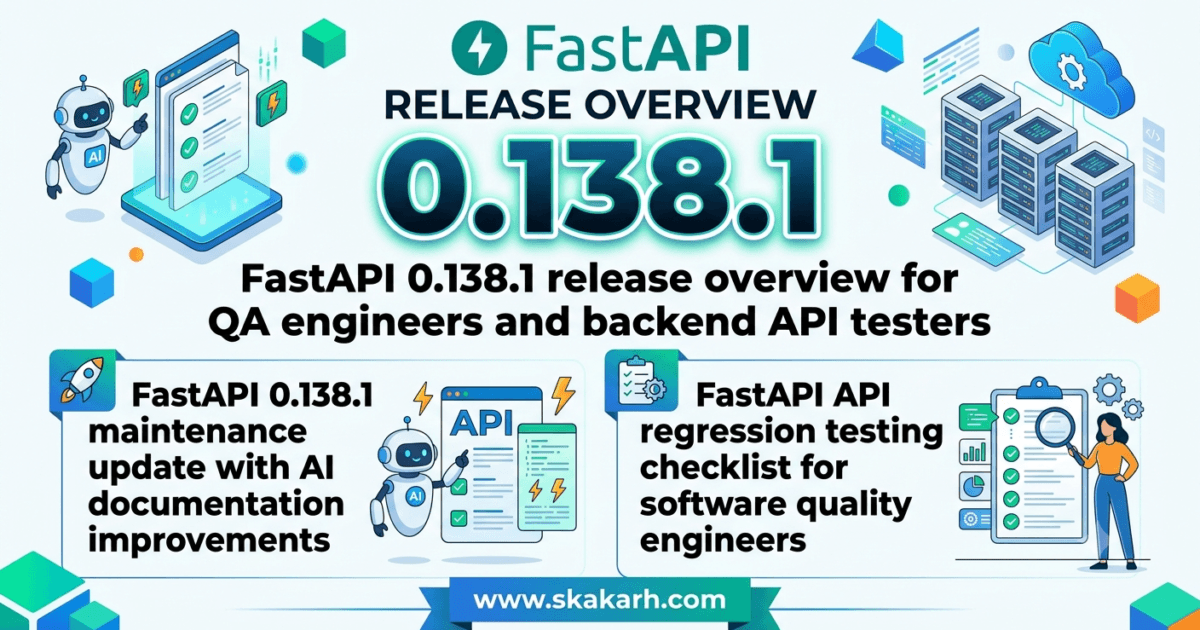
FastAPI 0.138.1 has officially been released, bringing another incremental update to one of the most popular Python web frameworks used for modern API development. While this release does not introduce new developer-facing features, it focuses on improving the project’s internal architecture, documentation organization for AI agents, dependency management, workflow security, and maintainability.
At first glance, many engineers may dismiss this release because it primarily contains refactoring and internal changes. However, experienced QA engineers understand that seemingly “small” maintenance releases often improve the long-term stability of a framework. These releases reduce technical debt, strengthen project infrastructure, and prepare the ecosystem for larger feature releases in the future.
If your organization builds REST APIs using FastAPI, this update deserves attention—not because it changes how your APIs behave today, but because it improves the foundation that future FastAPI releases will build upon.
In this article, we’ll examine the official changes, explain their practical impact on software testing teams, discuss whether you should upgrade immediately, and outline a testing strategy for validating FastAPI 0.138.1 in enterprise environments.
What Changed in FastAPI 0.138.1?
According to the official release notes, FastAPI 0.138.1 is primarily a maintenance release that includes:
- Refactoring of Library Skills to improve discoverability for AI agents.
- Simplified GitHub pull request workflow triggers.
- Updates to the internal issue-management tooling.
- Security improvements to repository workflows.
- Dependency updates, including a newer version of
pydantic-settings. - Sponsor and project maintenance updates.
Unlike feature releases, none of these changes introduce new API endpoints, decorators, validation mechanisms, or request/response behavior.
That is good news for production teams because maintenance releases generally carry a much lower upgrade risk.
Why This Release Still Matters for QA Engineers
Many organizations only pay attention to major feature releases.
That approach can be risky.
Healthy open-source projects continuously improve their internal architecture between major releases. These incremental improvements reduce bugs, improve maintainability, and strengthen development workflows.
FastAPI 0.138.1 is a perfect example.
Although your application code is unlikely to require modifications, the framework itself benefits from cleaner tooling, stronger automation, and improved project organization.
From a QA perspective, stable development infrastructure ultimately translates into more reliable releases.
The Biggest Change: Better Library Skills for AI Agents
The headline improvement in FastAPI 0.138.1 is the refactoring of Library Skills to make project information easier for AI agents to discover and use.
This may sound unrelated to software testing, but it reflects a growing trend across modern software engineering.
AI-powered developer assistants are becoming part of everyday development workflows.
Tools based on:
- GitHub Copilot
- OpenAI Codex
- Claude Code
- Cursor IDE
- Model Context Protocol (MCP)
- Agentic AI development platforms
all rely on structured project information to generate accurate code suggestions.
Improving how documentation and project metadata are organized helps these tools understand FastAPI projects more effectively.
For engineering teams already experimenting with AI-assisted coding, this represents a meaningful long-term investment by the FastAPI maintainers.
Why AI-Friendly Frameworks Matter for Test Automation
Modern QA engineering extends well beyond writing manual test cases.
Today’s automation engineers increasingly use AI to:
- Generate API tests
- Create regression scenarios
- Produce mock requests
- Explain validation errors
- Review pull requests
- Generate OpenAPI-based test suites
- Build automation frameworks faster
Frameworks that expose cleaner metadata and documentation enable these AI systems to generate higher-quality outputs.
Although FastAPI 0.138.1 doesn’t directly change API testing, it improves the ecosystem surrounding AI-assisted software development.
That makes this release more important than the short changelog initially suggests.
Internal Improvements Often Lead to Better Stability
One lesson experienced SDETs learn over time is that software quality isn’t determined only by customer-facing features.
Behind every stable framework lies an enormous amount of maintenance work.
FastAPI 0.138.1 continues that maintenance by improving:
- Internal workflows
- Repository management
- Security validation
- Dependency updates
- Documentation organization
These improvements rarely appear in marketing headlines, yet they reduce future maintenance costs and lower the likelihood of regressions in upcoming releases.
As QA professionals, we should appreciate releases that strengthen engineering quality rather than simply adding more features.
Security Improvements Are Good News for Enterprise Teams
Another notable aspect of this release is the update to repository security workflows.
The FastAPI project has strengthened its automated security validation by updating workflow security checks.
Although this does not directly affect runtime applications, it demonstrates an ongoing commitment to secure software supply chain practices.
Organizations building enterprise APIs increasingly evaluate not only application security but also the security posture of the open-source frameworks they depend upon.
A project that continuously improves its build and release pipelines is generally a healthier project to adopt over the long term.
For regulated industries such as banking, healthcare, insurance, and government systems, these maintenance improvements provide additional confidence in the framework’s maturity.
What FastAPI 0.138.1 Means for QA Engineers
From a testing perspective, FastAPI 0.138.1 is a low-risk maintenance release. There are no breaking API changes, no modifications to request validation, no changes to dependency injection, and no alterations to routing behavior. That means your existing automation suites should continue to execute without modification.
However, “low-risk” should never be confused with “no testing required.”
Even internal framework updates deserve structured validation before deployment. Organizations with mature QA processes understand that regression testing validates assumptions rather than simply confirming functionality.
For this release, QA teams should focus on verifying that:
- Existing REST endpoints behave exactly as before.
- Request and response validation remain unchanged.
- Authentication and authorization flows continue working correctly.
- API documentation generated through OpenAPI and Swagger UI remains accurate.
- Existing middleware executes without unexpected side effects.
- Performance characteristics remain consistent.
A lightweight regression suite is generally sufficient for this version, making it an ideal candidate for routine maintenance upgrades.
Dependency Update: Why pydantic-settings Matters
One of the few functional changes in this release is the update of pydantic-settings from version 2.14.1 to 2.14.2.
Configuration management is often overlooked during testing, yet many production incidents originate from configuration rather than application logic.
Since FastAPI applications commonly rely on environment variables for:
- Database connections
- API keys
- OAuth credentials
- Cloud storage
- Logging configuration
- Feature flags
- Secret management
QA engineers should validate configuration loading after upgrading.
Recommended checks include:
- Local development environments
- Docker containers
- Kubernetes ConfigMaps
- Secret managers
- CI/CD environment variables
While the dependency update is minor, validating application startup and configuration parsing is a worthwhile precaution.
Recommended Regression Testing Checklist
Before promoting FastAPI 0.138.1 to production, consider executing the following regression checklist:
✅ API endpoint validation
✅ Request body validation
✅ Response schema verification
✅ Authentication and authorization
✅ JWT token workflows
✅ OpenAPI documentation generation
✅ Swagger UI accessibility
✅ Dependency injection
✅ Background tasks
✅ Middleware execution
✅ Exception handlers
✅ Logging and monitoring
✅ Database integration tests
✅ Docker image build
✅ CI/CD deployment pipeline
These tests provide confidence that the maintenance update has not introduced unintended side effects into your application ecosystem.
Should You Upgrade Immediately?
For most organizations, yes.
Unlike major feature releases, FastAPI 0.138.1 introduces no known breaking API behavior and focuses primarily on improving project quality and maintainability.
My recommendation differs slightly depending on your environment:
Upgrade Immediately If:
- You actively maintain FastAPI applications.
- Your team regularly adopts patch releases.
- You already have automated regression testing.
- You value staying current with dependency and security improvements.
Schedule a Controlled Upgrade If:
- Your application is business-critical.
- You operate within regulated environments.
- Your release process requires formal validation.
- You maintain custom middleware or framework extensions.
In either case, this is a release that should comfortably fit into normal maintenance windows.
How to Upgrade FastAPI
Upgrade using pip:
pip install --upgrade fastapi
If you’re using Poetry:
poetry update fastapi
For projects managed with uv:
uv add fastapi@latest
After upgrading, rebuild your virtual environment if necessary and execute your full regression suite before deploying to staging or production.
My Verdict
FastAPI 0.138.1 is not an exciting release—and that’s exactly why it’s valuable.
The FastAPI maintainers continue investing in code quality, security, tooling, documentation, and maintainability instead of rushing unnecessary features into the framework.
These incremental improvements strengthen the ecosystem that thousands of production applications rely on every day.
From a QA perspective, this release earns a “Recommended Upgrade” rating. It carries low migration risk while keeping your projects aligned with the latest maintenance and security improvements.
Frequently Asked Questions
Does FastAPI 0.138.1 introduce breaking changes?
No. The release focuses on internal refactoring, dependency updates, and project maintenance. Existing FastAPI applications should continue to function without code modifications.
Should QA engineers perform full regression testing?
A focused regression suite covering APIs, authentication, validation, middleware, and deployment pipelines is recommended before production rollout.
Is this release important for AI-assisted development?
Yes. The refactoring of Library Skills improves how AI agents discover project information, contributing to better AI-assisted development workflows over time.
Should enterprise teams upgrade?
Yes, provided standard regression testing is completed. The release is well suited for routine maintenance upgrades.
Helpful Resources
Official References
- FastAPI Documentation: https://fastapi.tiangolo.com/
- FastAPI Release Notes: https://github.com/fastapi/fastapi/releases/tag/0.138.1
- Pydantic Documentation: https://docs.pydantic.dev/
- Starlette Documentation: https://www.starlette.io/
Continue Learning on QAPulse by SK
Explore more practical guides and release analyses on https://www.skakarh.com, including:
- FastAPI Testing Best Practices
- Playwright Automation Tutorials
- PyTest Deep Dives
- Selenium Framework Guides
- MCP and Agentic AI Tutorials
- AI Testing Strategies for Modern Engineering Teams
Internal Links
- Locust 2.44.3 Released: Important Build Stability Fix Performance Testers Should Know
- FastAPI 0.137.2 Release: 5 Important Updates for QA Engineers
- CrewAI 1.14.7 Released: Powerful Agentic AI Improvements QA Engineers Must Know
- Locust 2.44.1 Released: Valuable Observability Improvements Performance Test Engineers Will Love
- PostgreSQL 19 Beta 1 Released: Powerful Database Updates QA Engineers Must Know
Conclusion
FastAPI 0.138.1 may not introduce new endpoints or developer-facing features, but it reflects something equally important: a commitment to continuous engineering excellence. Cleaner internal architecture, stronger workflow security, updated dependencies, and improved AI discoverability all contribute to a healthier framework for the future.
For QA engineers and SDETs, this release is a reminder that maintaining software quality isn’t only about testing new features—it also means validating maintenance releases that improve stability behind the scenes. Teams that consistently adopt these incremental updates are often better prepared for larger framework changes and experience fewer surprises during major upgrades.
If your organization relies on FastAPI for APIs, microservices, or AI-powered backend applications, FastAPI 0.138.1 is a sensible maintenance upgrade that deserves a place in your next scheduled release cycle.
QAPulse by SK delivers expert insights on software testing, QA engineering, AI automation, Playwright, Selenium, FastAPI, Python, and modern DevOps tooling.
Visit https://www.skakarh.com for more in-depth tutorials, release analyses, comparison guides, automation frameworks, and practical resources designed for QA engineers and software professionals.