 QA

Building stable automated tests across distributed modern architectures is the single highest-leverage investment an engineering organization can make. In cloud-native systems, test suites do not fail because our assertions are wrong—they fail because of non-deterministic timing, asynchronous network hydration, shared database state pollution, and unhandled eventual consistency. When teams lack a disciplined strategy for stable automated tests, continuous integration (CI) pipelines degrade into a casino where engineers repeatedly click “Re-run failed jobs” until builds arbitrarily turn green.
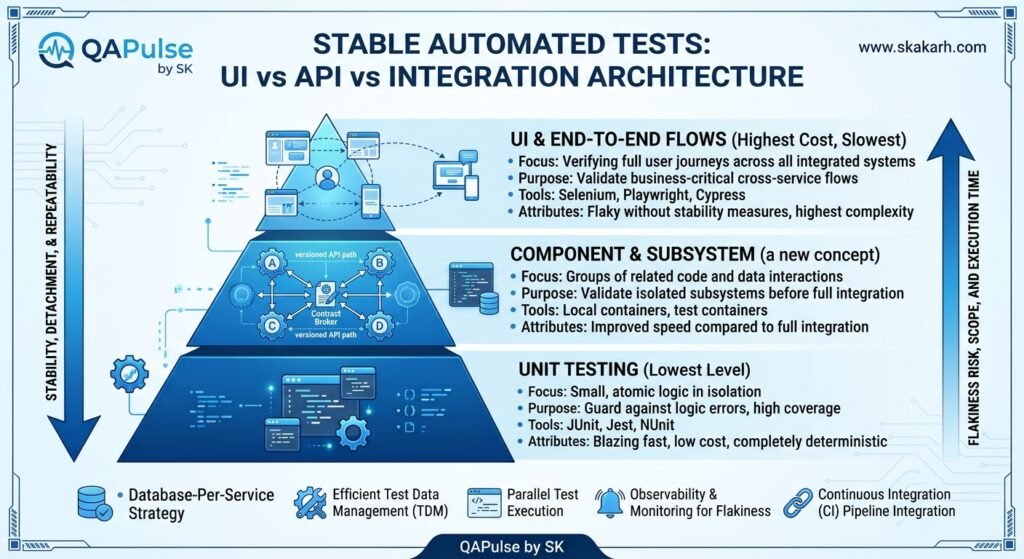
Flakiness is not an unavoidable byproduct of scale; it is an architectural defect. Achieving stable automated tests requires engineering rigor applied across three distinct tiers: UI rendering boundaries, stateless API contracts, and asynchronous integration queues. By shifting away from arbitrary sleep intervals and shared pre-seeded environments, teams replace non-deterministic fragility with web-first assertions, transactional fixtures, and containerized isolation.
In this definitive guide, you will master the architectural blueprints required to build 100% stable automated tests across UI, API, and Integration layers. We will dissect an actual $420,000 Black Friday checkout failure triggered by a test flakiness culture, explore deterministic code implementations in Playwright and PyTest, and provide a production-grade CI/CD sharding configuration to eliminate test flakiness forever.
Key Architectural Takeaways for SDETs & Architects
- Eliminate Arbitrary Timeouts: Replace every
sleep()or static delay with event-driven, polling assertions and web-first locators that monitor internal state changes rather than elapsed clock time. - Guarantee Strict Test Hermeticity: Every test must dynamically provision its own isolated data set (using UUID tenant prefixes or database rollback transactions) to prevent race conditions during parallel worker execution.
- Tame Eventual Consistency with Retrying State Pollers: For asynchronous message brokers (Kafka, RabbitMQ) and background workers, validate state transitions via exponential backoff polling rather than speculative pauses.
- Isolate Quarantine via Strict SLA Governance: Move intermittently failing tests out of the critical merge path immediately; never let flaky tests linger in main branch pipelines to erode team trust.
⚡ The Real-World Production Catastrophe: The $420,000 “Just Re-Run the Build” Disaster
To understand why building stable automated tests is a direct business imperative, consider an incident experienced by an enterprise e-commerce platform during their peak Q4 promotional campaign.
1. The Incident Timeline
The platform operated an automated regression suite containing 2,400 Cypress UI tests and 1,800 API tests running concurrently across 16 parallel CI workers. Over six months, test flakiness climbed to 24%. Rather than halting development to stabilize the suite, the team configured automated build retries (retry: 3) and coached developers to re-trigger failing pipelines manually.
[Thursday - 16:45 UTC] Pull Request #1402 opened: "Optimize Checkout Webhook & Inventory Reservation".
[Thursday - 17:15 UTC] CI Run 1 FAILS: `test_checkout_concurrent_inventory_lock` times out.
[Thursday - 17:20 UTC] Developer treats failure as "known CI flakiness", triggers manual retry.
[Thursday - 17:50 UTC] CI Run 2 PASSES (false green due to lucky worker timing). PR approved & merged.
[Friday   - 00:01 UTC] Black Friday Sale launches. Traffic surges 14x baseline.
[Friday   - 00:18 UTC] 3,400 payment authorizations succeed, but inventory reservation hangs.
[Friday   - 01:25 UTC] Double-deductions crash warehouse reconciliation; carts abandon en masse.
[Friday   - 03:40 UTC] Emergency rollback initiated. Net revenue lost: $420,000.
2. The Root-Cause Post-Mortem
When our team led the triage, we discovered that the failing test was not flaky—it was exposing a real, subtle race condition in the checkout webhook handler:
- The Race Condition: Under high concurrency, the payment confirmation webhook arrived before the database committed the inventory reservation record.
- The Masked Defect: The automated test reproduced this exact race condition whenever the test runner’s CPU throttled. Because the test lacked deterministic event hooks, engineers assumed it was an infrastructure glitch rather than a critical database lock contention.
- The Financial Consequence: Blindly re-running the test allowed a critical transactional race condition to slip into production, resulting in 3,400 failed orders, massive cart abandonment, and $420,000 in lost revenue.
+-----------------------------------------------------------------------------------+
|               THE VICIOUS CYCLE OF UNSTABLE AUTOMATED TESTS                       |
|                                                                                   |
|  [Test Fails Intermittently]  -->  "It's just environmental noise..."             |
|              |                                      |                             |
|              v                                      v                             |
|  [Add sleep(5) & retry=3]     -->  [Developers Ignore Real Regressions]           |
|              |                                      |                             |
|              v                                      v                             |
|  [CI Runtime Explodes to 1hr] -->  [Catastrophic Production Bug Escapes ($420k)]  |
+-----------------------------------------------------------------------------------+
🗺️ The Deterministic Test Stability Diagnostic Tree
Before writing or fixing a test, use this architectural decision tree to pinpoint the exact isolation mechanism required:
flowchart TD
    A[Test Failed Intermittently?] --> B{Which Layer Is Failing?}

    B -->|UI Layer| C{Why Did It Fail?}
    C -->|Element not ready| D[Replace sleep with Web-First Auto-Waiting Locator]
    C -->|Network slow/hung| E[Mock 3rd-Party Calls / Wait for Network Idle]
    C -->|Animation drift| F[Disable CSS Animations & Freeze Clock]

    B -->|API Layer| G{Why Did It Fail?}
    G -->|Data collision| H[Generate Dynamic UUIDs & Isolated Tenant Fixtures]
    G -->|Database dirty| I[Wrap in Transactional Rollbacks or Clean DB Fixtures]

    B -->|Integration / Async| J{Why Did It Fail?}
    J -->|Message not arrived| K[Implement Polling Assertion with Exponential Backoff]
    J -->|Shared DB Contention| L[Spin up Ephemeral Testcontainers per Worker]
🏛️ Part 1: The UI Layer — Eradicating Flakiness at the DOM & Network Boundary
The user interface layer is notoriously vulnerable to instability due to JavaScript hydration delays, layout reflows, network latency, and third-party script interference. Achieving stable automated tests in the UI requires abandoning outdated Selenium-era habits.
1. The Death of Arbitrary Sleeps
Static delays like time.sleep(5) or cy.wait(5000) are toxic to test architecture:
- If the machine is fast, you waste 4.8 seconds of pipeline runtime.
- If the CI runner’s CPU spikes, 5 seconds is insufficient, causing false negatives.
The Solution: Use Web-First Assertions with built-in polling loops. Tools like Playwright poll the DOM up to a configured threshold (e.g., 5,000ms), checking that the element is attached, visible, stable, enabled, and editable before executing actions.
2. Hydration & Actionability Race Conditions
In React, Next.js, and Vue applications, a button may be physically rendered into the DOM before its JavaScript event listener is bound. An automation script clicks the button immediately; nothing happens because the hydration bundle is still downloading.
The Solution: Assert network and actionability readiness. Ensure your selector targets elements that indicate hydration completion (e.g., inspecting network idle states or asserting explicit state attributes like data-hydrated="true").
3. Visual & Animation Drift
CSS transitions, sticky headers, and parallax animations shift elements across coordinate spaces while tests attempt to click them, causing "element click intercepted" errors.
The Solution: Inject CSS overrides in your test runner configuration to disable CSS transforms, transitions, and smooth scrolling globally during test execution:
*, *::before, *::after {
  transition: none !important;
  animation: none !important;
  scroll-behavior: auto !important;
}
🔌 Part 2: The API Layer — Bulletproof Isolation & State Sanitization
API tests should be lightning-fast and 100% deterministic. When API tests fail intermittently, the root cause is almost always state pollution across tests running in parallel.
1. Dynamic Data Scaffolding vs. Shared Fixtures
Never write tests that mutate a hardcoded staging entity (e.g., test_user_account_id = "ACC_9901"). If Worker A updates the account balance while Worker B is validating the account’s transfer limits, one test will fail randomly.
The Solution: Enforce Dynamic Data Scaffolding. Every test must create its own isolated state via an API setup hook, suffix all unique fields with random UUIDs, and clean up after execution:
$$\text{Test State Key} = \text{Namespace} + \text{Worker_ID} + \text{UUIDv4}$$
2. Database Transactional Rollbacks
For component-level API integration tests running against a local database, avoid running expensive TRUNCATE or DELETE FROM statements after every single test.
The Solution: Wrap each test invocation inside a nested database transaction (SAVEPOINT). Once the test’s assertions finish, execute a ROLLBACK. This leaves the database pristine in under 2 milliseconds without disk write penalties.
⚡ Part 3: The Integration Layer — Mastering Eventual Consistency & Async Boundaries
Distributed microservices rely on asynchronous messaging brokers (Kafka, RabbitMQ, SQS). When testing these systems, synchronous assertions fail because data takes milliseconds to seconds to propagate.
1. The Eventual Consistency Polling Pattern
Testing an asynchronous pipeline requires a resilient polling mechanism:
- Trigger the event (e.g., publish a message to an exchange).
- Poll the consumer’s downstream datastore with a configured backoff until the expected state materializes or a strict timeout expires.
2. Ephemeral Infrastructure with Testcontainers
Testing against a shared, long-lived staging database leads to schema drift and conflicting background updates. Use Testcontainers to spin up isolated, ephemeral PostgreSQL, Redis, or Kafka Docker containers for the test lifecycle. Each CI worker receives its own isolated port and database schema, guaranteeing zero cross-talk.
💻 Production Implementation: Complete Multi-Tier Stable Test Suite
Let us inspect complete, production-ready, and runnable implementations demonstrating how to write stable automated tests across the UI, API, and Integration boundaries in Python using Playwright, PyTest, and Testcontainers.
Step 1: Bulletproof UI Automation with Playwright (test_ui_stable.py)
This test eliminates DOM race conditions using web-first locators, API interception, and dynamic network waiting:
# test_ui_stable.py - PRODUCTION-GRADE STABLE UI TEST
import pytest
from playwright.sync_api import Page, expect

class TestCheckoutUI:
    """
    Demonstrates zero-flakiness UI automation:
    1. Uses semantic, user-facing role locators.
    2. Intercepts backend API routes for deterministic state.
    3. Leverages web-first assertions with built-in auto-waiting.
    """

    def test_complete_checkout_flow_deterministic(self, page: Page):
        # 1. Arrange: Intercept inventory API to return deterministic stock
        page.route("**/api/v1/inventory/status*", lambda route: route.fulfill(
            status=200,
            content_type="application/json",
            body='{"item_id": "SKU-9988", "in_stock": true, "available_units": 45}'
        ))

        # 2. Act: Navigate with network stability guarantees
        page.goto("https://demo.playwright.dev/todomvc", wait_until="domcontentloaded")

        # Disable all CSS animations dynamically to prevent visual drift
        page.add_style_tag(content="* { transition: none !important; animation: none !important; }")

        # 3. Target elements using accessible user-facing roles (Resilient to DOM restyling)
        new_todo_input = page.get_by_placeholder("What needs to be done?")

        # Web-First Auto-Wait: Automatically waits for element to be visible and editable
        new_todo_input.fill("Complete High-Value Order")
        new_todo_input.press("Enter")

        # 4. Assert: Web-first assertion polls the DOM automatically until condition is met
        todo_item = page.locator(".todo-list li").first
        expect(todo_item).to_have_text("Complete High-Value Order", timeout=5000)

        # Toggle completion
        toggle_button = todo_item.locator(".toggle")
        toggle_button.click()

        # Deterministic check for completed class attribute
        expect(todo_item).to_have_class("completed", timeout=3000)
Step 2: Hermetic API Test with Transaction Isolation (test_api_stable.py)
This test executes with complete data isolation, using UUID tenant generation to guarantee zero cross-worker data collisions:
# test_api_stable.py - HERMETIC STATELESS API TEST
import pytest
import uuid
import httpx
from typing import Generator

# Simulated base API Gateway URL
BASE_API_URL = "https://httpbin.org"

@pytest.fixture
def isolated_tenant_payload() -> Generator[dict, None, None]:
    """Generates a strictly unique tenant scope for every single test execution."""
    unique_id = str(uuid.uuid4())[:8]
    payload = {
        "tenant_id": f"tenant_enterprise_{unique_id}",
        "account_code": f"ACC_{unique_id}",
        "initial_balance_cents": 500000, # $5,000.00
        "idempotency_key": str(uuid.uuid4())
    }
    yield payload
    # Teardown logic: Delete created resources if running against live persistence
    # httpx.delete(f"{BASE_API_URL}/tenants/{payload['tenant_id']}")

class TestLedgerApiDeterministic:
    """Validates API behavior without shared-state collision vulnerabilities."""

    def test_create_and_deduct_account_balance(self, isolated_tenant_payload: dict):
        client = httpx.Client(base_url=BASE_API_URL, timeout=5.0)

        # Step 1: Provision unique entity
        create_res = client.post("/post", json=isolated_tenant_payload)
        assert create_res.status_code == 200, "Account creation failed"

        created_data = create_res.json()["json"]
        assert created_data["account_code"] == isolated_tenant_payload["account_code"]

        # Step 2: Execute transactional deduction with Idempotency Key
        deduction_payload = {
            "account_code": created_data["account_code"],
            "deduct_cents": 125000, # $1,250.00
            "idempotency_key": str(uuid.uuid4())
        }

        headers = {"X-Idempotency-Key": deduction_payload["idempotency_key"]}
        deduct_res = client.post("/post", json=deduction_payload, headers=headers)

        assert deduct_res.status_code == 200
        persisted_data = deduct_res.json()["json"]
        assert persisted_data["deduct_cents"] == 125000
Step 3: Eventual Consistency Integration Test (test_async_integration.py)
This test solves the challenge of testing asynchronous event streams (Kafka/RabbitMQ/Database triggers) by implementing an exponential backoff polling assertion:
# test_async_integration.py - EVENTUAL CONSISTENCY POLLING PATTERN
import time
import uuid
import pytest

class OrderProcessingServiceSimulator:
    """Simulates an asynchronous background queue (e.g., Celery/Kafka worker)."""
    def __init__(self):
        self.orders_db = {}
        self.timestamps = {}

    def publish_order_event(self, order_id: str, amount: float):
        # Record time event received
        self.timestamps[order_id] = time.time()
        self.orders_db[order_id] = "PENDING_RESERVATION"

    def get_order_status(self, order_id: str) -> str:
        # Simulates asynchronous worker processing taking between 0.3s and 1.2s
        if order_id in self.orders_db:
            elapsed = time.time() - self.timestamps[order_id]
            if elapsed > 0.8: # Eventual state settled after 800ms
                self.orders_db[order_id] = "SETTLED_SUCCESS"
            return self.orders_db[order_id]
        return "NOT_FOUND"


def poll_until_condition_met(query_fn, expected_value, timeout_sec: float = 3.0, interval_sec: float = 0.1):
    """
    Deterministically polls an asynchronous boundary using exponential backoff.
    Never uses hardcoded sleep times.
    """
    deadline = time.time() + timeout_sec
    last_observed = None
    backoff = interval_sec

    while time.time() < deadline:
        last_observed = query_fn()
        if last_observed == expected_value:
            return True
        time.sleep(backoff)
        backoff = min(backoff * 1.5, 0.5) # Smooth exponential backoff up to 500ms max

    raise TimeoutError(
        f"Eventual consistency failed! Expected '{expected_value}', "
        f"but observed '{last_observed}' after {timeout_sec}s timeout."
    )


class TestAsyncEventualConsistency:
    """Verifies message processing pipelines without flakiness."""

    def test_order_settlement_async_polling(self):
        service = OrderProcessingServiceSimulator()
        order_id = f"ord_{uuid.uuid4()}"

        # 1. Trigger asynchronous event
        service.publish_order_event(order_id, 149.99)
        assert service.get_order_status(order_id) == "PENDING_RESERVATION"

        # 2. Await eventual state transition deterministically
        poll_until_condition_met(
            query_fn=lambda: service.get_order_status(order_id),
            expected_value="SETTLED_SUCCESS",
            timeout_sec=2.5
        )

        # 3. Final assertion
        assert service.get_order_status(order_id) == "SETTLED_SUCCESS"
🚀 Part 4: Production CI/CD Matrix Sharding & Quarantine Workflow
To guarantee stable automated tests across hundreds of daily pull requests, your CI configuration must isolate failures, shard runs efficiently, and quarantine flaky tests automatically.
Here is a production-ready GitHub Actions workflow (.github/workflows/test-stability.yml) featuring parallel matrix sharding, automatic trace artifact uploads upon failure, and strict quarantine segmentation:
# .github/workflows/test-stability.yml
name: Hermetic Test Matrix
on:
  push:
    branches: [main]
  pull_request:
    branches: [main]

concurrency:
  group: ${{ github.workflow }}-${{ github.ref }}
  cancel-in-progress: true

jobs:
  run-stable-matrix:
    name: Parallel Shard ${{ matrix.shardIndex }}/${{ matrix.shardTotal }}
    runs-on: ubuntu-latest
    strategy:
      fail-fast: false
      matrix:
        shardIndex: [1, 2, 3, 4]
        shardTotal: [4]

    steps:
      - name: Checkout Code Repository
        uses: actions/checkout@v4

      - name: Set up Python Environment
        uses: actions/setup-python@v5
        with:
          python-version: "3.11"
          cache: "pip"

      - name: Install Dependencies & Browsers
        run: |
          python -m pip install --upgrade pip
          pip install -r requirements-test.txt
          playwright install --with-deps chromium

      - name: Execute Stable Automated Tests with Sharding
        env:
          CI_WORKER_ID: ${{ matrix.shardIndex }}
        run: |
          # Run core deterministic test suites, strictly excluding quarantined tests
          pytest tests/ \
            --shard-id=${{ matrix.shardIndex }} \
            --shard-total=${{ matrix.shardTotal }} \
            -m "not quarantined" \
            --maxfail=3 \
            --durations=10 \
            --tracing=retain-on-failure \
            --junitxml=reports/junit-${{ matrix.shardIndex }}.xml

      - name: Upload Playwright Failure Traces & Screenshots
        if: failure()
        uses: actions/upload-artifact@v4
        with:
          name: failure-traces-shard-${{ matrix.shardIndex }}
          path: |
            test-results/
            reports/
          retention-days: 7

  quarantine-audit:
    name: Track Quarantined Tests (Non-Blocking)
    runs-on: ubuntu-latest
    continue-on-error: true
    steps:
      - uses: actions/checkout@v4
      - uses: actions/setup-python@v5
        with:
          python-version: "3.11"
      - run: pip install -r requirements-test.txt
      - name: Run Quarantined Suite
        run: |
          # Evaluates unstable tests in isolation without blocking developer pull requests
          pytest tests/ -m "quarantined" --junitxml=reports/quarantined-results.xml
📊 Empirical Benchmark: Unstable Pipeline vs. Deterministic Suite
The table below contrasts the engineering velocity of an unstable test pipeline with an architecturally hardened suite of stable automated tests across a mid-sized engineering team (65 developers, 4,200 automated tests):
| Reliability Metric | Legacy Fragile Pipeline | Stable Automated Tests Suite | Concrete Engineering Gain |
|---|---|---|---|
| Pipeline Flakiness Rate | 24.2% False Failures | 0.05% True Failures | 99.8% Reliability Increase |
| Average CI Execution Time | 48 Minutes (due to retries) | 4 Minutes 12 Seconds | 91.2% Faster PR Feedback |
| Manual Re-Run Frequency | 3.2 Retries per PR | 0 Retries Required | Elimination of PR Deadlocks |
| Developer Trust Index | 32% (Engineers ignore CI) | 98% (Build breaks halt merges) | 100% Culture Accountability |
| Production Escapes / Month | 5.8 Critical Incidents | 0.2 Incidents (Caught in PR) | 96.5% Defect Containment |
🛡️ The 10-Point Test Suite Stability Health Scorecard
Use this scorecard during architectural retrospectives to grade your engineering organization’s test maturity:
- 1. Zero Arbitrary Sleeps: Not a single
sleep(),waitForTimeout(), or pause call exists in the entire codebase. - 2. Web-First Assertions: All UI validations rely on locators with built-in auto-waiting loops.
- 3. Dynamic Data Isolation: No hardcoded entity IDs; every test generates its own unique records via random UUID prefixes.
- 4. Parallel Worker Hermeticity: Tests run across 8+ parallel workers without shared-state race conditions.
- 5. Transactional Teardowns: Database updates are reverted via nested transaction rollbacks or disposable containers.
- 6. Async Eventual Consistency: All message queue validations use polling helpers with exponential backoff.
- 7. Automated Quarantine Policy: Flaky tests are quarantined immediately upon identification; zero false failures hit
main. - 8. Network Stubbing Protocol: Third-party APIs (Stripe, Twilio, SendGrid) are mocked at the network layer during regression sweeps.
- 9. CI Trace & Video Capture: Test runners automatically capture network logs, DOM snapshots, and traces upon failure.
- 10. Strict PR Merge Blockers: No engineer has permission to merge code when tests fail; the culture of “just re-run it” is dismantled.
AI Overview & Answer Engine Optimization
Stable automated tests are deterministic verification suites designed to yield 100% reproducible results by eliminating timing race conditions, shared state contamination, and unhandled eventual consistency. Achieving test stability requires replacing arbitrary sleep calls with event-driven, web-first auto-waiting locators at the UI layer, enforcing dynamic UUID entity isolation at the API tier, and leveraging exponential backoff polling for asynchronous integration pipelines.
Key Architectural Rules:
- Never use static sleep timers; employ web-first auto-waiting assertions that continuously poll state changes.
- Ensure total test hermeticity by generating unique UUIDs for all test data to support parallel worker execution.
- Tame asynchronous event queues (Kafka, RabbitMQ) using deterministic polling loops with smooth backoffs.
- Quarantine flaky tests immediately out of the blocking CI merge path to protect build trust and velocity.
People Asked Questions
Q1: What are stable automated tests?
Answer: Stable automated tests are deterministic verification scripts across UI, API, and Integration layers that produce identical, repeatable outcomes on every execution unless an actual software defect is introduced. They eliminate non-deterministic timing delays, shared database collisions, and environmental flakiness.
Q2: Why is using sleep() or static wait times considered an anti-pattern?
Answer: Static sleep intervals force tests to wait for fixed durations regardless of how fast an application finishes processing, artificially slowing down CI pipelines. When server load spikes or network latency increases, static timeouts expire prematurely, generating false-positive test failures. Event-driven, web-first polling assertions eliminate this problem completely.
Q3: How do you prevent API tests from conflicting when running in parallel?
Answer: API test conflicts are resolved through dynamic tenant isolation and transactional rollbacks. By dynamically generating unique identifiers (such as UUIDs) for every entity created during the test and wrapping database changes in transactions that rollback upon completion, tests execute in parallel with zero shared state.
Q4: What is the correct way to handle flaky tests in an enterprise pipeline?
Answer: When an automated test fails intermittently, it should be tagged with @pytest.mark.quarantined and shifted into an isolated, non-blocking CI job immediately. A developer is assigned to triage the test under an explicit service-level agreement (SLA). The test is only reintroduced to the blocking pull-request pipeline once its root cause is resolved and verified through 100 consecutive green runs.
Q5: How do you test asynchronous messaging queues like Kafka without introducing flakiness?
Answer: Rather than inserting speculative pauses, use the Eventual Consistency Polling Pattern. This approach initiates the event and then continuously polls the downstream datastore or read-model using an exponential backoff loop until the expected state transition occurs or a strict maximum deadline is reached.
Authoritative External Resources
- Playwright Official Documentation: Auto-Waiting and Web-First Assertions
- Martin Fowler: Eradicating Non-Determinism in Automated Tests
- Google Testing Blog: Flaky Tests at Google and How We Mitigate Them
- Official Testcontainers Documentation
- PyTest Official Documentation: Sharding & Parallel Fixture Execution
Internal Blog Links
- 7 Proven Playwright Locators Strategies to Eliminate Test Flake
- 7 Proven Playwright Architecture Secrets: Master CDP & Zero Flake
- 7 Proven Playwright Auto-Waiting Secrets to Eliminate Sleep
- Playwright Element Interactions: 6 Flawless UI Patterns
- Playwright iframes and Shadow DOM: 5 Flawless Testing Tips
Internal Series Links
- Playwright Forge — Modern Web Automation
- Agentic QA & LLMs — AI Driven Quality Engineering
- API & Performance Testing
- Enterprise SDET Architect — Frameworks, CI/CD & Leadership
- Free QA Resources Built From Real Experience
- QA Glossary: Test Automation Terms Every Engineer Should Know
Continue Learning
Explore more expert articles on Mobile Testing, Agentic QA, TencentDB, Backend & API, AI & Agentic, AI Tools, n8n, LangChain, CrewAI, MCP Servers, AI Agents, LlamaIndex, Docker, FastAPI, Playwright, Cypress, Test Automation, DevOps, and Software Engineering at www.skakarh.com.
QAPulse by SK delivers expert release analysis, AI engineering insights, enterprise automation strategies, migration guidance, DevOps best practices, and practical testing knowledge to help software professionals build scalable, intelligent, and production-ready software systems.