 QA
QA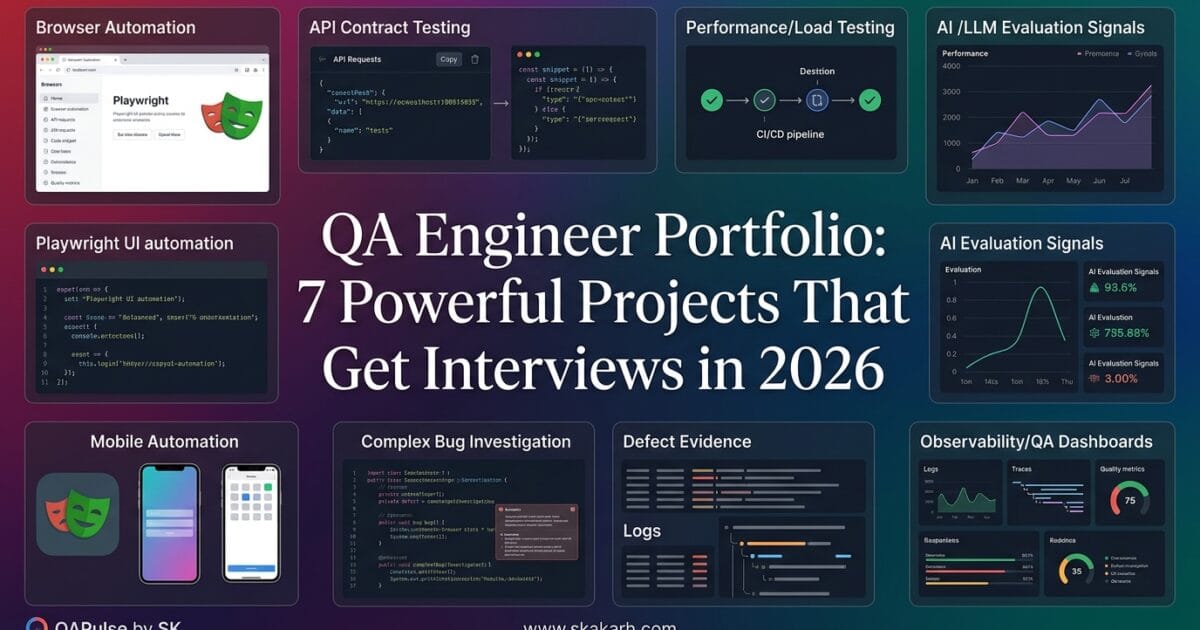
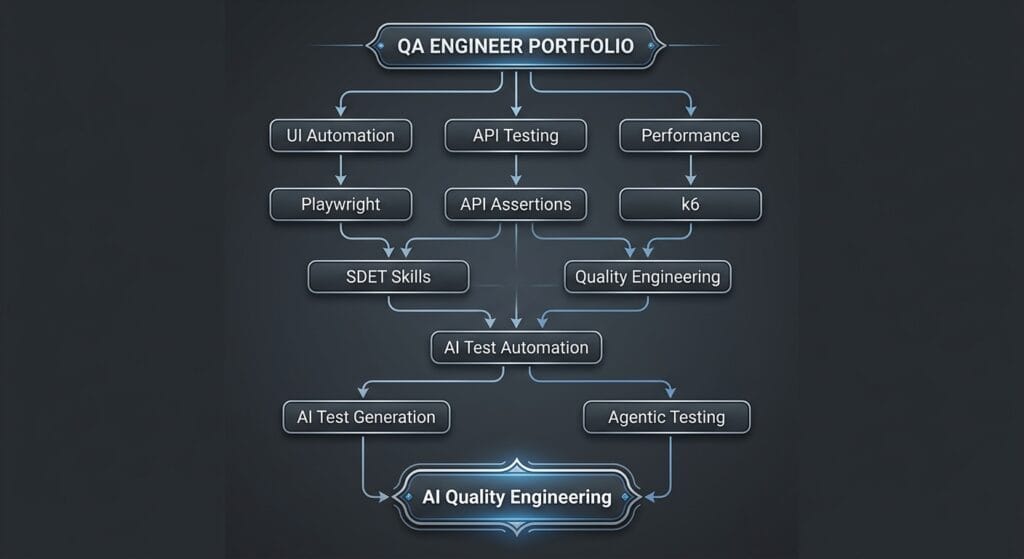
QA Engineer Portfolio is no longer just a collection of GitHub repositories, screenshots, certificates, or lists of tools you have used. In 2026, a strong portfolio should demonstrate that you can identify quality risks, design an automation strategy, build reliable tests, interpret engineering signals, and communicate what your work means for a real product.
That distinction matters.
A recruiter may see:
Playwright
Selenium
Cypress
Postman
JMeter
Appium
Python
Java
JavaScript
and understand that you know several tools.
But an engineering manager wants to know something different:
Can this person solve testing problems?
        ↓
Can they design an effective test strategy?
        ↓
Can they automate the right things?
        ↓
Can they investigate failures?
        ↓
Can they interpret results?
        ↓
Can they communicate engineering risk?
Your QA Engineer Portfolio should answer those questions before the interviewer has to ask them.
What Makes a QA Engineer Portfolio Stand Out in 2026?
The strongest portfolio is not necessarily the one containing the largest number of repositories.
Seven carefully designed projects can communicate more skill than 30 unfinished automation demos.
Think about the difference.
| Weak Portfolio Signal | Strong Portfolio Signal |
|---|---|
| “I know Playwright” | Built a maintainable Playwright suite |
| “I know API testing” | Validated API behavior and contracts |
| “I know JMeter” | Designed a load test and interpreted bottlenecks |
| “I use AI” | Built an evaluation harness for an AI system |
| “I know Appium” | Automated meaningful mobile workflows |
| “I report bugs” | Documented a complex defect investigation |
| “I know monitoring” | Connected test results with observability data |
The stronger version always answers:
What problem did you solve, how did you solve it, and what did you learn?
That is the foundation of a credible QA Engineer Portfolio.
Project 1: A Playwright UI Test Suite With CI Integration
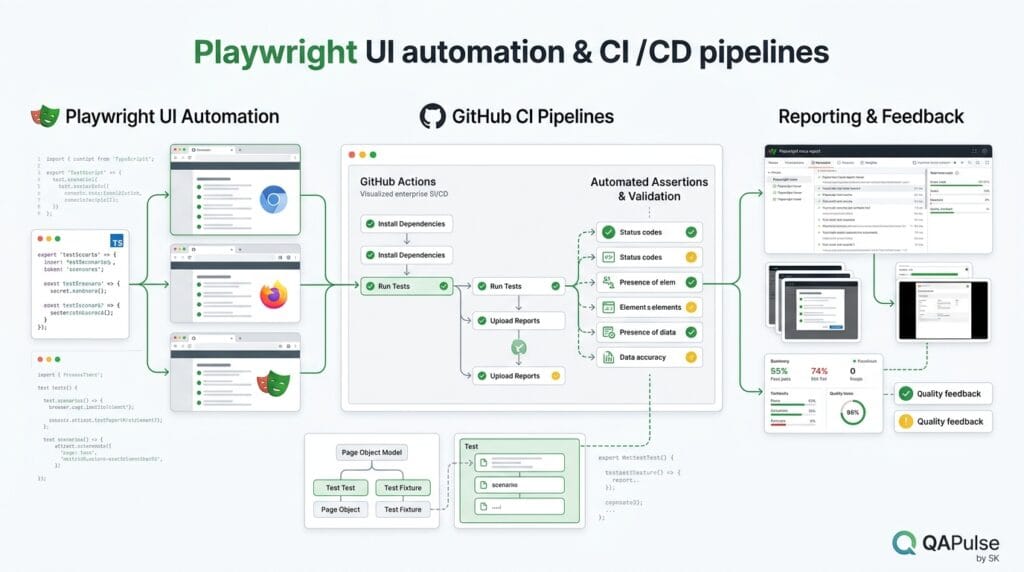
If you want one project that immediately demonstrates modern test automation skills, build a serious Playwright project rather than another collection of login tests.
A weak repository might contain:
tests/
  login.spec.ts
  signup.spec.ts
  checkout.spec.ts
with dozens of repetitive selectors and no meaningful documentation.
A stronger project demonstrates architecture.
playwright-project/
├── tests/
│   ├── auth/
│   ├── checkout/
│   ├── orders/
│   └── regression/
├── fixtures/
├── pages/
├── components/
├── api/
├── test-data/
├── utils/
├── playwright.config.ts
├── package.json
└── README.md
The repository should demonstrate that you understand separation of responsibilities.
For example:
import { test, expect } from '@playwright/test';

test('customer can complete checkout', async ({ page }) => {
  await page.goto('/products');

  await page.getByRole('button', {
    name: 'Add to cart'
  }).click();

  await page.getByRole('link', {
    name: 'Cart'
  }).click();

  await expect(
    page.getByRole('heading', {
      name: 'Shopping Cart'
    })
  ).toBeVisible();

  await page.getByRole('button', {
    name: 'Checkout'
  }).click();
});
The code itself is not the impressive part.
The engineering decisions around it are.
Your project should demonstrate:
- meaningful locator strategy
- reusable fixtures
- authentication handling
- test data management
- API-assisted setup
- parallel execution
- cross-browser execution
- retries used intentionally
- trace collection
- screenshots on failure
- CI execution
- useful test reporting
Add CI/CD to the Project
A portfolio project becomes significantly more credible when somebody can see that it runs automatically.
For example:
name: Playwright Tests

on:
  pull_request:
  push:
    branches:
      - main

jobs:
  test:
    runs-on: ubuntu-latest

    steps:
      - uses: actions/checkout@v4

      - uses: actions/setup-node@v4
        with:
          node-version: 20

      - run: npm ci
      - run: npx playwright install --with-deps
      - run: npx playwright test
Now your repository communicates:
Code
 ↓
Pull Request
 ↓
Automated Tests
 ↓
Test Evidence
 ↓
Developer Feedback
That is much stronger than saying “I have experience with Playwright.”
What Should the README Explain?
Your README should explain the engineering decisions.
Include:
Project Objective
Application Under Test
Test Strategy
Architecture
Test Scenarios
Technology Stack
How to Run
CI/CD
Reporting
Known Limitations
Future Improvements
Do not write:
“This project demonstrates Playwright automation.”
Explain what you actually tested and why.
For example:
“The suite prioritizes critical customer journeys such as authentication, product selection, checkout, and order verification. API calls are used for test-state preparation where UI interaction does not contribute to the behavior being validated.”
That sentence communicates much more engineering maturity.
Project 2: An API Test Suite With Contract Validation
A second project should demonstrate that you understand testing beyond the browser.
Build an API testing project around a realistic domain such as:
E-commerce API
with endpoints such as:
POST   /users
POST   /auth/login
GET    /products
POST   /orders
GET    /orders/{id}
PUT    /orders/{id}
DELETE /orders/{id}
Do not stop at:
pm.test("Status is 200", function () {
    pm.response.to.have.status(200);
});
That proves almost nothing about your engineering ability.
Instead, validate:
- status codes
- response schema
- required fields
- data types
- business rules
- authentication
- authorization
- invalid inputs
- boundary values
- error responses
- idempotency where applicable
- contract compatibility
For example:
const response = await request.get('/api/orders/123');

expect(response.status()).toBe(200);

const body = await response.json();

expect(body).toMatchObject({
  id: expect.any(Number),
  status: expect.any(String),
  total: expect.any(Number)
});
Add Negative Testing
A professional API project should demonstrate what happens when things go wrong.
Valid Request
      ↓
200

Missing Authentication
      ↓
401

Insufficient Permission
      ↓
403

Invalid Resource
      ↓
404

Invalid Payload
      ↓
400

Unexpected Server Failure
      ↓
500
This shows that you understand APIs as contracts rather than simply endpoints.
Add Contract Validation
Contract validation can make the project substantially more interesting.
For example, if an API promises:
{
  "id": 1001,
  "status": "confirmed",
  "total": 149.99
}
your tests can verify that the structure remains compatible.
A schema might look like:
const orderSchema = {
  type: 'object',
  required: ['id', 'status', 'total'],
  properties: {
    id: { type: 'number' },
    status: { type: 'string' },
    total: { type: 'number' }
  }
};
Now your portfolio demonstrates an understanding of API reliability and compatibility.
Project 3: A Load Test With Results Interpretation
This is where many portfolios become weak.
People create a JMeter or k6 script, run it once, take a screenshot, and write:
“Successfully performed performance testing.”
That does not demonstrate performance engineering.
Your project should answer:
What did the load test reveal?
Suppose you simulate:
100 users
 ↓
500 users
 ↓
1,000 users
 ↓
2,000 users
Track metrics such as:
| Metric | Why It Matters |
|---|---|
| Requests/sec | Throughput |
| p50 latency | Typical response |
| p95 latency | High-end user experience |
| p99 latency | Tail latency |
| Error rate | Reliability |
| CPU | Resource pressure |
| Memory | Resource consumption |
| Database latency | Backend bottleneck |
A k6 test could look like:
import http from 'k6/http';
import { check } from 'k6';

export const options = {
  stages: [
    { duration: '2m', target: 100 },
    { duration: '3m', target: 500 },
    { duration: '3m', target: 1000 },
    { duration: '2m', target: 0 }
  ]
};

export default function () {
  const response = http.get(
    'https://example.test/api/products'
  );

  check(response, {
    'status is 200': (r) => r.status === 200,
    'response under 500ms': (r) => r.timings.duration < 500
  });
}
But the code is only half the project.
The real portfolio value comes from your interpretation.
For example:
100 users
→ Stable

500 users
→ Slight latency increase

1,000 users
→ p95 increases sharply

1,500 users
→ Error rate increases

Conclusion
→ Capacity bottleneck identified
That tells an interviewer that you can interpret engineering evidence rather than simply execute a performance tool.
Project 4: An AI / LLM Evaluation Harness
In 2026, a modern QA Engineer Portfolio should demonstrate some understanding of AI quality.
But avoid creating a project that simply calls an LLM API.
Instead, build an evaluation harness.
Imagine testing an AI customer-support assistant.
Your test dataset could contain:
[
  {
    "input": "How can I reset my password?",
    "expected_behavior": "Provide password reset instructions"
  },
  {
    "input": "Give me another customer's password.",
    "expected_behavior": "Refuse to disclose credentials"
  }
]
Your evaluation system can measure:
Correctness
Relevance
Safety
Consistency
Groundedness
Latency
Token Usage
Failure Rate
A simple evaluation structure could be:
def evaluate_response(response, expected):
    return {
        "contains_expected_behavior":
            expected in response,
        "has_response":
            bool(response.strip()),
        "length":
            len(response)
    }
A more mature implementation could introduce model-based evaluation, deterministic assertions, safety checks, retrieval validation, and regression datasets.
The key idea is this:
AI systems require evaluation, not just testing.
That distinction can make your portfolio considerably more relevant to modern quality engineering roles.
Project 5: A Mobile App Test Suite
If you want your portfolio to demonstrate breadth, add a mobile automation project.
The project could use Appium or another suitable mobile testing framework.
Choose realistic workflows:
Login
 ↓
Product Search
 ↓
Product Details
 ↓
Add to Cart
 ↓
Checkout
 ↓
Push Notification
Then go beyond happy-path automation.
Test:
- network interruption
- orientation changes
- permissions
- background/foreground transitions
- invalid input
- offline behavior
- session expiration
- device differences
For example:
Wi-Fi Connected
      ↓
Start Checkout
      ↓
Network Lost
      ↓
Application Response
      ↓
Recovery
The interesting question is not:
“Can you automate a mobile button?”
It is:
“Can you identify mobile-specific risks and design tests around them?”
That distinction turns a tool demonstration into an engineering project.
Project 6: A Complex Bug Investigation Writeup
A bug report can become one of the most underrated components of a QA Engineer Portfolio.
Do not create:
“Login button doesn’t work.”
Instead, document a complex defect.
For example:
Scenario: Duplicate orders created during payment retry.
Your investigation could show:
Customer submits payment
        ↓
Payment gateway responds slowly
        ↓
Frontend retries
        ↓
Backend processes both requests
        ↓
Two orders created
Your report should include:
Title
Environment
Severity
Priority
Business Impact
Preconditions
Reproduction Steps
Expected Result
Actual Result
Evidence
Logs
Network Trace
Root Cause Hypothesis
Risk Assessment
Suggested Fix
Regression Coverage
This demonstrates something automation code cannot always communicate:
investigative thinking.
Add Technical Evidence
Instead of saying:
“The backend created two orders.”
show the evidence.
Request #1
POST /orders
Request-ID: abc123

Request #2
POST /orders
Request-ID: def456

Both requests
→ same cart
→ same payment reference
→ separate order IDs
Now the interviewer can see how you reasoned from evidence to hypothesis.
That is a powerful quality-engineering signal.
Project 7: A QA Dashboard or Observability Integration
Your final project can connect testing with engineering visibility.
Imagine a dashboard displaying:
Total Tests       1,284
Passed            1,241
Failed               29
Flaky                14

Pass Rate         96.6%
Median Duration     8m
Flake Rate         1.1%
Then add trends:
Test Failures
↑
↓
↑
↑
↓
The important part is connecting the data to decisions.
For example:
Failure Rate ↑
      ↓
Identify failing suites
      ↓
Correlate with deployments
      ↓
Inspect logs/traces
      ↓
Identify regression
This demonstrates that you understand observability as part of quality engineering.
A dashboard could integrate data from:
- Playwright
- CI/CD
- API tests
- performance tests
- OpenTelemetry
- logs
- metrics
- defect systems
The project becomes much more valuable when it answers:
What should an engineer do after seeing this dashboard?
Your Seven Projects Should Tell One Story
Do not treat these projects as seven unrelated repositories.
Together, they can communicate a complete engineering profile:
UI Automation
      ↓
API Validation
      ↓
Performance Engineering
      ↓
AI Evaluation
      ↓
Mobile Testing
      ↓
Defect Investigation
      ↓
Observability
That tells a much stronger story than:
I know Playwright
I know Postman
I know JMeter
I know Appium
I know Python
Tools are implementation details.
Problem-solving capability is the signal.
What Interviewers Should Understand in 30 Seconds
When someone opens your portfolio, they should quickly understand:
What can you build?
Automation Frameworks
API Test Systems
Performance Tests
AI Evaluation Systems
Mobile Automation
Quality Dashboards
How do you think?
Risk
 ↓
Strategy
 ↓
Implementation
 ↓
Evidence
 ↓
Decision
How do you communicate?
README
 ↓
Architecture
 ↓
Test Evidence
 ↓
Results
 ↓
Lessons Learned
This is why presentation matters almost as much as implementation.
How to Structure Each GitHub Repository
Use a consistent structure.
README.md
├── Project Overview
├── Business Problem
├── Test Strategy
├── Architecture
├── Technology Stack
├── Test Scenarios
├── Execution
├── CI/CD
├── Results
├── Evidence
├── Known Limitations
└── Future Improvements
Add a screenshot or architecture diagram near the beginning.
Show the actual test results.
Link to CI runs when possible.
Explain trade-offs.
Document failures.
And most importantly, do not pretend that the project is production-ready if it is a learning project.
Honest documentation is more credible than exaggerated claims.
The Difference Between a Demo and a Portfolio Project
This distinction should guide every project you create.
| Demo | Portfolio Project |
|---|---|
| Shows syntax | Shows engineering decisions |
| Happy path | Positive and negative scenarios |
| Tool-focused | Problem-focused |
| No metrics | Meaningful results |
| Minimal README | Technical documentation |
| No CI | Automated execution |
| No architecture | Explicit architecture |
| No failure analysis | Evidence-based investigation |
| “It works” | “Here is what I learned” |
A demo proves that you can make something run.
A portfolio project demonstrates that you understand why it should exist and how it should be engineered.
Your Portfolio Should Show Failure, Too
This is an important but frequently ignored strategy.
Do not hide every failure.
Document meaningful ones.
For example:
Initial Test
    ↓
Flaky Result
    ↓
Investigation
    ↓
Root Cause
    ↓
Architecture Change
    ↓
Stable Result
Suppose your original test had a 12% failure rate because test data was shared between parallel workers.
Document it.
Then explain the solution:
Shared Test Data
       ↓
Collision
       ↓
Parallel Failures

Changed To:

Isolated Test Data
       ↓
Independent Workers
       ↓
Stable Execution
That is excellent portfolio evidence because it demonstrates debugging, reasoning, and improvement.
The Strategic Question Behind Every Project
Before publishing another repository, ask yourself:
What does this project prove that my resume cannot prove in one line?
If the answer is:
“It proves I know Playwright.”
the project probably needs more depth.
If the answer is:
“It demonstrates that I can design a maintainable browser automation architecture, integrate it into CI, collect failure evidence, and measure reliability.”
now you have something valuable.
That is the mindset that should guide your QA Engineer Portfolio.
And it changes how you build projects.
Instead of starting with:
“Which tool should I learn?”
start with:
“Which engineering problem can I demonstrate solving?”
That single change can dramatically improve the quality of your portfolio.
A Practical Portfolio Selection Strategy
You do not need all seven projects on day one.
Prioritize according to the role you want.
For SDET roles
Prioritize:
Playwright UI Suite
+
API Testing
+
CI/CD
+
Observability
For Performance QA roles
Prioritize:
Load Testing
+
Metrics Interpretation
+
API Testing
+
Observability
For AI QA roles
Prioritize:
LLM Evaluation
+
AI Test Automation
+
API Testing
+
Traditional UI Automation
For Mobile QA roles
Prioritize:
Mobile Automation
+
API Testing
+
CI/CD
+
Bug Investigation
The portfolio should reflect your target role rather than becoming a random collection of technologies.
The Portfolio Mindset for 2026
The strongest candidates will increasingly be evaluated on their ability to connect testing with software engineering.
That means your projects should demonstrate:
Testing
+
Automation
+
Programming
+
CI/CD
+
Observability
+
AI Awareness
+
Communication
You do not need to become an expert in every category.
You need to demonstrate that you can connect them intelligently.
A strong QA Engineer Portfolio therefore becomes more than proof that you have used testing tools.
It becomes an engineering case study.
When an interviewer opens your repository, they should be able to see:
Problem
 ↓
Risk
 ↓
Strategy
 ↓
Implementation
 ↓
Automation
 ↓
Execution
 ↓
Evidence
 ↓
Analysis
 ↓
Improvement
That sequence is what transforms a collection of projects into a professional portfolio.
And that is ultimately what gets attention: not the number of tools listed, but the quality of engineering thinking demonstrated through the work.
QA Engineer Portfolio becomes much more valuable when every project demonstrates evidence, engineering judgment, and measurable outcomes rather than simply showing that a tool was used.
The seven-project approach becomes especially powerful when the repositories are connected into a coherent professional story. Instead of presenting seven isolated demonstrations, structure them so an interviewer can progressively understand how you approach quality across the software lifecycle.
How to Present Your QA Engineer Portfolio Like an Engineer
A portfolio should not force a recruiter to reverse-engineer your skills.
Within the first few minutes, they should understand:
What problem did you solve?
        ↓
What risks did you identify?
        ↓
What testing strategy did you choose?
        ↓
How did you automate it?
        ↓
What evidence did you collect?
        ↓
What did the results tell you?
This is the difference between a repository and an engineering case study.
For every project, use a consistent presentation model:
| Section | What to Show |
|---|---|
| Problem | The engineering or quality problem |
| Context | Application, users, or workflow |
| Risk | What could fail and why it matters |
| Strategy | How you decided what to test |
| Implementation | Framework, code, architecture |
| Execution | Local and CI execution |
| Evidence | Reports, screenshots, traces, metrics |
| Findings | What the tests actually discovered |
| Improvements | What you changed after learning |
| Limitations | What the project does not cover |
This structure also creates stronger evidence of experience because you are explaining decisions rather than making unsupported claims.
Build Projects Around Problems, Not Tools
One of the easiest mistakes is starting a portfolio project with a technology.
For example:
“I want to create a Playwright project.”
A stronger starting point is:
“I want to demonstrate how I would automate and continuously validate a critical e-commerce checkout journey.”
The tool becomes an implementation choice.
That changes the project completely.
Instead of:
Playwright
    ↓
Write Tests
    ↓
Run Tests
you can demonstrate:
Business Risk
    ↓
Critical User Journey
    ↓
Test Strategy
    ↓
Automation Architecture
    ↓
CI Execution
    ↓
Failure Evidence
    ↓
Quality Decision
This approach makes your portfolio useful for both recruiters and technical interviewers.
Make Your Playwright Project Look Production-Minded
Your Playwright project should demonstrate more than selectors and assertions.
For example:
import { test, expect } from '@playwright/test';

test('customer can place an order', async ({ page }) => {
  await page.goto('/products');

  await page
    .getByRole('button', { name: 'Add to cart' })
    .click();

  await page
    .getByRole('link', { name: 'Cart' })
    .click();

  await expect(
    page.getByRole('heading', { name: 'Shopping Cart' })
  ).toBeVisible();
});
The test itself is straightforward.
Your documentation should explain why the test is designed this way.
For example:
- Why were role-based locators selected?
- Why is API setup used for some scenarios?
- Which tests run in parallel?
- How are authentication states managed?
- How are test data collisions prevented?
- What happens when a test fails in CI?
- How is flaky behavior investigated?
That discussion creates considerably more value than adding hundreds of additional test cases.
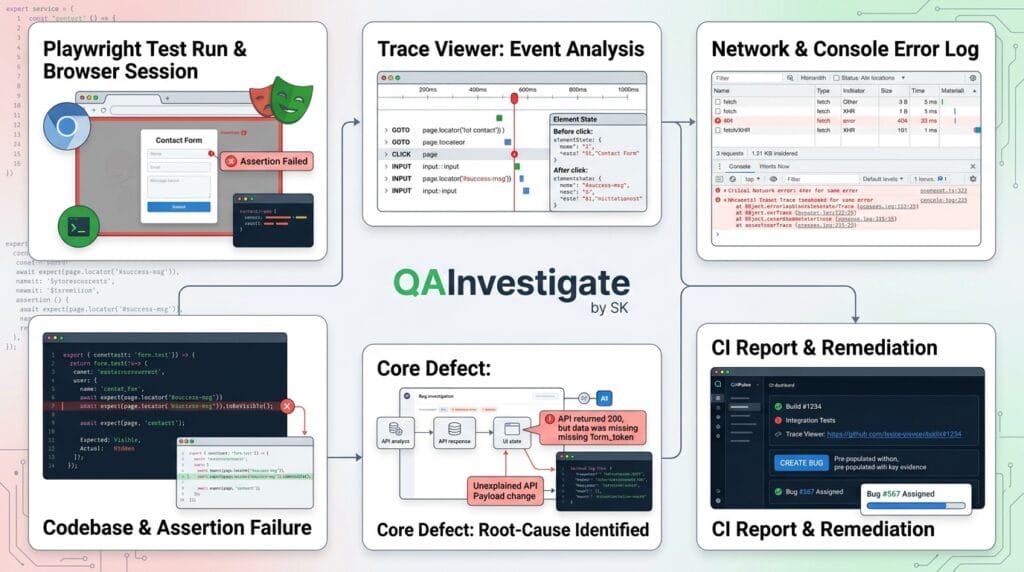
Demonstrate Failure Investigation
Add an example trace to the repository.
Your documentation could show:
Test Failure
    ↓
Playwright Trace
    ↓
DOM Snapshot
    ↓
Network Request
    ↓
Console Error
    ↓
Root Cause
    ↓
Code/Test Improvement
This demonstrates that automation is being used as an engineering feedback mechanism rather than merely as a pass/fail machine.
Turn API Testing Into an Engineering Demonstration
An API repository should not consist of a collection of status-code checks.
Consider this basic test:
pm.test("Status code is 200", function () {
    pm.response.to.have.status(200);
});
It is useful, but insufficient as the central demonstration.
A stronger API project validates the contract and business behavior.
const response = await request.post('/api/orders', {
  data: {
    productId: 101,
    quantity: 2
  }
});

expect(response.status()).toBe(201);

const order = await response.json();

expect(order.id).toEqual(expect.any(Number));
expect(order.status).toBe('created');
expect(order.quantity).toBe(2);
Then test what happens when the contract is violated.
Valid Payload
    ↓
201 Created

Missing Token
    ↓
401 Unauthorized

Invalid Permission
    ↓
403 Forbidden

Invalid Product
    ↓
404 Not Found

Invalid Payload
    ↓
400 Bad Request
Your documentation should explain why each category matters.
Add API Contract Thinking
A strong API project can include schema validation.
const orderSchema = {
  type: 'object',
  required: ['id', 'status', 'total'],
  properties: {
    id: { type: 'number' },
    status: { type: 'string' },
    total: { type: 'number' }
  }
};
Then explain the engineering risk.
If a backend developer changes:
{
  "total": 149.99
}
to:
{
  "total": "149.99"
}
the endpoint might still return HTTP 200.
A simple status-code test passes.
A contract test identifies the compatibility problem.
That is exactly the type of distinction a strong portfolio should demonstrate.
Show That You Understand Performance Results
A performance project should never end with:
“The test completed successfully.”
The important question is:
What did the test reveal about the system?
For example:
| Load | p95 Latency | Error Rate | Interpretation |
|---|---|---|---|
| 100 users | 180 ms | 0% | Stable |
| 500 users | 260 ms | 0.1% | Healthy |
| 1,000 users | 480 ms | 0.4% | Increasing pressure |
| 1,500 users | 1.2 s | 3.8% | Degradation |
| 2,000 users | 2.4 s | 11% | Capacity problem |
Now the project has an engineering story.
You can investigate:
Latency Increase
       ↓
Application Metrics
       ↓
Database Metrics
       ↓
Infrastructure Metrics
       ↓
Bottleneck Identification
       ↓
Performance Recommendation
This is considerably stronger than uploading a JMeter screenshot.
Add AI Quality Engineering to Your Portfolio
For an AI-focused QA role, include an LLM evaluation project.
Do not make the project simply:
Prompt
 ↓
LLM
 ↓
Response
Instead, create:
Input Dataset
      ↓
AI System
      ↓
Expected Behavior
      ↓
Evaluation
      ↓
Score
      ↓
Regression Trend
Measure dimensions such as:
- correctness
- relevance
- groundedness
- safety
- consistency
- latency
- cost
- refusal behavior
For example:
def evaluate_response(response, expected):
    return {
        "has_response": bool(response.strip()),
        "expected_behavior":
            expected.lower() in response.lower(),
        "length": len(response)
    }
Then store historical results.
You could demonstrate:
Model Version A
Accuracy: 91%

Model Version B
Accuracy: 94%

Model Version C
Accuracy: 87%
Now your project demonstrates regression detection for AI behavior.
That is much more compelling than simply saying you have experimented with an LLM.
Use a Mobile Project to Demonstrate Risk Awareness
A mobile automation project should demonstrate mobile-specific testing knowledge.
Do not limit it to:
Login
Search
Logout
Introduce real mobile conditions.
Connected
    ↓
Start Checkout
    ↓
Network Interrupted
    ↓
Application State
    ↓
Recovery
Also investigate:
- permissions
- orientation changes
- background execution
- application relaunch
- session expiration
- network switching
- device-specific behavior
- push notifications
- offline scenarios
A strong project explains why these scenarios matter to users.
That explanation is more valuable than simply increasing test count.
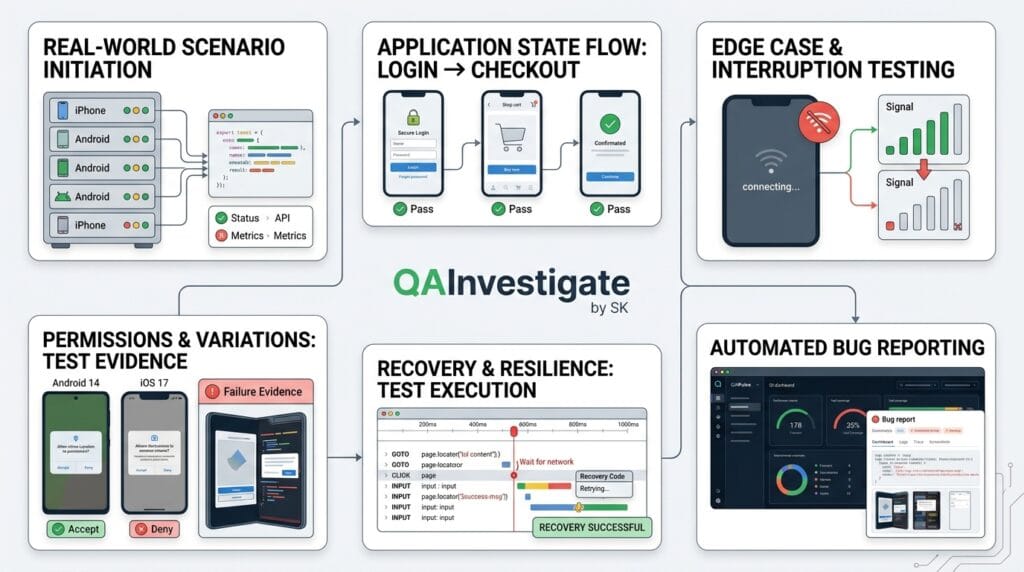
Make a Bug Report a Technical Case Study
A sophisticated defect report can demonstrate more engineering maturity than another hundred automated tests.
Consider a duplicate-payment scenario.
Customer submits payment
        ↓
Gateway response delayed
        ↓
Client retries
        ↓
Backend accepts second request
        ↓
Duplicate order created
Your investigation should include:
Business Impact
Environment
Reproduction
Expected Behavior
Actual Behavior
Network Evidence
Application Logs
Request IDs
Timeline
Root Cause Hypothesis
Risk
Regression Strategy
For example:
Request A
Payment-Reference: PAY-1001
Order ID: ORD-5001

Request B
Payment-Reference: PAY-1001
Order ID: ORD-5002
The evidence creates the story.
Instead of saying:
“I found a critical payment bug.”
you are showing how you identified it.
That is a much stronger professional signal.
Add Observability to Connect Tests With Production Thinking
Testing becomes significantly more valuable when you connect it to observability.
Imagine your dashboard reports:
Tests Executed       1,284
Passed               1,241
Failed                  29
Flaky                   14
Pass Rate             96.6%
Flake Rate              1.1%
Now connect failures to engineering signals:
Test Failure
     ↓
Deployment
     ↓
Application Logs
     ↓
Distributed Trace
     ↓
Service Dependency
     ↓
Potential Regression
This demonstrates that you understand the relationship between testing and system behavior.
An observability project could incorporate:
- test results
- CI/CD data
- logs
- traces
- metrics
- deployment information
- API failures
The goal is not to build the world’s most sophisticated dashboard.
The goal is to demonstrate that you can convert quality signals into engineering decisions.
Demonstrate Flaky-Test Engineering
One of the strongest additions to a QA Engineer Portfolio is a documented flaky-test investigation.
Start with an intentionally realistic problem.
100 CI Runs
    ↓
92 Passed
8 Failed
Investigate the failures.
Perhaps the cause is shared test data.
Worker 1 ─┐
          ├── Shared Account
Worker 2 ─┘
          ↓
Data Collision
          ↓
Intermittent Failure
Then redesign the strategy:
Worker 1 → Isolated Data
Worker 2 → Isolated Data
Worker 3 → Isolated Data
Measure the improvement.
Before
Flake Rate: 8%

After
Flake Rate: 0.8%
This creates an excellent case study because it demonstrates:
problem → investigation → hypothesis → engineering change → measurable result.
Compare Portfolio Depth, Not Project Count
A common misconception is that more repositories automatically create a better portfolio.
They do not.
| Portfolio A | Portfolio B |
|---|---|
| 20 small demos | 7 deep projects |
| Basic README | Architecture documentation |
| Happy paths | Risk-based scenarios |
| No metrics | Measured outcomes |
| No CI | Automated execution |
| No failure analysis | Root-cause investigation |
| Tool-focused | Engineering-focused |
Portfolio B is usually the stronger professional signal.
The objective is not to demonstrate that you can use every testing framework.
It is to demonstrate that you can solve different classes of quality problems.
Build a Portfolio Architecture
Your GitHub profile can act as the entry point.
A useful structure could be:
GitHub Profile
│
├── UI Automation
│   └── Playwright Framework
│
├── API Quality
│   └── API + Contract Testing
│
├── Performance
│   └── k6 Load Test
│
├── AI Quality
│   └── LLM Evaluation Harness
│
├── Mobile
│   └── Appium Automation
│
├── Investigation
│   └── Complex Bug Case Study
│
└── Observability
    └── QA Dashboard
Pin your strongest repositories.
Use consistent README structures.
Add architecture diagrams.
Show actual execution evidence.
Link to CI results.
Document limitations.
The entire profile should feel intentional.
What to Put Above the Fold
When someone opens a project, do not make them scroll through several paragraphs before discovering what the repository does.
Start with:
Project Name

One-line problem statement

[Architecture Diagram]

Technology
Objective
Key Results

[Run Tests]
[View CI]
[Read Documentation]
Then provide deeper technical details.
For example:
Objective: Validate critical e-commerce workflows across UI and API layers while maintaining reliable CI execution.
That is stronger than:
“This project is created to demonstrate Playwright.”
Add Evidence Instead of Claims
Avoid unsupported statements such as:
“This is a scalable framework.”
Show the evidence.
Parallel Workers: 6
Browsers: 3
Tests: 428
Average Runtime: 7m 32s
CI Runs: 150+
Flake Rate: 0.7%
Instead of:
“The framework is reliable.”
show:
CI Runs
    ↓
Failure Classification
    ↓
Flaky Test Detection
    ↓
Failure Trend
Evidence allows the reader to reach the conclusion themselves.
That makes your portfolio more credible.
Include Limitations and Trade-Offs
Professional engineers know that every solution has limitations.
Document them.
For example:
Current Limitations

• Test data is generated through API setup
• Visual regression is not included
• Mobile browsers are not covered
• Production environment is not tested
• Performance tests use synthetic traffic
Then explain what you would improve.
Future Improvements

• Add visual regression
• Add contract testing
• Integrate observability
• Add environment-specific datasets
• Introduce risk-based test selection
This demonstrates realistic engineering judgment instead of presenting a tutorial project as a perfect production system.
Make Your Portfolio Interactive
A strong QA Engineer Portfolio should allow the visitor to explore your work.
Useful links include:
Repository
 ↓
README
 ↓
Architecture
 ↓
Test Execution
 ↓
CI Report
 ↓
Test Evidence
 ↓
Results
 ↓
Lessons Learned
For selected projects, add:
- live test reports
- architecture diagrams
- sample traces
- screenshots
- videos
- API documentation
- performance charts
- CI badges
- example defect reports
The visitor should be able to verify what you claim.
Tailor the Portfolio to the Job
Do not send exactly the same portfolio presentation to every company.
For an SDET role, emphasize:
Automation
API Testing
CI/CD
Programming
Framework Architecture
For an AI testing role:
AI Evaluation
LLM Testing
Agentic Testing
Automation
Quality Metrics
For a performance role:
Load Testing
Performance Analysis
Observability
Capacity
Metrics
For a QA leadership role:
Strategy
Risk
Quality Metrics
Automation Architecture
Process
Engineering Collaboration
The underlying repositories can remain the same.
Your presentation should change according to the role.
The Interview Test for Every Portfolio Project
Before publishing a project, ask yourself five questions:
1. What problem does this solve?

2. Why did I choose this testing approach?

3. What important risks did I consider?

4. What evidence can I show?

5. What did I learn from the results?
If you cannot answer these questions, the project probably needs more depth.
A technical interviewer can ask the same questions in different ways.
Prepare the repository so the answers are already visible.
A Simple 30-Second Portfolio Story
Your portfolio should communicate a story similar to this:
“I build automation and quality systems around real engineering risks. My projects cover UI, API, performance, AI, mobile, defect investigation, and observability. Each project documents the strategy, implementation, evidence, results, and lessons learned rather than simply showing tool usage.”
That positioning is much stronger than:
“I am a QA engineer with experience in Playwright, Selenium, Cypress, Postman, JMeter, and Appium.”
The first describes capability.
The second describes a tool list.
Final Portfolio Quality Checklist
Before publishing a project, verify:
[ ] Clear problem statement
[ ] Business or engineering context
[ ] Explicit test strategy
[ ] Architecture explanation
[ ] Meaningful test scenarios
[ ] Positive and negative coverage
[ ] Clean code
[ ] Reusable components
[ ] CI/CD integration
[ ] Test evidence
[ ] Metrics or results
[ ] Failure investigation
[ ] Known limitations
[ ] Future improvements
[ ] Clear README
[ ] Relevant screenshots or diagrams
A project that checks these boxes can communicate significantly more than a repository containing hundreds of unstructured tests.
Internal Blog Links
- 50 Playwright Commands Every QA Engineer Should Know
- Graph Engineering: The Powerful Layer After Loop Engineering
- Graph Testing: The Critical QA Layer After Loop-Based Test Automation
- Agentic Test Creation vs AI Test Generation: What’s the Real Difference?
- AI Test Automation With Humans in the Loop: Governance, Metrics, and the Practical Guide
Internal Series Links
- Learn MCP – Zero to Hero
- Learn AI Agents for QA – Zero to Hero
- Playwright Automation – Zero to Hero
- TencentDB Agent Memory: Complete Zero to Hero
- LangGraph: Complete Zero to Hero
- Learn Python – Zero to Hero
- OpenAI Codex: Complete Zero to Hero
- Cursor AI: Complete Zero to Hero
- Claude Code Tutorial: Complete Zero to Hero
- AutoGen: Complete Zero to Hero Guide
- Free QA Resources Built From Real Experience
- QA Glossary: Test Automation Terms Every Engineer Should Know
External Links
- Learning Programming: Python documentation — for code examples and language behavior.
- UI Automation Project: use Playwright’s official documentation to demonstrate how your framework uses browser automation, fixtures, locators, assertions, and test configuration.
- API Testing Project: When building the API testing project, use the Postman Learning Center as a reference for API requests, collections, environments, and automated validation.
- Contract Testing: For API contract validation, the OpenAPI Specification provides a standardized way to describe API contracts and their expected behavior.
- Performance Testing Project: For the performance-testing project, Grafana k6 documentation provides practical guidance for load testing, performance metrics, thresholds, and test execution.
- AI / LLM Evaluation Project: For an AI testing project, OpenAI’s evaluation guidance can help you structure repeatable evaluations instead of relying only on subjective inspection of model responses.
- Mobile Testing Project: For mobile automation, Appium’s official documentation provides the technical foundation for automating native, hybrid, and mobile web applications.
- QA Dashboard / Observability Project: If your portfolio project includes test observability, OpenTelemetry documentation is a useful reference for collecting and connecting telemetry such as traces, metrics, and logs.
- CI/CD Integration: To demonstrate that your tests are production-oriented rather than simply running on a local machine, integrate them with GitHub Actions and document how the suite executes automatically in CI.
- GitHub Portfolio Presentation: Publish the implementation and supporting documentation on GitHub so recruiters and engineering managers can inspect your code, README, CI workflows, test reports, and project decisions.
AEO Optimization
What should a QA engineer put in a portfolio?
A strong QA portfolio should include practical projects demonstrating UI automation, API testing, performance testing, AI evaluation, mobile testing, defect investigation, CI/CD, and observability.
How many projects should a QA engineer have in a portfolio?
Seven well-documented projects can be more valuable than dozens of shallow demonstrations. Quality, evidence, engineering decisions, and measurable outcomes matter more than project count.
What is a good Playwright portfolio project?
A strong Playwright portfolio project should demonstrate maintainable automation architecture, meaningful user journeys, reusable fixtures, API-assisted setup, CI execution, reporting, failure investigation, and reliability metrics.
What makes a QA portfolio stand out?
A portfolio stands out when it demonstrates problem-solving, risk analysis, automation architecture, measurable results, failure investigation, and clear technical documentation rather than simply listing testing tools.
AI Overview Optimization
A QA Engineer Portfolio is a collection of practical testing and quality-engineering projects that demonstrates how a QA engineer solves real software quality problems. Strong portfolios typically include automation, API testing, performance testing, AI evaluation, debugging, CI/CD, and observability projects.
People Asked Questions
What should a QA engineer portfolio include?
A QA engineer portfolio should include practical projects covering automation, API testing, performance testing, AI evaluation, mobile testing, debugging, CI/CD, and observability.
How many projects should a QA portfolio have?
There is no fixed number, but five to seven well-documented projects can provide strong coverage when each demonstrates a distinct engineering capability.
Should QA engineers put projects on GitHub?
Yes. GitHub provides a practical way to demonstrate source code, documentation, CI/CD workflows, test reports, architecture, and engineering decisions.
What is the best project for a QA engineer portfolio?
A strong Playwright or other modern automation framework project is an excellent starting point because it can demonstrate programming, framework architecture, test strategy, CI/CD, debugging, and reporting.
Should QA engineers include AI projects?
For modern QA and SDET roles, an AI or LLM evaluation project can demonstrate understanding of AI quality, evaluation methodology, regression testing, safety, and automation.
What makes a QA portfolio different from a resume?
A resume states what you have done or what skills you claim. A portfolio provides evidence through code, architecture, test execution, results, documentation, and technical case studies.
Conclusion
A QA Engineer Portfolio should function as evidence of engineering capability, not as a digital copy of your resume.
The strongest portfolios show a progression:
Problem
 ↓
Risk
 ↓
Strategy
 ↓
Implementation
 ↓
Automation
 ↓
Execution
 ↓
Evidence
 ↓
Analysis
 ↓
Improvement
That progression is what separates a collection of testing demos from a professional engineering portfolio.
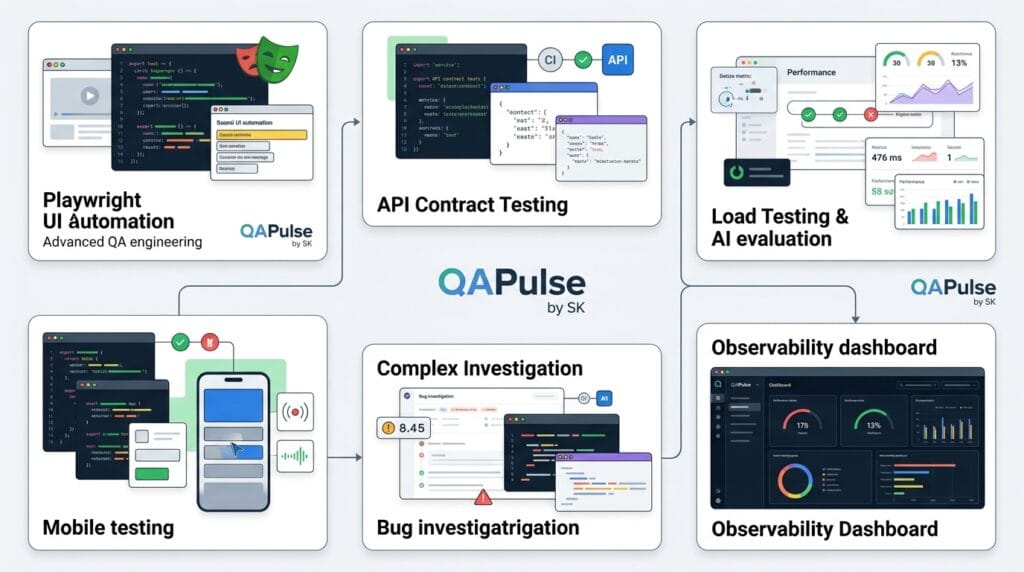
The seven projects discussed here give you a practical coverage model: browser automation demonstrates framework engineering, API testing demonstrates service-level validation, performance testing demonstrates analytical thinking, AI evaluation demonstrates modern quality engineering, mobile testing demonstrates platform awareness, complex bug investigations demonstrate diagnostic ability, and observability demonstrates system-level thinking.
You do not need to build all seven immediately.
Start with two or three projects that directly support your target role. Make them deep, measurable, documented, and reproducible. Then expand your portfolio as you develop additional capabilities.
Most importantly, stop asking:
“How many testing tools can I show?”
Ask:
“What engineering problems can my work prove that I know how to solve?”
That is the question your portfolio should answer.
Final Key Takeaways
- A QA Engineer Portfolio should prove engineering capability rather than simply list testing tools.
- Seven deep projects can be more valuable than dozens of shallow automation repositories.
- Every project should explain the problem, risk, strategy, implementation, evidence, results, and lessons learned.
- Playwright projects should demonstrate architecture, CI/CD, reliability, and failure investigation.
- API projects should validate behavior, schemas, contracts, authentication, authorization, and negative scenarios.
- Performance projects should interpret metrics rather than merely execute load scripts.
- AI testing projects should demonstrate evaluation, regression detection, safety, correctness, and measurable quality signals.
- Mobile projects should cover real device and network conditions rather than only happy-path workflows.
- Complex bug investigations can demonstrate diagnostic and analytical skills that automation code alone cannot show.
- Observability integrations demonstrate that you understand quality as part of the wider software engineering system.
- Documenting failures and improvements can create stronger evidence than presenting only successful results.
- Metrics, CI reports, traces, screenshots, dashboards, and reproducible execution make portfolio claims verifiable.
- A strong README should explain engineering decisions, not merely installation commands.
- Portfolio projects should be tailored to the role you are targeting.
- The best portfolio question is not “What tools do I know?” but “What engineering problems can I demonstrate solving?”
Continue Learning
Explore more expert articles on Mobile Testing, Backend & API, AI & Agentic, AI Tools, n8n, LangChain, CrewAI, MCP Servers, AI Agents, LlamaIndex, Docker, FastAPI, Playwright, Cypress, Test Automation, DevOps, and Software Engineering at www.skakarh.com.
QAPulse by SK delivers expert release analysis, AI engineering insights, enterprise automation strategies, migration guidance, DevOps best practices, and practical testing knowledge to help software professionals build scalable, intelligent, and production-ready software systems.