 QA
QA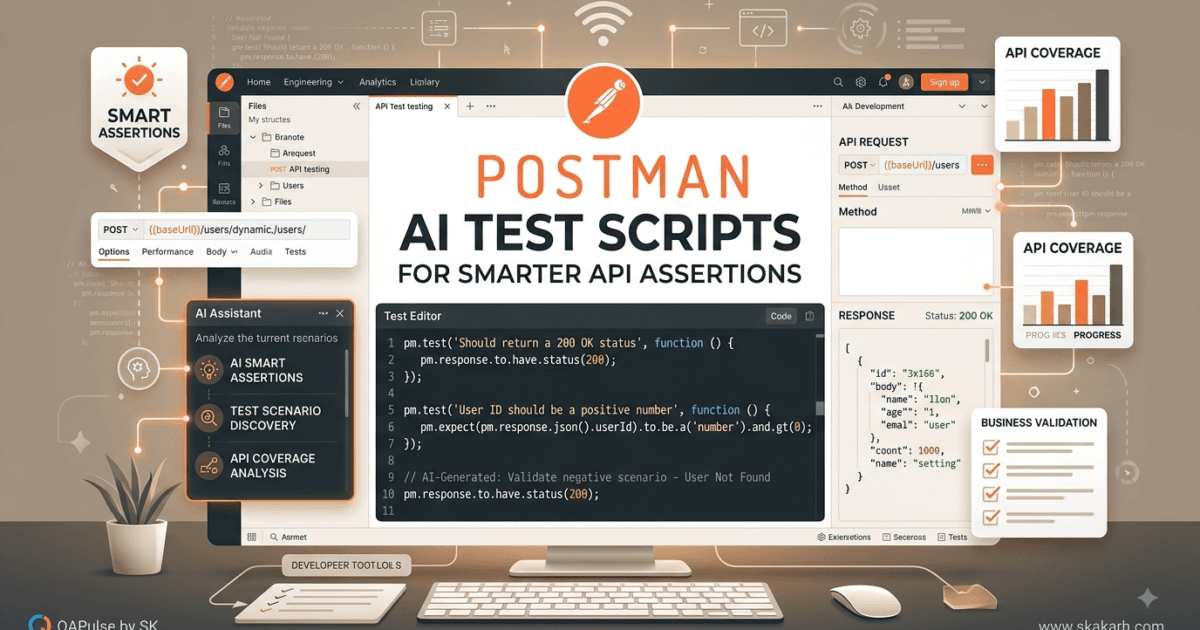
Postman AI Test Scripts can help QA engineers and SDETs transform API requirements into meaningful JavaScript assertions faster. The real advantage, however, is not simply asking AI to generate code. It is learning how to turn API behavior into precise, reliable, and maintainable automated evidence.
A generated script can be syntactically correct and still be a bad test.
For example:
pm.test("Request successful", function () {
    pm.response.to.have.status(200);
});
This test may pass even when the API returns incorrect or incomplete data.
Consider:
{
  "id": null,
  "name": "",
  "email": "invalid",
  "status": "unknown"
}
If the server responds with HTTP 200, the test above passes.
That is the fundamental problem this article addresses:
A successful HTTP response does not necessarily mean successful API behavior.
The purpose of Postman AI Test Scripts is therefore not merely to generate more JavaScript. The objective is to create assertions that prove the API is behaving according to its contract and business requirements.
What Makes a Good API Test?
Before asking AI to generate a test, understand what the test needs to prove.
A useful model is:
Requirement
    ↓
Expected Behavior
    ↓
Evidence
    ↓
Assertion
    ↓
Test Result
Imagine an API requirement:
A newly created customer must receive a unique numeric ID.
The requirement can be translated into:
HTTP Status → 201
ID          → Exists
ID Type     → Number
ID Value    → Greater than 0
The resulting Postman test could be:
const response = pm.response.json();

pm.test("Customer creation returns 201", function () {
    pm.response.to.have.status(201);
});

pm.test("Customer ID is returned", function () {
    pm.expect(response)
        .to.have.property("id");
});

pm.test("Customer ID is numeric", function () {
    pm.expect(response.id)
        .to.be.a("number");
});

pm.test("Customer ID is positive", function () {
    pm.expect(response.id)
        .to.be.above(0);
});
The important part is not the JavaScript.
The important part is the reasoning that produced the JavaScript.
Why Status-Code-Only Tests Are Not Enough
A common starting point for API automation is:
pm.test("Status code is 200", function () {
    pm.response.to.have.status(200);
});
There is nothing wrong with this assertion.
The problem occurs when it becomes the only meaningful validation.
Compare the following two approaches.
| Validation | Basic Test | Stronger Test |
|---|---|---|
| HTTP status | ✅ | ✅ |
| Required fields | ❌ | ✅ |
| Data types | ❌ | ✅ |
| Business rules | ❌ | ✅ |
| Boundary conditions | ❌ | Possible |
| Response consistency | ❌ | Possible |
| Error behavior | ❌ | Possible |
A 200 response tells you that the server considered the request successful.
It does not prove that the response contains the correct business data.
This is why AI-generated API tests need clear instructions about what success actually means.
Using AI Before Generating JavaScript
One of the biggest improvements you can make is changing the order of your AI interaction.
Instead of:
Write a Postman test for this API.
use:
Act as a Senior SDET.

Analyze this API response and identify the most important automated assertions.

For each assertion, provide:

1. What should be validated
2. Why it matters
3. What defect it could detect
4. The expected result

Do not generate JavaScript yet.

API response:
{
  "id": 1024,
  "email": "customer@example.com",
  "status": "active",
  "orders": 4
}
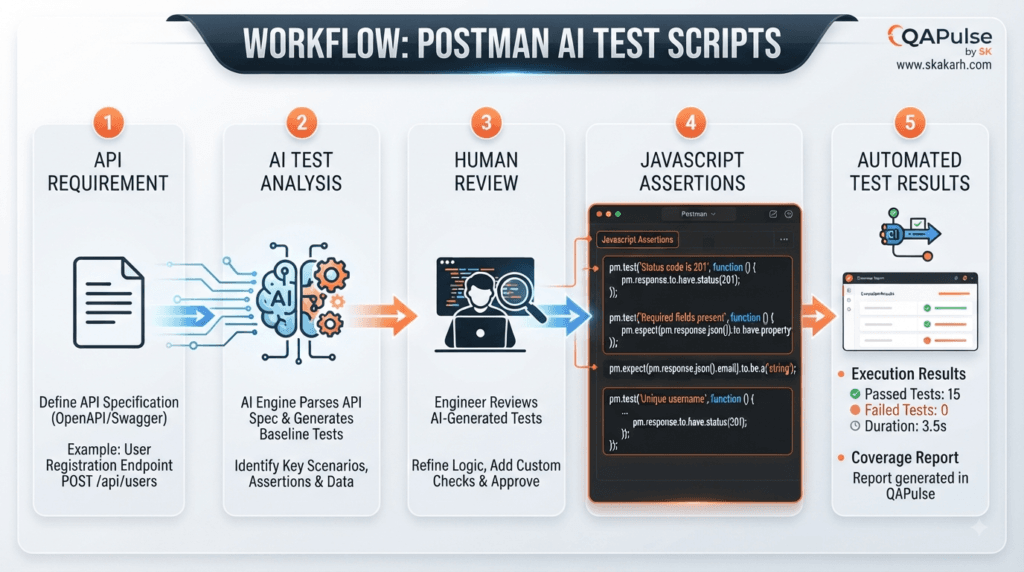
This creates a useful separation:
AI Analysis
     ↓
Human Review
     ↓
Approved Assertions
     ↓
JavaScript Generation
That process is considerably safer than copying the first script AI produces.
Turning an Approved Test Strategy Into JavaScript
Once the assertion strategy has been reviewed, AI can generate the implementation.
For example:
Generate a Postman JavaScript test script using only these approved validations:

- Status must be 201.
- Response must contain id.
- id must be numeric.
- id must be greater than zero.
- status must equal "active".

Use separate pm.test blocks.
Keep the code readable.
Do not introduce additional assumptions.
A suitable implementation could be:
const response = pm.response.json();

pm.test("Customer creation returns HTTP 201", function () {
    pm.response.to.have.status(201);
});

pm.test("Response contains customer ID", function () {
    pm.expect(response)
        .to.have.property("id");
});

pm.test("Customer ID is numeric", function () {
    pm.expect(response.id)
        .to.be.a("number");
});

pm.test("Customer ID is positive", function () {
    pm.expect(response.id)
        .to.be.above(0);
});

pm.test("Customer status is active", function () {
    pm.expect(response.status)
        .to.eql("active");
});
Notice the instruction:
Do not introduce additional assumptions.
This is extremely useful.
AI often tries to be helpful by adding validations you did not request. Those extra assertions can introduce false failures or encode assumptions that are not part of the API contract.
Structural, Type, and Business Assertions
Not all assertions serve the same purpose.
Structural assertions
These verify that required properties exist.
pm.expect(response)
    .to.have.property("id");

pm.expect(response)
    .to.have.property("email");
Type assertions
These verify the expected data type.
pm.expect(response.id)
    .to.be.a("number");

pm.expect(response.email)
    .to.be.a("string");
Business assertions
These verify application behavior.
pm.expect(response.status)
    .to.eql("active");
A strong API test often combines these categories:
Structure
   +
Type
   +
Business Rule
   =
Meaningful Validation
Asking AI to Classify Existing Assertions
AI can also review tests that already exist.
Try:
Review this Postman test script.

Classify each assertion as:

- HTTP
- Structural
- Type
- Business
- Boundary
- Security

Then identify important missing validation categories.

Do not rewrite the script yet.
This is particularly useful when inheriting an existing collection.
You may discover that a test suite contains hundreds of status-code assertions but very few business-level validations.
That is a coverage problem, not a code-generation problem.
Nested JSON Requires Careful Assertions
Real-world APIs often return nested responses.
For example:
{
  "data": {
    "customer": {
      "profile": {
        "email": "customer@example.com"
      }
    }
  }
}
A direct assertion might be:
const response = pm.response.json();

pm.test("Customer email exists", function () {
    pm.expect(response.data.customer.profile.email)
        .to.be.a("string")
        .and.not.empty;
});
This works when the entire structure exists.
But what happens if the API changes to:
{
  "data": {
    "user": {
      "profile": {
        "email": "customer@example.com"
      }
    }
  }
}
The test produces a failure deep inside the property chain.
A more diagnostic approach can validate the structure progressively:
const response = pm.response.json();

pm.test("Response contains data", function () {
    pm.expect(response)
        .to.have.property("data");
});

pm.test("Data contains customer", function () {
    pm.expect(response.data)
        .to.have.property("customer");
});

pm.test("Customer contains profile", function () {
    pm.expect(response.data.customer)
        .to.have.property("profile");
});

pm.test("Customer email is valid", function () {
    pm.expect(response.data.customer.profile.email)
        .to.be.a("string")
        .and.not.empty;
});
The second approach produces better diagnostic evidence.
Comparison: Compact Tests vs Diagnostic Tests
| Characteristic | Compact Test | Diagnostic Test |
|---|---|---|
| Lines of code | Fewer | More |
| Initial readability | Simple | Structured |
| Failure location | Less specific | More specific |
| Debugging | Can require investigation | Usually easier |
| Maintenance | Depends on complexity | Often easier for critical APIs |
| Best use | Simple responses | Complex/critical APIs |
There is no universal rule that every test must contain many assertions.
The right level depends on the complexity and risk of the API.
Interactive Challenge: Find the Weak Test
Suppose this API returns:
{
  "balance": 0,
  "currency": "USD",
  "status": "active"
}
The current test is:
pm.test("Account request succeeded", function () {
    pm.response.to.have.status(200);
});
Ask yourself:
What important behavior is still unverified?
At least these questions should come to mind:
Is balance present?
Is balance numeric?
Can balance be negative?
Is currency valid?
Is status valid?
A stronger test could be:
const response = pm.response.json();

pm.test("Account request succeeds", function () {
    pm.response.to.have.status(200);
});

pm.test("Balance is numeric", function () {
    pm.expect(response.balance)
        .to.be.a("number");
});

pm.test("Currency is supported", function () {
    pm.expect(response.currency)
        .to.be.oneOf(["USD", "EUR", "GBP"]);
});

pm.test("Account status is valid", function () {
    pm.expect(response.status)
        .to.be.oneOf(["active", "inactive", "blocked"]);
});
But there is an important engineering question.
Should every API support all three currencies?
If the answer is no, then the generated assertion is wrong.
This illustrates a critical principle:
AI can suggest an assertion, but requirements determine whether the assertion is correct.
Avoiding Over-Assertion
More assertions do not automatically create better automation.
Consider this response:
{
  "id": 123,
  "name": "John",
  "createdAt": "2026-08-12T10:30:00Z",
  "server": "node-17"
}
You probably should not assert:
pm.expect(response.server)
    .to.eql("node-17");
The server name may change between environments.
Similarly, this can be unnecessarily brittle:
pm.expect(response.createdAt)
    .to.eql("2026-08-12T10:30:00Z");
Instead, validate what the requirement actually guarantees:
pm.test("Created timestamp exists", function () {
    pm.expect(response.createdAt)
        .to.be.a("string")
        .and.not.empty;
});
The question should always be:
What behavior does the product promise?
Not:
What fields happen to appear in this response today?
Use AI to Detect Over-Assertions
Give AI both the requirement and the test:
Review this Postman test against the API requirement.

Identify:

- Correct assertions
- Missing assertions
- Assertions that are too strict
- Environment-dependent assertions
- Assertions that do not represent a business requirement

Optimize for meaningful defect detection rather than maximum assertion count.

Requirement:
A customer response must contain a unique ID, name, and email.

Test:
<paste test script>
This kind of review is more valuable than simply asking AI to rewrite the entire script.
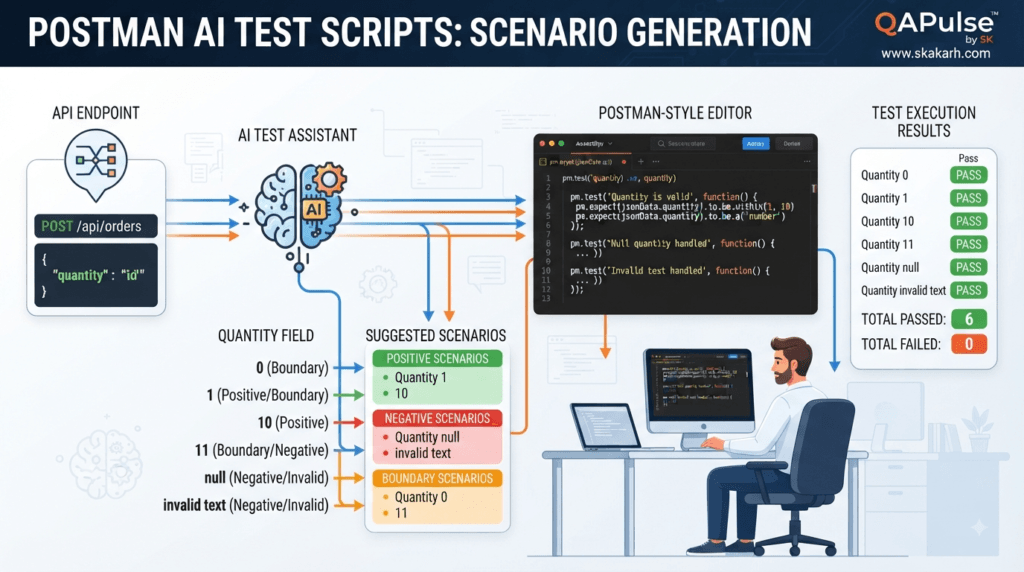
Generating Negative Assertions
Positive tests tell you what happens when users behave correctly.
Negative tests tell you whether the API protects itself when users do not.
Suppose:
{
  "quantity": 10
}
is valid.
Potential scenarios include:
0
-1
11
"ten"
null
missing
AI can help expand the scenario list:
The quantity field accepts integer values from 1 to 10.

Generate high-value negative and boundary scenarios.

For each scenario provide:

- Input
- Expected status code
- Expected error behavior
- Defect it could reveal

Do not generate JavaScript yet.
The resulting scenarios might be:
| Input | Category | Expected |
|---|---|---|
0 | Boundary | 4xx |
1 | Lower boundary | 2xx |
10 | Upper boundary | 2xx |
11 | Boundary | 4xx |
-1 | Invalid | 4xx |
"ten" | Type violation | 4xx |
null | Null value | 4xx |
| Missing | Required-field | 4xx |
Now AI can generate the implementation after the scenarios are approved.
Comparing Manual Test Design and AI-Assisted Test Design
| Step | Traditional Workflow | AI-Assisted Workflow |
|---|---|---|
| Understand requirement | Human | Human |
| Discover scenarios | Human | Human + AI |
| Identify edge cases | Human | Human + AI |
| Define expected behavior | Human | Human |
| Write JavaScript | Human | AI-assisted |
| Review assertions | Human | Human |
| Execute tests | Postman | Postman |
| Analyze failures | Human | Human + AI |
| Approve automation | Human | Human |
The key difference is that AI can participate in more stages of the workflow.
It does not mean that responsibility moves from the engineer to the AI.
A Practical Rule for AI-Generated Scripts
Before accepting any generated test, ask five questions:
1. What requirement does this test protect?

2. What defect would this assertion detect?

3. Could this assertion fail for a legitimate response?

4. Does the test depend on environment-specific data?

5. Would another engineer understand the failure?
If you cannot answer the first two questions, the test probably needs more thought.
If you cannot answer the third question, the test may be too strict.
If the answer to the fourth question is yes, the test may become fragile.
If the fifth answer is no, improve the test’s diagnostic quality.
This simple review habit can dramatically improve the quality of AI-assisted API automation.
Postman AI Test Scripts become much more valuable when they are connected to real API workflows rather than treated as isolated snippets of JavaScript. A good automation suite should understand request dependencies, capture dynamic values, validate responses, handle authentication, and reuse test data without creating unnecessary coupling.
The goal is to move from:
Request → Assertion → Result
toward:
Requirement
     ↓
Test Scenario
     ↓
Request
     ↓
Dynamic Data
     ↓
Assertions
     ↓
Business Validation
     ↓
Test Evidence
This is where AI can help engineers design more capable automation without removing human responsibility for test quality.
Connecting Requests With Dynamic Data
Consider a customer API.
The first request creates a customer:
POST /customers
The response might be:
{
  "id": 1045,
  "name": "Sarah Khan",
  "email": "sarah@example.com"
}
The next request needs that ID:
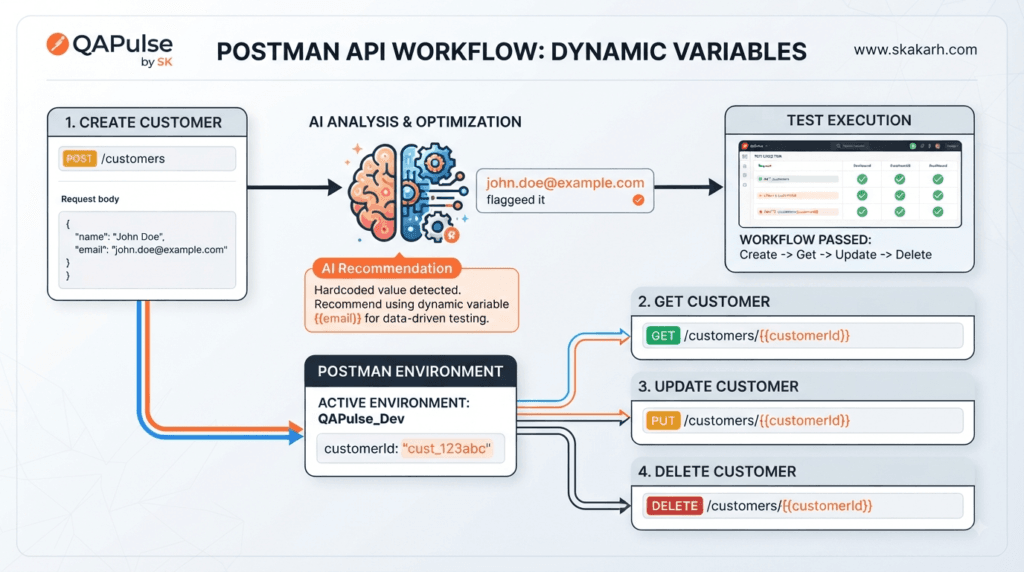
GET /customers/1045
Hardcoding 1045 is a poor automation strategy.
Instead, capture the ID dynamically:
const response = pm.response.json();

pm.test("Customer creation succeeded", function () {
    pm.response.to.have.status(201);
});

pm.test("Customer ID is returned", function () {
    pm.expect(response.id)
        .to.be.a("number")
        .and.above(0);
});

pm.environment.set("customerId", response.id);
The next request becomes:
GET /customers/{{customerId}}
Now the workflow is dynamic.
Create Customer
       │
       │ customerId
       ▼
Get Customer
       │
       ▼
Validate Customer
This is considerably more maintainable than manually copying IDs between requests.
Why Dynamic Variables Matter
Imagine running the same collection against 100 test customers.
A hardcoded approach requires:
Customer 1 → ID 101
Customer 2 → ID 102
Customer 3 → ID 103
...
A dynamic approach requires:
Create → Capture ID → Reuse ID
The second approach is easier to repeat and less dependent on the state of the environment.
You can ask AI to identify hardcoded dependencies:
Review this Postman collection.

Identify:

- Hardcoded IDs
- Hardcoded URLs
- Hardcoded tokens
- Values that should become variables
- Requests that depend on previous responses

Explain how each dependency can be made dynamic.
This is a practical use of AI because the AI is helping analyze an existing automation design.
Request Chaining With Authentication
Authentication is another common dependency.
Suppose login returns:
{
  "accessToken": "eyJhbGciOi...",
  "expiresIn": 3600
}
Capture the token:
const response = pm.response.json();

pm.test("Login succeeds", function () {
    pm.response.to.have.status(200);
});

pm.test("Access token is returned", function () {
    pm.expect(response.accessToken)
        .to.be.a("string")
        .and.not.empty;
});

pm.environment.set(
    "accessToken",
    response.accessToken
);
Then use it in subsequent requests:
Authorization: Bearer {{accessToken}}
The workflow becomes:
Login
  ↓
Capture accessToken
  ↓
Store environment variable
  ↓
Authenticated API requests
This is much stronger than manually copying tokens into requests.
AI-Assisted Authentication Review
Ask AI:
Review this Postman authentication workflow.

Check for:

- Hardcoded credentials
- Hardcoded tokens
- Missing token validation
- Incorrect variable scope
- Missing expiration handling
- Authentication dependencies
- Security risks

Do not modify the implementation.
Explain the findings first.
The instruction to explain first is important.
It prevents AI from immediately rewriting working automation without understanding the reason behind the change.
Environment Variables vs Hardcoded Configuration
Compare:
const baseUrl = "https://api.production.example.com";
with:
{{baseUrl}}
The second approach allows:
Development
baseUrl = https://dev.example.com

Staging
baseUrl = https://staging.example.com

Production
baseUrl = https://api.example.com
The collection can remain unchanged.
| Approach | Hardcoded Values | Environment Variables |
|---|---|---|
| Portability | Low | High |
| Maintenance | Difficult | Easier |
| CI/CD use | Poor | Better |
| Environment switching | Manual | Simple |
| Risk of wrong endpoint | Higher | Lower |
| Reusability | Limited | Strong |
AI can identify hardcoded configuration, but the engineer should decide which values genuinely need to be environment-specific.
Data-Driven API Testing
One of the strongest ways to make API automation scalable is separating test logic from test data.
Suppose you are testing registration.
Instead of creating separate scripts for:
Valid email
Duplicate email
Invalid email
Missing email
Empty email
Long email
you can create a data-driven structure.
Example CSV:
email,expectedStatus
valid@example.com,201
duplicate@example.com,409
invalid-email,400
,400
Then access the current iteration data:
const email = pm.iterationData.get("email");
const expectedStatus = Number(
    pm.iterationData.get("expectedStatus")
);

pm.test("Expected status is returned", function () {
    pm.response.to.have.status(expectedStatus);
});
The request can use:
{
  "email": "{{email}}"
}
Now the same automation logic can evaluate multiple scenarios.
Asking AI to Design Test Data
AI can be particularly useful for discovering test-data combinations.
Try:
Act as an API test-data strategist.

For the following customer registration API, identify:

- Valid data
- Invalid data
- Boundary values
- Missing values
- Null values
- Duplicate values
- Unexpected types
- Security-relevant inputs

Prioritize the highest-value scenarios.

Do not generate test scripts.
This keeps the focus on test design.
After reviewing the proposed scenarios, you can ask AI to create a suitable CSV structure.
Boundary Testing
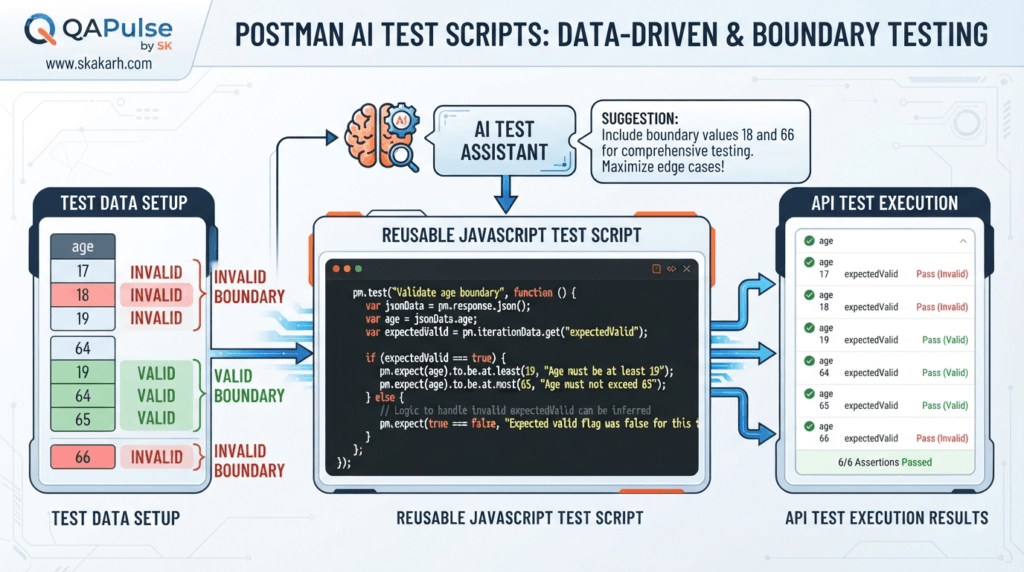
Consider an API requirement:
Age must be between 18 and 65.
Weak test data:
25
30
40
50
This tests normal values.
Better boundary coverage:
17 → Invalid
18 → Valid
19 → Valid
64 → Valid
65 → Valid
66 → Invalid
The boundary values are often more valuable than random values.
AI can help identify them:
The age field accepts integer values from 18 through 65.

Generate boundary-value scenarios and explain the defect each scenario could expose.
Then verify that the requirement is correct before implementing the tests.
Negative Testing With AI
A reliable API suite should test what happens when users provide invalid information.
Suppose the API expects:
{
  "quantity": 5
}
Possible inputs include:
{
  "quantity": 0
}
{
  "quantity": -1
}
{
  "quantity": "five"
}
{
  "quantity": null
}
and:
{}
A useful AI prompt:
Analyze the quantity field.

Valid range: 1–10.

Generate negative API test scenarios for:

- Zero
- Negative numbers
- Values above maximum
- Strings
- Null
- Missing field
- Decimal values

For each scenario provide:

Input
Expected HTTP status
Expected error behavior
Potential defect
This gives you a structured testing strategy before code generation.
Comparing Positive-Only and Risk-Based Testing
| Strategy | Positive-Only | Risk-Based |
|---|---|---|
| Valid input | ✅ | ✅ |
| Invalid input | ❌ | ✅ |
| Boundary values | Usually missing | ✅ |
| Missing fields | Usually missing | ✅ |
| Type violations | Usually missing | ✅ |
| Business abuse cases | Usually missing | Possible |
| Defect detection | Limited | Stronger |
AI is particularly useful for brainstorming scenarios that engineers might overlook.
But again, the output should be reviewed against the real API contract.
Reusing Common Validation Logic
Large Postman collections often contain repeated patterns.
For example:
pm.test("Response status is 200", function () {
    pm.response.to.have.status(200);
});
might appear hundreds of times.
Some duplication is perfectly acceptable.
However, repeated complex logic can become difficult to maintain.
For example:
const response = pm.response.json();

pm.test("ID exists", function () {
    pm.expect(response.id)
        .to.be.a("number")
        .and.above(0);
});

pm.test("Status is valid", function () {
    pm.expect(response.status)
        .to.be.oneOf([
            "active",
            "inactive"
        ]);
});
If the same validation is required across many related APIs, consider how it can be standardized.
AI can help identify patterns:
Analyze these Postman test scripts.

Find repeated assertion patterns.

For each repeated pattern:

- Show the duplication
- Explain whether it should be standardized
- Suggest a maintainable approach
- Identify any risks of abstraction

Do not refactor automatically.
This prevents over-engineering.
Reusable Logic vs Independent Tests
There is a trade-off.
Independent tests
pm.test("Customer ID exists", function () {
    pm.expect(response.id).to.be.a("number");
});
Advantages:
- Easy to read
- Easy to debug
- Low abstraction
Disadvantages:
- Repetition
- More maintenance when rules change
Reusable logic
function assertPositiveNumber(value, name) {
    pm.expect(value, name)
        .to.be.a("number")
        .and.above(0);
}
Then:
assertPositiveNumber(response.id, "Customer ID");
Advantages:
- Less duplication
- Centralized logic
- Consistent behavior
Disadvantages:
- More abstraction
- Debugging can become less direct
- Overuse can make tests harder to understand
The best strategy is usually somewhere between the two.
AI-Assisted Refactoring
You can give AI an existing script:
Review this Postman test script for maintainability.

Identify duplicated or unnecessarily complex logic.

Suggest improvements only where they provide measurable value.

Preserve:
- Existing behavior
- Assertion meaning
- Failure clarity

Explain every proposed change.
This is much safer than:
Make this code better.
The second prompt gives AI too much freedom.
The first defines the engineering constraints.
Testing Request and Response Consistency
Some of the strongest API assertions compare information from the request with information returned by the server.
Suppose you send:
{
  "email": "customer@example.com",
  "name": "Sarah"
}
and receive:
{
  "id": 1001,
  "email": "customer@example.com",
  "name": "Sarah"
}
You can validate that the API returned the same submitted values.
For example:
const response = pm.response.json();
const requestBody = JSON.parse(pm.request.body.raw);

pm.test("Returned email matches submitted email", function () {
    pm.expect(response.email)
        .to.eql(requestBody.email);
});

pm.test("Returned name matches submitted name", function () {
    pm.expect(response.name)
        .to.eql(requestBody.name);
});
This is stronger than checking only that the fields exist.
It verifies request-response consistency.
A Practical AI Prompt for Request-Response Validation
Review this API request and response.

Identify fields where the response should logically match:

- Request values
- Generated values
- Server-controlled values

Separate the fields into these categories and explain which comparisons should be automated.

Do not generate code yet.
This can help identify useful assertions without forcing the AI to make assumptions about every field.
Testing Response Headers
API testing should not always stop at the JSON body.
For example:
pm.test("Content-Type is JSON", function () {
    pm.expect(pm.response.headers
        .get("Content-Type"))
        .to.include("application/json");
});
You might also validate headers relevant to authentication, caching, correlation IDs, or other API requirements.
Ask AI:
Review this API response.

Identify response headers that may be relevant to:

- Content negotiation
- Security
- Caching
- Request tracing
- Authentication
- API versioning

Separate required validations from optional recommendations.
This encourages a broader API-testing mindset.
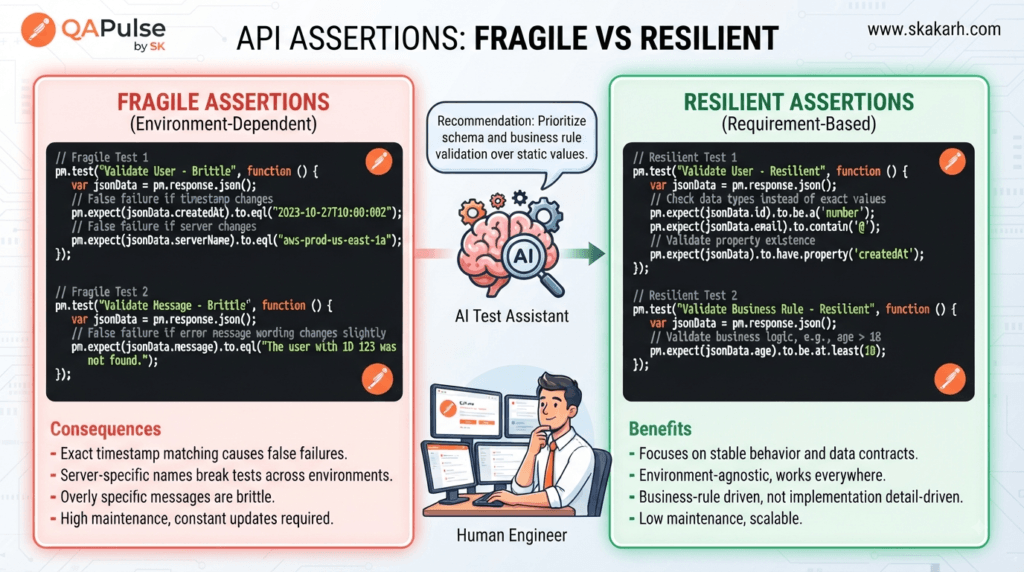
Avoiding Fragile Assertions
Consider:
pm.expect(response.message)
    .to.eql("Customer successfully created.");
If the application changes the wording to:
Customer created successfully.
the test fails even though the behavior may still be correct.
If the requirement is specifically the exact message, the assertion is appropriate.
If the requirement is only successful creation, the assertion may be unnecessarily strict.
A more flexible check could be:
pm.expect(response.message)
    .to.be.a("string")
    .and.not.empty;
Again, the requirement determines the correct level of strictness.
Interactive Exercise: Improve the Test
Start with:
const response = pm.response.json();

pm.test("API works", function () {
    pm.response.to.have.status(200);
});
The response is:
{
  "id": 501,
  "email": "test@example.com",
  "status": "active",
  "createdAt": "2026-08-12T11:20:00Z"
}
Before reading further, identify at least four useful validations.
A reasonable solution could include:
pm.test("User ID is valid", function () {
    pm.expect(response.id)
        .to.be.a("number")
        .and.above(0);
});

pm.test("Email is present", function () {
    pm.expect(response.email)
        .to.be.a("string")
        .and.not.empty;
});

pm.test("User status is valid", function () {
    pm.expect(response.status)
        .to.be.oneOf([
            "active",
            "inactive"
        ]);
});

pm.test("Created timestamp is present", function () {
    pm.expect(response.createdAt)
        .to.be.a("string")
        .and.not.empty;
});
But do not stop there.
Ask:
Which of these validations are actually guaranteed by the API contract?
That question is more important than the code itself.
A Better Prompting Pattern
A useful structure for AI-assisted test development is:
ROLE
Act as a Senior SDET.

CONTEXT
Here is the API requirement and response.

OBJECTIVE
Identify valuable automated validations.

CONSTRAINTS
Do not invent business rules.
Do not assume optional fields are mandatory.
Avoid environment-dependent assertions.

OUTPUT
Return:
- Assertion
- Reason
- Defect detected
- Priority

THEN
Generate Postman JavaScript only after the validation strategy is approved.
This is considerably stronger than asking:
Generate Postman tests.
The quality of AI output depends heavily on the quality of the constraints you provide.
The Strategic Difference
There are three levels of AI-assisted API testing:
Level 1
"Generate JavaScript."

        ↓

Level 2
"Identify useful assertions and generate JavaScript."

        ↓

Level 3
"Analyze requirements, risks, dependencies,
expected behavior, and coverage gaps,
then generate reviewed automation."
Level 3 provides the greatest engineering value.
The AI is no longer simply acting as a code generator.
It becomes an assistant in the test-design process.
Practical Exercise
Take five existing Postman requests and create an assertion matrix for each:
| Request | HTTP | Structure | Type | Business | Negative |
|---|---|---|---|---|---|
| Login | ✓ | ✓ | ✓ | ✓ | ✓ |
| Create User | ✓ | ✓ | ✓ | ✓ | ✓ |
| Get User | ✓ | ✓ | ✓ | ✓ | ✓ |
| Update User | ✓ | ✓ | ✓ | ✓ | ✓ |
| Delete User | ✓ | ✓ | ✓ | ✓ | ✓ |
Do not assume every category must contain an assertion.
Instead, determine which categories are meaningful for each endpoint.
Then ask AI to review your matrix.
Finally, compare its recommendations with your own reasoning.
That comparison is where the learning happens.
Postman AI Test Scripts become especially powerful when you move beyond individual assertions and start thinking about test quality at the collection level. A test suite can contain hundreds of technically valid checks and still miss the failures that matter most.
The strategic question is therefore not:
How many tests did we generate?
It is:
How much meaningful API behavior does our automation actually prove?
This distinction becomes critical as collections grow, endpoints multiply, and different teams begin depending on the same API automation.
From Individual Assertions to Test Coverage
Consider a simple customer API:
POST /customers
GET /customers/{id}
PUT /customers/{id}
DELETE /customers/{id}
A beginner might create one status assertion for each request:
pm.test("Status is successful", function () {
    pm.response.to.have.status(200);
});
The collection appears automated.
But consider what happens if:
POST /customers
returns the wrong customer ID.
Or:
GET /customers/{id}
returns another customer’s information.
Or:
PUT /customers/{id}
returns 200 but does not actually update the record.
Or:
DELETE /customers/{id}
returns 204 while the resource still exists.
All four tests could pass if they only check HTTP status codes.
This is why Postman AI Test Scripts should be used to improve behavioral coverage, not simply increase the number of assertions.
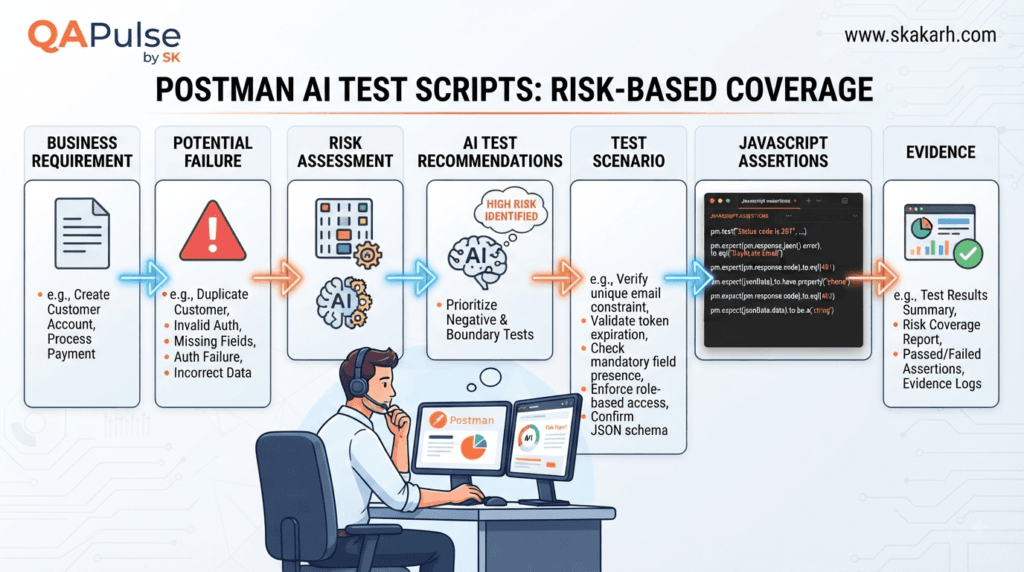
Think in Terms of Risk
A useful API testing model is:
Business Requirement
        ↓
Potential Failure
        ↓
Risk
        ↓
Test Scenario
        ↓
Assertion
For example:
Requirement:
Customer email must be unique.

Potential Failure:
API accepts duplicate email.

Risk:
Duplicate accounts are created.

Test:
Submit an existing email.

Assertion:
Expected conflict response.
The resulting test is much more valuable than another generic 200 assertion.
Asking AI to Identify Risk Areas
Instead of asking:
Generate tests for this endpoint.
try:
Act as a senior API test strategist.

Analyze this endpoint:

POST /customers

Identify the highest-risk behaviors that should be automated.

Consider:

- Data integrity
- Authentication
- Authorization
- Validation
- Boundary values
- Duplicate data
- Missing fields
- Incorrect data types
- Resource ownership
- Error handling

Rank the scenarios by risk.

Do not generate JavaScript yet.
This forces the AI to think about what could fail before thinking about how to code the test.
Test Coverage Is Not Just Test Count
Suppose Team A has:
100 tests
and Team B has:
40 tests
It would be tempting to assume Team A has better coverage.
That conclusion may be completely wrong.
Team A might have:
80 status-code assertions
15 field-presence checks
5 business validations
Team B might have:
20 business validations
10 negative scenarios
5 boundary tests
5 security-related checks
The second suite could provide substantially better protection despite having fewer tests.
Compare:
| Metric | Suite A | Suite B |
|---|---|---|
| Test count | 100 | 40 |
| Status validation | High | Medium |
| Business validation | Low | High |
| Negative testing | Low | High |
| Boundary testing | Low | High |
| Risk coverage | Medium | Potentially high |
The lesson is simple:
Test quantity is not the same thing as test quality.
Build an Assertion Matrix
An assertion matrix can make API coverage visible.
For a customer API:
| Endpoint | Status | Schema | Type | Business | Negative | Security |
|---|---|---|---|---|---|---|
| Create | ✓ | ✓ | ✓ | ✓ | ✓ | ✓ |
| Get | ✓ | ✓ | ✓ | ✓ | ✓ | ✓ |
| Update | ✓ | ✓ | ✓ | ✓ | ✓ | ✓ |
| Delete | ✓ | ✓ | ✓ | ✓ | ✓ | ✓ |
The matrix does not mean every endpoint needs identical assertions.
It means you deliberately decide what should be validated.
You can ask AI to review the matrix:
Review this API assertion matrix.

Identify:

1. High-risk gaps
2. Duplicate validations
3. Missing negative scenarios
4. Missing business validations
5. Potential security-related gaps

Prioritize findings by impact.

Do not generate code.
This is a much more strategic application of AI.
Contract Validation
APIs often have an expected structure.
For example:
{
  "id": 101,
  "name": "Alice",
  "email": "alice@example.com"
}
A basic test might check:
const response = pm.response.json();

pm.test("Response contains required fields", function () {
    pm.expect(response).to.have.property("id");
    pm.expect(response).to.have.property("name");
    pm.expect(response).to.have.property("email");
});
You can go further:
pm.test("ID has correct type", function () {
    pm.expect(response.id).to.be.a("number");
});

pm.test("Name has correct type", function () {
    pm.expect(response.name).to.be.a("string");
});

pm.test("Email has correct type", function () {
    pm.expect(response.email).to.be.a("string");
});
And further still:
pm.test("Customer ID is positive", function () {
    pm.expect(response.id).to.be.above(0);
});
Each additional assertion should have a reason.
Exact Schema vs Flexible Contract Testing
There are two different strategies.
Strict validation
pm.expect(response).to.have.all.keys(
    "id",
    "name",
    "email"
);
This can be useful when the response contract explicitly requires an exact structure.
But it may become fragile when APIs add optional fields.
Required-property validation
pm.expect(response).to.have.property("id");
pm.expect(response).to.have.property("name");
pm.expect(response).to.have.property("email");
This is more flexible.
| Strategy | Strict Schema | Required Properties |
|---|---|---|
| Contract enforcement | Strong | Moderate |
| Flexibility | Lower | Higher |
| Optional fields | Can cause failures | Usually safer |
| Breaking-change detection | Strong | Moderate |
| Maintenance | Higher | Lower |
The correct approach depends on the API contract.
Do not allow AI to choose automatically.
Tell it what contract behavior the team expects.
Detecting Breaking Changes
Imagine an API previously returned:
{
  "id": 10,
  "name": "Sarah",
  "email": "sarah@example.com"
}
A new release changes:
{
  "customerId": 10,
  "name": "Sarah",
  "email": "sarah@example.com"
}
A weak test may still pass.
But consumers expecting id could break.
A useful assertion:
pm.test("Customer ID field remains available", function () {
    pm.expect(response)
        .to.have.property("id");
});
This turns your API tests into an early-warning system for contract changes.
Asking AI to Analyze API Changes
Give AI the old and new responses:
Compare these two API response contracts.

Identify:

- Removed fields
- Renamed fields
- Changed data types
- New required fields
- Changed nesting
- Potential breaking changes

Classify each change as:

BREAKING
POTENTIALLY BREAKING
NON-BREAKING

Explain your reasoning.
This can be extremely useful during API evolution.
But the result should still be verified against the official API contract.
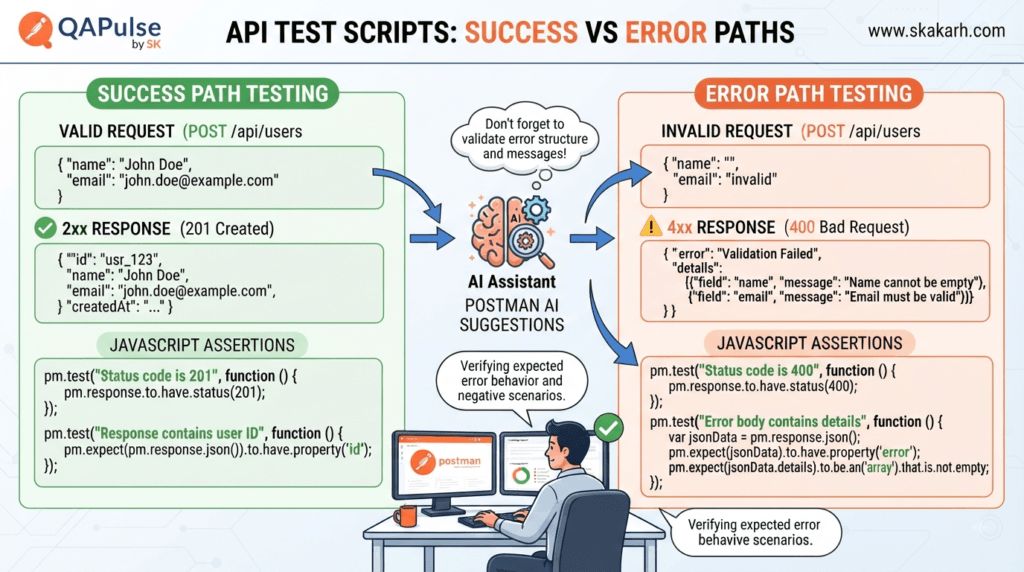
Error Responses Deserve First-Class Tests
Many teams spend most of their effort testing successful requests.
That leaves a major gap.
Consider:
POST /customers
with:
{
  "email": ""
}
The expected response might be:
400 Bad Request
with:
{
  "error": "email is required"
}
A meaningful negative test:
const response = pm.response.json();

pm.test("Invalid request returns 400", function () {
    pm.response.to.have.status(400);
});

pm.test("Error response contains message", function () {
    pm.expect(response)
        .to.have.property("error");
});

pm.test("Error message is meaningful", function () {
    pm.expect(response.error)
        .to.be.a("string")
        .and.not.empty;
});
The API is not only defined by what it does when everything is correct.
It is also defined by how it behaves when requests are invalid.
Error Message Assertions Need Care
This test:
pm.expect(response.error)
    .to.eql("email is required");
is appropriate if the API contract guarantees the exact message.
But if only the error code is guaranteed:
{
  "code": "INVALID_EMAIL",
  "message": "Email address is required."
}
then this may be better:
pm.test("Correct error code is returned", function () {
    pm.expect(response.code)
        .to.eql("INVALID_EMAIL");
});
The message can change without changing the underlying behavior.
This is another example where AI may produce technically valid but strategically weak assertions.
Boundary Testing With Assertions
Suppose an API accepts:
username length: 3–20 characters
The valuable values include:
2 characters  → Invalid
3 characters  → Valid
4 characters  → Valid
19 characters → Valid
20 characters → Valid
21 characters → Invalid
You can use AI to generate these scenarios:
The username must contain between 3 and 20 characters.

Generate boundary-value API scenarios.

For each scenario provide:

- Input length
- Expected HTTP status
- Expected validation behavior
- Reason the scenario matters

Avoid random test values.
This produces a much more useful testing strategy than simply generating random usernames.
Comparing Random Testing and Boundary Testing
| Approach | Random Values | Boundary Values |
|---|---|---|
| Easy to generate | ✅ | ✅ |
| Targets limits | ❌ | ✅ |
| Finds off-by-one defects | Low | High |
| Requirement-driven | Low | High |
| Reproducibility | Variable | High |
AI is good at quickly identifying boundaries, but the engineer still needs to verify that the stated limits are correct.
Testing Authorization, Not Just Authentication
Authentication answers:
Who are you?
Authorization answers:
Are you allowed to perform this operation?
These are different.
Suppose:
GET /customers/501
works for an authenticated customer.
But the same customer should not be able to access:
GET /customers/900
if customer 900 belongs to someone else.
A test should validate the expected behavior:
pm.test("Unauthorized resource access is rejected", function () {
    pm.expect(pm.response.code)
        .to.be.oneOf([403, 404]);
});
The exact expected status should come from the API’s security contract.
AI can help discover authorization scenarios:
Analyze this customer API.

Identify authorization test scenarios for:

- Own resource
- Another user's resource
- Admin access
- Unauthenticated request
- Expired token
- Invalid token

For each scenario explain the expected behavior.

Do not generate code yet.
This is a high-value use of AI because authorization scenarios are often overlooked.
Request-Response Relationship Testing
Consider a create request:
{
  "name": "Sarah",
  "email": "sarah@example.com"
}
Response:
{
  "id": 501,
  "name": "Sarah",
  "email": "sarah@example.com",
  "status": "active"
}
The API should normally preserve the submitted values.
You can validate that:
const requestBody = JSON.parse(pm.request.body.raw);
const response = pm.response.json();

pm.test("Returned name matches submitted name", function () {
    pm.expect(response.name)
        .to.eql(requestBody.name);
});

pm.test("Returned email matches submitted email", function () {
    pm.expect(response.email)
        .to.eql(requestBody.email);
});
This is stronger than merely checking that name and email exist.
It validates consistency between two stages of the API operation.
Using AI to Discover Missing Relationships
Prompt:
Analyze this API request and response.

Identify:

- Values that should remain unchanged
- Values generated by the server
- Values transformed by the server
- Values that should not be returned
- Relationships that should be validated

Explain each recommendation before generating assertions.
This can uncover validation opportunities that are not obvious from a simple response inspection.
Testing State Transitions
Some APIs represent resources with states:
pending
   ↓
approved
   ↓
completed
A test should not only validate the individual responses.
It should validate whether transitions are allowed.
For example:
Create Order
    ↓
pending

Approve Order
    ↓
approved

Complete Order
    ↓
completed
An invalid transition might be:
completed
   ↓
pending
AI can help model these scenarios:
Analyze this order lifecycle:

pending → approved → completed

Identify:

- Valid transitions
- Invalid transitions
- Required API requests
- Expected responses
- High-risk transition tests

Prioritize business-critical scenarios.
This moves API testing from simple request validation toward behavioral testing.
Using AI to Review a Complete Test Collection
Once a collection becomes large, reviewing individual requests is no longer enough.
Give AI a structured collection summary and ask:
Act as a senior API automation reviewer.

Review this Postman collection for:

- Duplicate tests
- Missing business validations
- Weak status-only assertions
- Missing negative scenarios
- Missing boundary scenarios
- Hardcoded values
- Environment dependencies
- Authentication gaps
- Authorization gaps
- Fragile assertions
- Poor failure messages

Rank findings by severity.

Do not rewrite the collection.
This is closer to an automation architecture review than simple code generation.
Improving Failure Messages
Compare:
pm.test("Test passed", function () {
    pm.expect(response.id).to.be.a("number");
});
with:
pm.test("Customer ID should be a positive number", function () {
    pm.expect(
        response.id,
        "Customer ID returned by the API"
    )
    .to.be.a("number")
    .and.above(0);
});
The second version communicates more intent.
Good test failures should help an engineer answer:
What failed?
Why does it matter?
What value was unexpected?
AI can help improve test messages:
Review these Postman test names and assertion messages.

Rewrite only those that are unclear.

Make each message communicate:
- What is being validated
- Expected behavior
- Business meaning where relevant

Do not change test logic.
The Difference Between Code Generation and Test Engineering
This distinction is worth remembering.
Code generation asks:
How do I write this JavaScript?
Test engineering asks:
What should I validate?
Why should I validate it?
What failure am I trying to detect?
How reliable will the assertion be?
AI is excellent at helping with the first question.
Its greatest strategic value comes when it assists with the second group of questions while the engineer remains responsible for the final decision.
A Practical Collection Review Checklist
Before considering an API collection mature, inspect whether it has:
✓ Status-code validation
✓ Required-property validation
✓ Data-type validation
✓ Business-rule validation
✓ Positive scenarios
✓ Negative scenarios
✓ Boundary scenarios
✓ Request-response consistency checks
✓ Authentication validation
✓ Authorization scenarios
✓ Dynamic variables
✓ Environment separation
✓ Useful failure messages
✓ Contract-change detection
Not every endpoint requires every category.
The point is to make the decision intentionally rather than accidentally.
Strategic Exercise
Take one important API endpoint from your own collection.
Write down:
Business requirement:
_________________________

Highest-risk failure:
_________________________

Positive scenario:
_________________________

Negative scenario:
_________________________

Boundary scenario:
_________________________

Business assertion:
_________________________

Security assertion:
_________________________
Then ask AI to review your answers.
Do not ask it to replace them.
Ask:
Review my API test strategy as a senior SDET.

Challenge my assumptions.

Identify important missing risks.

Do not generate code unless I explicitly ask for it.
This changes the interaction from AI writes my tests to AI challenges my testing strategy.
That is a much more valuable way to use AI in API automation.
Postman AI Test Scripts reach their real value when they become part of a disciplined API quality strategy rather than simply a faster way to produce JavaScript. By this point, the important shift is clear: AI can generate assertions, suggest scenarios, identify gaps, and review automation, but the engineer must decide what the API actually promises and what evidence is required to prove it.
A mature Postman test should answer three questions:
What should happen?
        ↓
What could go wrong?
        ↓
What assertion proves the behavior?
That mindset makes AI-assisted API testing far more useful.
Designing Tests Around Business Behavior
Imagine an order API:
POST /orders
Request:
{
  "productId": 501,
  "quantity": 2
}
Response:
{
  "id": 9001,
  "productId": 501,
  "quantity": 2,
  "status": "pending",
  "total": 49.98
}
A weak test could be:
pm.test("Order created", function () {
    pm.response.to.have.status(201);
});
A stronger test validates the actual behavior:
const response = pm.response.json();
const request = JSON.parse(pm.request.body.raw);

pm.test("Order creation returns 201", function () {
    pm.response.to.have.status(201);
});

pm.test("Order ID is generated", function () {
    pm.expect(response.id)
        .to.be.a("number")
        .and.above(0);
});

pm.test("Product ID matches request", function () {
    pm.expect(response.productId)
        .to.eql(request.productId);
});

pm.test("Quantity matches request", function () {
    pm.expect(response.quantity)
        .to.eql(request.quantity);
});

pm.test("New order starts in pending state", function () {
    pm.expect(response.status)
        .to.eql("pending");
});

pm.test("Order total is positive", function () {
    pm.expect(response.total)
        .to.be.a("number")
        .and.above(0);
});
This test provides much stronger evidence.
It checks not only whether the request succeeded, but whether the server created the expected resource correctly.
The Difference Between More Tests and Better Tests
Consider two teams.
Team A has 200 API tests but most contain only status-code assertions.
Team B has 80 tests covering:
- Business rules
- Negative scenarios
- Boundary values
- Authorization
- Request-response consistency
- State transitions
- Contract validation
Which team has better automation?
There is no answer based purely on test count.
A useful way to think about test quality is:
Test Quality
    =
Relevant Coverage
    +
Defect Detection
    +
Reliability
    +
Maintainability
This is why blindly asking AI to generate hundreds of tests can actually make an automation project worse.
More scripts mean more maintenance.
More assertions mean more potential false failures.
More generated scenarios mean more opportunities for incorrect assumptions.
The goal is high-value automation, not maximum code volume.
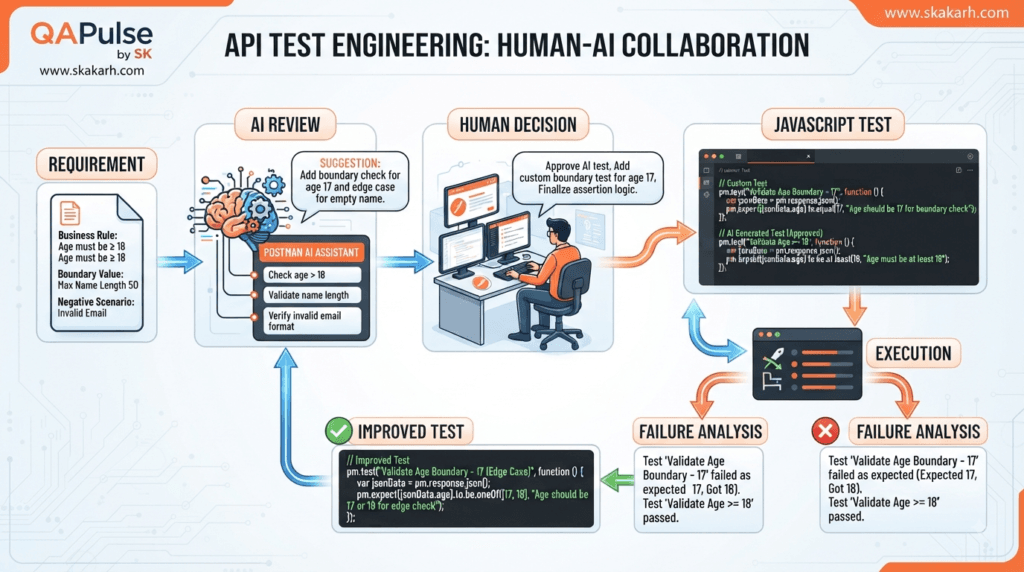
Use AI as a Test Reviewer
One of the most effective patterns is to give AI an existing test and ask it to challenge the implementation.
For example:
Act as a senior SDET reviewing this Postman test.

Identify:

1. What defects this test can detect
2. What important defects it cannot detect
3. Whether any assertion is too strict
4. Whether any assertion is environment-dependent
5. Whether negative scenarios are missing
6. Whether the failure messages are useful

Do not rewrite the test.

Explain the problems first.
This changes the role of AI.
Instead of:
Human → Requirement
AI → Code
you create:
Human → Requirement
AI → Challenge
Human → Decision
AI → Implementation
Human → Validation
That workflow is much more appropriate for professional automation.
Build a Test Pyramid for API Automation
Not every API test should have the same level of complexity.
A practical API test strategy can be visualized as:
              Business Scenarios
                    ▲
                    │
            Negative / Edge Cases
                    ▲
                    │
             Business Assertions
                    ▲
                    │
          Contract / Schema Checks
                    ▲
                    │
            Basic HTTP Validation
The foundation can be simple status validation:
pm.response.to.have.status(200);
But higher-risk APIs need more.
For a payment endpoint, for example, you may care about:
HTTP status
Response structure
Amount
Currency
Transaction ID
Payment state
Duplicate transaction handling
Authorization
Idempotency
Error behavior
AI can help enumerate those dimensions, but the team should prioritize them according to business risk.
AI-Assisted Test Prioritization
Instead of asking AI for every possible scenario, ask it to prioritize.
Act as an API risk analyst.

For this payment API, identify the top 10 automation scenarios.

Rank each scenario from Critical to Low.

Consider:

- Financial impact
- Data integrity
- Security
- Customer impact
- Frequency of use
- Probability of failure

Explain why each scenario deserves its priority.
This approach prevents an enormous collection of low-value tests.
The most useful automation is often the automation that protects the most important behavior first.
Testing Idempotency
Some APIs must behave consistently when the same request is submitted multiple times.
For example:
POST /payments
Idempotency-Key: transaction-123
The first request might produce:
{
  "transactionId": "TX1001",
  "status": "completed"
}
Sending the same request again should not necessarily create another payment.
A test strategy might be:
Request 1
   ↓
Payment created
   ↓
Request 2 with same idempotency key
   ↓
No duplicate payment
AI can help identify this scenario:
Analyze this payment API for idempotency risks.

Identify:

- Duplicate-request scenarios
- Expected behavior
- Data-integrity risks
- Assertions required
- Important negative cases

Do not generate code.
This is an example of business-level API testing where simply checking HTTP status is nowhere near enough.
Testing Data Integrity Across Requests
Suppose an API creates an order and another endpoint retrieves it.
The workflow could be:
POST /orders
      ↓
Capture orderId
      ↓
GET /orders/{{orderId}}
      ↓
Compare data
The create response might contain:
{
  "id": 501,
  "productId": 77,
  "quantity": 3
}
The retrieval response should preserve the relevant values:
{
  "id": 501,
  "productId": 77,
  "quantity": 3,
  "status": "pending"
}
You can capture the original response:
const createdOrder = pm.response.json();

pm.environment.set(
    "orderId",
    createdOrder.id
);

pm.environment.set(
    "createdProductId",
    createdOrder.productId
);

pm.environment.set(
    "createdQuantity",
    createdOrder.quantity
);
Then validate the retrieved resource:
const order = pm.response.json();

pm.test("Order ID is preserved", function () {
    pm.expect(order.id)
        .to.eql(Number(pm.environment.get("orderId")));
});

pm.test("Product ID is preserved", function () {
    pm.expect(order.productId)
        .to.eql(Number(
            pm.environment.get("createdProductId")
        ));
});

pm.test("Quantity is preserved", function () {
    pm.expect(order.quantity)
        .to.eql(Number(
            pm.environment.get("createdQuantity")
        ));
});
This creates an important form of API verification:
The resource created by one operation remains consistent when accessed by another operation.
Contract Testing and Business Testing Are Different
It is useful to distinguish two concepts.
Contract testing asks:
Does the API response follow the expected structure?
For example:
pm.test("ID exists", function () {
    pm.expect(response)
        .to.have.property("id");
});
Business testing asks:
Does the API implement the expected business behavior?
For example:
pm.test("New order starts as pending", function () {
    pm.expect(response.status)
        .to.eql("pending");
});
A strong collection often needs both.
| Validation | Main Question |
|---|---|
| HTTP | Did the request succeed or fail as expected? |
| Contract | Is the response structured correctly? |
| Type | Are values represented correctly? |
| Business | Is application behavior correct? |
| Security | Is access controlled correctly? |
| Boundary | Does behavior remain correct at limits? |
| Integration | Does data remain consistent across operations? |
AI can help classify your existing tests across these dimensions.
Use AI to Find Blind Spots
A useful collection-level prompt is:
Act as a principal SDET reviewing an API automation suite.

Based on the following endpoints and existing tests, identify testing blind spots.

Look specifically for:

- Untested business rules
- Missing negative cases
- Missing boundaries
- Missing authorization scenarios
- Missing data-integrity checks
- Weak response validation
- Status-code-only tests
- Fragile assertions
- Hardcoded test data
- Environment coupling

Rank each gap by risk.

Do not generate code.
This is a high-value review task because humans frequently overlook gaps when working inside familiar test suites.
AI Should Not Be the Final Authority
There is a critical limitation.
AI may recommend:
Expected status = 400
while your actual API contract defines:
Expected status = 422
AI may assume:
status = active
while the real system supports:
pending
active
suspended
deleted
AI may decide that a field is mandatory when it is actually optional.
Therefore:
AI Recommendation ≠ Requirement
The authoritative sources remain:
- API specification
- Product requirements
- Business rules
- Security requirements
- Existing application behavior
- Approved test strategy
AI should help you reason against those sources, not replace them.
A Strong Prompting Framework
For repeated use, create a reusable prompt structure.
ROLE:
Act as a Senior SDET and API test architect.

API CONTEXT:
[Describe endpoint and business purpose]

REQUEST:
[Request example]

RESPONSE:
[Response example]

REQUIREMENTS:
[List actual requirements]

RISKS:
[Known risks]

TASK:
Identify high-value assertions and missing scenarios.

CONSTRAINTS:
- Do not invent business rules.
- Do not assume optional fields are required.
- Avoid environment-specific values.
- Prefer stable assertions.
- Identify uncertainty explicitly.

OUTPUT:
1. Test scenario
2. Risk addressed
3. Expected behavior
4. Assertion recommendation
5. Priority
Only after reviewing the output should you ask for JavaScript.
Then:
Generate the Postman JavaScript for the approved scenarios.

Requirements:

- Use separate pm.test blocks.
- Use descriptive test names.
- Keep assertions focused.
- Do not add unapproved business rules.
- Avoid hardcoded environment-specific values.
- Preserve clear failure messages.
This two-step process is significantly safer than one-shot generation.
Comparing One-Shot AI With Structured AI
| Approach | One-Shot Prompt | Structured Workflow |
|---|---|---|
| Speed | Very high | High |
| Requirement control | Low | High |
| Reviewability | Low | High |
| Risk of assumptions | Higher | Lower |
| Test strategy | Often shallow | More deliberate |
| Maintainability | Variable | Better |
| Human involvement | Low | High |
| Best for | Simple prototypes | Production automation |
For a quick experiment, one-shot generation may be fine.
For production API automation, structured prompting is usually the better strategy.
A Production-Ready Review
Before merging an AI-assisted Postman test, review it like any other production code.
Ask:
Requirement covered?
        ↓
Correct expected behavior?
        ↓
Useful defect detection?
        ↓
Stable assertion?
        ↓
No unnecessary assumptions?
        ↓
Clear failure message?
        ↓
Works across environments?
        ↓
Readable by another engineer?
If the answer is yes throughout the chain, the generated code is much more likely to provide long-term value.
Practical Challenge
Take one API from your own collection and perform this exercise.
First, find the weakest test.
For example:
pm.test("API works", function () {
    pm.response.to.have.status(200);
});
Then ask AI:
Review this API test.

Do not rewrite it.

Tell me:

- What defect can this test detect?
- What defects can it miss?
- What business behavior should be considered?
- What negative scenarios are missing?
- What boundary scenarios are missing?
- What security scenarios should be considered?

Rank your recommendations by risk.
Now compare AI’s recommendations with your own.
Finally, implement only the validations that are supported by actual requirements.
This exercise teaches an important skill: evaluating AI-generated testing ideas instead of automatically accepting them.
Building a Maintainable AI-Assisted Workflow
A practical workflow for daily API automation can look like this:
1. Read the API requirement
          ↓
2. Identify business risks
          ↓
3. Ask AI for missing scenarios
          ↓
4. Review AI recommendations
          ↓
5. Select high-value scenarios
          ↓
6. Ask AI to generate JavaScript
          ↓
7. Review generated code
          ↓
8. Execute in Postman
          ↓
9. Investigate failures
          ↓
10. Refine assertions
The most important step is still the human review between AI suggestions and implementation.
That is what keeps automation aligned with the product rather than with AI assumptions.
What You Should Be Able to Do Now
After working through these concepts, you should be able to look at an API response and ask much better questions.
Instead of:
Does it return
200?
you should also ask:
Is the response structurally correct?
Are the data types correct?
Are business rules enforced?
What happens at the boundaries?
What happens with invalid data?
Can one user access another user’s resource?
Does data remain consistent across requests?
Are state transitions controlled?
Could this assertion become fragile?
What defect would this test actually detect?
Those questions lead to better automation than simply generating more code.
Internal Links:
- Learn MCP – Zero to Hero
- Learn AI Agents for QA – Zero to Hero
- Playwright Automation – Zero to Hero
- TencentDB Agent Memory: Complete Zero to Hero
- LangGraph: Complete Zero to Hero
- Learn Python – Zero to Hero
- OpenAI Codex: Complete Zero to Hero
- Cursor AI: Complete Zero to Hero
- Claude Code Tutorial: Complete Zero to Hero
- AutoGen: Complete Zero to Hero Guide
- Free QA Resources Built From Real Experience
- QA Glossary: Test Automation Terms Every Engineer Should Know
External Resources:
- Postman Official Documentation: https://learning.postman.com/docs
- Postman Learning Center: https://learning.postman.com
- Postman AI Documentation: https://learning.postman.com/docs/postman-ai/postman-ai-overview
- OpenAPI Specification: https://spec.openapis.org/oas/latest.html
- HTTP Semantics (IETF RFC 9110): https://www.rfc-editor.org/rfc/rfc9110
- OWASP API Security Top 10: https://owasp.org/API-Security
People Asked Questions
What are Postman AI Test Scripts?
Postman AI Test Scripts are AI-assisted JavaScript tests used in Postman to validate API responses, business behavior, errors, data integrity, and other API requirements.
Can AI generate JavaScript assertions in Postman?
Yes. AI can help generate JavaScript assertions, but the generated assertions should be reviewed against the API contract and actual business requirements.
How do I use AI to create Postman tests?
Start with the API requirement and expected behavior, ask AI to identify useful scenarios and assertions, review the recommendations, and then generate the Postman JavaScript.
Can Postman AI generate negative API tests?
AI can suggest negative scenarios such as missing fields, invalid values, boundary conditions, incorrect types, authentication failures, and authorization failures.
How can I improve Postman test coverage?
Combine HTTP validation with contract, data-type, business-rule, negative, boundary, security, and request-response consistency testing.
Should I trust AI-generated Postman tests?
No test should be accepted solely because AI generated it. Validate every important assertion against the API contract, requirements, and expected business behavior.
What makes a good Postman JavaScript assertion?
A good assertion validates meaningful expected behavior, produces a useful failure message, remains stable across environments, and detects a realistic defect.
Can AI replace API automation engineers?
AI can accelerate test creation and review, but API automation still requires engineering judgment, requirements analysis, risk assessment, debugging, architecture decisions, and maintenance.
AI Overview Optimization
Short answer: Postman AI Test Scripts are most effective when AI is used to identify risks and generate assertions while engineers validate the final tests against API requirements.
Best practice: Do not ask AI to generate API tests blindly. Provide the endpoint, requirements, expected behavior, constraints, and known risks first.
Key distinction: API test count measures quantity; meaningful risk and business coverage measure quality.
Conclusion
Postman AI Test Scripts are most effective when they sit inside a deliberate test-engineering process.
AI can accelerate JavaScript generation, suggest scenarios, identify potential blind spots, analyze existing assertions, and help review large collections. But it does not automatically understand your product’s true business requirements.
The strongest workflow combines both capabilities:
Human Engineering Judgment
            +
AI-Assisted Analysis
            +
Requirement-Based Assertions
            +
Reliable Automation
            =
Higher-Value API Testing
The objective is not to make AI write every test.
The objective is to use AI to help you think deeper about what should be tested, then turn those decisions into reliable automation.
Final Key Takeaways
- Postman AI Test Scripts should validate behavior, not merely HTTP status codes.
- AI is valuable for discovering scenarios, edge cases, risks, and coverage gaps.
- Human engineers must remain responsible for requirements and business rules.
- Separate test design from JavaScript generation whenever possible.
- Use dynamic variables instead of hardcoded IDs, tokens, and environment-specific values.
- Validate request-response consistency when the API contract requires it.
- Include positive, negative, boundary, security, and state-transition scenarios where relevant.
- Avoid assertions based on implementation details that can legitimately change.
- Prefer stable, meaningful assertions over maximum assertion count.
- Use AI as a reviewer and testing strategist, not merely as a code generator.
- The strongest AI-assisted API testing workflow is requirement → risk → scenario → assertion → implementation → review.
Continue Learning
Explore more expert articles on n8n, LangChain, Postman AI, CrewAI, MCP Servers, AI Agents, LlamaIndex, Docker, FastAPI, Playwright, Cypress, Test Automation, Mobile Testing, DevOps, and Software Engineering at www.skakarh.com.
QAPulse by SK delivers expert release analysis, AI engineering insights, enterprise automation strategies, migration guidance, DevOps best practices, and practical testing knowledge to help software professionals build scalable, intelligent, and production-ready software systems.