 QA
QA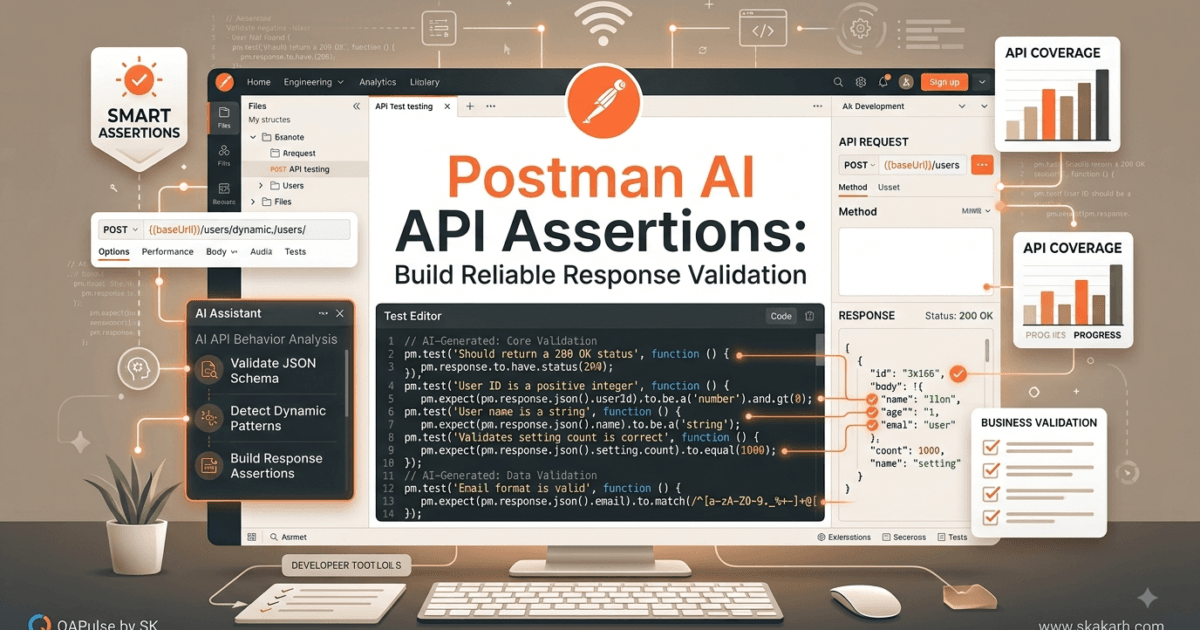
Postman AI API Assertions are becoming a practical way to improve API response validation without turning every test into a large block of repetitive JavaScript. The real advantage, however, is not simply generating assertions faster. It is understanding what the response must prove, selecting the right validation strategy, and using AI to accelerate the implementation.
A weak API test often looks like this:
pm.test("Request succeeded", function () {
    pm.response.to.have.status(200);
});
The request may return 200, but that does not prove the API returned correct data.
Consider:
{
  "id": 501,
  "name": "Sarah",
  "email": "wrong@example.com",
  "status": "deleted"
}
The HTTP request succeeded, but the application behavior may be completely wrong.
A stronger testing mindset is:
HTTP Status
     ↓
Response Structure
     ↓
Data Types
     ↓
Business Rules
     ↓
Data Relationships
     ↓
Security Expectations
That is where Postman AI Assertions become strategically useful.
What Should an API Assertion Actually Prove?
Before writing JavaScript, ask a more important question:
What defect should this assertion detect?
For example, suppose:
GET /users/501
returns:
{
  "id": 501,
  "name": "Sarah Khan",
  "email": "sarah@example.com",
  "status": "active"
}
A basic test could be:
pm.test("Status is 200", function () {
    pm.response.to.have.status(200);
});
But useful validation could include:
const response = pm.response.json();

pm.test("User ID is correct", function () {
    pm.expect(response.id)
        .to.be.a("number")
        .and.above(0);
});

pm.test("User name exists", function () {
    pm.expect(response.name)
        .to.be.a("string")
        .and.not.empty;
});

pm.test("User email exists", function () {
    pm.expect(response.email)
        .to.be.a("string")
        .and.not.empty;
});

pm.test("User status is valid", function () {
    pm.expect(response.status)
        .to.be.oneOf([
            "active",
            "inactive",
            "suspended"
        ]);
});
Now the test proves significantly more.
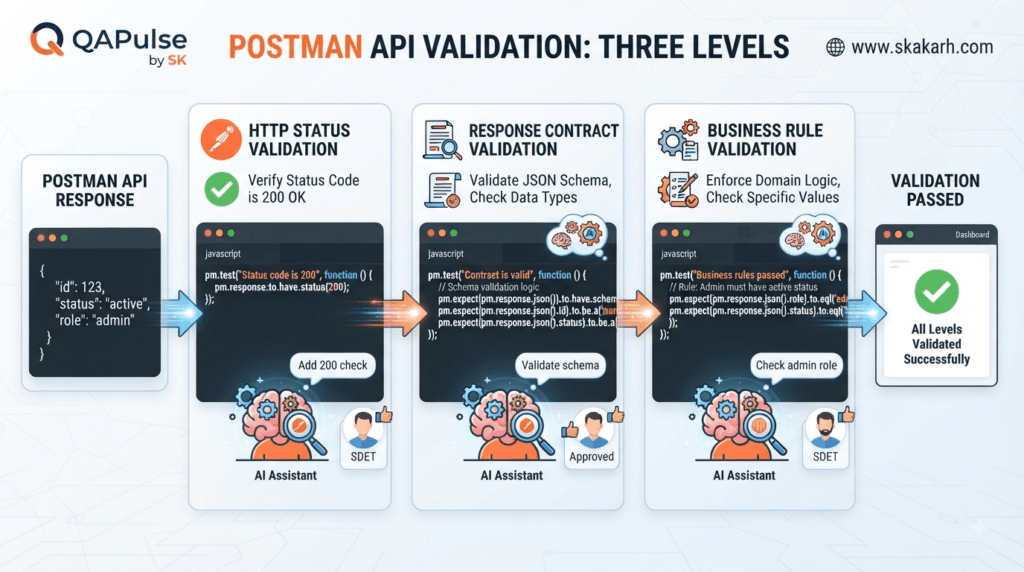
Three Levels of Response Validation
A useful way to design assertions is to separate them into three levels.
Level 1: Transport Validation
This validates HTTP behavior.
pm.test("Request returns 200", function () {
    pm.response.to.have.status(200);
});
It answers:
Did the server return the expected HTTP result?
Level 2: Contract Validation
This validates the response structure.
pm.test("Response contains user ID", function () {
    pm.expect(response).to.have.property("id");
});
It answers:
Did the API return the expected structure?
Level 3: Business Validation
This validates application behavior.
pm.test("New user starts as active", function () {
    pm.expect(response.status)
        .to.eql("active");
});
It answers:
Did the API perform the correct business operation?
The strongest API automation usually combines all three where appropriate.
Generate Assertions From Requirements, Not Just JSON
One of the biggest mistakes when using AI for API testing is providing only a JSON response:
Generate Postman tests for this response.
The AI can inspect the structure, but it cannot reliably know your business rules.
A better prompt provides requirements:
Act as a senior API test engineer.

Requirement:
A newly created customer must start with status "pending".
The API must return a positive numeric customer ID.
The submitted email must be returned unchanged.
The email must not be exposed for deleted customers.

Generate a list of assertions for this API.

For each assertion provide:
- What it validates
- Why it matters
- Defect it could detect

Do not generate JavaScript yet.
This gives AI the context required to reason about the test.
Only after reviewing the proposed assertions should you request code.
AI-Generated Assertions vs Human-Designed Assertions
Compare two workflows.
AI-first approach
JSON
 ↓
AI
 ↓
JavaScript
 ↓
Test
This is fast but can produce shallow validation.
Engineering-first approach
Requirement
 ↓
Risk
 ↓
Expected Behavior
 ↓
Assertion Strategy
 ↓
AI-assisted JavaScript
 ↓
Human Review
 ↓
Execution
The second workflow takes slightly more thought but provides much stronger control.
| Area | AI-First | Engineering-First |
|---|---|---|
| Speed | Very high | High |
| Business understanding | Variable | Strong |
| Risk of assumptions | Higher | Lower |
| Test strategy | Often shallow | Deliberate |
| Maintainability | Variable | Better |
| Production suitability | Requires review | Stronger |
AI should accelerate engineering decisions rather than eliminate them.
Validate Data Types
Consider:
{
  "id": "501"
}
when the contract expects:
{
  "id": 501
}
A simple property check will pass:
pm.expect(response)
    .to.have.property("id");
A type assertion catches the problem:
pm.test("ID is numeric", function () {
    pm.expect(response.id)
        .to.be.a("number");
});
You can ask AI to identify potential type validations:
Review this API response against the provided contract.

Identify every field where data type validation is important.

Return:
Field
Expected type
Risk if incorrect
Recommended assertion

Do not generate code.
This is particularly useful for large responses containing strings, numbers, booleans, arrays, objects, and nullable fields.
Strict Equality vs Flexible Validation
Not every assertion should use exact equality.
Suppose an API returns:
{
  "message": "Customer created successfully."
}
You could write:
pm.expect(response.message)
    .to.eql("Customer created successfully.");
This is appropriate if the exact message is part of the contract.
But if the requirement only says that a meaningful message must be returned:
pm.expect(response.message)
    .to.be.a("string")
    .and.not.empty;
may be more resilient.
Compare:
| Assertion | Strength | Risk |
|---|---|---|
| Exact string | Very strict | Can become fragile |
| Non-empty string | Flexible | May miss wording defects |
| Error code | Usually stable | Requires defined contract |
| Regex | Flexible control | Can become complex |
The correct assertion depends on the requirement.
Do not make every test maximally strict.
Make it appropriately strict.
Finding Fragile Assertions With AI
Give AI your existing tests:
Review these Postman assertions.

Identify assertions that may be fragile because they depend on:

- Exact wording
- Timestamps
- Environment-specific URLs
- Random values
- Dynamic IDs
- Ordering that is not guaranteed
- Optional fields

For every finding:
1. Explain the problem.
2. Explain the potential false failure.
3. Suggest a more stable validation strategy.

Do not modify the code.
This is one of the more useful ways to apply AI to an existing collection.
Validate Arrays Intelligently
Suppose an API returns:
{
  "users": [
    {
      "id": 1,
      "status": "active"
    },
    {
      "id": 2,
      "status": "active"
    }
  ]
}
A weak test:
pm.test("Users exist", function () {
    pm.expect(response.users).to.be.an("array");
});
A stronger test:
pm.test("Users array is not empty", function () {
    pm.expect(response.users)
        .to.be.an("array")
        .and.not.empty;
});
You could validate every item:
pm.test("Every user has an ID", function () {
    response.users.forEach(user => {
        pm.expect(user.id)
            .to.be.a("number")
            .and.above(0);
    });
});
And validate business rules:
pm.test("Every returned user has a valid status", function () {
    response.users.forEach(user => {
        pm.expect(user.status)
            .to.be.oneOf([
                "active",
                "inactive",
                "suspended"
            ]);
    });
});
This is much more useful than checking only that the response contains an array.
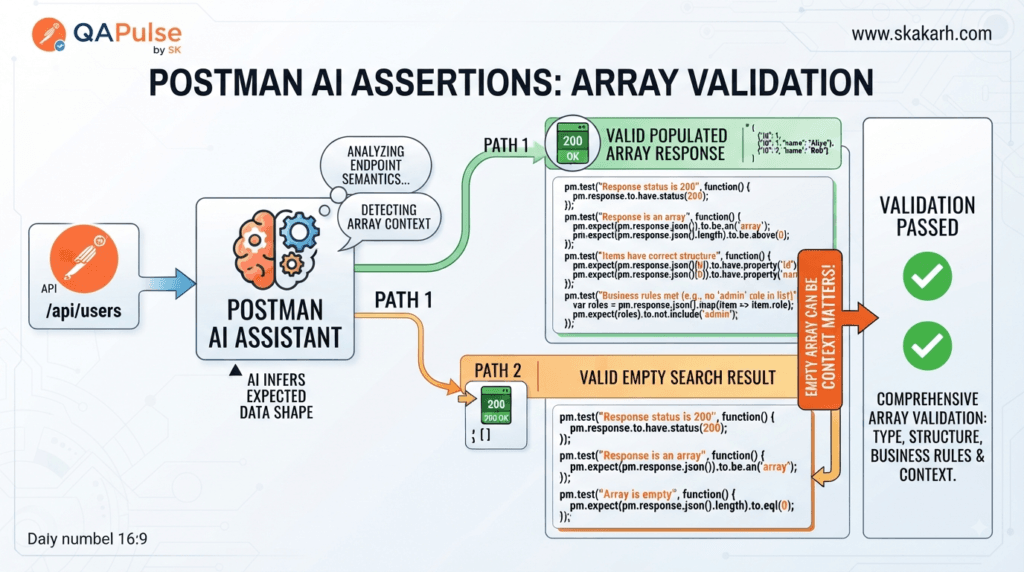
Be Careful With Empty Collections
An interesting edge case is:
{
  "users": []
}
Is this a failure?
Not necessarily.
For a search endpoint:
GET /users?name=nonexistent
an empty array may be exactly correct.
For:
GET /users
if the environment is guaranteed to contain users, an empty result might indicate a defect.
The assertion must therefore depend on endpoint semantics.
This is another reason AI should not invent requirements.
Validate Nested Objects
Consider:
{
  "customer": {
    "id": 501,
    "profile": {
      "name": "Sarah",
      "country": "Pakistan"
    }
  }
}
You can validate nested properties:
pm.test("Customer profile is valid", function () {
    pm.expect(response.customer)
        .to.have.property("profile");

    pm.expect(response.customer.profile.name)
        .to.be.a("string")
        .and.not.empty;

    pm.expect(response.customer.profile.country)
        .to.be.a("string")
        .and.not.empty;
});
For complex APIs, AI can help map nested response structures into validation requirements.
Prompt:
Analyze this nested API response.

Create a validation map containing:

- Required objects
- Required fields
- Data types
- Nullable fields
- Arrays
- Business-critical values

Identify fields that should not be asserted unless explicitly required.

Do not generate JavaScript.
That final instruction is important because it prevents premature code generation.
Response Validation Should Follow the API Contract
A useful mental model is:
API Contract
     ↓
Expected Structure
     ↓
Expected Types
     ↓
Expected Behavior
     ↓
Assertions
Not:
JSON
 ↓
AI
 ↓
Random Assertions
This distinction becomes increasingly important as your API collection grows.
Testing Optional and Nullable Fields
Suppose:
{
  "middleName": null
}
A test like:
pm.expect(response.middleName)
    .to.be.a("string");
would fail.
But that might be a legitimate response.
If the contract says:
middleName: string | null
the test should account for both:
pm.test("Middle name is valid", function () {
    pm.expect(
        response.middleName === null ||
        typeof response.middleName === "string"
    ).to.be.true;
});
The important point is to understand the contract first.
AI can help detect nullable fields, but it should not decide their semantics without reliable requirements.
Build Assertion Groups
For maintainability, organize related validations.
const response = pm.response.json();

pm.test("HTTP response is successful", function () {
    pm.response.to.have.status(200);
});

pm.test("Customer structure is valid", function () {
    pm.expect(response).to.have.property("id");
    pm.expect(response).to.have.property("name");
    pm.expect(response).to.have.property("email");
});

pm.test("Customer ID is valid", function () {
    pm.expect(response.id)
        .to.be.a("number")
        .and.above(0);
});

pm.test("Customer status is valid", function () {
    pm.expect(response.status)
        .to.be.oneOf([
            "active",
            "inactive"
        ]);
});
This produces clearer test reports than putting every assertion into one enormous block.
One Giant Assertion vs Multiple Assertions
Compare:
pm.test("Customer response is correct", function () {
    pm.expect(response.id).to.be.a("number");
    pm.expect(response.name).to.be.a("string");
    pm.expect(response.email).to.be.a("string");
    pm.expect(response.status).to.be.oneOf([
        "active",
        "inactive"
    ]);
});
with:
pm.test("Customer ID is valid", function () {
    pm.expect(response.id).to.be.a("number");
});

pm.test("Customer name is valid", function () {
    pm.expect(response.name).to.be.a("string");
});

pm.test("Customer email is valid", function () {
    pm.expect(response.email).to.be.a("string");
});

pm.test("Customer status is valid", function () {
    pm.expect(response.status)
        .to.be.oneOf(["active", "inactive"]);
});
The second approach usually gives better failure visibility.
If the email validation fails, the report immediately tells you which requirement failed.
Use AI to Improve Test Names
Test names are part of your debugging experience.
Weak:
pm.test("Check response", function () {
Better:
pm.test("Customer email is returned as a non-empty string", function () {
Prompt:
Review these Postman test names.

Make them:
- Specific
- Short
- Requirement-oriented
- Useful when the test fails

Do not change the test logic.
Good names make generated automation easier for other engineers to understand.
Strategic Exercise
Take an existing API response and create four validation categories:
HTTP:
____________________

Structure:
____________________

Data Types:
____________________

Business Rules:
____________________
Then ask AI:
Review my four validation categories.

Identify:
- Missing high-risk validations
- Unnecessary assertions
- Potentially fragile assertions
- Incorrect assumptions

Do not generate JavaScript.
Only after you agree with the validation strategy should you convert it into Postman JavaScript.
This simple exercise helps develop the most important skill in AI-assisted API testing:
Knowing what should be asserted before asking AI how to assert it.
A reliable API test does more than confirm that a request received a successful HTTP response. Postman AI API Assertions become significantly more useful when they validate the actual response contract, data relationships, headers, business rules, and failure conditions that matter to the application.
Postman provides pm.test() for defining test cases and pm.expect() for Chai-style assertions. Post-response scripts can inspect response data, headers, status codes, response times, and other response properties. (Postman Docs)
From Status Code Testing to Real Response Validation
Consider a login endpoint:
POST /api/login
A basic assertion might be:
pm.test("Login request succeeded", function () {
    pm.response.to.have.status(200);
});
This confirms the HTTP status, but it does not prove that authentication actually worked.
Imagine the API returns:
{
  "success": false,
  "message": "Invalid credentials",
  "token": null
}
while incorrectly returning 200.
The status-code assertion passes.
The login test should fail.
That is the difference between transport validation and behavior validation.
A stronger test could be:
const response = pm.response.json();

pm.test("Login request succeeded", function () {
    pm.response.to.have.status(200);
});

pm.test("Login is successful", function () {
    pm.expect(response.success).to.eql(true);
});

pm.test("Authentication token is returned", function () {
    pm.expect(response.token)
        .to.be.a("string")
        .and.not.empty;
});
Now the automation checks what the endpoint actually promises.
The Assertion Pyramid
A useful way to think about API validation is as a hierarchy:
                Business Rules
                     ▲
                     │
             Data Relationships
                     ▲
                     │
               Data Types
                     ▲
                     │
            Response Structure
                     ▲
                     │
              HTTP Behavior
The bottom layer is easy to automate.
The upper layers provide more meaningful defect detection.
For example:
pm.response.to.have.status(200);
answers:
Did the server return 200?
While:
pm.expect(response.account.status)
    .to.eql("active");
answers:
Did the server return the correct business state?
A production-grade collection should use the right level of validation for the risk of the endpoint.
Validate the Response Contract
Suppose an endpoint returns:
{
  "id": 1001,
  "name": "Ali",
  "email": "ali@example.com",
  "role": "customer"
}
A weak test only checks:
pm.response.to.have.status(200);
A contract-oriented test can verify the required properties:
const response = pm.response.json();

pm.test("Response contains required customer fields", function () {
    pm.expect(response).to.have.all.keys(
        "id",
        "name",
        "email",
        "role"
    );
});
However, be careful with .all.keys().
If the API legitimately adds a new field later, this assertion may fail even though the API remains backward compatible.
A more flexible approach is:
pm.test("Customer contains required fields", function () {
    pm.expect(response).to.have.property("id");
    pm.expect(response).to.have.property("name");
    pm.expect(response).to.have.property("email");
    pm.expect(response).to.have.property("role");
});
This distinction matters.
Strict validation
Use when:
- The exact structure is contractual.
- Additional fields should be rejected.
- Schema compatibility is critical.
Flexible validation
Use when:
- Additional response fields are allowed.
- Only selected fields are contractually important.
- The API evolves frequently.
Postman AI API Assertions can help suggest which strategy to consider, but the API contract should determine the final decision.
Validate Data Types, Not Just Values
Consider this response:
{
  "id": "1001",
  "price": "49.99",
  "available": "true"
}
The values may look correct to a human.
The data types may be completely wrong.
A test can expose the problem:
const response = pm.response.json();

pm.test("Product ID is numeric", function () {
    pm.expect(response.id).to.be.a("number");
});

pm.test("Product price is numeric", function () {
    pm.expect(response.price).to.be.a("number");
});

pm.test("Availability is boolean", function () {
    pm.expect(response.available).to.be.a("boolean");
});
This type of validation is particularly important when API consumers rely on strongly typed models.
An API returning:
"price": "49.99"
instead of:
"price": 49.99
could cause unexpected behavior in a mobile application, frontend, SDK, or downstream service.
Compare Strict Equality With Type Validation
These two assertions test different things:
pm.expect(response.id).to.eql(1001);
and:
pm.expect(response.id).to.be.a("number");
The first validates a specific value.
The second validates a type.
Sometimes you need both:
pm.test("Product ID is correct and numeric", function () {
    pm.expect(response.id)
        .to.be.a("number")
        .and.eql(1001);
});
But don’t automatically combine every possible assertion.
A good test should have a clear purpose.
| Assertion | What it proves |
|---|---|
status(200) | HTTP behavior |
property("id") | Field existence |
.to.be.a("number") | Data type |
.eql(1001) | Exact value |
.oneOf([...]) | Allowed values |
.above(0) | Numeric boundary |
.not.empty | Non-empty value |
Postman documents these assertion patterns as part of its response-testing capabilities. (Postman Docs)
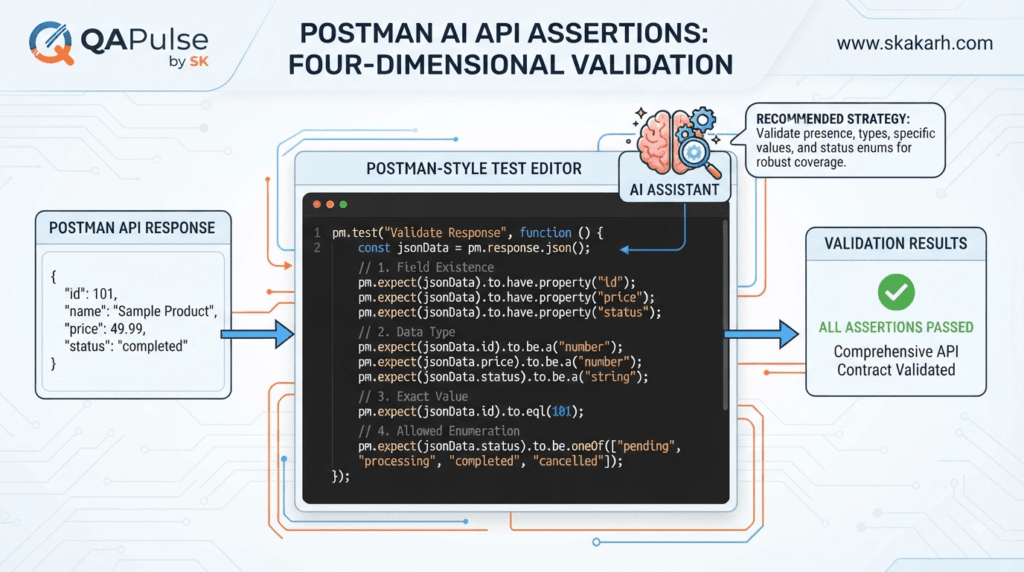
Use Allowed-Value Assertions for Enumerations
Imagine:
{
  "status": "processing"
}
The API contract allows:
pending
processing
completed
cancelled
A useful assertion is:
pm.test("Order status is valid", function () {
    pm.expect(response.status)
        .to.be.oneOf([
            "pending",
            "processing",
            "completed",
            "cancelled"
        ]);
});
This is better than:
pm.expect(response.status).to.be.a("string");
because "unknown" would pass the type assertion while violating the business contract.
This is an excellent scenario for AI-assisted test design.
Prompt:
Analyze the following API response and requirements.

Identify fields that represent enumerations.

For each field:
- List valid values
- Explain the business meaning
- Identify invalid values worth testing
- Recommend an assertion strategy

Do not generate JavaScript.
Do not invent values not supported by the requirements.
The final instruction is important.
AI should not invent business states simply because they seem plausible.
Validate Response Headers
API validation should not stop at JSON.
HTTP headers can also carry important contract information.
For example:
pm.test("Content-Type is JSON", function () {
    pm.expect(
        pm.response.headers.get("Content-Type")
    ).to.include("application/json");
});
This can detect an API accidentally returning:
text/html
instead of:
application/json
You can also validate security-related headers where they are part of your API requirements.
For example:
pm.test("Cache-Control header is present", function () {
    pm.response.to.have.header("Cache-Control");
});
Postman’s documentation supports assertions against response headers, cookies, body data, status codes, and response times. (Postman Docs)
The strategic lesson is simple:
An API response is more than its JSON body.
Validate Response Time Carefully
Performance-related assertions can also be useful:
pm.test("Response time is below 1000ms", function () {
    pm.expect(pm.response.responseTime)
        .to.be.below(1000);
});
But this needs context.
A 1-second threshold might be reasonable for one endpoint and completely inappropriate for another.
For example:
GET /health
might reasonably need to respond extremely quickly.
But:
POST /reports/generate
could legitimately take longer.
Don’t ask AI:
Make every API response faster than 500ms.
Instead ask:
Analyze these API endpoints.

Recommend response-time thresholds based on their purpose and expected behavior.

Do not assume that every endpoint should have the same threshold.
Explain the reasoning for each recommendation.
This creates a more useful performance strategy.
Validate Dynamic Values Without Hardcoding Them
Suppose an API creates a customer:
{
  "id": 91827,
  "createdAt": "2026-08-12T10:15:32Z"
}
This is a poor assertion:
pm.expect(response.id).to.eql(91827);
The ID changes every execution.
Instead:
pm.test("Customer ID is generated", function () {
    pm.expect(response.id)
        .to.be.a("number")
        .and.above(0);
});
For timestamps:
pm.test("Created timestamp is present", function () {
    pm.expect(response.createdAt)
        .to.be.a("string")
        .and.not.empty;
});
If you need stronger timestamp validation, use a format or semantic check appropriate to the contract.
Postman exposes the response through pm.response, including pm.response.json(), status code, headers, and response time. (Postman Docs)
Compare Hardcoded and Dynamic Assertions
| Approach | Example | Maintainability |
|---|---|---|
| Hardcoded ID | id === 91827 | Poor |
| Type validation | id is number | High |
| Boundary validation | id > 0 | High |
| Captured variable | Compare with previous request | High |
| Contract validation | Validate schema/type | High |
The general rule is:
Hardcode stable requirements, not runtime-generated data.
Validate Relationships Between Fields
This is where API testing becomes much more interesting.
Consider:
{
  "quantity": 3,
  "unitPrice": 20,
  "total": 60
}
Checking each field independently is useful:
pm.expect(response.quantity).to.be.a("number");
pm.expect(response.unitPrice).to.be.a("number");
pm.expect(response.total).to.be.a("number");
But you can also validate their relationship:
pm.test("Total matches quantity multiplied by unit price", function () {
    pm.expect(response.total)
        .to.eql(response.quantity * response.unitPrice);
});
Now the test can detect a calculation defect.
For example:
{
  "quantity": 3,
  "unitPrice": 20,
  "total": 50
}
Every individual field has the correct type.
The API is still wrong.
This is why Postman AI API Assertions should be designed around relationships and business behavior, not only response structure.
Ask AI to Find Relationship-Based Assertions
Use a prompt like:
Act as a senior API test architect.

Review this response and its business requirements.

Identify relationships between fields that should be validated.

Look for:
- Calculations
- Totals
- Counts
- Parent-child relationships
- Dates
- Status dependencies
- Request-response consistency

For every recommendation:
1. Explain the relationship.
2. Explain the defect it can detect.
3. Provide expected behavior.
4. Do not generate JavaScript yet.
This can reveal testing opportunities that are easy to miss when manually scanning JSON.
Validate Request-to-Response Consistency
Suppose the request is:
{
  "quantity": 3,
  "productId": 501
}
and the response is:
{
  "orderId": 1001,
  "quantity": 3,
  "productId": 501,
  "status": "pending"
}
The API should preserve the submitted values where the contract requires it.
You can parse the request:
const request = JSON.parse(pm.request.body.raw);
const response = pm.response.json();

pm.test("Product ID matches request", function () {
    pm.expect(response.productId)
        .to.eql(request.productId);
});

pm.test("Quantity matches request", function () {
    pm.expect(response.quantity)
        .to.eql(request.quantity);
});
This is stronger than checking that the response contains those fields.
It verifies a relationship between two separate pieces of data.
A Better AI Prompt for Response Validation
Instead of:
Generate Postman assertions for this API.
use:
You are a senior SDET specializing in API automation.

Analyze this API endpoint using the provided:
- Request
- Response
- API contract
- Business requirements

Identify assertions across these categories:

1. HTTP status
2. Response structure
3. Required fields
4. Data types
5. Allowed values
6. Business rules
7. Field relationships
8. Request-response consistency
9. Dynamic values
10. Headers
11. Error conditions
12. Boundary conditions

For every proposed assertion provide:
- Assertion
- Reason
- Defect detected
- Priority

Do not invent requirements.
Do not generate JavaScript until the assertion strategy is approved.
This prompt is much more useful because it forces AI to reason before generating code.
Postman AI API Assertions vs Manual Assertions
AI does not replace traditional assertion knowledge.
Compare the approaches:
| Capability | Manual Testing | AI-Assisted Testing |
|---|---|---|
| Basic assertions | Excellent | Excellent |
| Understanding requirements | Human-led | Human + AI |
| Repetitive code generation | Slower | Faster |
| Finding obvious fields | Easy | Fast |
| Finding overlooked scenarios | Depends on engineer | AI can assist |
| Business-rule decisions | Human | Human |
| Final validation | Human | Human |
| Code review | Required | Required |
The strongest approach is therefore not:
AI replaces tester
It is:
Tester
  +
AI
  +
API Contract
  +
Business Requirements
That combination provides both speed and engineering control.
Build an Assertion Decision Tree
When reviewing an API response, use this sequence:
Did the request return the expected HTTP result?
                 ↓
               Yes
                 ↓
Is the response structurally valid?
                 ↓
               Yes
                 ↓
Are required fields present?
                 ↓
               Yes
                 ↓
Are their types correct?
                 ↓
               Yes
                 ↓
Are allowed values valid?
                 ↓
               Yes
                 ↓
Do business relationships hold?
                 ↓
               Yes
                 ↓
Are security and error behaviors correct?
This is a practical way to prevent shallow test coverage.
Interactive Challenge
Take one endpoint from your Postman collection.
Before opening the AI assistant, write down:
Expected HTTP status:
________________________

Required fields:
________________________

Important data types:
________________________

Allowed values:
________________________

Business rules:
________________________

Field relationships:
________________________

Dynamic values:
________________________

Important headers:
________________________
Then ask AI to review your list.
Use:
Review my API assertion strategy as a senior SDET.

Find:
- Missing high-risk validations
- Assertions that are too strict
- Assertions that are too weak
- Unnecessary checks
- Business rules I may have overlooked
- Dynamic values that should not be hardcoded

Do not generate code.

Challenge my assumptions and explain your reasoning.
The goal is not to get AI to agree with you.
The goal is to make the test strategy better.
Debugging Failed Assertions
When an assertion fails, don’t immediately change the expected value.
Consider:
pm.test("Customer status is active", function () {
    pm.expect(response.status).to.eql("active");
});
If the test fails because the API returns:
{
  "status": "pending"
}
there are at least three possibilities:
1. API is wrong
2. Test expectation is wrong
3. Requirement changed
Changing:
"active"
to:
"pending"
without investigating the requirement can simply hide a defect.
Postman also documents common assertion failures such as referencing undefined properties or incorrectly scoped variables. (Postman Docs)
A good debugging workflow is:
Test Failure
     ↓
Inspect Actual Response
     ↓
Compare With Contract
     ↓
Check Business Requirement
     ↓
Determine Root Cause
     ↓
Fix API or Test
Not:
Test Failure
     ↓
Change Assertion
That distinction is fundamental to reliable automation.
The Strategic Rule
A useful rule for AI-assisted API testing is:
Never ask AI to decide what is correct when the system requirements already define correctness.
Give AI the requirements.
Let AI identify possibilities.
Review those possibilities.
Then encode the approved behavior into automation.
That is how Postman AI API Assertions become an engineering capability rather than merely a code-generation shortcut.
Making Postman AI API Assertions Reliable for Real-World APIs
Postman AI API Assertions become much more valuable when they are designed for the messy conditions that real APIs produce. Production APIs do not always return perfectly predictable data. They deal with missing records, invalid inputs, permissions, empty collections, duplicate requests, expired tokens, inconsistent environments, and changing business states.
That means a test such as:
pm.test("Response is successful", function () {
    pm.response.to.have.status(200);
});
is rarely enough.
A reliable API test should answer a more important question:
Did the API behave correctly for this specific scenario?
That requires thinking beyond status codes and validating behavior across positive, negative, boundary, security, and state-dependent scenarios.
Positive Testing Is Only the Beginning
Suppose you have:
POST /api/orders
with:
{
  "productId": 501,
  "quantity": 2
}
A positive test might verify:
const response = pm.response.json();

pm.test("Order is created", function () {
    pm.response.to.have.status(201);
});

pm.test("Order ID is generated", function () {
    pm.expect(response.orderId)
        .to.be.a("number")
        .and.above(0);
});

pm.test("Order status is pending", function () {
    pm.expect(response.status)
        .to.eql("pending");
});
That is useful.
But what happens when:
quantity = 0
quantity = -1
quantity = "two"
productId = null
productId = unknown
A mature API test strategy deliberately asks these questions.
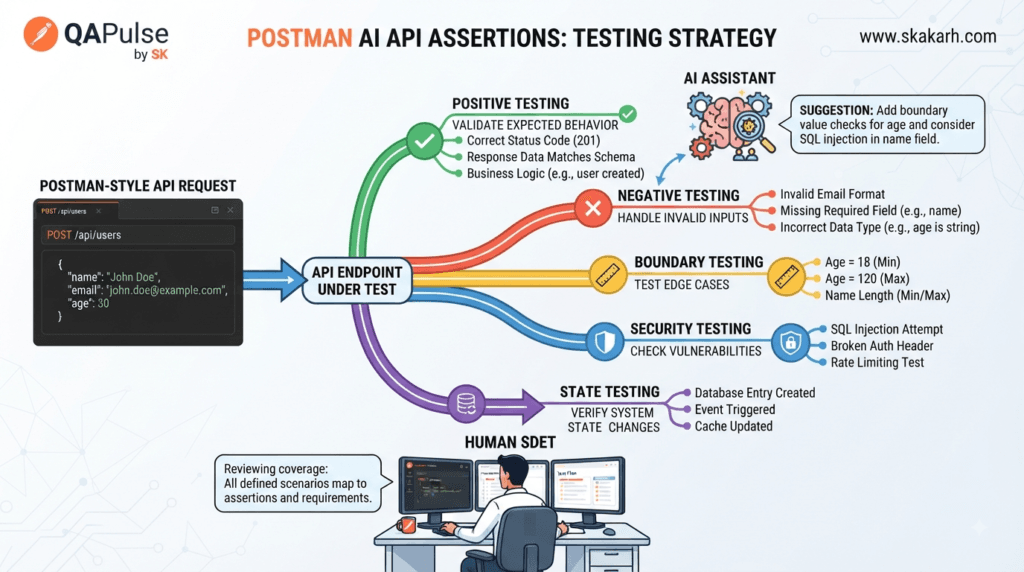
Positive vs Negative Assertions
Compare the two approaches:
| Strategy | Main Question | Coverage |
|---|---|---|
| Positive testing | Does valid input work? | Normal behavior |
| Negative testing | Does invalid input fail correctly? | Error behavior |
| Boundary testing | Does the API handle limits? | Edge behavior |
| Security testing | Does the API enforce access rules? | Security behavior |
| State testing | Does behavior depend on state? | Workflow behavior |
AI can help identify candidate scenarios, but the expected outcome must come from the API requirements.
For example:
quantity = 2
Expected: 201

quantity = 0
Expected: 400

quantity = -1
Expected: 400

quantity = "two"
Expected: 400
The important part is not generating four requests.
The important part is knowing why each request exists.
Validate Error Responses as Carefully as Success Responses
Many teams spend considerable effort testing:
200 OK
and:
201 Created
but barely validate:
400 Bad Request
401 Unauthorized
403 Forbidden
404 Not Found
409 Conflict
422 Unprocessable Content
500 Internal Server Error
An API’s error behavior is part of its contract.
Suppose an invalid request produces:
{
  "error": "INVALID_QUANTITY",
  "message": "Quantity must be greater than zero"
}
A useful test could be:
const response = pm.response.json();

pm.test("Invalid quantity returns 400", function () {
    pm.response.to.have.status(400);
});

pm.test("Error code is correct", function () {
    pm.expect(response.error)
        .to.eql("INVALID_QUANTITY");
});

pm.test("Error message is provided", function () {
    pm.expect(response.message)
        .to.be.a("string")
        .and.not.empty;
});
Notice that the test validates both:
HTTP behavior
+
Application error behavior
Checking only 400 would miss an API returning the wrong error classification.
Test the Error Contract, Not Just the Error Code
Consider two responses.
Response A:
{
  "error": "INVALID_QUANTITY",
  "message": "Quantity must be greater than zero"
}
Response B:
{
  "error": "SERVER_ERROR",
  "message": "Something went wrong"
}
Both could return 400.
But only Response A satisfies the expected business behavior for an invalid quantity.
A stronger test therefore checks:
pm.test("Correct error type is returned", function () {
    pm.expect(response.error)
        .to.eql("INVALID_QUANTITY");
});
This is an example of why Postman AI API Assertions should be based on expected behavior rather than simply copying the HTTP status.
Boundary Testing Finds Bugs Normal Tests Miss
Imagine the API requirement says:
quantity must be between 1 and 100
A basic test might use:
quantity = 10
That proves very little.
A better test matrix is:
0
1
2
99
100
101
-1
The boundary values are especially valuable.
A Postman test can validate an invalid boundary:
pm.test("Quantity above maximum is rejected", function () {
    pm.response.to.have.status(400);
});
But the test data should deliberately target the boundary.
Ask AI:
The API requires quantity to be an integer from 1 through 100.

Identify the highest-value boundary scenarios.

Return:
- Input
- Expected result
- Reason
- Defect that could be detected

Do not generate JavaScript.
A strong answer should identify at least:
0
1
100
101
negative value
decimal value
non-numeric value
missing value
null
The point is not to create endless tests.
It is to target high-risk transitions.
Use Equivalence Classes to Reduce Test Explosion
Suppose an API accepts age:
18–65
You do not necessarily need hundreds of tests.
Divide the input space:
< 18       → invalid
18–65      → valid
> 65       → invalid
Then select representative values:
17
18
40
65
66
This is more strategic than randomly generating values.
AI can help create these partitions:
Analyze this API input constraint:

age must be an integer between 18 and 65.

Create equivalence classes and boundary values.

Prioritize scenarios based on defect-detection value.
Do not generate duplicate test cases.
This is a much better use of AI than asking it to produce 100 random inputs.
Validate Optional Fields Intelligently
Consider:
{
  "name": "Ali",
  "phone": "+923001234567"
}
The phone field may be optional.
A poor assertion might be:
pm.expect(response.phone)
    .to.be.a("string");
If the contract allows the field to be absent, the assertion is unnecessarily strict.
A better approach is to first understand the contract:
phone:
optional
type: string
format: phone number
Then validate it only when present:
if (response.phone !== undefined) {
    pm.test("Phone is valid when provided", function () {
        pm.expect(response.phone)
            .to.be.a("string")
            .and.not.empty;
    });
}
This illustrates an important principle:
A good assertion is strict about requirements and flexible about implementation details.
Null, Missing, Empty, and Undefined Are Different
These values are not automatically equivalent:
{
  "middleName": null
}
versus:
{}
versus:
{
  "middleName": ""
}
They may represent:
null       → known absence of a value
missing    → field not supplied
empty      → field exists but contains no content
undefined  → property does not exist in JavaScript
Your test should reflect the API contract.
For example:
pm.test("Middle name may be null", function () {
    pm.expect(
        response.middleName === null ||
        typeof response.middleName === "string"
    ).to.be.true;
});
AI can help identify these distinctions in large response objects, but the contract remains the source of truth.
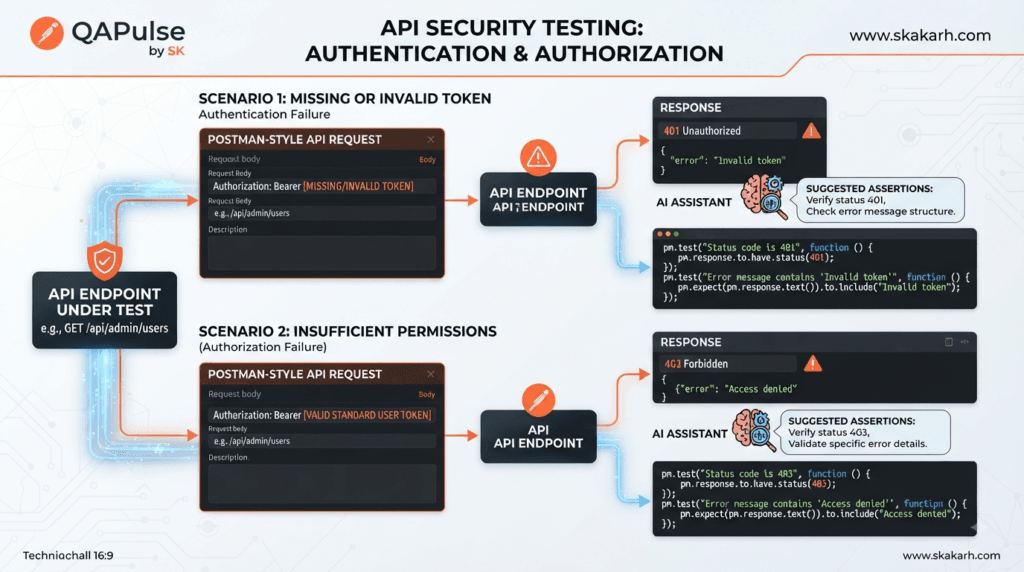
Test Authentication and Authorization Separately
A common API-testing mistake is treating authentication and authorization as the same thing.
Authentication asks:
Who are you?
Authorization asks:
Are you allowed to perform this action?
Consider:
GET /api/admin/users
A valid authenticated normal user might receive:
403 Forbidden
That is correct if the user lacks administrator privileges.
Your test can validate:
pm.test("Regular user cannot access admin endpoint", function () {
    pm.response.to.have.status(403);
});
Compare:
No token
   ↓
401 Unauthorized

Valid token + insufficient permission
   ↓
403 Forbidden
These scenarios should not be collapsed into one test.
Validate Response Data Against the Request
Suppose the request contains:
{
  "name": "Ayesha",
  "email": "ayesha@example.com"
}
and the response returns:
{
  "id": 9021,
  "name": "Ayesha",
  "email": "ayesha@example.com",
  "status": "active"
}
Instead of hardcoding:
pm.expect(response.name).to.eql("Ayesha");
pm.expect(response.email)
    .to.eql("ayesha@example.com");
you can compare the response against the actual request.
const request = JSON.parse(pm.request.body.raw);
const response = pm.response.json();

pm.test("Name matches submitted value", function () {
    pm.expect(response.name)
        .to.eql(request.name);
});

pm.test("Email matches submitted value", function () {
    pm.expect(response.email)
        .to.eql(request.email);
});
This creates a reusable test.
The test does not care whether the customer is:
Ayesha
Ali
Sarah
John
It verifies the relationship.
Validate Cross-Request State
API workflows often involve multiple requests:
POST /customers
      ↓
GET /customers/{id}
      ↓
PATCH /customers/{id}
      ↓
GET /customers/{id}
      ↓
DELETE /customers/{id}
      ↓
GET /customers/{id}
Each request should validate the state transition.
For example, after creation:
pm.test("Customer starts as active", function () {
    pm.expect(response.status)
        .to.eql("active");
});
After deletion:
pm.test("Deleted customer cannot be retrieved", function () {
    pm.response.to.have.status(404);
});
The individual assertions are useful, but the workflow is even more important.
The API should behave consistently across state transitions.
Store Dynamic IDs Instead of Hardcoding Them
After creating a resource:
const response = pm.response.json();

pm.environment.set(
    "customerId",
    response.id
);
Then use:
{{customerId}}
in later requests.
This creates a reusable workflow.
Compare:
Hardcoded:
GET /customers/9021

Dynamic:
GET /customers/{{customerId}}
The second approach is much better for repeatable automation.
Postman supports variables for storing and reusing values across requests and scripts, making dynamic workflows practical in collections. (learning.postman.com)
Validate State Transitions
Consider an order:
pending
   ↓
confirmed
   ↓
shipped
   ↓
delivered
A naive test may only check:
pm.expect(response.status)
    .to.be.a("string");
That is almost useless.
A state-aware test asks:
Can pending become shipped directly?
Can delivered become pending?
Can cancelled become shipped?
Can a shipped order be edited?
These are business rules.
For example:
pm.test("Order transitions to confirmed", function () {
    pm.expect(response.status)
        .to.eql("confirmed");
});
The real value comes from understanding the allowed transition.
Ask AI to Discover State-Based Test Scenarios
A useful prompt:
Analyze this order lifecycle:

pending → confirmed → shipped → delivered

Also:
pending → cancelled
confirmed → cancelled

Identify invalid state transitions that should be tested.

For each transition provide:
- Current state
- Requested state
- Expected HTTP status
- Expected business behavior
- Risk

Do not invent undocumented transitions.
This can turn a simple CRUD collection into meaningful workflow testing.
Avoid Over-Assertion
More assertions do not automatically mean better tests.
Consider:
pm.test("Everything is correct", function () {
    pm.expect(response.id).to.be.a("number");
    pm.expect(response.name).to.be.a("string");
    pm.expect(response.email).to.be.a("string");
    pm.expect(response.createdAt).to.be.a("string");
    pm.expect(response.updatedAt).to.be.a("string");
    pm.expect(response.url).to.be.a("string");
    pm.expect(response.version).to.be.a("number");
});
Some of these may be valuable.
Others may simply create maintenance noise.
Ask:
If this assertion fails, what defect does it reveal?
If the answer is unclear, reconsider the assertion.
Assertion Quality Matrix
| Assertion Type | Value | Maintenance Risk |
|---|---|---|
| HTTP status | High | Low |
| Required field | High | Low |
| Data type | High | Low |
| Business rule | Very high | Medium |
| Cross-field calculation | Very high | Medium |
| Exact timestamp | Often low | High |
| Dynamic ID equality | Low | High |
| Exact UI-style message | Variable | High |
| Security behavior | Very high | Medium |
| State transition | Very high | Medium |
This matrix provides a useful review framework for AI-generated tests.
Don’t judge an assertion by how sophisticated its JavaScript looks.
Judge it by the defect it can detect.
Compare Postman AI API Assertions With Schema Validation
Schema validation and individual assertions are complementary.
Schema validation can answer:
Does the response conform to the expected structure and types?
Individual assertions can answer:
Does this order have the correct status?
Does this total equal quantity × price?
Does this user have permission?
Does this request preserve the submitted email?
| Validation | Best For |
|---|---|
| JSON/schema validation | Structure and types |
| Individual assertions | Business rules |
| Status assertions | HTTP behavior |
| Header assertions | Protocol/API metadata |
| Relationship assertions | Data consistency |
| Workflow tests | State transitions |
A strong API automation strategy uses the appropriate tool for each problem.
Build a Review Checklist for AI-Generated Tests
Before accepting generated assertions, ask:
□ Does every assertion map to a requirement?
□ Does the test validate behavior rather than appearance?
□ Are dynamic values handled dynamically?
□ Are optional fields treated correctly?
□ Are null and missing values distinguished?
□ Are boundary conditions covered?
□ Are negative scenarios included?
□ Are authentication and authorization separated?
□ Are business relationships validated?
□ Are state transitions tested?
□ Are assertions stable across environments?
□ Would a failure provide useful diagnostic information?
This turns AI-generated code into an engineering review process.
Interactive Exercise: Improve a Weak Test
Start with:
pm.test("API works", function () {
    pm.response.to.have.status(200);
});
Imagine the endpoint:
POST /api/orders
Requirements:
quantity must be 1–100
productId must exist
successful creation returns 201
new order starts as pending
response must contain orderId
total = quantity × unitPrice
Your goal is to identify the assertions before writing code.
Think through:
HTTP:
201

Structure:
orderId, status, total

Boundary:
1, 100, 0, 101

Business:
status = pending

Relationship:
total = quantity × unitPrice

Negative:
invalid product
invalid quantity
Now ask AI to critique your strategy rather than blindly generate a replacement:
Review my API testing strategy for this order endpoint.

Act as a senior SDET.

Identify:
- Missing high-risk scenarios
- Weak assertions
- Overly strict assertions
- Missing relationships
- Boundary gaps
- Error-handling gaps

Do not rewrite my tests yet.
Explain what should change and why.
This workflow produces better results because the engineer remains responsible for test intent.
The Most Important Shift
The biggest improvement in AI-assisted API testing is not writing JavaScript faster.
It is moving from:
"What assertion can I write?"
to:
"What behavior must I prove?"
Once that question is answered, JavaScript becomes implementation.
That is the mindset that makes Postman AI API Assertions useful at scale: AI can accelerate analysis, scenario discovery, assertion generation, and review, while the engineer remains responsible for requirements, risk, correctness, and maintainability.
Turning Postman AI API Assertions Into Maintainable Automation
Postman AI API Assertions are most valuable when they become part of a repeatable engineering workflow rather than a one-time code-generation exercise.
A generated assertion can look perfectly reasonable:
pm.test("User is active", function () {
    pm.expect(pm.response.json().status)
        .to.eql("active");
});
But before accepting it, ask:
- Is
activeactually required for this scenario? - Could the user legitimately be
pending? - Is the value environment-dependent?
- Does the request determine the expected state?
- What defect would this test detect?
- Will the test remain valid six months from now?
These questions separate useful AI-assisted automation from fragile generated code.
Build Assertions Around Risk
Not every API field deserves equal testing effort.
Consider a payment response:
{
  "transactionId": 78231,
  "currency": "USD",
  "amount": 150.00,
  "status": "completed",
  "createdAt": "2026-08-12T10:30:00Z"
}
A practical risk model could be:
| Field | Risk | Validation Priority |
|---|---|---|
| transactionId | High | High |
| currency | High | High |
| amount | Critical | Critical |
| status | Critical | Critical |
| createdAt | Medium | Medium |
You could then create targeted tests:
const response = pm.response.json();

pm.test("Transaction ID is valid", function () {
    pm.expect(response.transactionId)
        .to.be.a("number")
        .and.above(0);
});

pm.test("Currency is supported", function () {
    pm.expect(response.currency)
        .to.be.oneOf(["USD", "EUR", "GBP"]);
});

pm.test("Payment amount is positive", function () {
    pm.expect(response.amount)
        .to.be.a("number")
        .and.above(0);
});

pm.test("Payment status is valid", function () {
    pm.expect(response.status)
        .to.be.oneOf([
            "pending",
            "completed",
            "failed",
            "cancelled"
        ]);
});
The strategic principle is simple:
Spend the most validation effort where an incorrect API response would create the greatest business risk.
Use AI for Test Review, Not Only Test Generation
Most people discover AI through prompts such as:
Generate Postman tests for this response.
That is useful, but it is only one capability.
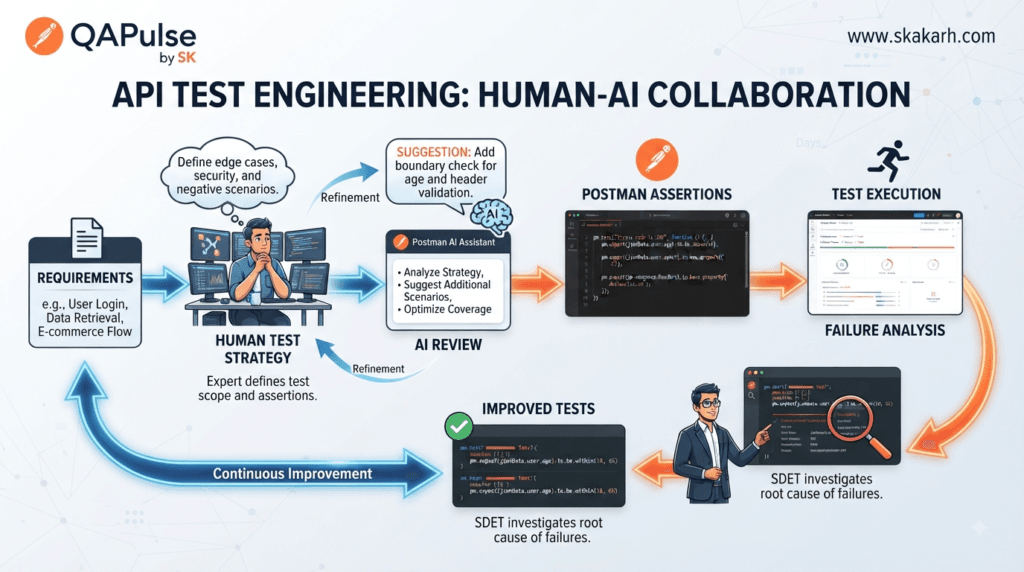
A stronger workflow is:
Requirements
     ↓
Human test strategy
     ↓
AI review
     ↓
AI suggestions
     ↓
Human decision
     ↓
Postman assertions
     ↓
Execution
     ↓
AI-assisted failure analysis
This makes AI part of the engineering feedback loop.
For example, after a test failure, provide AI with:
Expected:
status = completed

Actual:
status = pending

Endpoint:
POST /api/payments

Business requirement:
Payment should be completed only after successful authorization.

Analyze possible causes.

Separate:
- API defect
- test defect
- environment issue
- data/setup issue

Do not assume the test is wrong.
This is considerably more valuable than simply asking AI to “fix the failing test.”
Create Reusable Assertion Patterns
If your organization repeatedly validates similar API responses, don’t generate every assertion from scratch.
Create reusable patterns.
For example:
function assertPositiveNumber(value, fieldName) {
    pm.expect(value, `${fieldName} should be numeric`)
        .to.be.a("number");

    pm.expect(value, `${fieldName} should be positive`)
        .to.be.above(0);
}

function assertNonEmptyString(value, fieldName) {
    pm.expect(value, `${fieldName} should be a string`)
        .to.be.a("string");

    pm.expect(value, `${fieldName} should not be empty`)
        .to.not.be.empty;
}
Then:
const response = pm.response.json();

pm.test("Customer response fields are valid", function () {
    assertPositiveNumber(response.id, "Customer ID");
    assertNonEmptyString(response.name, "Customer name");
    assertNonEmptyString(response.email, "Customer email");
});
This approach gives you:
- Consistency
- Less duplicated code
- Easier maintenance
- Standardized failure messages
- Faster test creation
AI can help convert repeated test patterns into reusable helpers, but those helpers should be reviewed like production code.
Standardize AI Prompting Across Your Team
One engineer might ask:
Write tests for this API.
Another might ask:
Generate assertions.
A third might provide detailed requirements.
The results will vary considerably.
Create a team-level prompt structure:
Role:
Senior API automation engineer

Input:
API request
API response
API contract
Business requirements

Analyze:
HTTP behavior
Response structure
Data types
Required fields
Business rules
Relationships
Negative scenarios
Boundary conditions
Security behavior

Output:
Assertion strategy
Risk level
Defect detected
Recommended test

Restrictions:
Do not invent requirements.
Do not hardcode dynamic values.
Flag ambiguous requirements.
This creates a more consistent AI-assisted testing process.
Prompt AI to Challenge Your Tests
One of the strongest techniques is adversarial review.
Instead of asking:
Are these tests good?
ask:
Act as a hostile API test reviewer.

Review these Postman tests and try to identify defects they would NOT detect.

Look specifically for:
- Incorrect HTTP status with valid response body
- Incorrect business values
- Wrong data types
- Missing fields
- Invalid enum values
- Boundary failures
- Authorization failures
- State transition problems
- Request-response mismatches
- Dynamic data problems

For each gap, explain the missing test scenario.
This changes AI from a code generator into a test-design critic.
That is a much more powerful role.
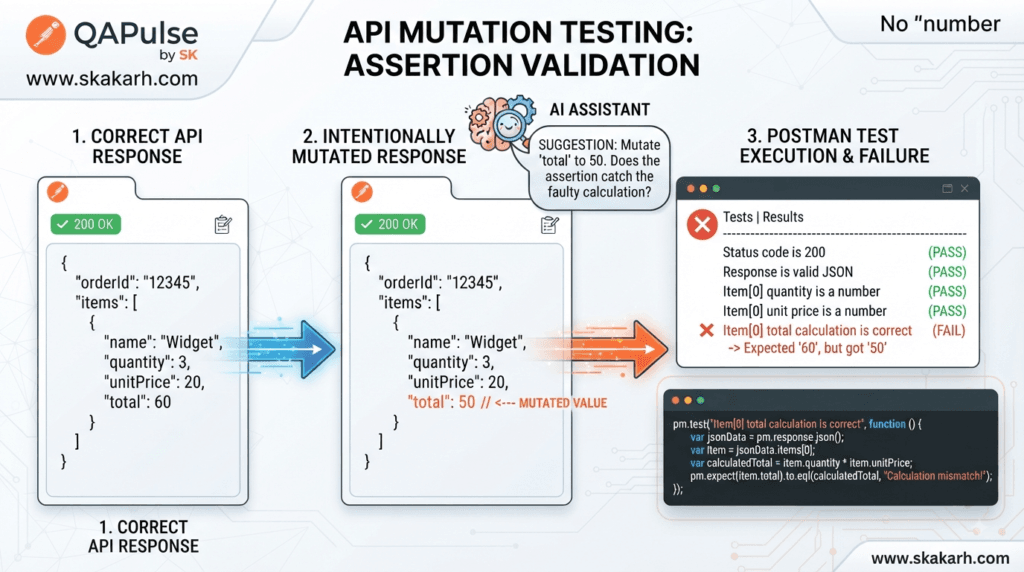
Mutation Thinking: Would Your Test Catch a Defect?
Imagine the correct response is:
{
  "quantity": 3,
  "unitPrice": 20,
  "total": 60
}
Now deliberately imagine defects:
{
  "quantity": 3,
  "unitPrice": 20,
  "total": 50
}
Would your tests fail?
If you only test:
pm.expect(response.total).to.be.a("number");
the answer is no.
Add:
pm.test("Total is calculated correctly", function () {
    pm.expect(response.total)
        .to.eql(response.quantity * response.unitPrice);
});
Now the defect is detected.
This gives you a powerful question:
If I deliberately break this response, will my test notice?
If the answer is no, your test may be providing false confidence.
Compare Weak and Strong API Automation
Consider this test:
pm.test("API works", function () {
    pm.response.to.have.status(200);
});
It is fast.
It is also weak.
A stronger implementation might be:
const response = pm.response.json();

pm.test("API returns expected status", function () {
    pm.response.to.have.status(200);
});

pm.test("Customer ID is valid", function () {
    pm.expect(response.id)
        .to.be.a("number")
        .and.above(0);
});

pm.test("Customer status is valid", function () {
    pm.expect(response.status)
        .to.be.oneOf([
            "active",
            "inactive",
            "suspended"
        ]);
});

pm.test("Customer email is present", function () {
    pm.expect(response.email)
        .to.be.a("string")
        .and.not.empty;
});
The difference is not the number of lines.
The difference is defect-detection capability.
| Approach | Speed | Coverage | Diagnostic Value |
|---|---|---|---|
| Status-only | Very high | Low | Low |
| Structure validation | High | Medium | Medium |
| Data + type validation | High | High | High |
| Business-rule validation | Medium | Very high | Very high |
| Full workflow validation | Medium | Highest | Highest |
Avoid Using AI to Invent Business Requirements
This is one of the most important boundaries.
Suppose your response contains:
{
  "status": "pending"
}
You ask AI:
Generate assertions.
AI may decide that:
pm.expect(response.status).to.eql("active");
looks reasonable.
But where did "active" come from?
If the requirement never said that, the generated test is an assumption.
Instead, provide:
Requirement:
New orders must begin in "pending" state.
Then the assertion has a legitimate foundation:
pm.test("New order starts as pending", function () {
    pm.expect(response.status)
        .to.eql("pending");
});
AI can accelerate implementation.
It should not manufacture your product requirements.
Create a Traceability Model
A mature API test can be traced back to a requirement.
For example:
REQ-PAY-004
     ↓
Payment must return a transaction ID
     ↓
Postman assertion
     ↓
transactionId exists and is positive
Implementation:
pm.test("Payment returns a valid transaction ID", function () {
    pm.expect(response.transactionId)
        .to.be.a("number")
        .and.above(0);
});
You can even include requirement identifiers in test names:
pm.test("REQ-PAY-004: transaction ID is returned", function () {
    pm.expect(response.transactionId)
        .to.be.a("number")
        .and.above(0);
});
This makes large collections easier to audit.
Use AI to Detect Duplicate Assertions
As collections grow, duplicate tests become common.
For example:
pm.test("Status is 200", function () {
    pm.response.to.have.status(200);
});
may appear across dozens of requests.
Some duplication is acceptable.
But duplicated business assertions may indicate an opportunity for standardization.
Ask AI:
Review these Postman tests.

Identify:
- Duplicate assertions
- Assertions testing the same behavior
- Inconsistent validation patterns
- Different naming conventions
- Opportunities for reusable helpers

Do not remove anything automatically.
Explain the recommended consolidation first.
This turns AI into a maintenance assistant.
Organize Assertions by Purpose
A clean script can follow a predictable order:
const response = pm.response.json();

// 1. HTTP
pm.test("Status is successful", function () {
    pm.response.to.have.status(200);
});

// 2. Structure
pm.test("Customer ID exists", function () {
    pm.expect(response).to.have.property("id");
});

// 3. Types
pm.test("Customer ID is numeric", function () {
    pm.expect(response.id).to.be.a("number");
});

// 4. Business rules
pm.test("Customer is active", function () {
    pm.expect(response.status).to.eql("active");
});

// 5. Relationships
pm.test("Total is correct", function () {
    pm.expect(response.total)
        .to.eql(response.quantity * response.unitPrice);
});
This makes the script easier to scan.
When another engineer opens it six months later, the intent is immediately visible.
Don’t Turn Every Assertion Into an AI Problem
AI is useful when it adds leverage.
For example, manually writing this:
pm.test("Status is 200", function () {
    pm.response.to.have.status(200);
});
takes seconds.
There is little value in spending more time prompting AI to generate it.
AI becomes more valuable when dealing with:
- Large JSON structures
- Complex business rules
- Many fields
- Nested objects
- Boundary analysis
- Workflow dependencies
- Existing test review
- Test-gap discovery
- Assertion refactoring
- Large Postman collections
The strategic rule is:
Use AI where reasoning and repetition create the most leverage.
A Practical AI-Assisted Assertion Workflow
A repeatable workflow can look like this:
1. Read the API requirement
          ↓
2. Identify business risks
          ↓
3. Examine request and response
          ↓
4. Design expected behavior
          ↓
5. Ask AI for missing scenarios
          ↓
6. Review AI recommendations
          ↓
7. Generate JavaScript
          ↓
8. Execute in Postman
          ↓
9. Investigate failures
          ↓
10. Review test stability
          ↓
11. Refactor reusable patterns
This is significantly safer than:
Response → AI → Copy → Paste → Done
A Complete Example
Consider:
POST /api/orders
Request:
{
  "productId": 501,
  "quantity": 3,
  "unitPrice": 20
}
Expected response:
{
  "orderId": 9001,
  "productId": 501,
  "quantity": 3,
  "unitPrice": 20,
  "total": 60,
  "status": "pending"
}
A practical assertion suite could be:
const request = JSON.parse(pm.request.body.raw);
const response = pm.response.json();

pm.test("Order is created successfully", function () {
    pm.response.to.have.status(201);
});

pm.test("Order ID is generated", function () {
    pm.expect(response.orderId)
        .to.be.a("number")
        .and.above(0);
});

pm.test("Product ID matches request", function () {
    pm.expect(response.productId)
        .to.eql(request.productId);
});

pm.test("Quantity matches request", function () {
    pm.expect(response.quantity)
        .to.eql(request.quantity);
});

pm.test("Unit price matches request", function () {
    pm.expect(response.unitPrice)
        .to.eql(request.unitPrice);
});

pm.test("Total is calculated correctly", function () {
    pm.expect(response.total)
        .to.eql(
            response.quantity * response.unitPrice
        );
});

pm.test("New order starts as pending", function () {
    pm.expect(response.status)
        .to.eql("pending");
});
This small suite validates:
HTTP status
+
Generated identifier
+
Request-response consistency
+
Business calculation
+
Initial business state
That is much stronger than simply checking 201.
Final Review Before Committing AI-Generated Assertions
Before adding generated tests to a shared collection, ask five questions:
1. What requirement does this test represent?
If there is no clear answer, reconsider it.
2. What defect would make this test fail?
A useful test should detect a meaningful failure.
3. Is the expected value stable?
Avoid hardcoding values that legitimately change.
4. Is the assertion too strict?
Do not reject valid API evolution.
5. Is the assertion too weak?
A test that only confirms a field exists may provide little protection.
This five-question review can prevent a surprising amount of bad automation.
Internal Links:
- Learn MCP – Zero to Hero
- Learn AI Agents for QA – Zero to Hero
- Playwright Automation – Zero to Hero
- TencentDB Agent Memory: Complete Zero to Hero
- LangGraph: Complete Zero to Hero
- Learn Python – Zero to Hero
- OpenAI Codex: Complete Zero to Hero
- Cursor AI: Complete Zero to Hero
- Claude Code Tutorial: Complete Zero to Hero
- AutoGen: Complete Zero to Hero Guide
- Free QA Resources Built From Real Experience
- QA Glossary: Test Automation Terms Every Engineer Should Know
External Resources:
- Postman Official Documentation: https://learning.postman.com/docs
- Postman Learning Center: https://learning.postman.com
- Postman AI Documentation: https://learning.postman.com/docs/postman-ai/postman-ai-overview
- OpenAPI Specification: https://spec.openapis.org/oas/latest.html
- HTTP Semantics (IETF RFC 9110): https://www.rfc-editor.org/rfc/rfc9110
- OWASP API Security Top 10: https://owasp.org/API-Security
People Asked Questions
What are Postman AI API Assertions?
Postman AI API Assertions are AI-assisted approaches for generating, reviewing, and improving Postman assertions that validate API responses, business rules, data types, errors, and workflows.
How do I write API assertions in Postman?
Postman uses JavaScript-based test scripts with APIs such as pm.test() and pm.expect() to validate response status, body data, headers, and other API behavior.
Can AI generate Postman test scripts?
Yes. AI can help generate Postman test scripts from API requirements, response examples, and natural-language testing instructions, but generated assertions should be reviewed against the actual API contract.
How do I validate a JSON response in Postman?
Parse the response with pm.response.json() and use assertions to verify required fields, data types, values, nested objects, arrays, and business rules.
What is the difference between 401 and 403 in API testing?
A 401 Unauthorized response generally indicates that authentication is missing or invalid, while 403 Forbidden indicates that the requester is authenticated but does not have permission to perform the requested operation.
Should API tests validate business rules?
Yes. Status-code and schema validation alone may miss application defects. High-value API tests should validate important business rules and relationships between response fields.
How can AI improve API test automation?
AI can help discover missing scenarios, generate assertion code, identify weak tests, review test coverage, analyze failures, and suggest boundary or negative test cases.
AI Overview / AI Search Optimization
Postman AI API Assertions help automate validation of HTTP responses, JSON structure, data types, business rules, error behavior, and relationships between API fields. AI can generate or review assertions, but expected behavior should come from the API contract and business requirements.
Conclusion
Postman AI API Assertions should not be treated as a shortcut for writing more test code. Their real value comes from helping engineers discover missing validation, reason about API behavior, identify edge cases, review existing tests, and convert approved test strategies into maintainable JavaScript.
The strongest approach combines three capabilities:
API Contract
     +
Engineering Judgment
     +
AI Assistance
AI can analyze a response, suggest assertions, identify potential gaps, generate implementation code, and help investigate failures. But correctness still comes from requirements, business rules, API contracts, and deliberate engineering decisions.
A mature Postman collection therefore does not aim to contain the most assertions.
It aims to contain the right assertions.
Final Key Takeaways
- Postman AI API Assertions should validate behavior, not merely successful HTTP responses.
- Start with requirements and risks before asking AI to generate JavaScript.
- Validate HTTP status, structure, data types, business rules, relationships, and state transitions where appropriate.
- Test error responses as seriously as successful responses.
- Use boundary and equivalence-class testing instead of generating random test cases.
- Treat authentication and authorization as separate validation problems.
- Avoid hardcoding dynamic IDs, timestamps, and environment-dependent values.
- Validate relationships such as
quantity × unitPrice = total. - Use AI to challenge and review your tests, not just generate them.
- Deliberately imagine broken responses and ask whether your assertions would detect them.
- Standardize AI prompts and assertion patterns across large API automation projects.
- Remove assertions that do not map to meaningful requirements or defect scenarios.
- Keep humans responsible for business correctness while using AI for analysis, generation, review, and acceleration.
- The goal is not more tests; the goal is higher-confidence API behavior.
Continue Learning
Explore more expert articles on n8n, LangChain, CrewAI, MCP Servers, AI Agents, LlamaIndex, Docker, FastAPI, Playwright, Cypress, Test Automation, DevOps, and Software Engineering at www.skakarh.com.
QAPulse by SK delivers expert release analysis, AI engineering insights, enterprise automation strategies, migration guidance, DevOps best practices, and practical testing knowledge to help software professionals build scalable, intelligent, and production-ready software systems.